


Emperor Taizu once ordered the planting of elms and willows in the Waqiao Pass region along the Song–Liao border. He prescribed that this forest should have only one road running through it, and this road should be narrow enough to allow only one mounted soldier to pass at a time. Later during the reign of Emperor Zhenzong (r. 997–1022), this road became the pathway that envoys traveled back and forth every year. As time passed by, the forest grew increasingly dense and luxuriant. The network of closely interlaced thick trees formed blockages and obstructions.
太祖嘗令於瓦橋一帶、南北分界之所,專植榆柳,中通一徑,僅能容一騎。後至真宗朝,以為使人每歲往來之路。歲月浸久,日益繁茂。合抱之木,交絡翳塞。Footnote 1
In this memoir, the Southern Song scholar Wang Mingqing 王明清 (1163–1124) described a manmade forest that the Northern Song (960–1127) had built along its border with its northern rival the Kitan Liao Empire (916–1125). Stretching east to west across six prefectures and three military prefectures in the East Hebei Circuit 河北東路 and the West Hebei Circuit 河北西路 (hereafter Hebei),Footnote 2 this forest served as the Northern Song's military defense line to thwart the Liao's strong cavalry force.Footnote 3 For a century and half, the Northern Song government invested heavily in building and maintaining this extensive landscape fortification. Although it only survived until the early twelfth century, the forest has nonetheless left a lasting legacy in later Chinese dynasties, remaining a literary metaphor for nostalgic borderscape and a symbol of formidable national defense.
Throughout world history, forests have played significant roles in many of the most historic battles. For example, in the Battle of the Teutoburg Forest between the Romans and the Germanic tribes in 9 CE, the densely wooded forest not only provided strategic hiding places for the Germans, but also forced the Roman legions to disperse and presented the ambushing Germanic army valuable opportunities to strike back.Footnote 4 Having stopped the Roman Empire from further expansion, the Teutoburg Forest thereby delimited the boundaries of the Roman world and marked a turning point in Roman history. To this day, the Teutoburg Forest remains a national symbol in the collective memory of modern Germans. During the German War of Liberation in 1813, for example, some German nationalists invoked the Teutoburg precedent and advocated establishing a “forest shield” (bannwald) along the German–French border.Footnote 5
Similarly, the Northern Song's defensive forest featured crucially in the history of Middle Period China. Demarcating an artificial border between the Northern Song and the Liao, this defensive forest helped to maintain peace and power balance between the two most influential countries in East Asia until their last years. However, unlike the Teutoburg Forest, a natural woodland to the east of the Rhine River, the Northern Song's defensive forest in Hebei was a manmade landscape born entirely of human engineering. The history of the Song–Liao borderland forest, therefore, is a history of how humans had modified the environment to serve non-environmental purposes in politics, military, and diplomacy (Map 1).
Defensive Forest on the Song–Liao Border
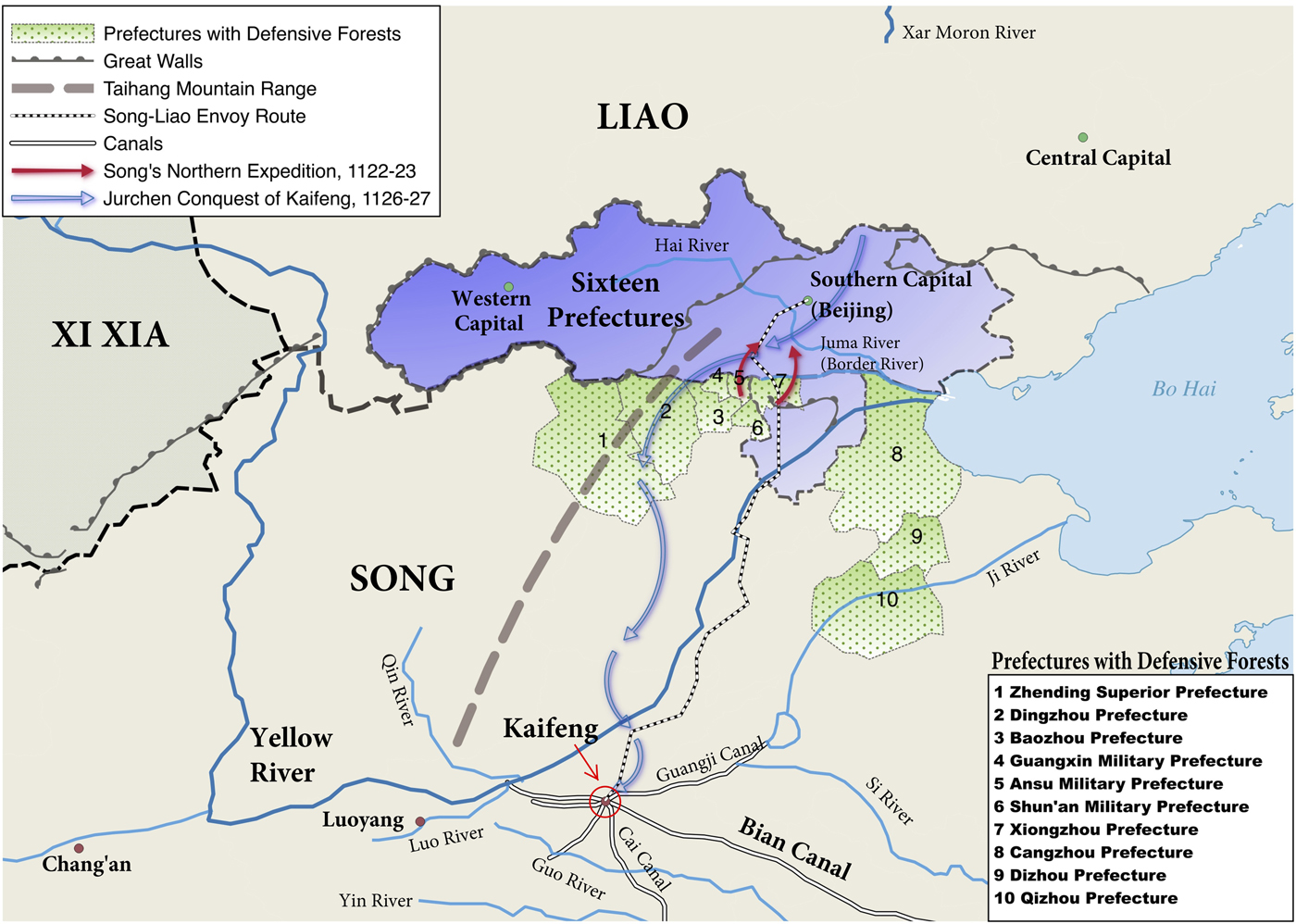
This article traces the creation, preservation, and destruction of this “Green Great Wall” of the Northern Song. Built as an artificial barrier to block Kitan attacks, this green bulwark established a defensible strategic depth Footnote 6 between the Northern Song's northernmost border and the empire's capital in Kaifeng 開封, which, located only 600 kilometers to the south of the Hebei frontline, was a city without effective geographical barriers. While the Song government deliberately created and painstakingly maintained this forest to guard the empire's northern border, it was its own actions that brought the forest to its final demise—in 1122, the Song declared war on the Liao and the Song troops cleared this borderland forest that stood in the way of their northern expedition. Consequently, the strategic depth between Hebei and Kaifeng was dismantled, presaging the fall of Kaifeng to the Jurchen Jin, the successor of the Kitan Liao, in merely a few years. This article shows that the strategic depth between the Hebei borderland and Kaifeng was not only a physical space, but also a diplomatic, sociopolitical, and military link that connected the ecology of the Song's northernmost periphery and the fate of the entire empire.
THE GENESIS OF THE DEFENSIVE WOODLAND
The initial creation of the defensive forest in Hebei was a direct response to the geopolitical challenges resulting from the Northern Song's decision to keep its capital in Kaifeng. As a capital city, one of Kaifeng's biggest disadvantages was its geographic vulnerability. Situated on the flat ground of the North China Plain 華北平原, Kaifeng had no distinct mountain ranges nearby to shield it from military attack. As the Northern Song scholar-official Qin Guan 秦觀 (1049–1100) explained in a policy response essay, the terrain around Kaifeng, without major geographical constraints, made the city a natural battleground since antiquity.Footnote 7 Although the Yellow River was there as the only major geographical barrier lying between Kaifeng and the northern steppe, constant floods, embankment failures, and course changes had brought more trouble than protection to the Northern Song government throughout the dynasty.Footnote 8
After 938, the military defensibility of Kaifeng was further compromised when the Later Jin 後晉 (936–947) emperor Shi Jingtang 石敬瑭 (r. 936–942) ceded to the Liao the “Sixteen Prefectures” (Yan Yun shiliuzhou 燕雲十六州),Footnote 9 which contained the Great Wall, China's most important and by far the best-known manmade military fortification.Footnote 10 The loss of the Sixteen Prefectures to the Liao meant that the Later Jin had forfeited the original strategic depth between the Great Wall and Kaifeng.Footnote 11 The Later Jin's new northern border had neither natural nor manmade barriers to block the Kitans. From that time on, the Kitan cavalry constantly marched through the flat Hebei Plain to attack the Later Jin, and eventually occupied Kaifeng in 947.Footnote 12 Although a year later the succeeding Later Han 後漢 (947–951) recaptured Kaifeng,Footnote 13 and afterwards the Later Zhou 後周 (951–960) even managed to recover three prefectures and three military passes in the Sixteen Prefectures,Footnote 14 the Great Wall nonetheless remained in the Liao territory by the time the Song was founded.
Having inherited this bitter legacy from the Five Dynasties, the Song's founder Emperor Taizu 宋太祖 (r. 960–976) was deeply concerned with Kaifeng's weak defensibility and suggested relocating the court westward to the Tang capitals at Chang'an 長安 or Luoyang 洛陽, which were much better geographically fortified.Footnote 15 Nevertheless, many officials vehemently objected to moving the capital. The Imperial Army Commander Li Huaizhong 李懷忠 memorialized to Taizu in 976:
The Eastern Capital has the Bian Canal, which transports millions of hu of rice from Jiangnan and Huainan. Hundreds of thousands of soldiers stationed in the capital rely on these provisions. ... Moreover, massive armed forces as well as their armors and supplies are concentrated in Kaifeng. The foundation [of the dynasty] has been long established and should not be shaken.
東京有汴渠之漕,歲致江、淮米數百萬斛。都下兵數十萬人,咸仰給焉。...且府庫重兵,皆在大樑,根本安固已久,不可動搖。Footnote 16
During the Northern Song, the population of Kaifeng reached over 1.5 million at its peak.Footnote 17 As Li Huaizhong pointed out, in order to sustain the livelihood of such a large population, which included a massive Imperial Army and their families, it was imperative to ensure the smooth transportation between the capital and the empire's major supplying regions in South China.Footnote 18
This massive demand would be extremely hard to satisfy if the capital were moved to Chang'an. Since the mid- to late-Tang period, heavy sediment deposition from the Loess Plateau into the Yellow River and its tributaries, a result of incessant deforestation, had created tremendous trouble for water traffic leading to Chang'an.Footnote 19 Transportation to Luoyang, located about 400 kilometers to the east of Chang'an and 200 kilometers to the west of Kaifeng, was relatively less troublesome but still not comparable to the convenience of transportation to Kaifeng. Thanks to the empire's advanced, well-connected transportation network, Kaifeng, situated at the hub of this network, enjoyed unparalleled accessibility to a wide variety of resources from across the country and beyond.Footnote 20
This compelling argument finally dissuaded Emperor Taizu from moving the capital.Footnote 21 With that, however, the Song government now had to come up with feasible measures to compensate for Kaifeng's geographical vulnerability. In particular, after Emperor Taizong's 宋太宗 (r. 976–997) several unsuccessful attempts to retake the Sixteen Prefectures from the Liao, strengthening Kaifeng's security became increasingly pressing as the Song turned to a defensive stance.Footnote 22 The government hence expanded the Imperial Army stationed in KaifengFootnote 23 and strengthened city fortification.Footnote 24 In addition, the government also planned to establish a defensible strategic depth between the empire's capital and the northern border.
However, the Song did not intend to build a new line of Great Wall along the Song–Liao border to create the desired strategic depth. By the Song, although the term “Great Wall” still conveyed the positive connotation of an impenetrable border defense, its construction, which in the past dynasties had fallen heavily on the civilians, did not fit the image of benevolence and humanity that the Song emperors wanted to cultivate.Footnote 25 Therefore, instead of continuing the tradition of wall building, the Song's border fortification initiative entailed artificially creating what the ancient military strategist Sunzi 孫子 (544–496 BCE) dubbed pidi 圮地 (literally, “difficult terrains”), which included “mountains and forests, perilous obstacles, deep marshes, and any roads that are hard to traverse,”Footnote 26 in the almost featureless Hebei borderland.
Two types of manmade terrain were thereupon constructed in Hebei. In 989, three years after Emperor Taizong's second failed northern expedition, the Military Commissioner of the Cangzhou Prefecture 沧州 He Chengju 何承矩 initiated the construction of a series of lakes and ponds along the Song–Liao border.Footnote 27 These water bodies varied in size. The largest ones were 120 li (approximately 55 kilometers) in length and 130 li (approximately 60 kilometers) in width, an area twice as large as the Lake Oahe in South Dakota and North Dakota, the largest manmade lake of the United States by surface area. Even the smallest ones were roughly 10 li (approximately 5 kilometers) in length and width, an area more than fifty times as large as the Central Park Reservoir in Manhattan.Footnote 28 Dubbed the “Great Ditch” by Peter Lorge, this hydraulic security line effectively served its defensive purpose the first decades of its creation.Footnote 29
Another pidi or “difficult terrain” engineered by the Song government was a massive manmade borderland forest. China had a long tradition of using forest for military fortification. Meng Tian 蒙恬 (d. 210 BCE), the General of the Qin State during the Warring States 戰國 period, built the Yusai 榆塞, or the “Elm Fortress,” to block the Xiongnu 匈奴 nomads:
When Meng Tian attacked the barbarians on behalf of the Qin, he expanded thousands of li of territory and set the border along the river.Footnote 30 The Qin soldiers piled up rocks to build castles and planted elms as fortresses. From then on, the Xiongnu dared not let their horses drink water from the river.
蒙恬為秦侵胡,闢數千里,以河為竟,累石為城,樹榆為塞,匈奴不敢飲馬於河.Footnote 31
Following this ancient model of the Qin's Elm Fortress, Emperor Taizu ordered the creation of a forest barrier in the vicinity of the Waqiao Pass 瓦橋關.Footnote 32 The Waqiao Pass, later renamed as the Xiongzhou Prefecture 雄州 (present-day Xiongxian County 雄縣 in Baoding, Hebei),Footnote 33 was one of the three military passes that the Later Zhou seized from the Liao in 959.Footnote 34 From then on, the Northern Song's defensive forest started to take root and grow.
PLANTING ELMS AND WILLOWS
According to the edict of Emperor Taizu, the defensive woodland was to primarily grow two types of trees: yu 榆 (elm), the namesake species used in the Yusai, and liu 柳 (willow).Footnote 35 A variety of desirable traits made these two species ideal choices for the borderland forestation project. First, yu, or Chinese elm, is remarkably resistant to diseases. The Essential Techniques for Common People (Qimin yaoshu 齊民要術, hereafter Essential Techniques), an agricultural manual compiled in the mid-sixth century, mentions that yu is resistant to “plague of beetles” (chongzai 蟲災).Footnote 36 This observation is in line with findings of modern botanical science. Modern scientists recognize that the Chinese elm (Ulmus parvifolia), unlike the European elm (Ulmus laevis) or the American elm (Ulmus americana), is practically immune to the Dutch elm disease spread by elm bark beetles.Footnote 37 In addition, the Chinese elm is also resistant to black leaf spot and elm leaf beetles.Footnote 38 Keenly aware of these unique advantages of Chinese elm, nowadays Western silviculture experts often plant plenty of Chinese elm trees in gardens and parks across Europe and America.Footnote 39
Second, yu/Chinese elm (hereafter “elm” for simplicity) is among the fastest-growing tree species known to premodern Chinese naturalists. The Essential Techniques offers a comprehensive account on how to grow elm trees quickly:
To plant elms, one should choose the north side of the plantation. In the autumn, plow the field to help the mature trees ripen. In the spring, when the elm pods fall, gather them, and randomly scatter them over the soil. Use a plough to carefully loosen the soil. During the first month of the next year, remove the weeds in the ground, cover the saplings with the weeds, and burn them with fire. Later, from each root more than ten branches will sprout. Keep the strongest branch and remove the others. In this year the elm sapling can grow eight to nine chi (approximately 2.5 to 3 meters). If not burnt, the growth would be slower.
種者,宜於園地北畔。秋耕令熟,至春榆莢落時,收取,漫散。犁細㽟勞之。明年正月初,附地芟殺,以草覆上,放火燒之。根上必十數條俱生,只留一根強者,馀悉掐去之。一歲之中,長八九尺矣。不燒則長遲也.Footnote 40
This instruction claims that with prescribed burning and cutting, elms could grow nearly three meters a year, or around three times as fast as the regular, average growth rate of modern Chinese elm.Footnote 41 This difference can be explained by what modern Darwinists call “human-guided artificial selection” (as opposed to “spontaneous natural selection”).Footnote 42 In a nutshell, through controlled burning and selective cutting, the cultivator can screen out and remove the weaker and slower growing trees and hence eliminate them from competing for water and nutrients with the stronger ones. As a result, the stronger saplings that remained will more likely be well-nourished and hence have a better chance to thrive.
Another advantage of elm is its low maintenance cost. The Essential Techniques notes that an elm, after being chopped down, can regrow spontaneously without much special care.Footnote 43 Moreover, elm trees can also thrive in a variety of soils and survive different types of extreme climate conditions. Considering the frequency and severity of droughts and floods hitting Hebei throughout history,Footnote 44 elm's exceptional adaptability to environment must have been essential in the planning of a sustainable defensive forest in the Northern Song Hebei. Taking into account all of these benefits, the Essential Techniques summarizes that planting elm is so labor-efficient that “one qing 頃 (approximate 16 acre) of land, which can yield wealth that is worth thousands of bolts of silk, only needs one person to attend it.”Footnote 45
Liu 柳, or willow, was also well known for growing fast. The Essential Techniques also records the technique for planting willows, which, similar to the elm cultivation method, involves selective cutting that allows the selected saplings to grow as much as three meters per year. As long as they get enough water, after three years willows can grow large and strong enough to make good construction timber.Footnote 46 Since willows develop best in moist soils, the “Great Ditch” of lakes and ponds built in conjunction with the defensive forest, which could greatly increase the moisture level of the soils, actually provided a highly suitable environment for willows to thrive.
Agriculture and silviculture treatises of later dynasties regularly cite the instructions on tree cultivation from the Essential Techniques. For example, the Essential Compendium of the Four Seasons (Sishi zuanyao 四時纂要, hereafter Four Seasons), compiled in the Tang period, records the same methods of elm and willow cultivation.Footnote 47 Later in the Song, thanks to the development and spread of woodblock printing technology, these treatises were constantly mass printed and hence made such knowledge available to increasingly larger audience.Footnote 48 For example, in 997, the Northern Song scholar Shi Yuanji 施元吉 woodblock-printed the Four Seasons so that these techniques would “circulate widely, benefit people extensively, and therefore support the country and guide agriculture.”Footnote 49 In 1020, the Northern Song court ordered the Agricultural Promotion Office (Quannongsi 勸農司) in every circuit to reprint both the Essential Techniques and the Four Seasons to facilitate agricultural development across the empire.Footnote 50 Two and a half centuries later, in the Essential Compilation of Agriculture and Sericulture (Nongsang jiyao 農桑輯要) compiled by the Agricultural Ministry (Sinongsi 司農司) of the Mongol Yuan Dynasty (1271–1368), the same elm and willow cultivation methods were also cited almost verbatim.Footnote 51 These later publications testify that such silviculture techniques were not only faithfully transmitted and widely circulated, but also repeatedly tested in practice over centuries. If the Northern Song officials in charge of borderland forestation had followed the instructions in the Essential Techniques and the Four Seasons, in merely three years the elms and willows in the borderland forest would grow tall and strong enough to make effective barriers against cavalry attacks.
EXPANDING THE FOREST DEFENSE LINE
This borderland forest gradually took shape and its effectiveness was soon tested in battle. In 1004, in order to take back the three prefectures that the Later Zhou had recovered in 959, Emperor Shengzong of the Liao 遼聖宗 (r. 982–1031) launched a major offensive against the Song. The Song troops organized a strong defense. In one of the battles, the densely wooded borderland forest not only provided ambush opportunities for the Song archers, but also forced the Kitan horsemen to dismount.Footnote 52 Having to abandon their horses and engage in close combat with the Song infantry, the Kitan cavalry lost their major military advantage.
The war ended with the Liao suffering over 30,000 fatalities and more than double that number of casualties.Footnote 53 The ceasefire led to the Song and the Liao reaching a peace agreement, the Treaty of Chanyuan 澶淵之盟. As a gesture of peace and trust, the treaty agreed on the current territorial division and specifically stipulated that neither side should build new military fortresses on the border.Footnote 54
However, even after signing the treaty, neither the Song nor the Liao let their guard down. Still putting a high premium on maintaining the strategic depth between Kaifeng and the northern border, the Song continued to add trees to the borderland forest. Although the Treaty of Chanyuan prohibited the construction of new fortifications, creating a bulwark of trees, unlike building conventional military fortresses that clearly signaled distrust, could easily be explained away as serving non-military purposes such as supplying construction timber, firewood, and fodder to borderland residents.
From 1006 to 1020, the Prefect of Xiongzhou Li Yunze 李允則 (953–1028) continuously promoted forestation efforts in his jurisdiction. The Pacification Commission (anfusi 安撫司), which administered general military affairs,Footnote 55 took charge of the tree-planting activities and tree-count reporting duties. Since the main utility of the forest was for military defense, Li Yunze specifically ordered soldiers to plant elms in all existing defense gaps. In just a few years, the fortresses in Xiongzhou were clothed in a mantle of fully grown elm trees. Pleased with the transformed borderscape with verdant forests, Li Yunze told his aides: “The current terrain advantages to our infantry and disadvantages the enemy cavalry. Who says trees can only be used to construct houses?”Footnote 56
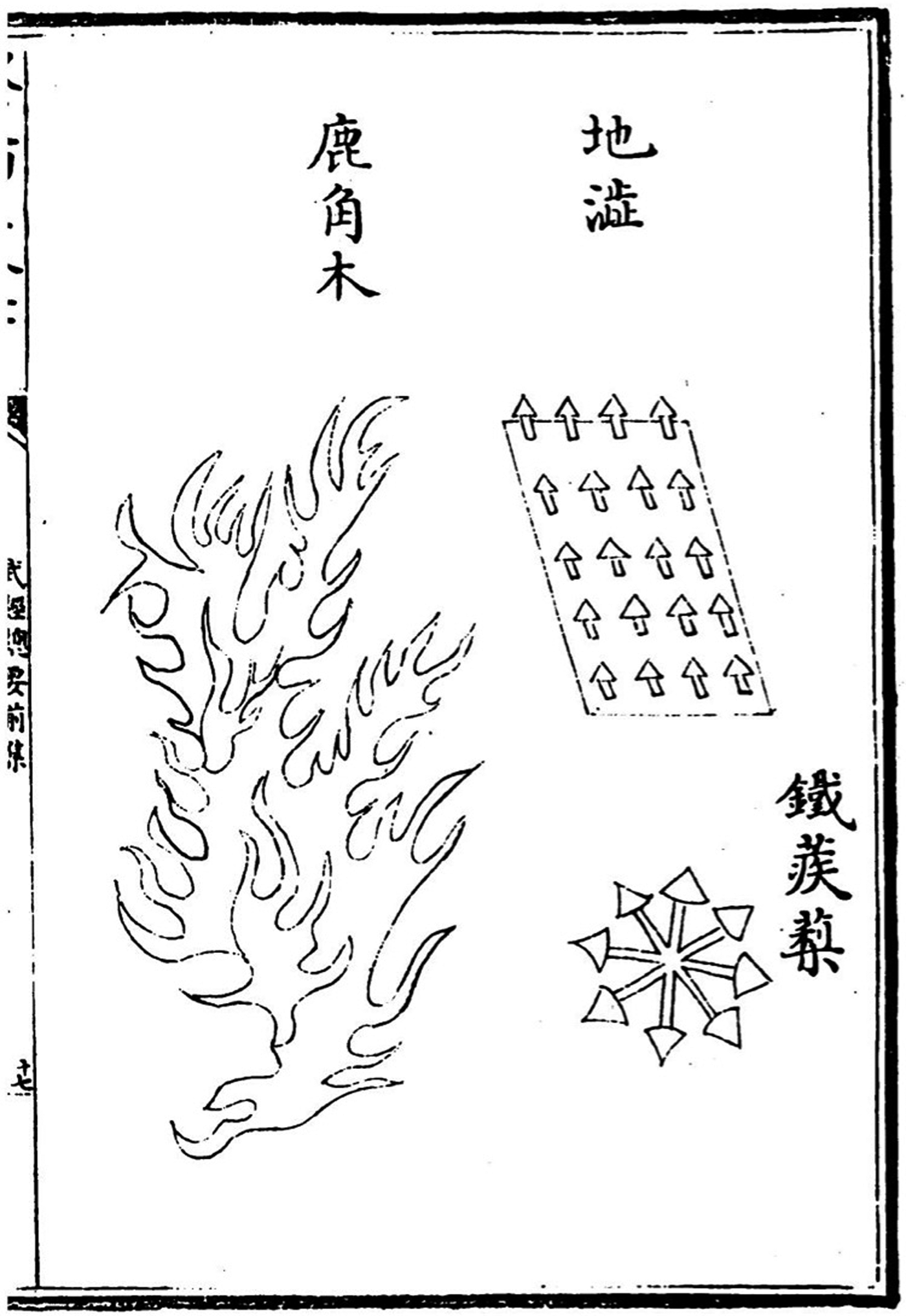
In 1016, according to the report by the Pacification Commission of Hebei, the total tree count in the Xiongzhou borderland forest reached over three million. To visually present this result to Emperor Zhenzong 宋真宗 (r. 997–1022), the borderland officers made an illustration of the borderland forest, the Illustration of Elms and Willows in the North (Beimian yuliu tu 北面榆柳圖).Footnote 57 The emperor was pleased with this achievement and commended Li Yunze's forestation efforts: “These trees can replace deer antler barricades.”Footnote 58 Deer antler barricades, or lujiao 鹿角 (Figure 1), were made of branches resembling deer antlers to repel horsemen. During the first decades of the Northern Song, a large part of the Song–Liao border defense line was still made of deer antler barricades.Footnote 59 However, these barricades were usually brittle and easy to break. In comparison, the densely spaced strong trees could make much more robust and more effective border fortifications.
A Northern Song illustration of the lujiao barricade. Zeng Gongliang 曾公亮 and Ding Du 丁度, Wujing zongyao 武經總要 [Essential of the Military Classics] (Beijing: Jiefangjun, 1988), 12: 553.
The borderland forestation project soon spread from Xiongzhou and extended westward as far as the Taihang Mountain Range 太行山. In 1033, the Palace Attendant Liu Zongyan 劉宗言 again invoked the precedent of the Qin's Elm Fortress and urged the government to plant trees at the foot of the Taihang Mountain Range in the Zhending Superior Prefecture 真定府, located approximately 200 kilometers to the southwest of Xiongzhou, to restrain potential Kitan invasions from that direction.Footnote 60 In this way, the manmade forest could be connected to the natural forests in the Taihang Mountains, forming a distinct and continuous green defense line along the Song–Liao border.
Located about 80 kilometers to the west of Xiongzhou, the Baozhou Prefecture 保州 was another strategic fortress town along the Song–Liao border.Footnote 61 While regions to the east of the Baosai 保塞, the main fortress in Baozhou, were already largely fortified by lakes and ponds, regions to the west of the fortress were mostly unprotected flat ground.Footnote 62 To fill in this vulnerable defense gap, in 1049 the Pacification Commission of Hebei led a campaign to extensively afforest lands to the west of the Baosai.Footnote 63 However, since the land would automatically become state-owned once trees were planted, local peasants complained about the state appropriation of potential farmlands. In 1068, the court dispatched several officials to inspect the agricultural and hydraulic works in Baozhou. After the inspection, one of these officials suggested building a dam to divide the open areas into farmlands and woodlands:
In the lands to the west of the lakes and ponds in Baozhou Prefecture we can build dams and plant trees up to 19 li [in depth]. Within the dam, we can grow paddy rice on lands where water can reach and open square fields on lands where water cannot reach. We can also use the soil dug out [from opening the fields] to construct trenches to restrain nomadic horsemen.
保州塘濼以西可築堤植木凡十九裡。堤內可引水處即種稻,水不及處並為方田。又因出土作溝,以限戎馬.Footnote 64
In this way, although the state would sacrifice some depth of the defensive forest, the woodland could still expand horizontally to the west to fill in the defense gaps. Meanwhile, the government–citizen tension could also be partially eased by allowing peasants to open new farm fields to the south of the state-owned woodlands.
From 1069 to 1076, the Vice Chancellor Wang Anshi 王安石 (1021–1086) launched the New Policies that aimed to “enrich the state and strengthen the army” (fuguo qiangbing 富國強兵).Footnote 65 Among these new policies, the Sericulture Promotion Act (Quanke zaisang fa 勸課栽桑法) was an experiment to concurrently promote agricultural productivity and strengthen national security in the borderland prefectures.Footnote 66 While soldiers under the command of the Pacification Commission had traditionally been the sole tree-planters since the inception of the defensive woodland, with the promulgation of the new act, the forestation labor force started to include civilians. In 1069, in order to incentivize peasants in Baozhou and the nearby Military Governorates of Shun'an 順安, Ansu 安肅, and Guangxin 廣信 to participate in borderland forestation, the Song government promised them rent reductions for planting agricultural species in the defensive forest:
[The government] ordered people to plant mulberries, elms, and other suitable tree species because they can restrain nomadic horsemen. Officials should count the number of surviving trees to calculate how much rent deduction a household could receive. Households that could not reach the quota should be fined. [The government] should require them to plant more to make up.
令民是其地植桑榆或所宜木,因可限閡戎馬。官計其活茂多寡,得差減在戶租數。活不及數者罰,責之補種.Footnote 67
This edict suggested that in addition to elms, other plant species such as mulberry, as long as they were suitable for growth, could be added to the defensive forest. Wang Anshi and his team hoped that this policy, by helping peasants to reap revenues from the borderland forest, would help maintain sustainability of the defensive woodland.
The Sericulture Promotion Act also helped spread the defensive forest to prefectures to the east of Xiongzhou. In 1072, the Eastern Palace Attendant Zhao Zhongzheng 赵忠政 expressed his concern over the current hydraulic defense line of lakes and ponds in Cangzhou and proposed that planting trees would make more effective fortifications:
Although lakes and ponds stretch over two hundred li from the south side of the boundary river to the Cangzhou City, their water volume fluctuates a lot. In the summer and the autumn, people can wade across the water by foot. When winter comes, the frozen lake surface is no different from a flat ground. Now, covering hundreds of li of area in the Qizhou and Dizhou Prefectures, plantations of elm, willow, mulberry, and jujube trees stretch beyond the sight in four directions, making the terrain truly difficult for cavalry to charge through. If elm, willow, mulberry, and jujube trees can be planted from Cangzhou eastward to the East Sea and westward to the Taihang Mountain Range, in a few years they can thwart the nomadic cavalry.
界河以南至滄州城,雖有塘泊二百餘里,其水或有或無,夏秋可徒涉,遇冬冰凍即無異平地。今齊、棣閒數百里,榆柳桑棗,四望綿亙,人馬實難馳驟。若自滄州東接海, 西徹西山,仿齊、棣植榆、柳、桑、棗,候數年閒可以限戎馬.Footnote 68
Like the edict issued to Baozhou in 1069, this proposal was also informed by the Sericulture Promotion Act and stressed adding mulberry and other economic plant types in the defensive forest. If it was fully carried out, the entire stretch of the Northern Song defensive forest would have spanned over 400 kilometers from the Bohai Bay in Cangzhou to the eastern hillside of the Taihang Mountain Range.
SETBACKS IN THE BORDERLAND FORESTATION PROJECT
Despite continuous effort to afforest and reforest the empire's northern border, the Northern Song met with a variety of challenges that significantly hindered the development of the defensive forest. Seeing trees being continuously added to the Song–Liao border, some Liao officials were suspicious of the true agenda behind the Song's forestation efforts. Lacking concrete evidence to accuse the Song of violating the Treaty of Chanyuan, the Liao resorted to other ways to sabotage the Song's borderland forestation.
In 1018, an undercover Liao spy lobbied Zhang Zhaoyuan 張昭遠, the Vice Pacification Commissioner of the Hebei borderland, to remove the forest. The Liao spy argued that the dense forest not only provided roaming bandits a refuge but also supplied them with wood to make “ladders and catapults” and rebel against the government.Footnote 69 Genuinely worried about fomenting local rebellions, Zhang Zhaoyuan was convinced by the Liao spy and memorialized to the emperor about this issue. Sharing the concern, the emperor granted Zhang permission to remove part of the forest.Footnote 70
In addition to sabotaging the Song's manmade defensive forest, the Liao also tried to cut through natural forests along the Song–Liao border. In 1044, Fu Bi 富弼 (1004–1083), the Vice Commissioner of Military Affairs (Shumi fushi 樞密副使), memorialized Emperor Renzong 宋仁宗 (r. 1022–1063) on the deforestation in the Taihang Mountains adjoining the Liao:
In the Taihang Mountain Valley in Zhending Superior Prefecture, there are over ten trails leading to Liao territory on the northern side of the mountain. Before 1004, these trails were rarely traveled. The mountains were steep and the creeks shallow. The trees were obstructive and restraining. Therefore, the enemy horsemen seldom took these routes. Although there have been some people coming from the Liao [on these trails], they had to cope with these dangerous and difficult impediments. However, I recently heard from people in Hebei that the Kitans have been clearing forests on the other side of the mountain to make a thoroughfare leading to the Taihang Mountain Range in the Han-Chinese territory. Now, traffic on this route is clear and fast enough to allow [the Kitan] troops to pass.
真定Footnote 71西山有谷口十餘道,盡通北界山後之路。景德以前,不甚跡熟。鴜溪澗峻狹,林木壅遏,故敵騎罕由斯路而入。雖有來者,亦不免艱阻。臣頃聞河朔人說契丹自山後斬伐林木,開鑿道路,直抵西山漢界而止。今則往來通快,可以行師.Footnote 72
The Northern Song government was deeply alarmed that the Kitans, in merely four decades after the Treat of Chanyuan, had already denuded such a large part of the mountain forests in the Taihang Mountain Range that its cavalry could move through them.
In addition to opening up military passages, the Liao soldiers also logged trees in Song territory to get timber for fort building and weapon making. In 1062, a group of Kitan soldiers crossed the Song–Liao border without the Song's permission and logged thousands of willow trees from the borderland forest in Xiongzhou.Footnote 73 In the same year, local officials in the Daizhou Prefecture 代州 (in present-day northeast Shanxi) reported that tree trunks felled by the Kitans were lined up for more than 10 li on the northern hillside of the Taihang Mountain Range.Footnote 74 To prevent Liao soldiers from further exploiting Song resources, the Song officials burnt down part of the mountain forests. Enraged by the loss of access to forest products, the Kitans asked the authorities of Daizhou to arrest and punish the arsonists. The Prefect of Daizhou Liu Yongnian 劉永年 turned down their request: “Even though the arsonists are guilty, the crime took place in our territory. What business is it of yours?”Footnote 75
On the other hand, although the Liao incessantly felled trees in the Song's border forest, some Liao officials learned from their rival to use forests as military fortifications. The epitaph of the Liao official Deng Zhongju 鄧中舉 (d. 1098), the Regent Official (liushou 留守) of the Liao's Southern Capital (modern Beijing),Footnote 76 records that once Deng Zhongju stopped another Liao high official from clearing forests and plantations around the Southern Capital. When Deng brought the case to the emperor at an audience, the emperor agreed to preserve the woodlands and also ordered planting more trees there on a regular basis.Footnote 77 Merely 100 kilometers away from Song territory, the Southern Capital was the most vulnerable among all the five Liao capitals. If the Song were to attack from the south, the forests near the Southern Capital could not only defend the city itself,Footnote 78 but also reinforce the strategic depth between the Southern Capital and the Liao's Supreme Capital and Central Capital in the Kitan heartland (in present-day Inner Mongolia), located at about 450 kilometers to its northeast.
In addition to fighting the Liao's incessant deforestation attempts, the Song government also had to deal with deforestation by its own officials, soldiers, and citizens. After the Liao spy persuaded Zhang Zhaoyuan to remove part of the defensive forest in 1018, the Song government later saw through the Liao's scheme and ordered reforesting the area. However, not long after the forest was rehabilitated, local officials and soldiers again attempted to fell the newly planted trees for construction timber and firewood. To stop these activities, in 1041 the court had to issue a strong warning to officials and residents in Hebei, vowing to severely punish any deforestation attempt in the borderland forest.Footnote 79
Peasants in Hebei, disgruntled by the government takeover of the open lands near the border for national security use, constantly pressured local officials to convert the existing woodlands to arable lands. While the Sericulture Promotion Act aimed to combine economic development with borderland forestation, the implementation of the act did not always result in the desired outcomes. In 1073, an investigator reported to the court that some officials heavily embezzled the sericulture incomes of the peasants.Footnote 80 Unable to receive the promised revenues from planting mulberry trees in the borderland forest, local peasants still saw the borderland forest as a threat to their livelihood and the dispute over land use yet persisted.
Located approximately 130 kilometers to the southeast of Xiongzhou, the Dingzhou Prefecture 定州 was among the most actively forested and yet the most heavily deforested borderland prefectures.Footnote 81 In 1049, concerned with the extreme shortage of firewood, the then Pacification Commissioner of Dingzhou Han Qi 韓琦 (1008–1075)Footnote 82 reported to the emperor that he had relaxed the ban on logging in the borderland forest:
In the past, the court prohibited people from felling trees in the borderland forest in order to block the enemies from invading us. At that time, tilling on lowland hills close to the borderline was entirely forbidden. As a result, many borderland residents lost their livelihoods. Now with the price of firewood soaring, the enemies are taking advantage of this opportunity and making high profits [by selling firewood to our people]. I used to dispatch officials to inspect the forbidden forest and found that a depth of fifty to sixty li from the enemy territory would still be thick enough for protection and blockage. I have re-demarcated the boundaries of the forbidden forest and put up an announcement to inform the locals. In areas that are not listed as forbidden in the announcement, commoners are allowed to log.
比朝廷欲禁近邊山林不許斬伐,以杜戎人入寇之路。當時並近裡淺山耕種之地㮣行禁止,致邊民遽然失業。今薪炭翔貴,翻令敵人乘時以取厚利。臣嘗遣官行視可禁之處,去敵尚五六十里,亦可廣為防蔽。已別定可禁之地,揭榜諭民。非令所禁者,任採伐之.Footnote 83
This report shows that the defensive forest in Dingzhou, before Han Qi re-demarcated the boundaries of the forbidden area, had a depth of much more than fifty to sixty li (approximately 25 kilometers), or more than six times the length of Central Park in Manhattan. This rich woodland reserve attracted not only local residents but also people from other prefectures. In 1074, officials of the Zhaozhou Prefecture 趙州 (approximately 100 kilometers to the south of Dingzhou) transported large quantities of timber from the Dingzhou forests to repair city walls and build houses.Footnote 84 In addition, the Zhaozhou officials also got large amounts of timber from the forests in the adjacent Shenzhou Prefecture 深州 near Wuqiang 武強,Footnote 85 a relay stop along the official route where the Song and Liao envoys traveled back and forth.Footnote 86
These tree logging activities took place in the midst of the Song–Liao border renegotiation from 1074 to 1076. In the spring of 1074, the Liao sent a letter of credence to the Song, accusing the Song of encroaching on the Liao territory and requesting to re-demarcate the Song–Liao borderline. This letter deeply alarmed the Song government. Worried that the Liao would tear up the Treaty of Chanyuan, Emperor Shenzong 宋神宗 (r. 1067–1085) ordered reinforcing border defense to prepare for potential attacks from the Liao.Footnote 87 Under these circumstances, deforestations in the border area in Dingzhou and along the envoy route in Shenzhou had profound security implications for the Song. Concerned that the heavily logged woodlands in these two prefectures could be perceived as signs of the Song's weakened defense, the Song court banned Zhaozhou officials from further felling of trees in these two prefectures.Footnote 88
During the prolonged border negation process, many conservative Song officials worried that the defensive forest would be interpreted as a sign of distrust. Han Qi, for example, urged Emperor Shenzong to show goodwill to the Liao so that the two countries could maintain peace. In particular, Han Qi stressed that any moves that might raise suspicion, including planting more trees on the border, should be discontinued.Footnote 89 At the same time, some progressives also advocated removing the forest based on other arguments. Shen Kuo 沈括 (1031–1095), a veteran envoy to the Liao and an expert geographer, stated that tree counts in Dingzhou were numbered in the hundred-millions.Footnote 90 Although the number “hundred-million” (yi 億) was most likely figurative rather than actual, Shen Kuo's statement nonetheless suggests that at that time the defensive forest still remained a distinct landscape feature along the Song–Liao border. Such a dense forest, according to Shen Kuo, could be a threat to national security because the attacking Liao soldiers could hide among the woods and use tree trunks and branches to make weapons.Footnote 91
Overall, throughout the dynasty, diplomatic pressures, social tensions, and political factionalism never stopped threatening the preservation of this defensive forest. Toward the last decades of the Northern Song Dynasty, maintenance of the Hebei forest became increasingly lax. In the early 1100s, the then Prefect of Xiongzhou Wang Hanzhi 王漢之 worried that the maintenance of the hydraulic and forest fortification in Xiongzhou, a project that was meant to “benefit China for ten thousand generations,” had been too long neglected.Footnote 92 At the same time, with natural disasters constantly hitting Xiongzhou but very limited relief funds coming from the central government, it is not hard to imagine that local residents would not only lose the incentive to plant trees for the state, but would even resort to exploiting forest products from the woodland for subsistence. Faced with all these pressures, the Hebei borderland forest was set on decline.
THE DEFENSIVE FOREST'S DEMISE AND ITS LEGACY
Since the late-eleventh century the Liao's political influence and military strength rapidly declined due to a combination of factors. Internally, the Liao court experienced incessant succession struggles, coups, and rebellions, which greatly challenged the authority of the Liao central government and exhausted its finances. Externally, the Liao's vassal the Jurchen tribe rebelled against the Liao and formed its own state, the Jin 金 Dynasty (1115–1234). Seeing the weakening of the Liao as the Song's chance to recover the long-lost Sixteen Prefectures, Emperor Huizong 宋徽宗 (r. 1100–1126) secretly formed an alliance with the Jurchens and co-plotted a joint invasion of the Liao.Footnote 93
In 1122, Emperor Huizong appointed the eunuch-general Tong Guan 童貫 (1054–1126) to lead a northern expedition army to form a pincer attack on the Liao with the Jurchens.Footnote 94 This war not only ruptured the Treaty of Chanyuan, which had brokered peace between the Song and Liao for over a century, but also brought the Song's own defensive forest to its final devastation. When the Song army arrived at the Hebei borderland, the defensive forest standing there became an apparent obstacle to the expedition. Wang Mingqing wrote that Tong Guan, to let the troops keep marching north, ordered the soldiers to “cut the trees and mow the forest.”Footnote 95 No further details are known about this deforestation process. Regardless, this expedition sealed the demise of the Northern Song's once luxuriant “Green Great Wall.”
The removal of the defensive forest dismantled the strategic depth between Kaifeng and Hebei and thereupon precipitated the downfall of the Northern Song. In 1126, one year after the full collapse of the Liao, the Jin broke its alliance with the Song and attacked Kaifeng. When the Jurchen cavalry arrived at the former Song–Liao borderland, which had then returned to its originally barren, tree-less moonscape, there were no barriers to stop the Jurchen horsemen from marching through. In the fourth month of 1127, the city of Kaifeng fell.Footnote 96
In hindsight, some later scholars believed that there was a causal link between the destruction of the Hebei defensive forest and the fall of Kaifeng. For example, Wang Mingqing lamented:
If the borderland had forest barriers like before, the Jurchen cavalry might not have been able to march all the way through so swiftly. This defensive forest was one of the grand strategies of the Song ancestors.
使如前日有所蔽障,則未必能卷甲長驅。如此亦祖宗規撫宏遠之一也.Footnote 97
Of course, attributing the fall of the Northern Song to a single factor was far too reductive. Nevertheless, even though Wang Mingqing's teleology was lopsided, using forest for border fortification continued to influence national security decisions in the Southern Song. Along the Song–Jin boundary from the flat Huai River Plain in the east to the mountainous terrain in Sichuan in the west, the central and local governments had repeatedly led tree-planting campaigns to strengthen border fortification.Footnote 98 In addition, the Song also attached great importance to protecting mountain forests along its borders with Tibet 吐蕃 and Dali 大理.Footnote 99 Overall, all these border forestation efforts helped the Song to survive for another century and half after its retreat to the south.
The Northern Song's defensive forest also deeply influenced literary works of later periods. After the Northern Song, the phrase “elms and willows” (yuliu 榆柳) gradually became a pervasive metaphor for borderland and borderscape.Footnote 100 The Southern Song poet Li Haogu 李好古 once wrote about the Guazhou Port 瓜洲渡口 at the junction of the Yangzi River and the Grand Canal, which at that time was a highly contested, strategic zone between the Jin and the Southern Song. Lamenting the turbulent situation there, the poet compared Guazhou Port with the Jade Gate (yumen 玉門), the northwestern border pass of the Han and Tang dynasties,Footnote 101 as well as the “elms and willows,” the symbol of the Northern Song's northern border fortress.Footnote 102 Another Southern Song poet Huang Ji 黃機 expressed his intense eagerness to see the Song recapture North China, imagining that the Song troops could march straight back to the Central Plains. However, he worried that with further delay of the irredentist expedition, “the elms and willows at the gate of the fortress would wither in autumn, and their leaves would sway and fall with sadness.”Footnote 103
Centuries later in the Ming period (1368–1644), the example of the Song's borderland forest was still invoked in strategic thinking and planning. A mid-Ming period gazetteer of Baoding, which included the Northern Song locales from Xiongzhou to Dingzhou in the historical Song–Liao borderland, recorded the local magistrate's memorial to the emperor about his plan to restore the Northern Song defensive forest. Just as the Song had to confront the military threat from the Kitans, the Ming also faced pressing menace from its northern nomadic neighbor, the Mongols. Therefore, the magistrate wanted to rebuild a woodland defense in Baoding to thwart potential Mongol invasions.
The task was by no means easy. The magistrate enumerated five major challenges for the Ming to build an effective defensive forest. First, it was difficult to afforest the full stretch of the Ming–Mongol borderline. Second, since soil conditions in various border areas varied greatly, some of the grounds might not be suitable for growing trees. Third, it would take time to mobilize enough manpower to build the forest. Fourth, it would take many years for the forest to fully take shape while the next Mongol attack could be imminent. And finally, maintaining the forest would require additional human resources. All these difficulties were exactly what the Northern Song borderland forestation project had faced centuries earlier.
Despite these challenges, this Ming magistrate still insisted that it was imperative to revive the Northern Song's defensive forest. He proposed corresponding solutions to address each of the five challenges. First, although the Sino-nomadic borderline was extensive, since most of the defense line was already fortified by mountains, in practice only thirty to forty percent of it needed to be forested. Second, one could always choose tree species to match the local soil condition. In addition to elm and willow, species such as mulberry, jujube, and chestnut, as long as they were suitable for the local soils, could all be planted to build the forest. Third, the government could hire local peasants familiar with silviculture to assist the forestation campaign. Joining the military and civilian labor forces would make the project progress much faster. Fourth, although it might take decades for the trees to grow into sturdy construction timber, for the trees to grow tall enough to thwart cavalry would require much less time. And finally, strictly enforcing forest protection laws would not be hard for an already well disciplined army.
The magistrate further listed several military and economic benefits that the forest could bring. If carefully planned and properly irrigated, in two to three years the forest would take shape and could then serve both as a barrier against the Mongols and as a woodland reserve to supply food and firewood for local residents. The magistrate laid out his plan and envisioned the future of the forest:
We must widely plant a variety of plants at strategic crossroads. If the trees are connected to mountains, there would be no weakness along the border. Densely planted for five li in depth, these trees will definitely grow into verdure. If our minds are not deterred by the five challenges, the forest can achieve more than the seven benefits. There will be exuberant plantations and forests lining up, making the landscape as awe-inspiring as the ten-thousand li Great Wall.Footnote 104 There will be abundant giant trees that will stand tall and protect [the empire] for hundreds of millions of years. This is the secret to building tight fortifications in the battlefields.
務要據要害之衝,廣雜卉之植。接連山險,毋俾有踈虞之失。厚種五里,必使有茂宻之勢。心不阻於五難,功必长乎七利。則園林蔚薈,森然萬里之長城。材木繁碩,屹乎億年之保障,疆場機綢繆之密則.Footnote 105
With the reforestation plan in full swing in Baoding, by the end of 1570 over two hundred thousand trees were reportedly added to the empire's northern border.Footnote 106 The next spring, an additional one hundred thousand trees were planted.Footnote 107 Although to fully revive the lush forest that used to stand on the Song–Liao border would still require much more time, effort, and investment, this sixteenth-century forestation campaign nonetheless exemplifies the rich legacy that the Northern Song's defensive woodland left behind.Footnote 108
CONCLUSION
Having undergone the continuous cycle of forestation, deforestation, and reforestation, the borderland forest that the Song built and maintained on its northern perimeter survived until the last years before the fall of Kaifeng. The fate of the borderland forest was dictated largely by the grand strategy of the Song empire: while its creation was a direct response to the call for better security for the dynasty's capital at Kaifeng, its demise was the bitter fruit of the Song's decision to tear up the peace treaty with the Liao.
The military historian Edward Luttwak's theory on the evolving nature of the Roman borders can help us better understand the connection between a peripheral forest and the course of the entire empire. Luttwak maintains that while the Roman borders in the Republican period were expanding frontiers that kept actively pushing into newly conquered territories, later, from the reign of Augustus onward, the Roman borders turned into defensive boundaries that divided the Roman and non-Roman realms.Footnote 109 The Battle of the Teutoburg Forest of the 9 CE was a watershed event in this transition. With the Romans losing to the Germanic tribes, the Teutoburg Forest became not a new Roman frontier but instead the first boundary-like Roman border that demarcated the limit of the Roman world.
In contrast, the nature of the Northern Song's border with the Liao followed the exact opposite course of change. I argue that the 1122–1123 war between the Liao and the Song–Jin alliance fundamentally altered the Song's perspective about the Song–Liao border and the borderland forest. Before this war, especially after Emperor Taizong's failed northern expedition in 986, the Northern Song had largely taken a defensive stance in the Song–Liao relation. Demarcating a distinct boundary between the Han-Chinese and the Kitan territories, the Northern Song's borderland forest in this period functioned as a delimiting boundary and military bulwark to protect the Song. Therefore, the view from the Song–Liao borderland in Hebei, then a protective and boundary-like border, was accordingly inward-looking and restraining. Later, with the Song flipping from defense to offense during the Huizong reign, Hebei suddenly became an irredentist and frontier-like borderland and the view from there correspondingly turned toward outward-looking and expanding. With this change of grand strategy, the original defensive functionality of the forest became meaningless. Accordingly, the borderland forest became a military liability rather than a national security asset.
Nevertheless, the Song's expansionist strategy did not last long after it recovered the Sixteen Prefectures. In just a few years, the empire had to defend itself against the invasion from its former ally the Jurchen Jin. While changing the nature of the Hebei borderland from boundary to frontier could be quickly achieved through deforestation, to reverse this action and reforest the borderland was much harder. Just as the Battle of the Teutoburg Forest marked the end of the Roman expansion, the removal of the forest on the Song–Liao border foreshadowed the fall of Kaifeng and henceforth the collapse of the Northern Song Dynasty. Connected through the intangible strategic depth between the heart and periphery of the Northern Song empire, the birth and demise of the Hebei borderland forest not only tells its own story, but also reflects the rise and fall of the entire dynasty.



