Introduction
Sexual size dimorphism in insects is well documented; in most species, the female is larger than the male (Blanckenhorn et al., Reference Blanckenhorn, Dixon, Fairbairn, Foellmer, Gibert, van der Linde, Meier, Nylin, Pitnick, Schoff, Signorelli, Teder and Wiklund2007). Scale insects (Hemiptera; Coccoidea) exhibit some outstanding cases of sexual dimorphism, which reaches extremes in mealybugs (Coccoidea: Pseudococcidae). The mealybug female is neotenic and wingless. The adult male completes the development inside a waxy cocoon that is produced by the second-instar nymph; in most biparental mealybug species, the males are winged and fly toward their conspecific female sex pheromone in search for a mate (Moreno et al., Reference Moreno, Fargerlund and Ewart1984; Zhang & Amalin, Reference Zhang and Amalin2005; Zada et al., Reference Zada, Dunkelblum, Assael, Franco, Silva, Protasov and Mendel2008). The gravid female mealybug weighs about 100–200 times more than the adult male (e.g. Gray, Reference Gray1954). The females feed during their three nymphal instars and throughout most of their adult existence, whereas the adult males terminate feeding towards the end of the second nymphal instar and lose weight during the pupation and adult stages (McKenzie, Reference McKenzie1967; Kosztarab & Kozár, Reference Kosztarab and Kozár1988; Gullan & Kosztarab, Reference Gullan and Kosztarab1997; Gullan & Martin, Reference Gullan, Martin, Resh and Cardé2003). Most mealybug species reproduce sexually (Kosztarab & Kozár, Reference Kosztarab and Kozár1988; Gullan & Kosztarab, Reference Gullan and Kosztarab1997).
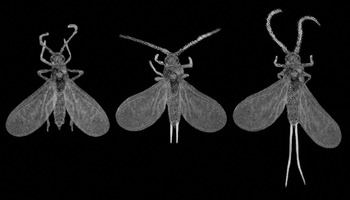
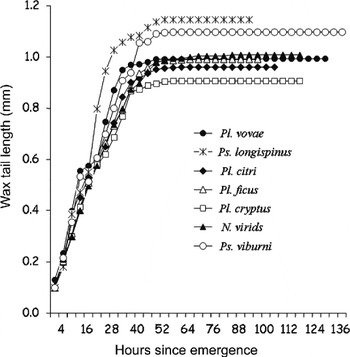
Male mealybugs are short lived, usually 2–4 days at room temperature (Razak et al., Reference Razak, Ananthi and Jayanthi1994; Chong et al., Reference Chong, Oetting and Van Lersel2003; Amarasekare et al., Reference Amarasekare, Mannion, Osborne and Epsky2008b). They tend to leave the colony to pupate, and in an outdoor situation they are not conspicuous. This is probably one of the reasons why mealybug males have been receiving relatively little attention. Males of scale insects are polygynous. It is known that Planococcus citri (Risso) males may fertilize an average of nine females (James, Reference James1937), with a maximum of 27 females during male life span (Silva et al., submitted); Planococcus ficus (Signoret) males mated a maximum of 19 times (Waterworth et al., Reference Waterworth, Wright and Millar2011). The adult male mealybug displays a pair of waxy caudal filaments that are secreted by glandular pouch setae located on segments VII and VIII of the abdomen (McKenzie, Reference McKenzie1967; Afifi, Reference Afifi1968; Kosztarab & Kozár, Reference Kosztarab and Kozár1988). In preliminary studies, we noticed that an elongation of these filaments occurs after the emergence of the adult male (fig. 1).
The change in the length of the waxy caudal filaments as related to age of the spherical mealybug Nipaecoccus viridis male.

Mealybugs are considered major pests on an international level, and their management relies heavily on the use of unselective insecticides. However, mealybug sex pheromones offer a potential promising alternative and ecologically friendly means for monitoring and controlling mealybug pests (Franco et al., Reference Franco, Zada, Mendel, Ishaaya and Horowitz2009). In practice, the use of pheromone traps as a monitoring tool (Franco et al., Reference Franco, Russo, Suma, Silva and Mendel2001; Walton et al., Reference Walton, Daane and Pringle2004) or to create a 'male vacuum' inside the plot by mass trapping (Franco et al., Reference Franco, Gross, Silva, Suma, Russo and Mendel2004) or for mating disruption (Walton et al., Reference Walton, Daane, Bentley, Millar, Larsen and Malakar-Kuenen2006) seems promising. Nevertheless, in order to pursue and to optimize such control tactics, more information is needed on the male mealybug's reproductive activity.
The objectives of the present study were: (i) to compare the lengths of the body, the antenna and the wing with that of the waxy caudal filaments of the seven mealybug species; (ii) to study the longevity of the adult male, with emphasis on the time taken to reach sexual maturity, using the elongation of the waxy caudal filaments as a timer; (iii) to determine the period of reproductive activity and responsiveness of a male to its conspecific female pheromone source, within the period of adult development; and (iv) to determine the diurnal pattern of the male sexual activity.
Materials and methods
The studied mealybug species and their rearing
Males of seven mealybug species of three genera were studied: the spherical mealybug, Nipaecoccus viridis (Newstead), the citrus mealybug, Pl. citri, the vine mealybug, Pl. ficus, the long-tailed mealybug, Pseudococcus longispinus (Targioni Tozzetti) and the obscure mealybug, Pseudococcus viburni (Signoret) were reared on potato sprouts (Solanum tuberosum); the cypress mealybug, Planococcus vovae (Nasonov) was reared on lemon-scented Monterey cypress, Cupressus macrocarpa; and the citriculus mealybug, Pseudococcus cryptus Hempel, was reared on red grapefruit saplings, Citrus paradisi.
Measurements of morphological parameters of adult male
The length of male mealybug body (between the forehead and the terminal tip of the abdomen), both antennae, wings and waxy caudal filaments were measured under a binocular microscope using an ocular with a 0.05-mm resolution ruler. For each of the seven studied species, measurements were taken of 60 two-day-old males that had been previously cooled down on an ice surface.
Production of males and females for the studies
Mealybug species that had been reared on potato sprouts were kept in rearing chambers in darkness at 25°C and 60–65% RH; others were reared on potted plants in greenhouses at temperatures of 20–32°C. Male prepupae and pupae were manually separated from colonies on the plants or from folded tissue-paper strips at the bottom of ventilated plastic cages in which the potato sprouts were placed. These immature males were kept in similar rearing chambers at the same conditions as mentioned above with a 12L:12D photoperiod. Virgin females were prepared by removing immature males from all rearing cages assigned for virgin production. Adult females, 3–8 days after the last molt, were used in the relevant experiments.
Male longevity
The longevity of the males, for each studied mealybug species, was determined at 25°C and 60–65% RH with a 12L:12D light period in a controlled rearing chamber. Longevity was defined as the period from adult male emergence until death. For each species, 60 males, collected as pupae from the rearing chamber, were placed singly in 30-mm-diameter Petri dishes each fitted with a filter-paper disk. After emergence, male survival was monitored every 4 h until death. A male mealybug was considered dead when it did not move if touched with a fine brush. Survival data were analyzed with the Life Test Procedure software package of SAS (SAS Institute, 2002). Empirical survival distributions were fitted to the various treatments. The homogeneity of the survival distributions was tested with log-rank statistics; mean survival±SE values for all species were also calculated. The LIFETEST Procedure was also used to calculate the point estimate of 50% mortality.
Determination of male physiological age
The physiological age was measured in relation to the elongation of the male waxy caudal filaments. The lengths of filaments were measured every 4 h, from 08:00 until 24:00, i.e. five observations per day. For this purpose, 50 healthy pupae of each of the seven studied species were collected from the rearing boxes. Each pupa was placed singly in a small Petri dish (30 mm diameter), which were kept in a chamber at 25°C and 60–65% RH. The pupae were inside the cocoon because, after the molt from pupa to adult, the male remains inside the cocoon webbing, where it remains visible and one can see the ‘buds’ of the developing filaments. The males exited from the wax webbing 4–12 h after the molt. The measurements of the waxy caudal filaments were taken with a binocular microscope, equipped with a scaled ocular, when the male stopped its movement in the dish. In some cases, we placed the Petri dish on a cold surface to slow down the male. We terminated the procedure when the male died. At this stage, the males appeared somewhat folded; in particular, the legs and the antennae were folded onto the body.
Estimation of the male waxy caudal filaments development parameters
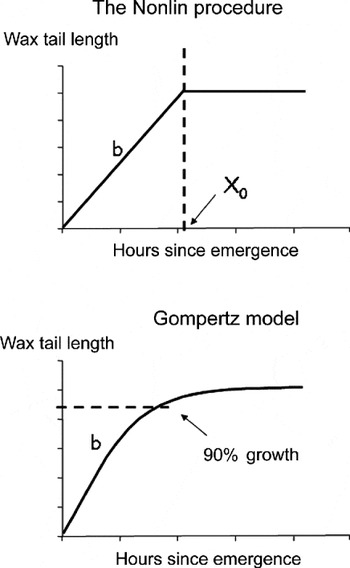
The growth curves of the studied males' waxy caudal filaments typically exhibit a bi-modal form. During the first part of the male life, the filaments elongate; whereas, in the second part, they do not change in length. Therefore, in order to generate information on the time the filaments take to reach their full length, we used two different analyses for waxy caudal filaments length measurements: (i) use of the Non-Linear Binomial Regression Model, by means of the SAS Library, Nonlinear Regression in SAS; and (ii) use of the nonlinear Gompertz model to describe the growth pattern of the waxy caudal filaments. By method (i) we estimated the time for the maximum growth (X0) and the relative growth rate (b) and by method (ii) we estimated the time for 90% growth (because of the exponential form of the growth curve an estimated time for 100% would be unrealistic) and calculated the maximum length of the filaments (fig. 2). The Gompertz model has been frequently applied to growth curves in both animals and plants (Winsor, Reference Winsor1932; Fox, Reference Fox1999; Yakupoglu & Atil, Reference Yakupoglu and Atil2001):

in which: Y=the length of the waxy caudal filaments at given development time, t; Y 0=the initial length at t=0; B=the growth rate of the waxy caudal filaments; e=the base of the neperian or natural logarithm; and K=maximal length of the waxy caudal filaments.
Models used for calculation of waxy caudal filaments growth parameters.

Estimation of the number of hours during which a male potentially may perform mating
The duration of the sexually active phase during the adult male life cycle of a specific mealybug species was calculated by the difference between the time (hours) estimated for maximum growth of the waxy caudal filaments, as calculated by the Nonlin procedure of SAS Institute (2002), and its mean longevity, as calculated by the LIFETEST Procedure (SAS Institute, 2002).
Preparation of males for behavior tests
Males of the studied species were divided into three age-range groups according to time after emergence, and the included proportions of their lifespan were expressed as percentages of the total waxy caudal filaments lengths. Group I comprised males 5–10 h after emergence, exhibiting 10–20% of the maximum elongation of the waxy caudal filaments; group II comprised males 16–24 h after emergence, exhibiting 40–60% of the maximum elongation; and group III comprised males 48–60 h after emergence, exhibiting 100% of the maximum elongation.
Preparation of sex pheromones for behavior tests
The synthetic sex pheromones of Pl. citri, Pl. ficus and Ps. cryptus were the only ones available to us when the experiments were conducted. The Pl. citri and Pl. ficus pheromones were prepared according to Zada et al. (Reference Zada, Dunkelblum, Harel, Assael, Gross and Mendel2004) and Zada et al. (Reference Zada, Dunkelblum, Assael, Harel, Cojocaru and Mendel2003), respectively. The pheromone of Ps. cryptus, which was kindly sent to us by T. Arai, was prepared according to Nakahata et al. (Reference Nakahata, Itagaki, Arai, Sugie and Kuwahara2003). For the tests with Pl. vovae and N. viridis, we used crude pheromone that was trapped on Porapak Q (50–80 mesh) in an airborne collection device similar to that used in our previous studies (Mendel et al., Reference Mendel, Saphir and Robison1990; Dunkelblum et al., Reference Dunkelblum, Mendel, Assael, Harel, Kerhoas and Einhorn1993; Zada et al., Reference Zada, Dunkelblum, Assael, Harel, Cojocaru and Mendel2003). The batch consisted of 10–20 sprouts carrying about 5000 virgin females. The pheromone was collected during 3- to 4-day periods. The Poropak Q columns were eluted with hexane, and the pheromone solutions were concentrated with a nitrogen flow. In the cases of Ps. viburni and Ps. longispinus, we used pheromone from approximately 400 virgin females of each species, extracted in 5 ml of hexane for 12 h. The biological activities of all pheromone solutions were bioassayed by using two-day-old males of the respective species.
Response of males of various physiological ages to their conspecific female sex pheromones
Males were bioassayed with the tested female sex pheromone in 10-cm diameter glass Petri dish arenas. The pheromone, as synthetic or crude solution, was impregnated into a filter paper disk (5-mm diameter, double-layer Whatman No. 1), with three untreated paper disks as controls in each arena. Dosage for Pl. citri and Pl. ficus was about 2 ng per disk. For the other tested species, we used concentrations equivalent to about 50 females per 1 μl hexane. In each test, we used five arenas: 10–15 males of each species and age group were introduced into each arena at about 09:00 h. Male behavior was recorded at 23–25°C, at intervals of 15 min for 3 h, i.e. a total of 12 counts per replicate.
Male behavior toward the pheromone source was characterized according to the responses to disks impregnated with the pheromone solution. Numbers of males that exhibited an attraction behavior were recorded. Attraction to the pheromone source was indicated when a mating attempt with pheromone impregnated disk was observed or when a male walked on the disk and conducted typical antenna drumming. The results were calculated as mean attraction for each arena; mean attraction was defined as the total number of males responding in the 12 counts divided by the total number of males that were introduced into the arena and ranged from a minimum of zero to possible maximum of 12. The attraction intensity of the males of all three age groups for each of the tested species was determined as the mean attraction±SD. The Tukey-Kramer HSD test (at P>0.05) was used to compare mean male attraction between the three tested groups of male physiological age for each species. A non-parametric coefficient (Spearman Rank correlation) was applied to analyze the correlation between male age and attraction, by means of the JMP software, version 8.0.2 (SAS Institute, 2008).
Responses of males of various physiological ages to their conspecific virgin females
Males were bioassayed in arenas, as described previously. The dish bottom was covered with filter paper (Whatman No. 1). In each test, we used 25 arenas for each species and age group; the tests were initiated at 09:00. We placed two virgin females in the center of each arena, and introduced a single male after a few minutes. Male behavior was described according to their response to the females. Three modes of response were defined: (i) indifference, i.e, males displayed random movement in the dish, paying no attention to the females; (ii) ‘courtship’ behavior, characterized by walking around the females or examining the females with their antennae; and (iii) mating. The males were exposed to the females for 15 min, after which the two females from each arena and test were transferred to a separate small plastic cage and placed on a mealybug-free potato sprout. The numbers of those females that produced a viable ovisac were recorded. Crawlers emerged from all recorded viable ovisac.
Attraction of mature males to a pheromone source as related to the time of day
Mealybug males were bioassayed, with the conspecific female pheromone and the same criteria of attraction as described previously. They were tested during three periods: 08:00–10:00, 12:00–14:00 and 16:00–18:00. The arenas were exposed to both fluorescent lights and natural light from the laboratory windows.
Attraction to the pheromone source was determined as described previously. Comparison of the mean intensity (±SD) of the attraction of mature males of four mealybug species to their conspecific female sex pheromones, as measured on a 12-point scale (minimum 0, maximum 12), was related to the time of the day. Each species was tested in 5–7 arenas in each time-of-day range, with ten naive males in each arena. The attraction intensity of the males of each of the three age groups for each of the tested species was determined as the mean attraction±SD. The Tukey-Kramer HSD test (P>0.05) was used to test the significance of the differences between means for each time period for each species.
Mating capability of male mealybugs as related to the time of day
Males of four mealybug species, N. viridis, Pl. citri, Pl. ficus and Ps. cryptus, were bioassayed in arenas as described in ‘Responses of males of various physiological ages to their conspecific virgin females’. Each mealybug species was tested during five periods: 06:30–07:30, 08:00–09:00, 12:00–13:00, 17:00–18:00 and 21:00–22:00. Male behavior was classified according to their responses to the females. We used 20 arenas for each species and for each time period. We placed two virgin females in the center of each arena and, after a few minutes, exposed a single naïve mature male (males possessed the maximum length to their caudal filaments) to them for 1 h. Occurrence of mating behavior by each tested male was monitored for the first 15 min of exposure. The intensity values of the mating activity were transformed to square root of (y+0.5) and subjected to the Chi-square test, and the correlation between ‘mating value’ and ‘period’ was tested by logistic regression by means of the JMP software version 8.0.2 (SAS Institute, 2008). After the 1-h exposure, the females from each test and arena were placed on mealybug-free potato sprouts in separate small plastic cages. The numbers of those females that produced a viable ovisac were recorded. The oviposition values were transformed to square root of (y+0.5) and subjected to Kruskal-Wallis one-way analysis of variance (ANOVA), and the correlation between ‘oviposition value’ and ‘period’ was evaluated according to the Non-parametric Coefficient (Spearman Rank correlation) between ‘period’ and ‘oviposition’, for each of the tested species separately, by means of the JMP software version 8.0.2 (SAS Institute, 2008).
Results
Adult male longevity
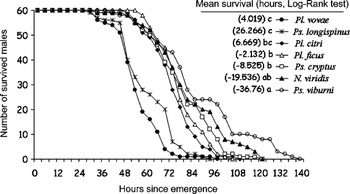
The survival patterns of adult males of the seven studied mealybug species, and the significant differences among them, are displayed in fig. 3. Mean longevity values, i.e. mean number of hours to estimated survival of 50%±SE, from the shortest to the longest, were as follows: 54.7±1.5 h for Pl. vovae; 58.8±2.2 h for Ps. longispinus; 77.1±1.5 h for Pl. ficus; 73.3±1.6 h for Pl. citri; 77.9±2.2 h for Ps. cryptus; 81.3±2.5 h for Ps. viridis; and 87.7±3.7 h for Ps. viburni (fig. 3).
Survival patterns of males of seven mealybug species at 25°C and 60–65% RH. Each treatment included 60 males. In parentheses are the values of Log-Rank statistics; values with the same letter are not statistically different (P=0.05) according to a close test procedure.

Body measures of the male
The body length of Pl. vovae was significantly shorter than those of the other species, which did not differ among themselves (table 1). Small but significant differences were found in the lengths of the antennae and the wings; for both parts, those of N. viridis were the longest (0.84 and 1.01 mm, respectively) and those of Ps. longispinus were the shortest (0.51 and 0.76 mm, respectively). The lengths of the waxy caudal filaments did not differ significantly among the males of the studied species, ranging between 0.96 and 1.15 mm (table 1). The estimated length of the filaments with the Gompertz model also suggested small but significant differences between species, within the range of 0.91–1.11 mm, with the longest waxy caudal filaments belonging to N. viridis and Ps. longispinus, and the shortest to Ps. cryptus (table 2). There was a high correlation (R2=0.8422) between the lengths of the filaments as predicted by the Gompertz model and the measured values.
Body measures (mean length±SD, in mm) of males of seven mealybug species.

Means within a column followed by same letters are not significantly different (P>0.05; Tukey-Kramer HSD test).
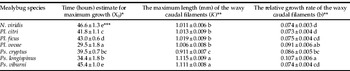
Waxy caudal filaments development parameters as calculated (mean±SE) for males of seven mealybug species using two methods: the Nonlin procedure and Gompertz model.

* The Nonlin procedure (SAS Institute, 2002).
** Gompertz model.
*** Test for comparing two estimates by approximate normal distribution; ratio <2; P1–P2/(SE12+SE22)0.5.
Male age as related to the elongation of the waxy caudal filaments
Growth patterns of the waxy caudal filaments of the males of the studied seven mealybug species are quite similar (fig. 4). The time (X0) for maximum growth of the waxy caudal filaments, as estimated by the Nonlin Model, revealed significant differences among the seven studied species. At one extreme, X0 for Pl. vovae was achieved after 29.5 h, whereas X0 for N. viridis was achieved after 46.6 h (table 2). The pattern of variation among X0 values for the seven studied species partly matches (R2=0.6257) that of the relative growth rates (b) of the waxy caudal filaments as estimated by the Gompertz model, with the highest and lowest b being calculated for Ps. longispinus and Pl. citri, respectively (table 2).
Growth patterns of the waxy caudal filaments of males of seven mealybug species at 25°C and 60–65% RH. Each treatment included 50 males.

Responses of male mealybugs of various physiological ages to their conspecific female sex pheromones
In general, the attraction intensity of males of each of the five studied mealybug species increased significantly with age (table 3). The attraction intensity of males of group III was significantly higher than of group I in all tested species. The difference between the response of males in group II and that of males in both group I and III varied among species.
Comparison of the intensity (mean±SD) of attraction of males of five mealybug species to their conspecific female sex pheromone (minimum to maximum attraction: 0–12, see the text) as related to three adult male age groups.

* Percentage of the total length of the waxy caudal filaments.
** Means within a row followed by same letters are not significantly different (P>0.05; comparison for the three pairs for each species using Tukey-Kramer HSD test).
*** Non parametric Spearman Rank correlation between male age and attraction.
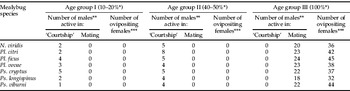
‘Courtship’ and mating activity of males of seven mealybug species as related to physiological age
Successful mating was obtained only in age group III. None of the males of the younger age groups performed a clear mating activity and none of the females that were exposed to these males oviposited. There were no marked differences between the tested species in mating success of group III: the mean number of males (±SD) engaged in mating activity was 21.7±2.1 (out of 25 tested males of each species), with a range of 18 (for Ps. longispinus) to 24 (for Pl. ficus). The mean number of virgin females successfully fertilized by the tested males was 31.1±4.7 (out of 50 females offered to tested males of each species), with a range of 32 (for Ps. longispinus) to 45 (for Pl. ficus) (table 4). Few males among the younger age groups displayed ‘courtship’ behavior, with no marked differences between the tested species; the mean numbers (out of 25 of each species) were 2.7±1.4 and 5.0±1.4 among males of groups I and II, respectively. None of the group III males of any of the tested species displayed a conspicuous ‘courtship’ behavior (table 4).
Occurrence of 'courtship' and mating activity among males of seven mealybug species as related to three adult male age groups.

* Percentage of the total length of the waxy caudal filaments.
** Out of total of 25 males.
*** Out of total of 50 females.
**** Non parametric Spearman Rank correlation between male age and attraction.
Calculation of the time during which a male may potentially perform mating
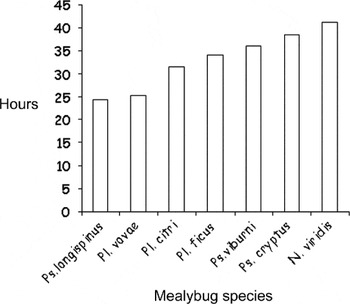
The estimated duration of the sexually active phase of the adult male within life span varied between mealybug species (fig. 5). Among the seven tested species, Ps. longispinus displayed the shortest period (34.4 h) and N. viridis the longest one (46.6 h).
The mean duration of the sexually active phase of tested males of seven mealybug species at 25°C. The period was calculated for males of each species by comparing the number of hours needed for maximum growth of the waxy caudal filaments with the mean longevity.

Attraction of mature male to a pheromone source as related to time of day
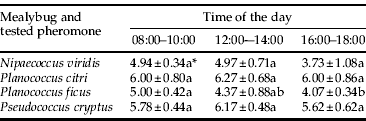
The levels of attraction of the tested males to a pheromone source did not differ between the three tested time periods, for all four studied mealybug species, but Pl. ficus whose male attraction to the pheromone was significantly greater in arenas operated during 08:00–10:00 than in those operated during 16:00–18:00 (table 5).
Comparison of the mean intensity (±SD) of the attraction of mature males of four mealybug species to their conspecific female sex pheromone (minimum to maximum attraction: 0–12, see the text) as related to the time of the day. Each species in each time of the day was tested in 5–7 arenas, each with 10 naïve males.
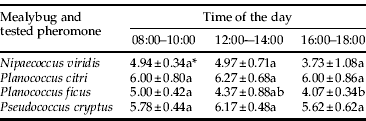
* Means within a row (for each species) followed by same letters are not significantly different (P>0.05; comparison for the three pairs for each species using Tukey-Kramer HSD).
Mating capability of male as related to the time of the day
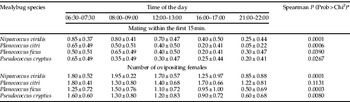
A continuous decrease in sexual activity from the morning (06:30–07:30) to the evening (21:00–22:00) was observed for the naive males of all four studied mealybug species (table 6). This activity decrease was observed both for mean values of immediate mating, i.e. during the first 15 min of male exposure, and for the numbers of mated females. Mating activity did not cease during any of the tested time periods. For all species examined, mating activity was significantly different among the study periods with a tendency to decrease from the morning to evening. The number of ovipositing females also showed a similar pattern in all mealybug species, except for Pl. citri.
The mating capability of four mealybug male species as related to the time of the day and displayed as mean value (±SD) of mating incidence per male and mean number (±SD) of ovipositing females per male. In all tests, each time a naïve mature male was exposed for one hour to two virgin females. The incidence of mating performance by each of tested males was monitored for the first 15 min of male exposure.

* Contingency tables for Chi2 test, (Spearman Rank correlation).
Discussion
The males of scale insects are short lived. Those of the pine bast scale Matsucoccus josephi Bodenheimer and Harpaz (Coccoidea; Matsucoccidae) emerge in the early morning and are dead at midday (Mendel et al., Reference Mendel, Saphir and Robison1990). Almost all males of Aonidiella aurantii (Maskell) (Coccoidea: Diaspididae) that emerged during a given afternoon were dead the next morning (Yan & Isman, Reference Yan and Isman1986). The males of the lac scale, Kerria lacca (Kerr) (=Laccifer lacca) (Hemiptera, Coccidae) live for 62 to 91 h (Misra, Reference Misra1931). To date, not much was published on the longevity of adult male mealybugs; for example, those of the cassava mealybug Paracoccus marginatus Williams and Granara de Willink, the Madeira mealybug Phenacoccus madeirensis Green, the pink hibiscus mealybug Maconellicoccus hirsutus (Green) and the sugarcane mealybug Dysmicoccus carens Williams survived for 1–6 days, depending on the species and temperature (Razak et al., Reference Razak, Ananthi and Jayanthi1994; Chong et al., Reference Chong, Oetting and Van Lersel2003, 2008; Amarasekare et al., Reference Amarasekare, Mannion, Osborne and Epsky2008b). The average longevity of seven mealybug species that were examined at 25°C in the present study fell within the same range, i.e. 53–88 h.
Our findings reveal for the first time the existence of a clear sexual maturation period of the adult males of the seven studied mealybug species which lasted for 30–47 h and with significant differences among some of these species (as estimated time for maximum growth of wax caudal filaments by the Nonlin procedure). The Gompertz model described well the growth (elongation) pattern of the wax caudal filaments of males in all studied mealybug species. We found significant differences in growth rates of male caudal filaments among some of the seven species (table 2). Nevertheless, the growth patterns of the filaments of all seven examined species were much the same. This enabled us to use the relative length of the waxy caudal filaments as an indicator of the physiological age of the adult male mealybugs. The differences in the growth rate of the waxy filaments of the studied male species are interesting on the background of the minor and negligible differences of their wing, antenna, body lengths waxy caudal filaments lengths.
After the last molt, the adult male stays in its cocoon, emerging before the sexual maturation period is complete; many exit the cocoon when the waxy caudal filaments have attained about 10% of its final length, whereas others may postpone it until the waxy caudal filaments reach more than 40–50% of its final length (Mendel, unpublished data).
Males of all tested ages were attracted to the conspecific female pheromone, and the intensity of attraction increased with age for all five tested mealybug species. However, previous observations showed that males of Pl. citri recently emerged (filaments less than 10% maximum length) did not respond to the conspecific sex pheromone; apparently, because they were not able to move (Silva et al., Reference Silva, Mouco, Antunes, Mendel and Franco2009).
Some of the callow adult male mealybugs were attracted to the virgin females in the arena; among the tested species, 4–20% and 16–32% of the males whose waxy caudal filaments reached about 10% and 50%, respectively, of its maximum length, displayed 'courtship' behavior. However, only mature males, whose waxy caudal filaments had reached its maximum length, skipped a clear 'courtship' phase, conducted mating and managed to fertilize the females.
Males develop more rapidly than females in most insect species (Thornhill & Alcock, Reference Thornhill and Alcock1983). Jarosik & Honek (Reference Jarosik, Honek, Fairbairn, Blanckenhorn and Székely2007) suggested that faster male development, relative to the female, may be less pronounced in holomeabolous insects because of the costly development of the male gonads. It is suggested that the non-reproductive state of the mealybug males may compensate most of the gap in development time between male and female mealybug. For the males of the seven mealybug species examined in the present study, the non-reproductive state, as determined under the assumption that mating can occur when the waxy caudal filaments reaches its maximum length, lasted about half (51–59%) of the male life time. The female mealybug begins to release the sex pheromone and is ready to mate within the first day after molting. However, the duration of the pre-oviposition period (ca. 1–2 weeks) depends on female age and corresponding ovary maturation phase at mating time, as well as on temperature and the mealybug species (Nelson-Rees, Reference Nelson-Rees1961; Chong et al., Reference Chong, Oetting and Van Lersel2003, 2008; Amarasekare et al., Reference Amarasekare, Chong, Epsky and Mannion2008a). The non-reproductive state of the adult male mealybug probably represents the cost of prolific sperm production that enables the males to perform multiple matings during their short sexually active period (James, Reference James1937; Waterworth et al., Reference Waterworth, Wright and Millar2011; Silva et al., in prep.). The finding that female fertilization in all seven studied mealybug species was conducted only by mature males, i.e. those with waxy caudal filaments of maximum length, further suggests that the process of sperm production occurs during the non-reproductive period of the males. This is in accordance with the observations of Nur (Reference Nur1962), who reported that the testes of recently emerged adult males of the obscure mealybug Ps. viburni (=Ps. obscurus) were not yet mature. Thus, we hypothesize that producing enough sperm requires a relatively prolonged non-reproductive state after emergence. For example, a trade-off between the time of exclusion and that needed to become reproductively mature was documented for drosophila fruit flies (e.g. Pitnick & Markow, Reference Pitnick and Markow1994; Pitnick et al., Reference Pitnick, Markow and Spicer1995).
The relatively long maturation period of the adult male mealybug is probably also related to several physiological processes that are needed for completion of male maturation. The most noticeable change is the elongation of the waxy caudal filaments. It is believed that the role of these caudal filaments is to assist in stabilizing flight (Duelli, Reference Duelli1985). Also, the wings and antennae sclerotize during the maturation period (Gray, Reference Gray1954). Therefore, it is expected that only mature males will be prepared to fly and search for mates. Field data obtained from male captures in pheromone traps support this hypothesis. Every one of the measured males, of all seven tested species, that were captured in pheromone traps displayed waxy caudal filaments of maximum length (Mendel & Protasov, unpublished data). It is, therefore, suggested that flight is also linked to male maturation. Since flight muscles in insects are expensive to maintain (Marden, Reference Marden2000), flight capability is costly; and there are known phenotypic trade-offs between flight and reproduction (Denno et al., Reference Denno, Olmstead and McCloud2008).
Since scale insect adult males do not feed, a strict energy budget is needed to cope with their short reproductive period. Mealybug males initiate flight at particular times of the day, and for rather short periods (e.g. Franco et al., Reference Franco, Zada, Mendel, Ishaaya and Horowitz2009). For example, by setting pheromone traps, we showed that males of Pl. citri and Pl. ficus started their daily flight at sunrise, to search for the female pheromone source (Zada et al., Reference Zada, Dunkelblum, Assael, Franco, Silva, Protasov and Mendel2008; Silva et al., Reference Silva, Mouco, Antunes, Mendel and Franco2009). Since the flight is mostly restricted to a 2–4 h period after sunrise, we addressed the question of whether mating activity is constrained to this period of the day or whether the males may engage in mating activity throughout the day. Furthermore, Rotundo & Tremblay (Reference Rotundo and Tremblay1980) showed that the females of Pl. citri and Ps. calceolariae emit the sex pheromone throughout the day. Among the four tested mealybug species, the males' readiness to mate and their fertilization capacity decreased from the morning to the evening. Our findings indicate that, although mating may be performed any time when ambient conditions are suitable, it is mostly concentrated in the morning and early afternoon. However, the daily sexual activity of a male mealybug seems to be limited by the number of matings he is capable to perform in a day. In fact, we recently found that the number of fertilized females of Pl. citri exposed to males during a 24-h period was not significantly different from that obtained in a 4-h period exposure (Silva, Mourato & Franco, unpublished data). Thus, the conclusion related to this aspect is that, although flight towards a pheromone source is restricted to a few hours, the male may continue its sexual activity throughout a longer period.
Acknowledgements
We thank Miriam Eliyaho, Hofit Kol-Maimon, Fabienne Assael (deceased), Daniela Fefer (Israel) and Manuel Cariano (Portugal) for their valuable assistance in rearing the studied mealybugs. We much appreciate the valuable corrections and suggestions raised by three anonymous reviewers. The research was partly supported by the Israel Science Foundation, as Grant No. 652/05 and Fundação para Ciência e Tecnologia (Portugal), as Grant PPCDT/AGR/57580/2004 and PTDC/AGR-AAM/099560/2008.