Economic historians of early modern and modern India consider that land, labour and credit transactions were reshaped by policies of the colonial state and by globalization, indirectly sustained by the new state. Three prominent cases in point are redefinition of property rights in land, new regimes of recruitment and control of labour and an expansion in rural credit that sustained peasant exports. An influential historiography of economic change in nineteenth-century India suggests that the consequences of these developments upon economic growth were on balance negative. For example, property rights were bestowed on groups that did not cultivate land, new labour laws empowered the coercive employer and usurious credit dispossessed peasants of land. Commodity producers and factor suppliers were forced by a new regime of taxation to participate in long-distance trade, but market imperfections left them poorer.Footnote 1 A story of immiseration informs the mainstream narrative of factor markets in eighteenth- and nineteenth-century India, and in turn offers a theory of the origins of international economic inequality in the modern world, which places considerable weight upon the agency of British colonial rule in the region.
This essay agrees with the mainstream on the scale of the commercialization process, but reads its significance somewhat differently. A fuller account of factor markets, I suggest, requires paying particular attention to the voluntary element in supply of factor services, and the organizational resources that the suppliers and users of land, labour and capital could deploy in negotiating terms of transaction. These resources and decisions were endogenous to the society. A consideration of these institutions alerts us to the ways in which economic actors tried to reduce risks while participating in the lucrative, yet unfamiliar and potentially hazardous, transactions enabled by globalization. The essay reviews the main elements and characteristics of the transition, with particular reference to those strategies that took shape at the level of the household and the community. There was a significant persistence and continuity of endogenous business models. The continuity did not represent a passive ‘survival’ of primordial cultural artifacts like caste. Rather, a creative and purposive reinvention of tradition was an ingredient in decisions to supply factor services in the new regime. That being said, I wish also to show that the institutional path dependence had ambiguous implications for economic growth. Social institutions, especially those that enabled formation of quasi-guilds or collectives, contributed to the globalization process, softened some of its disruptive effects, and yet added new forms of distortion in turn.
The remaining part of the essay is divided into three main sections, dealing with the land, labour and credit markets respectively. The last section concludes.
THE LAND MARKET
Three large sets of issues dominate the discussion on the history of the land market in India from the seventeenth century to the twentieth. These are property right, land transfer and incentive to invest in land improvement. This section will be organized around these themes.
Eighteenth-century British civilians who wrote on land tenure in the newly acquired territories of the East India Company, James Grant being the foremost, considered that private property rights had never existed in India, because the king was, according to the ancient theories of statecraft, the sole proprietor of land.Footnote 2 All peasants, then, were tenants of the state, and all rural magnates were officers of state. The premise carried over into the influential writings of Karl Marx and Fernand Braudel on Asian land systems.Footnote 3 Grant had evidently over-generalized. Any presumption that a land market and private property in land did not exist in precolonial India must stand discarded in the light of current historical scholarship on the subject. There is evidence of both sales of land and proprietary rights in northern and southern India for centuries before the colonial property laws were instituted. In Grant's own time, many tax collectors tried to establish some sort of proprietary right on the lands that they managed.
It would still be an error to consider that the precolonial and colonial periods were equivalent in this respect. In economic terms, the incentive to transact in land was almost certainly weaker in precolonial than in colonial India. And in institutional terms, there were at least two important differences between these periods. First, alienation was more difficult in precolonial India because of the entanglement of a variety of interests on agricultural land. The income of tax officers and that of the peasants were interdependent, which would mean that the former had a say on land sales. Colonial law reduced transaction costs by separating the private interests of tax officers from that of the peasants, and by creating sale laws. And second, private property was rarely vested in individuals in earlier times. On this point, colonial law was a change in principle, though only limitedly so in practice.
Supply of land being relatively inelastic in the medium term, the extent of land transactions can increase if population growth or the prospect of earning a profit from agriculture increased the demand for land. Population growth acted as a weak inducement for land transaction in the seventeenth and eighteenth centuries, being ‘a very modest 0.14 per cent’.Footnote 4 Profit was a weak inducement too. According to most accounts of precolonial India, the main form of agrarian surplus was not profit but tax. The nature of the premodern state has been the subject of an unfinished controversy. Aligarh historians claim that too much was taken out by the Mughal imperial state as taxes. Others propose a revision in the ‘despotic’ theory of the state, suggesting that the state shared its resources with other regional powers.Footnote 5 On medieval South India, Dharma Kumar summed up recent understanding in the same way: ‘outside a central core area, [the king] was ruler in name only, merely exercising ritual authority while the major part of state power was exercised by other “levels of the state”’.Footnote 6 There is, however, little dispute over the fact that the cultivator was subject to considerable exaction, and that the larger part of the surplus left the village to reach the military and regional elites, and the temples of South India. Furthermore, most accounts agree that the level of land yield did not increase, and might even have fallen, between the seventeenth and the twentieth centuries.Footnote 7 If yields were so rigid, one motive for buying land – to make improvements on it and capture the incremental yield – would be weak.
In this scenario, agricultural growth took the form of extensive growth or breaking new land frontiers, a project that required political resource. The nearest equivalent to agrarian ‘entrepreneurship’ involved the ruler or conqueror offering tax-free grants to a community of migrant peasants to induce them to clear forests and wastes. The lands were expected to add to the resources of the state when these were resumed for taxation a few years later. Burton Stein calls such moves, in the context of the dry uplands of Vijayanagar in an earlier era, ‘developmental investment’.Footnote 8 Strategies to raise land yield were not unknown. For example, C. A. Bayly shows how Muslim military or service gentry in North Indian villages often made land-saving investments to reduce the risks of excessive dependence on taxation rights.Footnote 9 However, if the long-term yield figures are believed, intensive growth was exceptional rather than the norm. And agrarian growth achieved by individual peasant initiative, as opposed to that achieved by political negotiation with communities, was rare indeed.
The overwhelming importance of political agency alerts us to the peculiar nature of property rights in land. Stein classified precolonial property rights on land into three classes: ‘prebendal’ or state-issued rights, private property rights and communal rights.Footnote 10 None of these rights was easily saleable, for each was a contingent right, contingent on loyalty, merit or membership of a community, respectively. Nearly all other rights with respect to land were use rights. And the mass of the peasantry belonged in that class of right-holders. Peasant rights to use land could be individual, village or kin rights, with or without rights to the commons, and with or without rights to sell and lease out. In the seventeenth century, ‘there was little question of the peasants claiming property rights over any parcel of land’.Footnote 11 It could not be an easy matter to enforce proprietary right because of an entanglement of three distinct forms of interest in land, all of which were or tended to become hereditary. These were the interest of tax collectors on a part of the surplus, that of the cultivators on subsistence and that of the peasant community on the village commons. There was thus a ‘welter of rights’ that bound each plot of land.Footnote 12 In a world where the important productive resources – labour and knowledge – were scarce, the chiefs and notables who lived upon a share of the taxes that they collected would have an interest in restraining rather than encouraging private transactions in land. The peasant community who controlled the commons had an interest too in not allowing the frequent entry and exit of individual members. We know about acts of land sales in precolonial India precisely because they were not commonplace.
Of these rights, the right to collect taxes began to show evidence of commercialization from the seventeenth century onward.Footnote 13 Correspondingly, the class that experienced significant change in composition, opportunities and risks was that of those who depended for their livelihood on the right to collect taxes. Earlier, these rights were both heritable and saleable to an extent. But sales were not common occurrences. Failure to pay taxes invited punishments, but did not usually lead to expropriation, because these rights were earlier connected with a promise to supply soldiers when necessary. But the collapse of the Empire, and the rise in its place of smaller states with insecure administrative and financial resources, led to a change. Revenue rights were now exchanged not for military service, but for taxation service. The rulers were forced to offer terms that made the revenue rights more marketable. Out of such circumstances, commercialization of taxation rights proceeded apace in the eighteenth century. In turn, this process could lead to ‘growing intensity of conflicts between rights’, as tax farmers tried to convert rights acquired from the state into something like private property rights, often in conflict with communal rights.Footnote 14
In the course of this transition, merchants and bankers participated more often in the eighteenth-century land market. Merchants had always played a critical role in running the fiscal system, in converting grain revenues into cash, for example. From the eighteenth century, merchants and bankers were also collecting taxes. ‘[M]oney [became] a crucial component of agrarian relations.’Footnote 15 Revenue farming reflected the fiscal weakness of the regional states and, through revenue farming, a substantially reconstituted class of tax collectors appeared in the third quarter of the eighteenth century in Bengal. These magnates, called zamindars in the 1770s, included families of old military stock and some who were the financiers of bankrupt military families. With the weakness of the regional state, these groups established systems of local governance. The East India Company, when it took the reins of the fiscal system of Bengal in the 1770s, was forced into making deals with this class of land controllers.
Further below merchants and tax farmers, among the peasantry, a crystallization of property rights had begun to happen as a result of the growing commodity trade in grain, cotton, indigo and opium. There is, however, no evidence suggesting that land market transactions freed themselves to a significant extent from the ‘welter of rights’ problem. Sumit Guha notes the presence of an informal peasant property right in the Deccan towards the end of the eighteenth century.Footnote 16 And yet contemporary descriptions of miras rights do not suggest that actual sales were either common or easy. The source cited in Guha stated that ‘the last sale here occurred two years ago’, and that sale deeds required the ‘consent of villagers’, secured by gifts exchange. Land deals were technically possible, but still bogged down in huge transaction costs.
The colonial property rights reforms, implemented over a period of thirty years from 1793, introduced two new elements. The first element was a desire to weaken the military elite, a policy which meant an end to the tax-collection rights that the groups in command of military resources had earlier enjoyed, and also an end to strategic land gifts. Tax rates were fixed, and tax collection became a state office. Second, the welter-of-rights problem was resolved by recognizing only ownership rights, including that of individual holders. Land could now be a source of private investment. The return on land became in theory measurable, and therefore comparable with other uses of capital, attracting moneyed people – including peasants – to transact in land. As B. B. Chaudhuri observes, ‘the landed society ceased to be a closed one, and any moneyed person could become a landed magnate’, simply by buying land.Footnote 17
The general idea was implemented in three different ways. In eastern India, the zamindari system gave property rights to the zamindars. The peasantry became tenants of these proprietors. In southern and western India, the ryotwari settlement gave property rights to the peasants (the Arabic word ‘ryot’ referring to the peasant proprietor in this case). In the western Gangetic plains, property rights accrued to dominant kinship lineages in the village. Under the zamindari tenure or ‘Permanent Settlement’, property rights were granted in exchange for revenue that was fixed in perpetuity. Under the other arrangements, property rights were granted in exchange for revenue that was subject to revision, approximately every thirty years. In 1793, the British in Bengal were too desperately in need of money to finance military campaigns and too ignorant of the rural power structure to consider a radical property-right regime. The Permanent Settlement, therefore, handed over property rights to those groups already entrenched in the village. In ryotwari areas, reforms were done later in a condition of greater information and confidence and peasant proprietorship seemed a logical choice.
The difference between these systems of tenure can be overstated. There was a significant element of convergence between them, which we see in the role of the dominant peasants and peasant community in the locality. Property rights in the ryotwari areas were usually granted to individuals who were prominent members of the peasant community, that is, individuals belonging to families that could claim some sort of original settler status. In zamindari regions, the system of rent collection was dependent on the collaboration of the dominant peasant. These peasants were sometimes organized in collectives, and negotiated terms with the zamindars as a group. In the course of the nineteenth century, there was entry into both the zamindar and tenant strata. Yet all new tenant groups organized themselves in caste collectives, using caste as a bargaining platform and as a means to ‘combine powerfully against the zamindar’.Footnote 18 The district officers supported the peasant community if the zamindar tried to resettle or evict them, as the most successful Bengali entrepreneur of the 1840s, Dwarkanath Tagore, realized when he tried to erect a large-scale sugar factory in a village on his own estate.Footnote 19 The dominant peasants owned or controlled key resources like land, credit, water, implements and animals. Real work in the village, therefore, was impossible without their consent, cooperation and control. Interdependence was present in all economic decisions.Footnote 20 Survival as a peasant in this environment did not depend on individual drive, but on getting along with the coalition of dominant cultivators.
Even if path dependence was present, the consequences of these reforms could still be revolutionary. For definition of an alienable property right in suppression of all other rights did formally end the ‘welter of rights’ problem and made land more saleable. In the second quarter of the nineteenth century, grain prices were depressed and nominal taxes set too high. In Bengal, for thirty or forty years after the zamindari settlement began, a lot of land came onto the auction market because zamindari tax was unaffordable for many proprietors. In the ryotwari areas, peasants mortgaged their land more frequently than before. Throughout India, the cleavage between high rent and low prices, combined with the rising mortgage value of land, encouraged new entry into the rural credit business. Money-lenders promised to pay rents in advance, leading peasants into debt traps. Some ryotwari lands also changed hands from peasants to money-lenders. Such land sales by defaulting tax-payers heralded a new trend. In an earlier time, defaulters were imprisoned, shamed, punished but not dispossessed of title and rights. Now, they faced the prospect of losing land. The Deccan Riots of 1875 were a violent expression of these new tensions in rural western India.
There was a change in the situation from the last third of the century. Between 1870 and 1920, agricultural prices about doubled whereas nominal taxes were almost stationary. Exports of agricultural goods in volume about doubled. Even as land yield remained unchanged, by changing the terms of trade globalization had made agriculture a more profitable business than before. The increased demand for peasant exports was largely met by expanding cultivation in new zones like Punjab, which state investment in canals and railways had made possible. In these conditions, expected profit from land-holding increased, and a reshuffling of ownership began. In northern and southern India, remnants of the precolonial military and priestly groups who owned land but did not cultivate it with their own hands were likely to sell their way out of the village, as part of a larger strategy to shift from landed to literate occupations. Peasants and labourers, and more rarely money-lenders and service-sector workers, were the buyers. The decline or withdrawal of the non-cultivating elites and the consolidation of the peasantry left asset inequality broadly unchanged.Footnote 21 The general character of land transfers, in other words, was not from the poor to the rich, as neo-Marxist historians suggested in the 1970s, but contained a significant element of transfer from the rich to the poor as well.Footnote 22
The expansionary conditions ended between 1900 and 1920, according to region, as the supply of land ran out. Rents and land prices began to outpace agricultural prices. The export market for grain collapsed. The terms of trade between agriculture and manufacturing turned against agriculture. There were episodes of rising rent, especially in the Bihar districts, in the second and the third quarters of the nineteenth century. But a sustained trend does not emerge until later. Nominal rents increased manyfold between the early twentieth century and the mid-twentieth century in North India.Footnote 23 In agriculturally prosperous coastal Andhra, grain rents more than doubled between 1860 and 1940 even as real wages remained almost unchanged.Footnote 24 Between 1860 and 1880, land prices in a semi-arid Madras region increased fourfold, reflecting not land improvement but a rise in grain prices.Footnote 25 After 1900, land prices or the present value of future rents increased sharply in most provinces. Land prices in arid Kurnool increased tenfold between 1900 and 1950.Footnote 26 In Punjab, the average land price increased more than tenfold between 1900 and 1945.Footnote 27 In the same period, agricultural prices had trebled. In Bengal, real rents did not increase in the early twentieth century, though there had been episodes of rises in rent in the nineteenth century.Footnote 28 Real rents were stationary in upland Maharashtra as well.Footnote 29 In both regions, overexploitation of land and/or overpopulation had so exhausted the agricultural economy that there was not enough demand for land. The 1920s also saw an acceleration in population growth. With population rising and extensive growth coming to an end, rural India was in the grip of a severe depression in the 1930s and 1940s. The devastating Bengal famine (1943) needs to be seen in the context of this steady erosion of food security.
In principle, a fall in the physical supply of land could be counteracted by increased yield. But yields did not increase. The rate of private investment in land improvement was too little to make a difference to yields.Footnote 30 The land market can make it easy for land to pass on from inefficient producers to those in possession of the knowledge and capital needed to effect land improvement. Why might the land market fail to perform this role in India? Available answers to the question take two roads: low incentive to invest and legal barriers to land transactions.
The former approach stands unsteadily upon the back of the zamindari experience in Bengal. In Bengal, property rights were given initially to zamindars, who were not cultivators themselves. The zamindar was technically in charge of land improvement but had little incentive to invest in land, because earning a rent was an easier and less risky way to earn money. Counteracting measures appeared late, and did not fundamentally change the rules. A series of tenancy acts (1880–1928) recognized and strengthened the occupancy rights of peasants settled on a piece of land for generations. In ryotwari areas too, tenancy protection was a general trend in the late nineteenth century. By strengthening cultivator rights, tenancy laws could encourage transactions in such rights.Footnote 31 The possession of a right turned the superior tenant into a small-scale landlord, and encouraged the sublease market.Footnote 32 Tenancy regulation tried to keep up with this ‘subinfeudation’, but not very successfully.Footnote 33
Neo-Marxist historians suggest that rent and interest squeezed out profits and thus weakened the incentive to invest. Shortage of land and lack of secure rights made rent extraction easy and profits too little and hard to obtain. Owners of land, who had access to cheap credit, advanced loans to poorer tenants who were in need of money to meet their consumption needs in years of bad harvests, and the former could charge exploitative interest rates thanks to their monopolistic position in the rural debt market. The availability of this alternative would again reduce the incentive to invest.Footnote 34 This theory of ‘interlocked markets’ has been popular in Indian economic history and almost canonical in the analytical development discourse as an explanation for agricultural underdevelopment. The argument is flawed, however. It implicitly assumes that the expected profit from land improvement was always small relative to rent or interest, but does not explain why that must be so.
In fact, expected earnings were low because of two environmental factors: the high cost of ensuring a secure supply of water in the dry seasons and the high risk of harvest failure in the tropical monsoon climate.Footnote 35 These factors were operative more or less in all regions of South Asia, but acutely so in the peninsular region. In the arid Deccan plateau, for example, shortage of water was an overwhelmingly more binding constraint on agricultural growth than class structure. Sinking wells was the only reliable way to ensure two or three good crops in a year. The low water table in the uplands, the thin top soil, the scarcity of perennial rivers and the basaltic rock underneath, made digging wells or constructing canals prohibitively expensive. In the mid-nineteenth century, constructing a well could cost two to three years' gross income of a peasant family, the attempt to locate water frequently failed after making that expenditure and drawing water was extremely labour-intensive. ‘Few cultivators’, an 1878 report on Madras explained, ‘are willing to encounter the risk.’Footnote 36 The main grains in these areas were the locally consumed arid crop, different varieties of millet, which yielded a small profit in the best of seasons.
Peasant entrepreneurs, therefore, did not have a strong enough reason to buy land in large quantities. Potential sellers held on to land for its insurance or status value. Land changed hands little in the aggregate. According to one estimate, between 1882 and 1945 secure cultivation rights that changed hands formed no more than 0.5–1 per cent (per year on average) of total area under such rights in Bengal.Footnote 37 In a South Indian district in the first decade of the twentieth century, the proportion of land that changed hands was 1.5–2.2 per cent.Footnote 38 Mortgaged area is usually a good predictor of net sales. In Punjab in the early twentieth century, net mortgaged area (the difference between mortgages entered into and those retired) was usually less than 1 per cent of the total area.Footnote 39
Along with weak incentives, there was also a legal reason why the land market was stunted. British-Indian land law created private property rights but founded inheritance and succession laws upon local custom and religious texts, which put the rights of the extended family before those of the individual.Footnote 40 In relation to land, the desire to protect the rights of the collective was a concession to the economic power that peasant lineages already possessed. The new regime reduced one kind of transaction cost in the land market by removing the welter of rights, but introduced another by embedding individual ownership within the rights of the family. Furthermore, the initial steps in a ryotwari exercise involved finding out who the original cultivators were, to whom private rights were to be delivered. This was never easy, given the legacy of the welter of rights. In trying to discover what the older practices really were, and who possessed rights by convention, the local administration needed informants, and these agents, willingly or otherwise, exploited the ignorance of their principals.Footnote 41 The result was a legal regime that was thoroughly ambiguous, with a perennial conflict between individual and collective rights built into it, that was written in a mixture of English, Persian and the vernacular and frequently unreadable, and that was open to constant reinterpretation by judges. A great many of the land transactions, therefore, were conducted within the framework of joint family or caste, that is, internal to these collectives. In this way, land law slowed the transition to a more capitalistic form of agriculture. Without the ambiguity in law, profitability might have played a larger role in land transactions.
Land, then, leaves us with a paradox. Secure property rights were a necessary but not a sufficient condition for productivity and growth in agriculture, for environmental and institutional constraints persisted. Labour history confronts us with another paradox.
THE LABOUR MARKET
Between 1800 and 1920, millions left their homes to work in new enterprises inside India or overseas. Circulation of working people in the Indian subcontinent had been a fact of history from a long time past, an essential part of a cycle of life that was punctuated by famine, land hunger, war, movements of grain, trade, artisan settlements and the rise and fall of states.Footnote 42 But few examples of large-scale migration or circulation before the eighteenth century involved wage work in permanent sites that employed hundreds of people together, such as the mills, plantations, canals and railways of the nineteenth century. Yet, real-wage data do not apparently suggest a strong reason why so many people moved jobs.
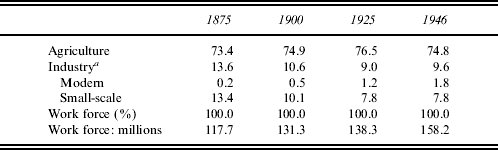
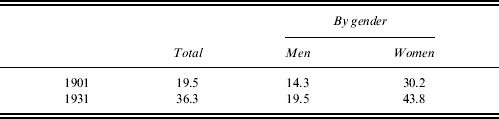
The neo-Marxist historiography cites a variety of ‘push factors’. New property rights in land, a decline of handicrafts and the high risks associated with grain exports that led peasants into a debt trap led to a pervasive rural crisis. These conditions pushed small peasants into landlessness and wage labour. Early statements of the thesis processed census occupational data to show a significant increase in the proportion of agricultural occupations in the work force, matched by a fall in the proportion of handicraft industries in the work force (see Table 1) and an increased number of wage labourers in the agricultural work force (see Table 2).Footnote 43
Sector-shares in the work force of colonial India, 1875–1946 (%)

a ‘Modern industry’ refers to legally defined factories; ‘small-scale’ refers to traditional industry in households and workshops.
Sources: Alan Heston, ‘National income’, in Dharma Kumar ed., The Cambridge economic history of India, vol. 2 (Cambridge, 1983), for 1875; S. Sivasubramonian, National income of India in the twentieth century (Delhi, 2000), for the other years.
Wage labourers in the agricultural work force of colonial India, 1901–1931 (%)

Sources: S. J. Patel, Agricultural labourers in modern India and Pakistan (Bombay, 1952); J. Krishnamurty, ‘The growth of agricultural labour in India’, Indian Economic and Social History Review 9, 4 (1972), 327–32.
The pessimistic reading of these ratios did not go unchallenged. A revisionist account argued that landlessness as such did not increase in rural India, but that older forms of landlessness associated with caste gave way to a new form associated with wage work.Footnote 44 The census occupational surveys, which were better able to observe market participants than non-market arrangements, captured this institutional change. The rural crisis theory received further criticism in four sets of scholarship. Researches on national income showed that average rural incomes increased in the fifty years before the First World War. Regional agrarian history revealed a rather limited extent of dispossession of the peasantry from land. Historians of industrial labour showed that many workers in the cotton textile mills were in fact land-owning peasants, and nearer the elite than the proletariat. And careful scrutiny of the census data found the evidence on proletarianization to be weak in relation to male workers, and strong for female workers (see Table 2).Footnote 45
In a reappraisal of the census data, I have offered an account of the transition in the labour market based on the proposition that the supply of labour was a family decision rather than an individual one.Footnote 46 A certain segment of the migrants from rural to urban occupations consisted of rural labourers who had formerly been part of a caste-based ‘attached’ labour relationship. These customary long-term contracts in agriculture had been male-biased. Women were scarcer in these arrangements. These systems were in decline in the late nineteenth century. As attached labourers were replaced by those hired in the casual wage-labour markets, the entry of women into rural labour markets increased. On the other hand, rural women were less likely to move to the cities because they married early and had children to look after. It was men who migrated into new industrial jobs in large numbers. The majority of those women who stayed behind reported themselves to the census as agricultural workers.
Agrarian slavery and serfdom were rare in India. The closest equivalent to serfdom was a caste-based obligation to perform labour, and the presence of implicit restrictions on the ownership of land. In some situations, such as in precolonial Malabar, individuals so tied to land were in effect sold when the land was sold.Footnote 47 But a more prevalent form of labour-tying was the farm-servant contract whereby the male head of a family pledged his labour, sometimes his family's labour, for one, two or three years, to a specific employer. There is some dispute over the reason why any tying was practised. While caste sometimes cemented these relationships, the economic motivation needs to be understood in terms of ‘hoarding’ labour for use during peak seasons. The timing of rainfall was a life-and-death matter for peasants in monsoon agriculture. For many employers, it was well worth paying a subsistence to a person throughout the year against an assured supply of effort on the few days when sowing and harvesting must necessarily be done. The average duration of these employment contracts was in decline in rural India from the late nineteenth century, however. The percentage of farm servants in agricultural-labour households was falling everywhere. In Madras, where farm-servant contracts had been particularly prevalent, the fall was dramatic.
An increasing supply of migrants reduced the employers' need for labour-hoarding. Several prominent streams of seasonal circulation of agricultural labourers emerged from the late nineteenth century on. Large numbers migrated every season from the uplands of the Godavari, Krishna, Guntur and Vizagapatam districts to the Krishna-Godavari deltas for farm work. Many from Chhattisgarh went every cotton season to Berar cotton fields and gins. The wheat fields of Narmada Valley, that is, Jubbulpore, Saugor and Damoh, received migrants from the United Provinces in the north and from Rewa, whence the Gonds descended the hills during harvests. Bihar workers migrated to Bengal in the jute harvest season. Azamgarh workers were recruited for large-scale earthworks in Bengal. From Ratnagiri, many went to work in the cotton fields of Broach. And the Punjab's canal colonies received migrants from Rajputana. Agricultural labourers also went to the plantations, urban services, railways and other public works, and (only rarely) to the mills. These shifts, which elsewhere I call ‘reallocation’,Footnote 48 were not just transfers of population between locales and jobs, but they involved transfers between labour institutions. When rural workers left their village, they left the more or less customary contracts to take part in wage labour. Therefore, migration also hastened the break-up of customary terms of employment.
Along with agricultural labourers, peasants who had limited access to land and artisans who had found their livelihoods becoming less secure after the importation of foreign articles moved in search of work too. Skills and caste preserved a great deal of segmentation. The rural proletariat circulated mainly in rural–rural seasonal movements, at times going to work in mines and plantations, whereas skilled artisans and land-owning peasants moved to factory jobs, land-ownership or entrepreneurship.
Permanent sites of hiring began to emerge from the eighteenth century, to receive migrant workers. Indigo factories of Bengal in the 1830s and 1840s, coal mines of Chota Nagpur and tea plantations of Assam somewhat later recruited workers who came from villages hundreds of miles away. From the end of the century, industrial cities recruited workers from longer distances and different regions. In the nineteenth century, India contributed vitally to the formation of a global proletariat. In 1920, the total number of persons of Indian origin working in the tropical colonies – Mauritius, Guiana, Fiji, Trinidad, Jamaica, Natal, Malaya, Ceylon, and East Africa – possibly numbered between two and five million.Footnote 49 Most were wage-earners. Hundreds of thousands left home for overseas in search of commercial opportunities. More than a million others had been born outside their place of work, and became engaged in manufacturing, mines and plantations inside India. These figures do not include the flow of short-distance and seasonal movements of agricultural labourers.
The system by which erstwhile villagers learnt to operate machinery, work to time, work in teams and work to order has been interpreted differently. Historians tend to read these organizations in terms of ‘controlling’ labour from above. Various coercive strategies were adopted to tie unwilling and disillusioned workers to employers who offered small wages and to cities that offered a poor quality of life. The capitalist formed alliances with the state and with the pre-existing forms of hierarchy in order to implement these strategies. The methods included penal laws for breach of the indenture contract, or the use of the authority of the foreman-cum-headman.Footnote 50 Other writers have seen the persistence of the same pre-existing forms of hierarchy as the survival strategies of workers in an unfriendly environment.Footnote 51 Common to such interpretations is the image of the worker as a victim of a state–capital alliance of the colonial kind. Arguing against these perspectives, Rajnarayan Chandavarkar made a plea for seeing the labour systems as a creative and adaptive evolution that incorporated both traditional elements and modern needs.Footnote 52 What were the traditional elements?
Nearly all workers participated in the new sites under the leadership of a headman. The headman was prominent also in the case of overseas migration. Formation of groups and the transformation of the group-leaders into agents of some kind were tendencies present in industrialization throughout the world, though ‘late’ industrialization shaped this dual process in particular ways. India supplied models of hierarchy from its own tradition, such as the bond between tribal villagers and their headmen, between caste members and caste elders and between apprentices and masters. Two independent variables – the need for large-scale recruitment and the propensity to form a hierarchical club – reinforced one another. The informal collective, which thus arose out of traditional roots, became an early form of collective bargaining institution. The nineteenth-century collective guided ‘villagemen’ through difficult and unfamiliar forms of market negotiation, at a time when the employers were organized into collectives or were friends of the police.Footnote 53
From these origins, the hierarchical club evolved into a unit of management in the late nineteenth century. The nineteenth-century collective represented a form of partnership between the headman and the foremen, ensuring a reliable supply of effort in exchange for some freedom granted to the former to recruit and retrench workers. The collective evolved further in the twentieth-century industrial cities. It became considerably less of a social combine and much more of an internal labour market, controlled, if imperfectly, by the headman using remnants of the old authority.
Increasingly, those powers were considered coercive by the workers and obsolete by the managers. The hierarchical club appeared as a pointless survival. From the workers' side, its key weakness was that the collective principle could turn into an exploitative device when some employers and headmen colluded to keep it going, and yet the workers did not need it any more. In the twentieth-century history of the cotton mills of Bombay, we see this syndrome develop. From the capitalists' side, recognizing the collective and negotiating with a headman represented a trade-off. Their gain was a stable and reliable work force, but they lost some control over skills, incentives and discipline. In situations that demanded that the capitalist try to raise labour productivity, the old organization could become a burden. And yet getting rid of the headman was not an easy job. The very presence of a community, even the shadow of one, could make any induced break with tradition look like a cultural transgression. Further, the slow development of formal technical and managerial education made the intermediary an essential ally for a long time.Footnote 54
The other organization that shaped the supply of effort was the family. There were two principal ways in which the family played a role in labour allocation. One of these involved the combination of cultivation and manufacturing, and the other involved the balance that women had to strike between raising children and doing wage work. On both these aspects India offers many points of contrast with Western Europe and Japan. Women, more than men, suffered ‘deindustrialization’. Mixed-occupation rural households declined. Women, who often commanded high degrees of artisanal skill, had poor access to capital and marketing on their own. They faced greater obstacles in the way of joining the urban labour force than did men. There were specific barriers to entering the larger factories in the form of the prohibition of night work or weak maternity-leave provisions. But the more universal obstacle faced by women was the low average age at marriage.
Marriage and childbirth act as universal barriers to paid work. However, in societies in which marriage takes place well after the attainment of adulthood, unmarried women in the age-group 15–24 can and do participate in wage work. In societies where marriage takes place before the onset of adulthood, the window between becoming of working age and the occurrence of marriage remains narrow, even closed. In such societies, as work shifts from the household to the factory, it is more likely that women will withdraw from paid work. In India, where the average age at marriage was as low as 13 in 1921, a withdrawal from manufacturing work was protracted and deep.Footnote 55 This situation pushed a disproportionate number of rural women into agricultural wage-labour, or to join factory labour only when their husbands worked in another department of the same mill, and neighbours and older siblings were available to look after young children. Factory women in interwar India were nearly all married.
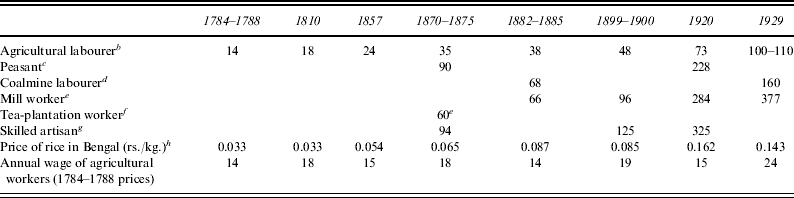
Family and community made a comfortable bridge by which millions crossed over from non-wage to wage labour. But why would anyone want to cross over? How well does the monetary incentive explain that decision? The nineteenth-century earning data are fragmentary. I collate some figures and estimates in Table 3. These figures and the estimates of agricultural wages that have been developed and used recently suggest several interesting conclusions.
Earnings of colonial Indian workers, 1784–1929 (in rupees at current prices)Footnote a

Notes and sources:
a The exchange rate was Rs. 8 to the pound sterling until 1864; Rs. 10 in 1864–1875, depreciating to about Rs. 18 in 1875–1892; Rs. 15 in 1893–1918; Rs. 11 in 1919–1920; and Rs. 13 in 1921–1947. The rupee–US$ exchange rate was approximately 2.7 throughout. It fell to 3.6–3.9 in the late 1890s and rose to 2.5 in 1919.
b The 1780s figures are an average of three observations on agricultural wages from Bihar and Bengal; one refers to farm servants. (Sources: Thomas Law, A sketch of some late arrangements and a view of the rising resources, in Bengal (London, 1792), 60 (I have converted the daily wage of 2d into an annual wage, assuming eight months' full-time work); British Parliamentary Papers (BPP), 1812–1813 (377), Select committee on affairs of the East India Company, fifth report, appendix (appendix 4, note by James Grant); H. T. Colebrooke, Remarks on the husbandry and internal commerce of Bengal (Calcutta, 1804).) The 1810 data are based on wages for general labour and agricultural labour from Dacca, Bihar, lower Bengal, Madras and Dinajpur, average of five observations. (Sources: John Stracey's note in BPP, 1812–1813 (122), Select committee, and committee of whole House of Commons, on affairs of the East India Company, minutes of evidence (trade and shipping, and renewal of charter), 296; R. Rickards, India, vol. I (London, 1829), 48; William Bruce Smith, merchant in Bengal, in BPP, ibid., 100; Thomas Munro, BPP, ibid., 124.) In all cases, I assume that the rupee was the current rupee (2s) and that workers were fully employed for eight months in a year. The 1830 figure refers to standard wages per month paid to workers in cotton and indigo, assuming eight months of work available, from House of Lords, Report from the select committee of the House of Lords appointed to inquire into the affairs of the East India Company and into the trade between Great Britain, the East Indies and China, with the minutes of evidence taken before the committee (1830), 324. The 1857 data are based on the monthly wage of Mysore labourers; I presume they are farm servants in year-round employment. (Source: BPP, 1857–1858 (415), Select committee to inquire into progress and prospects for promotion of European colonization and settlement in India, third report, minutes of evidence, 129.) For 1870–1875 and 1882–1885 the monthly wage is from Prices and wages statistics of India (Calcutta, various years), averaged. The 1899–1900 daily wage is from Report on an enquiry into the causes of rise in prices (Calcutta, 1914). For 1920 and 1929, see T. Roy, ‘Globalisation, factor prices and poverty in colonial India’, Australian Economic History Review 47, 1 (2007), 73–94; figures have been converted into an annual wage by assuming that a worker obtained 220 days of work per year on average.
c Estimated as a residual from total agricultural income, after agricultural labourers are accounted for.
d Report of the Royal Commission on Labour in India, vol. I, part I (London, 1931), ch. XII.
e F. C. Danvers, ‘A review of Indian statistics’, Journal of the Royal Statistical Society 64, 1 (1901), 31–72. Wages refer to ordinary workers (excluding ‘mistries’, or foremen) in the weaving department. The mill is located in northern India. The 1920 and 1929 figures are derived from the index of real wages in K. Mukerji, ‘Trends in real wages in cotton textile mills in Bombay City and Island from 1900–1951’, Artha Vijnana 1, 2 (1959), 82–95, applied to the 1899–1900 figure.
f C. H. Fielder, ‘On the rise, progress, and future prospects of tea cultivation in British India’, Journal of the Royal Statistical Society 32, 1 (1869), 29–67. Average monthly wages are converted into annual, assuming that workers got full-time work for eight months in a year.
g The 1810 figure refers to artisans in a Calcutta workshop, from the evidence of William Fairlie in Interesting extracts from the minutes of evidence taken before the committee of the whole house … illustrative of the improvements in the manufacture of iron, steel, brass, tin, copper, hemp, cordage, etc., by the natives of India (London, 1813), 8. Information on carpenters, masons and blacksmiths is from S. Sivasubramonian, The national income of India in the twentieth century (Delhi, 2000), and F. J. Atkinson, ‘A statistical review of income and wealth in British India’, Journal of the Royal Statistical Society 65, 3 (1902), 209–83.
h First three columns are from Brij Narain, Indian economic life: past and present (Lahore, 1929), 108–28. For other years, I updated the third column with the export price of Burma rice, because Narain's numbers seem to overstate the increase in price. See U. Khin Win, A century of rice improvement in Burma (Manila, 1991), 148.
Wages in the modern sectors were always significantly above farm labour wages. But workers in the modern sectors also included peasants and artisans, who did not necessarily experience a significant improvement in earnings by moving. That need not mean that wages played no role in inducing people to move. Because of the high seasonality of monsoon agriculture, there was disguised unemployment among the peasantry and rural artisans, so that labour supply displayed a high wage-elasticity. Even though average earnings were roughly equal across the nineteenth-century work sites, there was year-round work available in mills, mines, and plantations, whereas agriculture rarely offered full-time work for more than 220 to 240 days in a year, and in the dry regions much less than that. Even relatively well-off peasant families could afford to send their adult males off to non-agricultural wage work, recalling them to meet the peak-season labour demand only. Further, overseas plantation wages were always significantly above Indian average earnings in the nineteenth century.
Trends in real agricultural wages remain shrouded in mystery. Nominal wages changed very slowly until 1900, which I elsewhere attribute to the prevalence of annual contracts.Footnote 56 Real wages did rise at times, and they did this in the late nineteenth century when migration peaked.Footnote 57 But the effect of any such rise was short-lived. After all, agricultural workers moved between unskilled rural occupations more than out of them. Between 1875 and 1940, the wage differential between agriculture and industry increased. A growing trade union movement and new labour laws helped insiders in mills to push for higher wages. On the other hand, institutional barriers prevented the easy flow of workers from depressed to more lucrative sectors. The headman-dominated recruitment system in the mills, for example, meant that the headmen had to be bribed in order for jobs to be obtained.
Earnings in agriculture suffered further in the 1930s. As exports crashed and commodity prices began to fall, money wages were pushed down. A decline in real wages started within a few months. At the end of the period (1935–1936) they were usually below those at the onset of the Depression (1929–1930). The Second World War saw massive inflation, further depressing real wages. After India gained independence in 1947, the older tendency of progressive urban–rural wage differentials returned. Studies on wage trends in the 1950s and 1960s report a gradual descent into the low average that had been established around the mid-1930s.Footnote 58 Urban real wages, at the same time, responded well and positively to import-substituting industrialization.
Both family and community regulated labour supply and aided bargaining. A parallel narrative emerges with respect to the supply of liquid capital.
THE CREDIT MARKET
‘[While] banking in India has a long history … from the sixteenth century, it is possible to see the development of more specialized banking institutions.’Footnote 59 Among the several factors that gave rise to new businesses and firms were the textile export trade and inflow of New World precious metals, cash-crop production and a closer relationship between state power and commercial interests.Footnote 60 The mutual dependence that had developed between the post-Mughal regional states and their bankers exposed the latter to local conflicts and led them into taking sides in these conflicts. Financial deepening and transition to colonialism, in this way, were interdependent phenomena. That being said, it is not clear how significant these changes were for economic history. K. N. Chaudhuri finds no long-term tendency in interest rates between 1660 and 1760.Footnote 61 Shireen Moosvi disputes the conclusion, and shows that nominal interest rates fell somewhat (from an 18–24 per cent modal rate to about 12) through the seventeenth century.Footnote 62
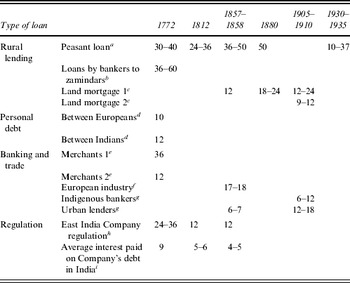
The four major activities in which private financial capital was engaged in the eighteenth century were tax farming, lending to the state, money-changing and internal remittances. Tax farmers thrived on the administrative weakness of the new states. Money-changers flourished upon the monetary fragmentation of a territory that had been relatively more united a century before. And the remittance business grew, not only because of the extension of commodity trade but also due to the emergence of new pockets of insecurity and lawlessness, in regions which nevertheless were quite central to commodity trade (one example was Malwa, an opium-producing area). When the East India Company settled down to rule Bengal in the late eighteenth century, many of the clients of the bankers had been bankrupt military families. Their bankers charged them usurious interest rates (see Table 4). Interest rates could also rise sharply for short-term risky loans. However, outside these non-traditional relationships, nominal interest rates were constrained by convention, and in the neighbourhood of 12 per cent (see Table 4), which is what Moosvi found to be usual for the late seventeenth century.Footnote 63
Interest rates in India, 1772–1935 (% per year)

Notes and sources:
aSources: BPP, 1812–1813 (306), Papers relating to revenues of India, and on growth of hemp and cotton, 56; BPP, 1772, Seventh report from the committee of secrecy appointed to enquire into the state of the East India Company together with an appendix referred to in the said report, 329, 335; Thomas Munro, in BPP, 1812–1813 (122), Select committee, and committee of whole House of Commons, on affairs of the East India Company, minutes of evidence (trade and shipping, and renewal of charter), 174; BPP, 1857–1858 (415), Select committee to inquire into progress and prospects for promotion of European colonization and settlement in India, third report, minutes of evidence, 129, reference to South Indian money-lenders; 1880: unsecured seed loan, J. A. Voelcker, Report on the improvement of Indian agriculture (London, 1893), 291; 1930–1935: cell reports range of the usual interest in Bengal. The ranges in Bombay were lower; see A. J. Saunders, ‘The Indian Central Banking Inquiry Committee, 1931’, The Economic Journal 42, 1 (1932), 32–41.
b Shroffs of Murshidabad and Seths of Rangpur, both advances on urgent rent payment, source BPP, ibid.
c BPP, 1857–1858 (415), Select committee to inquire into progress and prospects for promotion of European colonization and settlement in India, third report, minutes of evidence, 129, reference to South India, European advances. 1880 figure from BPP, 1878 (143), Mr. Robertson's report of tour in Coimbatore, 37. The two 1905–1910 numbers refer to rural north India and Bihar indigo planters; see H. R. Perrott, ‘Voices from the Indian up-country: banking and money-lending’, The Economic Journal 19, 4 (1909), 450–63.
d BPP, 1772, Seventh report from the committee of secrecy appointed to enquire into the state of the East India Company together with an appendix referred to in the said report.
e ‘Where the occasion has been urgent, and the Loan for a short Time, and attended with Risk’; BPP, 1772, Seventh report from the committee of secrecy appointed to enquire into the state of the East India Company together with an appendix referred to in the said report. For the rate that courts allowed on debt disputes, see BPP, 1772, ibid.
f For European planters outside Calcutta, see BPP, 1857–1858 (326), Select committee to inquire into progress and prospects for promotion of European colonization and settlement in India second report, minutes of evidence (J. P. Wise, indigo planter, p. 54).
g The 1905–1910 figure refers to ‘first class’ loans; see H. R. Perrott, ‘Voices from the Indian up-country: banking and money-lending’, The Economic Journal 19, 4 (1909). The 1857 range refers to mortgage rate in Calcutta; see BPP, 1857–1858 (326), Select committee to inquire into progress and prospects for promotion of European colonization and settlement in India second report, minutes of evidence.
h The 1772 range refers to maximum rates legally allowed for loans up to rs. 100 (24) and above rs. 100 (36); see BPP, 1772, Seventh report from the committee of secrecy appointed to enquire into the state of the East India Company together with an appendix referred to in the said report. See also B. Natarajan, ‘Influence of classical theories on interest regulation in India (1800–55)’, Economic History Review 9, 2 (1939), 186–92. The 1857 figure refers to the accepted maximum in the Punjab courts of law; see BPP, 1859, Session 2 (171), Select committee to inquire into progress and prospects for promotion of European colonization and settlement in India report, proceedings, minutes of evidence, Index, 20.
i W. H. Sykes, ‘The past, present, and prospective financial condition of British India’, Journal of the Statistical Society of London 22, 4 (1859), 455–80.
From the nineteenth century onward, credit market institutions evolved on three distinct planes: formal banking, ‘bazaar’ banking and rural lending. All of these spheres departed from convention in terms of participants and organizations, even though the second retained its dependence on the community for entrepreneurial resources and selection of clients for a long time.
The modern world that owned mills mines and plantations, and had easier access to ports and railways, relied on joint-stock banks and the formal capital market, located in the port cities. Indian entrepreneurs on the other hand, who engaged in commodity trade, produced and traded in handicrafts and used boats and carts for transportation, relied on community bankers for remittance and capital. A subset of this latter world, which one author designates the ‘bazaar’, moved into crop loans and consumption loans in rural India.Footnote 64
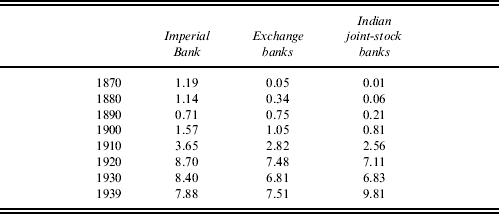
Table 5 shows that the scale of deposits in the formal sector grew about eighteen-fold between the 1870s and the 1930s. Against a threefold increase in nominal income in this time-span, we get a picture of impressive growth in the scale of modern banking in colonial India. Formal banking and insurance emerged first in the port cities, such as Calcutta or Bombay, where the indigo, opium, cotton and rice trades needed creditors, insurance agents, shipping firms, money-changers and conduct of remittance. Several of these new enterprises were formed by Indo-European partnerships, and while some of these firms failed in 1833 and 1846 when the indigo market suffered shocks, others survived. In the 1870s, legislation addressing company formation, contract and negotiable instruments initiated a new phase of banking growth. Until about 1900, formal banking consisted of a few European firms and the government-sponsored Presidency banks. The main clients of the Presidency banks were colonial firms and that small segment of Indian enterprise which the Europeans understood or could easily communicate with. The biggest bazaar bankers commanded liquidity with the formal sector, reflected in the moderate interest rates that they could charge (see Table 4). They also reduced risks by making use of government securities. The Presidency banks, on the other hand, were not easily persuaded to lend money to small- or medium-scale Indian business.
Growth of deposits in joint-stock banks in colonial India, 1870–1939 (in billions of rupees)Footnote a

a Exchange banks were licensed to deal in foreign currency. The Imperial Bank was formed by amalgamating the three Presidency banks (see text).
Source: Reserve Bank of India, Banking and monetary statistics of India (Bombay, 1952).
The example of the South Indian Chettiars illustrates the dynamism of traditional bankers. Lower Burma became part of the British Empire in 1852. The Nattukottai Chettiars were a community of merchants and bankers with their family homes in the Chettinad region. In the nineteenth century they extended their overseas business to regions in Southeast Asia; Burma became the most important of these centres. At that time the economic potential of the Irawaddy delta was largely unutilized. A modified ryotwari system enabled land-holdings to be mortgaged. Between 1852 and 1900, cultivated acreage expanded and rice exports grew from less than 200,000 to more than 2 million tons. Although in the early stages of the expansion local finance played a major role, after the 1880s capital came from migrant financiers. Between 1880 and 1930, Chettiar firms with their nerve centres located in South India met an increasing part of the credit demand of Burmese peasants.Footnote 65 This ascendancy has been explained in terms of the Chettiars' superior business organization, in particular to long apprenticeship, training in business ethics and special accounting techniques, group solidarity, inter-firm lending and informal sanctions to minimize default within the group. Furthermore, by the definition of a ‘community’, the Indian merchant communities combined business partnerships with marriage alliances. Chettiars too were an endogamous group. Consequently, along with shared financial stakes, they also shared much common emotional resource.Footnote 66
From the late nineteenth century, prominent bazaar families were also moving into mills, mines and plantations. They needed to raise money from the public, and eventually moved into joint-stock banking. The bazaar's foray into modern banking was not a happy one, however. The history of the Indian joint-stock banks up to the start of the Reserve Bank of India is a history punctuated by booms, crashes and panics. The first boom occurred in Calcutta in the early nineteenth century. The crashes of the 1830s and the 1840s finished off the pioneers, including the famous Union Bank of India of Dwarkanath Tagore. The second boom occurred in Bombay in the 1860s, encouraged by cotton speculation and the formal recognition of limited liability. Again, some of the banks that started then later went into liquidation. A third boom occurred with the spread of the spirit of swadeshi (or nationalistic self-reliance) from 1906. The centre of this movement was Calcutta. In 1913–1934, a few major bankruptcies led to a widespread crash of these banks. These banks tended to fail partly because of inadequate capitalization, partly from the absence of a lender of last resort, but mainly from an excess of insider lending. Many firms used public deposit to lend to community enterprises, which entailed a moral hazard problem. When a community member lent money to another member on personal security, the former could use excommunication as a threat to enforce contract. When the manager of a bank used public money to lend to dubious family ventures, monitoring was lax and, therefore, the chance of bad loans relatively high.
The third major field to grow was rural lending. Official banking enquiries conducted late in the interwar period estimated a large growth in rural credit, a development that caused more worry than celebration in administrative circles. The creation of property rights in land, and investment in water, enhanced the asset-value of land. The extended monetization of rent and tax, combined with the disparity between seasons of tax collection and harvests, required money advances. Cash crops like wheat or cotton needed finance because, being traded over long distances under prior contracts, these involved more investments in time and money. Through a process of mobility, migration and resettlement of members of the bazaar groups, credit relations penetrated deeply into rural India.
The new elements in the relationship between the debtor and the creditor in the Indian village became controversial among administrators and among historians, which is not surprising when we observe that the highest interest rates occurred in this sphere (see Table 4). It tends to be assumed that peasants as a class had inferior bargaining power, and that the peasant as an individual had to depend on a monopolistic creditor.Footnote 67 The credit market being imperfect, the lender could control the terms of credit. Knowledge and power were unequally distributed between debtor and creditor thanks to new laws that favoured the creditor, and to asymmetric distribution of accounting and legal literacy. Historians have used the term ‘dependence’ in the context of increasing indebtedness, and seen it as necessarily bad news for the peasant.Footnote 68 In reality, the peasantry was fragmented, and a lot of the loans were made by resourceful rich peasants to poor peasants. The high cost of borrowing reflected the unsecured nature of these loans and the high risks of harvest failure, in addition to more conventional forms of market failure. Further, peasant borrowings could mean either prosperity or misery. In the 1920s Punjab, debts were associated with an agricultural boom. Increasing expected income fuelled asset acquisition.Footnote 69 Debts financed growth, urbanization, emigration, land purchases and commodity production. Credit was a sign of creditworthiness. On the other side, in lower Bengal, peasant loans were often used to ward off hunger.
Interest rates in rural lending were on average higher. They also showed, in common with most wage and interest rates, little variability over time (see Table 4). The veritable flood of liquid money into the agricultural villages after the completion of every harvest season left the retail rates of interest unaffected. ‘Plentiful money does not necessarily mean cheap money.’Footnote 70 The reason for a high interest-elasticity of money supply was threefold. First, much money was used on short terms, as ‘call money’ to bridge a few days' or months' shortfalls during and after harvests. Second, there was nothing like a well-integrated money market: ‘The [rural and local] rates are quite independent of the money rates in Calcutta, or Bombay.’Footnote 71 But, perhaps most importantly, interest rates continued to be influenced by a mutually understood notion of custom.
If we take a long view, real interest rates fell somewhat, as one would expect when the volume of credit expanded in real terms, institutional diversity increased and custom was less respected than before. This was true for the rural credit business as well as for urban and mortgage lending. Prices, however, were also variable in the short run under the influence of the monsoon. In that case, sluggish nominal interest rates had the potential to cause huge effects on outputs, incomes and savings.Footnote 72 While the prehistory of such debt-induced cycles remains under-researched, the effect was illustrated dramatically during the Great Depression. With a sharp drop in prices, indebted peasants, including those in Punjab, were plunged into bankruptcy. Unsecured loans were destroyed and consumption reduced. The only way out for many indebted peasants was to sell their jewellery in extraordinary quantities. The export of gold, far more than anything the overly conservative government did, helped refloat the economy.
This huge rural debt crisis had a stabilizing effect upon formal banking. Much of the proceeds of the gold sales ended up in banks. Between 1932 and 1935, bank deposits increased by about half a billion rupees, paid-up capital in joint-stock companies increased significantly and about half of this increase was accounted for by financial companies. This was in contrast with the First World War period when only 4 per cent of incremental investment went to the financial sector, and with the 1920s when only 7 per cent did. Unlike in previous instances of a banking boom, the early 1930s saw expansion of the larger and more reputed banks, rather than the new entry of small banks. All this was combined, fortuitously, with big cuts in the Imperial Bank's lending rate, which pulled down a wide range of discount rates, both formal and informal, and reduced seasonal variation. Faced with a large cash balance in 1930–1931, the bank rate was reduced in the busy season of 1933, ‘an event unprecedented in the annals of Indian banking.’Footnote 73 Raymond Goldsmith observed that the aggregate savings rate probably doubled in the 1930s compared to the prewar average.Footnote 74 In turn, the period witnessed a growth of small-scale enterprise, a recovery of real investment and a big rise in the index of security prices.
CONCLUSION
I wish to make three general points in concluding this overview. First, factor markets had been influenced by politics to a greater degree in precolonial India than in colonial India. The nineteenth century saw a ‘de-coupling’ between the market and the state. Colonialism contributed to the tendency by defining private property rights and framing sale and contract laws. Globalization contributed to it by offering peasants, merchants, artisans and bankers – who had served near-bankrupt regional states in the eighteenth century – new businesses such as exports, selling to the urban classes and trade credit.
Second, underlying these changes there was a significant extent of path dependence in the shape of institutions that governed factor supplies. Labour supply was a family decision. Entrepreneurial resources were harnessed within the extended family. Peasants continued to organize themselves around communities. In part, the strength of the family and community was owing to deliberate government policy to preserve traditional lineages, as shown by the laws of inheritance or by the preference of employers to contract out the supervision of work to headmen of gangs. In part, the strength of the community derived from the long-held use of the endogamous professional combine as a firm and as a platform for collective bargaining in this region. In the latter aspect, collective supply of factors of production represented the adaptive capacity of such endogamous guilds. The persistence of caste, community and family surely softened some of the potentially disruptive effects of commercialization. For example, despite many cases of loss of livelihood, Indian labour history does not supply instances of pauperism in the manner in which early-nineteenth-century Britain does. Children, in particular, rarely worked as wage-earners on their own account. Indeed, few children worked in paid work at all.
Third, the persistence of the family and the community had costs. Land transactions remained small in extent because of the entanglement of collective and individual rights. In mills, mines and plantations, the power of the headman became a source of organizational inertia when quick adaptation in modes of working was needed. In the labour market, the primacy of the family as a decision-making unit effectively pushed women out of modern jobs, in sharp contrast with contemporary Japan. In a society in which women married very young, women were also more sedentary. We see reflection of this acute form of gender bias in migration, in work participation and in wages. In modern banking, bankruptcy risks were high because limited liability allowed bankers to raise public deposits and then waste the money on community enterprises with impunity.
Institutional stability thus reduced some costs of commercialization, but it increased others. This paradoxical character of commercialization in a collectivist setting surely mattered to the economic growth consequences of the transition. What part, if any, of international economic inequality in the modern world such path dependence can explain remains a point of speculation.
ACKNOWLEDGEMENTS
Comments and suggestions received from three readers led to major revisions in an earlier draft of this article. I also wish to thank participants in the Global Economic History Network workshop on factor markets (Utrecht University, 2005) at which the essay was first presented.