Eating disorders (ED) affect more than 9% of the US population in their lifetime, which equates to more than 28 million Americans (Deloitte Access Economics, 2020). This constellation of pernicious and burdensome psychiatric disorders typically run a chronic and relapsing illness course (Fichter, Quadflieg, Crosby, & Koch, Reference Fichter, Quadflieg, Crosby and Koch2017; Steinhausen, Reference Steinhausen2002; Watson & Bulik, Reference Watson and Bulik2013; Zipfel, Giel, Bulik, Hay, & Schmidt, Reference Zipfel, Giel, Bulik, Hay and Schmidt2015), and result in more than 10 000 deaths per year in the United States (Hoek, Reference Hoek2006). The most prevalent of all ED phenotypes is binge eating disorder (BED), which affects up to 3–5% of the US population (Deloitte Access Economics, 2020). BED is characterized by (i) frequent consumption of an objectively large amount of food in a discrete-time period, (ii) a subjective and self-reported loss of control, and (iii) an absence of compensatory behaviors to offset caloric intake (American Psychiatric Association, 2013).
Importantly, BED portends an array of deleterious medical and psychiatric sequelae, including weight gain (American Psychiatric Association, 2013), metabolic syndrome (Hudson et al., Reference Hudson, Lalonde, Coit, Tsuang, EcElroy, Crow and Pope2010; Tanofsky-Kraff et al., Reference Tanofsky-Kraff, Shomaker, Stern, Miller, Sebring, Dellavalle and Yanovski2012), diabetes (American Psychiatric Association, 2013), hypertension, dyslipidemia, abnormal cardiac function (American Psychiatric Association, 2013), and elevated suicidality (Olguin et al., Reference Olguin, Fuentes, Gabler, Guerdjikova, Keck and McElroy2017; Udo, Bitley, & Grilo, Reference Udo, Bitley and Grilo2019). With specific regards to weight, more than 75% of individuals with BED have a BMI classified as overweight or obese (Udo & Grilo, Reference Udo and Grilo2019), which in itself ranks among the leading causes of preventable death on a global scale (Flegal, Carroll, Kit, & Ogden, Reference Flegal, Carroll, Kit and Ogden2012; Hales, Carroll, Fryar, & Ogden, Reference Hales, Carroll, Fryar and Ogden2017; Ng et al., Reference Ng, Fleming, Robinson, Thomson, Graetz, Margono and Gakidou2013). With treatment options for BED remaining limited (Brownley, Berkman, Sedway, Lohr, & Bulik, Reference Brownley, Berkman, Sedway, Lohr and Bulik2007; Brownley et al., Reference Brownley, Berkman, Peat, Lohr, Cullen, Bann and Bulik2016; Grilo, Reference Grilo2017; Linardon, Reference Linardon2018), and with fewer treatment trials having been undertaken in children, the need to identify and target the mechanisms underpinning pediatric BED psychopathology is critical. This is further underscored by data suggesting that BED may be the most prevalent ED phenotype among pre-adolescent children in the United States (Murray et al., Reference Murray, Ganson, Chu, Jann and Nagatain press), and that early-onset BED is reliably associated with greater psychiatric and medical morbidity (Allen, Byrne, Oddy, & Crosby, Reference Allen, Byrne, Oddy and Crosby2013; Brewerton, Rance, Dansky, O'Neil, & Kilpatrick, Reference Brewerton, Rance, Dansky, O'Neil and Kilpatrick2014).
Interestingly, whereas dietary restraint typically precedes binge eating behaviors in other ED presentations (Malkoff, Marcus, Grant, Moulton, & Vayonis, Reference Malkoff, Marcus, Grant, Moulton and Vayonis1993), this is typically not the case in individuals with BED, where a developmental emergence of binge episodes precedes attempts at dieting (Grilo & Masheb, Reference Grilo and Masheb2000; Wilson, Nonas, & Rosenblum, Reference Wilson, Nonas and Rosenblum1993). Indeed, low pre-meal ghrelin level further suggests an absence of homeostatic antecedents to binge episodes in BED (Geliebter, Gluck, & Hashim, Reference Geliebter, Gluck and Hashim2005; Geliebter, Hashim, & Gluck, Reference Geliebter, Hashim and Gluck2008). Instead, the heightened drive toward high-fat and high-sugar foods during binge episodes (DeZwan, Reference DeZwan2001; DeZwan, Nutzinger, & Shoenbeck, Reference DeZwan, Nutzinger and Shoenbeck1992; Yanovski et al., Reference Yanovski, Leet, Yanovski, Flood, Gold, Kissileff and Walsh1992) when not calorically restricted suggests altered reward sensitivity and impulsivity in BED. Hedonic eating – the intense pleasure derived from eating highly palatable food, even when not hungry or calorically deprived, is elevated among individuals with BED (Davis et al., Reference Davis, Levitan, Reid, Carter, Kaplan, Patte and Kennedy2009), and prospectively predicts the frequency and intensity of food cravings and binge episodes (Lowe, Arigo, & Butryn, Reference Lowe, Arigo and Butryn2016; Witt & Lowe, Reference Witt and Lowe2014). In concert, elevated food-related impulsivity (Giel, Teufel, Junne, Zipfel, & Schag, Reference Giel, Teufel, Junne, Zipfel and Schag2017) and difficulty diverting attention away from food-related cues (Schag et al., Reference Schag, Teufel, Junne, Preissl, Hautzinger, Zipfel and Giel2013b) is evident among those with BED (Schag, Schönleber, Teufel, Zipfel, & Giel, Reference Schag, Schönleber, Teufel, Zipfel and Giel2013a), and is intricately linked to the inability to abstain from food consumption (i.e. loss of control eating) which characterizes BED. Broad deficits in behavioral inhibition have been noted, although this is particularly evident with respect to food stimuli (Svaldi, Naumann, Trentowska, & Schmitz, Reference Svaldi, Naumann, Trentowska and Schmitz2014). Interestingly, elevated hedonic eating appears to drive greater palatable (as opposed to bland) food consumption when low inhibitory control is present (Appelhans et al., Reference Appelhans, Woolf, Pagoto, Schneider, Whited and Liebman2011), suggesting critical intersectionality of altered reward and inhibitory control-related processes in BED.
Mechanistically, the neural circuitry underpinning reward and inhibitory control-related processes are well defined. The anticipation and receipt of reward and the initiation of goal-directed behavior involve a well-defined neural circuit comprising the anterior cingulate cortex (ACC), amygdala, ventral tegmental area (VTA), bed nucleus of the stria terminalis (BNST), orbitofrontal cortex (OFC), ventral striatum (VS)/nucleus accumbens (NAcc), and the prefrontal cortex (PFC) (Antons, Brand, & Potenza, Reference Antons, Brand and Potenza2020; Ivanov, Schulz, London, & Newcorn, Reference Ivanov, Schulz, London and Newcorn2008). Upon receipt of hedonic cues, the experience of pleasure appears to converge in the VS and OFC, where μ-opioid and endocannabinoid receptors mediate the hedonic perception of reward. Inhibitory control processes that suppress the dominant or habitual response to cue and goal-directed behavior are associated with activity in the PFC: the dorsolateral prefrontal cortex (dlPFC), inferior frontal cortex (IFC) and ACC. The PFC receives input from the VTA, thalamus and amygdala and in turn modulates reactivity of those areas through top-down control over the serotonergic and dopaminergic neurotransmitter systems (Robbins, Reference Robbins2005).
To date, relatively few neuroimaging studies have assessed the neural circuits involved in the psychopathology of BED (Steward, Menchon, Jiménez-Murcia, Soriano-Mas, & Fernandez-Aranda, Reference Steward, Menchon, Jiménez-Murcia, Soriano-Mas and Fernandez-Aranda2018), and those that exist have predominantly assessed adults. Existing studies of those engaging in binge eating episodes have revealed no consistent alterations in gray matter morphometry (Abdo, Boyd, Baboumian, Pantazatos, & Geliebter, Reference Abdo, Boyd, Baboumian, Pantazatos and Geliebter2020; Hagan & Bohon, Reference Hagan and Bohon2021), although arterial spin labeling studies suggest that women with binge type eating disorder presentations (BED, BN) demonstrate increased regional cerebral blood flow in both reward and inhibitory control regions (Martins et al., Reference Martins, Leslie, Rodan, Zelaya, Treasure and Paloyelis2020). Functional MRI (fMRI) studies have illustrated elevated OFC and VS activity during food cue presentation tasks (Lee, Namkoong, & Jung, Reference Lee, Namkoong and Jung2017; Weygandt, Schaefer, Schienle, & Haynes, Reference Weygandt, Schaefer, Schienle and Haynes2012), which predicts clinical BED symptom severity (Wang et al., Reference Wang, Geliebter, Volkow, Telang, Logan, Jayne and Fowler2011). In contrast, however, non-food-related reward processing tasks illustrate attenuated striatal activity during reward anticipation (Balodis et al., Reference Balodis, Kober, Worhunsky, White, Stevens, Pearlson and Potenza2013a, Reference Balodis, Molina, Kober, Worhunsky, White, Sinha and Potenza2013b), which is consistent with the blunted anticipatory processing observed in other disorders characterized by impulsivity (Balodis et al., Reference Balodis, Kober, Worhunsky, Stevens, Pearlson and Potenza2012; Beck et al., Reference Beck, Schlagenhauf, Wustenberg, Hein, Kienast, Kahnt and Wrase2009). During inhibitory control tasks, BED is characterized by reduced activity in nodes involved in inhibitory control, such as the PFC and inferior frontal gyrus (IFG) (Balodis et al., Reference Balodis, Kober, Worhunsky, White, Stevens, Pearlson and Potenza2013a, Reference Balodis, Molina, Kober, Worhunsky, White, Sinha and Potenza2013b). Moreover, PFC and IFG hypoactivity is directly related to impaired dietary restraint in individuals with BED (Balodis et al., Reference Balodis, Kober, Worhunsky, White, Stevens, Pearlson and Potenza2013a, Reference Balodis, Molina, Kober, Worhunsky, White, Sinha and Potenza2013b), suggesting that the diminished recruitment of impulse-control circuitry is related to an impaired ability to limit food intake.
Few studies to date have assessed functional connectivity (FC) in individuals with BED. One recent study of adults with BED noted hypoconnectivity between striatal regions which regulate reward processing, and prefrontal regions involved in cognitive and executive control (Haynos et al., Reference Haynos, Camchong, Pearson, Lavender, Mueller, Peterson and Lim2021). Moreover, this hypoconnectivity was associated with impaired performance on a compulsive reward-seeking task, and with increased binge frequency (Haynos et al., Reference Haynos, Camchong, Pearson, Lavender, Mueller, Peterson and Lim2021), suggesting that a disruption in the functional architecture of reward networks may drive BED psychopathology. In another study of adults with obesity, some of whom had BED, frontostriatal hypoconnectivity was also evident, relative to adults without obesity (Baek, Morris, Kundu, & Voon, Reference Baek, Morris, Kundu and Voon2017). However, while providing critical preliminary insights into the functional architecture of BED, these studies have been limited by relatively small sample sizes, and an exclusive focus on adult presentations of BED.
As such, the need for further assessment of BED in pediatric populations has been well stated (Bohon, Reference Bohon2019), although this may be especially pertinent for neuroimaging studies, since the putative circuit alterations underlying BED are in rapid development during childhood and adolescence (Constantinidis & Luna, Reference Constantinidis and Luna2019; Galvan, Reference Galvan2010). Indeed, despite clinical markers of BED being evident in pre-adolescent childhood (i.e. 6–12 years of age) (Birch & Fisher, Reference Birch and Fisher2000; Faith et al., Reference Faith, Berkowitz, Stallings, Kerns, Storey and Stunkard2006; Fogel et al., Reference Fogel, Mccrickerd, Fries, Goh, Quah, Chan and Forde2018; Miller et al., Reference Miller, Gearhardt, Retzloff, Sturza, Kaciroti and Lumeng2018; Tanofsky-Kraff, Marcus, Yanovski, & Yanovski, Reference Tanofsky-Kraff, Marcus, Yanovski and Yanovski2008), few studies have assessed BED in adolescence, and fewer still have assessed BED in pre-adolescence. This, in part, stems from ambiguity around BED diagnoses in children, where for instance, it can be challenging to define a ‘large amount of food’ for boys and girls at different developmental stages (Tanofsky-Kraff, Schvey, & Grilo, Reference Tanofsky-Kraff, Schvey and Grilo2020). As a result, more studies among pediatric populations have focused on the loss of control eating (irrespective of quantity consumed), rather than BED per se. This body of evidence suggests that children who report loss of control eating in middle childhood are more likely to develop subsequent subthreshold and full threshold BED (Hilbert, Hartmann, Czaja, & Schoebi, Reference Hilbert, Hartmann, Czaja and Schoebi2013; Tanofsky-Kraff et al., Reference Tanofsky-Kraff, Shomaker, Olsen, Roza, Wolkoff, Columbo and Yanovski2011), with earlier onset generally being associated with more severe binge eating in later life (Goldschmidt, Wall, Zhang, Loth, & Neumark-Sztainer, Reference Goldschmidt, Wall, Zhang, Loth and Neumark-Sztainer2016). However, natural remission of loss of control eating occurs in more than half of pre-adolescent children afflicted (Hilbert et al., Reference Hilbert, Hartmann, Czaja and Schoebi2013). As such, loss of control eating cannot necessarily be taken as a proxy or be conflated with clinical presentations BED amongst children, and the standalone assessment of pediatric BED would represent a significant addition to the literature.
The present study therefore aimed to leverage the Adolescent Brain Cognitive Development (ABCD) Study (Casey et al., Reference Casey, Cannonier, Conley, Cohen, Barch and Heitzeg2018) to undertake a comprehensive assessment of resting-state FC in pre-adolescent children with BED. With respect to the abundance of literature illustrating altered neurobiology and FC based on BMI classification (Moreno-Lopez, Contreras-Rodriguez, Soriano-Mas, Stamatakis, & Verdejo-Garcia, Reference Moreno-Lopez, Contreras-Rodriguez, Soriano-Mas, Stamatakis and Verdejo-Garcia2016), we compared those with BED to weight-matched controls, to avoid a potential confound of a differential between group weight status. In particular, we aimed to assess FC within and between nodes of the reward and inhibitory control networks in pre-adolescent children with BED, relative to age- and developmentally matched control pre-adolescent children. Owing to the centrality of altered reward and cognitive control circuit activity in presentations of BED, alongside recently demonstrated fronto-striatal dysconnectivity, it was hypothesized that reduced resting-state FC would be evident in children with BED, within and between both reward and inhibitory control-related networks, respectively.
Methods
Study sample
The ABCD Study is a large, diverse, and prospective cohort study of brain development and health throughout adolescence. We analyzed data from the ABCD 3.0 release from baseline (Year 0), which consisted of 11 875 pre-adolescent children aged 9–10 years collected in 2016–2018, recruited from 21 sites around the U.S. Further details of the study sample, recruitment process, exclusion criteria, procedures, and measures have been previously reported (Barch et al., Reference Barch, Albaugh, Avenevoli, Chang, Clark, Glantz and Sher2018). Centralized institutional review board (IRB) approval was obtained from the University of California, San Diego. Study sites obtained approval from their local IRBs. Caregivers provided written informed consent and each child provided written assent.
Measures
Diagnostic interview
Parents/caregivers completed the eating disorder module of the Kiddie Schedule for Affective Disorders and Schizophrenia (KSADS-5) (Kaufman, Birmaher, & Brent, Reference Kaufman, Birmaher and Brent1997a), assessing frequency, duration, and associated distress of their child's eating behavior. With the challenges presented for young children in rating complex cognitive constructs such as loss of control, and with evidence noting that parents are particularly important reporters for these behaviors in this age range (Braet et al., Reference Braet, Soetens, Moens, Mels, Goossens and Vlierberghe2007; Kaufman et al., Reference Kaufman, Birmaher, Brent, Rao, Flynn, Moreci and Ryan1997b), we used parent/caregiver reports of child behavior. Diagnoses were made according to DSM-5 criteria for BED (American Psychiatric Association, 2013).
Pubertal development scale (PDS)
Owing to the narrow age range of this sample (9–10 years), and the differential rates of neurodevelopmental maturation among pre-adolescent children of the same chronological age, a self-reported measure of pubertal status (Herting et al., Reference Herting, Uban, Gonzalez, Baker, Kan, Thompson and Sowell2021; Petersen, Crockett, Richards, & Boxer, Reference Petersen, Crockett, Richards and Boxer1988), frequently used as a measure of developmental maturation when studying brain function and structure (Blakemore, Burnett, & Dahl, Reference Blakemore, Burnett and Dahl2010; Goddings, Beltz, Peper, Crone, & Braams, Reference Goddings, Beltz, Peper, Crone and Braams2019), was used in the present study to control for differential rates of maturation.
Body mass index
BMI was based on the average of two-to-three measured heights and weights by trained research staff. Children's height (to the nearest inch) and weight (to the nearest 0.1 pound) in light clothing and stocking feet were measured according to a modified PhenX Anthropometric assessment (Barch et al., Reference Barch, Albaugh, Avenevoli, Chang, Clark, Glantz and Sher2018). With recent empirical data suggesting that BMIz scores can be less informative in the context of children with severe obesity (Kelly & Daniels, Reference Kelly and Daniels2017), and with the mean BMI percentile being above the 99th percentile in our cohort of children with BED, raw BMI scores were used as opposed to BMIz scores.
Control group participant matching
Control group participants were matched according to BMI and pubertal development. The mean and standard deviation for these variables were calculated for the BED group. Subsequently, non-BED participants were extracted from the parent data set if they had a (i) BMI, (ii) self-reported PDS score and (iii) parent-reported PDS score within half of one standard deviation of the mean of the BED group.
MRI data acquisition and preprocessing
Structural and resting-state fMRI data used in this study were from the minimally preprocessed imaging data in the ABCD study as provided on NIH Data Archive (Release 3.0). Since head motion is a significant factor in MR data specifically in pediatric imaging, children in the ABCD study underwent pre-scan simulations in dedicated mock scanners to help acclimate to the scanner environment and minimize head motion during MRI data acquisition (Casey et al., Reference Casey, Cannonier, Conley, Cohen, Barch and Heitzeg2018). Structural T1 weighted images used for normalization and atlas parcellation were collected on Siemens Prisma (TR/TE = 2500/2.88 ms, 176 slices, 256 × 256 matrix size, voxel size 1 × 1 × 1 mm3, FA = 8°), Philips Achieva (TR/TE = 6.31/2.9 ms, 225 slices, 256 × 240 matrix size, voxel size 1 × 1 × 1 mm3, FA = 8°) and GE MR750 (TR/TE = 2500/2 ms, 208 slices, 256 × 256 matrix size, voxel size 1 × 1 × 1 mm3, FA = 8°) scanner platforms. Resting-state functional MRI (rs-fMRI) data were acquired with the same imaging parameters across the three scanner platforms: TR/TE = 800/30 ms, 60 slices, 216 × 216 matrix size, voxel size 2.4 × 2.4 × 2.4 mm3, FA = 52°, MB = 6, Volumes = 383. Acquisition time was 5 min for rs-fMRI runs. During rs-fMRI, children were instructed to keep their eyes open and fixate on a cross or to watch a movie that was played.
MRI data were analyzed in ConnToolbox (Whitfield-Gabrieli & Nieto-Castanon, Reference Whitfield-Gabrieli and Nieto-Castanon2012). Preprocessing included motion alignment and bandpass filtering between 0.01 Hz and 0.1 Hz. To account for physiological noise, we corrected for a signal from the white matter and cerebrospinal fluid from the functional data using aCompCor (Behzadi, Restom, Liau, & Liu, Reference Behzadi, Restom, Liau and Liu2007). Furthermore, the six motion parameters from realignment and their first derivatives were regressed from the data and finally BOLD timeseries were motion scrubbed, which is particularly salient in pediatric populations (Power, Barnes, Snyder, Schlaggar, & Petersen, Reference Power, Barnes, Snyder, Schlaggar and Petersen2012; Power et al., Reference Power, Mitra, Laumann, Snyder, Schlaggar and Petersen2014). Subjects with excessive motion, i.e. mean framewise displacement above 0.5, were excluded from further analysis. Noise corrected fMRI images were then coregistered to anatomical T1 weighted images, normalized into MNI standard space and split into ROIs based on the Harvard-Oxford atlas.
MRI data analysis
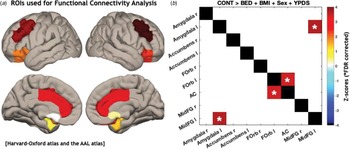
Seed-based FC analysis for selected ROIs representing key nodes of the inhibitory control and reward networks and which have been consistently reported in the BED literature (i.e. orbito-frontal cortex, ACC, nucleus accumbens, dlPFC, and amygdala, Fig. 1a) provided subject-specific seed-to-seed connectivity matrices. FC was calculated as Fisher-transformed bivariate correlation coefficients. Second-level analysis to test for group differences between the BED and control (CONT) groups included the subject-specific connectivity matrices as a dependent variable, group as independent variable and covariates for pubertal status (PDS), gender and BMI. Significance was set at p < 0.05 with correction for 36 (all possible connections between 9 ROIs) multiple comparisons using Benjamini–Hochberg FDR correction at q < 0.05 (Noble, Reference Noble2009). Additional seed-to-voxel FC analyses were performed to reveal whole-brain patterns of connectivity between ROIs within the inhibitory control and reward networks with brain areas in the rest of the brain. Second-level analysis of the seed-to-voxel models mirrored the seed-to-seed model as it evaluated the group differences between the BED and CONT groups, controlling for pubertal status (PDS), gender and BMI as covariates. Significance was set at p < 0.05 with correction for multiple comparisons using false discovery rate (FDR q < 0.05).
Seed-to-seed rs-fMRI analyses comparing pre-adolescent children with binge eating disorder and control pre-adolescent children, while adjusting for BMI and pubertal development. Seed regions included the bilateral amygdala, nucleus accumbens, orbitofrontal cortex (FOrb), dorsolateral prefrontal cortex (MidFG), and the anterior cingulate (AC). Darker red coloring indicates a more positive z-score, and darker blue indicates a more negative z-score (of which there were no significant effects).

Results
Sample demographics
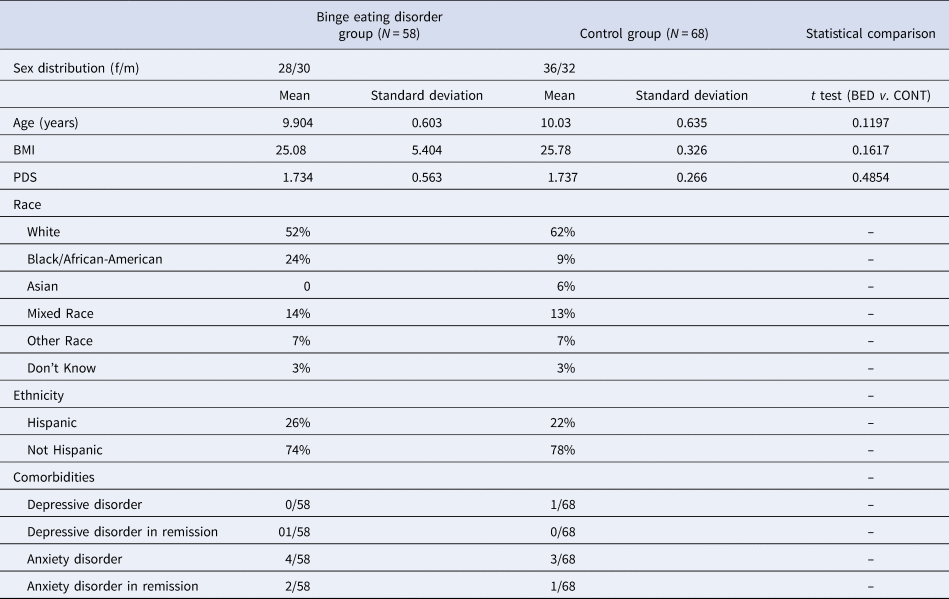
We identified 72 pre-adolescent children with BED diagnoses based on DMS-5 criteria in the baseline visit of the ABCD study. From this sample, 13 were excluded due to incomplete MR data (N = 13) and excessive motion (N = 1), leaving a sample of 58 children in the BED group (28 females; 30 males). We also selected 68 healthy control pre-adolescent children (36 females; 32 males) that matched those with BED in age (p = 0.1197), gender (p = 0.6016), BMI (p = 0.1617) and PDS (p = 0.4854). Table 1 illustrates a detailed characterization of the two cohorts. Among the overall sample, approximately 58% identified as White, 16% as Black, 14% as Mixed Race, 1% as Asian, and 11% as ‘other’. Additionally, 24% of the sample identified as Hispanic. Motion during rs-fMRI was assessed with framewise displacement (FD), revealing no significant difference in the amount of motion between the groups (t = 0.604; p = 0.547).
An overview of sample characteristics from the Adolescent Brain Cognitive Development Study, delineated by group

Seed-to-seed connectivity
Statistical analysis between the BED cohort (BED) and control group cohort (CONT) for specific seed-to-seed connectivity revealed significantly lower connectivity between areas of the inhibitory control and reward network. Specifically, left OFC to ACC, bilateral dlPFC to the bilateral amygdala (Amyg) and right OFC to left dlPFC (Fig. 1b). However, only two of these findings survived correction for multiple comparison: the AC to L-OFC and the L-dlPFC to R-OFC (indicated by the asterisk in Fig. 1b). Notably, all findings indicate differences in between network connectivity, as we found no significant differences for connections between ROIs within the reward or cognitive control network, respectively.
Seed-to-voxel connectivity
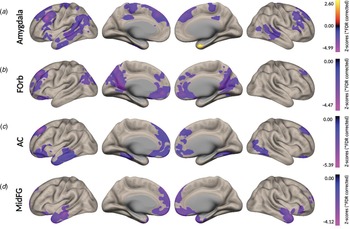
Statistical analysis of the connectivity from each bilateral pair of ROIs to all other voxels in the brain resulted in connectivity patterns indicating widespread hypoconnectivity in the BED group as compared to the CONT group (Fig. 2). For the amygdala seeds, we saw hypo connectivity in the BED group to dlPFC, PCC, superior frontal gyrus (SFG) and temporal lobe. The OFC showed reduced connectivity to PCC, ACC, dlPFC and ventromedial prefrontal cortex (VMPFC). The ACC displayed hypoconnectivity to OFC, SFG, parahippocampal gyrus and inferior temporal gyrus. Finally, the dlPFC exhibited reduced connectivity to OFC, middle temporal gyrus, SFG and IFG. We did not find any significant group differences for the NAcc seed. Hyperconnectivity was observed from one seed region in those with BED, where a small cluster in the temporal pole demonstrated hyperconnectivity with the amygdala.
Seed-to-voxel analyses comparing pre-adolescent children with binge eating disorder and control pre-adolescent children, while adjusting for BMI and pubertal development. Seed regions included (a) the amygdala, (b) the orbitofrontal cortex (FOrb), (c) the anterior cingulate (AC), and (d) the dorsolateral prefrontal cortex (MidFG). Hot colors in red, yellow, and white indicate a more positive z-score, and cooler colors in blue, purple, and pink indicate a more negative z-score. Gray brain areas showed no significant difference between groups.

Discussion
This study examined the functional organization and interaction within and between reward and cognitive control networks in pre-adolescent children with BED, using hypothesis-driven seed-based rsFC analyses. With theoretical and task-evoked neuroimaging evidence suggesting that BED may be characterized by abnormal neural activity in these networks (Gazzillo et al., Reference Gazzillo, Lingiardi, Peloso, Giordani, Vesco, Zanna and Vicari2013; Holliday, Tchanturia, Landau, Collier, & Treasure, Reference Holliday, Tchanturia, Landau, Collier and Treasure2005; Peñas-Lledó et al., Reference Peñas-Lledó, Jiménez-Murcia, Granero, Penelo, Agüera, Alvarez-Moya and Fernández-Aranda2010; Thompson-Brenner et al., Reference Thompson-Brenner, Eddy, Franko, Dorer, Vashchenko, Kass and Herzog2008; Wierenga et al., Reference Wierenga, Ely, Bischoff-Grethe, Bailer, Simmons and Kaye2014), and with one previous study of adult BED noting hypoconnectivity between reward and cognitive control networks (Haynos et al., Reference Haynos, Camchong, Pearson, Lavender, Mueller, Peterson and Lim2021), we examined rsFC within and between reward and cognitive control networks in pre-adolescent children with BED. Contrary to hypotheses, our findings suggest no alterations in FC within reward and cognitive control networks, respectively. However, findings illustrated a diffuse dysconnectivity between nodes of the reward and cognitive control networks in pre-adolescent children with BED, indicating that abnormalities in the functional synergy between reward and cognitive control networks may be evident in BED among children as young as 9 years of age.
Specifically, we noted reduced connectivity between the dlPFC and amygdala, and between the ACC and OFC in pre-adolescent children with BED. These findings illustrating hypoconnectivity between reward and cognitive control networks accord with theoretical models of the psychopathology of BED, which posit a critical interplay between reward and impulse control-related processes (Davis et al., Reference Davis, Levitan, Carter, Kaplan, Reid, Curtis and Kennedy2008). Essentially, it is thought that the increased food intake characteristic of BED typically develops when an increased reward value is placed on food, therefore facilitating a higher drive to eat, and persists over time if this heightened drive cannot be inhibited (Schag et al., Reference Schag, Teufel, Junne, Preissl, Hautzinger, Zipfel and Giel2013b). Our findings replicate recent findings in (i) adults with BED, noting hypoconnectivity between seed regions involved in reward processing, such as the NAcc and dorsal caudate, and prefrontal regions involved in cognitive control, such as the SFG (Haynos et al., Reference Haynos, Camchong, Pearson, Lavender, Mueller, Peterson and Lim2021) and (ii) pre-adolescent children who overeat, noting that eating in the absence of hunger is associated with the FC between the caudate and dlPFC (Shapiro et al., Reference Shapiro, Johnson, Sutton, Legget, Dabelea and Tregellas2019). Crucially, our hypothesis-driven findings extend these earlier findings by implicating additional regions of dysconnectivity between reward and cognitive control regions – namely the (i) dlPFC and amygdala, and (ii) dACC and OFC.
These hypotheses-driven seed-to-seed findings are further supported by exploratory seed-to-voxel whole-brain analyses. These statistically significant and corrected findings suggest broad dysconnectivity between reward and cognitive control circuits, illustrating that the dysconnectivity from (i) the amygdala to regions in the dlPFC and SFG, (ii) the OFC to regions in the dlPFC, ACC, vmPFC and PCC (iii) the ACC to regions in the vmPFC, SFG, and OFC, and (iv) from the dlPFC to regions in the OFC and vmPFC, rank among the most dysconnected of any voxels in the whole brain from these respective seed regions. This broad dysconnectivity between reward and cognitive control networks may have profound implications for the adaptive responding to rewarding cues, which rests on an intricate calibration of approach behaviors and cognitive/behavioral inhibition. The broadly reduced synchronicity of these networks in pre-adolescent children with early-onset BED, and the notion that this dysconnectivity is associated with binge frequency and volume in adults with BED (Haynos et al., Reference Haynos, Camchong, Pearson, Lavender, Mueller, Peterson and Lim2021; Shapiro et al., Reference Shapiro, Johnson, Sutton, Legget, Dabelea and Tregellas2019), suggests that these processes and networks are particularly important targets for treatment efforts among children with BED.
With respect to our assessment of the FC of nodes within the reward network, we found no evidence of dysconnectivity in our sample of pre-adolescent children with BED, relative to weight-matched controls. This accords with previous whole-brain seed-to-voxel analyses in adults with BED, which revealed no altered connectivity patterns within nodes of the reward network, relative to weight-matched controls (Haynos et al., Reference Haynos, Camchong, Pearson, Lavender, Mueller, Peterson and Lim2021). Interestingly, previous studies of FC in individuals reporting binge type behaviors based on BMI classification reveal mixed findings with regard to within reward network FC. For instance, in a study comparing individuals with obesity (some of whom had BED) and individuals without obesity, reduced connectivity was noted in those with obesity between nodes within the basal ganglia reward circuit, including the pallidum, putamen and amygdala, which was negatively correlated with patient weight and binge eating symptoms (Baek et al., Reference Baek, Morris, Kundu and Voon2017). In contrast, food addiction among individuals with obesity has been associated with increased connectivity between nodes within the reward network, relative to individuals without obesity or food addiction (Contreras-Rodriguez et al., Reference Contreras-Rodriguez, Burrow, Pursey, Stanwell, Parkes, Soriano-Mas and Verdejo-Garcia2019; Ravichandran et al., Reference Ravichandran, Bhatt, Pandit, Osadchiy, Alaverdyan, Vora and Gupta2021), and was associated with both the frequency and intensity of general food cravings in individuals with obesity (Ravichandran et al., Reference Ravichandran, Bhatt, Pandit, Osadchiy, Alaverdyan, Vora and Gupta2021). In contrast, FC analyses in adults without obesity and children who report binge eating (Oliva, Morys, Horstmann, Castiello, & Begliomini, Reference Oliva, Morys, Horstmann, Castiello and Begliomini2020) and overeating (Shapiro et al., Reference Shapiro, Johnson, Sutton, Legget, Dabelea and Tregellas2019) episodes, respectively, have revealed non-disturbed FC within the reward network (Oliva et al., Reference Oliva, Morys, Horstmann, Castiello and Begliomini2020), raising the interesting possibility that reward network functional abnormalities may be gated by bodyweight among those who engage in binge type behaviors. Standalone alterations in FC of the reward network have been well demonstrated among individuals with obesity, irrespective of the presence of binge eating (Syan et al., Reference Syan, McIntyre-Wood, Minuzzi, Hall, McCabe and MacKillop2021), and recent machine learning efforts have outlined a robust obesity FC phenotype involving hyperconnectivity within the reward network, which correlates with body mass, waist circumference, and waist-to-hip ratio (Park et al., Reference Park, Byeon, Lee, Chung, Kim, Morys and Park2020). Since controls in the present study were BMI-matched, it is noteworthy that reward network FC in overweight pre-adolescent children with BED was not discrepant from that of overweight pre-adolescent children without BED.
With respect to the hyperconnectivity between the amygdala and a small cluster in the temporal pole among individuals with BED, this finding warrants further investigation. The temporal pole has been described as an enigmatic brain region, which is incompletely understood both in terms of function and cytoarchitectonic structure (Olsen, Plotzker, & Ezzyat, Reference Olsen, Plotzker and Ezzyat2007; Pascual et al., Reference Pascual, Masdeu, Hollenbeck, Makris, Insausti, Ding and Dickerson2015), and its role in the psychopathology of BED remains unclear. However, with evidence suggesting functional and structural projections to the amygdala and OFC (Olsen et al., Reference Olsen, Plotzker and Ezzyat2007), further research ought to investigate how neural activity within the temporal pole relates to BED symptomatology.
With respect to connectivity within cognitive control networks, we found no evidence of dysconnectivity in BED. This echoes findings from previous studies of BED (Baek et al., Reference Baek, Morris, Kundu and Voon2017; Haynos et al., Reference Haynos, Camchong, Pearson, Lavender, Mueller, Peterson and Lim2021), and several studies assessing FC and overeating in populations both with and without obesity. Notably, one previous study of restrained eaters noted diminished inter-hemispheric dlPFC FC, relative to non-restrained eaters, which was associated with greater binge-type eating symptoms (Chen, Dong, Jackson, Su, & Chen, Reference Chen, Dong, Jackson, Su and Chen2016). While the present study did not assess inter-hemispheric FC, our findings suggesting that inter-node connectivity within cognitive control networks is not fundamentally disturbed in individuals with BED, relative to weight-matched controls. This accords with studies demonstrating comparable performance in neuropsychological tests of inhibitory control among women with obesity, with and without BED (Bub, Robinson, & Curtis, Reference Bub, Robinson and Curtis2016; Kollei et al., Reference Kollei, Rustemeier, Schroeder, Jongen, Herpertz and Loeber2018; Manasse et al., Reference Manasse, Forman, Ruocco, Butryn, Juarascio and Fitzpatrick2015). However, even in the context of comparable task performance on measures of inhibitory control, some studies have noted distinct neural activity in prefrontal regions among individuals with obesity who also have BED, relative to individuals with obesity who do not have BED, and control individuals without obesity (Balodis et al., Reference Balodis, Kober, Worhunsky, White, Stevens, Pearlson and Potenza2013a, Reference Balodis, Molina, Kober, Worhunsky, White, Sinha and Potenza2013b), suggesting divergent neural substrates underpinning inhibitory control. Our findings suggest that any functional atypicality in neural activity among those with BED during tasks of inhibitory control do not stem from alterations in FC within the cognitive control network. However, with studies illustrating reliable differences in cognitive control between individuals with and without obesity (Liang, Matheson, Kaye, & Boutelle, Reference Liang, Matheson, Kaye and Boutelle2014; Skoranski et al., Reference Skoranski, Most, Lutz-Stehl, Hoffman, Hassink and Simons2013), it is noteworthy that both cohorts in the present study had obesity. A crucial next step lies in parsing functional differences among individuals with BED across the weight spectrum.
Strengths of the present study include the relatively large sample size, which is among the largest neuroimaging studies of pediatric BED to date, and the use of a control sample that was tightly matched on gender, age, pubertal development and BMI. Additionally, the focus on pre-adolescent BED offers important insights on the mechanistic underpinnings of early-onset BED, which has been seldom studied. With much evidence noting the benefits of early intervention for ED (Allen et al., Reference Allen, Mountford, Brown, Richards, Grant, Austin and Schmidt2020; Brown et al., Reference Brown, McClelland, Boysen, Mountford, Glennon and Schmidt2016), an explication of the precise mechanisms underpinning pediatric BED may help mitigate the suite of deleterious outcomes associated with its longer-term course (Mitchell, Reference Mitchell2015; Wassenaar, Friedman, & Mehler, Reference Wassenaar, Friedman and Mehler2019). Relatedly, and owing to the centrality of impulse control in theoretical models of BED (Davis et al., Reference Davis, Levitan, Carter, Kaplan, Reid, Curtis and Kennedy2008; Gazzillo et al., Reference Gazzillo, Lingiardi, Peloso, Giordani, Vesco, Zanna and Vicari2013; Holliday et al., Reference Holliday, Tchanturia, Landau, Collier and Treasure2005; Peñas-Lledó et al., Reference Peñas-Lledó, Jiménez-Murcia, Granero, Penelo, Agüera, Alvarez-Moya and Fernández-Aranda2010; Thompson-Brenner et al., Reference Thompson-Brenner, Eddy, Franko, Dorer, Vashchenko, Kass and Herzog2008; Wierenga et al., Reference Wierenga, Ely, Bischoff-Grethe, Bailer, Simmons and Kaye2014), our assessment of pre-adolescent children accounted for developmental maturation, which is critical given the potentially discrepant development of the late-maturing PFC.
Limitations of the present study are also noteworthy, and findings should be interpreted with appropriate caution. First, and owing to the nature of the parent ABCD dataset, no dimensional measure of ED symptomatology was included. It is critical that future studies investigate how these patterns of functional dysconnectivity relate to ED symptoms among those with BED. Second, our findings relating to pre-adolescent children with BED cannot necessarily be seamlessly extrapolated to adults with BED. Owing to our cross-sectional design, it is unclear whether the dysconnectivity we observed represents a pathway through which BED develops and extends into adulthood, or whether this represents an age-specific abnormality which resolves upon further maturation of the regions implicated in reward and inhibitory control. Indeed, the natural remission of loss of control eating has been documented in more than half of all pre-adolescent children demonstrating this behavior (Hilbert et al., Reference Hilbert, Hartmann, Czaja and Schoebi2013), and so further investigation may seek to model this trajectory of dysconnectivity in BED throughout later adolescence. Third, food consumption prior to scanning was unknown. With evidence suggesting that neural activity in those with ED, and particularly in reward-related regions, may differ during sated and hungry states (Ely et al., Reference Ely, Wierenga, Bischoff-Grethe, Bailer, Berner, Fudge and Kaye2017; Kaye et al., Reference Kaye, Wierenga, Bischoff-Grethe, Berner, Ely, Bailer and Fudge2020), the inability to control for pre-scan food consumption and hunger levels may impact the generalizability of the findings. In addition, the variability in BMI among those with BED in our sample was wide, whereas the variability among those in our control sample was narrow. This means that a potentially disparate sample (in terms of BMI) of individuals with BED were compared to a highly circumscribed sample of control individuals. Further research may seek to parse the effect of patient weight upon FC patterns among those demonstrating BED and binge eating behaviors, given the variable findings among individuals with and without obesity (Baek et al., Reference Baek, Morris, Kundu and Voon2017; Oliva et al., Reference Oliva, Morys, Horstmann, Castiello and Begliomini2020; Ravichandran et al., Reference Ravichandran, Bhatt, Pandit, Osadchiy, Alaverdyan, Vora and Gupta2021; Shapiro et al., Reference Shapiro, Johnson, Sutton, Legget, Dabelea and Tregellas2019). Lastly, children were not administered the ED-focused module of the diagnostic interviews, and diagnoses were therefore based on parental reports. With evidence suggesting discordance between child and parental reports of eating behaviors (Steinberg et al., Reference Steinberg, Tanofsky-Kraff, Cohen, Elberg, Freedman, Semega-Janneh and Yanovski2004; Tanofsky-Kraff, Yanovski, & Yanovski, Reference Tanofsky-Kraff, Yanovski and Yanovski2005), this represents a limitation.
Notwithstanding, these findings offer novel insights into the neural architecture of early-onset BED, and suggest that rather than inherent FC abnormalities within reward and cognitive control networks, early-onset BED may be characterized by abnormalities in the functional synchrony between reward and cognitive control networks. Future research may extend these findings by assessing FC patterns during disorder-relevant tasks, and by carefully explicating the relationship between FC patterns and clinical variables in those with BED.
Financial support
S. B. M. is supported by the Della Martin Endowed Professorship, and the National Institute of Mental Health (K23MH115184). J. M. N. was funded by the National Heart, Lung, and Blood Institute (K08HL159350) and the American Heart Association (CDA34760281). R. P. C. is supported by the Chan Zuckerberg Initiative (2020-225670). S. J. S. is supported by Astellas. Additional Information: The ABCD Study was supported by the National Institutes of Health and additional federal partners under award numbers U01DA041022, U01DA041025, U01DA041028, U01DA041048, U01DA041089, U01DA041093, U01DA041106, U01DA041117, U01DA041120, U01DA041134, U01DA041148, U01DA041156, U01DA041174, U24DA041123, and U24DA041147. A full list of supporters is available at https://abcdstudy.org/nihcollaborators. A listing of participating sites and a complete listing of the study investigators can be found at https://abcdstudy.org/principal-investigators.html. ABCD consortium investigators designed and implemented the study and/or provided data but did not necessarily participate in the analysis or writing of this report.
Financial disclosures
S. B. M. receives royalties from Oxford University Press, Routledge, and Springer. J. M. N. receives royalties from Springer. S. J. S. is a Consultant to Zynerba, and an Advisor to Skyland Trail.
Conflict of interest
The authors all declare that they have no competing interests.
Ethical standards
The authors assert that all procedures contributing to this work comply with the ethical standards of the relevant national and institutional committees on human experimentation and with the Helsinki Declaration of 1975, as revised in 2008.