1. Introduction
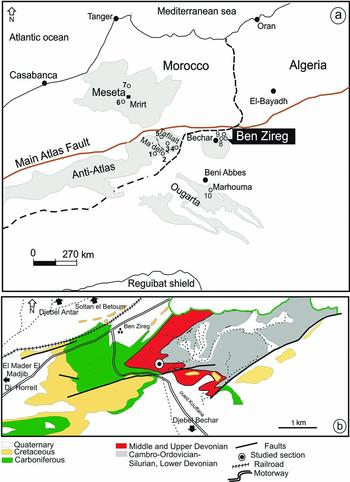
The Ben Zireg area at 50 km NE of Bechar township constitutes the north-easternmost exposure of Saharan Palaeozoic deposits adjacent to the Main Atlas Fault. They differ from all neighbouring outcrops of the Bechar basin, such as Soltane el Betoum and Maider el Mhadjib to the north and west of Djebel Antar (Weyant, Reference Weyant1988) (Fig. 1a), in comprising a well-exposed, almost complete, succession of Cambro-Ordovician – early Carboniferous marine sediments. As such, the Ben Zireg section is a reference for the northern margin of epi-continental Sahara in SW Algeria, at 200 km from the Palaeozoic sediments of the Ougarta region further to the south (Fig. 1a). A major description of the structure and stratigraphy by Pareyn (Reference Pareyn1961) was mainly devoted to Carboniferous sediments; apart from a few other scattered Devonian (Frasnian in particular) stratigraphic data, this area has remained largely unstudied in terms of biostratigraphical subdivision and sedimentary development.
Main Palaeozoic outcrops in NW Africa. (a) location of selected Frasnian sites: 1, Bou Terga; 2, Jebel Atrous II; 3, Bou Thrafine; 4, Ouidane Chebbi; 5, Oued Rheris; 6, Anajdam; 7, Bou Alzaz nord; 8, El Mader el Madjib; 9, Soltane el Boutoum; 10, South Mahrouma; and (b) investigated section in the Ben Zireg anticline (after Pareyn, Reference Pareyn1961).

After the first recognition of Devonian fossils at Ben Zireg by G.B.M. Flamand (unpub. thesis, University of Lyon, 1911), Menchikoff (Reference Menchikoff1936) established the existence of Late Devonian series based on cephalopods. Among them, Pharciceras was considered at that time representative of the early Frasnian period. However, this taxon is now restricted to the latest Givetian period since the definition of Frasnian stage boundaries by SDS/IUGS (Klapper, Feist & House, Reference Klapper, Feist and House1987; Klapper et al. Reference Klapper, Feist, Becker and House1993). The presence of Frasnian strata was definitely established when Massa, Combaz & Manderschied (Reference Massa, Combaz and Manderschied1965) recovered the first conodonts, notably Ancyrognathus asymmetricus and Ancyrodella curvata.
Since then, and in contrast to numerous conodont-based biostratigraphical investigations in the neighbouring Tafilalt area (e.g. Belka et al. Reference Belka, Klug, Kaufmann, Korn, Döring, Feist and Wendt1999), no more work has been carried out to evaluate the extent and completeness of the lower Upper Devonian sediments in the Algerian part of northern Sahara.
This study aims to provide fine-scaled conodont biostratigraphy and biofacies. The sedimentary dynamics of the Ben Zireg section emphasizes the importance of its pivotal position between Frasnian sections on both sides of the Main Atlas Fault, that is, the allochthonous Hercynian Meseta of Central Morocco and its eastern prolongation into the Algerian Hercynian Tifrit Horst, and cratonic Gondwana sections in both SW Algeria (Marhouma) and Tafilalt/Maider in SE Morocco (Fig. 1a).
2. Geological setting
In contrast to Palaeozoic rocks north of the alpine Main Atlas Fault, which were affected by complex tangential tectonics and deformation during the Variscan Irogeny (e.g. Allary, Lavenu & Ribeyrolles, Reference Allary, Lavenu and Ribeyrolles1976), the Palaeozoic deposits of the western Sahara platform north of the Precambrian Reguibat shield (Fig. 1a) were generally only weakly deformed to create wide synclinal and narrower anticlinal structures. Devonian sedimentation rates reflect basin- and ridge-dependent depositional environments (Elmi & Ameur, Reference Elmi and Ameur1984; Conrad, Massa & Weyant, Reference Conrad, Massa and Weyant1986; Wendt et al. Reference Wendt, Kaufmann, Belka, Klug and Lubeseder2006). Exposures of the NE Bechar basin close to the Atlas Fault are more intensely folded to form narrow E–W-trending anticlinal structures, often over-thrusted to the north. These features, along with the occurrence of synorogenic wildflysch sediments with olistolites of various ages characterizing the Dinantian of Ben Zireg (Pareyn, Reference Pareyn1961), might indicate dynamic relations to the Maghrebian Variscan belt in the north.
In this context, the Ben Zireg Palaeozoic rocks form an acute, narrow anticlinal structure with subvertical axial plane, opening to the ENE under 50°, before being unconformably covered by continental Permo-Triassic sediments and marine Liassic and Cenomanian–Turonian deposits (Fig. 1b). The structure is crossed by numerous vertical faults that run subparallel to the Main Atlas Fault, also affecting the Cretaceous cover, and may belong to the alpine transform system. The eastern end of the structure is framed by a prominent ridge of some 200 m of Middle–Late Devonian carbonates, easily accessible from the south where the road from Ben Zireg station to Taghit runs along the Oued Ben Zireg shortly before it bends to the south (Fig. 1b). The investigated Frasnian section is situated on the steep southern flank of the Devonian ridge along a southerly directed, deeply incised gorge (coordinates 31°54′39.4″N, 001°47′58.8″W, Fig. 1b).
3. Material and methods
One single section was logged in detail and 37 oriented samples were taken both for sedimentological investigations and conodont research. Thin slices from all samples were cut to investigate the corresponding microfacies. Microfacies were determined by using optical observations with a photonic microscope. Depositional settings result in zonations proposed by Wright & Burchette (Reference Wright, Burchette and Reading1996) and Flügel (Reference Flügel2004). Noticeable is a general recrystallization of micrite into microsparite in all samples, and the presence of pressure-dissolution surfaces indicative of a discrete cleavage. These features are related to the Variscan deformation and do not allow observations of the primary matrix of the rocks.
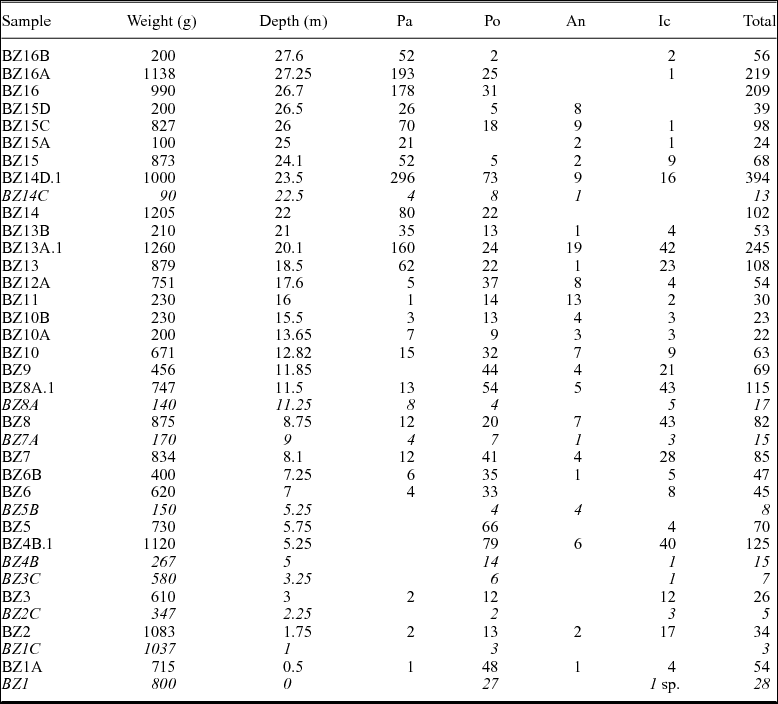
For conodont extraction, the calcareous samples were dissolved in 10% acetic acid. Sulphuric acid (10%) was used to dissolve iron-hydroxide and pyrite-rich samples (beds BZ1A, 1C and BZ2). The insoluble residue was then rinsed through two sieves (1 mm and 100 μm). Residues smaller than 1 mm were dried and handpicked using a stereomicroscope. Specimens were photographed with SEM (JEOL 5600). All platform (P1) elements were picked (2660 elements; Table 1). The limestone samples yielded relatively abundant conodont elements (mean of 115 kg−1). Some of these elements were identified at the specific level for biostratigraphy. In this paper the biostratigraphic zonations are those of Klapper (Reference Klapper, McMillan, Embry and Glass1989, Reference Klapper2007a , Reference Klapper b ) and lowermost Famennian biostratigraphic zonation is that of Schülke (Reference Schülke1999). Figured conodont specimens are housed in the collections of the University of Montpellier and are labelled UM-BZA-01 to 23.
Numbers of platform conodont genera at the Ben Zireg section. The low conodont abundances (<20P1) in italic are not included in the biofacies analyses. Pa – Palmatolepis; Po – Polygnathus and Linguipolygnathus (BZ1 only); An – Ancyrodella and Ancyrognathus; Ic –Icriodus.

Among the platform P1 elements, different genera can be recognized that are assumed to have different ecological preferences (e.g. Seddon & Sweet, Reference Seddon and Sweet1971; Sandberg, Reference Sandberg and Barnes1976). The changing distribution patterns of conodont abundance (called biofacies) in space and time can therefore provide some information about the depositional environment. The biofacies is named after the one or two most-abundant genera, and trends in the variations of the relative proportion of the different genera are assumed to provide indirect water depth proxy through time.
During the Frasnian period, five conodont genera dominated the assemblages. Icriodus is considered as characteristic of shallow environments, whereas Palmatolepis should prefer deeper conditions. Ancyrodella and Ancyrognathus are grouped under the term ancyrodellids. Together with Polygnathus they are considered as ubiquitous, with a slight preference for deep environments for Polygnathus while ancyrodellids would prefer shallow environments (Sandberg et al. Reference Sandberg, Ziegler, Dreesen and Butler1992; Sobstel, Makowska–Haftka & Racki, Reference Sobstel, Makowska–Haftka and Racki2006). The variations of relative abundances of these five different genera were investigated through the Ben Zireg section. The relative abundances of the four groups (Palmatolepis, Icriodus, Polygnathus and ancyrodellids) are provided as a percentage of the total assemblage.
4. Results
4.a. Lithostratigraphy
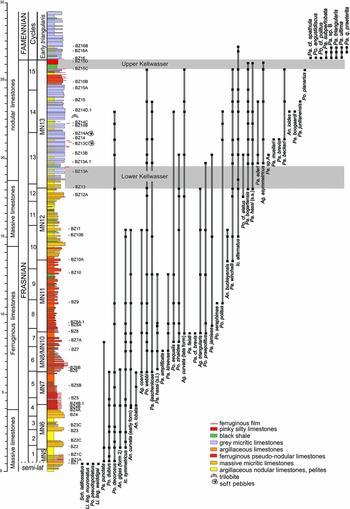
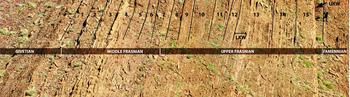
The Frasnian deposits at Ben Zireg section are 26.5 m thick between sample BZ1 (Givetian) and sample BZ16 (early Famennian) (Fig. 2). Sedimentary rocks display a rhythmic pattern characterized by centimetre- to decimetre-thick alternations (couplets) of hard, fine-grained limestones and softer, argillaceous fine-grained limestones or claystones. In the field, these alternations clearly display a rather constant organization which indicates sedimentary cycles and subcycles (Fig. 3). Sedimentary cycles are limited at the top and bottom by thick, argillaceous carbonates or dark claystones. Around 20 couplets are generally found between these, organized into four lithological subcycles (each composed of five couplets). Sedimentary subcycles are defined by rhythmic facies and bed-thickness changes. In the present-day, it is not possible to assign a clear significance to these sedimentary cycles. The Frasnian deposits comprise 15 sedimentary cycles. From bottom to top, a general increase in thickness of sedimentary cycles is observed through the Frasnian deposits: cycles 1–9, 11 and 12 are 1 to 2 m thick, while cycles 10 and 13–15 are 2.5–3.5 m thick.
Stratigraphic log with sedimentary cycles, Kellwasser events and distribution of conodont species in the Givetian, Frasnian and lowermost Famennian deposits at Ben Zireg section, Bechar basin. An – Ancyrodella; Ag – Ancyrognathus; Pa – Palmatolepis; Li – Linguipolygnathus; Po – Polygnathus; Ic – Icriodus; ling – linguiformis linguiformis (gamma morphotype); q – quadrantinodosalobata; s.l. – sensu lato; s.t. – sensu stricto; LKW – Lower Kellwasser; UKW – Upper Kellwasser; MN – Montagne Noire Zone.

Exposure of the Ben Zireg Givetian–Famennian succession, showing 15 sedimentary cycles. The Frasnian–Famennian boundary is located above the Upper Kellwasser horizon, and coincides with the top of cycle 15. The scale is given by B. Meyer-Berthaud, 1.55 m tall, upper right.

The facies are rather homogenous with rare macrofossil remains, but slight differences can be depicted as follows (from bottom to top).
-
1) Above sample BZ1 is a centimetre-thick crust of iron-hydroxide. Between 0.6 and 4 m above the base of the section, centimetre- to decimetre-thick massive, greyish to brownish, micritic limestones and centimetre- to decimetre-thick argillaceous limestones alternate. The first beds above the hard-ground are cherty and ferruginous (BZ1B). The massive limestones are tentaculite-rich wackestones. The top of some beds may be coated with iron-hydroxides. Limestones display a discrete nodular structure and some pyrite crystals.
-
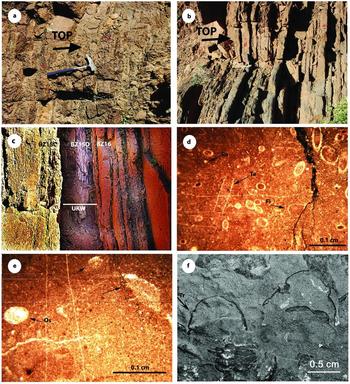
2) Between 4 and 10.7 m above the base of the section, ferruginous limestones and argillaceous limestones (Fig. 4a) alternate. Ferruginous limestones display a pronounced pseudo-nodular structure underlined by iron-hydroxide films around micritic nodules due to the pressure-dissolution process of tectonic origin or/and bioturbation (also referred to as bioerosion; Elmi & Ameur, Reference Elmi and Ameur1984). Limestones are mudstones to wackestones with tentaculites (Fig. 4d), some entomozoan crustaceans and pelagic molluscs (‘filaments’). Pyrite crystals are present and sparse phosphate grains occur. Most of the beds are covered with thin iron-hydroxide coatings. Argillaceous limestones also display nodular structure and iron-hydroxide films.
Figure 4.Upper Devonian facies types of Ben Zireg section (Algeria). Os – benthic ostracods; Tr – trilobite; Ra – radiolarian; Te – tentaculite (Homoctenus); Fi - Filaments. (a) View of the ferruginous limestone unit (7th cycle). (b) View of the thin- to thick-bedded grey nodular limestone (13th cycle). (c) Upper Kellwasser horizon (UKW) composed of a lower part with black shales (to the left) and an upper part of pinkish calcisiltites (BZ15D). BZ16 corresponds to the lowermost Famennian bed. The UKW is 0.65 m thick. (d) Tentaculite wackestone (Bed BZ6C, MN Zone 8). (e) Ostracod mudstone with unsculptured benthic specimens (Bed BZ13A, MN Zone 13). (f) Surface of mudstone slab with trilobite sclerites of Acuticryphops acuticeps (Kayser, Reference Kayser1889). Pointed glabella and reduced size of eye-lobe with few prominent lenses (arrow) are characteristic (Bed BZ14D, MN Zone 13).

-
3) Between 10.7 and 15.5 m above the base of the section, massive and argillaceous limestones are found. These are bioturbated mudstones with rare pelagic organisms (tentaculites, entomozoan crustaceans and pelagic molluscs). They also yield foraminifers in residues obtained for conodont extraction. Some centimetre-thick blackish shales are also interbedded.
-
4) Between 15.5 and 19.5 m above the base of the section are massive, greyish pseudo-nodular limestones. These are mudstones with some pelagic organisms (tentaculites, entomozoan crustaceans and pelagic molluscs) and some benthic ostracods (Fig. 4e).
-
5) Between 19.5 and 26.5 m above the base of the section deposits are dominantly pinkish to greyish pseudo-nodular limestones and interbedded argillaceous micrites (Fig. 4b). Limestones are tentaculite mudstones with some entomozoan crustaceans, pelagic molluscs and goniatites. They also yielded rare benthic ostracods, foraminifers and rare fragments of brachiopods and trilobites; the latter exclusively occur in dish-like flattened mud pebbles occurring on the surface of a single bed (Bed 14D with Acuticryphops acuticeps; Fig. 4f). The uppermost part of the Frasnian deposits consists of a 30-cm-thick black shale level overlain by a 35 cm bed of plane-laminated, grain-sorted, pinky calcisiltite between samples BZ15C and BZ16 (Fig. 4c). The significance of this reddish calcisiltite remains unknown. It could have resulted from turbidite current activity, carrying detrital carbonates and iron oxides of possibly continental origin into the offshore domain.

4.b. Biostratigraphy
The first level (BZ1) yields Linguipolygnathus linguiformis linguiformis (gamma morphotype), Li. linguiformis mucronatus, Li. linguiformis weddigei, Po. pseudofoliatus and Schmidtognathus latifossatus. This association indicates an age from the base of the latifossatus (topmost middle Givetian) through the top of the cristatus-ectypus Zone (upper Givetian) (Aboussalam, Reference Aboussalam2003) (Figs 2 and 5).
Significant conodonts from the Ben Zireg section. (a) Ancyrodella gigas Youngquist, Reference Youngquist1947 form 2 (UM-BZA-01) (Bed BZ2); (b) Polygnathus pseudofoliatus Wittekindt, Reference Wittekindt1966 (UM-BZA-02) (Bed BZ1); (c) Linguipolygnathus linguiformis linguiformis (Hinde, Reference Hinde1879) (gamma morphotype after Bultynck, Reference Bultynck1970) (UM-BZA-03) (Bed BZ1); (d, e) Schmidtognathus latifossatus Wirth, Reference Wirth1967; upper and lower views (UM-BZA-04) (Bed BZ1); (f) Linguipolygnathus linguiformis weiddigei (Clausen, Leuteritz & Ziegler, Reference Clausen, Leuteritz and Ziegler1979) (UM-BZA-05) (Bed BZ1); (g) Linguipolygnathus linguiformis mucronatus (Wittekindt, Reference Wittekindt1966) (UM-BZA-06) (Bed BZ1); (h) Polygnathus decorosus Stauffer, Reference Stauffer1938 (UM-BZA-07) (Bed BZ1); (i) Ancyrognathus triangularis Youngquist, Reference Youngquist1945 (UM-BZA-08) (Bed BZ11); (j) Palmatolepis kireevae Ovnatanova, Reference Ovnatanova1976 (UM-BZA-09) (Bed BZ8); (k) Palmatolepis ljaschenkoae Ovnatanova, Reference Ovnatanova1976 (UM-BZA-10) (Bed BZ6); (l) Ancyrognathus coeni Klapper, Reference Klapper1990 (UM-BZA-11) (Bed BZ11); (m) Palmatolepis feisti Klapper, Reference Klapper2007a (UM-BZA-12) (Bed BZ8); (n) Ancyrodella curvata (Branson & Mehl, Reference Branson and Mehl1934) early form (UM-BZA-13) (Bed BZ5B); (o) Palmatolepis punctata (Hinde, Reference Hinde1879) (UM-BZA-14) (Bed BZ2); (p); Palmatolepis jamieae (UM-BZA-15) (Bed BZ10B); (q) Palmatolepis bogartensis (Stauffer, Reference Stauffer1938) morphotype B, Klapper (Reference Klapper2007b ) (UM-BZA-16) (Bed BZ13); (r) Palmatolepis boogaardi Klapper & Foster, Reference Klapper and Foster1993 (UM-BZA-17) (Bed BZ14D.1); (s) Palmatolepis hassi Müller & Müller, Reference Müller and Müller1957 (UM-BZA-18) (Bed BZ6B), s. l. after Bultynck, Helsen & Hayduckiewich Reference Bultynck, Helsen and Hayduckiewich1998; (t) Palmatolepis ultima Sannemann, Reference Sannemann1955 (UM-BZA-19) (Bed BZ16); (u) Palmatolepis winchelli Stauffer, Reference Stauffer1938 (UM-BZA-20) (Bed BZ10A); (v) Palmatolepis cf. spathula Schülke, Reference Schülke1995 (UM-BZA-21) (Bed BZ16); (w) Palmatolepis triangularis Sannemann, Reference Sannemann1955 (UM-BZA-22) (Bed BZ16); and (x) Palmatolepis subperlobata Branson & Mehl, Reference Branson and Mehl1934 (UM-BZA-23) (Bed BZ16).

The following level BZ1A indicates MN Zone 5 due to the occurrence of Palmatolepis punctata. This level coincides with the base of the middle Frasnian stage (Becker & House, Reference Becker and House2000a ). Polygnathus dubius and Po. decorosus also occur within this zone.
The MN Zone 6 is identified with the entry of Ancyrodella gigas form 2 in bed BZ2. Icriodus symmetricus, Po. decorosus and Po. dubius are also present in this zone.
The occurrences of both An. lobata and An. curvata (early form) in bed BZ4B.1 mark the base of the MN Zone 7.
The undifferentiated MN Zones 8–10 are identified by the co-occurrence of Pa. hassi (sensu lato) (after Bultynck, Helsen & Hayduckiewich, Reference Bultynck, Helsen and Hayduckiewich1998), Ag. coeni and Pa. ljaschenkoae together with Pa. kireevae from bed BZ6 to bed BZ7A. The conodont association is completed by Pa. amplificata in bed BZ7 and Po. zinaidae and Po. aequalis in bed BZ7A.
The base of the MN Zone 11 is defined by the first occurrence of the marker Pa. feisti in bed BZ8 and corresponds to the base of the upper Frasnian substage (Becker & House Reference Becker and House1998).
The presence of the MN Zone 12 is attested in bed BZ12A with the first appearance of Pa. winchelli, index-species of the zone.
The presence of the marker Pa. bogartensis in bed BZ13 allows the base of MN Zone 13 to be determined. The level BZ13A.1 yields Pa. ederi and Ag. asymmetricus, and Pa. brevis and Pa. boogaardi occur in bed BZ14. The co-occurrence of Pa. beckeri and Pa. juntianensis is recorded in bed BZ15 at MN Zone 13.
The occurrences of Pa. ultima and Pa. triangularis in Bed BZ16 indicate the Famennian stage (early triangularis Zone) (Klapper, Reference Klapper2007b ). Other species present are Pa. subperlobata, Pa. sp. B, Pa. quadrantinodosalobata praeterita, Po. angustidiscus, Po. cf. politus and Ic. alternatus. In our record, Pa. cf. spathula occurs slightly before the first known appearance of Pa. spathula (late triangularis zone; Schülke, Reference Schülke1999).
4.c. Temporal calibration of terminal Frasnian black shales
Temporary dysoxic events are recorded by several thin intervals of black shale deposits that occur throughout the section, especially at the top of the succession where a 30-cm-thick discrete black shale level (between BZ15C and 15D) is developed. The Lower Kellwasser is known to occur at the boundary between MN Zone 12 and MN Zone 13 (Girard & Renaud, Reference Girard and Renaud2007). At Ben Zireg the Lower Kellwasser event is located at the end of sedimentary cycle 12 and the beginning of cycle 13, coinciding with the entry of the marker Palmatolepis bogartensis. It is not defined by a distinct horizon, but rather constitutes a 2-m-thick succession of dark micritic limestones and few black shales. The percentage of Icriodus elements increases in this interval (Fig. 6). The Upper Kellwasser horizon, comprising black shale deposits in its lower part and reddish calcisiltites in its upper part (BZ15C and D) at Ben Zireg, represents the uppermost part of MN Zone 13 before being superseded by basal Famennian strata (BZ16). As the most basal part of the lower triangularis Zone has not been established, a small depositional gap might exist. This gap might be related to a sea-level instability, materialized by the pinkish detrital level. Such instabilities are often recorded at the top of the Upper Kellwasser horizon event (i.e. Girard & Renaud, Reference Girard and Renaud2007; Schindler, Reference Schindler1990).
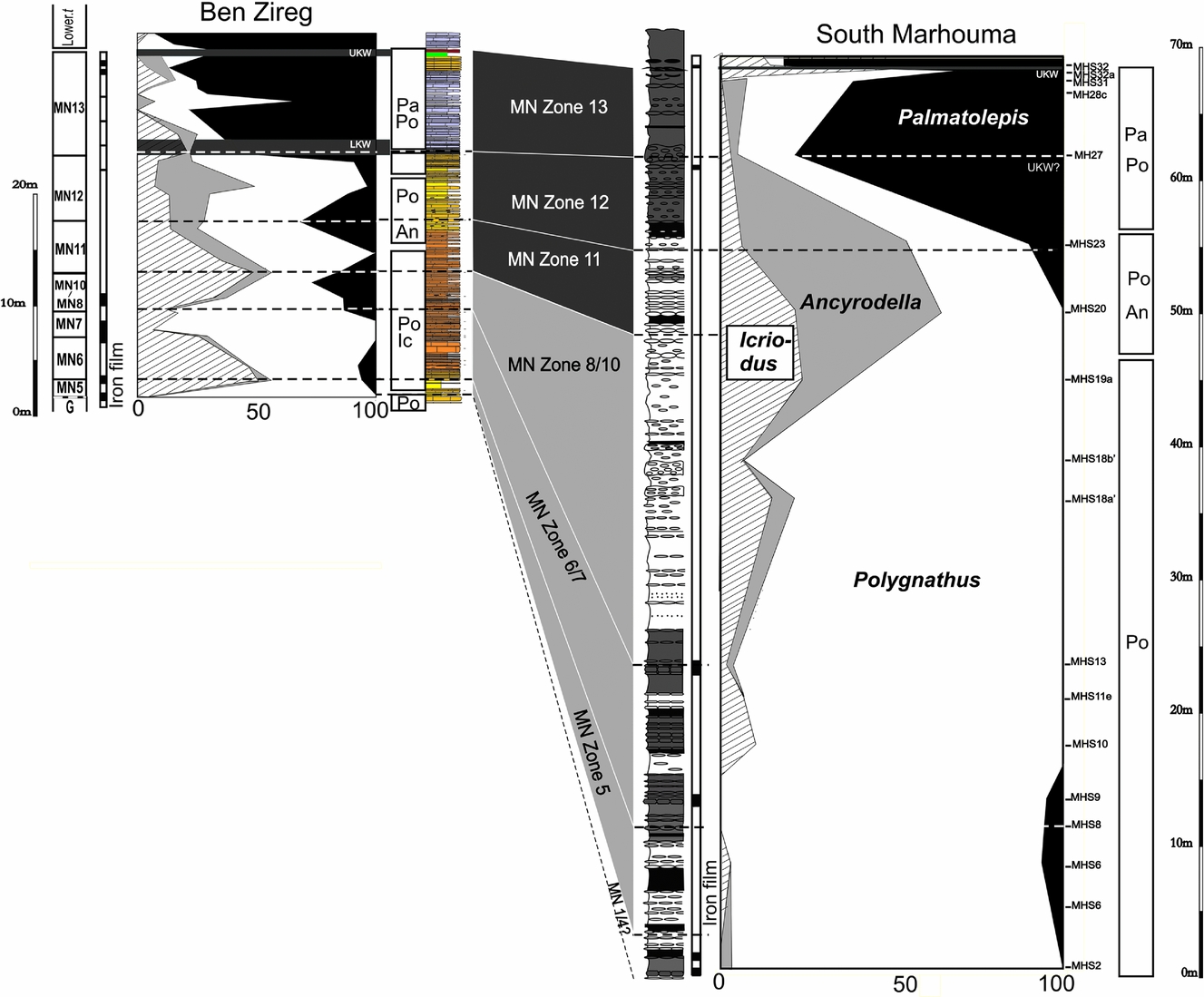
Percentage of conodont genera at Ben Zireg (left) and the South Marhouma section (right), and fine-scaled correlation between these sections based on the detailed biostratigraphical frame. Po – polygnathid biofacies; Po-Ic – polygnathid-icriodid biofacies; Po-An – polygnathid-ancyrodellid biofacies; Pa-Po – palmatolepid-polygnathid biofacies; G – Givetian, t. – triangularis.

4.d. Biofacies
Numerous studies using the biofacies approach were performed on Frasnian deposits from very different parts of the world, showing that the assemblages were dominated by Polygnathus during early–middle Frasnian time and then by Palmatolepis during late Frasnian time (e.g. Morocco: Lazreq, Reference Lazreq1999; China: Ji & Ziegler, Reference Ji and Ziegler1993; USA: Sandberg, Pool & Johnson, Reference Sandberg, Poole, Johnson, McMillan, Embry and Glass1989; Russia: Ovnatanova, Kuzmin & Menner, Reference Ovnatanova, Kuzmin and Menner1999). At Ben Zireg, three biofacies have been distinguished from bottom to top (Fig. 6): polygnathid-icriodid, polygnathid-ancyrodellid and palmatolepid-polygnathid. Several peaks of Icriodus occur successively in MN Zone 5 and through MN zones 8–10. Ancyrodellids were never dominant, but their percentage reached more than 20% of the assemblage at the end of MN Zone 11 and during MN Zone 12.
The change from relatively shallow-water polygnathid-icriodid and polygnathid-ancyrodellid to deep-water palmatolepid-polygnathid biofacies through the Frasnian sediments correlates with the conclusions of Johnson, Klapper & Sandberg (Reference Johnson, Klapper and Sandberg1985) and the globally observed trends in conodont biofacies.
5. Interpretation and discussion
5.a. Biostratigraphy and depositional environment
The fine-scaled conodont stratigraphy in the Ben Zireg section bears witness to a stratigraphic hiatus at the base of the section. Between beds BZ1 (late Givetian) and BZ1A (middle Frasnian), the gap extends at least from the top of the cristatus-ectypus Zone to the base of MN Zone 5. However, it could begin earlier at the top of the latifossatus Zone at the oldest. The underlying bed (BZ1) yields a Givetian, probably topmost of the middle Givetian, conodont association (semialternans Zone) where no typical Frasnian elements occur. The presence of Givetian deposits at Ben Zireg is emphasized by the occurrence of Pharciceras mentioned by Menchikoff (Reference Menchikoff1936). As the superseding bed (BZ1A) already yields Pa. punctata, the deposits of early Frasnian age are missing (i.e. MN Zones 1–4).
The interval of MN Zones 5–10 is only 9 m thick, attesting to severe condensation of deposits under slow sedimentation rates. Conversely, sedimentation rates increased considerably thereafter. Indeed, sedimentary cycles 10–15 comprise an interval of 17 m in thickness that represents two-thirds of the entire Frasnian deposits. The sedimentary cycles increase in importance from the bottom to the top of the section. Deposits of MN Zone 13 reach a thickness of 9 m that correspond to one-third of the total thickness of the section.
The resumption of the middle Frasnian sedimentation is not marked by erosional features or transgressive deposits. Only the presence of ferruginous cherty beds just above the iron-hydroxide crust is noticeable (bed BZ1b). Sedimentary rocks are condensed in the lower part of the section (cycles 1–6 with frequent iron-hydroxide coatings as micro-hard-grounds, phosphatic grains). They display a rhythmic pattern dominated by micritic deposits. Detrital deposits are restricted to a few shaly interbeds. Sediment texture is widely dominated by mudstones and fewer wackestones. The fauna is poorly diversified, mostly represented by pelagic organisms (tentaculites, pelagic bivalves, entomozoan crustaceans, goniatites and conodonts) associated with some autochtonous benthic foraminifers and benthic ostracods, and rare fragments of trilobites and brachiopods in flat mudstone pebbles. These criteria indicate that the Frasnian deposits were emplaced on a distal ramp or distal platform setting (e.g. Franke and Walliser, Reference Franke, Walliser, Martin and Eder1983), below wave action base and very far from emerged areas. Condensation in intervals (1) and lower (2) could indicate a distal submarine rise. The interval (3) between 10.7 and 15.5 m yields bioturbation features, rare pelagic organisms, abundant foraminifers, benthic ostracods and numerous Icriodus. These indicate that the corresponding sediments were probably deposited at shallower depths than both the overlying and underlying sediments. The interval (4) during the MN Zone 13 interval indicates a return to deeper outer ramp setting. Noticeable is the presence of some soft pebble-rich levels composed of mudstones with trilobites, indicative of downslope transport.
5.b. Conodont distribution patterns
In order to elucidate the significance of the conodont biofacies, assemblages from Ben Zireg were compared with those established from the Marhouma section (Ougarta area) by Mahboubi, Cornée & Girard (Reference Mahboubi, Cornée and Girard2013a ) and Mahboubi et al. (Reference Mahboubi, Girard, Cornée, Feist, El Hassini, Becker and Tahiri2013b ) (Fig. 6).
The Marhouma section is distinct from Ben Zireg in the lower part of the middle Frasnian deposits where a pure Polygnathus biofacies prevails. Thereafter, the Marhouma pattern is consistent with the trends of the Ben Zireg section first by a clear increase of the percentage of ancyrodellids during the MN Zone 11 (base of the upper Frasnian) and second by an obvious increase of Palmatolepis towards the Frasnian–Famennian boundary.
In detail, a slight shallowing is indicated during early late Frasnian time (MN Zones 11–12) in both sections due to the obvious increase of ancyrodellids. As depositional environments are different, that is, submarine rise v. subsiding basin, this trend seems to be independent of local setting dynamics.
5.c. Gaps at the Givetian–Frasnian transition
Occurrences of Late Devonian gaps, at the Givetian–Frasnian transition in particular, are quite common in sections south of the Atlas Fault. This is most obvious in Devonian outcrops of the Bechar Basin north and west of Ben Zireg where lower Visean conformably supersedes various levels in Tournaisian – upper Emsian deposits (Weyant, Reference Weyant1988), bearing witness to the marked diachronism of the omission. Whether the latter is due to syntectonic movements as Weyant (Reference Weyant1988) claims, or is a result of current induced erosion or the influence of differentiated submarine scenery into seamounts and depressions, is open to debate.
The Ben Zireg section can be compared with other conodont-dated sections in Algeria and Morocco (Fig. 7). Although the Givetian–Frasnian transition is presumably complete in the basinal Marhouma section (Göddertz, Reference Göddertz1987; Mahboubi et al. Reference Mahboubi, Girard, Cornée, Feist, El Hassini, Becker and Tahiri2013b ), various sections on the Tafilalt platform exhibit hiatuses (Becker & House, Reference Becker and House2000b ): Jebel Mech Irdane (latifossatus–semialternans Zone – MN Zone 4; Ebert, Reference Ebert1993; Walliser, Reference Walliser2000; Aboussalam, Reference Aboussalam2003); Jebel Amelane (MN Zones 1–6; Becker & House Reference Becker and House2000a ); Bou Tchrafine (lower part of the MN Zone 5; Becker & House, Reference Becker and House2000b ; Aboussalam, Reference Aboussalam2003); and Hamer El Khdad section (disparilis–MN Zone 4; Gouwy, Haydukiewicz & Bultynck, Reference Gouwy, Haydukiewicz and Bultynck2007). In these areas, the extent of the gap is variable and may range between the Givetian hermanni zone and the Frasnian MN Zone 6. Hiatuses in the same time interval were also noted in northern Morocco, France, Germany and Austria, implying a supra-regional distribution (summarized in table 1 of Hüneke, Reference Hüneke2006). These hiatuses have been interpreted as the result of a strong current-induced erosion, often occurring within lower parts of fossil contourite units (Hüneke, Reference Hüneke1995, Reference Hüneke2006).
Correlation of selected Frasnian sections from both sides of the Main Atlas Fault (for location see Fig. 1b): Bou Terga, Jebel Atrous II (Gouwy, Haydukiewicz & Bultynck, Reference Gouwy, Haydukiewicz and Bultynck2007); Bou Tchrafine (Bultynck & Jacobs, Reference Bultynck and Jacobs1981; Bultynck, Reference Bultynck1986, Reference Bultynck1987; Becker & House, Reference Becker and House2000b ); Ouidane Chebbi (Wendt & Belka, Reference Wendt and Belka1991; Belka et al. Reference Belka, Klug, Kaufmann, Korn, Döring, Feist and Wendt1999); Oued Rheris (Wendt & Belka, Reference Wendt and Belka1991); Anajdam, Bou Alzaz Nord (Lazreq, Reference Lazreq1999); South Marhouma (Mahboubi, Cornée & Girard, Reference Mahboubi, Cornée and Girard2013a ; Mahboubi & Gatovsky, Reference Mahboubi and Gatovsky2014).

Possible contourite deposits have not yet been identified at Ben Zireg however, and current activity is not obvious as no sorting of conodont assemblages were observed and accumulations of benthic biodetritus do not occur. Instead, we favour the interpretation that these hiatuses and condensation features resulted from depositional conditions on offshore submarine rises under slow sedimentation rates, with numerous episodes of non-sedimentation, sub-marine dissolution and abrasion of bedding surfaces marked by residual hydroxide iron-rich incrustations and hard-grounds.
5.d. Accumulation rates
Interbasinal correlation with the South Marhouma section reveals that the middle Frasnian interval is at least four times thicker there than in the studied section (Fig. 6). This suggests an important accumulation rate that reflects high subsidence in the Ougarta trough, while the Bechar basin suffered condensation (Fig. 7). This is presumably due to voluminous fine-grained detrital influx from the far highlands (i.e. Reguibat shield) into the Ougarta sill.
At Ben Zireg condensation progressively reversed during MN Zones 11–13. This was also the case in Marhouma and in the Anti-Atlas and Meseta domains (Wendt & Belka, Reference Wendt and Belka1991; Lazreq, Reference Lazreq1999; Gouwy, Haydukiewicz & Bultynck, Reference Gouwy, Haydukiewicz and Bultynck2007; Fig. 7). At the end of late Frasnian time, deposits tend to homogenize in thickness over wide areas. This may reflect more uniform depositional conditions and less differentiated subsidence rates, in both platform and basin domains.
5.e. Late Frasnian Kellwasser facies
The terminal Frasnian Upper Kellwasser horizon is defined by an outstanding level of oxygen-depleted carbon-rich black shales that occur intercalated in a succession of normally oxygenated sediments. This is generally the case in European sections of offshore cephalopod limestones (Schindler, Reference Schindler1990), but also in sections characterizing the Central Moroccan Hercynian Meseta near Mrirt (Lazreq, Reference Lazreq1999).
In contrast, south of the Main Atlas Fault, the upper Frasnian deposits in both platform and basin settings of the Tafilalt and Maider regions as well as in the South Marhouma area are exclusively composed of black cephalopod-rich limestones and shales. In these, the two Kellwasser horizons are lithologically difficult to discriminate but are discernable by conodont and goniatite biostratigraphy. This lithological unit of Kellwasser-like facies that starts diachronously at the base or in the lower part of the lower Frasnian stage and extends into the lower Famennian stage is referred to as the ‘Upper Kellwasser member’ by Wendt & Belka (Reference Wendt and Belka1991).
The Ben Zireg section differs from all other known sections of SE Morocco and adjacent NW Algerian Sahara in the persistence of well-oxygenated carbonate sedimentation of late Frasnian – early Famennian age in which, similarly to the situation in the Moroccan Meseta, the intercalation of a clearly defined Upper Kellwasser horizon is obvious. Additionally, the presence of the trilobite Acuticryphops acuticeps, index of pre-Upper Kellwasser MN Zone 13 in European and Central Moroccan sections, is exceptional as it is unknown from contemporaneous dysoxic deposits of Kellwasser facies in Southern Morocco and Algeria. Its occurrence shortly before the Upper Kellwasser horizon is an indication of normal oxygenated level bottom conditions at Ben Zireg.
These ‘Hercynian’ aspects of upper Frasnian lithology and fauna bear evidence of closer palaeogeographic relations to the Frasnian section of the Maghrebid Hercynides than to any other area south of the Atlas Fault.
6. Conclusions
The Ben Zireg section is representative of Frasnian deposits on the northern edge of the Algerian Sahara platform, where the lower Upper Devonian stage is generally largely incomplete or even absent from the Bechar Basin. Although deposits of early Frasnian age are missing at Ben Zireg, this section is the most complete as, conformably superseding upper Middle Devonian deposits, all conodont zones of the middle and upper Frasnian stage are represented below the lowest Famennian deposits. Such a fine-scaled biozonation representing MN Zones 5–13 is obtained for the first time in Frasnian sequences of the Algerian Sahara.
The lithological succession is one of largely oxygenated, fine-grained carbonates of the offshore realm that are condensed in its lower part to continuously gain in importance when sedimentation rates increased. The latest Frasnian MN Zone 13 is the thickest zone. The initial depositional environment was one of an offshore submarine rise subsequently smoothed to bottom level at the top of the section.
Both the Lower and Upper Kellwasser events are recorded, the latter being represented by an outstanding horizon of anoxic black-shale deposits intercalated in the normally oxygenated carbonate sequence. This disposition is unique among all other known terminal Frasnian sections south of the Atlas Fault, where the Kellwasser horizons cannot be distinguished lithologically within a uniform Kellwasser-like shale/limestone succession. Conversely, it is identical to equivalent sections characterizing terrains of the European and Maghrebian Variscids. In particular, evidence of instability in the topmost part of the Upper Kellwasser horizon has also been observed in many European sections.
Frasnian conodont biofacies patterns at Ben Zireg, that is, the notable increase of ancyrodellids at the lowermost of the upper Frasnian stage, follows the global trend independently of local conditions linked to subsidence or palaeogeographic constraints.
Acknowledgements
The authors would like to thank Abess Kada, M’hamed Mahboubi, Tadjedinne Hassen and Brigitte Meyer Berthaud for their help in the field. Gilbert Klapper is gratefully acknowledged for checking some Frasnian conodonts. The first fieldwork was supported by the ANR Palasiafrica (ANR- 08-JCJC-0017). Doriane Delmas and Christophe Nevado are acknowledged for the thin sections. Two anonymous referees are greatly acknowledged for their constructive comments and stimulating remarks. This is publication ISEM 2014–208 SUD.