School transitions have been receiving increased attention in educational research because they result in dramatic shifts in students’ lives (Akos, Rose, & Orthner, Reference Akos, Rose and Orthner2015). Transition from elementary to middle school is commonly regarded as a period of stress for early adolescents, and has been associated with changes in anxiety and other psychological problems, namely in psychological adjustment and well-being (Grills-Taquechel, Norton, & Ollendick, Reference Grills-Taquechel, Norton and Ollendick2010; Rice, Frederickson, & Seymond, Reference Rice, Frederickson and Seymour2011; Symonds & Galton, Reference Symonds and Galton2014), as well as declines in feelings of self-worth and in school performance (Fenzel, Reference Fenzel2000).
Symonds and Galton (Reference Symonds and Galton2014) noted that, in North America, Canada, Europe and Australasia, ten to fourteen year old children usually experience a similar transition process, switching from having a single classroom teacher, to being taught by multiple teachers, and going from being the oldest in their school to becoming the youngest in a much larger student body. In UK, the majority of pupils make a transition from primary school to secondary school at the age of 11 years (Rice et al., Reference Rice, Frederickson and Seymour2011), whereas in Portugal this transition takes place at an earlier age (9 years), since elementary school encompasses 1th to 4th grade. This earlier transition is likely to increase the difficulty of the transition given that Grills-Taquechel et al. (Reference Grills-Taquechel, Norton and Ollendick2010) concluded that the student´s age at transition may be an issue, as anxiety difficulties may be particularly pronounced in youth who are transitioned to a new school at an earlier age (circa 10 ten years of age).
In the Portuguese school system, elementary school is characterized by having a single teacher (who teaches all subjects), qualitative grades (except for the 4th grade exams), and for not retaining a student in 1st grade. When students transition to middle school (5th to 9th grade, with 5th and 6th grade being low middle school), the changes in school environment resemble what Theriot and Dupper (Reference Theriot and Dupper2010) described for an American setting: changes in classroom rules and expectations (leaving one primary classroom and entering into a much larger and impersonal environment where teachers change on an hourly basis), dealing with older peers given that all the students from 5th to 9th grade share the same building, well as added pressure to meet the higher academic demands, managing a schedule, eating in a larger cafeteria, and having to make new friends. According to the Direção Geral de Estatísticas da Educação e da Ciência (DGEEC, 2015) retention increased threefold in the 5th grade, with students being retained in the same grade if they have 3 or more negative grades (out of 9 subjects) in the end of the school year. Middle schools typically receive students from different elementary schools, presenting a more heterogeneous student population (Pereira & Mendonça, Reference Pereira and Mendonça2005).
Consequences of middle school transition
Middle school entry brings major changes both in the academic and social domains (Wenz-Gross, Siperstein, Untch, & Widaman, Reference Wenz-Gross, Siperstein, Untch and Widaman1997), as adjusting to the social aspects of a school transition may be equally as important as adjusting to its academic demands and these two aspects are intertwined (Akos & Galassi, Reference Akos and Galassi2004). The transition to middle school involves students having to negotiate and adapt to a more challenging school setting with different academic structures and expectations, as well as changes in social interactions with their teachers and peers (Akos & Galassi, Reference Akos and Galassi2004; Rice et al., Reference Rice, Frederickson and Seymour2011; Wenz-Gross et al., Reference Wenz-Gross, Siperstein, Untch and Widaman1997). Academically, students have new academic demands, with more pressure to achieve better academic performance, as well as a stricter grading and schedule with higher expectations from both new teachers (whom students perceive as being less supportive) and parents (Rudolph, Lambert, Clark, & Kurlakowsky, Reference Rudolph, Lambert, Clark and Kurlakowsky2001; Wenz-Gross et al., Reference Wenz-Gross, Siperstein, Untch and Widaman1997), while socially new relations have to be established within an unfamiliar, broader and more fluctuating peer network (Akos & Galassi, Reference Akos and Galassi2004; Wenz-Gross et al., Reference Wenz-Gross, Siperstein, Untch and Widaman1997). When entering middle school, students must also adapt to environmental changes (such as school structure and classroom organization), with new rules and routines; as well as multiple sets of behavioral and classroom rules and expectations (Akos & Galassi, Reference Akos and Galassi2004). A mismatch between adjustment in the social and academic aspects of school transition may create further tension and stress in the classroom (Rudolph et al., Reference Rudolph, Lambert, Clark and Kurlakowsky2001).
Therefore, middle school transition seems to be associated with a range of problem behaviors including poor attendance, lower grades (Rice et al., Reference Rice, Frederickson and Seymour2011), as well as a substantial increase in reported student discipline problems (Theriot & Dupper, 2012). Akos et al. (Reference Akos, Rose and Orthner2015) concluded that the impact of this transition to student’s academic and psychological well-being is both a constellation and culmination of various factors which influence student achievement during transitional years.
Thus, Rice et al. (Reference Rice, Frederickson and Seymour2011) considered research focusing on middle school transition is warranted because a poor transition can set in motion chains of events that impact on future attainment and adjustment.
Types of stress
In the last two decades research has shown the negative impact of stress (Escobar, Blanca, Fernández-Baena, & Trianes, Reference Escobar, Blanca, Fernández-Baena and Trianes2011), and this has sparked the interest in the development of interventions that prevent or reduce its negative effects (Escobar et al., Reference Escobar, Blanca, Fernández-Baena and Trianes2011; Rice et al., Reference Rice, Frederickson and Seymour2011). The uncertainty associated with middle school transition generates stress, with studies on school transition identifying the existence of concerns and worries prior to and associated with the transition process (Duchesne, Ratelle, & Roy, Reference Duchesne, Ratelle and Roy2012; Rice et al., Reference Rice, Frederickson and Seymour2011). Concerns about this transition refer to the anticipation about changes in academic expectations and teacher relationships (Duchesne et al., Reference Duchesne, Ratelle and Roy2012). Wenz-Gross et al. (Reference Wenz-Gross, Siperstein, Untch and Widaman1997) suggest it is important to understand the types of stress that students experience in middle school transition, since it may be an important predictor of school adjustment, even more than the previous level of adjustment.
Akos and Galassi (Reference Akos and Galassi2004) considered that the major stress sources regarding transition to middle school can be grouped into the academic, social and procedural domains. The most commonly reported specific concerns underlying the transition to middle school in the literature are: being bullied, getting lost, making new friends, increased workload, dealing with the new school environment, procedures, rules and routines, as well as dealing with new teachers and subjects (Akos & Galassi, Reference Akos and Galassi2004; Duchesne et al., Reference Duchesne, Ratelle and Roy2012; Qualter, Whiteley, Hutchinson, & Pope, Reference Qualter, Whiteley, Hutchinson and Pope2007; Rice et al., Reference Rice, Frederickson and Seymour2011; Symonds & Galton, Reference Symonds and Galton2014). Concerns associated with middle school transition might be associated with adjustment outcomes: such as academic difficulties, social acceptance, academic self-concept, and school disengagement (Duchesne et al., Reference Duchesne, Ratelle and Roy2012; Rudolph et al., Reference Rudolph, Lambert, Clark and Kurlakowsky2001; Wenz-Gross et al., Reference Wenz-Gross, Siperstein, Untch and Widaman1997).
Overall, literature suggests that stress is associated with anxiety, low self-esteem, hostility towards the school system and difficulties in interpersonal relationships (Escobar et al., Reference Escobar, Blanca, Fernández-Baena and Trianes2011), and that students who have difficulty coping with their concerns about school transition are at greater risk for academic, social, and emotional adjustment problems as they enter middle school (Duchesne et al., Reference Duchesne, Ratelle and Roy2012).
Gender differences in school transition
It is well established in the literature that girls display higher rates of stress after puberty (Escobar et al., Reference Escobar, Blanca, Fernández-Baena and Trianes2011; Grills-Taquechel et al., Reference Grills-Taquechel, Norton and Ollendick2010; Ortuño-Sierra, Fonseca-Pedrero, Aritio-Solana, & Chocarro de Luis, Reference Ortuño-Sierra, Fonseca-Pedrero, Aritio-Solana and Chocarro de Luis2016) and several authors (Akos & Galassi, Reference Akos and Galassi2004; Fenzel, Reference Fenzel2000, Grills-Taquechel et al., Reference Grills-Taquechel, Norton and Ollendick2010; Rice et al., Reference Rice, Frederickson and Seymour2011) also concluded that girls may experience more stress during middle school transitions. Chung, Elias, and Schneider (Reference Chung, Elias and Schneider1998) reported that following the transition to middle school girls find peer relationships more stressful, whereas boys find peer relationships, conflict with authority, and academic pressures as equal stressors. Akos and Galassi (Reference Akos and Galassi2004) concluded that the combination of physical and social transitions that girls experience from elementary to middle school may contribute to their distress, heightening the negative outcomes that some girls experience as they enter middle school and that they experience more peer upheaval because of the greater salience of their peer networks. Also, Grills-Taquechel et al. (Reference Grills-Taquechel, Norton and Ollendick2010) reported that girls presented increased anxious symptoms in the area of girls’ social concerns after middle school transition, even though there were no differences between genders in overall anxiety before transition. However, literature is not entirely consistent with some studies finding no differences between genders in adjustment to middle school transition (Kingery, Erdley, & Marshall, Reference Kingery, Erdley and Marshall2011; Pereira & Mendonça, Reference Pereira and Mendonça2005).
Given that retention increases threefold in the 5th grade (DGEEC, 2015) and that grade retention is associated with school withdrawal (Jimerson, Reference Jimerson1999), with retained students being more likely to drop out, it is important to identify what factors may contribute to increase the levels of school retention in order to create intervention programs that may reduce 5th grade retention. Previous literature (Duchesne et al., Reference Duchesne, Ratelle and Roy2012; Grills-Taquechel et al., Reference Grills-Taquechel, Norton and Ollendick2010; Pereira & Mendonça, Reference Pereira and Mendonça2005; Rice et al., Reference Rice, Frederickson and Seymour2011) has established that middle school transition is a stressor which may contribute to school retention. This study presents the following hypothesis: (1) students in the 5th grade present higher levels of all types school stress than when they were in 4th grade; (2) students who were retained in the end of 5th grade will present higher increases in Academic and Teacher-Rules Stress during 5th grade; (3) girls will show higher increases in their levels of Peer-related stress than boys during the 5th grade.
Method
Participants
Two hundred fifty-eight 4th grade students from six Portuguese public school groupings (three of which have middle schools situated in a rural setting), from the municipality of Torres Vedras (district of Lisbon) participated in this study. One hundred forty-three (55.4%) students were boys and all students frequented elementary school in a rural setting. Students’ age ranged from 9 to 12 years (M age = 9.55; SD = .77) at the end of the 4th grade, 92.9% were either 9 or 10 years old which is the regular age at the end of 4th grade if a student has not been retained, 15 (5.9%) were 11 and 3 (1.2%) were 12 years old. Data was gathered from two different cohorts, each spanning two school years. The sample is homogeneous regarding gender, χ2(1) = 2.21; p > .05, but heterogeneous concerning middle school location (rural vs. urban), χ2 (1) = 7.92, with more students moving to an urban middle school; p < .05. Regarding ethnicity, students were overwhelmingly Portuguese (98.5%). The total number of students per elementary school class ranged between seven and twenty-two (M = 12.54).
There was attrition (27 students, 11.8%), due to students who had to repeat 4th grade (9 students, 3.9%) or transitioned into private middle schools or middle schools outside the municipality (18 students, 7.9%).
Measures
Questionário de avaliação de stress escolar (QASE)
The QASE is the Portuguese adaptation of the School Stress Survey (Wenz-Gross et al., Reference Wenz-Gross, Siperstein, Untch and Widaman1997), an instrument that allows students, at the end of the school year, to assess the occurrence of disturbing events in school during the school year and the level of stress that they attribute to those events. The QASE was chosen because it is the only questionnaire that complied with three requirements: 1) was developed for this age group; 2) was adapted and validated in Portugal; 3) measured stress specifically at the end of the school year. The Portuguese version (Pereira & Mendonça, Reference Pereira and Mendonça2005) is comprised of 49 items, evaluating different sources of stress organized into three subscales: academic stress (15 items; α = .88; e.g., Having low grades), peer-related stress (14 items, α = .86 e.g., Being ashamed of my appearance), and teacher/rules stress (20 items; α = .90; e.g., Being shamed by a teacher). An overall stress score (0 – 196) is given by adding the three subscales, Pereira and Mendonça (Reference Pereira and Mendonça2005) established this version´s similar factor structure, good construct validity and adequate internal consistency and temporal stability.
In the QASE each item represents an event of potential stress. First, the student decides whether that particular event occurred during the previous academic year. If the event did not occur, a score of 0 was attributed, however if such an event happened, the student must indicate the level of stress associated with said event on 4- point Likert type scale (from 1 = It happened but he/she was not concerned about it to 4 = it happened and he/she was very concerned about it).
School records
School records are official records containing both the grades and the absences for each student in every subject he/she attends during a school term (there are three school terms per year). School records used were from the 3rd term, which are final for that school year and contain information about transition to 6th grade. Fifth grade school records are quantitative (for subjects like mathematics or history), varying between 1 and 5 (with grades 1 and 2 corresponding to negative grades and grades 3, 4 or 5 corresponding to adequate, good or very good achievement, respectively).
School records were used to obtain information about: Negatives scores – End of the year scores in which students were attribute negative scores, measured in number of disciplines; Grades - sum of grades in the five main areas of study (Math, Portuguese, History and Geography, English and Natural Sciences); Absences - number of classes that the student did not attend (these include disciplinary sanctions).
Procedure
The present study, developed by Académico de Torres Vedras and supported by the Torres Vedras municipality, was carried out in five school groupings. Each year the classes selected to participate in the study were chosen by the Board of the School Grouping, with the main criteria being the setting of elementary school (rural settings). All schools used passive informed consent following national legislation when a program is integrated into the school curriculum. Data was collected in the classroom, during regular curriculum, at the end of the 4th grade and at the end of 5th grade, by the school psychologist assigned to that school grouping. Teachers were asked to read the questions individually for students whose reading skills might impair their understanding of the items. Students participating in the present study are control groups in a wider longitudinal study meant to establish a program to promote better adjustment in middle school transition.
Data analysis
T tests were performed to analyze if there were initial differences in stress levels between genders and according to 5th grade success. Multilevel linear modeling (MLM), with a repeated measures design, was used (SPSS, mixed models) to evaluate the evolution of stress levels, by gender and 5th grade success. There are several advantages to MLM, compared with other analyses, such as the lack of requirement for complete data across time points (Heck, Thomas, & Tabata, Reference Heck, Thomas and Tabata2013). Also, in a repeated measures study design, individual scores are nested within individuals and these in turn are nested within classes. As nested data is more likely to correlate within the group, students’ evaluations from the same class are more likely to be highly correlated. Initially, a four-level model was run to account for the 231 individuals being nested within two measurements, and that the students were nested in 22 classes, which were nested in six school groupings. The intercept and time-related variables were used as random effects in the models, and the best model fit was achieved with scaled identity as covariance type.
For the variables with repeated measures (stress) parallel growth models were used. The advantage of this procedure is that they allow for the examination of the extent to which concurrent individual changes in the three dimensions of stress are mutually interrelated, as well as the extent to which changes may be explained by the hypothesized individual (gender and 5th grade success) factors in the model. A growth rate indicator variable was constructed to manage the parallel growth trajectories in outcome measures. There are different ways to code the growth rate variable. After several analyses the best fit was achieved by coding the first measurement occasion (baseline) as 0 and the second measurement occasion (follow-up) as 1. This was the procedure used to create the null model (Model 0). Model 1 was created to analyze interactions between time and stress levels, Model 2 was created to analyze interactions between time, 5th grade success and stress levels, while Model 3 was created to evaluate potential gender moderating effects, including interactions between 5th grade success, time, and gender, taking advantage that in MLM models can be adjusted simultaneously for the effects of numerous factors and covariates.
Heck et al. (Reference Heck, Thomas and Tabata2013) note that in SPSS MIXED, the reference group for a variable entered as a factor is the last category. The alpha level was set to < .05 and effect sizes (Cohen´s d) were calculated for stress levels. Cohen (Reference Cohen1988) suggests that d values of 0.2, 0.5, and 0.8 should be interpreted as small, medium and large effects, respectively. IBM SPSS Statistics for Windows, Version 20 (IBM Corp, Armonk, NY) was used.
Results
Preliminary analysis
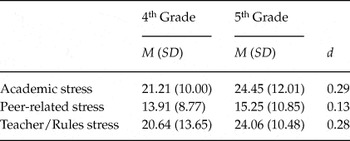
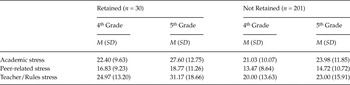
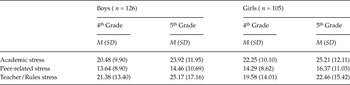
The descriptive statistics for stress levels in 4th and 5th grade are presented in Table 1, the same information by gender is presented in Table 2 and by 5th grade success in Table 3. There were no significant differences in the 4th grade stress levels between students who were retained in 5th grade and those who passed in Academic Stress, t(229) = –0.70, p = .485 or Teacher/Rules Stress, t(229) = –1.87, p = .063. However in Social Stress, t(229) = –1.97, p = .05, students who were retained at the end of 5th grade already present higher level of stress in the end of 4th grade. There were also no significant gender differences observed in any dimension of School Stress: Academic Stress, t(229) = –1.33, p = .185; Social Stress, t(229) = –0.56, p = .578; and Teacher/Rules Stress, t(229) = 0.99, p = .324.
Types of Stress Descriptive Statistics and Effect Sizes for Time

Types of stress descriptive statistics, by 5th grade success

Types of stress descriptive statistics, by gender

Intraclass Correlations (ICC) show that there is no need to take into account the school grouping level into the models, since that there is not sufficient variance explained at that level (ICCstress = .004) , following Heck at al. (2013). Accordingly, all school grouping level variables (i.e., middle school size; middle school location and middle school SES) were not included in the model.
Stress levels during middle school transition
Changes in stress from 4th to 5th grade
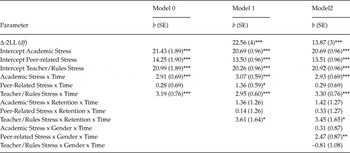
As seen in Table 4 (model 0), there are differences in Stress levels between the last year of elementary school (4th grade) and the first year of middle school (5th grade) in two dimensions: Academic stress and Teacher/rules Stress, with 5th grade students presenting higher stress levels. Effect sizes (reported in Table 1) for both dimensions can be considered small (according to the criteria established by Cohen, 1998).
Parallel growth curve models for types of stress

Note: Δ-2LL = difference between tested model and 0-model with corresponding dfs.
Retained = 1; Girls = 1 *p < .05; **p < .01; ***p < .001.
Stress and 5th grade retention
The effects of 5th grade retention and the interaction between 5th grade retention and time were tested in the model 1 (presented in Table 4). The fit of the model improved significantly when retention was added as a factor: Δχ2(4) = 22.56, p < .001. Significant interaction effects between retention and time were found for Teacher/Rules Stress, with students who were retained at 5th grade presenting a bigger increase in stress levels. The class level variable, 4th grade class size, was also introduced into the model, but its effects were not significant (β = –.02, SE = .13; t = –.18, p = .856) and so it was eliminated from additional models.
Gender differences
The descriptive data for both genders is presented in table 3. An additional model (model 2) was created to understand if both genders presented similar evolution patterns in the stress dimensions. There was one stress dimension that presented different evolution patterns during middle school transition, Peer-related stress, where the girls presented a greater increase in the year after middle school transition than boys.
Discussion
The results show that it is after middle school transition has taken place that stress levels are higher, especially in Academic Stress and Teacher/Rules Stress, hypothesis one. Therefore the results are in accordance with most literature findings (e.g., Duchesne et al., Reference Duchesne, Ratelle and Roy2012; Rudolph et al., Reference Rudolph, Lambert, Clark and Kurlakowsky2001) reporting increased levels of anxiety or stress even if the transition takes place at an earlier age (nine years). The lack of increase in Peer-related stress is probably to the school structure in Portugal, where elementary schools are usually smaller units, with few classes per grade, whereas middle schools are bigger units with several classes per grade and a larger number of peers leading to increased opportunities for developing rewarding and meaningful peer relations (Coelho, Marchante, & Jimerson, Reference Coelho, Marchante and Jimerson2016).
Students who were retained in the end of 5th grade showed a bigger increase in Teacher/Rules Stress from 4th to 5th grade, thus partially supporting hypothesis three, consistent with findings by Wenz-Gross et al. (Reference Wenz-Gross, Siperstein, Untch and Widaman1997) that students who had more stress pre-transition were likely to find the move into middle school more stressful. Further studies are needed to analyze the reasons for the lack of significant increases in Academic stress, given the increase in academic demands. It may be that, even though there is an increase in academic stress, this increase is less salient than the increase in Teacher stress for reasons described below.
There are several possible explanations for the increase in Teacher/Rules stress. The three most likely reasons are differences between elementary and middle school: stricter rules (Akos & Galassi, Reference Akos and Galassi2004); more disciplinary procedures in middle school (Theriot & Dupper, Reference Theriot and Dupper2010), and the change from one to several teachers per class, which results in middle school teachers having many more students for shorter time periods throughout the day, making it much more difficult for teachers to sustain warm and positive relationships with most of their students and engage them in relevant tasks (Pereira & Mendonça, Reference Pereira and Mendonça2005).
The pattern of gender differences found is consistent with the third hypothesis. In fact, in the present study, girls present a bigger increase in Peer-related stress with the transition, which is consistent with most literature findings that report girls as having higher levels of stress in social-related dimensions (Akos & Galassi, Reference Akos and Galassi2004; Chung et al., Reference Chung, Elias and Schneider1998; Grills-Taquechel et al., Reference Grills-Taquechel, Norton and Ollendick2010). The relevance of the results of the present study stems from the fact that they allow to disentangle this from the most common explanation that is the combination between physical and social transitions that leads to additional distress in girls (Akos & Galassi, Reference Akos and Galassi2004). Girls in the present sample go through transition into middle school when they are mostly nine when they are in elementary school and, as such, are mostly 10 when they are finishing the first year of middle school and therefore are not experiencing the bulk of physical transitions that accompany entry into adolescence.
As a whole, these results highlight the need for the development of interventions, specially focused on those students who present higher level of Teacher/Ruler Stress and reinforce the conclusions of Theriot and Dupper (Reference Theriot and Dupper2010) recommending transition programs to discuss rules and expectations for student behaviour, as well as defending that middle school orientation and transition activities should begin in elementary school, and that programs should allow students the opportunity to sit down with a trained adult or peer mediator and learn ways of resolving conflict.
The results of the present study add to the conclusion that, if students are not helped to develop appropriate coping strategies, they will not be equipped to cope with the academic and social changes that accompany the transition process (Qualter et al., Reference Qualter, Whiteley, Hutchinson and Pope2007). Without effective intervention programs, the developmental trajectories of children at risk in 5th grade will likely lead to subsequent academic failure or even school dropout.
The limitations of the present study are mainly due to sample characteristics, since they only cover two consecutive cohorts that experienced middle school transition and are limited to transitions from rural elementary schools and, as such, do not allow for comparisons with students from other settings such as students who transition from urban elementary schools. Also another limitation is that the findings from this study may have been limited by statistical power, particularly in the retention group.
A program designed to prepare students for middle school transition should be implemented in these schools. In the present setting, a program for middle school transition should start at the 4th grade and include activities such as visits to the new school, visits by middle school students to elementary schools as well as information sessions for parents (Akos & Galassi, Reference Akos and Galassi2004). It should also include interventions that are focused on correcting erroneous thoughts, modeling, role playing, and reinforcement (Duchesne et al., Reference Duchesne, Ratelle and Roy2012). The program should continue into the 5th grade addressing the areas that present higher stress levels per group.
Additionally, the introduction of a 4th grade program designed for Social and Emotional Learning may also be required, as Grills-Taquechel et al. (Reference Grills-Taquechel, Norton and Ollendick2010) recommend the introduction of school-based interventions for anxiety reduction in elementary school the implementation of such strategies prior to major school transitions would lessen psychosocial difficulties, particularly for girls.
The study was funded by the Municipality of Torres Vedras.