Introduction
Over the past 2 decades, natural disasters, along with man-made and technological disasters, outbreaks of diseases, and war, have affected many people in the world.Reference Mohammadi, Jafari and Etemadi1 These disasters cause homelessness, food shortages, outbreaks of diseases, emergence of mental illnesses.Reference Phillips and Williams2 In 2019, 396 natural disasters claimed 11,755 lives and affected 95 million people.Reference Mousavi, Zhu, Sheng and Beroza3 Developing countries are the worst hit,Reference Wang, Xia, Dong, Zhou and Deng4 and Asia is the most disaster-prone continent. Iran, always marked as vulnerable, belongs among the ten most disaster-prone countries,Reference Nekoei-Moghadam, Moradi and Tavan5 with 90% of its population vulnerable to such events as earthquakes and floods. It has the sixth-largest number of global natural disasters, such as the explosion of the Shazand Arak refinery and the collision of 2 trains.Reference Hejazi, Sharifi and Arvin6, Reference Malekmohammadi, Rezaei, Balist and Andarabi7 At the same time, floods in Golestan, Lorestan, and Khuzestan, and earthquakes in Bam and Rudbar have happened in Iran.Reference Fischer8 But what is important in such cases of disasters is timely and adequate responses to these disasters because if timely and adequate health measures and medical services are not taken care of, the people’s health may be endangered.Reference Clark-Ginsberg, McCaul and Bremaud9, Reference Mavrodieva and Shaw10
Before and during disasters, the support process and supply chain are critical pillars of disaster management.Reference Shareef, Dwivedi, Kumar, Hughes and Raman11 Disruption in the supply chain may be effective in all processes of providing goods or services and cause loss of funds, an increase in cost, and damage in the form of consecutive consequences.Reference Shen, Chang, Kim and Julian12 The findings of the study conducted by Dash et al. also revealed that organizations had serious transportation woes at large levels during disasters, and these woes had an immediate negative impact on the rescue rate of people affected by the crises and disasters.Reference Dash, Mishra and Mishra13
The supply chain should not only be able to cope with accidents and disasters, but it should also have high flexibility for returning to an original state or moving toward improved conditions. In other words, it should be resilient.Reference Sawyerr and Harrison14 Resilience in the supply chain refers to its ability to withstand risk-related disruptions and either restore previous operations in order to return to a more favorable state after a disruption. In emergencies and disasters, the resilience of the supply chain faces many challenges in meeting the needs of the affected society, which causes the vulnerability of the society to increase.Reference Berle, Rice and Asbjørnslett15-Reference Zobel, MacKenzie, Baghersad and Li18
Increasing concern in 2012 over external threats such as natural disasters, consumer shocks, systemic weaknesses, the cyber threat, increasing cost of insurance, and business financing caused experts to look at novel approaches to risk management. In response, the World Economic Forum, in collaboration with Accenture, developed a resilience-focused economic model for primary supply chains. This model, recognizing the critical roles of businesses and governments, is structured around 4 core components: participation (editing, coordinating, and adopting resilience standards), policy (establishing a multistakeholder evaluation process), strategy (developing adaptability mechanisms for supply chain resilience), and information technology (expanding data-sharing platforms).Reference Bhatia, Lane and Wain19
Pharmacies are key components of the health system in normal and emergency situations. The lack of medicine is the biggest problem in the management and normalization of postdisaster conditions, and patients who leave their homes during disasters are in dire need of medical and pharmaceutical services.Reference Aruru, Truong and Clark20, Reference Aburas and Alshammari21 Therefore, the position of medicine in the health system as a strategic product and the last link between the patient and the health system will be of double importance.Reference Talarposhti, Mahmodi and Jahani22 The important role of medicine in meeting people’s needs during humanitarian emergencies comes from a good understanding of how to use local medicine stocks in the country. Resilient medicine supply is more complex than many supply chains, and is affected by social and political dimensions. The medicine supply chain’s resilience helps to ensure the medicine supply processes in emergencies.Reference Bastani, Sadeghkhani, Ravangard, Rezaei, Bikine and Mehralian23, Reference Yaroson, Breen, Hou and Sowter24
Sedighpour et al. show in their study that pharmaceutical industry managers can create or use capabilities and strengthen enablers while reducing factors such as disasters that make companies prone to disruption and the necessary resilience in the face of them.Reference Sedighpour, Zandieh, Alem Tabriz and Dori25 Bennie et al. went further to outline how innovative strategies such as newer communication technologies, remote mode of pharmacy consultations, contactless mode of medicine delivery, and better adaptability of pharmacists and technicians could also greatly increase pharmacy resilience during disasters and pandemics.Reference Bennie, Weir, Newham, Dunlop and Ferguson26
The results of different studies indicate that the medicine supply chain in disasters is confronted by many problems, such as a reduction in the safety levels of medicines, delays in delivering medicines to people, medicine shortages, increased demands, and medicine stock loss.Reference Al-Ziftawi, Elamin and Ibrahim27-Reference Schrage, Bumblauskas and Becicka30 The results of the study by Bastani et al. showed that the main strategies for improving the resilience of the medicine chain in emergencies included the support of insurance organizations, strengthening relations with other countries, mechanizing the distribution system, and suppliers and manufacturers. At the same time, some intersectoral strategies can help the medicine chain and maintain its flexibility, including health care management and policy, exploitation of local potential, rational pricing, and integrated health information systems.Reference Bastani, Dehghan and Kashfi31
Despite recurring natural and man-made disasters in Iran, as well as frequent health care and medicine crises, no comprehensive study has yet examined the resilience of the medicine supply chain in emergencies. Given the urgent need for effective evaluation tools and models, this study aimed to assess the resilience of the supply chain of medicines and consumables during disasters in Iran based on the World Economic Forum framework.
Methods
This cross-sectional and descriptive-analytical study was conducted in 4 stages. In the first stage, the literature was reviewed in the field of identifying the factors affecting the resilience of the medicine supply chain. These factors were categorized according to the 4 key dimensions of the World Economic Forum framework—participation, policy, strategy, and information technology—and structured into a questionnaire for further analysis.Reference Bhatia, Lane and Wain19
In the second stage, the questionnaire was forwarded to 30 experts, including policy makers, managers, and hospital heads, to determine its validity and reliability. The inclusion criterion was having scientific or executive experience in medicine supply chain management, and having willingness to participate in the study. The questionnaire’s validity was checked by face and content validity, and its reliability was measured via Cronbach’s alpha.
Content validity was assessed using both qualitative and quantitative methods. In the qualitative phase, 10 experts in pharmaceuticals, disaster health management, passive defense, and crisis management reviewed the questionnaire to evaluate content accuracy and eliminate redundancies. For quantitative validation, Lawshe’s technique was applied, with the questionnaire distributed to 20 experts in the relevant fields who had related expertise or professional experience. The content validity ratio (CVR) was calculated to assess the importance of each questionnaire item. Experts rated the appropriateness of each statement using a 3-category scale: “necessary,” “useful but not necessary,” and “not necessary.” Lawshe’s technique set the minimum acceptable CVR for a panel of 20 experts at 42; items meeting or exceeding this threshold were retained, while others were removed. To determine the content validity index (CVI), questionnaire statements were rated by experts in terms of the 3 criteria of being relevant, clear, and simple on a 4-point scale for each statement. If the “relevancy” was 75% or over, then the “clarity” and the “simplicity” were also checked. If the CVI for any question was above 0.8, it would be accepted.Reference Romero Jeldres, Díaz Costa and Faouzi Nadim32, Reference Madadizadeh and Bahariniya33 Based on Table 1, the questionnaire’s overall relevancy was estimated at 81.47, simplicity at 82.19, and clarity at 81.57. The content validity index (CVI) averaged 81.74, while the content validity ratio (CVR) was 66.81, confirming the questionnaire’s validity. The standard deviations for CVI and CVR were 3.13 and 11.78, respectively.
Quantitative assessment of the content validity of the disaster resilient supply chain questionnaire

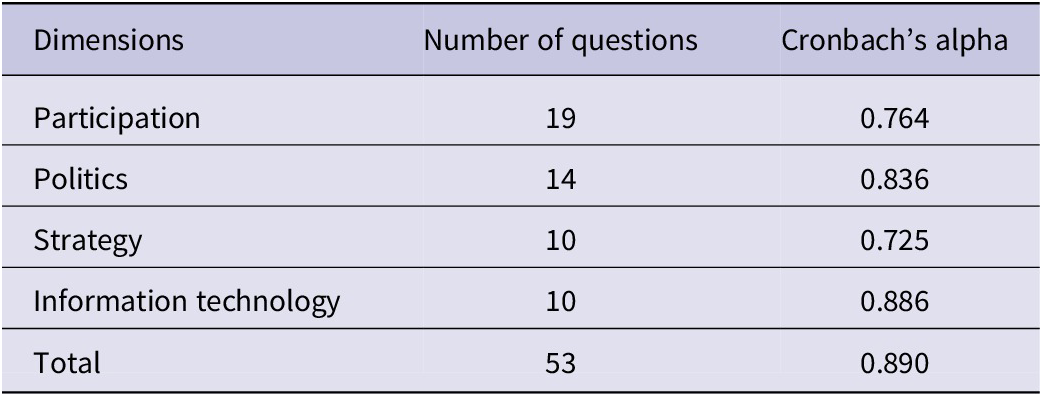
The reliability of the questionnaire was confirmed by the Cronbach’s alpha coefficient of 0.89, which showed high internal consistency. Table 2 presents alpha values for each dimension, demonstrating reliability across all sections.
Cronbach’s alpha related to the axes of the disaster-resilient supply chain questionnaire

The study’s statistical population included pharmacies in public and private hospitals, as well as city-level pharmacies in Shiraz. All hospital pharmacies in public (20 hospitals) and private (18 hospitals) hospitals were studied using the census method. Given the presence of 350 pharmacies in Shiraz, a 2-stage sampling method was applied for selecting 186 city-level pharmacies. Pharmacies in Shiraz were grouped into clusters based on the city’s eleven municipal regions, with each region considered a separate cluster. The number of pharmacies in each cluster was related to the number of pharmacies in each cluster and that in the entire city. Then, the simple random sampling method was applied within each cluster to select the pharmacies and collect the required data. The questionnaire was completed by the pharmacy technicians or their deputies in the studied pharmacies. The inclusion criteria were having at least 2 years of experience working in a pharmacy, having experience in medicine supply chain management, and having the willingness to participate in the study. Finally, the collected data were analyzed and modeled using SPSS v.21 and Smart PLS v.3 software.
Ethical Considerations
This study was approved by the Ethics Committee of Shiraz University of Medical Sciences (Code IR.SUMS.REC.1398.448). The participants were free to choose to participate in the study, and once the objectives of the research were explained to them, their written informed consent was obtained. The questionnaire was completed anonymously, and the participants were assured of the confidentiality of their answers to the questions.
Results
The majority of the pharmacies surveyed were at the city-level (76.78%), nonoutsourced (91.97%), nonacademic (87.06%), in Region 1 of Shiraz (39.74%), with 74.55% serving exclusively outpatients (Table 3).
Characteristics of the studied pharmacies

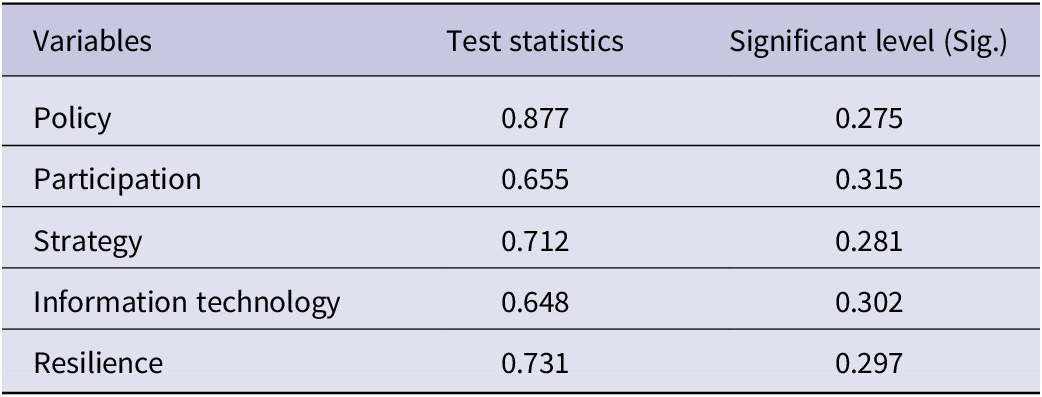
Normality of the distribution of data was tested using the One-Sample Kolmogorov-Smirnov test. The results showed that all variables had significance levels (P values) greater than .05, confirming that the data followed a normal distribution (Table 4).
The results of the One-Sample Kolmogorov-Smirnov test to test the normality of the study variables

The conceptual model was tested using SmartPLS v.3 software through 3 key analytical stages: (A) evaluating the fit of the measurement model, (B) assessing the fit of the structural model, and (C) examining the fit of the overall model.
A. The Fit of the Measurement Model
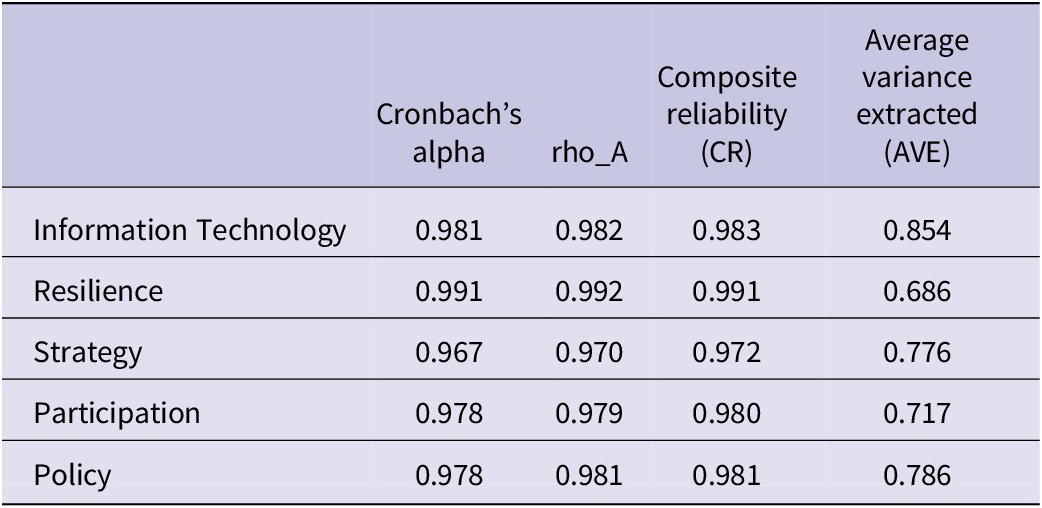
The measurement model demonstrated strong reliability and validity, with the values of Cronbach’s alpha exceeding 0.9 and Composite Reliability (CR) surpassing 0.7 for all constructs. Also, Convergent validity was confirmed with Average Variance Extracted (AVE) values above 0.5 (Table 5 and Figure 1).
Construct reliability and validity

AVE values and factor loadings of the model.

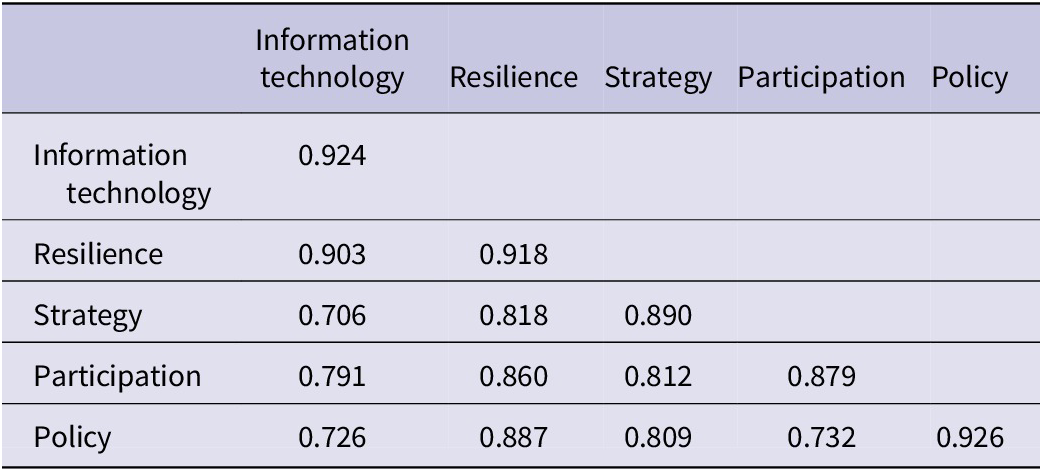
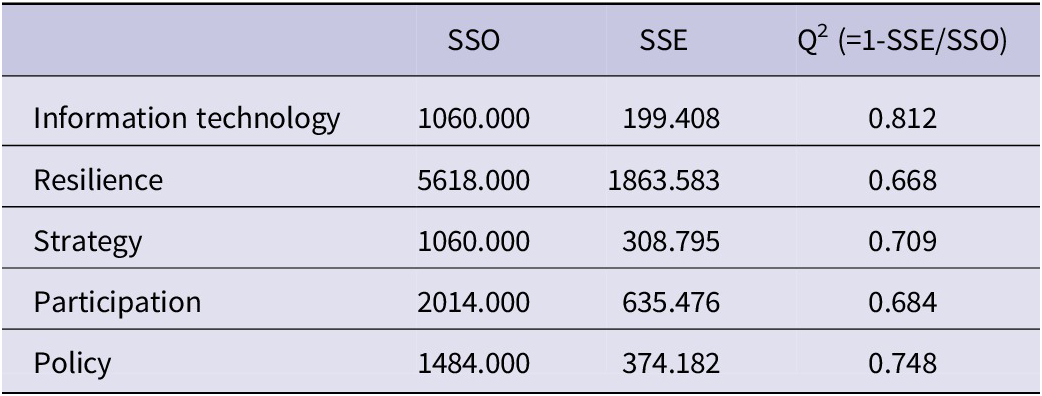
The model’s divergent validity was also confirmed using the Fornell-Larcker criterion, where the average variance extracted for each construct exceeded its shared variance with other constructs (Table 6), as well as the Cross Loadings test, which showed stronger correlations within designated constructs. The measurement model’s fit was further validated by the Construct Cross-Validated Communality (C.V. Com) index, with QReference Phillips and Williams2 values exceeding 0.5, indicating a robust fit (Table 7).
Fornell-Larcker criterion

Construct cross-validated communality

B. The Fit of the Structural Model
The structural model was assessed by analyzing relationships between existing variables. The criteria of significant coefficients for t-values, coefficient of determination (RReference Phillips and Williams2), effect size (f2), and redundancy index (QReference Phillips and Williams2) were examined.
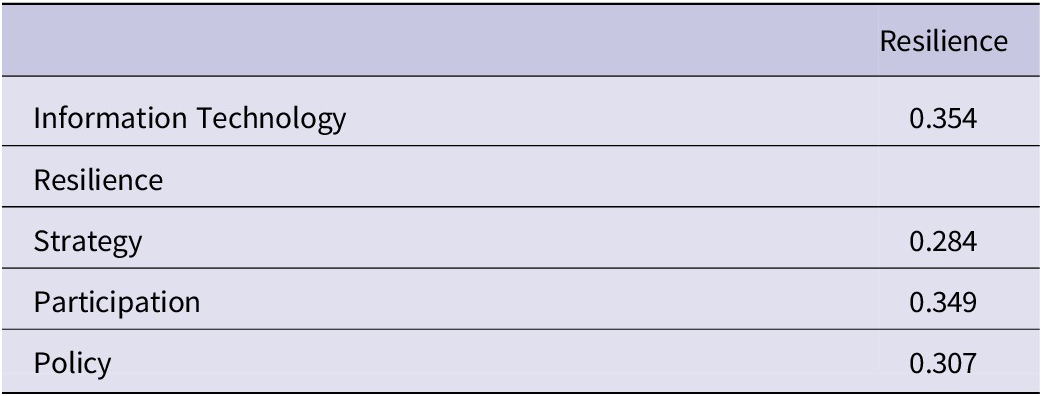
The significance criteria for t-values (T Statistics) in Table 8 indicated that all variables exceeded the threshold of 3.27 at a 99.9% confidence level, confirming the strong fit of the model. Since all path coefficients surpassed this value, the structural model of the study was validated.
Total effects

The structural model analysis revealed that Participation had the strongest positive effect on predicting the resilience of the medicine and consumables supply chain during disasters, with a path coefficient of 0.369 (t = 41.046, P < .001). This was followed by Policy, which demonstrated a substantial effect with a path coefficient of 0.284 (t = 30.226, P < .001). Information Technology also showed a significant positive impact, with a path coefficient of 0.217 (t = 26.719, P < .001). Finally, Strategy exhibited a significant positive effect, with a path coefficient of 0.190 (t = 23.467, P < .001). These findings confirm that all 4 dimensions (Participation, Policy, Information Technology, and Strategy) significantly contribute to enhancing supply chain resilience, with Participation being the most influential factor (Table 8 and Figure 2).
Values of path coefficients to evaluate the structural model.

The coefficient of determination (RReference Phillips and Williams2 = 0.87) indicated that the model explained 87% of the variance in supply chain resilience, reflecting a strong explanatory power (RReference Phillips and Williams2 > 0.25). Effect sizes (f2 > 0.25) confirmed strong contributions of all constructs to resilience (Table 9). In addition, the redundancy index (QReference Phillips and Williams2 > 0.35) strongly validated the predictive power of the model (Table 10 and Figure 3).
f Square

Construct cross-validated redundancy

Redundancy index values to evaluate the structural fit of the research model.

C. Fit of the Overall Model
The overall model fit was evaluated using goodness of fit (GOF), standardized root mean square residual (SRMR), and RSM-Theta criteria. The GOF index was calculated based on the formula
 $ GOF=\surd \left(\underset{\_}{communality}\times \underset{\_}{R^2}\right) $
.
Then,
 $ GOF=\sqrt{0.724\times 0.87} = 0.794 $
Since the GOF value was above 0.35, the model demonstrated a strong overall fit.
The SRMR value of 0.082 confirmed an acceptable fit (<0.1), supported by d_ULS and d_G metrics (Table 11).Reference Kok Wah34 The RSM-Theta value of 0.113 (<0.12) further validated the model’s good fit.Reference Kok Wah34
Fit summary

Discussion
The world is experiencing an escalation of frequency and intensity of natural and man-made disasters with major consequences for livelihoods, lives, and even economies of societies. In this context, proactive crisis response planning and preparedness is essential in reducing human and economic loss.Reference Dash, Mishra and Mishra13 The possibility of disruption in the supply chain results in the development of a flexible supply chain that can respond to accidents and disasters appropriately.Reference Lozano-Diez, Marmolejo-Saucedo and Rodriguez-Aguilar35 The results of this study showed the positive and significant impact of the components of participation, policy, information technology, and strategy in explaining the resilience model of the supply chain of medicine and consumables during accidents and disasters for use in crisis response planning and activities. Mohammadpour et al. indicated that the medicine supply and preparation were among the main challenges of Iran’s health system in the case of accidents and disasters.Reference Mohammadpour, Sadeghkhani, Bastani, Ravangard and Rezaee36 Ochi et al. also highlighted the importance of establishing a total preparedness plan in order to make sure that patients and health professionals were properly prepared with medicine stocks for evacuated people during a crisis.Reference Ochi, Hodgson, Landeg, Mayner and Murray37
The results of this study revealed that participation played the most significant role in shaping the resilience model of the medicine and consumables supply chain. Challenges related to the health system may be intersectoral or intrasectoral in nature. Based on this, one of the solutions to maintaining and improving the supply chain in times of crisis is to increase flexibility in partnership with stakeholders. This can cause an immediate supply of resources during accidents and disasters and prevent medicine shortages. Umar and Wilson also emphasize vertical and horizontal partnerships in the field of supply chain cooperation and state that partnerships affect the resilience of supply chains in disasters.Reference Umar and Wilson38 Intersectoral challenges associated with the health system include difficulties associated with the provision of service, crisis scene management, and supply, as well as the preparation of medical materials and supplies.Reference Mohammadpour, Sadeghkhani, Bastani, Ravangard and Rezaee36 Coordination between the government and nongovernmental organizations is also another key feature of the crisis management structure because collaboration with the stakeholders and division of resources, including equipment as well as the intergovernmental and non-governmental experiences, are paramount in achieving enhanced performance, cost-efficiency, and timely delivery of planning services.Reference Pazirandeh and Maghsoudi39 With the increase in the number of nodes and links in supply network relationships, it is important to understand partnership management and the required level of cooperation for sustainable supply network alignment.Reference Shin, Park and Park40 Supply chain companies do not operate in isolation, but get embedded into diverse networks with different resources and competencies. Supplying resources requires the participation of supply chain actors both vertically and horizontally. While vertical cooperation means other layer companies in the supply chain, namely buyers and suppliers, horizontal cooperation involves other companies on the same level, such as wholesalers.Reference Umar and Wilson38
In the present study, after participation, policy contributed the most to explaining the resilience model of the supply chain of medicine and consumables. Jaberidoost et al. identified and classified 86 main risks in 11 categories regarding the risk assessment of the medicine supply chain in Iran, most of which were related to financial, economic, political, and government issues.Reference Jaberidoost, Olfat and Hosseini41 Our study and Jaberidoost et al.’s study were conducted when Iran was facing international sanctions. Among the various aspects of the policy that have been examined in our study are the use of international suppliers during the occurrence of accidents and disasters regarding the supply of medicine and consumables, continuous changes in the economic situation and exchange rate in the country, and continuous changes in the political situation and trade relations with other countries. Since the methods of both studies are based on the opinions of experts and are conducted during sanctions, the field of politics and its related factors may have a different rank and contribution in explaining the case model under normal conditions than other dimensions. The lack of strategic medicines and anesthesia in Iran, especially under the influence of economic sanctions, was one of the challenges identified and expressed in the study by Mohammadpour et al.Reference Mohammadpour, Sadeghkhani, Bastani, Ravangard and Rezaee36 and McLean and Whang have noted that economic sanctions may take a toll on the country’s overall budget, including sanctions and budget set aside for disaster preparation.Reference McLean and Whang42 Apart from creating problems regarding the supply of medicine, Sanctions can also affect production in providing raw materials for manufacturing the medicines. On the other hand, Duch showed in his study that the External Engagement and Sustainability Governance component could affect supply chain resilience.Reference Duch43 Loss of suppliers was a critical factor in medicine shortage vulnerability in Shweta et al.’s study.Reference Shweta, Kumar and Chandra44 Another aspect of the policy is to create coordination in the supply chain. The lack of coordination between different departments in the government, as well as in the private sector, is one of the challenges of the medicine supply chain. These sectors often conflict with each other, and decisions related to them may become suboptimal for the entire supply chain. In most cases, the members of the medicine supply chain pursue opposite goals, which sometimes conflict with each other or with the entire supply chain.Reference Alidoost, Bahrami and Safari45 Regarding medicine policies, the study of Tucker et al. shows that the market mechanism alone cannot be responsible for the medicine supply chain due to the interests of pharmaceutical companies for more profit, and there is a need to establish government laws and policies for the medicine supply, such as fines for nonsupply of medicines and a mandatory supply chain.Reference Tucker, Daskin, Sweet and Hopp46 One example of coordination is the American Society of Health-System Pharmacists (ASHP). This organization encourages pharmaceutical companies to plan for disasters, especially the coordination of corporate pharmaceutical programs with private, local, state, and federal planners, and as a result of changes in the state policy, Alabama pharmacists can obtain prescriptions for a 30-day supply of medicines. Normal and nonnarcotic medicines for Katrina victims needed to be completed, and people’s demands during accidents and disasters had to be responded to.Reference Chin, Chant, Tanzini and Wells47 However, in most of the incidents, due to the inappropriate exchange of information between suppliers and service providers, coordination is hardly established, and this disrupts the flow of the supply chain.Reference Dash, Mishra and Mishra13
In the current study, after partnership and policy, information technology played a role in explaining the resilience model of the medicine supply chain. Moosivand et al. have emphasized 3 strategic policies to face the challenges of the medicine supply chain, including cooperative relationships with suppliers, investment in new technologies, and the creation of information technology (IT). Deploying information technology for visibility or information sharing among supply chain components is one of the critical elements to having an effective supply chain.Reference Moosivand, Rajabzadeh Ghatari and Rasekh48 The findings of the study by Hailu et al. also showed that supply chain practices and the implementation of information and communication technology had a positive and significant effect on the performance of the medicine supply chain.Reference Hailu, Gizaw, Berhanu, Mulugeta, Boche and Gudeta49 Resource management and information were 2 important factors that Bastani et al. identified as practical strategies to increase the resilience of the medicine supply chain. In their view, if they have an integrated, precise, reliable, and most current information system, it will be possible to use resources frugally and minimize wastage in disasters.Reference Bastani, Sadeghkhani, Bikine, Mehralian, Samadbeik and Ravangard50 Also, according to Breu et al., information systems are an integral part of the agile supply chain and increase its speed and flexibility.Reference Breu, Hemingway, Strathern and Bridger51 In this regard, the study of Rasheed and colleagues shows that the existence of an up-to-date information system to determine the epidemiological and pharmaceutical needs in the affected area can be a critical factor in quantifying and estimating the required medicine items and ordering them through the supply chain.Reference Rasheed, Usman, Ahmed, Bacha, Zafar and Bukhari52 Efforts to create and update monitoring systems and need-based decision support systems can also be useful in this field.Reference Bastani, Sadeghkhani, Bikine, Mehralian, Samadbeik and Ravangard50 Although Iran has made great progress in medicine production, there are still many unresolved issues in the management of information flow in the medicine supply chain. To achieve the highest level of performance, supply chain strategies should be aligned with information systems strategies. In this situation, information systems meet supply chain requirements in the best possible way.Reference Yousefi and Alibabaei53
Another dimension of the model explained in the present study was strategy. Khanyk et al. reported in their study that after the Ukrainian war, the economic availability of medicines in Ukraine had been considerably changed, because the price of the medicines had dramatically risen, and average salaries had dropped. The Ukrainian government was attempting to reduce the impact of the war on its health care system and medicines and consumables supply chain using new laws and the deployment of effective strategies. However, the existing pharmaceutical reimbursement program had covered only a limited number of medicines and health conditions.Reference Khanyk, Hromovyk, Levytska, Agh, Wettermark and Kardas54
Also, different aspects of the strategy in the present study have been aimed at creating appropriate participation, cooperation, and information technology. The results of Karuppiah et al.’s study showed that a collaborative partnership between the government and the private sector was the best strategy for a sustainable supply chain during the COVID-19 pandemic. Moreover, providing quick and correct information to the people had been another strategy during the spread of COVID-19.Reference Karuppiah, Sankaranarayanan, Ali and Paul55 Esmaeillou et al. have also stated in their study that to expand the use of the supply chain with an information technology approach, detailed planning in education, the expansion of e-government strategies, strong satellite communication channels, the appropriate use of information technology infrastructure, and the creation of a national network for the medicine supply chain are needed.Reference Esmaeillou, Tehrani, Masoudi Asl and Cheraghali56
Study Limitations
This study, like other studies, had some limitations, some of which were its cross-sectional design, using only a questionnaire for collecting the required data, and a focus on only Shiraz pharmacies. In the future, studies conducted prospectively on pharmacies in the country can increase the generalizability and authenticity of the findings.
Conclusions
The results of the present study confirmed the studied resilience model of the medicines and consumables supply chain during disasters. Also, the results showed that participation, policy, information technology, and strategy directly and positively contributed, respectively, to enhancing the resilience of the medicines and consumables supply chain during disasters. Therefore, the medicines and consumables supply chain resilience in Iran can be improved by facilitating international partnerships, developing better relationships with suppliers, moving towards digital and information technology-based supply chains, having a strategic plan for the medicines and consumables supply chain in disasters, and developing coordinating policies and effective strategies. For future studies, all components of the supply chain, including upstream suppliers and downstream consumers, and legal issues and complexities in the medicines and consumables supply chain, can be studied. Also, the described model of the supply chain of medicines and consumables can be generalized for other needs in accidents and disasters.
Data availability statement
The datasets used and/or analyzed during the current study are available from the corresponding author upon reasonable request.
Acknowledgments
This study was extracted from the thesis written by Narges Khatoon Siadat and was financially supported by Shiraz University of Medical Sciences grant No. 16154. The authors would like to thank all participants for their cooperation in collecting and analyzing the data. Also, the authors would like to thank the Center for Development of Clinical Research of Nemazee Hospital for their assistance in data analysis and Dr. Nasrin Shokrpour for editorial assistance.
Author contribution
Ramin Ravangard conceptualized and designed the study. Narges Khatoon Siadat collected the necessary data. Milad Ahmadi Marzaleh, Abolfazl Raeyat Mohtashami, and Ahmad Allahyari Bouzanjani conducted the data analysis. All authors contributed to data interpretation. The initial draft of the manuscript was written by Ramin Ravangard, Abolfazl Raeyat Mohtashami, and Milad Ahmadi Marzaleh. All authors reviewed, revised, and approved the final version of the manuscript.
Funding/support
This study was extracted from the thesis written by Narges Khatoon Siadat and was financially supported by Shiraz University of Medical Sciences grant No. 16154.
Financial disclosure
The authors have no financial disclosure to declare.
Competing interests
The authors have no conflict of interest to declare.
Ethical Standards
This study was approved by the Ethics Committee of Shiraz University of Medical Sciences (Code IR.SUMS.REC.1398.448). The participants were free to choose to participate in the study, and once the objectives of the research were explained to them, their written informed consent was obtained. The questionnaire was completed anonymously, and the participants were assured of the confidentiality of their answers to the questions.
Informed consent
Informed consent was obtained from all participants who participated in the study.
Consent for publication
None.