Introduction
This study explores the experiences of those living without a formal diagnosis of dementia, but who appear to fulfil criteria for a dementia diagnosis. It also explores the experiences of their main family carer(s). The study offers a rare opportunity to hear the accounts of individuals, and their families, who have, for various reasons, not received a diagnosis for cognitive difficulties. Their perspectives offer valuable insight into the ongoing discussion regarding the role that diagnosis plays in the lives of those living with or affected by dementia (de Vugt and Verhey, Reference de Vugt and Verhey2013).
The global number of people living with dementia is believed to have doubled over the past three decades, attributed mainly to an increase in population ageing, as when age is accounted for, the increase is 1.7 per cent over the same period (Nichols et al., Reference Nichols, Szoeke, Vollset, Abbasi, Abd-Allah, Abdela, Aichour, Akinyemi, Alahdab and Asgedom2019). The demand on health-care systems and subsequent financial impact is predicted to continue to increase (Wimo et al., Reference Wimo, Guerchet, Ali, Wu, Prina, Winblad, Jönsson, Liu and Prince2017).
A systematic review of under-detection of dementia suggests internationally an under-detection rate of 61.7 per cent (Lang et al., Reference Lang, Clifford, Wei, Zhang, Leung, Augustine, Danat, Zhou, Copeland and Anstey2017). Population statistics tell us that even in the United Kingdom (UK), with its highly developed system of universal health care and network of Memory Clinics, as well as in other developed countries, there is a considerable difference between the number of people projected to have dementia based on epidemiological studies and the number with a formal diagnosis (Schrauf and Iris, Reference Schrauf and Iris2012; Matthews et al., Reference Matthews, Arthur, Barnes, Bond, Jagger, Robinson and Brayne2013; Aldus et al., Reference Aldus, Arthur, Dennington-Price, Millac, Richmond, Dening, Fox, Matthews, Robinson, Stephan, Brayne and Savva2020). Possible mechanisms for the gap between projections and actual diagnoses include individual factors, such as gender, age, co-morbidity and living with a long-term partner/spouse (Aldus et al., Reference Aldus, Arthur, Dennington-Price, Millac, Richmond, Dening, Fox, Matthews, Robinson, Stephan, Brayne and Savva2020).
The possibility of systemic problems affecting diagnosis rates cannot be discounted. Geographical differences exist in the gap between predicted and actual numbers of people with a dementia diagnosis (Connolly et al., Reference Connolly, Gaehl, Martin, Morris and Purandare2011), as indicated by general practice dementia registers – a register of patients within each practice who have a diagnosis of dementia made either by their general practitioner (GP) or following a secondary care referral.Footnote 1 People with dementia in less-deprived areas are 25 per cent more likely to be prescribed pharmacological treatment (Cooper et al., Reference Cooper, Lodwick, Walters, Raine, Manthorpe, Iliffe and Petersen2016), suggesting that there might be a similar inequity in diagnostic rates in the UK. A relationship between socio-economic factors and diagnostic rates has also been found in studies of dementia diagnosis internationally (Scazufca et al., Reference Scazufca, Menezes, Vallada, Crepaldi, Pastor-Valero, Coutinho, Di Rienzo and Almeida2008; Schrauf and Iris, Reference Schrauf and Iris2012; Yaffe et al., Reference Yaffe, Falvey, Harris, Newman, Satterfield, Koster, Ayonayon and Simonsick2013).
The number of people living with undiagnosed dementia has been identified as a problem to address both in UK policy (Department of Health, 2016: 80; Welsh Government, 2018) and by advocacy organisations (Southern, Reference Southern2015; Alzheimer's Society Cymru, 2017). Within the UK, Wales has consistently had lower diagnosis rates than England, Scotland and Northern Ireland (53, 68, 67 and 73%, respectively, in 2017–2018), with those in England having increased markedly in response to a major centrally led, target-driven initiative to improve diagnosis rates (Alzheimer's Research UK, 2020).
The main benefit often attributed to obtaining an early diagnosis for patients and carers is that it allows people to develop coping strategies and to plan for the future (de Vugt and Verhey, Reference de Vugt and Verhey2013). For some, diagnosis can provide validation, legitimacy and the right to be unwell (Nettleton, Reference Nettleton2006). Other benefits could include access to services, paid sick leave, support groups, disability payments (Jutel, Reference Jutel2009) and being part of a community with a ‘collective illness identity’ (Hillman et al., Reference Hillman, Jones, Quinn, Nelis and Clare2018: 881). Early identification of mild cognitive impairment allows assessment for common, treatable and potentially reversible causes such as depression, anxiety and sleep disturbances (Liss et al., Reference Liss, Seleri Assunção, Cummings, Atri, Geldmacher, Candela, Devanand, Fillit, Susman, Mintzer, Bittner, Brunton, Kerwin, Jackson, Small, Grossberg, Clevenger, Cotter, Stefanacci, Wise-Brown and Sabbagh2021).
The majority of people who seek help for cognitive problems want to know their diagnosis (Robinson et al., Reference Robinson, Gemski, Abley, Bond, Keady, Campbell, Samsi and Manthorpe2011). However, a diagnosis of dementia can also lead to distress and loss of role (Robinson et al., Reference Robinson, Gemski, Abley, Bond, Keady, Campbell, Samsi and Manthorpe2011), and a restriction in activities at a time when physical activity is key to maintaining wellbeing (Duggan et al., Reference Duggan, Blackman, Martyr and Van Schaik2008). If there is limited access to support, then the question remains whether diagnosis alone is useful (Iliffe et al., Reference Iliffe, Robinson, Brayne, Goodman, Rait, Manthorpe and Ashley2009). Due to the possibility of stigma surrounding the later stages of dementia (Behuniak, Reference Behuniak2011; Robinson et al., Reference Robinson, Gemski, Abley, Bond, Keady, Campbell, Samsi and Manthorpe2011; Hillman and Latimer, Reference Hillman and Latimer2017), individuals might fear the condition, even in the early stages. This fear could act as a barrier to diagnosis. Providing care for someone living with dementia can affect the nature of that relationship (Quinn et al., Reference Quinn, Clare and Woods2009), and carers might experience grief, loss and emotional trauma (Hutchinson et al., Reference Hutchinson, Roberts, Kurrle and Daly2016). This might lead family members to be reluctant to acknowledge cognitive changes in their relative and make it less likely that they will seek a diagnosis. We do not know the value of a diagnosis of dementia among those who do not seek help for cognitive problems, as this group has historically been difficult to access.
Early or timely diagnosis is recommended to clinical practitioners (Robinson et al., Reference Robinson, Tang and Taylor2015); however, there is a lack of evidence about the harms of early diagnosis, and no cost–benefit studies of early versus later diagnosis have been undertaken. We do not currently have a way to identify the most appropriate time to give a diagnosis for each person. Furthermore, the governmental push for diagnosis without follow-up from services has been criticised by practitioners (Barer, Reference Barer2014; McCartney, Reference McCartney2014).
We currently know little about the experiences of people living with dementia symptoms without a formal diagnosis. Most studies of the perspectives of people living with dementia recruit people who have a diagnosis or are in the process of receiving one. Studies have collected details of the ‘undiagnosed’ period in retrospect (Schrauf and Iris, Reference Schrauf and Iris2012; Brossard and Carpentier, Reference Brossard and Carpentier2017). A retrospective retelling of events leading to diagnosis might not be entirely consistent due to the tendency for family stories to be reinterpreted in hindsight following diagnosis and a greater understanding of the condition (Brossard and Carpentier, Reference Brossard and Carpentier2017).
As part of the IDEAL programme (Clare et al., Reference Clare, Nelis, Quinn, Martyr, Henderson, Hindle, Jones, Jones, Knapp and Kopelman2014, Reference Clare, Wu, Jones, Victor, Nelis, Martyr, Quinn, Litherland, Pickett and Hindle2019) to extend our understanding of the experiences of living with dementia to people living without a formal diagnosis, the central aim of this study is to understand more about the contexts and circumstances of those people who live with and cope with cognitive difficulties without having a formal diagnosis of dementia. Part of understanding this context is to consider the meanings attached to cognitive decline by this group, including the role that stigma might play in their accounts.
Individuals living with suspected undiagnosed dementia can be detected in population-based epidemiological studies of older people, such as the Cognitive Function and Ageing Studies (CFAS: Matthews et al., Reference Matthews, Arthur, Barnes, Bond, Jagger, Robinson and Brayne2013 and CFAS-Wales: Clare et al., Reference Clare, Wu, Teale, MacLeod, Matthews, Brayne, Woods and CFAS-Wales study team2017). This creates an opportunity to identify individuals who at the time of being interviewed met study criteria for a dementia diagnosis but do not have a diagnosis according to GP records and self-report.
Quantitative data can go some way to explain factors that potentially contribute to the undiagnosed state (Aldus et al., Reference Aldus, Arthur, Dennington-Price, Millac, Richmond, Dening, Fox, Matthews, Robinson, Stephan, Brayne and Savva2020), but do not provide an in-depth exploration of the perspectives of individuals and their families who are living in this situation. In this study, we conducted in-depth interviews with a sub-set of individuals from the CFAS-Wales cohort, and their families, to gain the perspectives of this under-researched group who have the potential to help interrogate ongoing questions about the role diagnosis plays in shaping the lives of people living with dementia.
Research objectives
The research objectives are:
(1) To explore why some people living with significant signs of dementia might not have a diagnosis.
(2) To explore the recent experiences and individual stories of this group of participants living with symptoms of dementia but no diagnosis.
(3) To explore the experiences and stories of relatives/carers of individuals living with symptoms of dementia but no diagnosis.
Methods
Design
The study is based on a thematic analysis (Braun and Clarke, Reference Braun and Clarke2006) of interviews with six people with suspected undiagnosed dementia, and ten relatives, drawn from the longitudinal CFAS-Wales cohort. The CFAS-Wales study comprised 3,593 participants in total and included tests of cognitive function and health and wellbeing measures conducted two years apart with a representative population of people aged over 65 years resident in an urban and a rural area of Wales. Data were reviewed by a medically qualified member of the study team. A total of 2,771 CFAS-Wales participants also gave consent for access to GP records inspection during Wave 1 (2011–2013) and data linkage during Wave 2 (2013–2015). For a fuller description of the CFAS methodology, which includes CFAS-Wales, see Matthews et al. (Reference Matthews, Arthur, Barnes, Bond, Jagger, Robinson and Brayne2013). The CFAS-Wales dataset is deposited with the UK Data Archive, and is available for download (Woods et al., Reference Woods, Burholt, Brayne and Bennett2019).
Inclusion criteria for this study comprised: (a) meeting the CFAS-Wales study criteria for dementia in the second CFAS-Wales wave (2013–2015) based on tests of cognitive function, AGECAT diagnostic algorithm and clinical review of study data; (b) with no dementia diagnosis listed in either their GP dementia register or in their GP records; (c) had given consent for contact for follow-up studies; and (d) were still living at the time of the study.
Ethics
Written informed consent was secured for all CFAS-Wales participants. Ethical approval for the present study was granted by the Wales Research Ethics Committee 5, as an amendment to the original ethical approval for the CFAS-Wales study. The present study was conceived and conducted as part of the IDEAL programme: ‘Improving the experience of Dementia and Enhancing Active Life: a longitudinal perspective on living well with dementia.’ The IDEAL-2 study is registered with United Kingdom Clinical Research Network (UKCRN) (registration number 37955; see www.IDEALproject.org.uk).
There are practical and ethical issues around talking about memory problems with people with dementia. The question of whether or not to use the word ‘dementia’ was raised by the researchers. We could not make a clinical diagnosis of dementia as part of the research and it would be unethical to inform people indirectly of the possibility that they had dementia by introducing the term into the discussion. We decided that if the interviewee brought up the topic of dementia or a clinical diagnosis related to dementia, then it would be discussed in the interview. Where possible, the interviewer would take the lead from the participant in relation to the terms and language used to refer to their cognitive difficulties.
Procedure
Recruitment
Forty-eight CFAS-Wales participants met the inclusion criteria. Many could not be interviewed due to death or illness or were uncontactable. Eligible participants were invited to interview. Of these, six consented to interview (together with a family member, relative or friend). Five of these participants met CFAS-Wales dementia criteria from Wave 2 (2013–2015), and thus had been living with symptoms for five years at the time of the study. One participant met the criteria in both Wave 1 (2011–2013) and Wave 2, so had been living with symptoms for seven years.
A further three family members made contact on receipt of the letter and asked to take part in informant interviews. In all three cases, the original CFAS-Wales participant had been diagnosed with dementia following CFAS-Wales Wave 2 and was now living in a care home.
Participants were contacted by letter (in Welsh and English) in October 2018, with a request for an interview with them and a family member, relative or friend, followed by a telephone call two weeks later, or (where there was no telephone number on file or no response to the telephone call) a letter with a reply slip. Participants were advised that the study was an investigation into changes to memory and ageing: the term ‘dementia’ was avoided.
Data collection methods and instruments
With people with suspected undiagnosed dementia, process consent (Dewing, Reference Dewing2007) was used: participants were judged to have capacity to give informed consent and were asked at regular points throughout the interview whether they still wished to participate, reminded of the purpose of the study and asked whether they had any questions. This supplemented formal written consent taken from all participants at the start of the interview, which included a verbal, as well as written, explanation of the study and purpose and an opportunity for participants to ask questions.
Participants were interviewed in their own homes. Participants were offered separate interviews to increase participant confidentiality and enable participants to share information away from their partner (Zarhin, Reference Zarhin2018). However, the participants’ lead was followed, and dyads were interviewed together where they requested this. This was considered important to avoid unnecessary distress. Two couples were interviewed individually (‘individual interviews’), two had joint interviews, and two were interviewed together and then separately.
Questions were asked in four topic areas: (a) experience of change, (b) memory and thinking, (c) understandings and explanations of memory and/or thinking difficulties, and (d) wider networks, services and support. Interviews were conducted conversationally, and the participants’ lead was followed in extent and ordering of questions, and further questioning was avoided in areas that seemed to provoke distress. Similarly, participants were encouraged to spend time talking about areas of interest and had scope to shape the content of the interviews and raise the matters that were important to them.
The mean length of the interviews was 65 minutes for retrospective relative-only interviews (range = 42–92 minutes) and 39 minutes (range = 36–42 minutes) for dyads. For those interviews where people with suspected undiagnosed dementia chose to be interviewed separately from their relatives, their interviews were substantially longer (mean = 64 minutes) and relative interviews shorter (mean = 26 minutes).
Data analysis
Interview recordings were transcribed and anonymised. Analysis was thematic, seeking to identify common motifs, patterns and meanings within the data (Braun and Clarke, Reference Braun and Clarke2006). Following an initial process of familiarisation by reading and re-reading the transcripts, and line-by-line coding, tentative ‘overarching’ themes were generated, which were then reviewed and refined into sub-themes. Rigour was ensured in two ways. First, two researchers conducted the thematic analysis process for each transcript, improving internal validity. Themes were compared, discussed and agreed, and an iterative process of discussion and reification within the research team enhanced external validity.
Themes were found to be cross-cutting across all participants (both those living with suspected undiagnosed dementia and relatives) and were relevant to addressing the central study aim of exploring the issues associated with living with dementia symptoms but without a diagnosis. Thus, final theme generation considered the data as an integrated corpus.
Findings
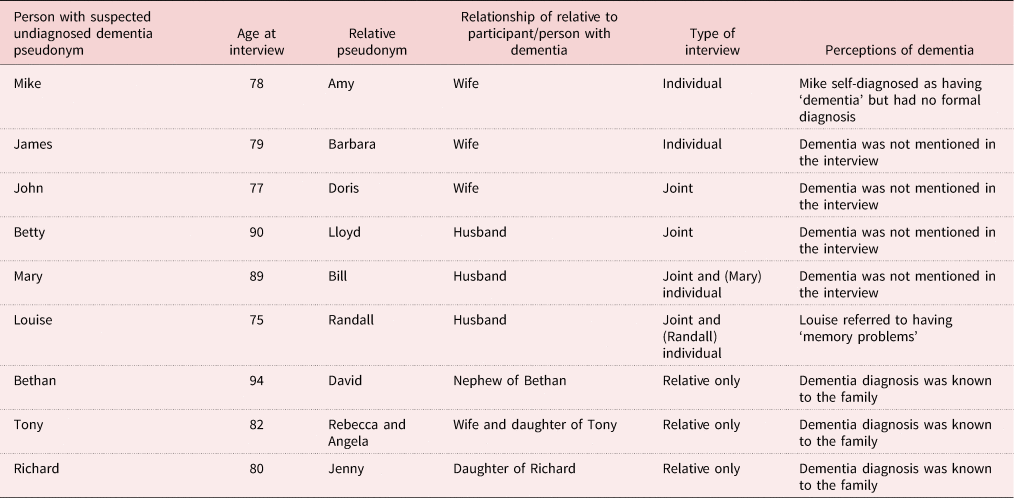
The participant characteristics are outlined in Table 1. The study included six people with suspected undiagnosed dementia, three men and three women, ranging in age from 75 to 90; six spouses of people with suspected undiagnosed demetia; and four relatives of three people who were diagnosed with dementia after taking part in the CFAS-Wales study, who were at the time of interview residing in care homes. These three relative interviews are somewhat different in nature as they are retrospective and subject to limitations of recall and possible reframing. All names assigned to participants in this paper are pseudonyms.
Summary of participant and relative characteristics

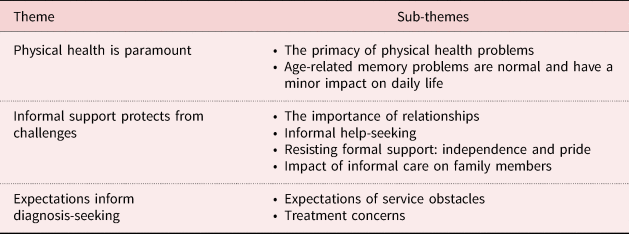
Three key themes emerged from the interview transcripts, each comprising two or three sub-themes, as outlined in Table 2.
Themes and sub-themes

Physical health is paramount
The primacy of physical health problems
Concern about physical health problems and the impact these had on the lives of people with suspected undiagnosed dementia and their spouses was pervasive in all interviews. When asked what had changed in their lives, participants focused on physical difficulties whereas cognitive difficulties appeared to have lower importance. For example, most people with suspected undiagnosed dementia reported reduced mobility:
I have become less able to walk. I've got a trolley out there and I now have a stairlift as well, which helps me up the stairs. (John, person with suspected undiagnosed dementia)
Participants with suspected undiagnosed dementia talked about no longer being able to perform physical tasks, such as heavy lifting (Louise), carpentry (Mike) and housework (John), due to their physical deterioration. All participants with suspected undiagnosed dementia had some form of physical problem that impaired their mobility, including arthritis, back problems and heart problems. Betty reported the most severe impairments, being registered blind, with her husband Lloyd saying:
It's the blindness that's the worst thing I think. (Lloyd, husband of person with suspected undiagnosed dementia)
Age-related memory problems are ‘normal’ and have a minor impact on daily life
In contrast to the framing of physical health as being the greatest source of annoyance and difficulty in coping, cognitive decline appeared to be something that participants with suspected undiagnosed dementia and their relatives could to some degree adapt to and manage. For example, when Louise, who had ‘memory problems’ noted in her GP records, was asked if there were ways in which changes to memory and thinking affect her daily life, she replied:
No I've just slowed down, that's all. (Louise, person with suspected undiagnosed dementia)
Some relatives reported that their spouse's cognitive problems did not affect them at all, or only minimally. Although they acknowledged symptoms, they were likely to regard them as a reflection of a normal process of ageing:
Oh, I think it's expected. There's nothing else I can put it down to. (Bill, husband of person with suspected undiagnosed dementia)
This belief that cognitive decline is a normal part of ageing was also prevalent among participants with suspected undiagnosed dementia:
Well, I'm getting old, so… (Betty)
I'm getting progressively worse, but it's to be understood isn't it, as time goes by … As far as I'm aware it's because I'm getting old, one day I'll forget everything (chuckling). (John)
Participants with suspected undiagnosed dementia acknowledged the changes they were experiencing, but contextualised these as something they could cope with:
When I'm writing things now, I have to think much more carefully about what I want to say next and how I'm going to phrase it whereas it used to flow. (Mike, person with suspected undiagnosed dementia)
If I go now to try and give directions to a person, I can see it up in the head, but I can't get the words out to do it. (James, person with suspected undiagnosed dementia)
Some participants contextualised their cognitive difficulties, viewing them as a part of their lives overall. They compared themselves to others of their age and considered themselves to be lucky as they were relatively active and materially well off:
I think physically for 88 we're both really good. I've seen a lot of people with problems in my life and it makes me realise how lucky we are. (Mary, person with suspected undiagnosed dementia)
They considered cognitive difficulties to be less significant in their lives than physical problems because they no longer needed a ‘sharp’ mind (Mike), having retired from work and other aspects of public life. Some spouses also reflected that their own memory had deteriorated, adding to the image of cognitive decline as a natural part of ageing. For example, during the dyad interview:
I think I'm worse than you. (Doris, wife of person with suspected undiagnosed dementia)
Informal support protects from challenges
The importance of relationships
All participants lived with a partner/spouse and most reported being in a close-knit family where people look out for each other. These relationships formed a central part of people's descriptions of managing difficulties in their lives, including cognitive difficulties. Betty and Mary both stressed the importance of their husbands’ support:
I manage alright. I couldn't manage without Lloyd [husband]. (Betty)
I don't like it … [memory difficulties], happening to me, but because he's with me I'm so confident because I know that he's always there. (Mary)
Louise and Randall presented themselves as a couple who had always shared chores and taken care of each other. Therefore, when Louise's cognitive abilities began to decline, her husband Randall saw no problem in stepping up:
We've accepted when she went ill, I got to deal with things. It doesn't bother me. (Randall, husband of person with suspected undiagnosed dementia)
This contrasts with Lloyd, who reports that, since Betty is unable to, he now does the shopping:
I don't like the job but … (laughs) I've got to do it. (Lloyd)
One aspect of care work that spouses might undertake is noticing the signs and symptoms, as Mike says when talking about how he feels about his cognitive problems:
The trouble is with dementia you don't really understand how bad it is. It's other people who notice it. (Mike)
However, relatives experienced incremental changes as minor and the extent of the changes could go unnoticed, only realised in retrospect. Angela describes:
When you make a commitment to look after somebody, I think you don't pay a lot of attention to their little subtleties of change. When he decided to stay in bed longer or didn't want this or that, we didn't tend to react to it. (Angela, daughter of person with dementia)
Informal help-seeking
A strong sense of relying on each other and on family/friends came across in the interviews. Relatives reported gradually taking on more responsibilities around the house; for instance, Amy says:
There's things that Mike can't do anymore, so I have to take them on. (Amy, wife of person with suspected undiagnosed dementia)
Mike describes how Amy has started to check he has done ‘little jobs’ that he has previously done routinely but now sometimes forgets:
I have occasionally forgotten to lock the front door when we've gone out, but my wife usually checks on me anyway. She locks up at night. I will do it, but she will come round afterwards. (Mike)
Bill talks about checking that Mary has switched off the iron or the gas (stove):
I've got to check sometimes if she's left the gas on or something … I have to check, keep an eye on it now and I obviously have to pull the plug out [of the iron]. (Bill)
These adaptations also involve providing emotional support, filling in the gaps in social interactions to allow the person with dementia to continue to engage in forms of interaction that they would otherwise struggle to maintain:
…somebody came to speak to us and said, ‘Oh hello, do you remember you used to come to my mother's house very often.’ And I didn't recognise her and she said her name and [how they knew each other] … So after she went I said to him, ‘That was Mrs L's daughter, remember?’ He said, ‘Oh! did I respond appropriately?’ (Rebecca, wife of person with dementia)
Angela and Rebecca talked about Tony (their father/husband) having to give up his previous voluntary work due to his cognitive problems, and that once he had given this up, he declined further. This impacted other activities, such as walking in the rural area where they lived. Rebecca walked with him due to safety worries, but was concerned about her ability to cope if he had an accident:
I thought well if he falls here, it's in a very lonely place, what am I going to do? (Rebecca)
So to compromise, they began to walk just up and down the length of their road:
The length of that and back and then I found that it came to half of it and back, and then less and less. (Rebecca)
The descriptions of managing and adapting, alongside the losses and diminished activities incurred as a result of cognitive decline, also sat alongside a shared reluctance from participants and relatives to seek help from outside their family and social circle. Interviewees talked about help received from friends and family, but not from professionals. Although people with suspected undiagnosed dementia valued independence and relatives reported coping alone, in fact, they often referred to a network of informal support, such as neighbours and non-resident family members. This, coupled with avoidance or reluctance to rely on formal support, seemed to give the impression of independence.
All participants indicated that they had minimal need of outside help, typified by comments such as ‘we're quite happy as we are’, which appears in two separate interviews, shown here in context:
Bill: We're quite happy as we are, and we go out every day.
Mary: Every day yes.
Bill: We go to anything where we want to go like, cook anything we want, so.
Louise: I've got daughter-in-laws, but we don't see that much.
Randall: Unless they want something.
Louise: Yeah, unless they want something done. We're quite happy as we are.
The phrase is used differently in the two extracts. Whereas Mary and Bill went from describing being happy with their situation to giving examples of activities that demonstrate their satisfaction, Louise and Randall mentioned that they were not supported by family but minimised the impact of this by saying they were happy, implying that they did not need this support.
This sense of pride in, and/or obligation to, cope alone was reflected in use of the word ‘manage’ by most people with suspected undiagnosed dementia and relatives in the context of how they live their lives. Again, the following quotes illustrate differences in how managing is viewed, with Doris acknowledging the changes and Randall suggesting that the current situation is an extension of the interdependence of the relationship:
I'm managing myself … I do all the cleaning myself, I do nearly all the gardening … It's a little bit harder but manageable. (Doris)
We've always managed. If she can't manage something, I can do it; if I can't manage, or we'll do it together, we've always coped. (Randall)
The descriptions of managing everyday life reflect how changes occur, are adapted to and become part of people's everyday lives.
Resisting formal support: independence and pride
Participants were asked if they had sought help from professionals for any cognitive problems they experienced, and if not, why. All six original participants said that they did not receive any professional help. When asked whether any professional agencies were working with them at all, including physiotherapists, social services, home help or a cleaner, participants dismissed the idea, for example:
We don't need it, do we? (Mary)
This reaction demonstrates an attitudinal barrier to receiving formal help – that receipt of formal help is framed as a failure or weakness, and that participants did not recognise a need for help.
Participants talked more openly and extensively about how they, as individuals and as a family, coped. These accounts reflect the concerns of people with suspected undiagnosed dementia over being a burden, not just to health services, but also to their loved ones:
It's putting a lot of responsibility on her and she's not a well woman herself. I've got to try and ease up so that I'm not a burden to her. (James)
Some people with suspected undiagnosed dementia and relatives suggested that they did not want to ask for formal help as they would rather cope alone, perhaps due to pride, so although they acknowledged issues, this was not enough to drive them to seek a diagnosis. For example, Mike stated that he
wouldn't bother them [GP] with anything other than a physical thing. (Mike)
There is potentially a degree of embarrassment or even shame attached to cognitive difficulties and mental health issues that might be less present with physical frailty. James had contacted the GP about his back problem, but
I didn't want to go down to see him … I don't want to waste his time, they've got enough to do as it is. (James)
He reluctantly agreed to visit the surgery for this physical problem but was adamant that he would not attend for memory problems. He suggested that this reticence to deal with what he saw as mental health was because he was male:
I suppose you could say it's a mannish thing. (James)
To exemplify this rejection of formal help, David, one of the retrospective relative-only interviewees, talked about his aunt, Bethan, receiving formal care from social services following her discharge from hospital. After three weeks, ‘she told them to go away’. When pressed to explain why, he said that he believed she wanted to ‘do it all herself’. David suggested that she took pride in her independence. Without speaking to Bethan herself, it is not possible to interrogate the complexity of reasons why she would not want social services involvement.
Rebecca and Angela talked about how Tony had not discussed his cognitive decline with either of them. He had masked it to such an extent that they ‘had a terrific shock’ (Rebecca) at how poorly he performed on the assessment that was administered by the GP, so much so that Rebecca thought he was not taking it seriously and was making a joke.
Angela explained that, although they realised in retrospect that he had been confused on a number of occasions:
He never said, ‘oh I don't know what's the matter with me lately, I've forgotten this, or I should have gone there and I didn't’. Never. (Angela)
Impact of informal care on family members
Spouses and other family members wanted to do the care work for their relative with cognitive problems, epitomised by Rebecca and Angela's situation. Angela gave up work to move home to take care of her father as she recognised that it would place a strain on her mother. They wanted to cope alone as they expressed that this is culturally considered the right thing to do:
We didn't seek external help … You tended to draw on your own resources. (Angela)
The frustration that Jenny expressed in her descriptions of trying to maintain a full-time job and a family of teenagers, while also being available for her father, is palpable:
He was having lunch delivered from a café, he was feeding it to the dog … I'd be like ‘no dad, that was your dinner’ … after that, I was like … I just broke down. I was like, look I can't keep up anymore. (Jenny)
The extent to which those living with cognitive difficulties rely on support from their loved ones might increase pressure on those relationships and the carer themselves. Barbara was increasingly taking care of James, affecting their relationship. For example, James had given up driving and was not able to use the bus due to his confusion over timetables, so Barbara had to drive although she disliked this.
Even with the amount of care work that Barbara was undertaking, she remained reluctant to accept outside help and would prefer that James did more for himself. Barbara was also taking care of her grandchildren, two of whom lived with them at the time of interview. Due to her situation, she was expecting to burn out at some point:
I suppose I'll push myself to the limit. I'll do it, while I can do it, I will do it, but then there might come a day when I think right, pff, that's it. (Barbara, wife of person with suspected undiagnosed dementia)
Expectations inform diagnosis-seeking
Expectations of service obstacles
Participants did not mention seeking a diagnosis or medical help; however, two spouses did suggest that they would like their spouse to discuss the situation with the GP. Amy, Mike's wife, who was interviewed separately, said that she felt he should go to the GP:
If it's going to worry him. (Amy)
Mary's husband, Bill, said during a dyad interview that he wanted her to go to the doctor:
I have tried to push you for the [GP] surgery haven't I, to mention it to the doctors? (Bill)
At least a portion of the reluctance to visit the GP can be attributed to service obstacles, both experienced and expected. Participants and relatives talked about how difficult it is to get a GP appointment or to have continuity of a relationship with the same doctor:
It's different in [local town], we haven't got a family doctor now. Like we used to … They don't know her history or anything of it. (Lloyd)
Mike had previous experience of working professionally in social services, and had a low opinion of the capability of the GP to help:
GPs have very little idea … They are so busy with routine things like mumps and measles that they don't have time, they don't have the knowledge base. (Mike)
The services of the UK National Health Service (NHS) were framed as involving a long wait to be seen and then when the appointment takes place, very little is achieved. This deters people who are already worried about being a burden on others:
The last time I went to the [GP] surgery was years ago. (Mary)
The frustration at the delays in care and seeing different staff each time, meaning a lack of continuity of care, can be summarised by the following:
I'm waiting to see somebody aren't I? … [physical health problem] Yeah I'm still waiting, still waiting. There's no point in me going to see anybody else because they'll say, ‘Oh yes we'll get you scanned.’ They won't be there when I have it. (John)
This expectation of a lack of support may be well-founded. Jenny described groups that her father attended, but said that it was over a year from when she took on his care to when she received information about those groups, which would have benefited both her father and herself as a carer had she known earlier:
You've got to get to rock bottom before anybody will help you. Shout, scream, and even that's not enough sometimes, and it's really not fair. Because they don't tell you where the help is either. (Jenny)
Angela and Rebecca said that they had not been offered any follow-up from services following Tony's diagnosis, only leaflets. They said that they had initially not sought help, but had mainly coped alone, suggesting that it was a point of pride to provide informal support. However, there were occasions when they had attempted to call and had not been able to get support. Angela's explanation for this was a lack of resources:
They're not there. They're busy, they've got emergencies. There aren't that many of them, unfortunately, so they're spread pretty thinly. (Angela)
The dissatisfaction with services was apparent from the interviews with Jenny and Rebecca and Angela, but they were clear that it was a structural issue related to services being under-resourced, while the majority of individual staff were praised. There is a tacit acknowledgement throughout the interview with Rebecca and Angela, as with many of the other interviewees, that as there is such a critical lack of resources in the NHS, one should only access the service if one is desperate and one should otherwise continue to cope alone:
I think that is classic down to resources. There weren't the CPNs [Community Psychiatric Nurses] available. So if you were coping, as far as they were concerned you were coping. They didn't come. (Angela)
Treatment concerns
Participants expressed the belief that no effective treatments were available to help or improve their cognitive function. It was suggested that any potential improvements would be minor compared to the amount of effort that would be required to get the treatment:
I know it's possible to stimulate the mind and do things, but John can't get out and that's the main deterrent. (Doris)
Mike, who had previously worked with people with dementia and was therefore knowledgeable about services from past decades, had already decided that there was no reliable treatment:
I don't think there's anything, there's no medication that's going to be any good. (Mike)
Similarly, Lloyd had developed a pessimistic view from discussions with various health professionals:
I don't know what she can do. I had a talk with the doctors in [local town] but they can't do anything about it. (Lloyd)
As Louise explains, the consequence of this perception for some is that they must cope alone:
There's nothing you can do about it, so I've learned to live with it. (Louise)
The low expectations associated with seeking a diagnosis and obtaining treatment are compounded by the perceived negative impact such a course of action might have on other aspects of their lives, such as their ongoing physical health needs. John, who does not leave the house over the winter due to his worry about infection, was particularly concerned that any treatment or assessments would require him to attend a clinic, exposing him to infection risk.
Discussion
We explored the contexts and circumstances of people who live with and cope with cognitive difficulties without having a formal diagnosis of dementia. The themes arising from the accounts of participants in this study have considerable scope to inform our understanding of the experiences of those living without a formal diagnosis of dementia and their family members. First, people may view their physical health problems as having a greater impact on their lives than their cognitive difficulties. Second, the support they receive from spouses and their wider informal networks provides substantial protection from the challenges posed by cognitive decline, but this is precarious due to the possibility of carer burnout. Third, their low expectations of formal help and treatments inform their diagnosis-seeking behaviour.
Findings from this study of people with suspected undiagnosed dementia show clear similarities with findings from prior studies of those with diagnosed dementia (Górska et al., Reference Górska, Forsyth and Maciver2018; Hillman et al., Reference Hillman, Jones, Quinn, Nelis and Clare2018, Reference Hillman, Jones, Quinn, Nelis, Lamont and Clare2020). Yet a clear difference emerges in perception of cognitive difficulties: participants in this study represented their cognitive problems as relatively insignificant in the context of their everyday lives. As highlighted in this paper, this gave rise to a variety of strategies, both by those living with cognitive difficulties and their relatives/carers, to manage and account for cognitive difficulties in the absence of a formal diagnosis.
Physical health is paramount
The impact of physical health on the life satisfaction of older people has long been established (Wikman et al., Reference Wikman, Wardle and Steptoe2011; Puvill et al., Reference Puvill, Lindenberg, de Craen, Slaets and Westendorp2016). Co-morbidities such as hypertension are common among people with dementia (Nelis et al., Reference Nelis, Wu, Matthews, Martyr, Quinn, Rippon, Rusted, Thom, Kopelman and Hindle2019). For our participants, it is as much about the relative legitimacy attributed to physical difficulties as a problem to be addressed and acted upon, as it is about the impact physical health has on their lives. This combination of impact and legitimacy accounted for the differences people with suspected undiagnosed dementia described in how they sought help for physical health problems compared to their propensity to cope with and manage their cognitive difficulties themselves. If a family gives less legitimacy to cognitive problems, perhaps they are less likely to seek help when someone experiences these, whereas those who see cognitive difficulties as relatively important would be more likely to seek help.
Connected to the legitimacy attributed to help-seeking for physical health problems is the belief expressed by participants that slow cognitive decline is a normal part of ageing. This is well-documented in previous studies of attitudes to dementia (Clare et al., Reference Clare, Quinn, Jones and Woods2016) and cited as a reason for not recognising early signs of dementia (Rimmer et al., Reference Rimmer, Stave, Sganga and O'Connell2005).
Normalising might be a key aspect of living with symptoms of cognitive decline while having no diagnosis (Parker et al., Reference Parker, Barlow, Hoe and Aitken2020). Part of seeking a diagnosis is to acknowledge that there is a problem (Brossard and Carpentier, Reference Brossard and Carpentier2017). Acknowledging cognitive decline as potentially reflecting an illness might be associated with lower mood (Clare et al., Reference Clare, Quinn, Jones and Woods2016), therefore normalising behaviour could be a coping strategy. Individuals with symptoms but no diagnosed condition, e.g. chronic pain, are known to express a desire for the symptoms to recede but do not necessarily want a diagnosis, which might change their perception of themselves (Nettleton, Reference Nettleton2006).
We have illustrated how some family/care-givers have difficulty in noticing gradual changes (Brossard and Carpentier, Reference Brossard and Carpentier2017) and labelling these changes as a disease (Krull, Reference Krull2005). In the circumstances of incremental minor changes, people struggle on, managing and coping with each new change. Carel (Reference Carel2014) describes illnesses that gradually alter everyday capacities, changing expectations, realigning meanings, values and ways of being that adjust to the new experiences, and distance the individuals from their previous lives. This process may be enacted in our participants without a specific label for the condition, other than ‘getting old’.
The changes described by the person living with dementia can mask the full extent of the difficulties (Johansson et al., Reference Johansson, Marcusson and Wressle2015). However, the narratives collected in this study provide a useful source for understanding reluctance in seeking out a diagnosis for cognitive difficulties. Most of the participants in this study mention that their cognitive decline is to be expected. Expectations of later life might have a significant bearing on what people are willing to live with and cope with, possibly reflected in inequities in diagnosis and help-seeking (Connolly et al., Reference Connolly, Gaehl, Martin, Morris and Purandare2011).
Informal support protects from challenges
This study shows the difficulties facing relatives in recognising cognitive decline (partly due to the slow, incremental nature of the change in their loved one) and in identifying it as a problem to be addressed (by seeing it as a normal part of getting older) and seeking some form of formal help (by not wanting to take the place of a person in greater need).
Independence is often important for people living with dementia (Clare, Reference Clare2002) and the need to cope alone is also reflected in the literature on carers’ needs (Eriksson et al., Reference Eriksson, Sandberg and Hellstrom2013). For our participants, the descriptions of self-reliance appear to be related to a cultural belief that it is necessary to cope independently and perhaps a sense of shame in being unable to continue to perform independent tasks previously taken for granted. Gendered mechanisms influence this, in the sense that hegemonic masculinity dictates that men are self-reliant, independent and do not show weakness, a strategy which some men with dementia might adopt to maintain personhood (Tolhurst and Weicht, Reference Tolhurst and Weicht2017). This stoic attitude prevents some of the male participants in this study from seeking medical advice due to their cognitive problems. Whereas for women, in the ability to continue with housework and other gendered tasks, including emotional labour in female carers, pride might prevent the admission of difficulty in fulfilling this culturally sanctioned female role (Eriksson et al., Reference Eriksson, Sandberg and Hellstrom2013).
A diagnosis does not necessarily restrict independence, however it might be that the cultural understanding of dementia is of the later stages, including a seemingly inevitable decline, restricted life and loss of ‘personhood’ (Feast et al., Reference Feast, Orrell, Charlesworth, Melunsky, Poland and Moniz-Cook2016: 429), leading individuals to be reluctant to recognise this in themselves and their loved ones. Some spouses expressed concern that they might not be able to cope in the future, suggesting a sense of precarity with the current situation, even while hoping that it would remain stable.
The belief in the need to cope alone and the role of the care-giver as an extension of the normal female household role is reflected in other studies of carers, especially of female carers (Eriksson et al., Reference Eriksson, Sandberg and Hellstrom2013). When male spouses are carers of their wives, this contradicts the culturally expected role and can lead to a lessening of intimacy (Fee et al., Reference Fee, McIlfatrick and Ryan2021). Participants expressed a great desire to avoid being a burden, meaning that spouses might feel pressure to hide any feelings of stress or difficulty that they have, reducing the possibility of help-seeking.
The checking behaviour that relatives in the present study described is an additional responsibility that provides a form of what Schrauf and Iris (Reference Schrauf and Iris2012: 743) call ‘scaffolding’. Rather than the spouse taking over certain household tasks or activities, so that the person with cognitive decline no longer performs them, they are checked or redone by the relative afterwards. McCabe et al. (Reference McCabe, Robertson and Kelly2018) extend the scaffolding metaphor and discuss how managing dementia is a collaborative exercise that progresses as the individual requires increasingly more complex strategies to cope with their difficulties. This scaffolding in both the practical and emotional nature of people's relationships, and the forms of support they provide, enable a degree of continuity and security for the person living with cognitive difficulties.
Brossard and Carpentier (Reference Brossard and Carpentier2017: 567) show that informal support, referred to as ‘network mobilisation’, can delay seeking a diagnosis because there is no perceived need for a diagnosis or formal support. Support and practical scaffolding from family might prevent the crisis that leads to a diagnosis (Brossard and Carpentier, Reference Brossard and Carpentier2017). We have also seen a perception in our data that services are only available for those in crisis. Thus, scaffolding helps prevent a crisis which in turn is perceived as the only way into services. Investment in scaffolding is very important where services are seen as crisis-only or where people do not want to be a ‘burden’. Conversely, a protective factor of the long-term partner is seen in Aldus et al. (Reference Aldus, Arthur, Dennington-Price, Millac, Richmond, Dening, Fox, Matthews, Robinson, Stephan, Brayne and Savva2020), so that having no close observer might also pose a barrier to obtaining formal help in the form of diagnosis. Our data suggest that to ensure that a person seeks a diagnosis, the optimum situation is that sufficient informal support is provided and at least one relative can notice the signs and is confident in asserting the need for professional involvement.
Expectations inform diagnosis-seeking
Our data suggest the perception of health services among this group is relatively poor, describing them as difficult to reach, stretched and with a high turnover of stressed staff, leading to a focus on those most in need. This can deter the person who doubts their entitlement to receive help. Our data, alongside carer accounts in the literature (e.g. Minghella, Reference Minghella2013)), demonstrate that this perception may be well-founded. The experience that dementia care services are patchy and difficult to navigate is represented in reports from staff in England (Sutcliffe et al., Reference Sutcliffe, Jasper, Roe, Jolley, Crook and Challis2016) and people with dementia and their carers in the UK (Peel and Harding, Reference Peel and Harding2014). This phenomenon is not unique to the UK. Studies in Europe and Australia of the under-use and non-use of services for people with cognitive decline demonstrate a perception that the cost–benefit balance for use of the service is too high (Stirling et al., Reference Stirling, Andrews, Croft, Vickers, Turner and Robinson2010), that the complexity of access is off-putting (Stephan et al., Reference Stephan, Bieber, Hopper, Joyce, Irving, Zanetti, Portolani, Kerpershoek, Verhey, de Vugt, Wolfs, Eriksen, Rosvik, Marques, Goncalves-Pereira, Sjolund, Jelley, Woods and Meyer2018) and the service itself is not adequate (Rimmer et al., Reference Rimmer, Stave, Sganga and O'Connell2005; Moholt et al., Reference Moholt, Friborg, Henriksen, Hamran and Blix2021).
There appear to be contradictory beliefs surrounding services in our data, with an implication from our findings that the services are for those in crisis only, alongside the belief that GPs are busy with ‘routine things’ and do not have expertise. It should be noted, however, that the services referred to in our sample are specialist services for people highlighted as in need, whereas GPs are general services, expected to identify those in need and make referrals to specialists. There is a common point to be made in both comments from participants, that is the breakdown in this chain leading to a lack of provision.
People's beliefs in what treatment options might be available to them are likely to influence their decisions to pursue a diagnosis. Getting treatment and medication for the family member was identified by carers as a key benefit of diagnosis by Wackerbarth and Johnson (Reference Wackerbarth and Johnson2002); therefore, access to pharmacological treatment is likely to be a motivating factor for seeking a diagnosis. However, the belief that very little treatment is available as in our sample, might be verified by a health professional (Wilkinson et al., Reference Wilkinson, Stave, Keohane and Vincenzino2004), and the expectation of practical issues in accessing treatment (Parker et al., Reference Parker, Barlow, Hoe and Aitken2020) were powerful barriers.
For participants in this study, it seems that the perceived physical and emotional effort required to pursue a diagnosis does not match expectations of the subsequent treatment, interventions or support that may follow. The degree to which seeking a diagnosis is a good use of energy is therefore undermined. The informal cost–benefit analysis of seeking a diagnosis undertaken by people with signs of cognitive decline and their relatives, coupled with a low expectation of service provision once the diagnosis has been received, would lead to a conclusion that the inherent value of a diagnosis is relatively low for people with already difficult lives. Our participants’ views are aligned with findings of Schrauf and Iris (Reference Schrauf and Iris2012), where the ‘adaptive response’ of not seeking treatment but relying on informal care is preferred.
The main benefit of an early diagnosis cited by de Vugt and Verhey (Reference de Vugt and Verhey2013) is to allow the development of coping strategies. Our data suggest that this might be accommodated in informal support networks among people getting older without the need for a diagnosis.
The accounts of our participants illustrate a complex interaction between a set of interconnecting expectations, perceptions and everyday strategies for coping that culminate in a propensity to avoid seeking formal help or a diagnosis. These factors include: the expectation of services as lacking or only for those in crisis; scaffolding practices to avoid a crisis occurring; the maintenance of ‘normality’ in everyday activities and interactions; the distinction between formal and informal support; and, finally, the distinction between physical health problems, seen as legitimate, and cognitive problems, seen as less legitimate.
People might prefer self-reliance and informal help, but this might also be the result of an expectation that there is no other option (Schrauf and Iris, Reference Schrauf and Iris2012). Peel and Harding (Reference Peel and Harding2014) point to the chronic underfunding of services in the UK and difficulties in access leading to cultural expectations that services will be inaccessible to the degree that people make their own arrangements for care. Taking control of care arrangements then becomes an indicator of independence, but risks being mistaken by service providers as a lack of need (Eriksson et al., Reference Eriksson, Sandberg and Hellstrom2013). The expectation that there is little or no effective treatment for dementia is associated with lower wellbeing and higher stress among carers (Quinn et al., Reference Quinn, Jones, Martyr, Nelis, Morris and Clare2019). The lack of services in Wales is a major barrier to diagnosis, according to an Alzheimer's Society report (Southern, Reference Southern2015).
Fears of losses expressed by carers in this group are aligned with actual losses experienced by people with a dementia diagnosis (Aminzadeh et al., Reference Aminzadeh, Byszewski, Molnar and Eisner2007; Robinson et al., Reference Robinson, Gemski, Abley, Bond, Keady, Campbell, Samsi and Manthorpe2011; Sanford et al., Reference Sanford, Rapoport, Tuokko, Crizzle, Hatzifilalithis, Laberge, Naglie and Dementia2019). However, the fears in this participant group seemed to be linked to avoidance of taking steps towards change, describing a sense of wanting to hold on to the status quo and stay as they are.
Study strengths and limitations
This is the only known qualitative study that accesses people who are living with significant signs of dementia but without a dementia diagnosis. The majority of investigations of people without a dementia diagnosis are either retrospective (i.e. following diagnosis, e.g. Schrauf and Iris, Reference Schrauf and Iris2012) or during the diagnostic process. Accessing individuals who are not seeking a diagnosis is understandably difficult and the methodology used here of following up people who have previously participated in a larger study of cognitive health in ageing is innovative. This is a key strength, as there has not, to our knowledge, previously been a participant group such as this represented in qualitative research. The sample was small, due to the time that had elapsed since the interviews for the original study, and was augmented by a sub-sample of retrospective relative-only interviews.
We were limited, due to ethical considerations, in the form of our interview questions and were unable to ask specifically about dementia or a medical diagnosis concerning memory problems unless the participant mentioned it directly. We also do not have information about the severity of participants’ symptoms from the original study. We were only able to access the list of people who met the study criteria for a dementia diagnosis but had no dementia diagnosis in their GP records, and did not have access to other information such as individual scores on cognitive tests. The nature and severity of dementia might have a significant impact on the participants’ experiences. However, scores on the tests would have been from five years previously and would not indicate rate of progression of severity. We were able to ask about subjective experiences of difficulties and challenges, and the degree to which the participants sought out sources of support, which was our focus.
Some of the spouses in this study appeared to minimise the problems experienced, perhaps as an artefact of the dyadic interview process, as they might not want to express too much concern about their spouse in their presence (Zarhin, Reference Zarhin2018). Joint interviewing dynamics had been anticipated and, as such, the method of individual interviews was pursued unless participants requested otherwise.
As a population-based study the CFAS-Wales sample reflects the demographic make-up of Wales, with the majority of participants identifying as white and in mixed-gender relationships. Given the small number of participants who met the inclusion criteria for the study presented here, it is not surprising that all participants were white, mixed-gender couples. Population-based sampling means that minority groups might not be represented, reflecting the barriers for minorities’ involvement in research studies (Brown et al., Reference Brown, Marshall, Bower, Woodham and Waheed2014). We must therefore take care not to generalise the views of the individuals represented here across different groups (O'Shea et al., Reference O'Shea, O'Shea, Timmons and Irving2020).
All the individuals with suspected undiagnosed dementia interviewed in person had a spouse as the second interviewee. This might be an artefact of the recruitment process. It is possible that there may have been potential participants with no resident family member, who were unable to answer the telephone, or to understand the letter or fill out the reply slip, and so were not included.
The evidence presented in this study indicates that some people with significant cognitive decline take a pragmatic view of diagnosis. There is a view that there is no benefit in seeking a diagnosis due to the use of informal support and coping strategies coupled with low expectations of service delivery. Moreover, cognitive decline is viewed as a normal part of ageing and other health worries are perceived as having greater legitimacy for help-seeking and have a greater impact on daily lives. This indicates that the value of a dementia diagnosis might be low for some individuals.
Conclusion
Employing an innovative methodology to identify participants, this study provides insight into a difficult group to access: people living with significant signs of dementia but who have no formal diagnosis in primary care. This study is the only known qualitative study to have accessed the opinions of this group. The findings indicate that the primacy of physical health needs, the importance of informal support, and expectations of difficulties in accessing services and treatment contribute to an overall reluctance to seek formal support for cognitive symptoms. The value placed on a diagnosis by some individuals might, therefore, be lower than anticipated by government policy. Addressing these identified barriers to diagnosis and treatment/support services is necessary or the current gap between diagnosis and prevalence of dementia is likely to remain.
Acknowledgements
We are grateful to the NISCHR Clinical Research Centre (now Health & Care Research Wales) for their assistance in tracing participants, interviewing and checking general practice records, and to general practices in the study areas for their co-operation. The support of the Economic and Social Research Council (ESRC), the National Institute for Health Research (NIHR) and the Alzheimer's Society is gratefully acknowledged. The views expressed are those of the authors and not necessarily those of the ESRC, UK Research and Innovation, NIHR, the Department of Health and Social Care, the National Health Service or the Alzheimer's Society.
Financial support
‘Improving the experience of Dementia and Enhancing Active Life: living well with dementia. The IDEAL study’ was funded jointly by the Economic and Social Research Council (ESRC; part of UK Research and Innovation (UKRI)) and the National Institute for Health Research (NIHR) (grant number ES/L001853/2) (Investigators: L. Clare, I. R. Jones, C. Victor, J. V. Hindle, R. W. Jones, M. Knapp, M. Kopelman, R. Litherland, A. Martyr, F. E. Matthews, R. G. Morris, S. M. Nelis, J. A. Pickett, C. Quinn, J. Rusted, J. Thom). ‘Improving the experience of Dementia and Enhancing Active Life: a longitudinal perspective on living well with dementia. The IDEAL-2 study’ is funded by the Alzheimer's Society (grant number 348, AS-PR2-16-001) (Investigators: L. Clare, I. R. Jones, C. Victor, C. Ballard, A. Hillman, J. V. Hindle, J. Hughes, R. W. Jones, M. Knapp, R. Litherland, A. Martyr, F. E. Matthews, R. G. Morris, S. M. Nelis, C. Quinn, J. Rusted). The CFAS-Wales study was supported by the ESRC (RES-060-25-0060) and the Higher Education Funding Council for Wales as ‘Maintaining function and well-being in later life: a longitudinal cohort study’ (Investigators: R. T. Woods, L. Clare, G. Windle, V. Burholt, J. Phillips, C. Brayne, C. McCracken, K. Bennett, F. Matthews).
Author contributions
Conception or design of the work: LC, BW, CAM, IRJ. Data collection: JH. Data analysis and interpretation: JH, AH, CP. Drafting the article: JH. Critical revision of the article: JH, AH, LC, BW, CAM, IRJ, CP. Final approval of the version to be published: JH, AH, LC, BW, CAM, IRJ, CP.
Ethical standards
Ethical approval for the present study was granted by the Wales Research Ethics Committee 5 on 3 July 2018, as an amendment to the original ethical approval for the CFAS-Wales study (reference 10/WNo01/37 – amendment 10).