Significant outcomes
-
∙ Despite similar levels of exposure, the severity of relapse after withdrawal differed depending on the pattern-of-administration.
-
∙ This difference was consistent in both drug-paired relapse and unpaired relapse.
-
∙ Controlling memory related to exposure and reward must be considered when developing a strategy for addiction treatment.
Limitations
-
∙ This study used 2, 4, 6, 8, and 10 h daily session times; however, it would be preferable for more diverse session times to be utilised.
-
∙ Authors hypothesised that the 2 h group would exhibit the most severe relapse because of a stronger consolidation of memories regarding reward, and proceeded to carry out a second experiment in which the CA1 of the hippocampus was blocked; however, data showing a direct association with memory are lacking.
Introduction
Morphine is a frequently prescribed and effective pain reliever (Reference Van Ree, Gerrits and Vanderschuren1,Reference Patanwala, Keim and Erstad2). However, repeated use can produce problems like tolerance, dependence, and addiction (Reference Marie-Claire, Courtin, Robert, Gidrol, Roques and Noble3–Reference Vanderschuren, De Vries, Wardeh, Hogenboon and Schoffelmeer7).Therefore, the chronic use of morphine should probably be restricted, and relapse during abstinence should be monitored to prevent addiction.
Relapse is a major characteristic of drug addiction and an important issue in the clinical field (Reference O’brien8). To address this problem, many studies have focussed on regulating the reward pathways related to dopamine (DA) activity, and a number of medications have been developed (Reference Diamond and Yao9). Also, many studies have investigated the efficacy of various therapies and treatment strategies that may treat or prevent relapse (Reference Schoenthaler, Blum and Braverman10). However, the prevention of relapse still remains a difficult problem, implying that an increased understanding of the factors associated with relapse is needed.
In our previous studies, we demonstrated that re-exposure to morphine in the operant chamber induced a marked increase in drug-seeking behaviour (Reference Lee, Lim and Jeon11), but that re-exposure to morphine not in the context of the operant chamber produced lower levels of relapse (Reference Lee, Ma and In12). Thus, re-exposure to the drug-taking environment induced more severe relapse. This may be because re-exposure to the environment evoked a memory of reward, resulting in more severe relapse. Based on these results, the present study was performed to better understand why re-exposure to the drug-taking environment produces more severe relapses.
Initially, we hypothesised that memories of reward would be involved in more severe relapse, and investigated whether a different experience of exposure would affect the degree of relapse.
With this goal, we established diverse daily self-administration sessions lasting for different periods of time while yielding the same total exposure time, and assessed the degree of morphine-seeking behaviour after withdrawal.
Materials and methods
Animals
Male Sprague–Dawley rats (Daehan Animal, Seoul, Korea) weighing 270–300 g at the beginning of the study were used. Animals were individually housed in a temperature- (22±2°C) and humidity- (60±5%) controlled environment on a 12 h light-dark cycle (lights on at 07:00 a.m.) with free access to food and water for at least 7 days to adapt to the experimental environment. Experimental procedures were approved by the Institutional Animal Care and Use Committee at Daegu Haany University.
Chemicals
Morphine hydrochloride and CoCl2 were obtained from JEIL Pharmaceutical Co. (Daegu, Korea) and Sigma (St. Louis, MO, USA), respectively.
Apparatus
Morphine self-administration and food-taking training were conducted in the same operant chambers equipped with active and inactive levers (Med Associates, St. Albans, VT, USA). A cue light placed above the active lever turned on when rats pressed the active lever for 5 s. After 5 s, the cue light was extinguished and animals received 10 s of time-out (TO). The house light turned on at the start of experiment and turned off for 15 s when rats pressed the active lever. The active lever response and inactive lever response were recorded during TO, but produced no consequence. When the active lever was pressed, a motor pump (Razel, Stamford, CT, USA) outside the operant chamber pushed a syringe according to the experimental program (Schedule Manager, Med Associates), and the morphine solution (0.1 ml) was infused from the syringe into the animal’s jugular vein.
Food training
After adaptation, rats were trained to press the active lever for 45 mg food pellets (Bio-serve, Frenchtown, NJ, USA) under a fixed-ratio (FR) 1 schedule until they reached the criterion level (100 food pellets within 3 h for 3 consecutive days) considered to promote learning of the active lever press. This was performed on all days other than the first day, during which rats were exposed to an overnight schedule.
Surgery
Animals were allowed food and water for at least 1 day after food training. Under sodium pentobarbital (50 mg/kg, i.p.) anesthesia, a chronic catheter (Dow Corning, Midland, MI, USA) was implanted into the jugular vein and fixed with mersilene mesh (Ethicon Inc., Somerville, NJ, USA). The catheter passed subcutaneously across the back of the animal and exited through a 22-gauge guide cannula (Plastics One, Roanoke, VA, USA). The silastic tubing and guide cannula were embedded with dental cement onto prolene surgical mesh (Ethicon Inc., Somerville, NJ, USA). After surgery, the catheter was infused daily with 0.2 ml of saline containing heparin (30 U/ml) and gentamycin sulfate (0.33 mg/ml) to maintain patency and to prevent infection during the recovery period.
Morphine self-administration training
Following recovery, rats were trained to self-administer morphine (1.0 mg/kg per infusion) by pressing the active lever under a FR 1 schedule. Animals were randomly assigned into one of the following groups: 2, 4, 6, 8, or 10 h. Training schedules of each group were discontinued when a total exposure of 42 h was achieved (i.e. the 2 h group self-administered for 21 days, the 4 h group for 11 days (11th day: 2 h), the 6 h group for 7 days, the 8 h group for 6 days (6th day: 2 h), and the 10 h group for 5 days (5th day: 2 h)). Saline containing heparin and gentamycin was flushed into the catheter immediately before and after each daily session. After morphine training, animals were exposed to the withdrawal phase.
Withdrawal
During the 7 days of withdrawal, rats were kept in their home cage and not exposed to morphine.
Relapse
Relapse was induced by re-exposure to the chamber combined with a priming injection of morphine (0.25 mg/kg, i.v.) or saline immediately before the test session. During the 2 h test session, morphine was substituted with saline in order to assess the degree of craving.
Microinjection into the hippocampus
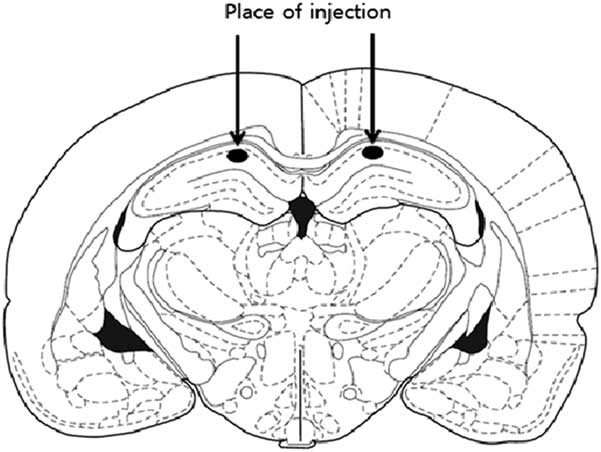
During the withdrawal period, animals were positioned in a stereotaxic apparatus under pentobarbital anesthesia (50 mg/kg, i.p.) and implanted with a 26-gauge guide cannula (Plastics One, Roanoke, VA, USA) into the bilateral cornu ammonis area (CA) 1 of the hippocampus (AP: −3.6 mm, ML: ±2.0 mm, and DV: −2.7 mm from skull) (Fig. 1) (Reference Paxinos13). Microinjections were performed immediately before the test by inserting the injector into the guide cannula. Animals were administered cobalt chloride (CoCl2, 1 mM) or saline into the bilateral CA1 (0.2 µl over 10 s), as previously described (Reference Fortaleza, Tavares and Correa14–Reference Lomber18). After microinjection, the injector was kept in place for 30 s to avoid reflux.
Site of microinjection (CA1 region of dorsal hippocampus).

Statistical analysis
Data were analysed by one-way analysis of variance (ANOVA) and the post-hoc Tukey test. In all cases, p<0.05 was considered to indicate statistical significance.
Results
Experiment 1: effect of the number of exposures on morphine-seeking behaviour
Total amount of morphine consumed before withdrawal
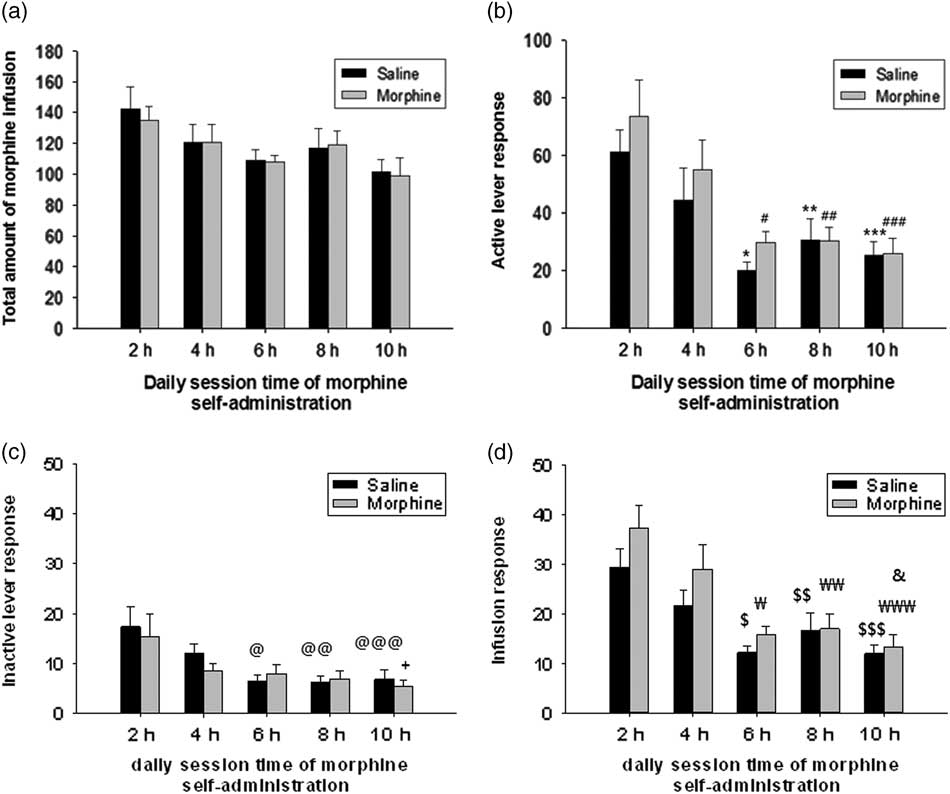
To investigate whether the total amount of morphine consumed during a 42 h self-administration period differed significantly among the exposure groups, the infusion numbers of each group were compared. Results showed no significant differences among the groups (p>0.068 for saline priming and p>0.070 for morphine priming), suggesting that each group had consumed similar amounts of morphine during training (Fig. 2a).
Active lever responses during relapse
To examine the degree of morphine-seeking behaviour, the numbers of active lever presses during the relapse test session were compared. One-way ANOVA and the post hoc Tukey test revealed that the number of active lever presses of the 2 h group was significantly higher than that of the 6, 8, and 10 h groups, for both saline and morphine priming (Fig. 2b).
Effects of the exposure time on the morphine-seeking behaviour. (a) Amount of total intake during morphine self-administration period for 42 h. (b) Number of active lever responses on the test session. *: 2 h group versus 6 h group (p=0.0007), **: 2 h group versus 8 h group (p=0.0267), ***: 2 h group versus 10 h group (p=0.0046) on the saline priming; # : 2 h group versus 6 h group (p=0.0016), ## : 2 h group versus 8 h group (p=0.0025), ### : 2 h group versus 10 h group (p=0.0007) on the morphine priming. (c) Number of inactive lever responses on the test session. @ : 2 h group versus 6 h group (p=0.0091), @@ : 2 h group versus 8 h group (p=0.0121), @@@ : 2 h group versus 10 h group (p=0.0157) on the saline priming; + : 2 h group versus 10 h group on the morphine priming (p=0.0390). (d) Number of infusion on the test session. $ : 2 h group versus 6 h group (p=0.0002), $$ : 2 h group versus 8 h group (p=0.0165), $$$ : 2 h group versus 10 h group (p=0.0003) on the saline priming, \ : 2 h group versus 6 h group (p=0.0003), \\ : 2 h group versus 8 h group (p=0.0009), \\\ : 2 h group versus 10 h group (p=0.0003), & : 4 h group versus 10 h group (p=0.0213), on the morphine priming. Results are mean±SEM. One-way ANOVA and post hoc Tukey test. 2 h, 4 h, 6 h and 8 h groups, n=12; 10 h group, n=10.

Inactive lever responses during relapse
With respect to the numbers of inactive lever presses during relapse, statistical analyses revealed significant differences between the 2 h group and each of the 6, 8, and 10 h groups for saline priming, and between the 2 h group and the 10 h group for morphine priming (Fig. 2c).
Infusions during relapse
With respect to infusion numbers during the test session, there were significant differences between the 2 h group and the 6, 8, and 10 h groups for both saline and morphine priming. Additionally, the infusion numbers of the 4 h group differed significantly from that of the 10 h group in the context of morphine priming (Fig. 2d).
Experiment 2: effects of CoCl2 injection into the CA1 on morphine-seeking behaviour
To investigate the effects of memory on relapse, animals trained to self-administer morphine using a daily 2 h session received microinjections of either CoCl2 or saline into the CA1 of the hippocampus.
Active lever responses during relapse
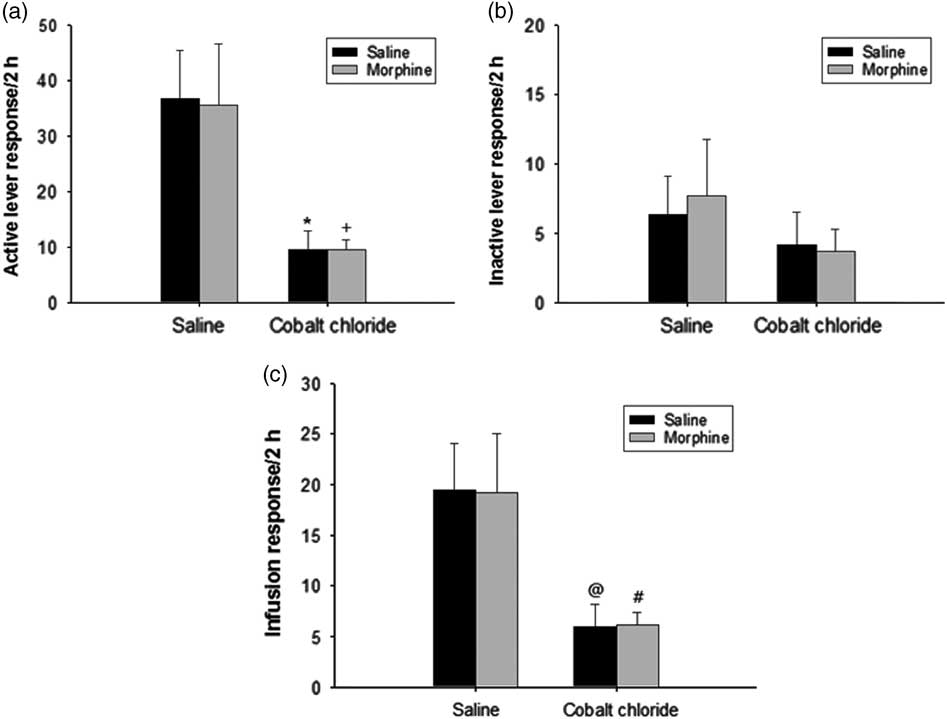
During the relapse session, the numbers of active lever presses were significantly different between the saline group and the CoCl2 group, for both saline and morphine priming (Fig. 3a).
Effect of CoCl2 injected into CA1 on the morphine-seeking behaviour. (a) Number of active lever response on the test session. *: saline group versus CoCl2 group on the saline priming (p=0.017), +: saline group versus CoCl2 group on the morphine priming (p=0.043). (b) Number of inactive lever response on the test session. (c) Number of infusion on the test session. @ : saline group versus CoCl2 group on the saline priming (p=0.023), # : saline group versus CoCl2 group on the morphine priming (p=0.046). Results are mean±SEM. One-way ANOVA and post hoc Tukey test. Each group, n=6.

Inactive lever responses during relapse
During the test session, the numbers of inactive lever presses were attenuated by injection of CoCl2 into the CA1, for both saline and morphine priming; however, the difference was not significant (Fig. 3b).
Infusions during relapse
During relapse, the infusion numbers were significantly different between the saline group and the CoCl2 group, for both saline and morphine priming (Fig. 3c).
Discussion
In the present study, we assessed the influence of the exposure pattern associated with the formation of memories of a particular environment on morphine-seeking behaviour after withdrawal.
During the self-administration period, all animals received the same total exposure time and consumed a similar amount of morphine (Fig. 2a). However, the degree of morphine-seeking behaviour after withdrawal significantly differed among the groups. The 2 h group, which self-administered for 21 days, exhibited the most severe morphine-seeking behaviour compared to the 6, 8, and 10 h groups (Fig. 2b and d). The same pattern was observed in the context of both morphine priming and saline priming. In addition, the number of infusions of the 4 h group was significantly larger than that of the 10 h group. These results suggest that a greater number of exposure events results in more severe drug-seeking behaviour after withdrawal.
Even in the non-drug-paired inactive lever responses, a significant difference was observed with the same pattern (Fig. 2c) of active lever responses and infusions; the 2 h group showed an increased response. Given that the morphine was substituted with saline in the test session, this suggests that animals from the 2 h group craved enough morphine to cause them to press the inactive lever.
Finally, given that each group consumed a similar amount of morphine during the same total exposure time, we conclude that more discrete drug-taking experiences result in stronger craving after withdrawal. The present results are consistent with other reports on the influence of administration patterns on behavioural and neurochemical outcomes. According to other studies, different intake patterns produce different results in behaviour and receptor levels in the context of both morphine and cocaine drug-taking (Reference Le Marec, Marie-Claire, Noble and Marie19–Reference Puig, Marie, Benturquia and Noble21). These results, together with our data, suggest that the drug administration pattern is important for the understanding and treatment of addiction.
What mechanisms underlie these results? With respect to why the administration pattern influences the degree of craving after abstinence, we focussed on the memory formed from the experience. Because the 2 h group experienced more drug-taking sessions, it is possible that this increased experience resulted in the formation of a stronger memory of reward which, in turn, resulted in increased craving after abstinence.
Given that blocking the hippocampus can inhibit relapse, the memory function of the hippocampus is thought to be involved in the craving for morphine in this study. To confirm this, CoCl2 was microinjected into the CA1 of the hippocampus of rats trained to self-administer morphine using 2 h daily sessions that exhibited the strongest craving response in the first experiment.
As a consequence, microinjection resulted in a significant reduction in morphine-seeking behaviour compared with saline injections, and this effect was observed for both morphine priming and saline priming (Fig. 3). These results suggest that the memory function of the hippocampus is involved in the morphine craving exhibited by the 2 h group.
Interestingly, a number of studies have indicated that the development process of addiction is similar to that of learning and memory. Basic cellular mechanisms involving DA, glutamate, and their associated-intracellular protein kinases have been the focus of intense research concerning reward-related learning and addiction (Reference Kelley22). Other recent studies have indicated that a neuron known as the engram-bearing cell is associated with a specific memory trace (Reference Josselyn23–Reference Han, Kushner and Yiu25). The hippocampus is known to play an important role in the formation, consolidation, and retrieval of episodic memories (Reference Bird and Burgess26,Reference Clark, Zola and Squire27), and in the hippocampus, the CA1 region is thought to be critical for spatial memory (Reference Yiu, Rashid and Josselyn28–Reference Yang, Wen and Dong30). The activation of CA1 synaptic inputs causes long-term potentiation of the α-amino-3-hydroxy-5-methyl-4-isoxazoleproprionic acid receptor in relation to memory (Reference Whitlock, Heynen, Shuler and Bear31). These data suggest that the CA1 region is of great importance for spatial memory.
The second experiment was carried out to determine whether spatial memory underlies the 2 h group’s severe relapse, in parallel with previous studies (Reference Taubenfeld, Muravieva, Garcia-Osta and Alberini32). The results from this experiment support the role of hippocampus-associated memory for relapse not only in the context of drug exposure, but also in the context of non-drug exposure, as shown for saline priming.
Furthermore, it is interesting that the saline priming and morphine-priming conditions were not significantly different in the relapse session. According to our previous studies (Reference Lee, Lim and Jeon11,Reference Lee, Ma and In12), a pharmacological cue induced a similar level of morphine-seeking behaviour compared to before abstinence, whereas a pharmacological plus an environmental cue induced a seven-fold higher degree of morphine-seeking compared to before abstinence, implying that the environmental cue plays a more important role than the pharmacological cue in the relapse to morphine. Therefore, the present result is thought to have come about because the effect of the pharmacological cue was obscured by the effect of the environmental cue, and this result may be linked to our hypothesis that memory may play a more important role in relapse than morphine priming.
Taken together, the present findings demonstrated that more exposure events resulted in more severe morphine-seeking behaviour after withdrawal, implying that the consumption pattern influences the degree of relapse. Therefore, the drug-taking pattern must be considered for the understanding and treatment of relapse. Further studies are needed to investigate to what extent memory is involved in the degree of craving.
Acknowledgements
Authors’ Contributions: Sunghyun In and Hye Ryeong Han performed the experiments and collected data. Rong Jie Zhao and Chae Ha Yang drafted. Hee Young Kim and Young S. Gwak discussed the experiment schedules and methods and did data analysis. Bong Hyo Lee designed this study and finalised the manuscript.
Financial Support
This study was supported by Basic Science Research Program through the National Research Foundation of Korea (NRF) funded by the Ministry of Education (2010-0025821) and the Research Fund for Overseas & Returned Scholars from the Heilongjiang Provincial Department of Education, China (No. 1154h22).
Conflicts of Interest
None.
Ethical Standards
The authors assert that all procedures contributing to this work comply with the ethical standards of the relevant national and institutional guides on the care and use of laboratory animals.