Introduction
Preterm birth (<37 weeks gestation) affects 10% of U.S. births and up to 18% of all births worldwide. 1,2 Increasing preterm birth survival rates has introduced a new population of survivors reaching adulthood, making it critically important to understand the long-term health consequences of preterm birth. Reference Greer, Troughton, Adamson and Harris3 Growing evidence associates preterm birth with increased risk for the development of hypertension and other chronic conditions including diabetes, metabolic syndrome, and asthma. Reference Crump, Winkleby and Sundquist4-Reference Heikkila, Pulakka and Metsala11 To date, most preterm-adult disease prevalence studies terminate at early adulthood and are conducted in Nordic European nations with universal health care and less racial diversity, perhaps revealing better outcomes than in the U.S. Reference Crump, Winkleby, Sundquist and Sundquist12-Reference Hack, Schluchter, Cartar and Rahman14 Consequently, it is not known whether chronic health conditions persist, change, occur in higher frequency, and with multiple conditions in preterm-born mid-late U.S. adults. Since preterm birth history is widely known by individuals and their families, early risk is known and can be monitored from infancy to adulthood.
Hypertension, the strongest cardiovascular disease (CVD) risk factor acquired during life, is the most prominent health condition found in preterm-born adults. Reference de Jong, Monuteaux, van Elburg, Gillman and Belfort5,Reference Parkinson, Hyde, Gale, Santhakumaran and Modi6,Reference Mohamed, Marciniak and Williamson9,Reference Wang, Yuan and Zheng15,Reference Kringeland, Tell and Midtbø16 Women, representing 51% of the hypertensive population, experience a steeper increase in blood pressure beginning in the 3rd decade of life, are predisposed to increased CVD risk at lower blood pressure levels, and develop adverse pathophysiologic cardiovascular consequences compared to men. Reference Gerdts, Sudano and Brouwers17-Reference Wenger, Arnold and Bairey Merz19 Hypertension is highly prevalent among individuals with rheumatoid arthritis (RA); a comorbidity three times more common in women than men. Reference Jagpal and Navarro-Millán20-Reference Favalli, Biggioggero, Crotti, Becciolini, Raimondo and Meroni22 Furthermore, individuals with hypothyroidism are predisposed to the development of hypertension. Reference Berta, Lengyel and Halmi23,Reference McCoy, Crowson and Gabriel24 Hypothyroidism affects approximately 30 million people aged ≥18 years in the U.S. and is 5–10 times more likely to occur in women compared to men. Reference Dunn and Turner25,Reference Wyne, Nair and Schneiderman26 Studies on the prevalence of concurrent hypertension, RA, and hypothyroidism are limited. Huang et al. Reference Huang, Sung, Chen, Lin, Lin and Huang27 found the incidence of hypothyroidism to be 1.74-fold higher in the RA sufferers, hypertension to be the greatest comorbid CVD risk factor in RA individuals, and the risk of hypothyroidism to be increased further in individuals with hypertension. These findings are based on the general adult population. The increased risk of chronic disease multimorbidity in adults born preterm, and preterm-born women has been minimally studied. Reference Luu, Katz, Leeson, Thébaud and Nuyt10,Reference Heikkila, Pulakka and Metsala11
The underpinnings of the Developmental Origins of Health and Disease (DOHaD) theory substantiate the greater likelihood of multimorbidity in preterm-born adult women. Reference Barker28 Disrupted organ development associated with preterm birth, together with early-life factors and environmental exposures that precipitate epigenetic modifications, is the basis for this investigation of hypertension and two prominent related conditions in women, RA and hypothyroidism. Reference Anyfanti, Gkaliagkousi and Triantafyllou21,Reference Favalli, Biggioggero, Crotti, Becciolini, Raimondo and Meroni22,Reference Dunn and Turner25,Reference Huang, Sung, Chen, Lin, Lin and Huang27-Reference Mahagna, Caplan and Watad29 The strong associative evidence of hypertension with RA and hypothyroidism occurring simultaneously supports the rationale of a higher prevalence of the same three conditions in adult women born preterm, an already susceptible population. Reference Luu, Katz, Leeson, Thébaud and Nuyt10,Reference Heikkila, Pulakka and Metsala11 To our knowledge, this is the first U.S. study of adults 50 years of age and older who were born preterm, in which the co-occurrence and cumulative prevalence of these three conditions are examined.
The three study aims comparing term-born to preterm-born adult women were to (1) evaluate the prevalence of each condition alone; (2) estimate the co-occurrence of two and three conditions; and (3) determine the cumulative prevalence of each condition alone and concurrently. To answer these aims, we leveraged the Women’s Health Initiative Observational Study (WHI-OS), a large-scale, racially and ethnically diverse, well-characterized, longitudinal cohort of U.S postmenopausal women. Reference Anderson, Manson and Wallace30,Reference Langer, White, Lewis, Kotchen, Hendrix and Trevisan31
Methods
Study design and participants
The WHI is a prospective longitudinal cohort study of women aged 50–79 years (birth years 1920s–1940s) designed to investigate the major causes of chronic disease in postmenopausal women, including risk factors for CVD, breast and colorectal cancers, and osteoporotic fractures. The WHI’s study design, recruitment methods, inclusion and exclusion criteria, and implementation have been described elsewhere. Reference Anderson, Manson and Wallace30,Reference Langer, White, Lewis, Kotchen, Hendrix and Trevisan31 Briefly, 161,608 women were enrolled in three overlapping clinical trials (WHI-CT, n = 67,932) or the longitudinal Observational Study (WHI-OS, n = 93,676). Reference Anderson, Manson and Wallace30,Reference Langer, White, Lewis, Kotchen, Hendrix and Trevisan31
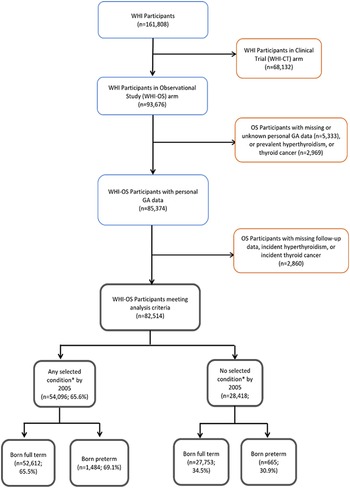
The present study included women who enrolled in the WHI-OS between 1993 and 1998 (n = 93,676). Of the 93,676 women enrolled in the WHI-OS, the following women were excluded: (1) women with missing or unknown personal gestational age data (n = 5,333), (2) women with a self-reported history of prevalent hyperthyroidism (n = 2,532); prevalent thyroid cancer (n = 470); and, prevalent hyperthyroidism and thyroid cancer (n = 33), and (3) women who developed hyperthyroidism (n = 2,621); thyroid cancer (n = 262); or, both conditions (n = 23) during the follow-up years, ending in 2005. The final analytical count after the specified exclusions was 82,514 women (Fig. 1).
Prevalence of selected condition by 2005.
WHI, women’s health initiative; OS, observational study; GA, gestational age; *, selected condition consist of any of the following: hypertension, hypothyroidism, and/or rheumatoid arthritis.

Exposures
Birth status, the primary exposure variable, was ascertained from WHI-OS participants at enrollment. Women were asked when born, were they “full term (a pregnancy that lasted about 9 months), 4 or more weeks premature, or don't know.”
Outcomes
Hypertension was based on the self-reported physician diagnosis of hypertension at enrollment, the annual medical history questionnaires during the follow-up years (years 1–9), being treated for hypertension with antihypertensive medications, or if systolic blood pressure (SBP) ≥140 mmHg and/or diastolic blood pressure (DBP) ≥90 mmHg (treated or untreated) was identified at enrollment. Further, to make a hypertension diagnosis comparable to RA and hypothyroidism, hypertension incidence was examined through the year 2005 (the end of the core study).
The development of RA and hypothyroidism were determined through questionnaires obtained at enrollment (prevalence at baseline) and the continuing annual WHI-OS follow-up surveys administered from Year 1 through Year 9 of the core study (1994–2005). Although the WHI-OS continued to collect data for years after 2005, information on the development of RA (collected on the annual Medical History Update form) and hypothyroidism (collected on the yearly OS Follow-Up form) were not collected after 2005 due to the removal of RA from subsequential Medical History Update forms and the cessation of OS follow-up. The analyses reflect the cumulation of prevalent disease at study enrollment and as reported each year.
Covariates
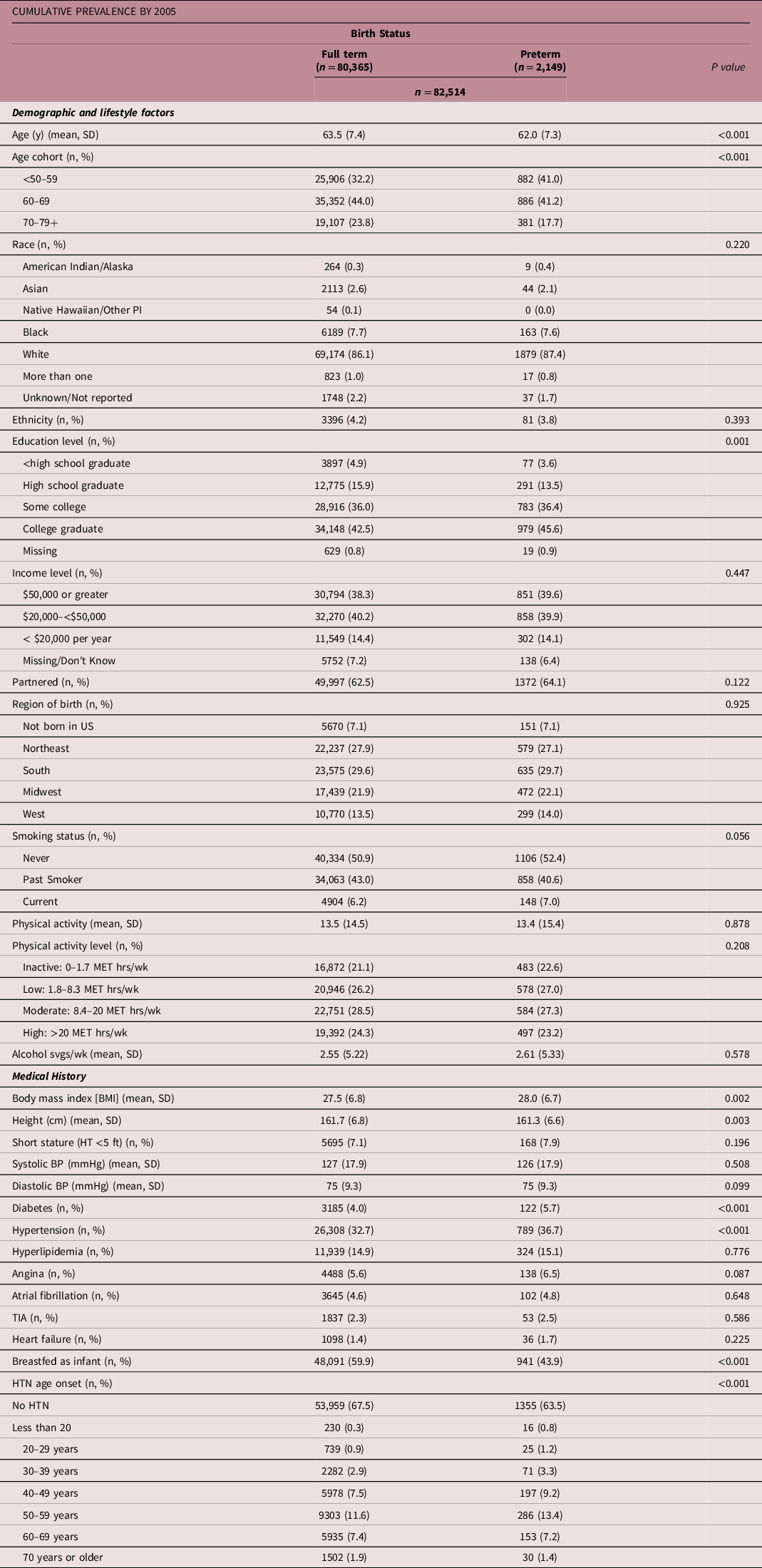
Selected covariates from enrollment were categorized as sociodemographic, lifestyle, and risk factors. Selected sociodemographic covariates included race/ethnicity, education level (four categories ranging from < high school graduate to college graduate), income level (three categories from <$20,000 per year to ≥$50,000 per year), marital status (partnered/not partnered), and region of birth (Northeast, South, Midwest, West, or not born in the U.S.). Lifestyle covariates incorporated smoking status (never, past, and current), physical activity (inactive, low, moderate, and high), alcohol intake (servings/week), and body mass index (BMI). Risk factor covariates were short stature (height <5 feet), breast fed as an infant, and the report of diabetes or hyperlipidemia (Table 1). Reference Langer, White, Lewis, Kotchen, Hendrix and Trevisan31
Characteristics of WHI-OS participants by birth status at enrollment and at the end of core study (1993–2005)

WHI-OS = Women’s Health Initiative Observational Study; y = year(s); n = number; SD = standard deviation; cm = centimeters; mmHg = millimeters of mercury; PI = Pacific Islander; HT = height; MET = metabolic equivalent for task; hrs/wk=hours per week; TIA = transient ischemic attack; HTN = hypertension. One-way ANOVA was used to determine the difference in birth status for continuous variables and chi-square analysis was used to examine the difference in birth status for categorical variables.
Ethical considerations
Participants provided written consent at the time of enrollment, and ethics approval was granted by each enrolling center’s Institutional Review Board. Reference Anderson, Manson and Wallace30,Reference Langer, White, Lewis, Kotchen, Hendrix and Trevisan31
Statistical analyses
Analyses were performed by birth status (preterm, term) using baseline data. Descriptive statistics were used (mean and standard deviation for continuous variables; count and percentage for categorical variables) to summarize socio-demographic characteristics. For continuous variables we looked at the difference in birth status using one-way ANOVA. For categorical variables, we examined the difference in birth status using chi-square analysis. Covariates selected for inclusion in modeling were known risk factors for hypertension, RA, and hypothyroidism. Demographic variables included education level, income level, marital status, and region of birth. Lifestyle variables incorporated smoking status, physical activity, alcohol intake, and BMI. Risk factor covariates were defined as short stature, diabetes, hyperlipidemia, and breastfed as an infant. Initially, individual conditions were analyzed using logistic regression models and included the other conditions as covariates.
Modeling of the combined diagnosis outcome was configured in two ways. The first outcome configuration summed the presence of the three diagnoses (conditions) under examination per participant and ranged from 0 to 3 (no diagnosis to all three diagnoses). The second outcome configuration examined the actual diagnoses combinations present in each participant (none, RA only, hypothyroidism only, hypertension only, hypothyroidism and RA, RA and hypertension, hypertension and hypothyroidism, and all three – hypertension, RA, and hypothyroidism). Both configurations of the outcome variable were modeled with multinomial logistic regression using no diagnosis (no condition) as the reference. Odds ratio (OR) and their associated 95% confidence intervals estimated the association of diagnosis by birth status. The first model included age, race/ethnicity, education level, income level, marital status, and region of birth. The second model included age, smoking status, physical activity, alcohol intake, and BMI. The third model included age, short stature, diabetes, hyperlipidemia, and breastfed as an infant. Building on the previous models, the fourth model included those from model 1 without marital status, model 2 and model 3. Marital status was removed from model 4 because it did not have a significant effect in the modeling. This was performed after adjusting for potential confounders such as age and race/ethnicity. Analyses were conducted using SAS v9.4 (Cary, NC). A significance level of p ≤ 0.05 was used for all analyses unless otherwise noted.
Results
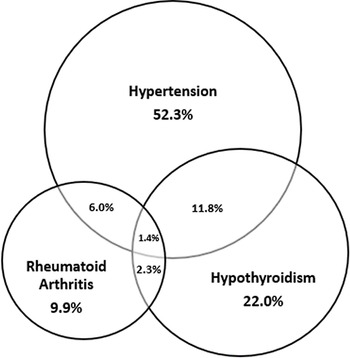
Results of the baseline characteristics of women born preterm compared to women born full term are outlined in Table 1. Women born preterm were more likely to be younger, identify as White, and self-report as having diabetes, hypertension, and diagnosed with hypertension at a younger age. As shown in Fig. 2, hypertension was the most prevalent independent condition (52.3%), followed by hypothyroidism (22.0%) and RA (9.9%) in the full cohort of WHI-OS participants (n = 82,514). Hypertension and hypothyroidism were the most common comorbidities (11.8%), followed by hypertension and RA (6.0%). The co-occurrence of all three conditions was 1.4% for the WHI-OS participants.
Unadjusted rates of cumulative prevalent condition at study’s end (2005).

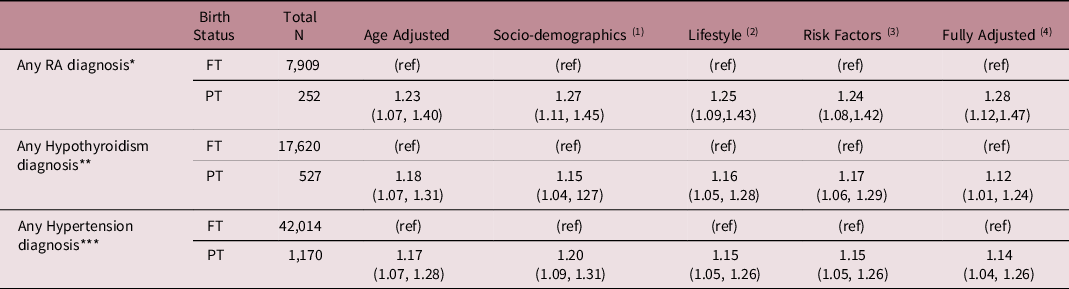
For study aim 1, the logistic regression model for individual diagnosis determined that women born preterm were 14% more likely to have hypertension, 28% more likely to have RA, and 12% more likely to have hypothyroidism compared to their full-term peers (aOR 1.14, 95% CI [1.04, 1.26]; aOR 1.28, 95% CI [1.12, 1.47]; and aOR 1.12, 95% CI [1.04, 1.26], respectively). The odds ratio for each diagnosis, corrected for the other conditions as covariates by birth status, is shown in Table 2.
Adjusted odds ratio with 95% confidence intervals from logistic regression model for individual diagnoses by birth status

N = number; reference group (ref) = women born full term; FT = full-term born women; PT = preterm-born women; RA = rheumatoid arthritis.
(1) - model covariates include age, race/ethnicity, education, income, marital status, and region of birth.
(2) - model covariates include age, smoking status, physical activity, alcohol intake, and BMI.
(3) - model covariates include age, short stature, diabetes, hyperlipidemia, and breastfed as infant.
(4) - model covariates include those from (1) without marital status, (2), and (3).
*RA models also include indicator variables for hypothyroidism and hypertension as covariates; **Hypothyroidism models also include indicator variables for RA and hypertension as covariates; ***Hypertension models also include indicator variables for RA and hypothyroidism as covariates.
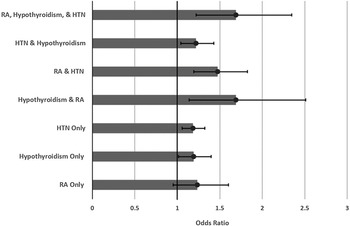
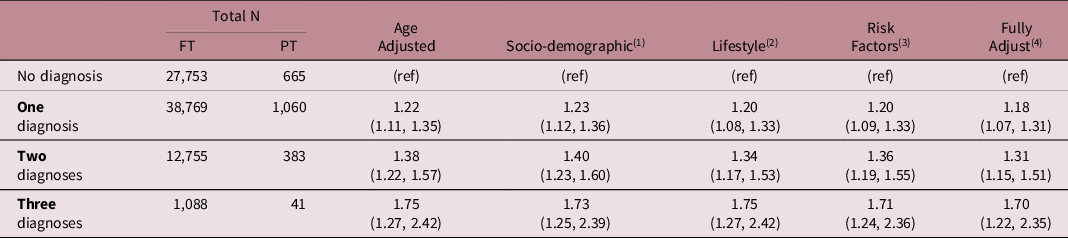
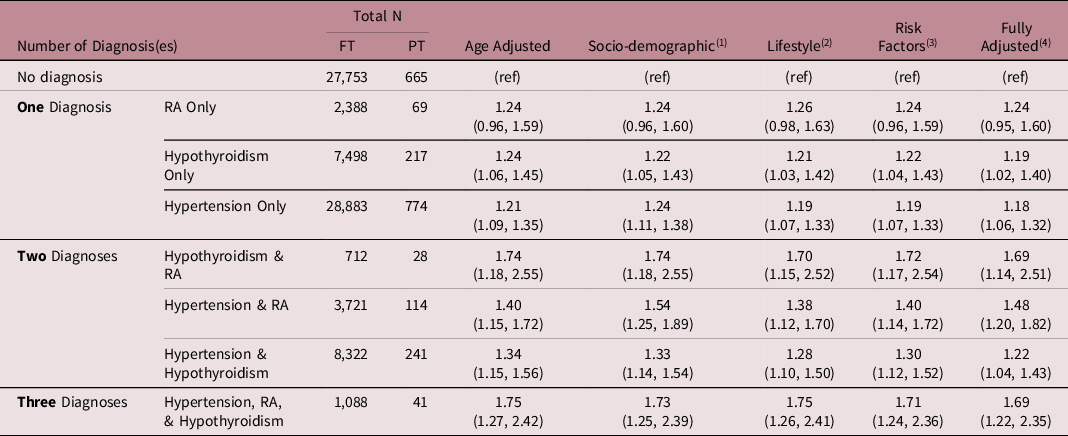
The cumulative prevalence count of the three conditions for birth status, using full term women as the reference is depicted in Table 3. As shown, preterm-born women were at a greater risk for morbidity and multimorbidity. For aim 2, the actual diagnosis combinations are shown in Table 4. Women born preterm were found to be at an increased risk for hypertension, RA, and hypothyroidism, alone, concomitantly, and in any combination compared to women born full term (Table 4 and Fig. 3). Preterm-born women had approximately a 20% greater likelihood of having any one of the selected conditions (aOR 1.18 hypertension; aOR 1.24 RA; and aOR 1.19 hypothyroidism) compared to women born full term. In terms of diagnosis combinations (aim 3), preterm-born women were 69% more likely to have RA and hypothyroidism [aOR 1.69 (1.14, 2.51)], 48% more likely to have RA and hypertension [aOR 1.48 (1.20, 1.82)], and 22% more likely to have hypertension and hypothyroidism [aOR 1.22 (1.04, 1.43)]. Further, preterm-born women had a 69% higher risk of having all three conditions compared to women born full term [aOR 1.69, 95% CI (1.22, 2.35)].
Fully adjusted odds ratio and 95% confidence intervals for preterm-born women.
HTN, hypertension; RA, rheumatoid arthritis; reference group = women born full term. Fully adjusted model covariates include age, race/ethnicity, education, income, region of birth, smoking status, physical activity, alcohol intake, BMI, short stature, diabetes, hyperlipidemia, and breastfed as infant.

Adjusted odds ratio with 95% confidence interval from multinomial logistic regression model for the cumulative diagnosis count for preterm-born women

N = number; reference group (ref) = women born full term; FT = full-term born women; PT = preterm-born women.
(1) - model covariates include age, race/ethnicity, education, income, marital status, and region of birth.
(2) - model covariates include age, smoking status, physical activity, alcohol intake, and BMI.
(3) - model covariates include age, short stature, diabetes, hyperlipidemia, and breastfed as infant.
(4) - model covariates include those from (1) without marital status, (2), and (3).
Adjusted odd ratio with 95% confidence interval from multinomial logistic regression model for diagnosis combinations for preterm-born women

N = number; reference group (ref) = women born full term; FT = full-term born women; PT = preterm-born women; RA = rheumatoid arthritis.
(1) - model covariates include age, race/ethnicity, education, income, marital status, and region of birth.
(2) - model covariates include age, smoking status, physical activity, alcohol intake, and BMI.
(3) - model covariates include age, short stature, diabetes, hyperlipidemia, and breastfed as infant.
(4) - model covariates include those from (1) without marital status, (2), and (3).
Discussion
Hypertension, RA, and hypothyroidism have been studied independently as comorbidities in the general population, but not in preterm-born adults to our knowledge. Our findings concur with research of adults born preterm having an increased risk of elevated blood pressure. Reference Crump, Winkleby and Sundquist4,Reference Bates, Levy and Nuyt32-Reference Brewer, D'Agata and Roberts40 We found preterm-born women of the WHI-OS had a 20% higher risk for the development of hypertension. Their hypertension onset was reported at a younger age and required more medication for control (Table 1). International studies have reported SBP 2–8 mmHg higher, greater 24-hour variability in those born preterm starting as young as six years of age, and more antihypertensive agents for blood pressure control compared to hypertensive full-term peers. Reference Crump, Winkleby and Sundquist4-Reference Parkinson, Hyde, Gale, Santhakumaran and Modi6,Reference Sipola-Leppanen, Karvonen and Tikanmaki39 However, the lack of comparative studies in older preterm-born adults hinders our understanding of the life trajectory and cardiovascular consequences of early-onset hypertension.
Our examination of RA in preterm-born adult women found preterm birth associated with a 24% greater likelihood of RA. When paired with a comorbidity such as hypertension or hypothyroidism, prematurity resulted in a 40–75% greater likelihood of RA. Few studies have explored this association and those that did found low birth weight and preterm birth associated with a reduced risk of RA. Reference Carlens, Jacobsson, Brandt, Cnattingius, Stephansson and Askling41-Reference Jacobsson, Jacobsson and Askling43 In one study, the sample size was small (n = 15), and the OR was nonsignificant 1.4 (0.7, 3.0). Reference Jacobsson, Jacobsson and Askling43 Another found low birth weight (<3000 g) and preterm birth (gestational age ≤37 weeks) were not statistically associated with the development of RA [OR 0.6 (0.7, 1.0)]. Reference Carlens, Jacobsson, Brandt, Cnattingius, Stephansson and Askling41 Similar results for women [RR 1.1 (0.8, 1.5)] were found by Simard et al. Reference Simard, Costenbader and Hernán44 in the Nurses’ Health Study, a comparable sized study to the WHI. It is important to note that in these cited investigations, the cut-off points or references defining preterm status differed from the accepted definitions. For instance, in Simard et al.’s Reference Simard, Costenbader and Hernán44 study preterm birth was defined as a birth <38 weeks gestation and Carlens et al.’s Reference Carlens, Jacobsson, Brandt, Cnattingius, Stephansson and Askling41 definition of low birth weight was <3000 g rather than <2500 g as defined by the World Health Organization. Reference Sparks, Chang and Liao45,46 In short, there are no large-scale, longitudinal studies of preterm-born adults to compare our RA findings.
Research on hypothyroidism and preterm birth have resulted in variable findings. Reference Crump, Winkleby, Sundquist and Sundquist12,Reference Brix, Hansen and Rudbeck47-Reference Phillips, Osmond, Baird, Huckle and Rees-Smith49 Small sample populations have limited the ability to discern an association between prematurity and underactive thyroid development. Reference Crump, Winkleby, Sundquist and Sundquist12 An evaluation of 27,935 young adults born preterm (23–32 weeks) found preterm birth associated with an increased risk (aOR 1.59, 95% CI [1.18–2.14]) of pharmacologically treated hypothyroidism, independent of fetal growth. Reference Crump, Winkleby, Sundquist and Sundquist12 Our findings align with this literature. The WHI-OS preterm-born adult women were on average 20% more likely to have hypothyroidism, approximately 30% more likely to have hypothyroidism paired with hypertension, and 70% more likely to have hypothyroidism and rheumatoid arthritis.
In summary, our findings add to the literature associating preterm birth with a higher prevalence of chronic disease comorbidity and multimorbidity. The increased awareness of multimorbidity in preterm-born adult women, presently non-existent, is necessary as the large and growing preterm-born population age into mid-late adulthood. Importantly, each condition examined in this study independently increases the risk for CVD, and as high as a fourfold increased risk when any combination of these conditions occur concomitantly. Reference Raterman, van Halm and Voskuyl50 Recognition and treatment of these co-occurring conditions and CVD risk factors may be crucial in reducing CVD in women.
Strengths and limitations
Strengths of this study include its large, national U.S. sample with extensive data collection. The prospective design of the WHI-OS provided the evaluation of 8 years of cumulative disease prevalence. Numerous potential confounders, such as education, income, and lifestyle factors, like BMI, alcohol intake, and physical activity, that may modify underlying associations between birth status and the three conditions of study, were included in the analysis. Notably, studies of multimorbidity in aging preterm-born individuals are limited.
Self-report data, specifically in regard to birth status and the prevalence of each condition limits our findings. Birth certificates and birth registries are the most reliable birth data collection methods, while medical records are for diagnosis of disease or condition. Without documented birth records, the self-report of a woman’s own gestational age is a weakness. However, the correlation between maternal recall and the accuracy of childbirth has been found to be as high as 89%, particularly when they occurred at earlier gestational ages. Reference Catov, Newman and Kelsey51-Reference Yawn, Suman and Jacobsen53 Other limitations include cautious interpretation of the data when the subsample size was small, an incorrect self-reported condition as other conditions may resemble RA, and the inability to adjust for all covariates. Reference Deane, Demoruelle, Kelmenson, Kuhn, Norris and Holers54
Conclusion
Preterm birth was significantly associated with higher risks for hypertension, RA, and hypothyroidism, alone and concomitantly in a national U.S. sample of preterm-born postmenopausal women. To our knowledge, this is the first known study of its kind to evaluate the association between birth status and three CVD risk conditions concurrently in preterm-born adults over 50 years of age. This research provides additional evidence regarding the role of early developmental phenotypes in the development of later-life conditions, further illustrating the importance of targeted interventions across the lifespan to reduce the burden of these CVD-associated conditions. As each condition is an independent risk for CVD, it is plausible to suggest CVD risks would be significantly amplified when all three conditions co-exist. Inquiring about birth status during clinical encounters can heighten awareness to stimulate preemptive screening, earlier identification and treatment, and to help avert adverse cardiovascular outcomes for preterm-born adults. Directions for future research include large prospective studies of women and men with lifelong follow-up to substantiate findings and expand our understanding of the interplay of organ systems and prematurity. In addition to human studies, mechanistic experimental animal research may identify pathways that contribute to organ alterations which may be translated into human clinical interventions that reduce the CVD risk in preterm-born individuals.
Acknowledgements
We thank the WHI-OS study participants for their long-term dedication to research and for making this study possible, as well as the WHI principal investigators.
Financial support
The WHI is funded by the National Heart, Lung, and Blood Institute, National Institutes of Health, U.S. Department of Health and Human Services through contracts HHSN268201100046C, HHSN268001100001C, HHSN268201100002C, HHSN268201100003C, HHSN268201100004C, and HHSN271201100004C.
Competing interest
None.
Ethical standard
The authors assert that all procedures contributing to this work comply with the ethical standards of the Helsinki declaration of 1975, as revised in 2008. The WHI Publications and Presentations Committee and the University of Rhode Island Institutional Review Board approved this study. Patient consent was not required for this secondary data analysis as women provided written consent at the time of enrollment and ethics approval was granted by each enrolling center’s institutional review board.