Introduction
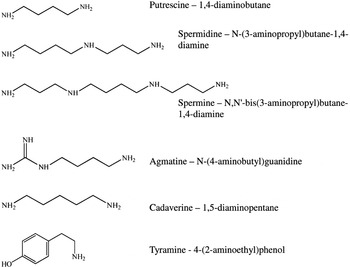
Polyamines (PAs) and aromatic amines are components of living cells that participate in diverse processes, including regulation of gene expression, translation, cell proliferation, modulation of cell signalling, biomembrane stabilization and modulation of ion channel action (Kusano et al., Reference Kusano, Berberich, Takeda and Takahashi2008; Igarashi & Kashiwagi, Reference Igarashi and Kashiwagi2010). Their activity is often connected with the ability to bind macromolecules such as proteins and nucleic acids. Amines occur in various plant species in free forms and/or as amide derivatives synthesized through conjugation with hydroxycinnamic acids (HCAAs). Among them, putrescine, spermidine, spermine, agmatine and cadaverine as well as aromatic tyramine are common compounds of plant tissues (fig. 1). In healthy plant tissues, their content ranges from 100 µM to a few millimolar and is tightly regulated (Kusano et al., Reference Kusano, Yamaguchi, Barberich and Takahashi2007). According to Horbowicz et al. (Reference Horbowicz, Kosson, Sempruch, Dębski and Koczkodaj2014), the content of putrescine reaches approximately 2–3.5 µmol g−1 fresh weight in radish, about 400 nmol g−1 in maize and several to tens of nanomoles g−1 in tomato and onion tissues. Spermidine levels range from several nanomoles to several hundred nanomoles g−1 in these plant species, and spermine was detected only in tomato and onion in the amount of several nanomoles g−1. Amounts of cadaverine varied from above 1 nmol to 15 mols g−1 fresh weight, depending on the plant species and organ examined (Tomar et al., Reference Tomar, Lakra and Mishra2013). However, agmatine occurs in traces in plant tissues, acting as an intermediate in putrescine biosynthesis. The aromatic monoamine tyramine, depending on the plant material, may be present in traces (e.g., in parsley and zucchini) or in range of 0.1 to approximately 1 mg 100 g−1 fresh weight (arugula and broad bean) (Moret et al., Reference Moret, Selma, Populin and Conte2005). Moreover, it is well-known that the PA concentrations that are necessary to exert physiological effects are on the millimoles rather than the μmoles level.
Chemical structures of common plant polyamines and aromatic tyramine.

At normal levels, biogenic amines are necessary components of living cells, protecting cellular macromolecules and biomembrane phospholipids against damage under stress conditions. However, at higher concentrations these compounds may have cytotoxic properties, inducing for example, programmed cell death during the hypersensitive response (HR) (Kusano et al., Reference Kusano, Yamaguchi, Barberich and Takahashi2007). HR is an important part of plant defence against aphids and other herbivorous insects (Ollerstam et al., Reference Ollerstam, Rohfritsch, Höglund and Larsson2002; Moloi & van der Westhuizen, Reference Moloi and van der Westhuizen2006). Thanks to such properties, amines are known molecules involved in stress responses to various abiotic and biotic factors. Accumulation of PAs occurs under stresses caused by drought, salinity, low temperature, heavy metals, herbicides and wounding as well as fungal, bacterial and viral infections (Fariduddin et al., Reference Fariduddin, Varshney, Yusuf and Ahmad2013; Todorova et al., Reference Todorova, Katerova, Sergiev, Alexieva, Ajum and Gill2014). On the other hand, accidental decreases in PA content as a result of some abiotic and biotic stresses are also known. However, the participation of these compounds in biochemical responses developed by plants against infestation by herbivorous insects is still not clear.
Goggin (Reference Goggin2007) suggested that during probing behaviour aphid stylets transiently puncture the epidermis, mesophyll and parenchyma, and such mechanical damage may induce plant responses to the infestation. According to Groppa & Benavides (Reference Groppa and Benavides2008), an increase in the content of free PAs and their HCAA derivatives as well as the induction of key enzymes of their biosynthesis may result from the wounding effect on the infested plant tissues. However, aphids usually penetrate plant tissues via an intercellular route, and their influence on the host results from the assimilation, uptake and injection of salivary secretions into phloem and xylem elements (Saheed et al., Reference Saheed, Liu, Jonsson and Botha2007). The compounds secreted by aphids may be translocated long distances within plant tissues, inducing systemic responses. PAs may participate in plant systemic responses in at least two ways. It was shown that exogenous methyl jasmonate induced increases in transcript levels and activities of key enzymes of PA biosynthesis and elevated levels of HCAAs with a simultaneous reduction of the free PA content in sweet pepper, tobacco, tomato and potato tissues (Mader, Reference Mader1999; Biondi et al., Reference Biondi, Scaramagli, Capitani, Altamura and Torrigiani2001, Reference Biondi, Scoccianti, Scaramagli, Ziosi and Torrigiani2003; Xu et al., Reference Xu, Sheehan and Timko2004; Tebayashi et al., Reference Tebayashi, Horibata, Mikagi, Kashiwagi, Mekuria, Dekebo, Ishihara and Kim2007; Horbowicz et al., Reference Horbowicz, Kosson, Sempruch, Dębski and Koczkodaj2014). In addition, amines may interact with proteins and nucleic acids involved in plant signalling pathways via electrostatic and/or covalent bonds, thus influencing the conformation and activity of these macromolecules. Transgenic tomato lines obtained through transformation with the yeast S-adenosylmethionine decarboxylase (SAMDC) gene were characterized by increases in glutamine, glutamate, asparagine, citrate, malate and fumarate levels and decreases in aspartate, threonine, valine, glucose and sucrose contents (Mattoo et al., Reference Mattoo, Minocha, Minocha and Handa2010). This gene is related to the expression of SAMDC (a key enzyme in spermidine and spermine biosynthesis). Zhao et al. (Reference Zhao, Chen, Cheng, Sun, Liu and Tian2009) observed that grain aphids feeding on wheat increased the activities of key enzymes regulated by both jasmonic acid (JA) and salicylic acid (SA) signalling pathways as well as the relative transcript levels of their defence genes. According to Ferry et al. (Reference Ferry, Edwards, Gatehouse and Gatehouse2004), plant responses caused by sap-feeding insects (i.e., Homoptera) have been shown to be similar to pathogen attacks connected with changes in PA accumulation and metabolism (Jiménez-Bremont et al., Reference Jiménez-Bremont, Marina, de la Luz Guerrero-González, Rosi, Sánchez-Rangel, Rodrigez-Kessler, Ruiz and Gárriz2014). Thus it is suggested that PAs may modify the nutritive value of plants to herbivorous insects. Moreover, aromatic amines such as tyramine and catecholamines may be toxic to herbivorous insects, similarly to plant phenolics (Facchini et al., Reference Facchini, Hübner-Allanach and Tari2000; Kulma & Szopa, Reference Kulma and Szopa2007). In the case of aphid–plant interactions, it was stated that putrescine, spermidine and spermine contents varied in triticale plants infested by Sitobion avenae (F.), and the direction of these changes was dependent on the triticale cultivar and plant organ attacked (Sempruch & Ciepiela, Reference Sempruch and Ciepiela2005). Cereal aphid feeding also influenced polyamine levels and activities of key enzymes of PA and tyramine biosynthesis depending on the triticale cultivar, aphid density and duration of infestation (Sempruch et al., Reference Sempruch, Wójcicka, Makosz and Leszczyński2008, Reference Sempruch, Leszczyński, Wójcicka, Makosz, Chrzanowski and Matok2009, Reference Sempruch, Leszczyński, Wójcicka, Makosz, Matok and Chrzanowski2010b, Reference Sempruch, Horbowicz, Kosson and Leszczyński2012, Reference Sempruch, Marczuk, Leszczyński and Czerniewicz2013). Generally, increases in the level of these compounds as well as a higher rate of their biosynthesis differentiated more resistant plants from susceptible ones. Moreover, Sempruch et al. (Reference Sempruch, Leszczyński, Kozik and Chrzanowski2010a) observed that placing triticale seedlings in a 0.01% solution of agmatine and cadaverine, and in 0.1% solutions of agmatine, cadaverine, putrescine, spermidine and spermine disturbed food assimilation and survival in S. avenae wingless females.
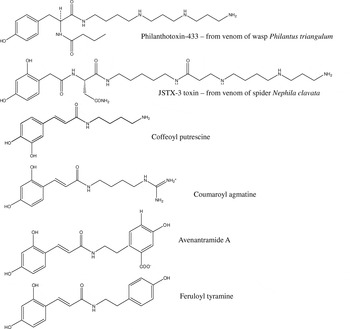
A significant portion of plant amines accumulates in plant cells as HCAA derivatives. These compounds act as phytoalexins and phytoanticipins and/or effective toxins for arthropods (Fixon-Owoo et al., Reference Fixon-Owoo, Lavasseur, Williams, Sabado, Lowe, Klose, Mercier, Fields and Atkinson2003). Plant HCAAs are structurally similar to highly selective and potent ligands of specific ionotropic receptors, particularly certain glutamate receptors subtypes and nicotine and acetylcholine receptors occurring in the venoms of some spider and wasp species (fig. 2) (Strømgaard et al., Reference Strømgaard, Jensen and Vogensen2005; Mortari et al., Reference Mortari, Cunha, Ferreira and Ferreira dos Santos2007). These compounds cause insect paralysis by binding to quisqualte type glutamate receptors on the exoskeletal muscles and blocking synaptic transmission (Klose et al., Reference Klose, Atkinson and Mercier2002). Transgenic tobacco lines expressing tyrosine decarboxylase (TyDC) were characterized by wound-inducible overaccumulation of phytoalexin HCAAs, such as p-coumaroyl tyramine (CT) and feruloyl tyramine (FT) (Guillet & De Luca, Reference Guillet and De Luca2005; Hagel & Facchini, Reference Hagel and Facchini2005). Tebayashi et al. (Reference Tebayashi, Horibata, Mikagi, Kashiwagi, Mekuria, Dekebo, Ishihara and Kim2007) demonstrated that ovipositional deterrence of leaf miner Liriomyza trifolii (Burgess) acquired by sweet pepper (Capsicum annuum L.) after JA treatment was resulted from caffeoyl putrescine (CP) accumulation. In addition, synthetic p-coumaroyl putrescine was characterized by similar activity. Silencing of the NaMYB8 transcription factor that controls the biosynthesis of p-coumaroyl putrescine and dicaffeoyl spermidine in Nicotiana attenuata (Torr. ex Wats.), allowed better performance of Manduca sexta (L.) and Spodoptera littoralis (Boisduval) (Bassard et al., Reference Bassard, Ullmann, Bernier and Werck-Reichhart2010). Moreover, HCAAs of tyramine polymerized within cell walls formed a mechanical barrier against pathogens and/or attack by sucking-piercing insects (Facchini, Reference Facchini1998). Wu et al. (Reference Wu, Wang and Zhang2010) showed a higher incidence of diapause in putrescine-feeding individuals of Helicoverpa armigera (Hüb.). This diamine also restricted the development of larvae and post-diapause development of pupae. The influence of putrescine on diapause induction and intensity as well as post-diapause development of H. armigera was dependent on photophase and temperature.
Chemical structures of selected acylpolyamines from spider and wasp venoms, and phytoalexins and phytoanticipins from plant tissues.

Although the content of amines and their HCAA derivatives within plant tissues was modified by signalling molecules that were also involved in cascades of responses against herbivores and wounding as a result of insect feeding (Stotz et al., Reference Stotz, Kroymann and Mitchell-Olds1999; Chen et al., Reference Chen, Jones and Howe2006), their participation in plant defence against phytophagous insects is not clear. Thus, in the present research, the effects of common plant PAs and tyramine on bird cherry-oat aphid (Rhopalosiphum padi L.) (Hemiptera, Aphididae) were studied in vitro. The electrical penetration graph (EPG) method was used to monitor the probing behaviour of bird cherry-oat aphids exposed to the studied compounds in an agarose-sucrose gel. No previous study has examined the effects of these chemicals on the probing behaviour of the bird cherry-oat aphid. Understanding the activity of these compounds should help researchers to clarify their precise mode of possible insecticidal action.
Materials and methods
Aphid culture
The R. padi morphs used in this study were descended from single parthenogenetic females collected on experimental plots of triticale (Lamberto cv. obtained from the Danko plant breeding company, Horyń, Poland) on the Agricultural Experimental Station in Zawady near Siedlce (east-central Poland). Aphids were transferred and reared on seedlings of Lamberto cv. grown in plastic pots in an environmental chamber at 21 ± 1°C, with an L16:D8 photoperiod and 70% relative humidity (RH) at the Siedlce University of Natural Sciences and Humanities, Poland. Several generations of the multiclonal aphid culture were developed on winter triticale seedlings. Adult apterous females were used for all probing behaviour experiments.
Chemicals and gels
Individual amines (agmatine, cadaverine, putrescine, spermidine, spermine and tyramine) were purchased from Sigma – Aldrich, (EC No. A7127, C8561, P5780, S2501, 85605 and T2879, respectively). The effect of the tested compounds on bird cherry-oat aphid probing behaviour was investigated in vitro, using agarose-sucrose gels. The gels were prepared by incorporating 1.25% agarose (Sigma A-0169) into a 30% sucrose solution and then adding the tested amines to obtain concentrations of 0 (control), 1 and 10 mM dm−3. The mixtures were stirred and heated in a water bath (at 75°C for 30 min) and then poured into plastic rings (10 mm high; 15 mm diameter) covered with a stretched Parafilm M® membrane. Transparent gels formed after 1–2 min and were offered to aphids for probing.
EPG recordings
EPGs (Tjallingii, Reference Tjallingii, Campbell and Eikenbary1988) were used to monitor the probing behaviour of adult aphids exposed to amines on agarose-sucrose gels. Bird cherry-oat aphid probing behaviour was recorded using insects that had been starved for 2 h. Apterous adults were collected between 6 and 7 a.m., then dorsally tethered on the abdomen with a gold wire (2 cm long, 20 µm in diameter) and water-based conductive silver paint (Demetron, L2027, Darmstadt, Germany). The EPGs were started between 9 and 10 a.m. by carefully transferring the aphids to the gels. Aphids were individually placed in a central location on each gel. A second electrode was introduced into the gel. Four aphids were connected to each Giga-4 EPG amplifier (Wageningen Agricultural University, Entomology Department, The Netherlands), coupled into a IBM-compatible computer through a DAS 8 SCSI acquisition card (Keithley, USA). EPG patterns were recorded in a Faraday cage in the laboratory (21 ± 1°C, L16:D8 photoperiod, and 70% RH). EPG recordings were made for ten aphids on ten different gels without tested compounds (control) and ten gels for each combination of the tested compounds. Aphid feeding behaviour was monitored for 4 h.
EPG analysis
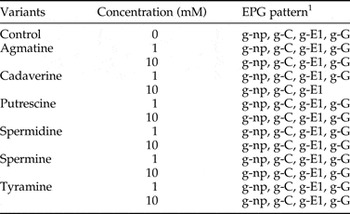
EPGs were acquired and analyzed using STYLET 2.2 software provided by Dr W.F. Tjallingii. The main waveform patterns g-np, g-C, g-E1 and g-G were recorded (Sprawka & Goławska, Reference Sprawka and Goławska2010; Sprawka et al., Reference Sprawka, Goławska, Czerniewicz and Sytykiewicz2011; Goławska & Łukasik, Reference Goławska and Łukasik2012; Goławska et al., Reference Goławska, Sprawka, Goławski and Matok2014) by analogy to those already defined and described for plants (Tjallingii, Reference Tjallingii1985, Reference Tjallingii, Campbell and Eikenbary1988, Reference Tjallingii, Campbell and Eikenbary1990, Reference Tjallingii1994). In the waveform pattern g-np, the aphid's stylet is outside of the gel (analogous to the stylet being outside of the plant). Pattern g-C may be considered as stylet activity in the gel (analogous to the stylet penetrating the epidermis and mesophyll, before salivation and ingestion), pattern g-E1 describes salivation into the gel (analogous to the stylet salivating into phloem sieve tubes) and pattern g-G, ingestion of fluid from the gel (analogous to the stylet ingesting from the plant tissues). During the experiments, 12 behavioural parameters were measured. These parameters could be divided into two groups: (1) nonsequential parameters, such as frequency and total and average duration of patterns; (2) sequential parameters, such as time to first patterns (g-C, g-E1, and g-G) from the start of recording. The time spent on each EPG-recorded aphid activity was measured in each group and recalculated per insect (table 1).
Presence of EPG patterns during feeding behaviour of R. padi on agarose-sucrose gels expressed in studied amines.

1 g-np, the aphids stylet is outside the gel (analogous to the stylet being outside the plant); g-C indicates stylet activity in the gel (analogous to the stylet penetrating the epidermis and mesophyll); g-E1 indicates salivation into the gel (analogous to secreting saliva), and g-G represent ingesting the gel (analogous to ingestion of plant sap).
Statistical analysis
Kruskal–Wallis analysis of variance in rank was applied after rejection of data normality by chi-square test. Differences between probing behaviour in R. padi on control and amine-containing gels were subjected to a Mann–Whitney's rank U-test using ten replicates for each occasion. In the case of time to the first g-C, g-E1 and g-G patterns, U cofactors were calculated on the basis of various numbers of activities, relative to their real frequency during the experiment. The acceptance level of statistical significance was P ≤ 0.05, and the results presented in tables 2–5 are arithmetical means with standard errors. All statistical analyses were conducted using the Software Statistica for Windows version 9.0 (StatSoft Inc., 2010).
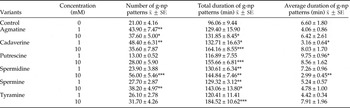
An influence of analyzed amines on frequency of non-probing (g-np pattern) by R. padi during the experiment.

Significance of differences from the control values: ***P ≤ 0.001; **P ≤ 0.01; *P ≤ 0.05 (Mann–Whitney's U-test).
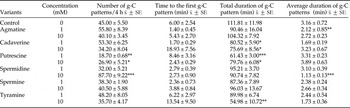
Effect of added amines on R. padi stylet activity (g-C waveform) expressed within agarose-sucrose gels.

Significance of differences from the control values: ***P ≤ 0.001; **P ≤ 0.01; *P ≤ 0.05 (Mann–Whitney's U-test).
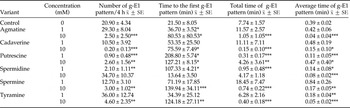
Comparison of R. padi salivation (g-E1 waveform) into agarose-sucrose gels contained in studied amines.

Significance of differences from the control values: ***P ≤ 0.001; **P ≤ 0.01; *P ≤ 0.05 (Mann–Whitney's U-test).
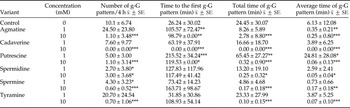
Comparison of R. padi ingestion (g-G waveform) from agarose to sucrose gels contained in studied amines.

Significance of differences from the control values: ***P ≤ 0.001; **P ≤ 0.01; *P ≤ 0.05 (Mann–Whitney's U-test).
Results
EPG recordings indicated that the addition of the agmatine, cadaverine, putrescine, spermidine, spermine and tyramine to the agarose-sucrose gel clearly affected the probing behaviour of R. padi (tables 1–4). Although aphids probing behaviour was characterized by the presence of g-C patterns, in case of the gels with all amine treatments, they did not exhibit ingestion (as indicated by the absence of a g-G pattern) from the gel containing 10 mM cadaverine. All EPG patterns were observed on gels in the rest of the amine treatments (table 1).
The studied amines significantly affected the number of penetrations (Kruskal–Wallis test; H 64, 650 = 505.10; P < 0.001), time to occurrence of the first g-C pattern (Kruskal–Wallis test; H 64, 650 = 332.50; P < 0.001), total duration (Kruskal–Wallis test; H 64, 650 = 560.40; P < 0.001) and the average duration of aphid activities in the gels (Kruskal–Wallis test; H 64, 650 = 497.88; P < 0.001).
One millimolar agmatine and cadaverine and 10 mM agmatine, spermidine and spermine were associated with an increase in the number of g-np patterns. A similar tendency was observed for the rest of the amines, but the effect was not statistically significant (table 2). The studied concentrations of amines also prolonged the total duration of aphid non-probing behaviour. For the total duration of g-np pattern, the statistical differences were observed for all tested amines at 10 mM and for cadaverine, spermidine and spermine at 1 mM concentrations. Moreover, 1 mM putrescine and spermidine increased the average duration of the g-np pattern, while agmatine, cadaverine, spermine and tyramine reduced the values of this parameter. The observed changes in R. padi probing behaviour were statistically significant for cadaverine and putrescine (table 2). At 10 mM concentrations, as indicated by the g-np pattern, amines tended to prolong or inhibit aphid non-probing behaviour in the gel, but the differences were significant only in the case of spermidine, which shortened average duration of g-np pattern (table 2).
The number and average duration of g-C pattern fluctuated under the influence of the tested amines (table 3). A statistically significant decrease in the number of g-C patterns was caused by putrescine at both studied concentrations, while an increase was only observed for spermidine at the higher tested concentration. One millimolar agmatine as well as 10 mM spermidine significantly shortened the average duration of the g-C pattern. Moreover, the total duration of stylet activity within the gel also tended to be lower with addition of the amines; however, a statistically significant effect was confirmed for cadaverine and putrescine at both concentrations and for tyramine only at the higher level. The influence of amines at both concentrations on time to the first g-C pattern was not statistically significant (table 3).
Agmatine and cadaverine at 10 mM, spermidine at 1 mM and putrescine at both concentrations were associated with a decrease in the number of salivations into the gels (g-E1 pattern) (table 4). The tested amines, with the exception of 10 mM spermidine, tended only to delay the appearance of the first g-E1 pattern, but the effect was significant only for 1 mM agmatine, 10 mM cadaverine and agmatine and putrescine at both concentrations (table 4). The total duration of aphid salivation into the gel fluctuated under the influence of amines at 1 mM. The amines putrescine and spermidine altered aphid behaviour, which was expressed in different values for the EPG-derived parameters. At higher concentrations, all tested amines were associated with a decrease in the total duration of the g-E1 pattern, but the effect was statistically significant only for agmatine, cadaverine, spermine and tyramine. The amines at 1 mM concentrations were also associated with various changes in the average duration of salivation into the gels by the bird cherry-oat aphid; however, a statistically significant decrease was only confirmed after the application of putrescine, spermidine and tyramine. At higher concentrations, the tested compounds significantly reduced the average duration of the g-E1 pattern with the exception of putrescine, which elevated the value of this parameter (table 4).
At a concentration of 10 mM, the studied amines reduced or completely inhibited aphid ingestion (pattern g-G) (table 5). No ingestion at all occurred with 10 mM cadaverine. The average and total time of ingestion also tended to be shorter with the addition of the amines at a concentration of 1 mM, but the effect was statistically significant only for agmatine. Only 1 mM putrescine prolonged the ingestion of aphids from the gel (table 5). The addition of 1 mM cadaverine, putrescine, spermidine and spermine into the gels exposed to penetration by aphids caused a decrease in number of fluid ingestions from the gels (g-G pattern); an increase was observed for agmatine and a decrease for tyramine, but without statistical significance (table 5). The addition of all tested amines at a concentration of 10 mM into the gels caused a decrease in the number of g-G patterns. Both of the studied concentrations of agmatine and putrescine prolonged the time until the first g-G pattern. The time to the first g-G pattern for other amines tended to be higher, but the effect was not statistically significant (table 5).
Discussion
Aphid feeding behaviour is related to the chemical composition of their host plants (Kubo, Reference Kubo, Rai and Carpinella2006). Plant chemicals can act as repellents, antifeedants or toxic compounds (Horowitz & Ishaaya, Reference Horowitz and Ishaaya2004; Goławska et al., Reference Goławska, Leszczyński and Oleszek2006, Reference Goławska, Łukasik and Leszczyński2008; Rharrabe et al., Reference Rharrabe, Bakrim, Ghailani and Sayah2007). Under worse nutritive conditions caused by quantitative and qualitative differences in chemical composition, individuals of Acyrthosiphum pisum (Harris) and R. padi spent longer time on non-probing activity, and showed fewer and shorter plant probes, especially with reference to the phloem phase (Kordan et al., Reference Kordan, Gabryś, Dancewicz, Lahuta, Piotriwicz-Cieslak and Rowińska2008; Sytykiewicz et al., Reference Sytykiewicz, Goławska and Chrzanowski2011). Various aphid species penetrate plant tissues intercellularly and sieve elements are their main source of nutrients (Douglas, Reference Douglas2006). Thus, the passive ingestion of phloem sap (E2 pattern) is an important part of their feeding behaviour, acting to determine the quantity of ingested food. Ponder et al. (Reference Ponder, Pritchard, Harrington and Bale2000) stated, that R. padi individuals reached the phloem quickly and fed for a longer time on barley plants characterized by high nutritive value dependent on high amino acid content within phloem sap.
Results of the in vitro study presented here suggest that the studied amines had an important impact on probing behaviour in R. padi, since this behaviour was clearly modified. Two concentrations of the amines, 1 and 10 mmol, were selected to the tests. Earlier studies show that these compounds are biologically active at the mmol levels. Therefore in these preliminary studies we applied their equivalent concentrations at maximum and for minimum values of the potential activity in them. Generally, the amines at a 10 mM concentration elevated the duration of nonpenetration, decreased the number and duration of salivation into the gels (g-E1) and ingestion from the gels (g-G) and delayed time to the first g-E1 and g-G patterns. However, at a 1 mM concentration the phenomenon was evident only for some amines, such as putrescine, spermidine and spermine, with regard to non-penetration; agmatine, putrescine and spermidine in the case of salivation and agmatine, putrescine, spermidine and spermine in relation to ingestion. Moreover, these results may also suggest that intensity of influence of the studied compounds on probing behaviour of R. padi is dependent on its concentration. Because they observed, that total duration of g-np pattern grew longer along with the increase in the concentration of amines, therefore average duration of g-E1 pattern as well as average and total duration of g-G pattern demonstrated downward trends. On the other hand, lack of differences in the influence of spermine in both the concentrations on all studied parameters of g-C pattern, and similar results obtained in case of spermidine and spermine, and time to the first g-C and g-G patterns may suggest that effect of such PAs on these activities reflected probing behaviour of R. padi is rather constant in the entire scope of tested concentrations. However, explaining these relations require further research by applying the higher number of concentrations of the tested compounds.
It is possible that changes in the frequency and duration of particular EPG aphid activities caused by the tested amines may act on aphid–plant interactions in the field. From this point of view, changes in salivation into plant tissues may be especially important. Giordanengo et al. (Reference Giordanengo, Brunissen, Rusterucci, Vincent, van Bel, Dinant, Girousse, Faucher and Bonnemain2010) reported that aphid gelling saliva is primarily composed of such proteins as phenoloxidases, peroxidases, pectinases and β-glucosidases, and small biomolecules such as phospholipids and conjugated carbohydrates. Watery saliva is a complex mixture of enzymes and other compounds, and its composition varied within different aphid species as well as the same species feeding on various diets (Cherqui & Tjallingii, Reference Cherqui and Tjallingii2000). Pectinase, pectinmethylesterase, polygalacturonase and cellulose may facilitate aphid penetration through degradation of cell walls, while other enzymes can help to detoxify plant allomones. Urbanska et al. (Reference Urbanska, Tjallingii, Dixon and Leszczynski1998) detected polyphenol oxidase (PPO) and peroxidase (Px) activity in salivary secretions of the grain aphid. Since both the oxidoreductases can metabolize phenolics occurring naturally in cereal tissues, S. avenae is at least partially able to neutralize the detrimental effect of phenolics before they are ingested. On the other hand, some components of aphid saliva may induce typical plant responses to biotic stressors. For example, oligogalactouronides released after primary cell wall degradation by the hydrolytic activity of salivary enzymes are known to induce plant defence mechanisms (Giordanengo et al., Reference Giordanengo, Brunissen, Rusterucci, Vincent, van Bel, Dinant, Girousse, Faucher and Bonnemain2010). Glucose oxidase detected in the saliva of Myzus persicae (Sulz.) oxidized d-glucose and generated H2O2 that stimulated SA accumulation and induced HRs. Moreover, β-glucosidases were the first reported enzymatic elicitors of plant defence produced by herbivorous insects (Felton & Tumlinson, Reference Felton and Tumlinson2008). These enzymes activated components of chemical plant defence towards herbivores by releasing toxins through hydrolysis of cyanogenic glucosides, benzoxazinoid glucosides, biodesmosidic saponins and glucosinolates (Goławska et al., Reference Goławska, Leszczyński and Oleszek2006; Morant et al., Reference Morant, Jørgensen, Jørgensen, Paquette, Sánchez-Pérez, Møller and Bak2008).
In addition, cadaverine and putrescine at both tested levels as well as tyramine at a 10 mM concentration reduced the total duration of g-C pattern during R. padi puncturing of the agarose-sucrose gels. Some of the amines caused simultaneous increases in the number of the selected EPG patterns and decreased their average duration. Such activity was observed in the case of 1 mM cadaverine and agmatine and 10 mM spermidine and agmatine in relation to nonpenetration, and 1 mM agmatine and 10 mM spermidine in relation to stylet activity in the gels (g-C pattern). These data suggest that these amines also interfered with gel puncturing by the aphids. Similar results were obtained by Groppa & Benavides (Reference Groppa and Benavides2008), who reported that free PAs and their HCAAs were accumulated in the plant response to wounding. It is well-known that part of the plant's defence against aphid attack is strictly connected with the penetration of peripheral tissues (g-C pattern), while the stylets cause mechanical damage, puncturing epidermal, mesophyll and parenchyma cells (Goggin, Reference Goggin2007). During such activities, aphids quite often are for the first time exposed to plant antifeedants, e.g., phenolic compounds, and continuation of their penetration is dependent on the insect's ability to detoxify such biomolecules (Urbanska et al., Reference Urbanska, Tjallingii, Dixon and Leszczynski1998).
When tested at higher concentrations, all amines eliminated the g-G pattern of probing in agarose-sucrose gels by R. padi, while at lower concentrations, no consistent tendencies were observed. During plant–aphid interactions, the in vivo G pattern is associated with uptake of xylem sap, of which the osmotic pressure is generally low (0.2 MPa) (Spiller et al., Reference Spiller, Koenders and Tjallingii1990). Thus, on artificial diet the g-G pattern represents active ingestion involving sucking by the insect because there is no liquid pressure on the membrane. Xylem ingestion is considered a common method of restoring and maintaining the water content of insect tissues, especially important after active flight or moulting, activities characterized by higher susceptibility to water loss. Moreover, Pompon et al. (Reference Pompon, Quiring, Giordanengo and Pelletier2010) suggested that the ingestion of xylem sap by aphids is a part of their osmoregulation. Thus, it is possible that the bioactivity of plant amines towards herbivores is connected with the disturbance of water balance and/or osmoregulation.
Despite the obvious differences between the nutritive demands of herbivorous insects and humans, the data presented here are in agreement with Shalaby (Reference Shalaby1996), who reported that putrescine, cadaverine, tyramine, spermidine and spermine acted as the most important biogenic amines in food. These compounds were also cited as natural antinutritional factors. There are only few data on the participation of plant amines in aphid–plant interactions. Our earlier studies showed that the amine content and enzyme activities increased in more resistant plants after various times of aphid infestation (Sempruch & Ciepiela, Reference Sempruch and Ciepiela2005; Sempruch et al., Reference Sempruch, Wójcicka, Makosz and Leszczyński2008, Reference Sempruch, Leszczyński, Wójcicka, Makosz, Chrzanowski and Matok2009, Reference Sempruch, Leszczyński, Wójcicka, Makosz, Matok and Chrzanowski2010b, Reference Sempruch, Horbowicz, Kosson and Leszczyński2012, Reference Sempruch, Marczuk, Leszczyński and Czerniewicz2013). On the other hand, it was shown that wingless female grain aphids assimilated a higher quantity of food from triticale seedlings placed in 0.01% solutions of agmatine and cadaverine, and lower amounts in the case of spermidine and spermine (Sempruch et al., Reference Sempruch, Leszczyński, Kozik and Chrzanowski2010a). An increase in the polyamine concentration up to 0.1% caused a strong reduction in the body mass and survival of S. avenae. These data and results of the EPG tests carried out on the R. padi individuals indicate that PAs and tyramine take part in biochemical plant responses to cereal aphids. Such plant defences may result in prolongation of aphid non-probing behaviour and reduction in probing, salivation and passive and active ingestion. It is possible that the bioactivity of the tested amines is connected with their ability to form of covalent and/or ionic bonds with proteins (Serafini-Fracassini et al., Reference Serafini-Fracassini, Della Mea, Tasco, Casadio and Del Duca2009). The consequences are the changes in protein macromolecular conformation and loss of activity. The conjugation of proteins with PAs is catalyzed by Ca2+-dependent transglutaminases (TGases), and such interactions represent an important mechanism of post-translational regulation of protein activity. Therefore, it is possible that the influence of amines on the aphids results from their reactions with digestive enzymes within the alimentary track. It may also cause a disturbance in probing behaviour and consequently, limit aphid growth, development and survival. Moreover, PAs participated in protein translational regulation through the expression of regulatory genes (Kusano et al., Reference Kusano, Berberich, Takeda and Takahashi2008).
In conclusion, we can state that common plant PAs and tyramine participate in plant defence responses to cereal aphids through disturbance of their sucking-piercing probing behaviour. This is important novel information because only the earlier data suggested that HCAA derivatives play an important role including plant resistance towards mining insects (Tebayashi et al., Reference Tebayashi, Horibata, Mikagi, Kashiwagi, Mekuria, Dekebo, Ishihara and Kim2007). These compounds may act as biopesticides towards arthropod pests through neurotoxic properties: blocking of glutamate receptor subtypes as well as nicotine and acetylcholine receptors (Klose et al., Reference Klose, Atkinson and Mercier2002; Fixon-Owoo et al., Reference Fixon-Owoo, Lavasseur, Williams, Sabado, Lowe, Klose, Mercier, Fields and Atkinson2003; Strømgaard et al., Reference Strømgaard, Jensen and Vogensen2005). However, a full understanding of the problem needs further studies focused on the toxicity of cereal HCAAs towards aphids and on the accumulation and metabolic transformations of amines and their HCAA derivatives within host plant tissues under aphid attack.
Acknowledgements
The work was supported by Siedlce University of Natural Science and Humanities Scientific Research Project (Project code 245/08/S).