Introduction
The High Andes region in South America is an important centre for the domestication and diversity of crops (Harlan, Reference Harlan1992; Castillo, Reference Castillo1995). A large proportion of crops domesticated in this region, as compared with other centres of origin, are propagated vegetatively (Hawkes, Reference Hawkes, Harris and Hillman1989). Besides potatoes (tuberous Solanum spp.), at least another seven species have been cultivated since pre-Columbian times through vegetative means (Castillo, Reference Castillo1995; Hermann, Reference Hermann, Hermann and Heller1997). Remarkably, asexual propagation is also practiced in arracacha (Arracacia xanthorrhiza Bancr.), while numerous Old World domesticated species of the same family are generally propagated by sexual seeds. In arracacha the presence of developed cormels with several shoots are used for plant propagation (Hermann, Reference Hermann, Hermann and Heller1997; Blas et al., Reference Blas, Hermann and Baudoin2008b).
In recent decades the interest in arracacha has increased. Arracacha belongs to the New World genus Arracacia which extends from Mexico to Bolivia (Hermann, Reference Hermann, Hermann and Heller1997). From a last taxonomic revision, 10 of 30 species are found in the South American Andes region. Wild tuberous forms of A. xanthorriza have been reported in Ecuador, Peru and Bolivia, and are considered to be the most closely related to the crop (Hermann, Reference Hermann, Hermann and Heller1997; Blas et al., Reference Blas, Hermann and Baudoin2008b). Wild A. xanthorrhiza grows in seasonally dry areas and forms large tuberous storage roots, enable the plants to survive through dry periods. The storage roots have been consistently reported by indigenous people to have specific medicinal uses which note a strong relationship with man (Valderrama and Seminario, Reference Valderrama and Seminario2002; pers. obs.). In ancient times, humans may have gathered wild tuberous forms as a food source, which may eventually have led to the domestication of A. xanthorriza. Wild tuberous forms have been described under several species names (i.e. Arracacia andina Britton, Arracacia equatorialis Constance, Arracacia peruviana Wolff, Arracacia incisa Wolff; Hermann, Reference Hermann, Hermann and Heller1997). However, Knudsen (Reference Knudsen2003) claimed that these species are synonymous (with the exception of A. incisa), and proposed the species name A. xanthorrhiza to encompass a complex including the cultivars (A. x. var. xanthorrhiza) and two wild varieties, a perennial (A. x. var. andina) and a monocarpic life form (A. x. var. monocarpa).
The perennials flower and bear fruit yearly (they are also called polycarpic) once their persistent storage roots have grown to a sufficiently large size to support the formation of vigorous generative shoots. By contrast, the monocarpic A. xanthorriza only flower once and an abundant seed set exhausts the plant and concludes the life cycle (Hermann, Reference Hermann, Hermann and Heller1997; Knudsen, Reference Knudsen2003; Blas, Reference Blas2005).
Based on this morphological and phenological similarity with the cultivated varieties, the wild perennial A. xanthorrhiza is suspected to be the direct ancestor of the crop (Hermann, Reference Hermann, Hermann and Heller1997; Knudsen, Reference Knudsen2003; Blas, Reference Blas2005). However, the origin of the crop form has not been elucidated yet; and both perennial and monocarpic are a priori possible ancestors of the cultivated A. xanthorrhiza (Knudsen, Reference Knudsen2003; Blas et al., Reference Blas, Ghislain, Herrera and Baudoin2008a).
Here, we look to establish the relationships of wild tuberous and non-tuberous Arracacia species with the cultivated form by performing an amplified fragment length polymorphism (AFLP) and chloroplast DNA survey of a representative set of accessions from the presumed domestication area.
Materials and methods
Plant material
A set of 57 plant samples from Ecuador and Peru were used in the AFLP analysis (Table S1). Set samples represented the tuberous forms with the cultivated A. xanthorrhiza (27), wild perennial (14), wild monocarpic (11) and the closely related species A. incisa (1). Non-tuberous forms were represented by the species present in Ecuador: Arracacia elata Wolff (1), Arracacia moschata Kunth (1) and Arracacia acuminata syn. N acuminata Benth (2). Crop samples from Ecuador included cultivars from a collection which is conserved in the field at the Instituto Nacional Autónomo de Investigaciones Agropecuarias (INIAP) (Mazon et al., Reference Mazon, Castillo, Hermann and Espinosa1996). Wild species from Ecuador were sampled during prospection trips. From Peru, leaf samples were provided by S. R. Knudsen (KVL University, Denmark).
AFLP analysis
Young leaves dried with silica gel were used for DNA extraction using the method reported by Jhingan (Reference Jhingan1992). The standard AFLP protocol using M13 technology with a LI-COR sequencer was used (IR2; LI-COR Biosciences). Seven primer pair combinations (out of 24 pairs tested) were selected for its polymorphism and profile quality: E-AAT/M-CGA, E-AAT/M-CGG, E-AAT/M-CGT, E-ACT/M-CAC, E-ACT/M-CGA, E-AGC/M-CCA and E-AGC/M-CGT. Band scoring was carried out using the AFLP-Quantar™ Pro 1.0 (KeyGene).
Chloroplast DNA sequencing (CpDNA)
Two pairs of universal primers amplifying non-coding chloroplast regions were used for the cpDNA survey: trnQ-rps16 (Q16 locus) and trnS-trnfM (SfM locus) (Demesure et al., Reference Demesure, Sodzi and Petit1995; Hahn, Reference Hahn2002). The amplification products were purified and sequenced in both directions using forward and reverse primers. We sequenced both fragments for two cultivated accessions (C1 and C62, representing the two cultivar groups G1 and G2, revealed by AFLPs, see the Results), two wild perennial accessions (P2 and P6), two wild monocarpic accessions (M4 and M7) and one accession of each of the following species: A. incisa (RBS-001), A. elata (MST-036) and A. acuminata (MST-015). Arracacia moschata could not be represented in this analysis as no amplification of the cpDNA markers was obtained in all the available samples of this species.
Data analysis
AFLP bands were scored as 1 if present, 0 if absent, and 9 in the case of ambiguity. Only bands of similar intensity across samples were recorded in order to minimize missing data in the data matrix. Bands observed in a single genotype were not used for the statistical analysis. Nei genetic distances (Nei, Reference Nei1972) were computed in pairwise combination. Genetic structure was analysed using Cluster analysis and a Principal coordinate analysis (PCoA) based on a distance pairwise comparison. For the cluster analysis, we used the mean character difference and the UPGMA method in the PAUP ver. 4b8 software package (Swofford, Reference Swofford2001); the bootstrap values were derived from 100 replications. PCoA was carried out with GenAIEx ver. 6 software, which uses Orloci's algorithm (Peakall and Smouse, Reference Peakall and Smouse2001). Analysis of the molecular variance (AMOVA) between the examined species and intraspecific determined groups were performed. AMOVA provides an estimate of ΦPT that is an analogue of Fst when binary data are analysed (Peakall and Smouse, Reference Peakall and Smouse2001). A significance test of ΦPT values was performed using 1000 random permutations. Finally, in order to test the Nei genetic distances between the obtained groups in the A. xanthorrhiza complex, an ANOVA test was performed using the values obtained from the pairwise comparison among accessions of each group. The Newman–Keuls test (Keuls, Reference Keuls1952) which compares the mean values over the groups was performed with STATISTICA 6 (StatSoft, Inc., 2001).
For the cpDNA survey, DNA sequences were aligned with DNAstar ver.5.07 (DNAstar, 2003). Insertions or deletions (indels) were scored as binary data to the nucleotide matrix for the analysis. The phylogenetic analysis was carried out using PAUP ver. 4b8 with the Maximum Parsimony method using the ‘Random stepwise addition’ and ‘Tree bisection reconstruction’ options for the heuristic research of parsimonious trees, and bootstrap values were obtained from 100 replications.
Results
AFLP polymorphism
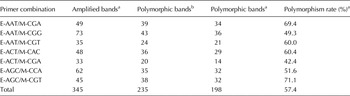
As detailed in Table 1, approximately 345 bands were amplified with the seven AFLP primer combinations, and of these 235 polymorphic AFLPs were scored between the 58 plant DNAs examined. The polymorphism rate ranged from 42 to 71% for the different primer combinations. A total of 198 bands were polymorphic among the tuberous forms (including cultivated and wild A. xanthorrhiza and A. incisa). Only 104 bands were polymorphic among the cultivars. Among A. xanthorrhiza, the cultivars showed less polymorphism than the wild plants, in spite of the increased number of plants analysed. Only 42% of the scored bands were polymorphic within the cultivars, 59% within the wild perennials and 64% within the wild monocarpic plants. No AFLP fragment was observed in all the cultivars and was absent from the wild A. xanthorrhiza or vice versa. However, 10 and 65 bands were observed only in the cultivar and wild forms, respectively.
Number of AFLP bands scored for each primer combination in 59 samples of wild and cultivated A. xanthorrhiza and related species

a Including only the tuberous plant species.
b Including all tuberous and non-tuberous species.
Genetic relationships revealed by AFLPs
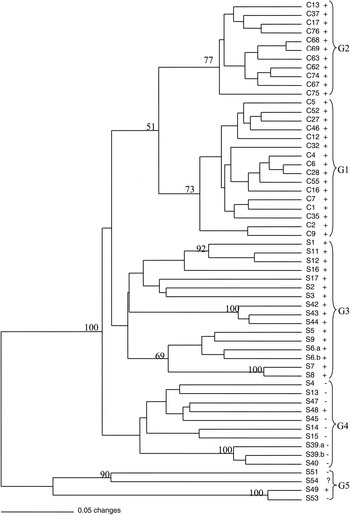
A UPGMA tree obtained from the distance matrix in a pairwise comparison of accessions is shown in Fig. 1. The tuberous forms clustered with a bootstrap value of 100, and four groups of accessions were distinguished as follows: G1 and G2 included only cultivars and were supported by bootstrap values of 73 and 77, respectively. G1 consisted of 16 Ecuadorian accessions, and G2 of 11 accessions, including all six Peruvian cultivars analysed. G3 included all wild perennial A. x. var. xanthorrhiza plants, along with three accessions from Cajamarca (S42, S43 and S44) identified as A. x. var. monocarpa (S. R. Knudsen pers. Comun., 2005); G3 appeared to be closer to the cultivars. G4 pooled the remaining monocarpic samples and the A. incisa sample, and appeared to be more distantly related to the cultivars. As expected, the non-tuberous species were located in a more distant cluster (G5). Unexpectedly, the group of cultivars as a whole appeared to be distinct from all the wild A. xanthorrhiza accessions. The AMOVA produced a ΦPT value of 0.26 (P = 0.001), that is 26% of the overall variation is explained by the differences between (and the remaining 74% within) the cultivated and wild A. xanthorrhiza, respectively.
UPGMA tree obtained from 235 AFLP bands scored in a set of cultivated arracacha and wild relatives. The groups are described in the text. Bootstrap values were obtained from 100 replicates (only values over 50 are shown). The presence or absence of the Q16 cp indel is indicated by a + or − for each accession.

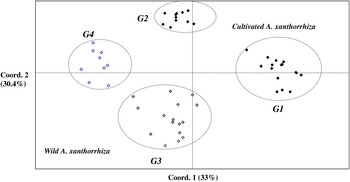
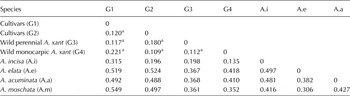
This structure of diversity between the two cultivar groups, and both wild perennial species and monocarpic species (recognized as groups G3 and G4) was also revealed by these within group means of Nei's pairwise genetic distance (Table 2). It appears that both groups of cultivars (G1 and G2) are contrastingly related to both groups of wild tuberous species (G3 and G4); G1 is closer to the wild perennial (G3) (0.117), whereas G2 is closer to the wild monocarpic species (G4) (0.109). This genetic structure cannot be evidenced in the dendrogram of Fig. 1, because only the overall mean genetic distance values between the wild and cultivated groups is used according to the UPGMA algorithm. We thus utilized a PCoA analysis of the tuberous forms to verify whether this contrasted relationship involves all accessions within a group. The plane defined by the first two axes clearly highlighted the relationship between the four groups distinguished among the tuberous forms in the UPGMA tree (Fig. 2). The first axis, representing 33% of the total variance, separated the G1 cultivar group and the wild monocarpic accessions (G4), leaving the wild perennial accessions (G3) and the G2 cultivar group in an intermediate position. These latter two groups were separated along the second axis which represents another 30.4% of the total variance. The Newman–Keuls test confirmed that, based on individual pairwise Nei's distances, G1 is significantly closer to the wild perennial, whereas G2 is significantly closer to the wild monocarpic forms, as confirmed by the mean between groups distances provided in Table 2.
Plane defined by the first two axes of a PCoA based on 198 AFLP polymorphisms. Cultivated accessions are represented by black symbols and wild perennial and monocarpic A. xanthorrhiza by grey and white symbols, respectively. The dotted circles (G1–G4) refer to the clusters numbered in Fig. 1.

Pairwise matrix of Nei's genetic distance from 235 scored AFLP bands in cultivars and wild Arracacia species or varieties

a Ranges (a–d) obtained with the Newman–Keuls test are indicated for the four groups (G1–G4) revealed in the A. xanthorrhiza complex.
The genetic divergence of the two groups of wild A. xanthorrhiza (G3 and G4) was supported by a ΦPT value of 0.24 (P = 0.001), while the two cultivar groups showed an even larger genetic divergence with a ΦPT value of 0.47 (P = 0.001), reflecting that the two cultivar groups exhibit greater genetic divergence than the perennial versus the monocarpic forms of the ancestral A. xanthorrhiza populations. This result can be explained by the specificity of the AFLP bands to each one of the cultivar groups, thus 18.2% of the scored bands were specific to the G1 or G2 cultivar groups, respectively. The wild groups (G3 and G4) have fewer specific bands, which reflect the lower ΦPT value obtained in the comparison of the wild A. xanthorrhiza varieties.
Phylogenetic relationships revealed by cpDNA
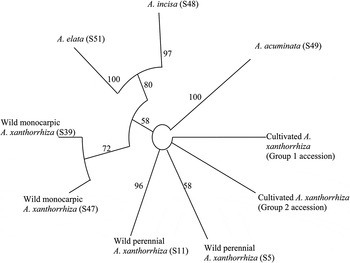
The Q16 and S-FM primer pairs amplified a 1250 bp and a 1110 bp PCR product, respectively. These two sequences represented a total of 2000 aligned base pairs, 1969 of which were constant, seven were not parsimoniously informative, and 24 were informative, including five observed indels. The Q16 locus was the most informative with 16 informative polymorphisms. No polymorphism was observed between the cultivated and the wild tuberous arracacha, except for a 13 bp insertion located in the Q16 region. Interestingly, the sequences showed that this insertion was present in the cultivated and the wild perennial A. xanthorrhiza, as well as in A. incisa and A. acuminata, but absent in the wild monocarpic A. xanthorrhiza and A. elata accessions.
The parsimonious phylogram based on the 24 informative SNPs and indels is shown in Fig. 3. Out of all the analysed Arracacia accessions, both of the wild perennial A. xanthorrhiza samples are closer to the cultivated arracacha, which includes the samples in groups G1 and G2 revealed by AFLPs. The wild monocarpic arracacha samples are separated from this branch only by the Q16 insertion described previously. We screened for the presence of this insertion with the following primer combination: RPS16-R (5′CAAGTCCGACGTTGCTTTCTACCACATCGTTT3′) and Q16-ExF1 (5′TTTTTGTCAATCCATTTATCTGCT3′). Screening for this insertion in the entire set of samples by PCR (in which an amplified fragment of approximately 260 bp in the case of the presence of this insertion, or 247 bp in case of its absence could be obtained) showed that: (1) this insertion was not observed in the analysed monocarpic accessions, except in the three accessions included in the wild perennial group G3; and (2) this insertion was present in all the cultivated and wild perennial samples (groups G1, G2 and G3) (see Fig. 1).
Parsimonious phylogram and bootstrap values of Arracacia species obtained through the phylogenetic analysis of 24 informative sites observed in 2000 bp of two chloroplast DNA regions (the Q16 and SfM loci).

Discussion
Since plant domestication is known to be very recent in relation to biological evolution, domesticated forms would be expected to be closely related genetically to their wild ancestors. However, mutations and selection pressure or genetic drift in the course of domestication, as well as possible introgression from other wild relatives, could account for a differentiation between a cultigen and its direct wild ancestor. Although no wild Aracaccia species include all of the observed molecular variation of the cultivars, the present results confirmed the most direct wild ancestors of arracacha, as described below.
Among the species present in the presumed domestication area, both AFLP and cpDNA sequence polymorphisms showed that the non-tuberous species analysed (A. acuminata, A. elata and A. moschata) are the most distantly related to cultivated arracacha. Among the wild tuberous forms, both AFLP and cpDNA distinguished an increased genetic divergence of the crop with A. incisa. Overall, A. incisa cannot be considered as a direct ancestor of cultivated arracacha. Our results, in agreement with those of Blas (Reference Blas, Ghislain, Herrera and Baudoin2008a) who analysed a greater number of A. incisa accessions, reinforced the position of Knudsen (Reference Knudsen2003) that this species should be considered as separate taxa, although close to the A. xanthorrhiza complex. Thus, in accordance with morphology, the wild forms of A. xanthorrhiza are the most directly related to the cultivars. However, the wild and cultivated forms are well distinguished at the AFLP level, which can be explained by the increased polymorphism of the wild forms, with many specific markers not found among the cultivars and differences in the frequencies of the common AFLP fragments.
Among the two wild A. xanthorrhiza varieties, AFLP and cpDNA also reveal genetic differences, with the exception of three plants previously identified as A. x. var. monocarpa from the northern region of Cajamarca in Peru, which are classified by molecular analysis within the wild perennial group. This latter result could be explained by a more recent independent derivation of monocarpic populations from perennial ancestral populations (S. R. Knudsen, pers. commun., 2005), spontaneous gene flow between both wild varieties that can easily cross (Knudsen, Reference Knudsen2003), or an error in the characterization or labelling of the material. The molecular survey agrees with the taxonomic identification based on important morphological differences between the two life forms (Knudsen, Reference Knudsen2003; Blas et al., Reference Blas, Hermann and Baudoin2008b). The perennial form differs by the presence of compressed basal stems (cormels) with several shoots and fewer umbels, whereas the monocarpic form is characterized by an absence of thickened starchy stems and has only one (rarely two) reproductive shoot(s) per plant. Moreover, monocarpic plants are taller (up to 3.5 m) and have a vigorously branching shoot carrying up to 250 umbels (Knudsen, Reference Knudsen2003).
Unexpectedly, the genetic diversity of the cultivars was also structured into two well-supported groups. One of the groups was found to be closer to the wild perennial, whereas the other was closer to the wild monocarpic varieties. The Newman–Keuls test confirmed that the genetic distances between the groups are statistically significant. In addition, similar genetic structure was also observed in the phylogeny based on the polymorphism of the flanking region of an microsatellite locus (Morillo, Reference Morillo2006).
Since arracacha was reported to have a narrow genetic base, this is a revealing and interesting finding. We suspect that this cryptic structure could be associated with the differential response of the cultivars to flowering. In fact, arracacha rarely flowers under normal cultivation conditions. Knudsen (Reference Knudsen2003) studied flowering in a range of experiments designed to identify methods to induce flowering in arracacha. After applying experiments in Peru over a period of 3 years using a wide selection of landraces and different treatments, Knudsen concluded that the landraces differed significantly in their ability to flower, reporting that some flowered with high intensity, whereas others did not respond of all. This author assigned this difference to genetic differences. It is interesting to note that, among our analysed samples, the landrace A which was classed by the AFLPs in genetic group G2 (closer to the wild monocarpic) did not flower under this induction experiment, whereas other landraces which were evaluated showed a significantly high flowering response (69–77%).
We propose two hypothesis to explain this genetic divergence in the cultivated varieties: an independent domestication from each of the two wild life forms (perennial and monocarpic), or crop diversification through introgression from a wild form. Since both groups of cultivars share the same cytotype with the wild perennial, we have arguments for supporting the second hypothesis. Additionally, based on the higher genetic affinity of A. x. var. monocarpa with one of the groups of cultivars, we suggest that wild monocarpic A. xanthorrhiza or other wild species could have participated through introgression.
According to previous works (Hermann, Reference Hermann, Hermann and Heller1997; Knudsen, Reference Knudsen2003), our molecular analysis confirms that the wild perennial variety is the ancestral form of the cultivated arracacha. This conclusion is also supported by the higher morphological affinity of the wild perennial and the cultivated forms, which both share the ability to undergo vegetative propagation, whereas the monocarpic form presents no evidence of vegetative reproduction (Knudsen, Reference Knudsen2003; Blas, Reference Blas2005). Thus, combined evidence supports that arracacha was domesticated from the wild perennial type. Based on this scenario, we propose that the wild monocarpic A. xanthorrhiza is close but not ancestral to the domesticated form, and could have likely contributed to the genetic diversity of this crop through introgression, or that both the G2 cultivars and the monocarpic form itself evolved from the introgression of the G1 cultivars from another wild unidentified species. Such scenarios may be possible from the residual sexuality of the vegetatively propagated cultivars. In some other asexually propagated crops, sexual reproduction has been documented; in cassava for instance which the use of sexual germination can still be observed in its area of origin (Emperaire et al., Reference Emperaire, Pinton and Second1998; Elias et al., Reference Elias, Rival and Mckey2001), or yams (Scarcelli et al., Reference Scarcelli, Tostain, Vigouroux, Agbangla, Daïnou and Pham2006). In arracacha no recruitment of sexual seedlings has been documented, although a higher diversity of cultivars found in the Sibundoy Indian area in Colombia has been suggested to be a result of sexual reproduction (Bristol, Reference Bristol1988; Vásquez et al., Reference Vásquez, Medina and Lobo2004).
Overall, our study provides elements for understanding the domestication and genetic diversity of A. xanthorrhiza. The proposed scenario of domestication from a perennial ancestor could be representative of a more general domestication pattern in the Andean region, concerning various root and tuber crops, and involving vegetative reproduction. Our study suggests a preference for a perennial type with asexual propagation potential, while a monocarpic life form might also have been available for domestication.
We also reveal an unsuspected genetic structure in cultivated A. xanthorrhiza reputed previously to have a narrow genetic base. This is an important revelation for genetic resource utilization and conservation. It may represent the start of a new era for breeding arracacha, a crop of high value but so far disappointing in terms of adaptation to new environments.
Supplementary material
To view supplementary material for this article, please visit https://doi.org/10.1017/S1479262116000046
Acknowledgements
We thank Steen Randers Knudsen from KVL University, Denmark for providing Peruvian leaf samples for DNA analysis, and J. C. Pintaud and S. Dussert for their assistance on the cpDNA approach and the Newman–Keuls test, respectively.