INTRODUCTION
Parasites are known to influence the life history, behaviour and demography of host populations (Agnew et al. Reference Agnew, Koella and Michalakis2000; Moore, Reference Moore2002; Poulin, Reference Poulin2007). Hosts in turn have evolved a wide range of adaptations to prevent initial parasite infection and subsequent proliferation. These adaptations range from the extraordinary complexity of antigen-specific cell-mediated responses found in vertebrates to the simpler humoral and cell-mediated responses of invertebrates, through barrier mechanisms, to behaviour that may reduce the likelihood of an individual becoming exposed to a parasite or that may act to control infections once they have been developed (Sheldon and Verhulst, Reference Sheldon and Verhulst1996; Schmid-Hempel, Reference Schmid-Hempel1998; Moore, Reference Moore2002). In parasite-host systems with invertebrate hosts and relatively large parasites, the reproduction of parasites highly depends on the condition of the host because parasites consume a high proportion of the host resources (Seppälä et al. Reference Seppälä, Liljeroos, Karvonen and Jokela2008). For example, starvation in Daphnia magna (Straus 1820) reduces the spore load and prevalence of the microsporidian gut parasite Glugoides intestinalis (Chatton 1907), but causes also an increased host mortality (Pulkkinen and Ebert, Reference Pulkkinen and Ebert2004).
The conditions for parasites may also be altered during the hibernation of ectothermic hosts. This is of particular interest when the duration of the hibernation period varies among host populations. If the hibernation of the host is extremely long, then the host-parasite dynamics might be disturbed. So far, the influence of hibernation on the host-parasite dynamic has been poorly studied in invertebrates (Tyler and Jones, Reference Tyler and Jones1974; Callait and Gauthier, Reference Callait and Gauthier2000; Moore, Reference Moore2002; Schüpbach and Baur, Reference Schüpbach and Baur2010a). In land snails, hibernation is an overwintering strategy characterized by a reduction of feeding, locomotion and reproduction (Ansart et al. Reference Ansart, Vernon and Daguzan2001). Many species bury in the soil or remain in protected places and close the shell aperture with the epiphragm, a mucoproteinacaeous membrane. The metabolism slows down, and a reduction of oxygen consumption and rate of water loss occurs (Banhart and McMahon, Reference Banhart and McMahon1988; Ansart et al. Reference Ansart, Vernon and Daguzan2001, Reference Ansart, Vernon and Daguzan2002).
Riccardoella limacum (Schrank 1776) is an ectoparasite mite of terrestrial gastropods (Fain and Van Goethem, 1986). The mite feeds on blood in the mantle cavity of its host (Baker, Reference Baker1970a). It reduces the activity and growth rate of the gastropod Cornu aspersum (Müller 1774) delaying reproductive development (Graham et al. Reference Graham, Runham and Ford1996). In the land snail Arianta arbustorum (Linnaeus 1758), parasite infection reduced the activity of individuals and their reproductive output, and decreased winter survival (Schüpbach and Baur, Reference Schüpbach and Baur2008a). Host survival during hibernation decreased with increasing parasite load and differed among families, but was not affected by snail size (Schüpbach and Baur, Reference Schüpbach and Baur2010b). The mites are transmitted through physical contact among the hosts (Baur and Baur, Reference Baur and Baur2005), via mucus trails of the host snail or indirectly via soil (Schüpbach and Baur, Reference Schüpbach and Baur2008b). It is unknown, however, how long the parasites can survive in the soil. Natural snail populations vary widely in prevalence of mite infection (0–78% in 11 populations; Baur and Baur, Reference Baur and Baur2005). However, parasitic mites have not been found in snail populations situated at elevations of 1290 m or higher. It has been hypothesized that the host's hibernation period might be too long at high elevations for mites and their eggs to survive (Baur and Baur, Reference Baur and Baur2005).
The aim of our study was to investigate the influence of hibernation duration in experimentally infected host snails on the intensity of infection and host survival. In particular, we addressed the following questions. (1) Is host survival affected by the intensity of infection and hibernation duration? (2) Does the intensity of parasite infection decrease with hibernation duration of the host? (3) Do parasitic mites leave the host at the beginning of hibernation? (4) Can parasitic mites and/or their eggs survive the winter (7 months) in the soil?
MATERIALS AND METHODS
Study species
The mite Riccardoella limacum is a monoxenous parasite that lives in the mantle cavity of land snails (Fain and van Goethem, Reference Fain and van Goethem1986). The total life cycle of R. limacum lasts 19–23 days at temperatures of 20–25°C. Female mites lay their eggs in the respiratory tissue of the host. After 3 nymphal stages, mites develop to sexually mature males and females of 0·4 mm body size (Baker, Reference Baker1970b).
Arianta arbustorum is a simultaneously hermaphroditic land snail common in moist habitats of north-western and central Europe, living at elevations of up to 2700 m above sea level (Kerney and Cameron, Reference Kerney and Cameron1979). The snail has determinate growth (shell breadth of adults 17–24 mm; Baur, Reference Baur1984). Individuals become sexually mature at 2–4 years old and adults live for another 3–4 years (Baur and Raboud, Reference Baur and Raboud1988). Arianta arbustorum mates repeatedly in the course of a reproductive season (Baur, Reference Baur1988).
Experiment 1: Host survival and intensity of infection during hibernation
We randomly collected 240 adult individuals of A. arbustorum in a parasite-free population on an alpine pasture with scattered scree, near Gantrisch, 20 km south of Bern, Switzerland (46°42′19″N, 7°26′42″E; altitude 1810 m) on 29 August 2010. The snails were kept individually in transparent plastic beakers (6·5 cm in diameter, 8 cm deep) on moist soil mixed with powdered limestone under a light/dark cycle of 16:8 h and a constant temperature of 19°C. The soil was obtained from the snails' site of origin. The beakers were cleaned 1–2 times per week and a diet of fresh lettuce was provided ad libitum.
After 4 weeks, we experimentally infected half of the snails with R. limacum (the other half served as controls). Mites were obtained from parasite-infected A. arbustorum collected near Nuglar, 15 km south–east of Basel (47°28′42″N, 7°41′38″E; altitude 434 m). We transferred 6 adult mites to the soft body of an uninfected snail using a small, moistened paintbrush. When the transmitted mites had entered the pulmonary cavity, we put the newly infected snail back into its beaker (Schüpbach and Baur, Reference Schüpbach and Baur2010a). Mite intensity of experimentally infected snails was in the range of infection intensities recorded in natural populations (0·3–8·0 mites/snail; Baur and Baur, Reference Baur and Baur2005). Transmitted mites were allowed to reproduce for 6 weeks on their host i.e. 2 mite generations under the conditions described above (Graham et al. Reference Graham, Runham and Ford1996). We measured the size of each snail (shell diameter) to the nearest 0·1 mm using vernier callipers.
Infected snails and those of the control group were randomly assigned to all 4 groups of about 30 individuals that were allowed to hibernate for 4, 5, 6 or 7 months. Hibernation occurred at 4°C, in darkness, in beakers lined with 4 cm of moist soil. These conditions are similar to those of hibernating snails buried in the field (Baur, Reference Baur1994). Hibernating snails (infected and uninfected) were checked every second week to record dead animals. After a hibernation period of 4, 5, 6 or 7 months, infected and uninfected snails were kept again under the same conditions as in the pre-hibernation period for 3 weeks (see above). Infected and uninfected snails did not differ in shell size at the beginning of the experiment (ANOVA, F1,232=0·552, P=0·458) and individuals assigned to the 4 groups with different hibernation duration did not differ in shell size (ANOVA, F3,230=0·027, P=0·994).
We assessed the parasite load (=intensity of infection) of infected and control snails immediately prior to hibernation and in the 3-week period after hibernation using a non-invasive screening method (Baur and Baur, Reference Baur and Baur2005). The soft body and respiratory pore of each individual were carefully examined for mites using a binocular microscope. The intensity of parasites was expressed as the mean number of mites observed in 3 examinations on 3 different days (Baur and Baur, Reference Baur and Baur2005). A snail was considered as infected if at least 1 mite could be detected during the 3 observations.
Three weeks after hibernation, the hosts were frozen for a posterior screening of mites in the lung tissue. Snails were fixed in 70% ethanol and dissected under a binocular microscope (Leica MZ8) to quantify the number of mites and eggs in the lung. To assess the potential effect of parasitic mites on the reproductive system of the host, we determined the dry mass of the albumen gland of each snail.
Experiment 2: Short-term response of parasitic mites
To examine whether parasitic mites leave the host at the beginning of the hibernation, we collected 81 adult individuals of A. arbustorum from a naturally infected population near Nuglar (47°28′42″N, 7°41′38″E; altitude 434 m) on 18 September 2010. The snails were kept individually in beakers (depth 8 cm, diameter 6·5 cm) lined with moist soil at 19°C and a 16:8 light/dark cycle. The soil used was from the site Gantrisch, where no mites occur. We repeated the non-invasive parasite screening 5 times. After 19 days, 45 infected snails were randomly assigned to 7 groups each consisting of 6–8 individuals. The groups did not differ in mean shell size (F6,38=0·016; P=0·999) and parasite load (F6,38=1·541; P=0·191). The snails were allowed to hibernate as described above for periods of 0 (control), 4, 8, 12, 24, 48 or 72 days. After hibernation, snails of the corresponding group were frozen and the actual number of mites and eggs in the lung tissue was determined for each host as described above.
Experiment 3: Mite survival in the soil
To examine whether parasitic mites survive in the soil during the hibernation period of snails, beakers containing soil on which experimentally infected snails from Gantrisch (n=34), natural infected snails from Nuglar (n=26) or uninfected snails from Gantrisch (n=26, control) had been maintained singly for 6 weeks, were transferred to hibernation conditions (4°C, darkness), but without snails. After a period of 7 months, uninfected individuals of A. arbustorum from Gantrisch were placed singly in the beakers with the 3 soil treatments and kept under standard conditions (19°C, 16:8 dark/light cycle; as described above) for 3 months. After 3 months, snails were frozen and a posterior screening of mites and their eggs in the lung tissue was performed as described above.
Statistical analysis
Data analysis was performed using R Statistical Software (R Development Core Team, 2011). We used Generalized Linear Models (GLM) with binomial distribution to examine the effects of parasite infection (categorical predictor), hibernation duration and size of individual snails (both continuous predictors) on host survival (Exp. 1). The minimal adequate model was selected by Akaike Information Criterion (AIC). We used linear models (LM) to test whether the intensity of mite infection changed with increasing duration of hibernation and with snail size as well as to examine whether the dry weight of the albumin gland (log (x+1)-transformed) differed between infected and uninfected snails and was affected by hibernation duration and snail size. We used GLM with Poisson distribution to examine whether the numbers of mites and eggs found in the lung tissue of hosts were influenced by hibernation duration (Exp. 2).
RESULTS
Experiment 1: Host survival and intensity of infection during hibernation
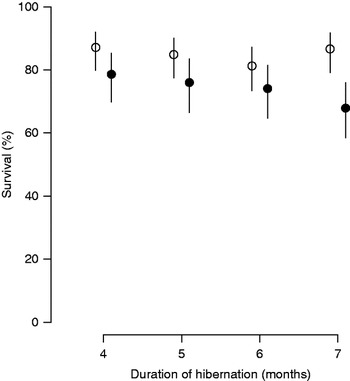
Host survival was affected negatively by parasite infection but not by the duration of hibernation and the size of individual snails (Fig. 1). Statistical model selection removed the factors hibernation duration and shell size as well as the two-way interactions keeping only the factor parasite infection in the minimal adequate model (GLM, estimate=−0·678, s.e.=0·332, z=−2·044, P=0·041). Overall, 80 out of the 108 infected snails (74·1%) survived hibernation as did 107 of the 126 (84·9%) uninfected snails. The intensity of infection prior to hibernation averaged 2·9 mites (range 0·3–12·0, n=108). Survival of host snails during hibernation tended to be negatively affected by the intensity of infection assessed prior to hibernation (GLM, estimate=−0·783, s.e.=0·425, z=−1·841, P=0·062).
Survival of infected (black dots) and uninfected (open dots) host snails in relation to hibernation duration. Whiskers represent standard errors based on binomial distributions. Sample sizes for infected snails were 28, 25, 27 and 28, those for uninfected snails were 32, 33, 32 and 30.

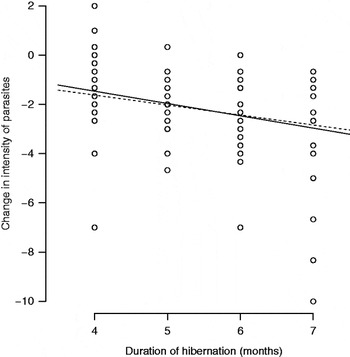
The intensity of infection decreased with increasing hibernation duration (Fig. 2). Model selection removed the factor snail size and the two-way interaction keeping only the factor hibernation duration in the minimal adequate model (LM, estimate=−0·500, s.e.=0·186, t=2·688, P=0·008). The decrease in parasite load, expressed by the difference between intensity of infection prior to hibernation and intensity of infection after hibernation, was 1·5±0·4 mites after 4 months (n=22), mean±s.e., 2·0±0·3 mites after 5 months (n=19), 2·3±0·4 mites after 6 months (n=20), and 3·1±0·6 mites after 7 months (n=19).
Decrease in intensity of parasitic mites in relation to hibernation duration of the host snail Arianta arbustorum. Open dots represent single snails. The solid line represents the fitted linear model (Y=−0·500X+0·538; R2=0·085, n=80, P=0·008), the dashed line the linear model including the zero point (no intercept: Y=−0·405X; R2=0·596, n=80, P<0·001).

The dry weight of the albumen gland, an estimate of the female reproductive capacity in the successive season, did not differ between infected and parasite-free host snails (LM, estimate=0·028, s.e.=0·218, t=0·129, P=0·898). Furthermore, the dry weight of the albumen gland was neither affected by hibernation duration (estimate=−0·068, s.e.=0·075, t=0·911, P=0·365) nor by snail size (LM, estimate=−0·018, s.e.=0·116, t=0·158, P=0·875).
Considering exclusively infected host snails that survived, the detailed examination of the lung tissue 3 weeks after hibernation revealed a mean number of 10·2 mites (s.e.=2·0, range: 0–77, n=80) and of 8·3 eggs (s.e.=1·8, range: 0–87, n=80). The number of mites found in the lung was negatively affected by the hibernation duration of the host (GLM, estimate=−0·101, s.e.=0·031, z=−3·224, P=0·001). However, the number of mite eggs was not influenced by hibernation duration (GLM, estimate=−0·035, s.e.=0·034, z=−1·010, P=0·312).
Experiment 2: Short-term response of parasitic mites
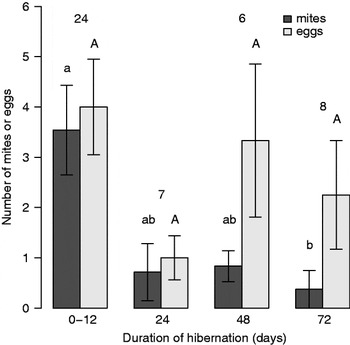
Host snails kept under hibernation conditions for 0 (control), 4, 8, or 12 days did not differ in the number of mites and mite eggs found in the lung tissue (mites: ANOVA, F3,20=1·173, P=0·345; eggs: F3,20=0·054, P=0·983). This indicates that none or very few mites left their hosts at the beginning of hibernation. Consequently, data of host snails kept under hibernation conditions for 0–12 days were combined for further analyses. Host snails hibernating for different periods showed different numbers of mites (Fig. 3; ANOVA, F3,41=2·854, P=0·048). In contrast, the number of mite eggs found in the lung tissue did not change with increasing hibernation duration of the host snails (Fig. 3; F3,41=1·206, P=0·319).
Number of mites and eggs found in the lung tissue of the host snail Arianta arbustorum after hibernation periods of different lengths. Means±1 s.e. are shown with sample size on the top of bars. Small letters (in mites) and capitals (in eggs) indicate significant differences between hibernation periods of different lengths.

Experiment 3: Mite survival in the soil
No parasitic mites and eggs were found in the lung tissue of originally parasite-free snails (n=26) kept on control soil for 6 weeks. Similarly, no parasitic mites and eggs were recorded in originally parasite-free snails (n=26) kept on soil on which naturally infected snails from the population Nuglar had previously been maintained before the soil was stored at 4°C for 7 months. However, 1 single mite egg but no adult mite was found in the lung tissue of one of the 34 originally parasite-free snails kept on soil on which experimentally infected snails from the population Gantrisch had previously been maintained before it was stored at 4°C for 7 months. This indicates that mite survival in the soil might be very low during winter.
DISCUSSION
Our study provides experimental evidence that winter survival of the host snail A. arbustorum is negatively affected by R. limacum, but not by the size of the snails. Furthermore, the intensity of mite infection decreased with increasing hibernation duration of the host. Reduced winter survival has also been found in naturally infected individuals of A. arbustorum in 2 out of 3 populations (Schüpbach and Baur, Reference Schüpbach and Baur2008a). In experimentally infected A. arbustorum, mortality during hibernation was both influenced by the intensity of infection and family origin (Schüpbach and Baur, Reference Schüpbach and Baur2010a). Similarly, in the present study, host survival during the winter tended to be negatively affected by the intensity of infection. Differences in winter survival of parasitized and parasite-free hosts may directly affect gene frequencies in the host population and thus influence the host-parasite co-evolution (Mitchell et al. Reference Mitchell, Rogers, Little and Read2005).
Any estimate of intensity of infection relies on the accuracy of the method used for counting the parasites. In our study organism, the non-invasive estimate could be influenced by uncertainties in the recognition of lightly infected animals. The dissection of snails with a careful examination of their lung epithelium is the most precise but also time-consuming method, provided that the mites do not leave the freshly-killed host. We did not observe that mites left dead A. arbustorum, which were killed by freezing. However, apart from the ethical issue of killing animals, potential effects of parasite infection on the hosts can no longer be examined. These problems can be avoided by using non-invasive parasite screening methods. The non-invasive method used in this study is fairly accurate and its precision can further be improved by increasing the number of visual mite assessments (e.g. from 3 to 5 times, as done in Exp. 2), which is feasible in snails kept in controlled laboratory experiments (Baur and Baur, Reference Baur and Baur2005).
Riccardoella limacum depends on its host to complete the life cycle (Baker, Reference Baker1970b). Food uptake and reproduction are only possible in the mantle cavity of the host (Baker, Reference Baker1970a). Mites are frequently transmitted during courtship and mating of A. arbustorum. The parasites move over the soft body of the snail and switch to the new host. Furthermore, R. limacum has been found to be successfully transmitted via soil without physical contact (Schüpbach and Baur, Reference Schüpbach and Baur2008b). Experiments showed that the blind mites use fresh mucus trails of snails to locate new hosts (Schüpbach and Baur, Reference Schüpbach and Baur2008b). In this way they also infect juvenile snails. Baker (Reference Baker1970a) studied the off-host survival of R. limacum and found that mites kept in culture cells survived for 8 days without food supply at room temperature. In moist soil kept at 19°C, individuals of R. limacum survived and infected new snails (Schüpbach and Baur, Reference Schüpbach and Baur2008b). In the present study, none or only very few mites survived in moist soil kept at 4°C for 7 months. We found only a single mite egg in 1 out of 60 originally parasite-free snails maintained on these soils. This indicates that 1 mite may have survived in the soil before it could find a new host and deposit the egg in its lung.
The influence of a parasite on its host may change in response to altered physical conditions of the environments. When infected gastropods aestivate, such as during summer droughts, parasite development is normally inhibited (Solomon et al. Reference Solomon, Paperna and Markovics1996) and host survival is reduced compared to uninfected snails. Temperature can be a limiting factor on parasite development, both within invertebrate hosts and in free-living parasites. At low temperature, larval development of the nematode Elaphostrongylus rangiferi (Mitskevich 1958) was delayed in the host snails A. arbustorum and Euconulus fulvus (Müller 1774) and 1st-stage larvae of this lung worm showed a higher survival than their successive stages in hibernating hosts (Halvorsen and Skorping, Reference Halvorsen and Skorping1982; Schjetlein and Skorping, Reference Schjetlein and Skorping1995). The minimum temperature necessary for the development of R. limacum is not known. However, the number of mites found in the lung tissue was reduced in hosts hibernating for 24 days or longer, while the number of eggs did not change with increasing hibernation duration. In Experiment 2, which had shorter recording intervals, mites did not leave the host when the snails buried in the soil at the beginning of hibernation. However, the number of mites found in the lung tissue decreased when the hosts hibernated for 24 days or longer, while the number of eggs did not change with increasing hibernation duration. Thus, most parasitic mites died and no eggs hatched during hibernation. We frequently observed clumps of white mucus containing dead mites in the respiratory pore of parasitized snails. This could represent a kind of lung cleaning in infected hosts. In spring, when the temperature increases and the host snails emerge from hibernation, the small parasite population might mainly stem from surviving eggs. During the host's activity season the mite population increases, reaching a peak in autumn. This explanation is in line with the seasonal pattern in mite number recorded in A. arbustorum and C. aspersum (Graham et al. Reference Graham, Runham and Ford1996; Baur and Baur, Reference Baur and Baur2005). The seasonal increase in number of mites might depend on the temperature and the length of the snail‘s activity season.
The prevalence of infection by R. limacum in populations of A. arbustorum is highly variable. In Switzerland, infected populations occurred at localities with a higher mean temperature in June (a surrogate for the length of the vegetation period) than populations without mites (Baur and Baur, Reference Baur and Baur2005). Parasitic mites did not occur in snail populations situated at altitudes of 1290 m or higher. Climatic factors are known to have a significant effect on the occurrence of helminth parasites in terrestrial gastropods. For example, Morley and Lewis (Reference Morley and Lewis2008) found a positive correlation between winter maximum temperature and total sporocyst prevalence of trematodes Dicrocoelium sp. in a land snail community in southern England.
Snails are ectothermic animals and are particularly vulnerable to climatic change, not only due to physiological responses but also to a shift in plant community composition and structure impacting on their population dynamics (Baur and Baur, Reference Baur and Baur1993b; Sternberg, Reference Sternberg2000). In the temperate zone, global climate change will probably lead to shorter and milder winters, resulting in shorter periods of hibernation. Climate warming may extend the active season of terrestrial gastropods and increase the availability of free-living parasites (Harvell et al. Reference Harvell, Mitchell, Ward, Altizer, Dobson, Ostfeld and Samuel2002). In the host A. arbustorum, hibernation duration may decrease and winter survival of R. limacum will increase. The extended active season of the host may allow the parasitic mite to spread to higher altitudes by dispersing snails (Baur and Baur, Reference Baur and Baur1993a).
ACKNOWLEDGEMENTS
We thank Anette Baur and an anonymous referee for valuable comments on the manuscript. Financial support was received from the Swiss National Foundation.