INTRODUCTION
The cardinal motor symptoms of Parkinson’s disease (PD) appear as a result of progressive degeneration of dopamine-containing neurons in the substantia nigra pars compacta (Hughes, Daniel, & Lees, Reference Hughes, Daniel and Lees2001). Studies report that the disease extends far beyond the dopaminergic nuclei in the mesencephalon (Braak et al., Reference Braak, Del Tredici, Rub, de Vos, Jansen Steur and Braak2003; Braak, Ghebremedhin, Rub, Bratzke, & Del Tredici, Reference Braak, Ghebremedhin, Rub, Bratzke and Del Tredici2004). In fact, patients with PD frequently experience non-motor symptoms, including autonomic, behavioral, and cognitive dysfunctions (Pellicano et al., Reference Pellicano, Benincasa, Pisani, Buttarelli, Giovannelli and Pontieri2007).
Contradictory results have been reported in recent studies aimed at investigating one of these non-motor symptoms, that is, impaired facial emotion recognition (for a review, Assogna, Pontieri, Caltagirone, & Spalletta, Reference Assogna, Pontieri, Caltagirone and Spalletta2008). The most concordant result in these studies was impaired recognition of the emotion of disgust in patients with PD (Sprengelmeyer et al., Reference Sprengelmeyer, Young, Mahn, Schroeder, Woitalla and Büttner2003; Suzuki, Hoshino, Shigemasu, & Kawamura, Reference Suzuki, Hoshino, Shigemasu and Kawamura2006), which, however, was not confirmed in all studies (Ariatti, Benuzzi, & Nichelli, Reference Ariatti, Benuzzi and Nichelli2008; Clark, Neargarder, & Cronin-Golomb, Reference Clark, Neargarder and Cronin-Golomb2008; Kawamura & Kobayakawa 2009; Lawrence, Goerendt, & Brooks, Reference Lawrence, Goerendt and Brooks2007). Although some studies described non-selective facial emotion recognition impairment in PD (Dujardin et al., Reference Dujardin, Blairy, Defebvre, Duhem, Noel and Hess2004; Kan, Kawamura, Hasegawa, Mochizuki, & Nakamura, Reference Kan, Kawamura, Hasegawa, Mochizuki and Nakamura2002; Sprengelmeyer et al., Reference Sprengelmeyer, Young, Mahn, Schroeder, Woitalla and Büttner2003; Yip, Lee, Ho, Tsang, & Li, Reference Yip, Lee, Ho, Tsang and Li2003), others found no impaired recognition of facial emotions (Adolphs, Schul, & Tranel, Reference Adolphs, Schul and Tranel1998; Pell & Leonard, Reference Pell and Leonard2005). Only one study investigated the effect of intensity on the accuracy of patients with PD in decoding facial emotions (Dujardin et al., Reference Dujardin, Blairy, Defebvre, Duhem, Noel and Hess2004). In this study, the authors showed that healthy controls (HC) rated high-intensity emotions (70% intensity level) as easier to decode than low-intensity emotions (30% intensity level). No differences emerged for patients with PD, and the two groups showed no difference in decoding accuracy for high- and low-intensity emotion expressions. No results were reported for individual emotions.
Until now, only a few controversial data have been reported on the role of cognitive status in the processing of facial emotion expressions in PD. In treated PD patients, Sprengelmeyer and collaborators (Reference Sprengelmeyer, Young, Mahn, Schroeder, Woitalla and Büttner2003) found that a deficit in spatial contrast sensitivity was related to impaired recognition of fearful facial expressions. Furthermore, Dujardin and colleagues (Reference Dujardin, Blairy, Defebvre, Duhem, Noel and Hess2004) found that facial emotion expression recognition was correlated with executive function performance but not with visuo-perceptual function, and Kawamura and Kobayakawa (Reference Kawamura and Kobayakawa2009) reported a relationship between disadvantageous decision-making and decreased emotional responses. Finally, some studies found no correlation between emotion recognition and cognitive functions (Adolphs et al., Reference Adolphs, Schul and Tranel1998; Kan et al., Reference Kan, Kawamura, Hasegawa, Mochizuki and Nakamura2002; Lawrence et al., Reference Lawrence, Goerendt and Brooks2007; Pell & Leonard, Reference Pell and Leonard2005).
In most of these studies, results were obtained in small samples of participants. Therefore, larger samples have to be investigated to assess the impact of different levels of emotional intensity on emotion recognition and to determine whether facial emotion recognition performance is related to cognitive level. This issue is crucial because human interaction requires deciphering the non-verbal facial expression of low-intensity emotions, which are more difficult to decode than high-intensity ones. The correct interpretation of non-verbal emotional stimuli has been linked to social achievement in studies investigating social intelligence (Adolphs, Reference Adolphs2006; Andersen & Phelps, Reference Andersen and Phelps2000; Papa & Bersani, Reference Papa and Bersani2007). In social interaction, correct deciphering of others’ emotional states is essential to understand behavior and avoid useless conflict. Although a wide variety of cognitive deficits can be observed in the early stages of PD, including bradyphrenia, deficits in working memory, attention, executive functions, visuo-spatial ability, language, and impaired recognition of emotional tenses in phrases (Ackermann & Ziegler, Reference Ackermann and Ziegler1996; Blonder, Gur, & Gur, Reference Blonder, Gur and Gur1989; Borod et al., Reference Borod, Welkowitz, Alpert, Brozgold, Martin and Peselow1990; Brown & Marsden, Reference Brown and Marsden1990; Cooper, Sagar, Tidswell, & Jordan, Reference Cooper, Sagar, Tidswell and Jordan1994; Dubois & Pillon, Reference Dubois and Pillon1997; Ivory, Knight, Longmore, & Coaradoc-Davies, Reference Ivory, Knight, Longmore and Caradoc-Davies1999; Mayeux, Stern, Sano, Cote, & Williams, Reference Mayeux, Stern, Sano, Cote and Williams1987), it is not clear whether or not they are related to impaired facial emotion recognition.
Therefore, this study was designed to investigate differences in the recognition of facial emotion expressions in a large sample of patients with PD under stable dopaminergic therapy compared with a group of well-matched HC using a low- versus high-intensity paradigm. We also investigated the relationship between facial emotion recognition performances and individual cognitive domains. We predicted that the patients with PD would recognize the facial expression of disgust less frequently than HC, that low-intensity emotions would be recognized less frequently than high-intensity emotions, and that cognitive impairment would be related to poor recognition of facial emotion expressions in patients with PD.
METHOD
Participants
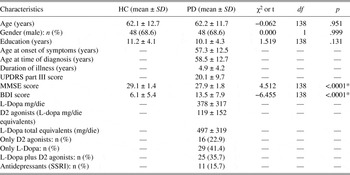
The study included 70 subjects diagnosed with idiopathic PD on the basis of international guidelines (Hughes et al., Reference Hughes, Daniel and Lees2001). Patients were recruited at the outpatient services for movement disorders of three institutions (I.R.C.C.S. Santa Lucia Foundation, Department of Neurological Sciences II Faculty of Medicine, University “Sapienza”, Sant’Andrea Hospital, Department of Neuroscience, University “Tor Vergata”, Rome, Italy). Seventy HC, matched with the patients with PD for age, gender, and educational attainment (see Table 1), were recruited in the same geographical area. Besides a diagnosis of PD, the other inclusion criterion was age between 35 and 85 years.
Sociodemographic, clinical, and behavioral characteristics of 70 HC and 70 patients with PD

Note
SD = standard deviation; df = degrees of freedom; HC = healthy controls; PD = Parkinson’s disease; UPDRS = Unified Parkinson’s Disease Rating Scale; MMSE = Mini Mental State Examination; BDI = Beck Depression Inventory; *Statistically significant difference.
Common exclusion criteria for patients with PD and HC were the following: (1) presence of major medical illnesses (non-stabilized diabetes, obstructive pulmonary disease or asthma, hematologic/oncologic disorders, vitamin B12 or folate deficiency, pernicious anemia, clinically significant and unstable active gastrointestinal, renal, hepatic, endocrine or cardiovascular disorders, and recently treated hypothyroidism); (2) known or suspected history of alcoholism, drug dependence and abuse, head trauma, and major psychiatric disorders (i.e., schizophrenia, personality disorders, or any other significant mental disorders) with onset before PD onset according to the DSM-IV TR criteria (American Psychiatric Association, 2000). Among mental disorders, only minor or major depressive disorders with onset after PD onset were eligible for inclusion; (3) presence of vascular brain lesions, brain tumor, or marked cortical and subcortical atrophy on computed tomography or magnetic resonance imaging scan; (4) suspected dementia on the basis of clinical examination or Mini Mental State Examination (MMSE) score <24 (Folstein, Folstein, & McHugh, Reference Folstein, Folstein and McHugh1975); (5) vision and hearing inadequate to comply with testing procedure. Specific exclusion criteria for patients with PD were the following: (1) history of neurological diseases other than idiopathic PD, and (2) unclear history of chronic dopaminergic treatment responsiveness. The patients with PD enrolled in the study had been under stable dopaminergic therapy for at least 2 months and did not require booster doses of L-Dopa or dopamine agonists. Mean dosages of L-Dopa equivalents are shown in Table 1. In particular, for dopamine agonists 18 patients (26%) were treated with pramipexole, 12 (17%) with cabergoline, 8 (11%) with ropinirole, and 3 (4%) with pergolide.
Clinical evaluation of motor symptoms was made using the Unified Parkinson’s Disease Rating Scale – Part III (UPDRS-III) (Langston et al., Reference Langston, Widner, Goetz, Brooks, Fahn and Freeman1992). Trained specialists, who were blind to the aims of the study, carried out all testing and clinical evaluations two hours after the patients had received their first dose of medication. Acceptable inter-rater reliability was defined as k > 0.80.
The Santa Lucia Foundation Ethical Committee approved the study. In accordance with the Declaration of Helsinki, each subject signed an informed consent form before enrollment.
Cognitive and Behavioral Evaluations
The neuropsychological examination included the following tests: (1) MMSE (Folstein et al., Reference Folstein, Folstein and McHugh1975), a global index of cognitive impairment with scores ranging from 30 (no impairment) to 0 (maximum impairment); (2) Rey’s 15-word test – Immediate Recall (RIR) and Delayed Recall (RDR) to evaluate verbal memory (Carlesimo, Caltagirone, & Gainotti, Reference Carlesimo, Caltagirone and Gainotti1996); the total score is the total number of words recalled in each test; (3) Copy of the Rey-Osterrieth picture (CRO) and Delayed Recall of the Rey-Osterrieth picture (DRO) to evaluate complex constructional praxis and long-term visual memory (Osterrieth, Reference Osterrieth1944; Rey, Reference Rey1941); scores range from 0 (maximum impairment) to 36 (no impairment) on both tests; (4) Phonological Verbal Fluency (PVF) test (Carlesimo et al., Reference Carlesimo, Caltagirone and Gainotti1996) to assess language ability; the total score is the total number of words produced during the test; (5) Wisconsin Card Sorting Test – short form (WCST) (Greve, Reference Greve2001), which explores executive functions and requires matching 48 cards to four key cards by color, shape, and number and choosing the six correct categories from feedback given by the examiner. The WCST was scored for total number of categories and failures to maintain set, that is, the total number of perseverative and non-perseverative errors; (6) Stroop Color-Word Test (SCWT) (Stroop, Reference Stroop1935), which consists of three parts and assesses frontal abilities of attention shifting and control. In the “word reading” task, participants were asked to read as quickly as possible Italian words for colors (e.g., “blue,” “red,” and “green”) printed in black on a sheet of white paper. In the second part (“color naming”), participants were shown a sequence of blue, red, and green dots and had to name the colors as quickly as possible. The third part of the test (“interference time”) consisted of color words printed in a color that did not correspond to the word (e.g., the word “blue” printed in red ink). Participants were requested to name the color the word was printed in as quickly as possible (in the example, to answer “red”). If they made a mistake, they were stopped and requested to go back to the previous word. The time needed to complete the interference test was used as the measure.
To determine whether they had psychiatric disorders, the patients with PD were also submitted to a structured psychiatric interview (SCID-P) (First, Spitzer, Gibbon, & Williams, Reference First, Spitzer, Gibbon and Williams2002), which was based on the DSM-IV TR criteria (American Psychiatric Association, 2000). The presence of current or past (in the last year) psychiatric disorders in HC was assessed using the SCID-NP (First, Spitzer, Gibbon, & Williams, Reference First, Spitzer, Gibbon and Williams1997).
All subjects were administered the Beck Depression Inventory (BDI) (Beck & Steer, Reference Beck and Steer1987), a 21-item self-report inventory that quantifies severity of depressive symptoms.
Emotion Recognition Test
The Penn Emotion Recognition Test (PERT) was used to assess facial emotion recognition ability. The PERT is a standardized and validated test (Gur et al., Reference Gur, Sara, Hagendoorn, Marom, Hughett and Macy2002) composed of digitized high-quality pictures of 3-dimensional (3D) facial expressions of evoked or felt emotions and non-emotional or neutral expressions. These pictures were obtained by using an algorithm that merged four 2D images, captured by digital cameras, to produce a 3D model of the face. The final product is a static, bi-dimensional picture that accurately re-constructs the geometry and reproduces the facets of the human face more realistically than a simple 2D image. The set includes 96 color photographs of facial expressions of emotions (happiness, sadness, anger, fear, disgust) and neutral faces. There are eight low-intensity and eight high-intensity expressions for each emotion and neutral expressions. Across emotional categories, stimuli are balanced for poser’s gender and ethnicity. There are 48 male and 48 female faces, 59 of Caucasian people, and 37 of non-Caucasian people.
First, the participants viewed the pictures of the facial expressions on the computer screen. Then, they had to label the basic emotion by choosing one out of six possibilities (i.e., anger, happiness, sadness, fear, disgust, neutral). Second, they had to indicate the intensity (low or high) of the emotional state represented by the faces, which were presented one at a time. To facilitate the participants in labeling each facial expression, the labels of the six possibilities and the two intensities were printed on a sheet of paper, which was placed on a table in front of them. There was no time limit and the labels were visible throughout the testing session. The experimenter provided no information about whether or not the responses were correct. Regardless of whether or not they recognized the intensity level correctly, for each emotion we calculated a “total score”, which was the number of neutral faces or emotions recognized correctly. Moreover, two additional sub-scores were derived from the “total score”: a “low-intensity score,” which indicated the number of emotions correctly recognized when they were shown at the low-intensity level; and a “high-intensity score,” which indicated the number of emotions correctly recognized when they were shown at the high-intensity level.
Finally, we obtained three “global emotion” scores: the first was the sum of the five emotion “total scores”; the second, the sum of the five emotion “total scores” when the emotions were of low- level intensity; and the third, the sum of the five emotion “total scores” when the emotions were of high-level intensity.
Statistical Analysis
Between-group comparisons for sociodemographic and total emotion and neutral face scores were performed using t tests for continuous variables and χ2 tests for categorical variables.
Differences in facial emotion recognition performances between the two groups were analyzed by factorial analysis of variance (ANOVA), with diagnostic groups (PD vs. HC) and facial emotion intensity level (low vs. high) as independent variables and recognition scores of all individual facial emotions as dependent variables. To minimize the likelihood of type I errors, ANOVAs were preceded by overall multivariate analysis of variance (MANOVA) using all facial emotion recognition scores as dependent variables.
To analyze the error patterns, confusion matrices were generated for individual facial emotions by response cell and were classified by diagnosis. A series of t tests were performed to analyze the differences between patients with PD and HC for error distribution in recognizing individual facial emotions. Bonferroni’s correction for multiple comparisons was used to define the statistical significance of these t tests.
Crude correlations between individual PERT scores, neuropsychological scores, BDI scores, dopaminergic therapy doses, UPDRS III scores, and illness duration were analyzed using Pearson’s correlation coefficient and Fisher’s r to z. The level of statistical significance was defined as p < .05.
RESULTS
Sociodemographic, clinical, and behavioral characteristics of patients with PD and HC are summarized in Table 1. As expected, due to the matching procedure no differences in sociodemographic characteristics emerged between the two groups. Furthermore, patients with PD had significantly lower MMSE scores and higher BDI scores than HC.
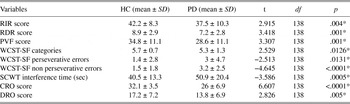
Table 2 presents the scores obtained for the neuropsychological domains tested. Although no patient with PD had a dementia diagnosis, patients performed significantly worse than HC on all variables.
Neuropsychological variables of 70 HC and 70 patients with PD

Note
SD = standard deviation; df = degrees of freedom; HC = healthy controls; PD = Parkinson’s disease; RIR = Rey’s 15-word test-Immediate Recall; RDR = Rey’s 15-word test-Delayed Recall; PVF = Phonological Verbal Fluency; WCST-SF = Wisconsin Card Sorting Test-short form; SCWT = Stroop Color-Word Test; CRO = Copy of Rey-Osterrieth picture; DRO = Delayed Recall of Rey-Osterrieth picture; *Statistically significant difference.
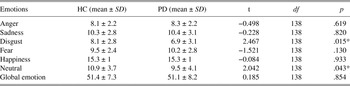
Table 3 shows the facial recognition total (low- plus high-intensity) scores for all individual emotions of the patients with PD and HC. The former displayed selectively worse recognition for the disgust facial emotion and for neutral faces. However, when the scores for all emotions were pooled (global emotion) we found no difference in emotion recognition performances between HC and the patients with PD.
Total emotion and neutral face scores of 70 HC and 70 patients with PD

Note
SD = standard deviation; df = degrees of freedom; HC = healthy controls; PD = Parkinson’s disease; Global emotion = sum of the total scores of five emotions (anger, sadness, disgust, fear, happiness); *Statistically significant difference.
The disgust or neutral face recognition performances of the 11 patients with PD who were treated with SSRI antidepressants were similar to those of the 59 patients who were not treated with antidepressants. Furthermore, L-Dopa daily equivalent doses did not correlate with disgust facial emotion and neutral face recognition scores, and in the 16 patients who were treated with dopamine agonists only, no relationship was found between drug doses and scores for the recognition of disgust or neutral faces. Finally, no significant correlations were found between BDI total score and disgust facial emotion recognition performance in the PD and HC groups or among duration of illness, UPDRS III score, and disgust recognition score in the patients with PD (data not shown, available on request).
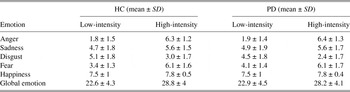
Table 4 shows the low-intensity and high-intensity facial emotion recognition total scores of the patients with PD and HC.
Total low-intensity and high-intensity emotion scores of 70 HC and 70 patients with PD

Note
SD = standard deviation; HC = healthy controls; PD = Parkinson’s disease; Global emotion = sum of total scores of the five emotions when they were shown at low- and high-intensity levels.
The MANOVA carried out with diagnostic groups (PD vs. HC) and facial emotion intensity level (low vs. high) as main effects and all facial emotion recognition scores as dependent variables revealed a significant global effect of diagnostic groups (Wilks’ lambda = 0.947; F = 3.046; df = 5,272; p < .0001) and a significant global effect of intensity level (Wilks’ lambda = 0.200; F = 217.067; df = 5,272; p < .0001) on facial emotion recognition. However, we found no significant global interaction between diagnosis and intensity level in facial emotion recognition performances.
A series of follow-up univariate ANOVAs indicated that only facial disgust emotion recognition was significantly worse (F = 8.796; df = 1,276; p = .003) in the patients with PD than in HC and that the patients recognized low-intensity fear expression better than HC (F = 4.981; df = 1,276; p = .026). In particular, disgust facial emotion recognition was lower at both intensity levels in patients with PD compared with HC. Furthermore, intensity level influenced recognition of facial emotions. This intensity effect was highly significant for all emotions (p < .0003 for all comparisons). In particular, both HC and the patients with PD recognized all high-intensity facial emotions (except for disgust) better than low-intensity emotions. On the contrary, both groups recognized the low-intensity disgust facial emotion better than the high-intensity facial emotion. Thus, this effect was independent of diagnosis.
In the patients with PD, we explored the influence of clinical variables on the ability to recognize each emotion. Only fear facial emotion recognition was significantly correlated with duration of illness (r = 0.242; p = .044) and L-Dopa daily equivalents (r = 0.372; p = .001).
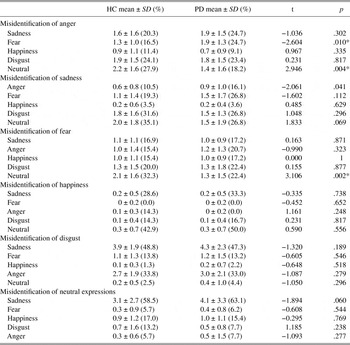
Examining the pattern of error rates, we found that the patients with PD and HC had different distributions of errors for anger and fear expressions, but not for disgust, sadness, happiness, and neutral expressions (Table 5). Regarding anger recognition, HC overattributed neutral expressions to anger more than the patients with PD, whereas the latter overattributed fear expressions to anger. Regarding fear recognition, the HC group overattributed neutral to fear expressions, whereas the PD group did not.
Error profile of 70 HC and 70 patients with PD in identifying individual facial emotions and neutral expressions

Note
SD = standard deviation; HC = healthy controls; PD = Parkinson’s disease; *Statistically significant difference.
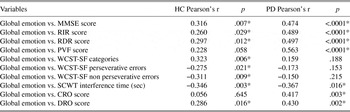
Table 6 shows the correlations among global emotion and neuropsychological scores in HC and the patients with PD.
Correlation between global emotion and neuropsychological scores of 70 HC and 70 patients with PD

Note
Global emotion = sum of the total scores of five emotions (anger, sadness, disgust, fear, happiness); HC = healthy controls; PD = Parkinson’s disease; MMSE = Mini Mental State Examination; RIR = Rey’s 15-word test-Immediate Recall; RDR = Rey’s 15-word test-Delayed Recall; PVF = Phonological Verbal Fluency; WCST-SF = Wisconsin Card Sorting Test-short form; SCWT = Stroop Color-Word Test; CRO = Copy of Rey-Osterrieth picture; DRO = Delayed Recall of Rey-Osterrieth picture; *Statistically significant correlations.
The global score for facial emotion recognition was significantly correlated with MMSE, RIR, RDR, SCWT-interference time, DRO in both HC and PD groups, and with WCST-SF (categories, perseverative and non perseverative errors) scores in HC but not in the patients with PD. Indeed, in the PD but not in the HC group significant correlations were found among emotion global scores and PVF and CRO scores.
As disgust facial emotion recognition performance was significantly reduced in the patients with PD, we also correlated the disgust recognition total score with all individual neuropsychological domain scores (data not shown in the table). The disgust recognition total score was significantly correlated with MMSE (r = 0.393; p = .001), RIR (r = 0.345; p = .003), RDR (r = 0.266; p = .026), PVF (r = 0.430; p = .001), SCWT-interference time (r = -0.276; p = .020), CRO (r = 0.334; p = .004), and DRO (r = 0.252; p = .035).
Finally, in the patients with PD recognition of neutral faces did not correlate significantly with any sociodemographic, clinical, or neuropsychological variable, except for education level (r = 0.349; p = .003).
DISCUSSION
Although the selectivity and degree of the facial emotion recognition impairment in patients with PD has received considerable attention, results are contradictory (for a review, Assogna et al., Reference Assogna, Pontieri, Caltagirone and Spalletta2008). The findings of the present study, obtained in a larger sample, confirm previous observations of worse disgust facial emotion recognition performance in PD (Sprengelmeyer et al., Reference Sprengelmeyer, Young, Mahn, Schroeder, Woitalla and Büttner2003; Suzuki et al., Reference Suzuki, Hoshino, Shigemasu and Kawamura2006). Furthermore, the intensity-based approach, which was used for the first time in this study, confirms that in patients with PD recognition of disgust facial emotion is lower at both levels of intensity. However, this effect is very selective in PD because the global recognition of facial emotion expressions in these patients is intact.
In Darwin’s original hypothesis, disgust was a consequence of exposure to unpleasant olfactory and gustatory stimuli. However, feelings of disgust arise not only from sensory stimuli (taste and smell) but also from more abstract sources, for example, in relation to aspects of body or moral judgments (Rozin, Lowery, Imada, & Haidt, Reference Rozin, Lowery, Imada and Haidt1999).
From a theoretical point of view, these interpretations indicate that the recognition of disgust is a complex phenomenon (Rozin et al., Reference Rozin, Lowery, Imada and Haidt1999). Indeed, patients with PD might underrecognize disgust because they have difficulty in identifying it. Notably, we found no significant correlation between depression severity and disgust recognition in either the PD or the HC group. Therefore, it is very unlikely that the influence of depression, which was more severe in the patients with PD, was responsible for the facial emotion recognition results. As for the relationship between disease severity and disgust recognition, in the PD patient group worse disgust recognition was not correlated with motor symptom severity or duration of illness. Another study (Pell & Leonard, Reference Pell and Leonard2005) reported a marginally significant negative correlation between degree of motor impairment and identification of disgust; however, the correlation was found in a very small sample (21 patients with PD). Thus, disgust recognition might already be compromised in early stages of the disease, as shown by Suzuki and colleagues (Reference Suzuki, Hoshino, Shigemasu and Kawamura2006), and might be one of the early markers of PD.
Moreover, the intensity-based approach allowed us to identify an important emotional intensity-level effect on the recognition of emotional expressions in both patients with PD and HC. In fact, with the exception of disgust both groups decoded all high-intensity emotions more easily. Surprisingly, they recognized disgust better when stimuli were viewed with the emotional intensity commonly encountered in human interactions (low-intensity faces) than when the intensity was presumably easier to decipher (i.e., high-intensity faces). This is an important finding of the present study. In fact, it confirms and extends previous data observed in patients with schizophrenia and younger healthy controls (Kohler et al., Reference Kohler, Turner, Bilker, Brensinger, Siegel and Kanes2003) to patients with PD and older healthy subjects, demonstrating that physiological processes underlie the better recognition of low-intensity disgust expressions. In fact, to mimic the high-intensity disgust expression several muscles must be activated that are probably involved in the expression of some other negative emotions, and this might impede correct deciphering of the high-intensity disgust facial expression. This demonstrates that neither group of subjects (PD or HC) used high intensity to reinforce correct identification of the disgust emotion, probably because the low-intensity expression of disgust represents the purest expression of this emotion and is therefore easier to decipher. Moreover, our results were confirmed by analysis of the distribution of errors in the recognition of disgust, which was similar in the two groups. Therefore, it is unlikely that lower disgust facial expression recognition in PD is caused specifically by confusion with other emotions only in patients.
Conversely, our patients with PD showed greater accuracy than HC in identifying fearful facial expressions, in particular, low-intensity facial emotions, which are more frequently encountered in daily-life interactions and are presumably more difficult to perceive and decipher as non-verbal emotional communication. This finding might have been caused by dopaminergic stimulation due to pharmacological therapy in patients who had probably been ill for a longer period of time and thus were taking higher doses of anti-Parkinson medication. In fact, we found a positive correlation among dopaminergic therapy (L-Dopa daily equivalents), duration of illness, and fear facial emotion recognition. Patients with PD might also be in greater contact with the emotion of fear in their daily life and in social situations due to manifestations of disease symptoms (e.g., fear of falling) and they might become very sensitive to this emotion. Thus, dopaminergic therapy could lead to overactivation of already active emotional pathways. Indeed, there is previous evidence of the role of the amygdala in fear recognition (Sprengelmeyer et al., Reference Sprengelmeyer, Young, Mahn, Schroeder, Woitalla and Büttner2003) and of amygdala activation by dopaminergic drugs (Takahashi et al., Reference Takahashi, Yahata, Koeda, Takano, Asai and Suhara2005; Tessitore et al., Reference Tessitore, Hariri, Fera, Smith, Chase and Hyde2002; Yoshimura, Kawamura, Masaoka, & Homma, Reference Yoshimura, Kawamura, Masaoka and Homma2005). On the other hand, the better recognition of fear expression in patients with PD can be further explained by results of the analysis of error rates. The latter confirmed that the HC group significantly overattributed neutral expressions to fear emotion, whereas the PD group significantly overattributed fear to anger emotions and showed a tendency to overrate fear also in the recognition of sadness, disgust, and neutral expressions.
The brain structures involved in fear and disgust recognition also mediate the behavioral and cognitive dysfunctions frequently encountered in PD. For example, degeneration of the dopaminergic mesolimbic neurons projecting to the extended amygdala has a role in depression (Alexander, Delong, & Strick, Reference Alexander, Delong and Strick1986; Remy, Doder, Lees, Turjanski, & Brooks, Reference Remy, Doder, Lees, Turjanski and Brooks2005; Torack & Morris, Reference Torack and Morris1988). It can be hypothesized that derangement of reciprocally interconnected cortical-subcortical circuitries is responsible for altered identification of disgust and modified recognition of the facial emotion of fear and for behavioral and cognitive symptoms, such as depression and memory, praxis, and attention dysfunctions.
Another important finding of this study is the relationship between better facial emotion recognition and higher cognitive performance. In fact, as demonstrated by the data of both groups of participants the global ability to recognize emotions should be viewed as a complex cognitive process requiring the integrity of several cognitive functions (i.e, verbal and visuo-spatial memory, attention, language, and executive functions). In the human brain, emotions are normally regulated by a complex circuit, which includes the prefrontal, orbitofrontal, amygdala, insula, and cingulate cortices. Apparently, several other interconnected regions are also associated with processing emotion facial stimuli (Murphy, Nimmo-Smith, & Lawrence, Reference Murphy, Nimmo-Smith and Lawrence2003; Phan, Wagner, Taylor, & Liberzon, Reference Phan, Wager, Taylor and Liberzon2002) and cognitive functions. Moreover, several studies conducted in patients with mild cognitive impairment (MCI) and Alzheimer’s disease (AD) confirmed the relationship between emotion recognition impairment and cognitive deficits (Albert, Cohen, & Koff, Reference Albert, Cohen and Koff1991; Spoletini et al., Reference Spoletini, Marra, Di Iulio, Gianni, Sancesario and Giubilei2008; Teng, Lu, & Cummings, Reference Teng, Lu and Cummings2007; Weiss et al., Reference Weiss, Kohler, Vonbank, Stadelmann, Kemmler and Hinterhuber2008). In particular, Spoletini and colleagues (2008) found that emotion recognition progressed from a deficit in recognizing low-intensity fearful facial expressions in the amnestic MCI phase to a deficit in all intensities and emotions, with the exception of disgust, in mild AD. They explained these data as a possible effect of the progressive degeneration of brain structures that modulate the processing of emotion and of progressive cognitive deterioration.
Of interest, we found a specific difference between patients with PD and HC. A correlation emerged between the two groups for emotion recognition, verbal fluency, and complex constructive praxis, but not for executive functions. This finding can be explained as the effect of a compensatory mechanism that arises in patients with PD because they are unable to use cognitive functions that have a key role in emotional processing, such as decision-making processes.
An ancillary finding of this study is the worse neutral face recognition in PD, which, however, was not correlated with the scores of any clinical or cognitive variables. The only significant correlation was with educational level. This might indicate a phenomenon linked to general intelligence or sociocultural factors, but not directly associated with the illness. Although the analysis of error rates showed a similar distribution of errors on neutral expressions in patients with PD and HC, the worse performance of the former on neutral faces might be explained by the greater tendency of HC to attribute neutral expressions to unrecognized expressions, as shown by their significant overestimation of neutral expressions in the recognition of fear and anger. Future studies should attempt to clarify this issue.
Before concluding, we would like to acknowledge some aspects of the study that limit generalization of the results. The present study could be biased because the patients with PD were under dopamine replacement therapy. There is evidence that dopaminergic therapy influences facial emotion recognition in this disease (Sprengelmeyer et al., Reference Sprengelmeyer, Young, Mahn, Schroeder, Woitalla and Büttner2003). The patients with PD enrolled in the present study had been under stable dopaminergic therapy for at least 2 months. Therefore, although our findings provide a clear picture of the entity of this phenomenon under stable and efficacious pharmacological therapy, they might underestimate the prevalence of impaired facial emotion recognition in PD. However, the daily L-Dopa equivalents in the whole group of patients, and selectively in those treated with dopamine agonists only, did not correlate with disgust facial emotion recognition, suggesting that treatment did not cause lower emotion recognition. Despite these indications, further studies on drug-free patients with PD are needed to clarify this issue. Another important limitation regards the PERT. The photographs used in this test are static; they lack the dynamic information available in the natural context, which facilitates the interpretation of facial expressions. On the other side, the main advantage of this test is the 3D nature of the stimuli, which eliminates effects of tilt. This is crucial for examining asymmetry in facial expressions and produces a more “real” effect of the facial emotion than other tests, which are based on bi-dimensional pictures.
In conclusion, the results of the present study confirm the presence of selective lower disgust recognition in PD, independent of stimulus intensity. Furthermore, disgust facial expression recognition was easier for low-intensity than for high-intensity faces regardless of which group the subjects belonged to (PD or HC) and, thus, could be the expression of a physiological process. Finally, our findings support the hypothesis of a relationship between cognitive deficits and worse performance in recognizing the facial emotion of disgust.
ACKNOWLEDGMENTS
None of the authors has a conflict of interest. This work was supported by the Italian Ministry of Health (RC 06-07-08/A and RF 06-07). Drs. Assogna and Pontieri contributed equally to this work.