Paphlagonia, Honorias, and Hadrianoupolis in Byzantine times
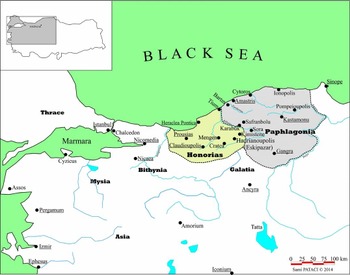
In the Byzantine period Paphlagonia and Honorias were provinces on the north-central Black Sea coast of Asia Minor, situated between Bithynia and Pontus. Paphlagonia appeared as a separate province in the fourth century A.D. (Hierocles, Synecdemus c. 33) (map 1). In the seventh century it became part of the theme of Opsikion and, later, of the Boukellarion theme, before it was detached again to form a separate unit. The theme of Paphlagonia was a military-civilian province of the Byzantine empire in the namesake region; it was definitely created after c. A.D. 815–819Footnote 1 and so the theme seems to have been established during the reign of Michael II, simultaneously with the theme of Chaldea in c. A.D. 820.Footnote 2 The territory of the theme corresponds roughly to the Late Antique province of Paphlagonia, which had been subsumed in the themes of Opsikion and Boukellarion.Footnote 3 After the battle of Manzikert in A.D. 1071, most of the region was lost to the Seljuk Turks; Alexios I Komnenos recovered the coast. However, the campaigns of John II Komnenos in the 1130s which were destined to reconquer the interior were in vain. After the Fourth Crusade, the Paphlagonian coast came under the control of David Komnenos, but in 1214 the Nicaean emperor Theodore I Laskaris seized the western parts up to Kromna east of Amastris. These remained in Byzantine hands until the late fourteenth century, when they were taken over by the Turks or the Genoese.Footnote 4
Map of Paphlagonia and Honorias in Late Antiquity with the places mentioned in the text. Underlined places indicate cities with local museums.

The southern neighbour of Paphlagonia was Honorias and as a Late Roman province Honorias encompassed parts of Bithynia and Paphlagonia. Its capital was Klaudioupolis (modern Bolu), and its governor held the rank of praeses. The province was established under Theodosius II and named after his uncle Honorius. It formed part of the diocese of Pontus, bordering with Bithynia in the west, Galatia Prima in the south, and Paphlagonia in the east. In the administrative reforms of Justinian I, the province was united with that of Paphlagonia for a short time (c. A.D. 535–548) and formed a new province of Paphlagonia under a governor named as Praetor Paphlagoniae Iustinianeus. Aside from Honorias’ capital Klaudioupolis, the major cities and episcopal sees of the province listed in the Synecdemus were Heraclea Pontica, Prusias ad Hypium, Tium, Cratea and Hadrianoupolis. Less well known is the hinterland of Paphlagonia and Honorias, especially its southwestern part where field surveys were conducted between 1997 and 2001, producing some Byzantine evidence.Footnote 5
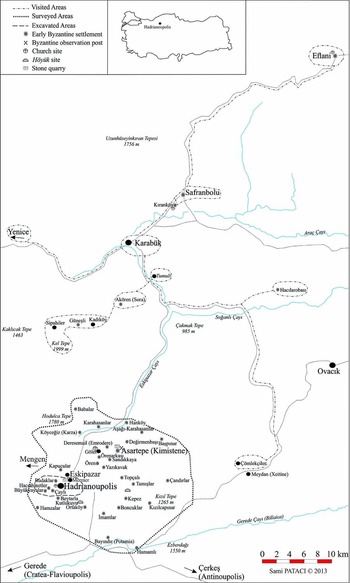
Hadrianoupolis is located 3 km west of the modern town of Eskipazar, near Karabük. Geographically it was on the principal western route from the Central Anatolian plateau through the mountains to Bartın and the Black Sea. Thus it lies basically in Roman Paphlagonia and Byzantine Honorias and on the borders of the Galatian, Bithynian, and Paphlagonian territories (map 2). It was a small but important city, controlling this major route and dominating a rich agricultural, especially viticultural, hinterland. It has been determined that the nucleus of the Byzantine city extended along the Eskipazar-Mengen route for 8 km east-west and 3 km north-south. The chora of Byzantine Hadrianoupolis is much more extensive in size;Footnote 6 it is not, however, well-known. At the site it was difficult to locate a classical settlement pattern of a typical Byzantine polis, since parts of the city are widely distributed in the area and they are some distance apart. Between the late fifth and early eighth centuries Honorias was a densely populated region. The Byzantine neighbours of Byzantine Hadrianoupolis were Gangra-Germanicopolis (today Çankırı), Sora (today Zobran) and Cratea (today Gerede).Footnote 7 Of the major cities in inland Paphlagonia Hadrianoupolis seems to be more intact than Gangra; it is one of only two large-sized settlements of inland Paphlagonia that has been excavated; the other one is Pompeiopolis, 40 km east of Kastamonu.
Map of surveyed Byzantine find spots in southwestern Paphlagonia in 2005.

Hadrianoupolis was probably founded in the first century B.C., and during the second century A.D. the city changed its former name Caesarea and probably its status as a small city. As the excavations and finds show, there was perhaps a collapse or total abandonment of the settlement between the third and fourth centuries A.D. In late fifth-early sixth century, however, there was a sudden population and urban boom in Hadrianoupolis and its chora. The Early Byzantine period in Hadrianoupolis was not very well represented in literary and ecclestiastical sources. Ecclestiastically, Hadrianoupolis was a dependent of Klaudioupolis.Footnote 8 In the reign of Justinian I, it was the bishop of Hadrianoupolis who received imperial edicts against banditry and communicated them to the local landowners, assembled in the audience chamber adjoining his basilica.Footnote 9 Some of the bishops of Hadrianoupolis are known at Church Councils, starting with Theophilos at Chalcedon in A.D. 451, Plato at Constantinople in 681Footnote 10 (no bishop is recorded at the Concilium Quinisextum in 692),Footnote 11 and Niketas who attended the Seventh Ecumenical Council of Nicaea in 787.Footnote 12 It is likely that a tenth/eleventh century seal of a bishop George refers to it.Footnote 13 In the church listings the city is mentioned until the twelfth century, variously in Galatia, Honorias, Opsikion, or Boukellarion-Paphlagonia.Footnote 14 Through epigraphicFootnote 15 and archaeological finds one can assume that the city was very prosperous during the period between the late fifth and mid seventh century, perhaps owing to the viticultural activities in the region. During the reign of Heraclius St. Alypius the Stylite (A.D. 522–640) lived in an ancient pagan cemetery ‚in a deserted area‘ outside of HadrianoupolisFootnote 16 which should be related to the Basilica A; in addition there were also a monastery and a convent, as well as a basilica for the great martyr St. Euphemia ‚on the site of a dilapidated pagan temple‘,Footnote 17 built by the same saint.
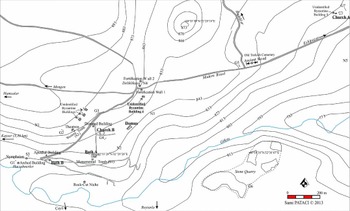
The districts of Hacıahmetler, Eleler, and Çaylı of the village of Budaklı formed the core of Byzantine Hadrianoupolis. A fortification wall surrounded at least a major part of the city. In 2005 archaeological field surveys were begun at Hadrianoupolis and its environs by a team from the Dokuz Eylül University, Izmir. As a result of the 2005 survey, it has been confirmed that Hadrianoupolis was indeed located at modern Eskipazar, with finds dating from the first century B.C. to the mid-eighth century A.D. In 2006 and 2007 excavations were carried out, followed in 2008 by a study season for site for conservation and restoration. The field activities between 2005 and 2008Footnote 18 identified the remains of at least 25 buildings (map 3). Among them are two bath buildings of the Late Roman-Early Byzantine periods, two Early Byzantine basilicas, a domus (formerly called a ‚villa’), a fortified structure of the Middle Byzantine period, a possible theatron (auditorium), a vaulted building, a domed building, and some domestic buildings with mosaic floors. At least half of these buildings had mosaic floors and in some buildings there were frescoes.Footnote 19
Plan of Hadrianoupolis in 2008 with the find spots of coins underlined and in bold.

In general, these four campaigns have established that Hadrianoupolis was a fortified regional centre during the Early Byzantine period (late fifth-late seventh centuries A.D.), when it can easily be defined as a ‚polis’ with civic buildings. It had a fairly large urban population as well as a dense rural population in its chora. Most of the visible surface remains in southwestern Paphlagonia-Honorias belong to this period. It seems that the city of Hadrianoupolis was abandoned to a large extent during the second quarter of the eighth century A.D. because of Arab attacks in Galatia and Paphlagonia and the Christian population must have moved to rural mountain-top refuges in the area. In the chora of Hadrianoupolis, an area within a radius of 20 km of the city was extensively surveyed and more than 15 archaeological sites of various types were discovered. These sites comprise höyüks, cemeteries with single graves or grave groups, tumuli, stone quarries, farmyards, villages, sanctuaries, and other remains. The largest Byzantine settlements in the chora are Kimistene, a Middle Roman mountaintop sanctuary with a mid-ninth to the late eleventh/early twelfth centuries A.D. fortification and observation post, as well as Örenarkası, an Early Byzantine settlement for viticultural activities and its extensive cemetery, c. 3 km east of Hadrianoupolis. During the Middle Byzantine period (mid/late eighth to the late eleventh-early twelfth centuries A.D.) life at the city of Hadrianoupolis seems to be very weak and the sole archaeological record are some primitive burials of mid-eighth-ninth centuries on the floor of Basilica B.
The coin finds from Hadrianoupolis
During the four seasons of field work between 2005 and 2008 a total of 21 Byzantine coins were collected, all of which are today stored in the Amasra Museum. No Roman or earlier coins were found. One coin is silver (no. 14) and the rest are all bronze or copper alloy. The coins are from the following seasons: one from 2005, seven from 2006, ten from 2007, and three from 2008. Their chronology is as follows (see table 1 below): three belong to the sixth century, ten to the seventh century, one to the eighth century, three to the late tenth-early eleventh, and two to the eleventh century. The remaining two coins have not been identified. The earliest Byzantine coin from Hadrianoupolis (no. 1) is from the reign of Justin I (A.D. 518–527) and the latest (no. 19) is of Romanos IV (1068-1071) which fits perfectly to the date of battle of Manzikert in A.D. 1071 and the lasting entry of the Seljuk Turks into Asia Minor. After the twelfth century there seems to be no more Byzantine coins or any other Byzantine finds in this part of Paphlagonia.
Numbers of Byzantine coins by date found in Hadrianoupolis.

The Byzantine coins from Hadrianoupolis were found in the following areas: Bath A, domus, Bath B, Basilica A, from an unidentified Byzantine building (building no. 4) close to the domus, and from the acropolis of Kimistene (see table 2 below). The Bath A was a monumental building located in the southern part of the city, c. 130 m southwest of Early Byzantine Basilica B, which was initially excavated in 2003 by the local Archaeological Museum of Ereğli. In 2006 and 2007 a large part of the structure was excavated, revealing 15 rooms, and it was ascertained that Bath A had five main archaeological phases, i.e. A.D. c. 475–525, c. 525–575, c. 575–675, c. 675–725 and c. 725 (i.e. the Arab invasions that reached Gangra and Hadrianoupolis) to the nineteenth century. In this last phase the Bath A must had been converted into a barn. The small find deposits range from the first to the nineteenth century A.D.; finds after eighth century, however, are very sparse and infrequent. Ten coins, ranging from the sixth to the eleventh century were found here, two of which belong to the sixth, four of which are probably seventh, and four of which are tenth-eleventh century.
Distribution of find-spots of the Byzantine coins in Hadrianoupolis.

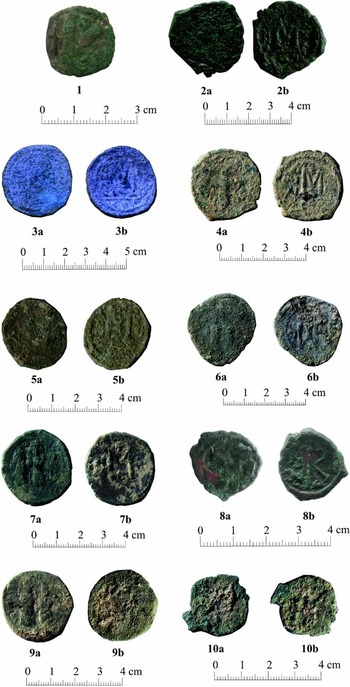
Byzantine coins from Hadrianoupolis in Paphlagonia, nos. 1–10.

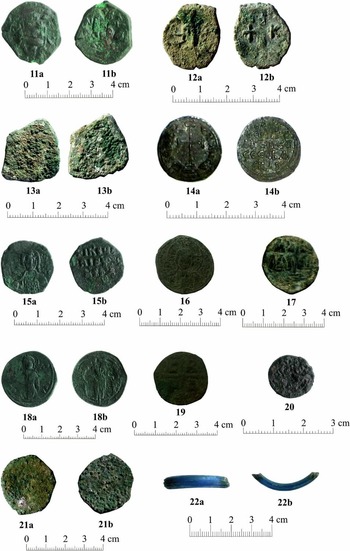
Byzantine coins from Hadrianoupolis in Paphlagonia, nos. 11–21 and a fragment of a blue glass bracelet, nos. 22a-b, found with no. 18.

The second major find spot of coins was the domus, which is a large complex with several rooms, some of them with extensive mosaic floors and frescoes. This building has provided five coins, which indicate that it must have been in use with a domestic purpose during the sixth and seventh century. No coins later than the seventh century were found in this building.
Bath B is c. 100 m west of the Bath A and its function is still uncertain. Three coins were found here, all indicating a clear use of the building during the mid and late seventh century.
Only one single coin was found in Basilica A (no. 14) as well as one (no. 13) in an unidentified Byzantine building close to the domus, both of which perhaps show the abundance of these buildings in the seventh and eighth centuries.
To the west of the township of Eskipazar, near the village of Deresemail and the hamlet of Değirmenbaşı, there is a ridge called ‘Asartepe’ with four hilltops, marking the ancient site of Kimistene.Footnote 20 The 2005 field survey at Asartepe covered three further areas or ‘peaks’ along the mountain ridge in addition to the acropolis: necropolis 1, necropolis 2, and the cistern. Most of the material was collected from the acropolis. The site clearly shows signs of occupation over a long period, with particularly important phases in the Hellenistic and Roman Imperial periods, as surface pottery ranges from the Late Iron Age into the Middle Byzantine period. As indicated above, the acropolis of Kimistene served as a fortification and observation post between the tenth and twelfth centuries, probably controlling an important road coming from Gangra and heading to the Black Sea. At the eastern terrace of the peak of the acropolis an eleventh-century follis (no. 17) was found. In this area at the peak of the hill numerous Middle Byzantine sherds were collected in the 2005 survey, indicating a settlement shift from the valley floor to more rugid places east of Eskipazar.
Catalogue of the Coins
No. 1 (fig. 1): Justin I (A.D. 518-527)
Amasra Museum, inv. no. Hdrn. 08-13.
Bath A, from the topsoil; 2008 season.
22 mm. 2.79 g.
Mint of Constantinople.
Obv. Bust of emperor r.
Rev. Large K; above,
 ; to l., +; to r. (?).
DOC 15, MIB I 19, dated A.D. 522-527.
Æ half follis.
No. 2 (figs. 2a-b): Justinian I (A.D. 527-565)
Amasra Museum, inv. no. K07-21 KS.
Bath A, room 3; from the illegal excavation trench next to the tiled platform; 2006 season.
Mint of Constantinople.
34 mm. 5.86 g.
Obv.
 ; in field r., +. Bust of emperor facing; in r. hand, globe cruciger.
Rev. Large M; above, +; to l.,
 ; to r., [XIXII]; below,
 (?); in ex., [
 ].
DOC 50a; MIB I 95, Morrisson, BN 4/Cp/Æ21-81, dated A.D. 547/548.
Æ follis.
No. 3 (figs. 3a-b): probably Justinian I (A.D. 527-565)
Amasra Museum, inv. no. HP07/07.
Domus, room 1; 2007 season.
35 mm. 7.35 g.
Mint of Constantinople.
Obv. Bust of emperor facing.
Rev. Large M; above, +; to l.,
; to r., [-]; in ex.,
.
Æ follis.
No. 4 (figs. 4a-b): Heraclius (A.D. 610-641)
Amasra Museum, inv. no. HP07/03.
33 mm. 6.11 g.
Mint of Constantinople.
Domus, court of the room 5, under the floor covering (found with no. 20); 2007 season.
Obv. Heraclius and Heraclius Constantine, standing.
Rev. Large M; above, christogram (
 ); below, officina letter illeg.; to l.,
. To r.,
 . In ex.
.
Overstruck.
MIB III 159b or 160b, dated A.D. 612/613.
Æ follis.
No. 5 (figs. 5a-b): Heraclius (A.D. 610-641)
Amasra Museum.
Domus; 2007 season.
30 mm. 4.57 g.
Mint of Constantinople.
Obv. Faint traces of a bust.
Rev. Large M; to l.,
. to r.,
. In ex.,
.
Very corroded.
MIB III 159b or 160b, dated A.D. 612/613.
Æ follis.
No. 6 (figs. 6a-b): Heraclius (A.D. 610-641)
Amasra Museum.
Domus, room 5, court, under the floor covering; 2007 season.
35 mm. 6.73 g.
Mint of Constantinople.
Obv. Heraclius and Heraclius Constantine, standing.
Rev. Large M; below, officina letter Δ; to l.,
. To r.,
 . In ex.,
.
Very corroded.
MIB III 161, dated A.D. 615/616.
Æ follis.
No. 7 (figs. 7a-b): Heraclius (A.D. 610-641)
Amasra Museum.
Bath B, room 2, just below the topsoil; 2007 season.
33 mm. 4.17 g.
Mint of Constantinople.
Obv. No inscription. Three figures standing, facing: Heraclius, centre; Heraclius Constantine, to r.; Martina or Eudocia, to l.; crosses in upper field to l. and r.
Rev. Large M; above, +;
 ; to l.,
 ; to r.,
 ; below,
(?); in ex.,
 .
MIB III 162, dated A.D. 628/629.
Æ follis.
No. 8 (figs. 8a-b): Heraclius (A.D. 610-641)
Amasra Museum, inv. no. K07-17 KS.
Bath A, room 6a, in arch-like area, 2 m below the surface; 2006 season.
23 mm. 3.04 g.
Obv. No inscription. Two figures standing, facing front, Heraclius on l. with long beard, and Heraclius Constantine on r., holding globe cruciger in r. hand; between heads, +; [to l.
 ; to r., K].
Rev. Large K; above, (+?); to l.,
; to r., [-]; below, Δ.
DOC 120-124, MIB III 171d, dated A.D. 631/632-639/640.
Æ half follis, small series.
No. 9 (figs. 9a-b): probably Heraclius (A.D. 610-641)
Amasra Museum.
Domus, court of the room 5, under the floor covering (found with no. 16); 2007 season.
30 mm. 6.93 g.
Obv. Heraclius and Heraclius Constantine, standing.
Rev. Illegible, very corroded.
Æ follis.
No. 10 (figs. 10a-b): probably Heraclius (A.D. 610-641)
Amasra Museum.
Bath B, room 1, from the illegal excavation trench; 2007 season.
25 mm. 4.11 g.
Obv. Heraclius in military garb, and Heraclius Constantine wearing the chlamys, standing.
Rev. Illegible, very corroded.
Æ follis.
No. 11 (figs. 11a-b): Constans II (A.D. 641-668)
Amasra Museum, inv. no. K07-20 KS.
Bath A, room 9; 2006 season.
29 mm. 3.53 g.
Mint of Constantinople.
Obv.
 . Emperor standing, facing front, wearing crown and chlamys, holding long cross in r. hand and globe cruciger in l.
Rev. Large
 ; above,
; to l.,
 ; to r.,
 ; in ex., to l.
 ; to r., (?).
DOC 59-60, MIB III 162c, dated A.D. 642-642/643.
Æ follis, class 1, overstruck on an earlier follis.
No. 12 (figs. 12a-b): Constantine IV (A.D. 668-685)
Amasra Museum.
Bath B, room 4, layer no. 3; 2007 season.
24 mm. 4.29 g.
Mint of Constantinople.
Obv. No inscription. Bust of emperor, three-quarter facing, wearing plumed helmet and loricum, and holding long transverse spear behind head in r. hand.
Rev. Large I; to l., +; to r., K.
DOC 39; MIB III 89-94, Morrisson 14/Cp/Æ/14, dated A.D. 674-685.
Æ decanummium, class 2.
No. 13 (figs. 13a-b): possibly Justinian II, first reign (A.D. 685-695) or little later (max. A.D. 717)
Amasra Museum.
Unidentified Byzantine building close to the domus; 2007 season.
25 mm. 2.45 g.
Illegible, very corroded.
No. 14 (figs. 14a-b): Leo III (A.D. 717-741)
Amasra Museum.
Basilica A, nave 3, directly on the floor; 2006 season.
23 mm. 1.67 g.
Mint of Constantinople.
Obv.
 (“Jesus Christ conquers”) cross potent on three steps, border.
Rev.
 in 5 lines, border.
AR silver miliaresion.
DOC 231-32; Morrisson, BN II, 451; dated A.D. 720-741.
Publication: Laflı and Zäh, “Forschungen im byzantinischen Hadrianupolis“, 691, fig. 2.
No. 15 (figs. 15a-b): Anonymous follis
Amasra Museum, inv. no. K07-14 KS.
Bath A, room 11; 2006 season.
27 mm. 5.60 g.
Obv.
 . Bust of Christ facing front, with nimbus cross and holding book; in field,
 .
Rev.
 .
DOC 652.
Class A2,Footnote 21 dated A.D. 976-c. 1030/1035, probably var. 4.
No. 16 (fig. 16): Anonymous follis
Amasra Museum, inv. no. Hdrn. 08-12.
Bath A, from the topsoil; 2008 season.
29 mm. 6.11 g.
Obv.
 . Bust of Christ facing front, with nimbus cross and holding book; in field,
 .
Rev.
 .
DOC 666-67.
Class A2, dated A.D. 976-c. 1030/1035, probably var. 40.
No. 17 (fig. 17): Anonymous follis
Amasra Museum.
Kimistene, peak of the acropolis, eastern terrace, surface find; 2005 season.
29 mm. 5.36 g.
Obv.
. Bust of Christ facing front, with cross nimbus, holding book with quincunx decoration on cover; in field,
.
Rev. Cross on base and two steps, with
 in angles.
DOC 676-81.
Class B, dated A.D. c. 1030/1035-1042.
Publication: Laflı and Christof, “Tempel von Asartepe/Kimistene”, 239, fig. 7.
No. 18 (figs. 18a-b): Signed follis of Constantine X and Eudocia (A.D. 1059-1067)
Amasra Museum, inv. no. K07-12 KS.
Bath A, room 5, found just below a wall with a fragment of a blue glass bracelet (figs. 22a-b); 2006 season.
32 mm. 8.74 g.
Mint of Constantinople.
Obv.
 . Christ standing facing front, with nimbus cross and holding book; r. hand raised in blessing; in field,
 .
Rev.
 (on r.),
 (on l.). Emperor and empress standing facing front, crowned and wearing loros, holding between them long cross labarum, resting on three steps.
DOC 774-76.
Class 1, dated A.D. 1059-1067.
No. 19 (fig. 19): Signed follis of Romanus IV (A.D. 1068-1071)
Amasra Museum, inv. no. Hdrn. 08-14.
Bath A, from the topsoil; 2008 season.
26 mm. 4.85 g.
Mint of Constantinople.
Obv. No inscription. Bust of Christ facing front; in field,
over
 .
Rev. C R / P Δ.
 with X at intersection and one large and two small pellets at end of each arm; to l. and r. of pellets at base, ornaments.
DOC 796-97, dated A.D. 1068-1071.
No. 20 (fig. 20): Uncertain
Amasra Museum, inv. no. K07-18 KS.
Bath A; 2006 season. Found in a stratified level with traces of ash and bones.
18 mm. 3.38 g.
Illegible, overstruck, very corroded.
No. 21 (figs. 21a-b): Uncertain
Amasra Museum.
Bath A, from the topsoil; 2007 season.
31 mm. 4.67 g.
Illegible, very corroded.
The significance of the numismatic evidence from Hadrianoupolis
The numismatic assemblage in Hadrianoupolis is very small, but it shows some traits that allow for preliminary interpretation and discussion. The coins point to an active city in the sixth and seventh centuries A.D. which shows no clear signs of economic decline (especially in the domus area). This can also be deduced from the datable ceramic and glass material.
The miliaresion of Leo III that was found on the floor of Basilica A proves the use of that Early Byzantine church up until at least the first half of the eighth century. This should not surprise us, since the basilica certainly belonged to the pilgrimage complex of St. Alypius the Stylite, which was built only around one hundred years earlier. The fate of the town in the seventh century A.D. seems to be closely connected to the cult of the saint.
Hadrianoupolis exhibits a pattern commonly known from most parts of Asia Minor: a numismatic reduction, or even gap, starting in the 660s, and this lack of coinage is only overcome in the 830s at the earliest at most Anatolian sites.Footnote 22 The hiatus in the assemblage here stretches even into the late tenth century, for which various reasons can be postulated. It is not necessary to connect this common gap with specific Arab invasions known from the written sources in the 720s,Footnote 23 because it is typical for Asia Minor, and especially for Paphlagonia as a whole.Footnote 24 For the time being, it seems likely that Hadrianoupolis belongs with the majority of Late Antique Anatolian towns that were abandoned during that period.Footnote 25
In the middle of the ninth century, the military outpost on Kimistene was occupied by a small garrison;Footnote 26 parts of the former town were resettled and probably used for rural fairs.Footnote 27 This fact can be deduced not only from the finds, but also from the etymology of the Turkish name of the later settlement: ‘Viranşehir’ (=ruined city) resp. ‘Eskipazar’ (=old bazaar). After the Seljuk conquest, the indigenous population seems to have shifted mostly to the north to the new regional centre, Safranbolu (Borlu/Zalifre in the early sources), where a Christian community existed until the 1920s. Hadrianoupolis was abandoned, as shown by the lack of finds.
The legible coins of Hadrianoupolis were all minted at Constantinople, which unsurprisingly dominated the coin supply in Honorias/Paphlagonia overwhelmingly. The wider area was part of the heartland of the empire, garrison point of the Black sea fleet, and also typical in its rural character. The transformation of Late Antique society to Byzantine structures began early there, consequently large parts of the aristocracy of the ninth to twelfth centuries stemmed from Paphlagonia. Therefore Hadrianoupolis and also Paphlagonia are very suitable to study Middle Byzantine realities.Footnote 28
This paper provides us with the opportunity to put the Hadrianoupolis assemblage into a wider Paphlagonian context. The Byzantine coins found at Pompeioupolis since 1984 (professional excavations started in 2006) have already been partially published;Footnote 29 the data presented here includes the finds of 2015. The amount of material is greater than in Hadrianoupolis (141 are legible as Byzantine coins), but the range is much more limited – the latest coin is a follis of Tiberios III (r. A.D. 698–705) from his first regnal years. The sixth century is only poor represented (post-reformed Anastasius I two; Justinian I six; Justin II five; Maurice two), when compared to the seventh century (Phocas four; Heraclius thirty-three; Constans II thirty-six; Constantine IV three; Justinian II twenty-one, Leontios three; Tiberios III seven). 80% of the identified coins were minted in Constantinople (four coins from Antioch, one each from Carthage and Thessalonike). Constantinople's share in Sinop Museum amounts to 61%.Footnote 30 . Obviously, a roughly similar situation to Hadrianoupolis can be found here, with the major difference being a much more limited re-occupation in the Middle Byzantine period. Middle Byzantine glazed table wares and amphorae presented on the site, but no coins have been as yet unearthed.
The recently published coin finds from the on-going excavations in Tium encompass only 20 legible Byzantine coins, which are in better accordance with those in Hadrianoupolis compared to Pompeioupolis.Footnote 31 They stem from three periods: 580–680 (4 specimens), 830–910 (3) and 970–1180 (12).
If we bring the coin collections of the museums of Amasra,Footnote 32 AmasyaFootnote 33 and SinopFootnote 34 into consideration, as well, we can see some similar trends. Both collections stem from their respective regionFootnote 35 and are therefore representative of them, although some peculiarities have to be kept in mind, e.g. the picture is distorted by choice of acquisition and preservation, which in turn is worse for the Dark Age coins.
Amasya houses a large collection of sixth-century coins (267 pieces), and impressive emissions of Phocas (26) and Heraclius (40), with Constans II (6) and Constantine IV (1) bringing an end to the seventh century sequence. The much smaller Amasra collection lies within the same framework: the finds from the sixth century (38) outweigh those of Phocas (2) and Heraclius (4), and an exceptional issue of Justinian II's first reign. Regarding the mints of the sixth and seventh century coins, Constantinople holds the top rank (both 58%), Nicomedia's share is in Amasra larger (16% to 21%), the same is true for Thessalonike (none to 8%), while Cyzicus’ role is very minor (both 5%), and Antioch's productive mint is more strongely represented in Amasya, of course (20% to 13%).
As a preliminary reason for the preponderance of the seventh to the sixth century coins in Pompeioupolis and Hadrianoupolis in comparison to the collections in Amasra and Amasya we suppose the military activities of these interior sites on the Roman military road to Satala and Armenia in the first half of the seventh century.
The Heraclian campaignsFootnote 36 against the Sasanian invasions are reflected in the numismatic material in northern Asia Minor, and the Hadrianoupolitan finds follow that pattern. Roughly, the emissions of A.D. 610-616 are well-represented, while those up to 627 appear very rarely and circulation in the area recovers only in the years thereafter.Footnote 37 This situation cannot be explained by an empire-wide minting policy, because the picture in Cypriot Salamis is completely different, to name just one example.Footnote 38 This phenomenon does not allow us to draw any conclusions regarding a possible Sasanian takeover, but points only to a lack of coin supply, which in turn was certainly connected with a diminished military and administrative presence in the region during this decade.Footnote 39 The hoard find of ten solidi near Duruğan was deposited in the early reign of Constans II, perhaps in connection with an Arab offensive.Footnote 40
After Constans II (A.D. 641-668) the coin sequence becomes sparse in Paphlagonia, and a true recovery only appears under Leo VI (A.D. 886-912). This matches the general pattern for Asia Minor as a whole, while the European parts of the empire witnessed the beginning of the remonetisation approximately fifty years earlier.Footnote 41
Notes and Acknowledgements
Some abbreviations in alphabetic order: fig.: figure; g.: gram; inv. no.: inventory number; l.: left; max.: maximum; mid.: middle; mm.: millimeter; obv.: obverse; r.: right; rev.: revers and vol.: volume. All the plates and maps were prepared by Dr. Sami Patacı (Ardahan) who also took the photographs in 2013 whom we would like to express our gratitudes. We also would like to thank Dr. Alexander Zäh (Maintal), Prof. Cécile Morrisson (Paris) and the editors as well as anonymous peer reviewers of BMGS for making various comments and suggestions.