The limitations of the traditional historiography of the ethical regulation of biomedical research are becoming increasingly well recognized. A simplistic history has been used to justify a simplistic policy, in the elaboration of regulatory instruments associated with a bureaucracy of administration and enforcement that has acquired its own material interests in self-perpetuation and jurisdictional expansion. The official history of institutionalized ethical regulation sees a clear and self-evident line of descent from the Nazi experiments of World War II to the various legal and quasi-legal instruments that now govern most scientific and, increasingly, social scientific practice. Without regulatory interventions, it is claimed, researchers will revert to barbarism.
This version of the “rise of bioethics” tends to place considerable emphasis on the Nuremberg Doctors Trial, and the Nuremberg Code promulgated at its conclusion, and to use these as an “origin myth” that legitimizes its professional project.Footnote 1 As a narrative, it says little, for example, about the lengthy gap between the conclusion of the Nuremberg trial in 1948 and the development of regulatory interventions for medical research in the victor countries during the 1960s. It tends not to acknowledge the evidence, from writers like Henry Beecher in the United States and Maurice Pappworth in the United Kingdom, that ethically questionable experiments continued in the victor countries well after World War II, a phenomenon explored further by Tal Bolton in a recent Ph.D. thesis and her article in this journal issue.Footnote 2 However, it also tends to equate an absence of regulation with an absence of ethical concern, despite the evidence from Susan Lederer and Sydney Halpern about the effective operation of informal social controls in the United States before World War II.Footnote 3 Most crucially, it neglects Jenny Hazelgrove’s exploration of the difficulty that the prosecutors faced in framing charges against the Nuremberg defendants because they were unable to point to any clear set of regulations or standards in any country other than Germany that could be said to have been violated.Footnote 4
The publication of further analyses of the pre–World War II German experience provides an additional resource for the critical examination of the claims being made about the importance of formal regulation in the maintenance of ethical standards in biomedical research. This body of work has documented the rise of attempts at ethical research governance in Germany from the late nineteenth century through to the 1930s. In so doing, it may seem to provide us with an opportunity to explore the limits of regulation. Why did it fail to protect the victims of the Nazi medical experiments? Why did it seemingly attract so little international interest, despite Germany’s leading role in science and biomedicine over much of this period?Footnote 5 However, as a number of influential historians of late nineteenth- and early twentieth-century Germany have observed, the study of this period has suffered from the imposition of narrative arcs, influenced by sociology or political science, that see it only as the precursor to the disaster of the Nazi regime.Footnote 6 No actor at the time consciously sought this end for their actions: even the Nazi leadership sought power rather than defeat. Accounts that find a logic in the events from the late nineteenth century to the end of World War II may overlook the unintended consequences of actors dealing with contingent events on the basis of partial information interpreted according to what were contemporaneously considered valid knowledge or theories. It is important, then, to avoid constructing an equally simplistic counter-narrative about the general ineffectiveness of regulation.
CREATING CONCERN: THE EMERGENCE OF MEDICAL EXPERIMENTATION AS A SOCIAL PROBLEM
If the search for a Grand Narrative of German history may be compared to the search for grand explanations in sociology or political science, the emphasis on contingency resonates much more with some microsociological approaches that treat social order as a more local and spontaneous phenomenon. Within this framework, for example, social problems are not seen to be self-evident: they reflect processes by which problem entrepreneurs define some state of affairs as contrary to an interest or value that is critical to those groups in society with the power to legislate or otherwise intervene to alter that situation. They must be recognized, formulated, and defined in order to become a basis for action.Footnote 7 Our first question, then, must be to ask how and when biomedical experimentation came to be seen as a social problem that required a regulatory solution.
One genealogy of biomedical ethics emphasizes its descent from Thomas Percival’s Medical Ethics, published in 1803. This tradition, however, is largely concerned with matters of professional etiquette, a doctor’s duties toward his peers and the profession as a whole.Footnote 8 Percival’s work precedes the rapid growth of human experimentation in the nineteenth century, and his comments on duties to patients mostly focus on careful, and sober, observation and record-keeping. Sustained debates about the ethics of human experimentation only began in Europe in the 1850s and a little later in the United States. Alex Dracoby describes a major dispute within the French medical profession in 1859 about experiments involving the deliberate infection of hospital patients with syphilis.Footnote 9 Although two well-connected Paris physicians escaped prosecution, two others in Lyon were convicted of criminal assault and fined. However, this remained essentially a dispute within elite circles and there is no report of any coverage in the popular press.
Dracoby suggests that the dearth of such cases in France implies the strength of informal social controls, although conceding that these were a weak constraint on a doctor who was really determined to carry out inappropriate experiments on his patients. The German and British medical professions were also discussing the ethics of human experimentation among themselves from the 1850s and these issues were picked up by U.S. doctors who had studied in Europe and returned in the 1870s.Footnote 10 American physicians “who pursued postgraduate medical study in the hospitals and clinics of Vienna, Berlin and other European countries … recalled their distaste for the attitudes displayed by German physicians toward their patients. … ‘Though the results were fairly satisfactory, the human element was largely lacking. The patient was something to work on, interesting experimental material, but little more.’”Footnote 11
Although German doctors appeared callous to some of their contemporaries, German legal academics were debating the basis of consent to treatment, particularly of an experimental nature, by the 1880s.Footnote 12 In 1890, there was widespread press criticism of an experiment by the Berlin surgeon Eugen Hahn on a woman with advanced breast cancer, where a section of the tumor had been implanted in her other breast in order to study its spread.Footnote 13 Hahn’s international reputation appears to have elicited support from other doctors, and the reports do not seem to have harmed his professional standing.Footnote 14 Similarly, Robert Koch’s standing seems to have survived the fiasco over the introduction of tuberculin in 1890 and the ethical questions that were rapidly raised by other physicians about the basis for its use in human subjects.Footnote 15 On the other hand, the Prussian government did forbid the use of tuberculin against a patient’s will in 1891.Footnote 16 Lederer also cites a cancer-grafting experiment in France, by Victor Cornil in 1891, which was denounced by the Académie de Médecine and barred from presentation. And she discusses a number of American and British experiments from the same period, which attracted hostile peer responses and inquiries by professional bodies.Footnote 17
A number of factors seem to have combined to generate this concern. One, obviously, was the changing nature of medicine itself. Medical experimentation could not become an issue much before the 1850s simply because very little was being done before that time. But at the beginning of the nineteenth century, doctors transformed hospitals from shelters for the old and feeble into sites where patients could be collected, categorized, and observed.Footnote 18 As this process gathered pace, it merged with the contemporaneous developments in biological sciences to recast patients as not just the objects of observation but of intervention and experimentation. Doctors struck a perilous bargain with the urban poor, who would receive access to whatever care or treatment counted as appropriate by the standards of the time in exchange for making their bodies available to education or research.Footnote 19
A second element was the creation of the modern medical profession. At the beginning of the nineteenth century, healing was an open market with more or less unfettered competition between those who we would now describe as “regular” and those who we would describe as “irregular” practitioners. Again, genealogies have been constructed to link the winners from the licensing regimes introduced during the nineteenth century to medieval guilds or colleges, but these are essentially mythical. Modern medical professions emerged in Europe as the state became increasingly involved with the provision of health care, beginning with the French law of 19 Ventose 1803, which defined the qualifications of those who could provide free treatment to the poor as envisaged by the Revolutionary government.Footnote 20 This process of unification and standardization proceeded at varying speeds in different countries as state funding was made available. In the United Kingdom, the growth of salaried offices in local government and the Poor Law was associated with government action through the Medical Act 1858. In Germany, a period of deregulation in the 1860s was followed by reregulation at a state level, following the introduction of a national health insurance scheme in 1883. The French licensing regime was reconstituted in 1892, alongside the consolidation of the public hospitals and associated with the introduction of a limited mutual insurance scheme under the Medical Assistance Law of 1893.Footnote 21
The creation of these monopolies of legitimate practice reflected a coincidence of state interest and occupational lobbying, where science was an important rhetorical device for those demanding professional regulation on terms favorable to themselves. Practice that rested on a scientific basis could be justified as an object of state investment more readily than the claims of folk healers, empirics, or cultists, all of whom were seen as serious rivals by nineteenth-century doctors.Footnote 22 Biomedical experimentation became more than just a hobby for leading practitioners, or part of an intraprofessional competition for status and recognition. It supported physicians’ public claim to superiority over potential rivals for healing work. As such, publication was crucial: although the first scientific journals appeared in the seventeenth century, it is estimated that there were only about thirty in regular circulation by 1800, increasing to around two thousand by 1900.Footnote 23
While the conduct of experiments on patients, and public announcement of the results, may have been necessary conditions for the recognition of the treatment of participants as a social problem, they would not, in themselves, have been sufficient. We also need to ask what shift in values made this seem unacceptable. This is a complex question, but would seem to involve some reevaluation of the bargain between doctors and the poor that acknowledged greater citizenship rights for the latter. Instead of giving their bodies in return for charity, the working class, if not the destitute, were increasingly pressing their own claims through both mutual aid and state institutions. Germany, Britain, and France pursued rather different routes in the political incorporation of the working class, but faced a similar challenge from roughly the 1870s onward.
Germany seems to have been distinctive in approaching biomedical experimentation as a potential matter for state intervention. Arguably, this reflects the attempt to manage working-class grievances through social legislation as an alternative to the recognition of socialist political parties—the Social Democratic Party was a banned organization between 1868 and 1890, when the basis of the German welfare state was constructed, for example.Footnote 24 In 1892, the Wissenschaftliche Deputation für das Medizinalwesen, an advisory board appointed by the Prussian Ministry of Culture, expressed its concerns over biomedical research in a report on the permissibility of human experimentation.Footnote 25 This began to address the question of the circumstances under which doctors could experiment on patients and sought to draw a distinction between entirely novel investigations in the name of science and investigations to explore the application of established knowledge. It recommended that dangerous experiments purely in the search for scientific knowledge should be forbidden, although they might be permissible where patients were terminally ill. This privilege should be restricted to scientifically trained doctors, excluding naturopaths and other competitors.
In practice, the report had a limited effect. Its distinctions were difficult to sustain: research did not clearly distinguish between therapeutic and basic goals and could always be reinterpreted in retrospect. Moreover, the Prussian legislators focused on the statute creating Medical Courts of Honor (Ärztliche Ehrengerichte), which did not finally come into force until April 1, 1900.Footnote 26 Although these self-regulatory bodies are sometimes thought to have been concerned to police medical practice, Andreas-Holger Maehle shows that, as with the General Medical Council in Britain, most of their work actually concerned offenses against the professional community, breaches of collegial etiquette rather than mistreatment of patients. However, they did have a statutory foundation, in contrast to the management of experimentation mainly by administrative directives.
Nevertheless, by the early 1890s, Germany, or at least the state of Prussia, had identified the ethics of human experimentation as an issue for biomedicine in a way that had not occurred in either Britain or France. Richard D. French comments, “it is clear that through the mid-nineteenth century experimental medicine in Britain was greatly underdeveloped, both in technical sophistication and degree of professionalization, in comparison to developments in Germany and France.”Footnote 27 The British were not doing much work on humans, so their concerns had focused on animal experimentation, resulting in a regulatory framework under the Cruelty to Animals Act 1876 which lasted until replaced by the Scientific Procedures Act 1986.Footnote 28 What might be perceived as the backwardness of British medicine meant a lack of research and thus few experiments: “in Britain, the situation in the first decade of the century was still the traditional one of part-time hospital consultants pursuing mixed careers of teaching and practice, with clinical research being a luxury sandwiched in by those so inclined.”Footnote 29 As for France, Giovanni Maio argues that the medical profession had successfully defined experimentation as an internal issue on which there was no relevant public or political interest: “The astonishment of the French observer [of Germany] relates primarily to the fact that the named regulations officially sanction the right to experiment and thus affirm the need to conduct non-therapeutical experiments.”Footnote 30 The French were amazed that the Germans thought regulation necessary. Maio is referring here to the Anweisung an die Vorsteher der Kliniken, Polikliniken und sonstigen Krankenanstalten (Directive to all medical directors of university hospitals, polyclinics, and other hospitals) issued by The Royal Prussian Minister of Religious, Educational and Medical Affairs in 1900, but his analysis focuses on the conditions that generated this, to which we turn in the next section.
NEISSER’S EXPERIMENTS AND THE CRISIS OF PUBLIC CONFIDENCE IN GERMANY
In 1892, Albert Neisser, a leading professor of dermatology and venereology, injected nine female patients, being treated for other diseases, with serum from syphilis patients. Even though some of the test patients were minors, no consent was obtained, and the injections were presented as routine treatment. Four patients, all prostitutes, later developed syphilis. While this established that the serum had no protective value, it was unclear whether they had contracted the infection from the experimentation or from their trade.
Neisser’s study was first published as a scientific article, but was then picked up by a liberal newspaper, the Münchner Freie Presse as part of a series that it ran from October 1898 on ‘Arme Leute in Krankenhäusern’ (poor people in hospitals).Footnote 31 Although the coverage was skewed by the editor’s anti-vivisectionist agenda, it promoted a considerable scandal in the press and the Prussian Parliament, which, according to Barbara Elkeles, conflated genuine concern about the legality of the experiments with anti-Semitism. Although many of Neisser’s peers could see nothing wrong with his behavior, a disciplinary proceeding was brought. The Royal Disciplinary Court for Civil Servants fined him 300 marks with costs of 1245 marks and administered an official reprimand in December 1900 for neglecting his duty, as a physician, clinic director and professor, to obtain consent from the test patients or their legal representatives.Footnote 32
Alongside the proceedings against Neisser, the Prussian Ministry for Religious, Educational and Medical Affairs commissioned a range of medical and legal opinions about experimentation in human subjects.Footnote 33 Ludwig von Bar, from Göttingen, provided a particularly influential opinion, which emphasized the dominant view among academic lawyers that medical intervention without consent was an assault contrary to the Penal Code. Consent could justify experimentation that involved minor risks but subjects must be fully informed about all likely hazards. Experimentation on juveniles was never justified, even with parental consent. On the same day that Neisser was disciplined, the Ministry issued the Directive to heads of clinics and hospitals. This forbade any medical intervention that did not serve diagnostic, therapeutic or immunization purposes if (1) the person on whom it was carried out was a juvenile or not fully competent; (2) the person concerned had not fully consented; (3) the person had not been informed in advance about potential harmful effects. The intervention had to be authorized by the clinic or hospital chief and the details recorded in the patient’s file.Footnote 34
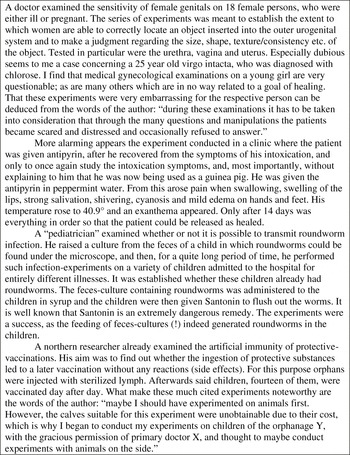
Although the Neisser case was the most conspicuous, it was far from untypical of medical experimentation at the time. Albert Moll, a neurologist and psychiatrist specializing in sexual disorders, identified more than six hundred ethically questionable experiments in his Ärzliche Ethik, published in 1902.Footnote 35 (Some examples appear as Figure 1.) Moll adopted a position close to that of the lawyers in arguing that the doctor/patient relationship should be seen as a voluntary contract that did not give the physician any special rights to introduce elements or impose treatments that had not been explicitly incorporated into the contract. The patient’s right to self-determination must be respected. Moll’s position attracted limited support from his peers, however, although it was well received and widely cited by lawyers. Unlike many of his other books, it did not go into a second edition and received rather cool reviews. The organized medical profession continued to lobby for exemptions from the general law of battery whenever the German Criminal Code was reviewed, right through to 1927, although without success.Footnote 36
Examples of Experiments Questioned by Moll

The 1898–1900 German crisis over medical experimentation seems to have been generated by four factors, although their status as explanations must have an element of conjecture. More evidence is still needed on who did what when, but we can note some of the wider social and cultural shifts that are likely to have contributed to making it possible to articulate these challenges in these ways. One was the development, since German unification in 1871, of a political mass press that reached large sections of the population and could mobilize support, in this case from social democrats, in the Prussian Parliament.Footnote 37 Neisser’s abuse of his patients could become a public scandal in a way that would not previously have been possible. Second, it provided a basis for social democrat challenge to the increasingly authoritarian domestic regime of Wilhelm II and the post-Bismarck chancellors. The parliamentary strength of the SDP continued to grow throughout this period, following its relegalization in 1890. The treatment of workers by the sickness insurance scheme and the balance of interests between doctors and workers was a tense issue. The behavior of elite physicians was a synecdoche for the wider exclusion of the working class from the governance of institutions crucial to their well-being, although this was in part a reflection of their own status insecurities relative to the military and aristocracy.Footnote 38
Third, there were tensions within the profession itself, which had become more competitive: in Prussia, the ratio of doctors to population rose from 1:3,112 in 1876 to 1:2,114 in 1898.Footnote 39 This may well have been an element in the increasing evidence of anti-Semitism within the profession, particularly as Jewish researchers clustered in fields like bacteriology and venereology, where a substantial amount of human experimentation took place.Footnote 40 Although science might be important to the profession’s external legitimation, its internal ownership was always a potential source of rivalry that could erupt into wider view. Fourth, the evidence suggests a growing competition between medicine and law for control of the medical sphere. Law was central to the development of the German state in the nineteenth century and the consolidation of bourgeois interests.Footnote 41 As a result, German lawyers were historically more prestigious and deeply entrenched in the societal elite than were doctors. Much of the medical regulation through the Courts of Honor was modeled on that developed by the legal profession.Footnote 42 However, the lawyers were clearly concerned about the attempts by doctors to place themselves beyond ordinary legal jurisdiction, whether as a matter of self-interest or of principle.
This conjunction provided for concerns to leak into the public domain and to be pursued in ways that pressed the Prussian government to act through the 1900 directive. However, while this is often held up as an exemplary and prescient regulation, its practical impact is questionable. Writing in 1902, Moll questioned its coherence: the scope of exemptions was ill-defined; entries in a patient record did not guarantee full and unambiguous consent, particularly given the low educational level of many hospital patients; and, most egregiously, responsibility for enforcement had been placed in the hands of some of the leading sinners, the prestigious professors and clinic chiefs who exercised the power of minor deities over their subordinates.Footnote 43 Elkeles notes that the commission set up to monitor compliance with the directive through reviews of the published scientific literature ceased to function in 1913, having only considered six cases, all of which were considered to have been harmless.Footnote 44
Nor did the directive have much impact beyond Prussia. Other German states seem not to have adopted it, though six of these had established Courts of Honor between 1864 and 1876, before the Prussian system was introduced. One should also note the lack of apparent impact on U.S. medical research institutions, which were strongly influenced by German models at this time. While more research is needed on the impact of the Prussian model, it is still necessary to focus on the specifically Prussian contingencies that generated the 1900 directive rather than assuming this to be representative of German developments as a whole.
CONTROLLING EXPERIMENTATION: THE SECOND ATTEMPT
Even within Prussia, attention to medical research ethics died away quickly after 1900. No further high-profile scandals were reported, and the issue did not reappear on the policy agenda again until after World War I.Footnote 45 By the 1920s, however, a substantial level of public concern had reappeared with a wide consensus that this attempt at regulation had failed. The medical profession itself had never taken ownership of the directive, preferring to ignore voices like Moll’s. The nationalist climate of Wilhelmine Germany had established an environment where the behavior of professional elites was largely unquestioned and unquestionable. Esther Fischer-Homberger argues that World War I led to “a new doctoral morality, which placed the welfare of the endangered Fatherland above the well-being of the individual sick person.”Footnote 46 The fall of this regime with Germany’s defeat in 1918 reopened the issues, although the debate was not an immediate political priority as the Weimar Republic tried to deal with the problems of economic and political reconstruction.
Discussion regarding the ethics of human experimentation became more widespread after World War I: ‘In the 1920s in Germany, criticism in the daily press, as also in the Reichstag, of alleged unethical conduct on the part of the medical profession reached a crescendo unparalleled in any other country.”Footnote 47 The vigor of the renewed discussion is also illustrated by the founding of a new journal called Ethik in 1922. Frewer describes it as “the first journal, which contained the term ‘ethics’ in the title of a medical journal and focused on the discussion of ethical questions in medicine.”Footnote 48 There was also more direct political pressure from people like Dr. Julius Moses, who practiced general medicine in Berlin and was a prominent Social Democrat member of the Reichstag: “In 1930 Moses alerted the public to the deaths of 75 children caused by pediatricians in Lübeck in the course of experiments with tuberculosis vaccinations.”Footnote 49 More widely, there was concern about the relationships between hospitals and the German pharmaceutical industry. Although this had lost some of the international lead that it had held before World War I, because of the expropriation of its patents, particularly in the UK and the United States, it remained at the forefront of product development. The price, however, was widespread testing of new therapies on German patients.Footnote 50A representative of the Reichsgesundheitamt (National Health Administration), speaking early in 1930, summarized the accusations:
Naked cynicism; placing the lives of small children on the same level as those of experimental animals (rats); dubious experiments having no scientific purpose; science sailing under false colours; crimes against the health of defenceless children; lack of sensibility; mental and physical torture; martyrization of children in hospitals; the worst forms of charlatanism; disgustingly shameful abominations in the name of science run mad; horrors of the darkest middle ages, outstripping the infamous deeds of the Inquisition and the hangman; social injustice; discrimination between the rich and the poor. Footnote 51
The change in national priorities due to the war had contributed to a mentality among the medical profession that placed scientific progress and the welfare of the society as a whole above that of the individual. The view that disabled, elderly, and “incurable patients” were nothing more than parasites draining the strength of the Fatherland became more widespread during the 1920s.Footnote 52 The renewed debate led the Reich Health Council to hold a session on March 14, 1930, to discuss the circumstances under which medical experiments on healthy and sick subjects might be permitted.Footnote 53
The two main speakers were Friedrich Müller from Munich and Alfons Stauder from Nuremberg. Both supported the principle of human experimentation, although admitting deficiencies in practice. Müller argued that experiments should only be undertaken with the patient’s agreement unless the patient was confused or unconscious. They should be carefully planned, evaluated, and executed by suitably experienced staff, with the chief physician assuming ultimate responsibility. He rejected a proposal from the Berliner Ärztekammer, which had found support in the press, that there should be an official regulatory body for human experimentation. This would cause serious conflicts, stifle research, and hinder German medical science in international competition. Stauder was given the brief of explaining the current ethical stance of the medical profession. He stressed the physician’s duty to try to alleviate or cure a patient’s condition by any available means, which might lead to experimentation. Indeed, any intervention was in some sense an experiment, but without this kind of risk-taking, medical progress would cease. In the end, he concluded, the limits to experimentation would not be set by law or by regulatory intervention but by the doctor’s professional conscience.Footnote 54
Subsequently, on February 28, 1931, the Ministry of the Interior published a Circular, Richtlinien für neuartige Heilbehandlung und für die Vornahme wissenschaftlicher Versuche am Menschen (Guidelines on innovative therapy and scientific experimentation involving human subjects).Footnote 55 The precise legal status of this document remains disputed.Footnote 56 Professor H.-J. Wagner and others claim that the guidelines remained in force until 1945, although they were not part of the prewar legislation that was validated at the end of the war.Footnote 57 However, although Howard-Jones had adopted this position in 1978, in a 1983 paper he simply refers to them as recommendations without legal force.Footnote 58 A review of the original text suggests that they may be better understood as a contractual device rather than as an actual regulation: all doctors working in institutions under the jurisdiction of the Reichsgesundheitsrat (National Health Council) were required to sign a commitment to the guidelines when taking up their employment. Enforcement would presumably then be through employment discipline rather than professional discipline or a regulatory agency. Nothing is said in the document about its applicability in these terms to existing employees, although presumably they would be expected to abide by its provisions. Given the institutional continuity that persisted throughout the Nazi period, it would certainly be correct to regard the document as continuing to have some kind of force, at least in the sense that it does not seem explicitly to have been withdrawn. On the other hand, since it was not a regulation as such, one would not expect it to be directly incorporated into the postwar legal code.
The 1931 guidelines are set out as fourteen points. They begin by recognizing the need for medicine to progress by introducing novel therapies and that human experimentation makes an indispensable contribution toward achieving this goal. However, the rights granted to doctors to experiment must be balanced by an awareness of the special duties that are associated with the protection of the life and health of each individual involved. The likely risks must always be proportionate to the benefits. New therapies may only be introduced after testing in animals, if possible. Patients must always give explicit and documented consent, based on appropriate information, unless the need is urgent for the preservation of life or the prevention of severe damage to health and prior consent cannot be obtained. In the latter case, the record should explain why consent could not be obtained. New therapies should be introduced with particular care on patients under the age of eighteen and without exploitation of social or economic need. Particular care should be taken in all cases when the therapy uses living microorganisms. The use of novel therapies must always be the responsibility of the chief physician. All of these principles applied equally to experimentation. In addition, however, the guidelines banned any experiment that did not make a clear contribution to therapeutic development. Animal studies must always precede human experiments. Experimentation could only be carried out on minors if the risks were minimal and must never be carried out on dying patients. The guidelines should be consistently stressed during academic teaching.Footnote 59
On paper, the guidelines were impressive. They went well beyond contemporary provisions elsewhere: there seems to be “no parallel for such concern, or for such governmental action, in any other country.”Footnote 60 Moreover, many commentators consider that in most respects they were in advance of subsequent codes, such as the Nuremberg Code of 1948 and the Helsinki Declaration of 1964.Footnote 61 Hans-Martin Sass notes that “the Reichsrichtlinien apply the principles of the Hippocratic Oath to the modern world of human experimentation in clinical therapeutic and nontherapeutic research. They (a) emphasize the leading physician’s personal responsibility for the subject involved and the profession’s general responsibility for progress in the healing arts and sciences, (b) establish some special guidelines in special areas of human experimentation, and (c) stress strongly the teaching of research ethics and ethics of new therapy on all levels of medical education.”Footnote 62 According to Howard-Jones, the only aspect in which they were lacking pertained to “reference to independent ethical review.”Footnote 63 And even this idea was in circulation; Moll had previously called for a structured forum for discussion, a call, as noted above, echoed by the Berliner Ärztekammer and the general press.Footnote 64 However, these calls were rejected by the relevant state agencies, who preferred to emphasize the need for doctors to behave ethically.
The real problem was that Germany in 1931 was not fertile ground for ethics regulation. In certain respects, these regulations reflected the aspirations of the expanded welfare state of the 1920s, with the government attempting to implement the social rights embedded in the constitution. However, these guarantees were now under increasing attack as morally and financially unsustainable. An increasing influential body of German political opinion was arguing that the sick, the weak, and the feeble-minded should be considered lower-priority candidates for social protection. This view had gained increasing traction within the professions, the universities, and the civil service, who had all suffered badly from the political and economic turmoil of the early 1920s, and faced a renewed assault on their values and interests in the face of the economic crisis of the early 1930s. They were all deeply conservative institutions, concerned to sustain a traditional bourgeois class structure in the face of demands that they adapt to the democratic conditions of the republic. The understanding of law, for example, was dominated in both the courts and the universities by a positivist approach that emphasized impersonal formalism over the class-oriented substantive justice demanded by legislators. Contraction in the labor market had created a significant pool of unemployed graduates and public employees had experienced repeated wage cuts. Although there were pro-republic elements among all these groups, they were marginal voices with limited impact except through their influence on some legislators. For most of these professionals, the natural order of things would only be restored once the poor and the working class were reestablished in their proper place, as grateful recipients of charity rather than citizens with rights Footnote 65
For the most part, then, German doctors’ views on the ethics on human experimentation remained closely linked to their traditional view of the “doctor-patient” relationship. A doctor’s responsibility toward his patient remained the main moral yardstick from the first debates in the 1890s through to the 1930s. Significantly, the 1931 guidelines appeared only as an administrative action rather than as legislation, which may not have been achievable in the context of economic chaos and political conflict. The values espoused by the authors of the circular had a precarious anchorage in the professional circles they sought to influence.
As Elkeles stresses, “The roots of Medizin ohne Menschlichkeit (medicine without humanity) ran much deeper historically than the rise of National Socialism, that they were, in Viktor von Weinzäcker’s words, ‘fostered by a way of thinking which viewed humans as chemical molecules or frogs or lab rats.’”Footnote 66 This view was, she suggested, reinforced and legitimized by the administrative approach to research governance: “The adherence to particular research-rituals turn into a magic formula, motivating, exonerating, vindicating, and makes further explanations subordinate. The best example is once again found in bacteriology: Whoever relies in his research on the method established by Robert Koch does not require any further justifications of his procedure and his goals. … Concurrently, the ‘research student’ places himself in the shadow of the ‘great master’; into an affirmative and legitimizing continuity.”Footnote 67 Such views only intensified in the 1930s. Even the journal Ethik shifted to promote “biologism” and “collective ethics.”Footnote 68 Rather than championing the rights of patients, the journal’s contributors came to argue an ethical case for sterilization or euthanasia in the national interest of promoting the biological fitness of German citizens.
Without support in the culture of the profession, both the 1900 directive and the 1931 guidelines failed to change doctors’ behavior. Julius Moses understood this, warning in 1932 that “in the national socialist ‘Third Reich,’ the doctor would have the following mission, in order to create a ‘new, noble humanity’: Only those that can be (fully) healed will be! The incurable sick, however, are ‘dead weight existences,’ ‘human refuse,’ ‘unworthy of living’ and ‘unproductive.’ They have to be destroyed and eliminated. In other words, the doctor should become the executioner.”Footnote 69 Ten years later, Moses died in the concentration camp at Theresienstadt.
REGULATION AND RESEARCH ETHICS
Historians are always properly cautious about the notion that there may be simple lessons to learn from history. If events are seen as largely contingent, then generalizations are always fragile. Sociologists are a little more sanguine: while they may be more skeptical than they once were about the possibility of grand narratives, they are more comfortable with the notion that a series of cases can be examined to induce second-order generalizations from their similarities and differences, and that these generalizations may yield testable predictions about the outcome of other cases. What, then, can we infer from these experiences that may speak to contemporary policy debates.
Perhaps the first point to be made is that, although we talk rather glibly of “ethical regulation,” the German interventions seem to constitute regulation in only the most minimal sense. Neither the 1900 nor the 1931 documents could be said to be “hard law” in the form of a statutory instrument. Both are, at best, “soft law,” administrative actions based on the general competence of civil servants that may have indirect legal consequences such as dismissal from public employment or complaints to professional disciplinary tribunals but which do not carry direct civil or criminal penalties.Footnote 70 The existence of such interventions may still mark Germany as unique in the years prior to World War II, but their power and reach should not be exaggerated.
The second point is to acknowledge that the evidence base for this article is quite thin and much primary work still needs to be done on the specifics of these cases. Although there is a growing literature in German and in English, the connections between the economic, cultural, professional, and ideological factors identified by scholars and the production of the 1900 and 1931 documents have not yet been clearly identified. This means that there is an undoubted risk that secondary authors cherry-pick their explanations and conclusions because of the limited understanding of who was doing what when with what interests and/or motives.
Some commentators, for example, may draw from these events the conclusion that administrative action alone is insufficient: the evident lack of impact in the German case could substantiate an argument that research governance needs a statutory foundation and an enforcement agency. However, while the U.S. IRB system does have a legal basis in the rule-making powers of federal agencies, the equally interventionist UK system rests on administrative directions.Footnote 71 Alternatively, one could draw the inference that the lack of impact reflected a failure to engage the hearts and minds of the physicians involved in biomedical experimentation. As Sass notes, writing about the contemporary situation, “By and large, problems of professional ethics have become problems of public policy. Questioning such a development does not automatically mean to question the general interest and right of the public to regulate ethical conduct … but it does question the prudence of balancing public responsibility and personal responsibility and of replacing primary personal responsibility and liability with lengthy regulatory procedures and forms of shared or limited liability.”Footnote 72
The danger that regulatory interventions may elevate procedure and adherence to prescribed rules above normative evaluation is not, though, a recent concern, but one that has been raised by ethically sensitive doctors, like Albert Moll, in Germany since the late nineteenth century. Our “progress” in improving ethical standards may be due less to more interventions than to a change in perception by the medical profession and the subsequent move away from the “dominance over the sick person, the precedence of science over well-being of the individual, the parochial mindset of the medical profession and the suppression of other ways of healing.”Footnote 73 According to Elkeles, this is the reason why the interventions in Germany from the 1890s to the 1930s did not lead to real change in the practices of doctors.
It is important to be realistic about what regulation can achieve. While we may be tempted to conclude from this account that ethical issues would be better addressed by hard law, command and control, interventions, there is abundant evidence that regulators make very restricted use of such powers, partly because of their own resource limitations and partly because of their desire to retain their own legitimacy among the regulated groups.Footnote 74 In the case of medical experimentation, for example, regulators depend heavily on information from the scientific community both to define and to identify misconduct. Clinical work is not as accessible as production-line work to standardized rule-making or inspection.Footnote 75 If regulation is considered to be unduly prescriptive or penalties to be excessively harsh, those best placed to observe infractions are unlikely to cooperate by reporting them: those who are sanctioned will then often appear to be a random selection of socially marginal members, further increasing the perceptions of an arbitrary and unjust regulatory regime.
Moreover, where the relational distance between regulator and regulated is small, as a result of similar educational and professional backgrounds, regular contact and shared sense of purpose—all of which are evident in the German context—enforcement is particularly likely to be restrained.Footnote 76 John Braithwaite has argued that shaming for breaches of social norms is likely to be more effective than formal sanctions, but this depends on a context in which such norms are available as a point of reference.Footnote 77 In this case, the wider conflict over the nature of the German state, and the place of different classes within it, left no common point of moral reference for medical ethics: indeed, to the extent that one existed within the profession and its main social partners throughout this period, it was more likely to have rested on the priority of national over individual interest than to have reflected the preferences of modern bioethicists.
Regulation is a more complex matter than many bioethicists recognize: to the extent that it succeeds, it rests on a prior consensus of relevant opinion, although it may also articulate and mold that consensus.Footnote 78 The presence or absence of regulation should not be equated with the presence or absence of barbarism in the treatment of patients or research subjects.