Introduction
At about 12 months of age, infants begin to produce their first words, and show remarkable ability in learning new words (Houston-Price, Plunkett, & Harris, Reference Houston-Price, Plunkett and Harris2005; MacKenzie, Graham, & Curtin, Reference MacKenzie, Graham and Curtin2011; Schafer & Plunkett, Reference Schafer and Plunkett1998; Woodward, Markman, & Fitzsimmons Reference Woodward, Markman and Fitzsimmons1994). However, knowing the meaning of a particular word does not make infants mature language users; instead they also need to learn conventions, which are shared practices within a cultural community (Clark, Reference Clark, A. and E. F.1992, Reference Clark1993; Diesendruck & Markson, Reference Diesendruck and Markson2011). The basic conventions of word use include the fact that words can be generalized to objects of like kind, as well as across speakers (Buresh & Woodward, Reference Buresh and Woodward2007; Graham, Stock, & Henderson, Reference Graham, Stock and Henderson2006; Henderson & Woodward, Reference Henderson and Woodward2012; Novack, Henderson, & Woodward, Reference Novack, Henderson and Woodward2013). Understanding these basic conventions saves infants cognitive effort when learning new words (Horvath, Liu, & Plunkett, Reference Horváth, Liu and Plunkett2016). For example, knowing that the word chair can be used by all English speakers to refer to chairs of different colours or sizes means that infants do not need to repeatedly learn the word chair every time they see a new chair or meet a new person. This would in turn allow infants to use words they learnt in a more flexible manner (Sabbagh & Henderson, Reference Sabbagh and Henderson2007).
Houston and Jusczyk (Reference Houston and Jusczyk2000) investigated infants’ ability to recognize words across speakers. In their experiments, 7.5- to 10.5-month-olds were first familiarized with word pairs (e.g., bike and feet) produced by one speaker. They then heard four passages produced by another speaker. Two of the four passages contained the familiarized word pairs. It was reasoned that infants should attend longer to passages containing the familiarized words if they could recognize them. Results revealed that 7.5-month-olds attended longer to passages containing the familiar words only when the two speakers were of the same gender. Furthermore, 10.5-month-olds showed the ability to recognize the familiarized words produced by speakers of the opposite gender. Therefore, infants have the basic ability to generalize different instances of the same word across speakers. However, this study only documented that infants are able to recognize words produced by different people. It did not reveal whether infants could generalize word meanings (e.g., the association between words and their referents) across people.
Findings from more recent studies suggest that infants also have a basic understanding that word meanings are shared among different people (Buresh & Woodword, Reference Buresh and Woodward2007; Graham et al., Reference Graham, Stock and Henderson2006; Henderson, Gerson, & Woodward, Reference Henderson, Gerson and Woodward2008; Henderson & Graham, Reference Henderson and Graham2005; Henderson & Scott, Reference Henderson and Scott2015; Henderson & Woodward, Reference Henderson and Woodward2012; Novack et al., Reference Novack, Henderson and Woodward2013). Using a visual habituation paradigm, Henderson and Woodward (Reference Henderson and Woodward2012) repeatedly presented 9-month-old infants with an event in which an experimenter labelled one of two objects (i.e., the target) using a novel word while ignoring the other object (i.e., the distractor). After infants habituated to the event, they then watched the same speaker and a different speaker using the word to label either the target or the distracter object. It was found that infants looked longer when both speakers used the word for the distractor object. These findings indicate that infants understand that word meanings are shared among people and that they expect different speakers to maintain previously established word–referent links.
While the above studies focused on infants’ ability to generalize word meanings across speakers, another line of research explored infants’ appreciation that word meanings can also be generalized to objects of like kind. In a study by Horvath and colleagues (Reference Horváth, Liu and Plunkett2016) that used the Intermodal Preferential Looking (IPL) paradigm, 16-month-olds infants were first trained with two novel word–object pairs. The objects then changed colour and infants heard only one of the trained words. Results showed that when infants had enough time to consolidate the information (i.e., after taking a nap), they were able to map the word to the correct object even if the object was in a different colour. Similar findings were also observed with 13-month-old infants (Woodward et al., Reference Woodward, Markman and Fitzsimmons1994). In line with these findings, Graham and Poulin-Dubois (Reference Graham and Poulin-Dubois1999) discovered that infants tend to rely on an object's shape rather than colour when generalizing an object label. This could be because shape is more stable than other features such as colour and size and thus is more relevant for word generalization (Xu, Carey, & Quint, Reference Xu, Carey and Quint2004; Yoon, Johnson, & Csibra, Reference Yoon, Johnson and Csibra2008).
One remaining question in the current literature concerned whether infants would also expect the generalization of words to be a shared practice. For example, when an infant notices that his or her mother uses the word chair to refer to all chairs at home, he or she should also know that other people would also generalize the word chair to chairs of different appearances. Henderson and Graham (Reference Henderson and Graham2005) found that two-year-old children expect different speakers to generalize a novel label across objects from the same category. However, it remained unknown whether younger infants also have the same level of understanding. Moreover, past studies mainly focused on infants in the English-speaking community. It has long been suggested that infants’ learning is consistently shaped and refined by culture (Tomasello, Reference Tomasello2016). Since Western culture (an individualist culture) tends to concentrate more on the satisfaction of individual goals. while Asian culture (a collectivist culture) concentrates on shared interests and practices (Oyserman, Coon, & Kemmelmeier, Reference Oyserman, Coon and Kemmelmeier2002), it is possible that infants raised in Asian societies could receive more training about collective activities and thus have more advanced understanding about conventionalities. Therefore, it was unknown how much infants in the Mandarin Chinese language community would understand about the conventions within their own language. Also, replicating findings from English-learning infants in a different language would shed insights into whether the cognitive development regarding conventionality is a universal or rather a culture-specific process.
To clarify whether Chinese infants understand that words can be used by different speakers to refer to objects of like kind, the present study adopted a methodology that combined the visual habituation paradigm and the IPL paradigm. This is because, in past studies that utilized the visual habituation paradigm, infants’ novelty response (e.g., looking longer when a speaker disrupted a previously established word–object link) was used as the main indicator of their understanding of word meanings. While the paradigm has been argued to be a valid method for testing word learning (Colombo & Mitchell, Reference Colombo and Mitchell2009), some suggest that a novelty response does not reflect infants’ full mental processes apart from their recognition that a person is performing a new action different from habituation (Oakes, Reference Oakes2010). Thus, the present study also incorporated the IPL paradigm because it could obtain more detailed information about infants’ looking responses (such as the exact location and the duration of specific fixations when they are presented with a word and different objects) and demonstrate that infants can actively match a word to its referent after learning a word–object link (Golinkoff, Ma, Song, & Hirsh-Pasek, Reference Golinkoff, Ma, Song and Hirsh-Pasek2013).
In the present study, 13-month-old infants were habituated to a speaker using a novel word to label a novel object (i.e., the target) in the presence of another object (i.e., the distractor). After habituation, the objects were replaced with two different coloured objects (i.e., the test target and test distractor) and reversed in position. Infants then watched the speaker from habituation and a new speaker using the same word to label either the test target or the test distractor. It was hypothesized that if 13-month-old Chinese infants understood that different people should generalize a word to objects of like kind, they would show a novelty response by looking longer when the previously presented word was applied to the distracter object regardless of who the speaker was. Moreover, extra tests called the ‘where is it’ tests that shared features with the IPL paradigm were arranged throughout the study. In these tests, each of the speakers asked infants to find the referent of the novel word by directly looking at it. It was hypothesized that Chinese infants would look at the test target more than the distractor for both speakers.
Method
Participants
Thirty full term infants (12 males, mean age = 13 months, 13 days, range = 12 months, 3 days to 14 months, 17 days) were recruited from a public advertisement released in Shanghai. All infants were Chinese and were selected based on monolingual exposure to Mandarin Chinese. Four additional infants were tested but not included in the final sample because of failure to complete the procedure due to distress (n = 3) and insufficient eye-tracking data (n = 1).
Stimuli
Four novel objects (two objects from each object category that differed only in colour) were used (see Figures 1 and 2). During each habituation trial and test trial, one object from each category was presented on screen and one of the two objects was named by the speaker using the novel Mandarin pseudo-word ‘midou’.
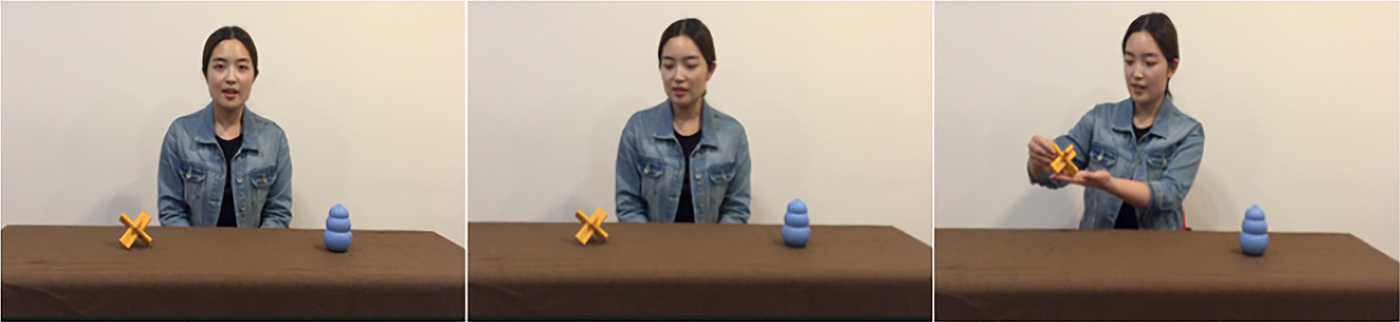
An example of a habituation trial. The habituation speaker named the target object using a novel word.

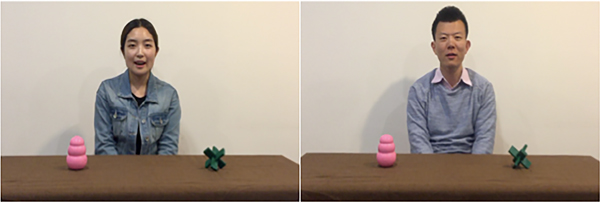
An example of the ‘where is it’ test pair. The objects from habituation changed colour and position. The habituation speaker and the new speaker each asked infants to find the referent of the novel word.

Procedure
The study consisted of a habituation phase and a post-habituation test phase. In the habituation phase, infants sat on their caregivers’ lap approximately 60 cm from a Tobii T120 eye-tracker in a curtained room where infants could only see the eye-tracker screen. The eye-tracker was connected to a computer (controlled by the experimenter) that presented video stimuli on the eye-tracker screen using the TobiiStudio software. A video camera was placed above the eye-tracker to record infants’ gazes, and the recordings were relayed to another room in which a coder (who was blind to the trials that had been run) coded infants’ looking time on-line using the computer program jHab (Casstevens, Reference Casstevens2007).
At the start of the habituation phase, infants first saw a Speaker Familiarization video. In the video, two Chinese speakers (one male and one female) played a familiarization game. Each speaker appeared from behind a table alone once, saying wo zai zhe li ‘here I am’ in Mandarin, and then the two appeared together, saying kan, wo men dou zai zhe li ‘Look, we are all here’. This video served to familiarize infants with the two speakers.
Following the Speaker Familiarization video, infants watched a habituation trial as one of the speakers (i.e., the habituation speaker) appeared on screen with two novel objects placed side by side on a table in front of him or her. The speaker first attracted infants’ attention by making direct eye contact and saying ni hao ‘hi’. He or she then gazed at one of the two objects (i.e., the target), named it using a novel word by saying midou, grasped the target, and named it the second time by saying yi ge midou ‘a midou’. After that the speaker maintained his/her final position (see Figure 1). The other object (i.e., the distracter) was not labelled or acted upon. Looking time for the habituation trial was started when infants first looked at the trial on screen, and the trial was ended when infants looked away from the screen for more than two consecutive seconds or after 120 s had elapsed. Infants were shown the same habituation trial repeatedly until their total looking on three consecutive trials fell below half of the total amount of time they looked on the first three trials, or until 15 trials had elapsed (an indicator that the habituation criteria had been reached).
Throughout the habituation phase, infants were also presented with tests known as the ‘where is it’ tests. There were three test pairs (six test trials) in total. In all ‘where is it’ test pairs, the two objects from the habituation phase were replaced with different coloured ones (i.e., the test target and test distractor) and were also reversed in position. In the first trial of each ‘where is it’ test pair, the habituation speaker appeared on screen, said ni hao ‘hi’ and asked the infants midou zai na li, kan yi kan midou, ni kan jian midou le ma? ‘where is the midou, look at the midou, have you seen the midou?’ The habituation speaker then put his or her head down and maintained his or her final position. This was followed by the second trial of the test pair during which infants saw a new speaker, who they had seen in the Speaker Familiarization video but not in habituation trials, who asked infants the same questions (see Figure 2). Each ‘where is it’ test pair were presented after the passage of five habituation trials (e.g., the first ‘where is it’ test pair were presented after the fifth habituation trial, the second test pair began after the tenth habituation trial, and the third test pair began after the fifteenth habituation trial). If the habituation criteria were reached but infants had not finished watching all three ‘where is it’ test pairs, they then watched the remaining test pairs together at the end of the habituation phase. The ‘where is it’ test trials were started and ended in the same way as the habituation trials. Infants’ looking patterns (e.g., fixations) towards the objects were recorded directly by the eye-tracker. The ‘where is it’ tests shared the main features with an IPL paradigm because they involved infants being verbally presented with a previously taught word and asked to identify its referent by looking at the objects on screen (Golinkoff et al., Reference Golinkoff, Ma, Song and Hirsh-Pasek2013).
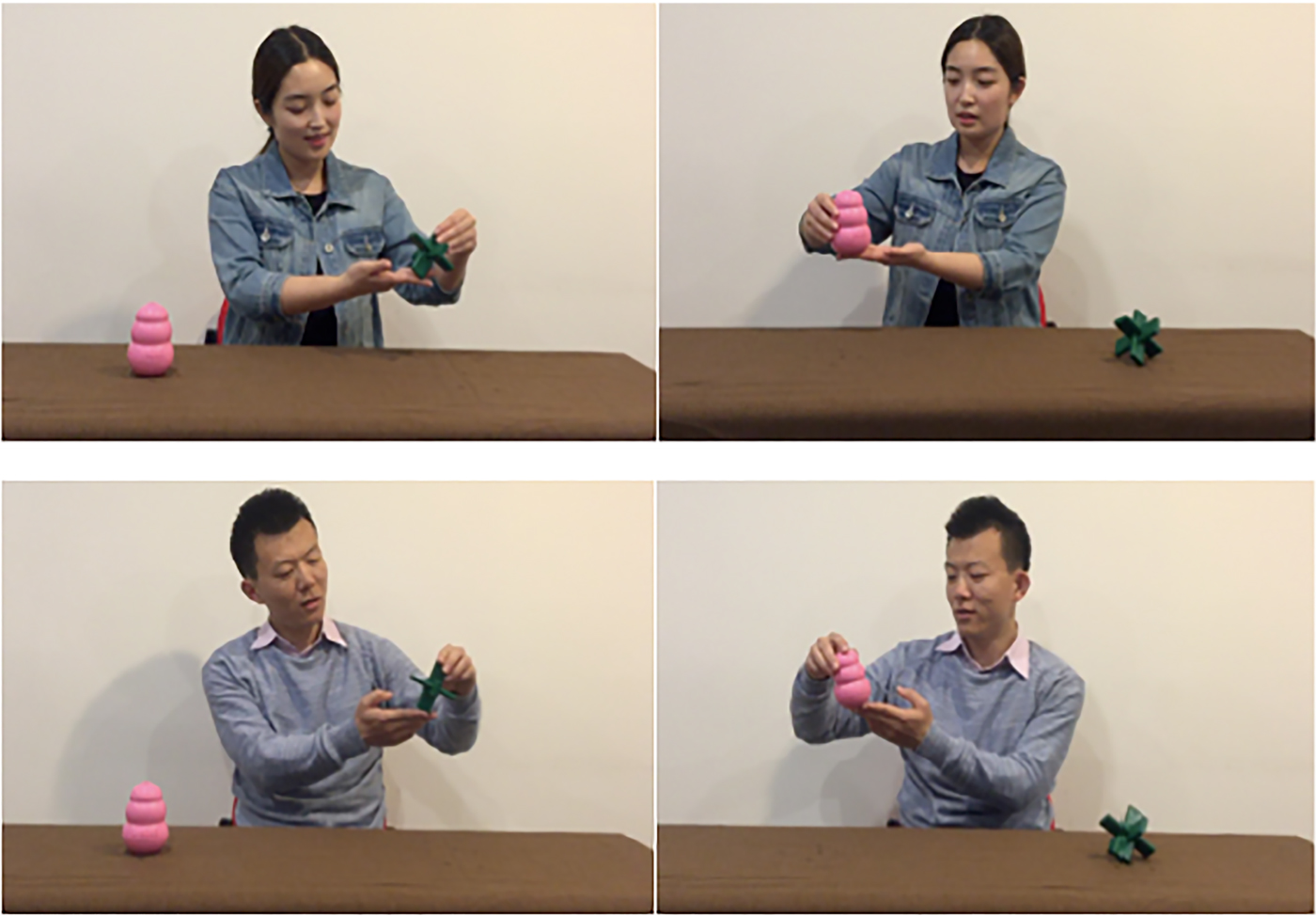
Following the habituation phase, infants underwent the post-habituation test phase. During this phase, infants watched four post-habituation test pairs (eight trials in total). In test pair one, infants watched the habituation actor alternate his or her labelling behaviour by either using the word midou to name the test target (i.e., the target test trial) or the test distractor (i.e., the distractor test trial). In test pair two, infants watched the new speaker present the target test trial and distractor test trial (see Figure 3). These two test pairs were then repeated (test pair three being the same as test pair one; test pair four was the same as test pair two). The speakers’ action sequences and on-line coding procedure were identical to those in the habituation phase. At the end of the post-habituation test phase, infants watched a final pair of ‘where is it’ tests (a flow chart depicting the above experimental procedure can be found in the ‘Supplementary materials’, ‘Appendix A’, available at < https://doi.10.1017/S030500091900014X>).
An example of post-habituation test pair one (top) and test pair two (bottom). In test pair one, the habituation speaker labelled the test target (top left) and then the test distractor (top right) using the novel word. The new speaker repeated these actions in test pair two.

It is important to note that the inclusion of the habituation speaker in the ‘where is it’ tests and the post-habituation tests served to establish within-subject control. That is, if infants showed a similar looking pattern for both the habituation speaker and the new speaker in these tests, it would indicate that they understand that different speakers should generalize words in the same manner.
The following factors were counterbalanced across infants: the target object, the first post-habituation test trial (i.e., target test trial first vs. distracter test trial first), and the gender of the speaker who presented the habituation trials and post-habituation test trials (i.e., infants who watched the male speaker during habituation watched the female at the post-habituation test phase and vice versa).
Results
Preliminary analyses
Infants reached the habituation criteria in an average of 10.10 trials (SD = 2.83). To test if infants’ looking time during the post-habituation phase was affected by the timing of the test pair, the test trial type and the first test trial type (i.e., the speaker preferring the test target first or distractor first), a 4 (test pair: first, second, third, and fourth) × 2 (test trial type: target, distracter) × 2 (first test trial: target, distracter) mixed-design analysis of variance (ANOVA) with test pair and test trial type as the within-subject factors was conducted on infants’ mean looking time for the post-habituation test trials. The ANOVA revealed a significant main effect of test pair (F(3,26) = 30.45, p < .001, η 2Partial = .52). To further explore this main effect, paired-samples t-tests were then conducted on infants’ total looking time for each test pair. Results showed that infants looked significantly longer towards test pair one (M = 32.66, SD = 15.54) than test pair two (M = 27.45, SD = 11.67) (t(29) = 2.07, p < .05,d = 0.38, r = .19), test pair three (M = 16.64, SD = 11.44) (t(29) = 6.80, p < .001, d = 1.17, r = .51), and test pair four (M = 13.71, SD = 11.08) (t(29) = 6.81, p < .001, d = 1.40, r = .57). They also looked significantly longer towards test pair two than three (t(29) = 4.70, p < .001, d = 0.93, r = .42). Therefore, infants’ attention declined during the post-habituation test phase, and this could be explained by the finding that infants’ attention tends to decline after repeated presentation of the same test event (Henderson et al., Reference Henderson, Gerson and Woodward2008). Moreover, the ANOVA revealed a significant main effect of test trial type (F(1,28) = 7.40, p = .01, η 2Partial = .21). This suggests that infants’ looking time was different for the target test trials and distractor test trials (analysed in the ‘Main analyses’ section below). No other significant effects were found.
Main analyses
Test trial type analyses
The first focal question of the present study was whether infants would expect a word to be generalized to a target object even if it changed colour. The result most relevant to this question was infants’ differential looking pattern towards the target and distractor test trials indicated by the main effect of test trial type in the above ANOVA analysis. To further explore this main effect, a paired-samples t-test was conducted on infants’ mean looking time towards each type of test trials. Results revealed that infants looked significantly longer towards the distractor test trials (M = 12.74, SD = 5.39) than the target test trials (M = 9.99, SD = 5.87) (t(29) = 2.75, p = .01, d = 0.49, r = .24). Thus, infants demonstrated a novelty response only when the word was generalized to a differently shaped distractor object but not when it was generalized to a different coloured target.
Speaker and test trial type interaction analyses
The second focal question of the present study was whether infants would generalize a word to objects of different colours regardless of who the speaker was. In exploration of this question, a 2 (test trial type: target, distracter) × 2 (speaker: habituation speaker, new speaker) repeated-measures ANOVA was conducted on infants’ mean looking time in the post-habituation test phase. Results showed a significant main effect of test trial type, as stated in the test trial type analyses. There was also a significant main effect of speaker (F(1,29) = 6.03, p = .02, η 2Partial = .17). A follow-up paired samples t-test for this main effect showed that infants looked significantly longer towards the habituation speaker (M = 12.45, SD = 5.04) than the new speaker (M = 10.29, SD = 4.86) (t(29) = 2.46, p = .02, d = 0.44, r = .21). Since the preliminary analyses indicated a general decline of attention in the post-habituation phase, the longer looking time for the habituation speaker could be a result of infants generally paying more attention, as the habituation speaker always appeared earlier in the test phase than the new speaker.
Most importantly, the ANOVA revealed no significant interaction between speaker and test trial type (p > .05). This suggested that infants’ differential looking pattern for the target and distractor test trials was not affected by who the speaker was. In order to confirm that infants showed similar looking pattern regardless of speakers, a paired samples t-test was conducted on infants’ average total looking time towards each type of test trials for different speakers. Results revealed that for the habituation speaker, infants looked significantly longer towards the distractor test trials (M = 14.24, SD = 6.04) than they did towards the target test trials (M = 10.65, SD = 8.33) (t(29) = 2.42, p = .022, d = 0.49, r = .24). For the new speaker, infants also looked significantly longer towards the distractor test trials (M = 11.25, SD = 6.28) than the target test trials (M = 9.32, SD = 4.53) (t(29) = 2.09, p = .046, d = 0.35, r = .17). Therefore, infants looked longer towards the distractor test trials for both speakers.
‘Where is it’ tests analyses
These tests served to provide more confirmation about infants’ ability to generalize words under a different methodological approach. To investigate infants’ looking pattern when they were asked to find the referent of the midou, the following four main variables were analysed.
Time to first fixation
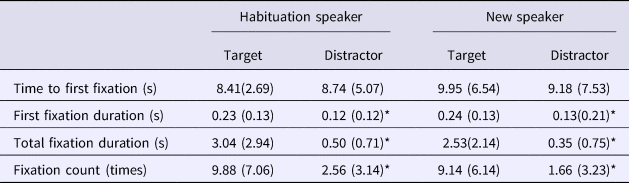
This variable measured the time from which the speaker first asked the question “where is the midou” until the infants first fixated on each of the object. A 2 (object type: target, distracter) × 2 (speakers: habituation speaker, new speaker) repeated-measures ANOVA showed no significant main effect or interaction effect (p > .05). Thus, the time to taken for infants to first fixate on each of the objects was similar and not affected by speaker (for detailed results for each speaker see Table 1). One possible explanation is that during the ‘where is it’ trials, the objects changed colour and were reversed in position, thus infants could have spent their first look checking to see how the objects’ appearance and location had changed. This could result in infants randomly looking at the two objects for their first fixation.
Mean looking time and counts on the target and distractor for habitation speaker and new speaker in ‘where is it’ tests (with standard deviations in parentheses)

Note. * Different from the target, p < .05.
First fixation duration
A similar 2 × 2 repeated-measures ANOVA was conducted on infants’ average time of their first fixation. Results showed a significant main effect of object type (F(1,28) = 15.53, p < .001, η 2Partial = .36). To follow up with this main effect, a paired samples t-test revealed that infants’ first fixation duration was significantly longer for the target (M = 0.24, SD = 0.11) than for the distractor (M = 0.12, SD = 0.13) (t(29) = 3.94, p < .001, d = 0.99, r = .45). There was no significant interaction between speaker and object type (p > .05). Thus, infants’ first fixation was longer on the target regardless of who the speaker was. To further confirm that infants’ first fixation duration pattern was similar for both speakers, a paired samples t-test showed that, for the habituation speaker, infants’ first fixation was significantly longer for the target than for the distractor (t(29) = 3.60, p = .001, d = 0.88, r = .40). For the new speaker, first fixation was also significantly longer for the target than for the distractor (t(29) = 2.95, p = .006, d = 0.63, r = .30) (see Table 1). Therefore, infants’ first fixation for the target object was longer than for the distractor regardless of which speaker asked them to find the midou.
Total fixation duration
A 2 × 2 repeated-measures ANOVA revealed a significant main effect of object type (F(1,29) = 41.56, p < .001, η 2Partial = .59). To closely examine this main effect, a paired samples t-test revealed that infants’ total fixation duration was significantly longer for the target (M = 2.79, SD = 2.45) than for the distractor (M = .43, SD = 0.70) (t(29) = 2.6.44, p < .001, d = 1.31, r = .55). Moreover, there was no significant interaction between speaker and object type (p > .05). Thus, infants fixated longer on the target regardless of who the speaker was. To further confirm this finding, a paired samples t-test showed that, for the habituation speaker, infants’ total fixation duration was significantly longer for the target than for the distractor (t(29) = 5.61, p < .001, d = 1.19, r = .51). For the new speaker, infants also fixated on the target significantly longer than on the distractor (t(29) = 6.81, p < .001, d = 1.36, r = .56) (see Table 1). Therefore, infants spent longer fixating on the target for both speakers.
Fixation count
A 2 × 2 repeated-measures ANOVA showed a significant main effect of object type (F(1,29) = 61.02, p < .001, η 2Partial = .68). To follow up this main effect, a paired samples t-test revealed that infants fixated on the target more times (M = 9.51, SD = 6.33) than on the distractor (M = 2.11, SD = 2.77) (t(29) = 2.81, p < .001, d = 1.51, r = .60). There was no significant interaction between speaker and object type (p > .05). Thus, infants’ total fixation count was longer on the target regardless of who the speaker was. To further confirm that the speakers did not affect infants’ fixation count on the objects, a paired samples t-test indicated that for the habituation speaker, infants fixated on the target significantly more than they did on the distractor (t(29) = 6.55, p < .001, d = 1.34,r = .56). As for the new speaker, the number of fixations was also higher for the target than for the distractor (t(29) = 8.35, p < .001, d = 1.52, r = .61) (see Table 1). Thus, infants did not only fixate on the target for longer, but also more frequently, regardless of who the speaker was.
Discussion
The results of the present study extend previous literature in a number of ways. First, findings from the post-habituation test provide evidence for Chinese infants’ understanding of the basic language conventions. After being habituated to a speaker using a word to name the target object, infants’ looking time increased only when the same speaker used the same word to refer to the distractor object that was from a different category. This novelty response indicates that infants expected the same speaker to use the word to only refer to objects that belonged to the target objects’ category. This finding is in line with past literature which suggests that infants can discriminate between correct and incorrect word–object links, and also understand that words should be used by the same person to refer to objects of like kind (Horvath et al., Reference Horváth, Liu and Plunkett2016; Woodward et al., Reference Woodward, Markman and Fitzsimmons1994). More importantly, infants in the present study also showed similar novelty responses towards a different speaker (i.e., the new speaker) when he or she applied the word to the distractor object. While past studies documented that infants expect different individuals to use the same word to name a particular object, and older children expect different speakers to generalize the same word to objects of the same category (Henderson & Graham, Reference Henderson and Graham2005; Henderson & Woodward, Reference Henderson and Woodward2012), results from the present study further demonstrate that 13-month-old Chinese infants also expect different people to generalize a word to objects of like kind.
Second, the results from the ‘where is it’ tests also provide incremental evidence documenting Chinese infants’ ability to generalize words. When asked to find the referent of a previously presented word, infants looked longer at the differently coloured test target during their first fixation, and fixated on the target more times and also for a longer period of time, regardless of who the speaker was. These findings provide more evidence in addition to the results from the visual habituation paradigm to indicate that infants do not only show novelty responses when speakers demonstrated incorrect labelling behaviour, but can also actively match a word to objects of like kind for different speakers. This again reveals infants’ ability to recognize that word generalization is a shared practice.
Third, the present study was also the first to examine the understanding of basic language conventions for Chinese infants in the Mandarin-speaking community. As the current findings align with the results obtained with English-speaking infants, it is likely that Chinese infants have a similar level of understanding of the basic conventions for word use. This finding suggests that (1) mastery of language conventions is unlikely to be largely affected by infants’ language and culture, and (2) methods such as the visual habituation and IPL paradigm are suitable for testing non-English-learning infants. However, the finding that 13-month-old Chinese infants also expect a different speaker to generalize words to objects of like kind extends the existing literature, and thus should be tested on English-speaking infants of the same age to examine if this level of understanding also matches.
One limitation of the present study concerns whether infants noticed that there were two different speakers involved in the experiment. There is a large body of research indicating that new-born infants can discriminate between human faces (Bushnell, Sai, & Mullin, Reference Bushnell, Sai and Mullin1989; Field, Cohen, Garcia, & Greenburg, Reference Field, Cohen, Garcia and Greenberg1984; Pascalis, de Schonen, Morton, Deruelle, & Fabre-Grenet, Reference Pascalis, de Schonen, Morton, Deruelle and Fabre-grenet1995), especially faces from their own ethnic groups (Kelly et al., Reference Kelly, Quinn, Slater, Lee, Gibson and Smith2005). In the present study, the two speakers were of the opposite gender, and past research revealed that infants can discriminate between female and male faces and also their voices (Miller, Younger, & Morse, Reference Miller, Younger and Morse1982; Righi, Westerlund, Congdon, Troller-Renfree, & Nelson, Reference Righi, Westerlund, Congdon, Troller-Renfree and Nelson2014). Nonetheless, there remains the possibility that, although infants could perceptually discriminate the speakers, they simply did not attend to the fact that there were two different speakers involved. Thus, future studies should include a control study to test if infants would perceive the two speakers as distinct individuals. Another limitation is embedded in the procedure that the ‘where is it’ tests were interspersed in the habituation phase. Although these tests could add confirmatory evidence supporting infants’ ability to generalize words, they could potentially disrupt infants’ habituation. The exposure to the new speaker using the word midou in the habituation phase might also potentially have had an impact on infants’ responses by strengthening the link between the new speaker, the word, and the target object. In addition, the habituation speaker always appeared before the new speaker in the post-habituation test trials. This could have alerted infants about how to respond for the new speaker, or impacted the results in unexpected ways (see ‘Appendix B’ in the ‘Supplementary materials’ for additional analyses regarding this limitation, available at < https://doi.10.1017/S030500091900014X>). Therefore, future studies should remove all ‘where is it’ tests in the habituation phase and arrange the appearance of the speakers in a counterbalanced order during tests to examine if the results would replicate the present ones.
In summary, the present study indicates that 13-month-old Chinese infants expect different individuals to use the same word to refer to objects of like kind. Together, the findings from the present study combined with previous literature reveal that Chinese infants, like those in the English-speaking community, are equipped with some ability to learn a range of conventional knowledge which would benefit them in the ongoing process of word learning.
Supplementary materials
For Supplementary materials for this paper, please visit <https://doi.org/10.1017/S030500091900014X>.