Introduction
With the population, world-wide, living longer and healthier lives, older adults, especially in first-world countries, can expect to live independently in the community for many years after their adult children have reached the age of emancipation. Increased life expectancies and improved health for seniors also affects the wellbeing of their adult children, as most older parents continue to provide support for their older adult children, especially in times of need. For some older adults, providing increasing levels of intergenerational transfer of both financial and residential support to their adult children can put their personal safety, emotional health and retirement at risk (Newman, Reference Newman2012; Kahn et al., Reference Kahn, Goldscheider and Garcia-Manglano2013; Smith, Reference Smith2015; Fry, Reference Fry2016; Perrine, Reference Perrine2017; Haider and McGarry, Reference Haider and McGarry2018; Isengard et al., Reference Isengard, König and Szydlik2018). Much less is known about how older parents experience the unexpected role of providing for their adult children than is known about how adult children manage their feelings about changing family roles when providing care to their ageing parents (Wong, Reference Wong2005; Brandão et al., Reference Brandão, Ribeiro, Oliveira and Paúl2017). Research on how parents adapt to the period when, and if, their adult children are out of the house has shown both positive and negative effects (White and Edwards, Reference White and Edwards1990; Ryff et al., Reference Ryff, Schmutte, Lee, Ryff and Seltzer1996). Family researchers in the United States of America (USA), and more recently in the European Union, have identified how the trajectory towards independence for young adults is changing, focusing on the later age of exit, as well as returns, to the family ‘nest’ (Newman, Reference Newman2012). These patterns vary by gender and by region (Newman, Reference Newman2012; Isengard et al., Reference Isengard, König and Szydlik2018). Although the delayed age of exit from the parental home is common across Europe, the division between the north and south is considerable. Young adults in the south of Europe were three times more likely than their northern European counterparts to be still living in the parental home (Biggart and Kovacheva, Reference Biggart and Kovacheva2006). Structural and individual explanations have been given for the delayed independence of adult children, called NEETS in Europe (Not in Education, Employment or Training), NINIS in Spain and Hikkimori in Japan.
Family ties in later life have been studied by looking at expectations of filial responsibility (Gans and Silverstein, Reference Gans and Silverstein2006), intergenerational solidarity and intergenerational conflict (Silverstein and Bengston, Reference Silverstein and Bengston1997; Bengtson et al., Reference Bengtson, Giarrusso and Mabry2002), and most recently the intergenerational ambivalence model (Pillemer and Suitor, Reference Pillemer and Suitor1991; Luscher and Pillemer, Reference Luscher and Pillemer1998; Connidis and McMullin, Reference Connidis and McMullin2002; Luscher and Hoff, Reference Luscher, Hoff, Pillemer and Luscher2013; Connidis, Reference Connidis2015).
In contrast to the large body of popular and academic attention to the early parent–child relationship, very few models attempt to describe parenting in later life. Rossi (Reference Rossi1968: 30) wrote that there is no socially accepted way to become an ex-parent and that parenting in later life includes ‘an attenuated process of termination with little cultural prescriptions on when the authority and obligation of a parent ends’. The literature on intergenerational ambivalence, however, does offer a theoretical lens for examining how older parents experience their later-life parental role which includes managing conflicting norms of intergenerational loyalty and interdependence, side by side, with the norm that supports individuality, autonomy and separateness of the generations (Pillemer and Suitor, Reference Pillemer and Suitor2002). This paper presents data from an empirical qualitative research study that explored older mothers’ experiences when their adult children had serious problems that interfered with their autonomy and self-sufficiency. The findings present new insights into mothering in later life with a focus on how older mothers respond to and navigate the problems in their adult children's lives, including mental illness, substance abuse and absence of employment.
There is no way to calculate precisely how many older women there are in the USA or other nations who are providing shelter for their adult children, some of whom return home temporarily, and some who return home and may stay home for many years, due to inability to work linked with mental illness and substance abuse. A recent report from the US National Alliance for Caregiving (Hunt et al., Reference Hunt, Greene and Whiting2016) estimated that at least 8.4 million Americans provide care to an adult with an emotional or mental health issue. Most were providing care for an adult son or daughter, many of whom were financially dependent on the family. Older parents opening up their homes to their dependent and troubled adult children, and grandchildren, can in some situations create a climate for emotional, physical and financial abuse (Pillemer and Finkelhor, Reference Pillemer and Finkelhor1989; Smith, Reference Smith2012; Band-Winterstein et al., Reference Band-Winterstein, Smeloy and Avieli2014). Risk to parents is increased if there is an absence of services for adult children with mental health or substance abuse problems. High rates of violence by adult children towards family care-givers in Japan is associated with the mental illness of the dependent adult children, coupled with the high levels of stigma that Japanese families experience if an adult child has a psychiatric illness, such as schizophrenia (Totsuko, Reference Totsuko1990; Kageyama et al., Reference Kageyama, Solomon, Yokoyama, Nakamura, Kobayashi and Fuji2018; Rubinstein, Reference Rubinstein2018).
Theoretical model
The intergenerational ambivalence model allows for the study of how individuals are affected by conflicting normative expectations that exist in a given social role (Merton and Barber, Reference Merton, Barber and Tiryakian1963). Ambivalence is posited to emerge when individuals experience contradictory expectations for a role that they hold. For older parents with dependent adult children they must balance the internal and socially sanctioned mandate to help one's children when in trouble, and the social norm that expects adult children to establish independent lives (Connidis and McMullin, Reference Connidis and McMullin2002; Wilson et al., Reference Wilson, Shuey and Elder2003). The lifecourse perspective stresses the importance of ‘social timing’, that is, the way age norms delineate activities appropriate to each stage of life, providing a sense of when people should accomplish major social role transitions (Elder, Reference Elder1994; Hagestad and Bengston, Reference Hagestad, Bengtson and Bengtson1996). Research has demonstrated that parents experience heightened ambivalence when their adult children are ‘off time’ in their achievement of self-sufficiency (Hagestad, Reference Hagestad1986). Two different groups of older parents have been identified who are providing care for their adult children. The first are those who have cared for their disabled children from birth (‘perpetual’ or ‘eternal’ parents) (Kelly and Knopf, Reference Kelly and Knopf1995; Band-Winterstein et al., Reference Band-Winterstein, Avieli and Smeloy2018). The second, the focus of this paper, are those whose adult children develop psychiatric, chronic unemployment or underemployment, and/or substance abuse problems later in their development.
Luscher and Pillemer (Reference Luscher and Pillemer1998) described two aspects of intergenerational ambivalence: (a) contradictions at the level of social structure which include the impact of institutional policies and resources that affect family members’ statuses, roles or norms; and (b) contradictions at the subjective level in terms of individuals’ thoughts, emotions and motivations. Connidis and McMullin (Reference Connidis and McMullin2002) have combined feminist theory with their examination of sociological ambivalence and demonstrated how ambivalence in family relationships is particularly prominent for women. Luscher and Hoff (Reference Luscher, Hoff, Pillemer and Luscher2013) argue that the real power of the concept lies in the ability to connect the social and psychological perspective of intergenerational ambivalence.
Gerontological family researchers have produced quantitative studies that demonstrate, among other findings, that parents express elevated levels of ambivalence about their problematic adult children (violation of adult status such as marriage, completion of education, trouble with the law and mental illness; including Pillemer and Suitor, Reference Pillemer and Suitor2002; Birditt et al., Reference Birditt, Fingerman and Zarit2010, Fingerman et al., Reference Fingerman, Chen, Hay, Cichy and Lefkowitz2006, Reference Fingerman, Chang, Birditt and Zarit2012; Pillemer et al., Reference Pillemer, Suitor, Mock, Sabir, Pardo and Sechrist2007). Parents’ own sense of wellbeing is impacted by their children's normative successes, or lack thereof. Yet, Fingerman et al. (Reference Fingerman, Chang, Birditt and Zarit2012) have shown that parents’ positive feelings about their adult children's successes do not offset the negative and ambivalent feelings they experience about their ‘least successful child’, supporting the popular sentiment that one is ‘only as happy as one's least happy child’. Ambivalence has been found to be associated with greater depression, lower quality of life, and poorer health among older and younger parents (Lowenstein, Reference Lowenstein2007; Ward and Spitze, Reference Ward and Spitze2007; Fingerman et al., Reference Fingerman, Pitzer, Lefkowitz, Birditt and Mroczek2008). In addition, there is a large and growing body of literature that demonstrates the impact of family stress on older parents’ physical and mental health (Lantz et al., Reference Lantz, House, Mero and Williams2005; Ha et al., Reference Ha, Hong and Greenberg2008; Gilligan et al., Reference Gilligan, Suitor, Feld and Pillemer2015) and the unique stress on the physical health of living with a family member with mental illness and/or substance abuse (Orford et al., Reference Orford, Templeton, Velleman and Copello2005; Laslett et al., Reference Laslett, Catalano, Chikritzhs, Dale, Doran and Ferris2010; Caswell et al., Reference Caswell, Quan-You and Huckle2011).
Differential impact on the older parents’ wellbeing has been found based on chronicity of the adult child's problem and/or the parents’ perception of the problems as more or less controllable by the child (Pillemer and Suitor, Reference Pillemer and Suitor2002). Birditt et al. (Reference Birditt, Fingerman and Zarit2010) described ‘life-long problems’ (developmental delay, disability or physical disability) or ‘lifestyle-behavioural problems’ (drinking or drug use, financial problems, trouble with the law or relationship problems). Parents in the latter group have been found to feel greater guilt and are blamed and blame themselves for their children's lifestyle problems (Kelly and Knopf, Reference Kelly and Knopf1995). Mothers, in particular, have been blamed by professionals and the community for most of their young children's, adolescents’ and later-life problems (Caplan and Hall-McCorquodale, Reference Caplan and Hall-McCorquodale1985; Garey and Arrendell, Reference Garey, Arrendell, Hertz and Marshall2001; Allan, Reference Allan2004; Jackson and Mannix, Reference Jackson and Mannix2004). Within the field of addiction and elder abuse, it has been noted that wives and mothers have been labelled as ‘enabling’ their husband's or adult children's dysfunctional behaviours and accused of having a stake in their continued deviance (Krestan and Bepko, Reference Krestan, Bepko and Bepko1991; Orford et al., Reference Orford, Velleman, Guillermina, Templeton and Copello2013).
Older women care-givers in families continue to be counted on as the safety-net for dependent family members who are not able to negotiate the market economy (Hooyman and Gonyea, Reference Hooyman and Gonyea1995; Bozalek and Hooyman, Reference Bozalek and Hooyman2012; Hooyman, Reference Hooyman2014). Deinstitutionalisation for psychiatric care has aggravated the reliance in the USA on informal, unpaid family (mostly female) care-givers. Several researchers have looked at the unique stressors on older parents who are providing care-giving for their mentally ill and abusive adult children (Avieli et al., Reference Avieli, Smeloy and Band-Winterstein2015; Band-Winterstein, Reference Band-Winterstein2015; Band-Winterstein et al., Reference Band-Winterstein, Avieli and Smeloy2018) and aggressive adolescent children (Holt, Reference Holt2011, Reference Holt2013; Clarke et al., Reference Clarke, Holt, Norris and Nel2017). Orford et al. (Reference Orford, Velleman, Guillermina, Templeton and Copello2013) have called for more research to focus on the experience and stress that adult family members of substance abusers experience.
Due to structural racism and segregation, low-income and minority adults are more likely to be the parent of an adult child who experiences unemployment, substance abuse, divorce, health problems and/or incarceration. Surprisingly, few studies using intergenerational ambivalence have looked at the impact of adult children's problems on older parents within the context of low-income populations. But several have noted this gap and have called for future studies to focus on the experience of older low-income parents and minority families (Pillemer et al., Reference Pillemer, Suitor, Mock, Sabir, Pardo and Sechrist2007; Levitzki, Reference Levitzki2009).
Most of the studies that examine intergenerational ambivalence within late-life families use large-scale cross-sectional survey data that include Likert scale measures of parents’ feelings of ambivalence (see Suitor et al., Reference Suitor, Gilligan and Pillemer2011). A few qualitative researchers have used intergenerational ambivalence as their theoretical frame to study parenting in later life (Peters et al., Reference Peters, Hooker and Zvonkovic2006; Levitzki, Reference Levitzki2009), intergenerational care-giving of family members with psychiatric illness (van Gaalen et al., Reference van Gaalen, Dykstra and Komter2010; Ingersoll-Dayton et al., Reference Ingersoll-Dayton, Dunkle, Chadiha, Lawrence-Jacobson, Li, Weir and Sarorius2011), and ambivalence in gay and lesbian family relationships (Reczek, Reference Reczek2016). All of these qualitative studies have included both mothers and fathers when researching the parental role, without differentiating the gendered aspects of their experience. This study used a sample that only included older women/mothers. The study addresses the noted gaps in the literature by including low-income and minority older parents, and focusing specifically on the maternal experience.
Method and sample
Participants
The study used a purposive sample of older women in the USA, both poor and non-poor, to examine how mothers with challenging adult children (or adult children who were off-time in their development and had turned to their mothers for renewed support) experienced their maternal role in later life. The sample was limited to women, as the researcher assumed that parenting was not a gender-neutral category (Henderon et al., Reference Henderon, Harmon and Newman2016). The small qualitative sample size would not have allowed for controlling by gender. The subjects all self-identified as having an adult child who was having problems negotiating adulthood. The sample expressly included some families who were low-income, minority and had experienced elder abuse.
Procedures
Only older women (>60) whose adult children had been able to live successfully independently outside their parents’ home for some period of time were eligible to be in the study, thereby eliminating perpetual or eternal parents. University Institutional Review Board approval was obtained for the study. The risks and benefits to the participants were considered at every stage of the research. The informed consent communicated to subjects that if they became upset discussing their problems with their adult children, the researcher who was also a clinical social worker would be available to stop the interview and discuss with them their feelings about continuing the interview, or not. All subjects were promised anonymity in all written reports. They were also allowed to stop participating at any point in the research process, which no one chose to do. Recruitment was carried out in two waves. The first targeted low-income women (<150% of the US poverty threshold) and the second was for non-poor women (>300% of the US poverty threshold). Low-income women were recruited in Senior Centers, in Trade Union associations for retired workers in the New York City metro area (for the recruitment protocol, see Smith, Reference Smith2015). All of the subjects had self-identified as having adult children who were having problems as adults. In order to be included in the study, the adult children had to have had a period of time living outside the parental home.
After interviewing and analysing the transcripts of the first eight women subjects, theoretical sampling (Charmaz, Reference Charmaz and Gubrium2008) was used to specifically recruit women into the study who had contacted elder services for legal or supportive counselling to manage situations with their adult children. This decision was made after analysing the second interview conducted with a woman from the Senior Center population that revealed that this mother's needs were being seriously neglected by her children and Adult Protective Services (APS) had been called in. I had coded her upset with her daughter as ‘role violation’, a code that had emerged in many of the previous interviews related to the women's upset that her children did not treat her with the respect that she believed she was due as the mother. Upon learning that APS had been called to investigate this woman's situation with her adult daughter, I realised that there was an overlap between mothers who were potentially at risk for abuse or neglect and those who were not. Based on this discovery, a decision was made to expand the sample to include women who had been abused by their adult children in order to be able to compare more clearly the two groups. Analysis and subject recruitment were concluded once meaning saturation was achieved (Hennick et al., Reference Hennick, Kaiser and Mercino2017).
The interviews were open-ended dialogues about the woman's experience with mothering her adult child whom she believed was having problems. All the interviews were carried out by the researcher, who is also a clinical social worker. I prefaced the interviews by talking about myself as an older woman/mother and alluded to having had my own challenges helping her son become self-sufficient. As the women shared their often-painful stories, I was careful to separate out my own experience from what I was learning from the interviewees, by writing memos about the issues that could bias the analyses (Charmaz, Reference Charmaz, Denzin and Lincoln2012).
Based on the literature that has shown how mothers feel stigmatised or blamed for their adult children's problems (Liss et al., Reference Liss, Schiffrin and Rizzo2013), the women were interviewed two times. The first interview focused on women's early mothering when their children were young in order for the mothers to be able to first discuss less-conflictual material before focusing on the problems that emerged in adulthood. This also was a way for me to learn the possible chronicity of the mother's ambivalence in her feelings about her child and maternal role. The second interview focused exclusively on the current problems with the adult children. I used prompts based on codes that emerged in the first interview. (Three women were only interviewed once and their interviews were included in the analysis.) I began the second interview with a more open-ended question asking the women to ‘Pretend you are creating a movie – tell me the story of your relationship with [name] since right before the first time he/she moved out of your house. What have been the high points and what have been the low points?’ This question is based on McAdams’ (Reference McAdams1995) life-story approach and allowed the women to narrate the development of stress between themselves and their children in the way that presented how they saw the timing or chapters in their parenting career without the researcher imposing an order.
The interviews were transcribed by someone other than the researcher. The transcripts were coded using Atlas-Ti for assistance in organising the material. A graduate assistant also assisted in coding some of the interviews and meetings were held to discuss inconsistencies and overlaps in coding. As the senior researcher, I made the final determination for all coding. Whenever possible, the first interview was coded before doing the second interview.
Analytic method
The analysis strategy used was constructivist grounded theory (Charmaz, Reference Charmaz and Gubrium2008, Reference Charmaz2014). Initial codes were created which identified the mother's positive or negative feelings about her child, her role and their relationship, as well as her presentation of the adult child's problematic behaviours. Vignettes that illustrated mixed, conflicting, or back to back positive and negative feelings were coded as ambivalent. Initial codes led over time to focused coding. Comparisons across cases and within cases was done. Memos were written throughout the project on emerging theoretical ideas. Several research questions guided the coding and analysis. The first was how does the woman describe her role as a mother of an adult child? What situations create conflict for her in this role? The second question was what types of situations are linked with the mothers’ expressions of negative (and/or positive) appraisal or negative (and/or positive) emotions when talking about their adult child. A third question was how the mothers’ stories convey their personal explanations for their adult children's problems?
In this paper, to illustrate each of the themes, segments of the women's verbatim stories or narrative are included (Mishler, Reference Mishler1999). Narrative analysis is not used as the method of analysis (Riessman, Reference Riessman2008) but instead portions of the women's narratives are presented as an entity of the research material that directly share the women's subjective experiences. By annotating the data in narrative form, the women's voices become more accessible to the reader. The women's stories are often shortened, here, and where their words are cut ellipses are inserted. All the women's names and their adult children's names have been changed.
Results
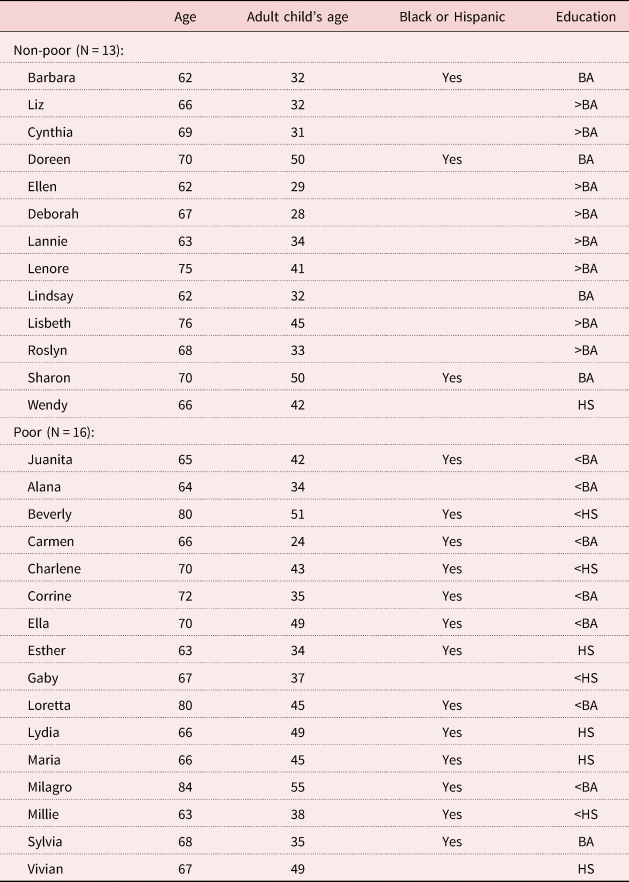
Twenty-nine American women were interviewed 55 per cent were poor (total income <150% of the poverty threshold) and a little more than half were minority (four Hispanic and 12 black) (Table 1). Racial differences were associated with income and education. Among those who were poor, 75 per cent were Black or Hispanic. Among those who were non-poor, 16 per cent were Black or Hispanic. Within the group of poor women, 70 per cent had experienced some form of abuse, compared to 50 per cent of the non-poor women. Median age of the low-income mothers was 67 and 66.5 for the non-poor. The median age of the adult children among the low-income women was 42 compared to 32.5 for the non-poor. A third of the final sample had sought help from the elder abuse service community.
Sample demographics

Notes: N = 29. BA completed 4 years of university: HS completed 4 years of high-school.
While all of the adult children had left the parental home in late adolescence or early adulthood, problems or transitions in the adult child's life led to a change in the mother's life when she responded to her adult child's renewed need for support. All of the women (except for two) had willingly re-opened their home to provide shelter to their adult children for some period of time. The issues in the adult children's lives that had led to their need for shelter included mental health and substance abuse problems, and/or relationship break-ups or loss of employment that interfered with the adult child's ability to afford housing. Many of the adult children had remained living with their mothers for many years once they returned home.
Intergenerational ambivalence
The analysis revealed that the older mothers experienced a wide range of mixed feelings towards their adult children and about themselves as mothers. While the sample specifically recruited women who self-identified as having adult children with problems, the finding of negative, as well as positive, feelings was expected. What was not known were the types of problems that the women would identify as ‘difficult’, whether these conflicts would be perceived as structural or psychological ambivalence, and whether there would be differences between those mothers who were poor and non-poor. Also not known were the strategies the women used to manage their ambivalent feelings towards their adult children and themselves.
Types of adult child problems reported by older mothers
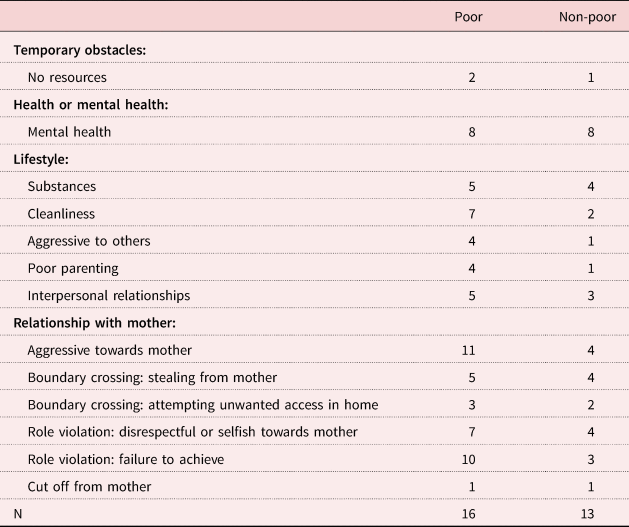
Using qualitative methods, the woman's perceptions of their adult children's problems were discovered by analysing the stories they shared about their family interactions. Most women told anecdotes that alluded to more than one problem, for example, a mental health diagnosis, adult child's selfishness and the adult child's lack of cleanliness while co-residing with the mother. Of the 29 women, only three mothers described their adult child's problem as what was coded as ‘temporary’ and seen by the mother as a lack of resources, specifically immigration status or employment opportunities. Table 2 shows the types of problems the women experienced, differentiating mothers who were poor and those who were non-poor.
Number of mothers reporting each adult child problem

Note: N = 29.
Structural ambivalence: I'm the mother
The women's stories about themselves and their difficult adult children included vivid descriptions of the women's conflicts regarding their commitment to protecting their adult children alongside their feelings of being used and disrespected. The analysis also revealed that much of the women's ambivalence was situated within their current situation as mothers (a gendered and socially constructed role). The qualitative analyses were able to analyse ambivalence within the context of the women's perceptions of their adult children's specific behaviours and the women's current status vis-à-vis this adult child. All of the stories that related to the women's conflicts as mothers were coded as structural ambivalence. Psychological ambivalence (or mixed feelings towards the adult child) was also discovered and is discussed below. According to Connidis and McMullin (Reference Connidis and McMullin2002), structural ambivalence results from the contradictions inherent in social relations, and it is experienced when an individual faces conflicting social-structural expectations, which in this study are conflicting mandates regarding the social mandates to be ‘a good mother’.
The researcher discovered three types of structural ambivalence. The first included reactions to the adult children's behaviour that violated the mothers’ expectations of reciprocity. The women expected to experience reciprocity from their grown children by being treated with respect and also by being able to experience the fruits of their mothering through feeling pride in their children.
As the mother, I should be respected and rewarded
The older women reported two expectations that they held as mothers: they expected their children to treat them in a respectful manner and they also expected their adult children to achieve their full potential as self-sufficient and independent adults. The fact that they felt denied these two aspects of their mothering was disappointing, embarrassing and personally painful. Millie, below, described the two intertwined ways that her son's behaviour violated these two maternal expectations: he was disrespectful to her on an individual basis, and he had not yet become a mature and responsible man and father. She expressed upset that her granddaughters (her son's children) would not be able to look up to their dad with pride:
And sometimes he talks to me in a way that is totally uncalled for, like a little disrespectful, and it really hurts me … He seems to forget who is the parent and who is the child? … And I ask myself, ‘when is he really going to grow up and really act his age?’ I said to him, ‘You're not 21. You are 32 years old. Here you are, a father of four kids … but you're acting like a 16-year-old boy … And you really need to grow up.’ (Millie, low-income)
As Sylvia coped with Stage 4 cancer, she tried to make sense of her older daughters’ lack of caring behaviours towards her, especially now that she was ill. She revealed that she had expected that when she was in need, the reciprocity in the mother–child relationship would shift. She referred to her daughters’ lack of attention to her needs as ‘selfish’. Her story ended with her expressing that her daughters’ behaviours made her embarrassed, as if she herself was at fault:
It's a confusion, you know, I felt as me being a mother, I had to make sure, no matter how old they were, that I can help them. That's the way I was; and now, because I did everything to help all of them, I am feeling hurt and disappointed because I expect so much of them that they can't seem to give me … But I would be looking at people when I go to chemotherapy at [the hospital] having their families with them, their children and … I am embarrassed, you know, that I have four children and I am sitting here, now, and none of them is sitting up there with me. (Sylvia, low-income)
He's not succeeding; I'm being blamed as the mother
Esther's son moved in with her after his relationship with a girlfriend ended. She described her son as depressed, unemployed, no woman in his life, hanging out with the ‘wrong’ people – smoking dope and staying out late. She described how his situation not only denied her the opportunity to feel pride in her son, but his economic dependence on her elicited in others the assumption that his idleness was her fault:
You know, you want to feel proud of your children. You want to see progress in their life. You want to see they do something that will lift up or portray the kind of life you instil in them, the values you instil in them. And people tend to point fingers at their parents every time a child turns bad. They will point fingers at the parents, like in a way, the parent didn't do good, the parent didn't train the children, you know … And yet, you do your part and nobody ask if you did it. Automatically, they already know you didn't. (Esther, low-income)
Violating maternal expectations within the macro context of poverty
At the time of the interviews, almost twice as many poor women were living with their adult children than the non-poor women. Only three mothers in the full sample never had had their difficult adult child move back in with them; and these three all were non-poor.
Income differences were found between the mothers who were poor and non-poor regarding adult child behaviours that violated maternal expectations. Ten mothers who were living in poverty expressed upset that their adult children had failed to reach their full potential, compared to only three of the non-poor mothers (three times as many). Twice as many poor mothers talked about their adult children being disrespectful to them and/or having problems with cleanliness in their homes. More poor mothers reported that their adult children engaged in aggressive behaviours towards them. More than three times more poor women complained about their adult children's abilities to parent their own children.
Sylvia's story illustrated how she felt shame because of her daughters’ and her own poverty status. Sylvia was 72 years old. Several years back, her two daughters had both returned to live with her and her husband, in their small three-bedroom apartment. Both daughters brought two young children. Side by side with feeling neglected by their seeming uncaring attitude towards her as she coped with Stage 4 cancer treatment, she also described feeling embarrassed and disappointed at the daughters’ impoverishment and lack of accomplishments. Both daughters had done some college, but had never finished. Neither of them was employed. Her feelings of shame were affected by her children's (and her own) poverty:
They have nothing, you know, they have no clothes, no houses, no apartment … they don't have anything. You know, they should have a car, you know, to drive their children around. I should have a car. (Sylvia, low-income)
Rappoport and Lowenstein (Reference Rappoport and Lowenstein2007) found that shame was expressed as a part of structural ambivalence in which the individual feels that they are violating social norms, while guilt refers instead to the subjective experience of ambivalence. In Sylvia's comments, above, she expressed that her feelings of shame as a mother were compounded by being a mother living in poverty.
Self-blame within the macro context of low income
Self-blame was heard in nearly every woman's story across income groups. But unique to the low-income mothers was the assumption that their poverty status or employment status might have caused their adult children's later-life problems. Each of the low-income women alluded to how their lifetime impoverished status might explain what went wrong with their adult child, including the fact they, as young mothers, had had to work, or use babysitters, or did not have a man in the house, due to divorce or death:
There wasn't a father around too much. I don't know if that makes the difference. I don't know if that would have helped if they had a father around, I actually think that in his twisted mind, my youngest son, not seeing a father around bringing in what they call the bread and butter, he thinks it's my duty – because I was the only one he saw. He thinks it's still a woman's job to take care of him … But you see, in my situation I go around with the guilt that I did not do enough, I did not do the right – not enough. I did not do the right things to really put them on the road for a better life. (Charlene, low-income)
A second type of structural ambivalence was mothers’ upset when they felt violated or mistreated by their own child. The aggressive or hostile behaviour towards them by their own children was not part of how they understood mothers should be treated.
Disrespecting my boundaries
Boundary violations was a process variable that emerged in many of the women's stories describing how they felt uncomfortable when their adult child overstepped what the mothers believed was the adult child's place within the mother's physical space (her home) or her needed personal boundaries. Many, but not all, of the boundary violations occurred within the context of the adult child co-residing with the mother. These events included the adult child eating the mother's food that she had cooked and saved for herself, disrespecting the mother's need for quiet and cleanliness, stealing from the mother and, the most invasive, the adult child verbally insulting the mother and/or physically attacking her.
Six of the women were physically assaulted. Several were threatened with knives or other household items like a hammer. When describing incidents in which their adult child was aggressive towards them – verbally, physically or stealing from them – the acts were presented as uniquely upsetting because they violated the women's expectations of how one should be treated by a family member. Loretta owned a small home. When her son, Jason, and his girlfriend, Zahra, had their first child they asked if Loretta would let them stay in her small enclosed front porch. They stayed for over ten years and had many subsequent children. Jason and Zahra disrespected Loretta's need for safety and peace of mind. Here below, she described an incident in which they would not even let her into her own bathroom. Her son's sense of entitlement and disregard for Loretta's needs escalated into legal attempts to have Loretta evicted so that he could take possession of her house, which he believed should have been his:
Okay. It was a constant thing about the bathroom. I wanted to go to the bathroom. So, I says to the kid, ‘Oh, please.’ I begged her … I mean, it was just like – I don't want to use the word, ‘hell’, but it was just too much. Too, too much. The bathroom would be all wet, you know, and I could slip when I go in there. They just didn't even care. It was just a house of confusion, just a house of confusion. (Loretta, low-income)
Whose needs should take priority?
Many of the women's stories addressed their concern about the harm that they were inflicting on themselves by putting their adult children's needs over their own. While Beverly, below, stated that she saw herself at a crossroads in her life. She wanted to take care of her own health and step back from the ongoing strain of caring for her adult children, but she also believed she could not give up on protecting her daughter and grandson:
Of course … I'm not going to do anything that's going to put myself in jeopardy, pushing myself too far, because I know I can't. My heart is – I get palpitations and I get stress. So, I have to step back a step. But I can't give up on them. I'm still trying to help them. But at the same time, I can't keep on leaving myself out. I have to help myself. And I'm at a crossroads here. (Beverly, low-income)
Corrine described how her neighbours and family members have begged her to remove her son from her home. They worry about her health and safety. She is 73 and has Parkinson's disease. They worry about the stress she experiences living with her son who has mental illness and has already threatened her on several occasions with physical violence. As she described below, although she knows that harm could still come to her, her son's safety takes precedence for her over her own:
I know he needs to be out of here. He's 36 years old this year. I'll be 73. He needs – we need to be separated. I don't need all these on me at this age in my life. But I don't want to see him, you know, have homeless or whatever because he won't survive. He won't survive. He will not survive … So that's what I feel. You know, fears that there's harm would come for him. I mean that could come to me, too, but I just fear harm coming to him. (Corrine, low-income)
My health is suffering
In addition to self-blame and guilt, many described feelings of depression and awareness of the long-term impact the stress was having on their health and mental health. Many, especially those over 70 years of age, referenced being ‘tired’ and worn out from focusing on their adult child and not themselves. Lisbeth was approaching her 80th birthday. Here she described her increasing awareness of mortality (running out of gas) and her wish to live a different type of life:
…because I think it has really done a number on my health in the sense that I have bad irritable bowel syndrome. And I've had ulcers, and I think that – and, plus, I would say that I've run out of gas. I just don't have the emotional reserves to tap into. I just don't. (Lisbeth, non-poor)
I can't walk away
Lisbeth (non-poor) described herself as being like a ‘mule on a harness’. The harness is her need to protect her daughter. For more than 25 years, Lisbeth has dreaded when the phone would ring, knowing that it could likely be her daughter or someone associated with her daughter (landlord or police) calling to report a problem with her daughter. Her daughter has never worked. Lisbeth and her husband, both professional people, have been able to afford to house Kristen in a separate apartment. They chose to use their financial resources to house her in her own apartment and thereby avoid the stress of sharing their home with their troubled daughter. Yet despite having this economic latitude, Lisbeth still described feeling trapped. She has overseen her daughter's finding a new apartment 21 times in the past 20 years. She explained her need to continually bail out her daughter, who has been diagnosed with paranoid schizophrenia, by the simple statement, ‘She has to have a place to live … she has to eat.’
If not me, who?
Several women's stories described their frustration with larger societal structures that they had hoped would ease their burden as mothers and provide needed mental health services for their adult children or legal help for themselves when they felt endangered by their adult children's behaviours. Each time Lisbeth's daughter was hospitalised for a psychiatric breakdown, she would quickly stabilise on the medication and be released after three days with a discharge plan that included medication and counselling. Lisbeth expressed feeling helpless at the current laws in her state that prohibited mandated medication for people like her daughter.
Several of the women expressed feeling frustrated at the limits of legal redress for their problems with their adult children. Most did not see jail time as a preferred way to help them and their adult children. Several chose to not use legal means for eviction and stay in what they perceived as a dangerous situation. Others expressed that while they wanted their adult child to be removed from their care, they would only accept the removal if they could be assured that the adult child would be placed in a safe alternative living space. Sending the child to prison or to live on the streets was not seen as safe alternatives for most of the women interviewed for this study.
Psychological ambivalence: mixed feelings towards one's adult child
Surprisingly, very few of the mothers’ narratives specifically included holding mixed feelings towards their adult children, although their narratives were saturated with conflict and resentment. The women were asked about the high and low experiences of each phase of their mothering, but hardly any positive experiences or feelings about their adult children were shared. Here, Lindsay, whose daughter had psychiatric problems and had tried to set fire to her own mother's house, expressed that she loved her daughter and also resented her. Although her words reflect ambivalent sentiments, they also reference these mixed feelings within the context of the burden, i.e. being the person others assumed would be responsible for her daughter's care:
I love her, but I resent her at the same time. Does that make any sense? You know, I resent this burden that I have to bear. (Lindsay, non-poor)
Managing ambivalence
While all of the women experienced ambivalent feelings regarding the conflicting norms contained in their maternal role, the types of actions that the women took to protect themselves or handle their feelings of ambivalence varied. Some took legal actions to ensure their own safety, despite their wish to protect their adult children. Half of the women who had experienced some type of abuse (physical, verbal, financial or emotional) had taken the initiative to report the problem, either by calling the police or going to family or housing court. Yet, two of the women who had had their adult children evicted or excluded from their homes by court order had reopened their homes to the adult child who was again living in their homes. A few were able to impose limits on the adult child's abusive behaviour by communicating clear limits on the adult child's behaviour within the home.
Liz seemed most able to set clear limits with her son, Ronald. On the one hand, when she learned that he was having marital problems, she and her husband opened their home to him and his four-year-old son. As soon as she then learned that he was using drugs, she said he could stay in the house only if he immediately enrolled in drug treatment. One year later, after having driven him every morning at 6 am to a methadone clinic for treatment, and then being with him through a detox from the methadone, she discovered that he was continuing to shoot heroine; she immediately acted. She took a photograph of the syringe to make the problem real to herself and told him he had to leave the house. When we spoke, Ronald was living on the streets in the small rural town where she lived. He was selling drugs. All her friends and neighbours saw him as he lived on the streets. Liz tolerates the social embarrassment and hopes that her son will eventually ‘wake up’ and get himself into treatment. However, she ended our interview talking about how hard it is to actually do ‘tough love’ and ‘let go’. She said ‘I still feel like he's my child, I haven't divorced myself from him. I haven't ever given up on him, but I put it in his court’:
Tough love, sometimes, doesn't feel like love. It just feels like … exasperation, pure hatred … But you have to do it for yourselves. More than for the child, I guess, it's such a balance in there. And one's person's answer is not another person's answer. That's what I've learned, everybody walks their own path. We all do. That's my parting thought. (Liz, non-poor)
Discussion
This study adds to the literature on intergenerational relationships in later life by using qualitative methods to capture the process of ambivalence among older mothers. The findings demonstrate how ambivalence is more than the woman's personal and conflicting feelings towards their adult child but is a lived experience of day-to-day decision-making regarding how to balance the conflicting internal and societal mandates they hold as mothers. The study describes the mothers’ expressed conflicts regarding adult children whose renewed needs for residential, financial or emotional support confront the women with several seemingly insolvable conflicts regarding her role as a mother/protector. Despite the women's and adult children's advanced ages, the indissoluble bond of mothers towards their children was found to frame the women's actions and feelings (van Gaalen et al., Reference van Gaalen, Dykstra and Komter2010).
The study is one of the first in-depth studies of intergenerational ambivalence to include a purposive sample of low-income and minority women, as well as middle-class and affluent women. The analysis shows that both low-income and non-poor older women experience structural ambivalence regarding how much help and support they should be offering their difficult adult children. Similar problems in their adult children's lives were discussed by both groups, but more poor women talked about relationship problems (Table 2), such as their reactions to the adult child's aggressive behaviour towards them (11 poor women versus four non-poor), being disrespectful (seven poor women versus four non-poor) and mother's disappointment regarding adult child's failure to achieve (ten poor women versus three non-poor). One possible explanation for this difference may be that the adult children of the low-income women are older (median age 42 versus 32.5). These older mothers have been affected by their adult children's problems for more years than younger mothers and because their adult children were already over 40, and in mid-life, they may believe that there is less chance for change. Mothers in both groups include self-blame as a partial explanation for the adult children's problems, but several of the poor women measure their upset about their child's lack of success as linked to their own poverty status.
Other differences by income were found. Problems with the adult children's cleanliness and parenting behaviours towards their own children were reported much more frequently by the low-income women. This finding may be related to the fact that many more of the low-income mothers were living with their adult children for long periods of time and were therefore more directly impacted by their lifestyle behaviours. The finding that the low-income women reported more incidents of physical aggression by the adult child towards them than the non-poor women may be also explained by their sharing their homes with their adult children. The situation of co-residence has been documented to be a high-risk factor for elder abuse by the dependent adult child towards their parents (Lachs and Berman, Reference Lachs and Berman2011).
This study examines the unique stressors that older American women experience when they provide support to their adult children who are experiencing obstacles to remaining self-supporting or self-sufficient. This study adds to the qualitative work of others who have also documented mothers’ dilemmas when caring for their adult children with mental illness (Avieli et al., Reference Avieli, Smeloy and Band-Winterstein2015), or mothers with aggressive adolescents who jeopardise their mothers’ physical and emotional safety (Holt, Reference Holt and Squires2008, Reference Holt2013). This study looks across diverse problems of the adult children to examine patterns of mothers’ responses. The analysis documents the different types of problems the older mothers experienced as problematic in their adult children's lives. While Birditt et al. (Reference Birditt, Fingerman and Zarit2010) classified how parents perceived adult children's problems as either life-long or lifestyle, this researcher discovered that the mothers’ presentations of their adult children's problems could be classified as ‘temporary obstacles’ or ‘chronic problems’. Within the chronic problems, I differentiate between those problems that could be classified as ‘lifestyle’ and those problems that were specific to the relationship with the mother. The mothers’ upset with how the adult child was treating her (aggressive acts towards her, stealing from her, role violations and boundary violations) was the problem behaviour most often discussed by the women.
The study adds to the field of ageing and intergenerational ambivalence by demonstrating how ambivalence, both structural and psychological ambivalence, is experienced by older mothers whose adult children experience set-backs in achieving self-sufficiency (Pillemer et al., Reference Pillemer, Suitor, Mock, Sabir, Pardo and Sechrist2007; Connidis, Reference Connidis2015). Three types of structural ambivalence are discovered in the analysis. The first includes the women's reactions to their adult children's behaviour that violate their expectations as mothers for reciprocity. The second type of structural ambivalence also addresses the women's expectations regarding how they should be treated by their adult children, but here the focus is specific egregious behaviours by the adult child towards the mother, herself. Being physically or emotionally abused by one's child was included in this category, as the women describe the abuse as a violation of how they expect to be treated as a mother. The women's rationale for staying in an abusive relationship with their adult child is also framed within the structural conflict of what does one do as a ‘good mother’. The third type of structural ambivalence is linked to the women's struggle regarding balancing their role as a mother to protect their adult children alongside their wish and identified needs for self-care.
This study reveals how the socially constructed role of ‘mother’ impacts women's wellbeing into later life. There is a rich feminist literature on how the socially constructed role of mother impacts women's identity when children are young (Ruddick, Reference Ruddick1989; Parker, Reference Parker1995). This current research demonstrates how the women's identity as mothers, even in later life, continues to frame how women manage (or avoid) their ambivalent feelings regarding their maternal responsibilities in later life. The women's seemingly insoluble conflicts regarding how to negotiate with their difficult adult children resonates with Connidis and McMullin's (Reference Connidis and McMullin2002) definition of ambivalence as ‘a bridging concept between social structure and individual action, made evident in social interaction’ p. 1. While shame and guilt have been documented among mothers of young children in regarding to return to employment (Guendouzi, Reference Guendouzi2006), this is one of the first studies that documents how maternal guilt and shame is present among older mothers. Finnish researchers and evolutionary biologists Rotkirch and Janhunen (Reference Rotkirch and Janhunen2010) documented how mothers of young children report that their most prevalent feeling towards themselves and their mothering role is guilt. They defined maternal guilt as the woman's internalisation of her self-blame for not meeting her internalised goal to be a ‘good mother’. This study has shown how this structural mandate is powerfully present also for older mothers whose adult children are failing to meet the expected milestones of autonomy and self-sufficiency.
The discovery of the predominance of structural intergenerational ambivalence expressed by this population of older women regarding their ‘off-time’ adult children can be used when framing needed clinical interventions with this population. Clinical interventions for women at risk for abuse by their adult children could engage older mothers by framing the problem as structural, rather than merely personal (or intrapsychic). This approach might allow women to more openly express and manage their ambivalence, which could then allow them to make decisions more easily and with less self-blame about their own need for safety. Supervisors in elder abuse settings have reported how confusing it is for new therapists or social workers to understand women's resistance to ‘getting help’ and creating safety plans regarding their adult children. Yet, helping their workers understand that the older women's conflicts are rooted in their identities as mothers (rather than individual ‘resistance’) allows the workers to understand better their clients’ difficulties in taking actions to protect themselves (Solomon and Olivera, Reference Solomon and Olivera2018).
There are several limitations in this study. The study was conducted in the USA and generalisations about how different cultures or societies define normative family behaviour vary (Kosberg et al., Reference Kosberg, Lowenstein, Garcia and Biggs2003). Second, as a qualitative study with a small sample size, the findings are not generalisable to the total population. The sample also did not include women who had cognitive impairments, or were homebound due to physical disabilities, a group that is potentially more vulnerable to abuse, even by family members. The women in the sample who had been physically or emotionally abused by their adult children were women who had already sought help from elder abuse services, therefore, those who are more vulnerable and unable to seek outside help are not included here. The sample was also restricted to women who only spoke English, therefore, immigrant older parents’ experiences are not included in the analysis and they may experience additional structural pressures due to their immigrant status and potential acculturation conflicts with their adult children. Finally, no interviews were conducted with the older adult children to corroborate the mothers’ description of the problems in the family interaction.
Overall, this study demonstrates the utility of using intergenerational ambivalence to examine older mothers’ experiences with their adult children whose problems are interfering with their ability to be self-sufficient. This study also adds to the growing body of feminist gerontological research (Hooyman and Gonyea, Reference Hooyman and Gonyea1995; Funk and Kobayashi, Reference Funk and Kobayashi2009; Hooyman, Reference Hooyman2014) that identifies the impact of cost shifting from public provision of services to the private sphere, in this case, older mothers. The absence of sufficient community mental health services, out-patient and in-patient services for substance abusers and their families, as well as needed affordable housing for idle adults has left families, in this case, older mothers, living with the insoluble conflict of ‘if not me, who?’ The ‘difficult’ dilemma for older women with troubled adult children is both personal and political.