Reduced fat cheeses typically have poor body and texture, flavor, and functional properties (Mistry, Reference Mistry2004). When fat is reduced, a tighter casein calcium-phosphate network is formed. Moisture level is usually increased in reduced fat Cheddar cheese to improve texture. Curd washing, inclusion of whey proteins and sweet buttermilk, reducing the cooking temperature and time, draining whey and milling at a higher pH value, and reducing rate of salting increase moisture retention in cheese (Mistry, Reference Mistry2004). However, the high moisture in reduced fat cheese makes it pasty and difficult to shred. In addition, reduced fat cheese containing high levels of moisture undergoes extensive water redistribution and protein hydration during the first few weeks of ripening, leading to too much softening (Awad et al. Reference Awad, Hassan and Muthukumarappan2005b). In previous studies, an exopolysaccharide (EPS)-producing strain of Lactococcus lactis subsp. cremoris (JFR1) increased moisture retention and produced a firm yet smooth texture (Awad et al. Reference Awad, Hassan and Halaweish2005a, Reference Awad, Hassan and Muthukumarappanb). However, because of its high moisture content and residual chymosin activity, this cheese was bitter after 2–3 months ripening (Awad et al. Reference Awad, Hassan and Halaweish2005a; Agrawal & Hassan, Reference Agrawal and Hassan2007).
Ultrafiltration (UF) is a molecular sieving, pressure driven membrane separation process that allows better control of cheese making and reduces production costs. In addition, less rennet is needed to coagulate UF milk (Kosikowski, Reference Kosikowski1973; Agrawal & Hassan, Reference Agrawal and Hassan2007). The reduced amount of chymosin used in making cheese from UF milk (1·2×) resulted in reduced residual chymosin activity and bitterness associated with reduced fat Cheddar cheese made with EPS-producing cultures (Agrawal & Hassan, Reference Agrawal and Hassan2007). As the residual chymosin activity is a major factor in proteolysis and texture development in cheese (Lawrence et al. Reference Lawrence, Creamer and Gilles1987), the objective of this study was to evaluate characteristics of EPS-positive and negative reduced fat Cheddar cheeses as affected by UF of cheese milk.
Materials and Methods
Cultures
The EPS-producing culture was a ropy strain of Lactococcus lactis subsp. cremoris (JFR1; Hassan et al. Reference Hassan, Frank and El-Soda2003). The culture was propagated and maintained as described by Awad et al. (Reference Awad, Hassan and Halaweish2005a). Chr. Hansen (Milwaukee, WI) provided the EPS-non producing commercial DVS Cheddar cheese culture (DVS 850).
Cheddar Cheese making
The Cheddar cheese studied here was also used in Agrawal & Hassan (Reference Agrawal and Hassan2007) and the method of production is described in that publication. Pasteurized (63°C for 30 min), ultrafiltered (1·2×; UF) or normal milk was used after adjusting the casein: fat ratio to either 1·35 for making reduced fat (RF) cheese or 0·7 for full fat (FF) cheese. Full fat cheese was made with normal milk. Three replicates of the following 5 treatments were employed: (1) Reduced fat cheese made using 32 g DVS 850/100 kg RF milk (RFC); (2) Reduced fat cheese made using 2 l JFR1/100 kg RF milk (RF-JFR); (3) Reduced fat cheese made using 32 g DVS 850/100 kg UF milk (UFC); (4) Reduced fat cheese made using 2 l JFR1/100 kg UF milk (UF-JFR); and (5) Full fat cheese made using 32 g DVS 850/100 kg FF milk (FFC). The proteolysis in cheeses used in this study was reported by Agrawal & Hassan (Reference Agrawal and Hassan2007).
Texture profile analysis
A 2-bite compression test was performed using the Instron Universal Testing Machine (model Sintech 2/D; MTS Systems Corp., Eden Prairie, MN) according to the method of Awad et al. (Reference Awad, Hassan and Muthukumarappan2005b).
Estimation of softening point and flow characteristics
The modified squeeze-flow apparatus described by Muthukumarappan et al. (Reference Muthukumarappan, Wang and Gunasekaran1999) was used to study the flow characteristics of cheese samples using a constant temperature of 70°C. The softening temperature, softening time, and extent of flow were calculated as described by Muthukumarappan et al. (Reference Muthukumarappan, Wang and Gunasekaran1999).
Measurement of viscoelastic properties
Viscoelastic properties were measured as described by Hassan et al. (Reference Hassan, Awad and Muthukumarappan2005) using a Viscoanalyzer (ATS Rheosystems, Rheologica Instrument Inc., Bordentown, NJ) equipped with a MP parallel plate geometry.
Sensory Evaluation
A panel of four experienced judges from the Dairy Science Department, South Dakota State University (Brookings), evaluated body and texture of cheese samples at 3 and 6 months ripening. Sample preparation and evaluation were done as described by Awad et al. (Reference Awad, Hassan and Muthukumarappan2005b).
Statistical analysis
Data were analysed by analysis of variance using the General Linear Model procedure of SAS statistical analysis software package (SAS Institute, 1999). Duncan's multiple range test was used to compare means. Differences were considered significant at P⩽0·05.
Results and Discussion
Cheese composition
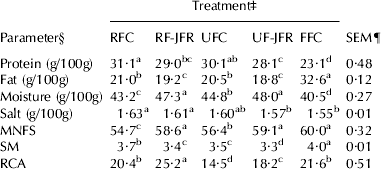
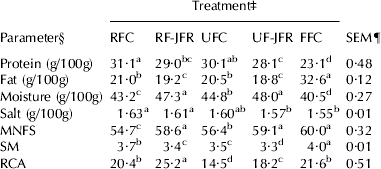
Fat reduction decreased fat and increased protein and moisture in cheese (Table 1). The EPS-producing culture increased moisture level in reduced fat cheese. No difference in MNFS was observed between reduced fat cheese made with the EPS-producing culture and full fat cheese. Ultrafiltration increased moisture in cheese made with the EPS-non-producing but not the EPS-positive culture.
Chemical composition and residual chymosin activity of reduced and full fat Cheddar cheesesFootnote †
† From Agrawal & Hassan (Reference Agrawal and Hassan2007)
‡ RFC=reduced fat control made with an EPS-non-producing culture; RF-JFR=reduced fat cheese made with the EPS-producing culture Lactococcus lactis subsp. cremoris (JFR1); UFC=reduced fat control made from 1·2× ultrafiltered milk and an EPS-non-producing culture; UF-JFR=reduced fat cheese made from 1·2× ultrafiltered milk and the EPS-producing culture Lactococcus lactis subsp. cremoris (JFR1); and FFC=full fat control made with an EPS-non-producing culture
§ MNFS=moisture in nonfat substance; SM=salt-in-moisture; RCA=residual chymosin activity, rennet activity units/kg of cheese
¶ SEM=Standard error of means
a–d Means in the same row without common subscripts are significantly different (P⩽0·05)
Textural characteristics
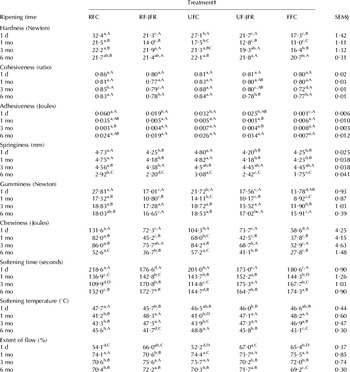
In RFC and UFC, the reduction in fat increased cheese hardness (Table 2). Fat reduction increases the compactness of the protein network and hardness of reduced fat cheese (Bryant et al. Reference Bryant, Ustunol and Steffe1995). As the MNFS decreases and protein increases, the hardness of the fresh Cheddar cheese increases (Awad et al. Reference Awad, Hassan and Muthukumarappan2005b). At d 1, the hardness of RF-JFR and UF-JFR did not differ from that of the FFC. In addition, FFC, RF-JFR, and UF-JFR were softer (P<0·05) than RFC and UFC. Exopolysaccharides interfere with the protein-protein interactions and reduce hardness (Hassan & Frank, Reference Hassan and Frank1997; Awad et al. Reference Awad, Hassan and Muthukumarappan2005b). In addition, EPS soften the structure of cheese by increasing water retention (Awad et al. Reference Awad, Hassan and Muthukumarappan2005b).
Texture profile analysis and softening characteristics of reduced and full fat Cheddar cheeses during ripeningFootnote †

† Mean of three replicates
‡ See Table 1 for explanation of treatments
§ SEM=Standard error of means
a–e Means in the same row without common subscripts are significantly different (P⩽0·05)
A–D Means in the same column without common subscripts are significantly different (P⩽0·05)
During the first month of ripening, a decrease (P⩽0·05) in hardness of all cheeses was observed (Table 2). The rubbery texture of fresh cheese is converted into a smoother and softer product during this period of ripening (Lawrence et al. Reference Lawrence, Creamer and Gilles1987; McMahon et al. Reference McMahon, Fife and Oberg1999; Lucey et al. Reference Lucey, Johnson and Horne2003). This softening is attributed to hydrolysis of αs1-casein (Lawrence et al. Reference Lawrence, Creamer and Gilles1987), water redistribution (McMahon et al. Reference McMahon, Fife and Oberg1999), and solubilization of colloidal calcium phosphate (Lucey et al. Reference Lucey, Johnson and Horne2003). Residual chymosin activity is one of the major factors thought to affect structure development during the first few weeks of ripening (Lawrence et al. Reference Lawrence, Creamer and Gilles1987; Lucey et al. Reference Lucey, Johnson and Horne2003). However, the reduction in the amount of chymosin (about 40% less) and residual chymosin activity in the UF cheeses (Table 1) did not affect texture development (reduction in hardness) during the first month of ripening as no differences were seen between RF-JFR and UF-JFR (Table 2). Furthermore, UFC was even softer than RFC at 1 month. These findings support the proposal of O'Mahony et al. (Reference O'Mahony, Lucey and McSweeney2005) and suggestion of Awad et al. (Reference Awad, Hassan and Muthukumarappan2005b) that factors other than the chymosin action on casein are responsible for cheese softening during this first month of ripening. The hardness of the 6 month old RFC and UFC was lower (P⩽0·05) than that of corresponding fresh cheeses. However, such reduction in hardness was not observed in RF-JFR, UF-JFR and FFC. The EPS produced by Lactococcus lactis subsp. cremoris JFR1 forms a 3-D network (Hassan et al. Reference Hassan, Frank and El-Soda2003; Hassan & Awad, Reference Hassan and Awad2005) that entraps water (Awad et al. Reference Awad, Hassan and Muthukumarappan2005b). This might decrease the amount of expressible water which is responsible for protein hydration and softening in the first month of ripening (McMahon et al. Reference McMahon, Fife and Oberg1999).
The UFC was softer (P⩽0·05) than RFC, which could be because of higher (P⩽0·05) moisture in the former cheese. A similar effect of UF was reported by Spangler et al. (Reference Spangler, Jensen, Amundson, Olson and Hill1990). However, the UF at a concentration factor of 1·2× did not affect either moisture or hardness of cheese made with the EPS-producing culture. At the third month of ripening, UF cheeses contained lower levels of water soluble nitrogen than did the non-UF-cheeses (Agrawal & Hassan, Reference Agrawal and Hassan2007). However, there were no differences (P⩾0·05) in hardness between UF and non-UF cheeses. This shows that the reduction of the level of soluble peptides caused by 1·2×UF does not affect cheese hardness.
No differences (P⩾0·05) were found in the cohesiveness among all cheeses at d 1 (Table 2). During the first month of ripening, cohesiveness did not change. The 3 month old FFC was less (P⩽0·05) cohesive than all other corresponding cheeses. Bryant et al. (Reference Bryant, Ustunol and Steffe1995) and Awad et al. (Reference Awad, Hassan and Muthukumarappan2005b) also reported that reduction in fat increased the cohesiveness in cheese. After 6 months ripening, RFC and UFC were more (P⩽0·05) cohesive than RF-JFR, UF-JFR, and FFC, which were similar (P⩾0·05).
Fresh RF cheeses were more (P⩽0·05) adhesive than their FF counterparts. Awad et al. (Reference Awad, Hassan and Muthukumarappan2005b) also reported that reduction in fat increased the adhesiveness in fresh Cheddar cheeses. After 6 months ripening, the adhesiveness of all cheeses was similar (P⩾0·05).
The RFC and UFC at d 1 were springier (P⩽0·05) than RF-JFR and UF-JFR, which were not different (P⩾0·05) from FFC (Table 2). After 3 months ripening, a decrease (P⩽0·05) in springiness was observed in all cheeses. This might be due to the hydrolysis of para κ-casein, which is responsible for springiness of the cheese curd (Awad et al. Reference Awad, Hassan and Muthukumarappan2005b). At 6 months, FFC was the least springy of all cheeses (similar observations were reported by Awad et al. Reference Awad, Hassan and Muthukumarappan2005b); RF-JFR and UF-JFR were less (P⩽0·05) springy than RFC and UFC while UF cheeses were springier (P⩽0·05) than non-UF cheeses. This could be due to limited proteolysis in UF cheeses compared with the non-UF cheeses (Agrawal & Hassan, Reference Agrawal and Hassan2007). The springiness of UF-JFR was lower (P<0·05) than that in both RFC and UFC.
At d 1, FFC was the least (P⩽0·05) gummy among all corresponding cheeses and RF-JFR and UF-JFR were less (P⩽0·05) gummy than RFC and UFC (Table 2). Awad et al. (Reference Awad, Hassan and Muthukumarappan2005b) reported similar differences between RFC and RF-JFR. There were no differences (P⩾0·05) in gumminess at 6 months among RF-JFR, UF-JFR and FFC, which were less gummy than corresponding RFC and UFC. Gumminess of cheese made with the EPS-producing culture was not affected by UF. However, fresh and 1 month old UFC were less gummy than RFC. This finding agrees with the hardness data (Table 2) and seems to be related to higher moisture in UFC than in RFC (Table 1).
Chewiness of FFC was the lowest (P⩽0·05) of all cheeses (Table 2) and RFC and UFC were more chewy (P⩽0·05) than RF-JFR and UF-JFR. The UF at 1·2×did not affect the chewiness of the EPS-positive cheeses. However, in agreement with the hardness and gumminess results, lower chewiness values were seen at 1 d and 1 month UFC than in RFC.
Softening and flow characteristics
At d 1, RF-JFR, UF-JFR and FFC softened in a shorter (P⩽0·05) time with a greater extent of flow than did RFC and UFC (Table 2). McMahon et al. (Reference McMahon, Fife and Oberg1999) observed lower meltability in mozzarella cheese with reduced fat than in the control. Kuo et al. (Reference Kuo, Wang, Gunasekaran and Olson2001) reported reduced meltability in cheeses with higher protein and lower MNFS. The high MNFS in RF-JFR, UF-JFR and FFC and interference of EPS and fat with protein-protein interactions could be responsible for the improved melting properties in these cheeses. During the first month of ripening, the extent of flow increased (P<0·05) in all cheeses. However, the RFC and UFC softened at a greater rate than did RF-JFR, UF-JFR and FFC, which is in agreement with findings of Awad et al. (Reference Awad, Hassan and Muthukumarappan2005b). Although changes in softening were greater in RFC and UFC than in FFC during the first month, proteolysis indices did not differ (Agrawal & Hassan, Reference Agrawal and Hassan2007). This indicates that factors other than proteolysis also affect cheese softening.
Ultrafiltered milk seemed to affect cheese softening (Table 2). While the softening time was shorter in the 1 d and 6-month old UF cheeses than in the corresponding non UF cheeses, the opposite was observed in the 1 and 3 month old cheeses. Differences were also seen in the extent of flow between UF and non UF in the 1 and 3 month old cheeses, but not in the cheeses at 6 months.
Viscoelastic properties
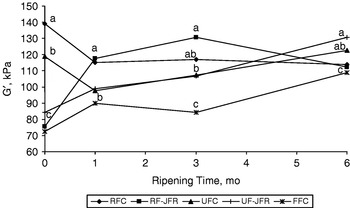
A reduction in fat and increase in protein resulted in an increase in cheese viscoelastic moduli (Fig. 1). Changes in the elastic and storage moduli followed the same pattern. Fresh RF-JFR and UF-JFR had smaller (P⩽0·05) viscoelastic moduli than did RFC and UFC (Fig. 1). Furthermore, no differences (P⩾0·05) were found in the viscoelastic moduli among fresh RF-JFR, UF-JFR, and FFC. These had similar MNFS levels which were higher than that in RFC and UFC (Table 1). Microscopic observations revealed that large fat serum channels in full fat cheeses and EPS are responsible for a less tight network in these cheeses than in the EPS-negative cheese (Dabour et al. Reference Dabour, Kheadr, Benhamou, Fliss and LaPointe2006; Hassan & Awad, Reference Hassan and Awad2005). During the first month of ripening, whereas the viscoelastic moduli of RFC and UFC decreased (P⩽0·05), they increased in RF-JFR, UF-JFR, and FFC (Fig. 1). Similar results were reported by Hassan et al. (Reference Hassan, Awad and Muthukumarappan2005). The viscoelastic moduli of 6 month old FFC, and RF-JFR and UF-JFR were higher (P⩽0·05) than those in the corresponding fresh cheeses (Fig. 1). However, such increase in moduli was not observed in RFC and UFC. This indicates that the high fat level in FFC and EPS in RF-JFR and UF-JFR prevented excessive softening of cheeses during ripening.
Changes in the elastic modulus (G') of reduced and full fat Cheddar cheeses during ripening. RFC=reduced fat control made with an EPS-non-producing culture; RF-JFR=reduced fat cheese made with the EPS-producing Lactococcus lactis subsp. cremoris (JFR1); UFC=reduced fat control made from 1·2× ultrafiltered milk and an EPS-non-producing culture; UF-JFR=reduced fat cheese made from 1·2× ultrafiltered milk and the EPS-producing Lactococcus lactis subsp. cremoris (JFR1); and FFC=full fat control made with an EPS-non-producing culture. Different letters (a,b,c) indicate significant differences (P⩽0·05) within the same ripening period.

Fresh UFC had smaller viscoelastic moduli than RFC, which might be due to the higher MNFS level in UFC. No differences (P<0·05) were seen in the viscoelastic moduli between fresh RF-JFR and UF-JFR. At 3 months ripening, although there were no differences in the pH between RF-JFR and UF-JFR (data not shown) and more extensive proteolysis occurred in RF-JFR than in UF-JFR (Agrawal & Hassan, Reference Agrawal and Hassan2007), lower moduli were seen in UF-JFR than in RF-JFR (Fig. 1). However, no differences were seen in the moduli between RFC and UFC at 3 months. The 6 month old RF cheeses made from UF milk were more elastic (P⩽0·05) than the corresponding cheeses made from non UF milk (Fig. 1). There were no differences in the frequency dependence between the 6-month old RF-JFR and UF-JFR (data not shown). However, more frequency dependence of the viscoelastic moduli was seen in 6 month old RFC than in UFC. This means that the non UF cheese appeared more viscous in nature than the UF cheese, possibly due to more extensive proteolysis in the former cheese. The differences in the water soluble nitrogen and trichloroacetic acid soluble nitrogen between RFC and UFC at 6 months were greater than those between the corresponding RF-JFR and UF-JFR (Agrawal & Hassan, Reference Agrawal and Hassan2007). This might explain the difference in the frequency dependence between RFC and UFC but not between RF-JFR and UF-JFR.
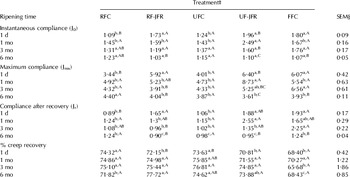
Fresh FFC, RF-JFR, and UF-JFR had higher (P⩽0·05) creep compliance values than did RFC and UFC (Table 3). This indicated that the former cheeses were less rigid and more deformable. Viscoelastic moduli were in negative correlation with Jmx. A similar correlation was reported by Hassan et al. (Reference Hassan, Awad and Muthukumarappan2005) and Brown et al. (Reference Brown, Foegeding, Daubert, Drake and Gumpertz2003). Six month old RF-JFR, UF-JFR and FFC were less (P⩽0·05) deformable (lower Jmx) than corresponding fresh cheeses. However, the reduction in the deformation during ripening was not seen in RFC and UFC.
Changes in creep compliances (1/Pa,×10−5) and % creep recovery of reduced and full fat Cheddar cheeses during ripeningFootnote †

† Mean of three replicates
‡ See Table 1 for explanation of treatments
§ SEM=Standard error of means
a–c Means in the same row without common subscripts are significantly different (P⩽0·05)
A–C Means in the same column without common subscripts are significantly different (P⩽0·05)
At d 1, the % creep recovery was higher (P⩽0·05) in RFC and UFC than in RF-JFR, UF-JFR and FFC (Table 3). The firmer the cheese, the smaller the deformation, and therefore, lesser amount of strain change is needed for total recovery in a given period of time (Brown et al. Reference Brown, Foegeding, Daubert, Drake and Gumpertz2003). After 1 month ripening, this parameter remained unchanged in all cheeses (P>0·05). The % creep recovery was lower in the 6 month old FFC than in all other corresponding cheeses.
No differences in deformation were seen between UF-JFR and RF-JFR except at month 1 where the UF cheese was more deformable. This is due to the limited increase in the viscoelastic moduli in the UF cheese compared with the non-UF cheese during the first month of ripening (Fig. 1). Ultrafiltration did not affect the deformation of the EPS-negative cheese except after 6 months ripening where the RFC was more deformable than the UFC, which might be due to more extensive proteolysis in the former cheese (Agrawal & Hassan, Reference Agrawal and Hassan2007).
Sensory evaluation
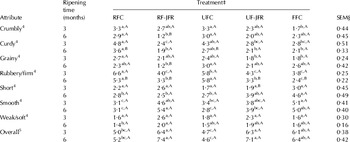
Panelists did not detect differences (P >0·05) in the overall body and texture among RF-JFR, UF-JFR, and FFC (Table 4). Interestingly, although TPA analysis showed differences in hardness between the FF cheese and RF cheese but not among RF cheeses, panelists found that the EPS-positive RF cheeses were less firm than the EPS-negative reduced fat cheeses. The 3 and 6 month old RFC and UFC had lower (P⩽0·05) overall body and texture scores than did other cheeses. The RF-JFR and FFC were less (P⩽0·05) rubbery than RFC and UFC. This reduction in rubberiness is significant since this defect is associated with most reduced and low fat cheeses even with increased moisture levels. Panelists did not find differences (P>0·05) in all sensory attributes between the RF-JFR and UF-JFR except smoothness, which was higher in the former cheese.
Body and texture scores for reduced and full fat Cheddar cheeses during ripeningFootnote †

† Mean of three replicates
‡ See Table 1 for explanation of treatments
§ SEM=Standard error of means
4 1=none, 5=definite, and 9=pronounced
5 1=poor, 5=average, and 9=excellent
a–c Means in the same row without common subscripts are significantly different (P⩽0·05)
A,B Means in the same column without common subscripts are significantly different (P⩽0·05)
In conclusion, milk UF did not affect texture and deformation of fresh (1 d old) and aged (3 and 6 month old) cheeses made with the EPS-producing culture. Also, panelists did not find differences in body and texture between the two cheeses. Ultrafiltration (1·2×) which significantly reduced the residual chymosin activity in the UF cheeses (Agrawal and Hassan, Reference Agrawal and Hassan2007) did not affect texture development during the first month of ripening. Factors other than action of chymosin on proteins in cheese seem to play a major role in structure development.
Acknowledgements
This research was supported by South Dakota Agricultural Experiment Station.