Introduction
The socio-economic changes related to new trends towards local and typical productions, receive increasing interest from the consumers, as natural, healthy and tasty products that are produced in environmentally friendly production systems, provide new opportunities for the sustainable development of local animal breeds (Ligda, Papadopoulos and Georgoudis, Reference Ligda, Papadopoulos and Georgoudis2002). Their special quality is defined by the uniqueness of the resources used, the natural vegetation “consumed”, the production methods employed and the local gastronomy.
The new demands of the modern consumer for high-quality food, poor in saturated fats, but rich in polyunsaturated fatty acids because of their beneficial effects on human health provide a new framework for livestock farming (Borsotelli and Berra, Reference Borsotelli and Berra1994; Vonghia et al., Reference Vonghia, Marsico, Zezza, Gallo, Caputi Jambrenghi and Giannico1999). Following these trends, farmers from the regions of Thessalia in Greece and Apulia in Italy have considered rearing autochthonous animals, as in the case of the bovine Podolian (Italy) and Katerini (Greece). Both these populations derive from the Bos primigenius or Uro, the first bovine for which there were findings and its domestication seems to have taken place in the 400 B.C. in the Middle East. There are two theories about the origin of these two breeds. According to the first, they derived from cattle that came to southern Europe in 452 B.C. following Huns who, on their way from Mongolia, passed through the Ukrainian steppe, which is considered to be their birthplace. However, according to another theory, in Crete in Greece existed a long-horned cattle which can be identified as Bos primigenius. Recent assessments indicate that there are 23 000 heads of Podolian bovine in south Italy, registered in the Herdbook (ANABIC, 2007) and only 217 of the Katerini breed (MRDF, 2008). The Podolian cattle are spread throughout an area that mainly covers the inland territories of southern peninsular Italy (Abruzzo, Basilicata, Calabria, Molise and Apulia) (Marsico et al., Reference Marsico, Ragni, Melodia, Tarricone, Cocca and Vicenti2008a, Reference Marsico, Rasulo, Forcelli, Tarricone, Pinto, Cagnetta and Basile2008b). One of the outstanding characteristics of these cattle is their exceptional ability to adapt to particularly difficult environments, as well as their extraordinary capacity to utilize food resources that would not otherwise be used (ANABIC, 2007). The Podolian has been used in the past, mainly for their labour capacity and secondarily for meat and milk products. Its milk is ideal for producing the famous “caciocavallo” cheese (Tarricone et al., Reference Tarricone, Marsico, Ragni, Forcelli, Pinto, Vicenti and Rasulo2009a, Reference Tarricone, Karatosidi, Marsico, De Vito, Colangelo and Rasulo2009b).
The Katerini cattle breed is of small size with average wither height of 125 and 113 cm for males and females, respectively. The head is large with long lyra-shaped horns. The neck is medium to short and strong. The basic colour is grey, but it ranges from black to brown. The average weight is 375 kg for males and 280 kg for females. The breed is characterized by a white ring around the nose. In general, the body conformation is of a strong draft animal of the Steppe type. The few remaining animals are raised in the region of Thessaly (central Greece) (Ligda, Reference Ligda2009).
However, owing to the rise and spread of agricultural mechanization, the selection of these two breeds was oriented mainly towards meat production, and to a lesser extent, towards dairy production, particularly in certain areas. As far as the reproductive aspect is concerned, age at first calving is rather advanced (about 3 years). This is primarily because of the breed's harsh habitat, especially owing to extreme heat of the summer months, with the amount of available food resources being decreased; thus, slower the growth rates of younger animals. Nevertheless, these types of cattle develop a long reproductive life, breeding for over 10 years with an average time span of 15 months between calvings. For the most part, calvings are spontaneous and are concentrated during the springtime. Calves suckle for at least 4 months (ANABIC, 2007). The calves are then slaughtered in order to be sold for meat at around 15–18 months with weights ranging around 300–350 kg (in Greece, the slaughtering weight is lower and around 250 kg).
Although, for the Podolian cattle, there is available literature (Braghieri et al., Reference Braghieri, Pacelli, Marsico, Sabia, Tarricone and Napolitano2007, Reference Braghieri, Girolami, Sodo, Riviezzi, Marsico and Napolitano2009; Marsico et al., Reference Marsico, Ragni, Vicenti, Melodia, Cocca and Perrucci2007, Reference Marsico, Ragni, Melodia, Tarricone, Cocca and Vicenti2008a, Reference Marsico, Rasulo, Forcelli, Tarricone, Pinto, Cagnetta and Basile2008b; Vicenti et al., Reference Vicenti, Ragni, Di Turi, Marsico, Toteda, Facciolongo and Lastilla2007; Ragni et al., Reference Ragni, Vicenti, Rasulo, Perrucci, Tarricone and Marsico2008; Tarricone et al., Reference Tarricone, Marsico, Ragni, Forcelli, Pinto, Vicenti and Rasulo2009a, Reference Tarricone, Karatosidi, Marsico, De Vito, Colangelo and Rasulo2009b), for the Katerini cattle (Greece) the bibliography is very limited and it refers to the origins and the genetic characterization of animals (Georgoudis and Ligda, Reference Georgoudis and Ligda2000; Ligda et al., Reference Ligda, Georgoudis, Floros, Xenoudakis and Boyazoglu2006; MRDF, 2008; Ligda, Reference Ligda2009). Therefore, we considered that it would be interesting to compare some meat quality parameters of the two breeds, Podolian and Katerini, for a possible future plan of rescuing the latter by ensuring the biochemical and nutritional characterization of its meat.
Materials and methods
Location of experiment and management system
This trial was carried out on two farms selected in Italy and Greece: the “Rago” farm in south Italy and the “Ark Dimou” farm in central Greece. In both farms, the raised cattle are born and weaned on pastures in the same period. Both farms are focused on meat production. Animals are kept outdoors during the summer where they feed on pasture and only during the cold months of winter they are kept indoors and fed with forage gathered from pastures, when available.
For the analysis, four Italian Podolian and four Greek Katerini bulls were used, born from parents registered in the relevant herdbooks of each breed. All animals were raised under an extensive grazing system based on local pastures. When the animals reached the target slaughter age (18 months), they were slaughtered according to the European Union (EU) Regulations (European Parliament and Council, 2001).
Slaughter and sampling procedures
The animals were slaughtered in licensed slaughterhouses in their country of birth, when they reached the lower end of the typical endpoint age range (18 months) for the local market. The bulls were transported to a local public abattoir and kept in covered yards, deprived of feed but with free access to water. They were weighted immediately prior to slaughter.
After the fasting period, the steers were stunned using a captive bolt pistol and slaughtered according to standard commercial procedures. The carcasses were chilled at 10–12 °C for 12 h and 0–2 °C for 12 h. On every cold carcass of each animal, we recorded the weight and pH with a pH-meter (Eutech Instruments XS PH110) with a Hamilton Double Pored penetrating electrode. The carcasses were split along the spine into two halves. From each carcass forequarter, the 9–11th rib section of the Longissimus dorsi muscle was removed by a straight cut perpendicular to the vertebral axis, from the middle of each intercostal space of the vertebrae. The Longissimus dorsi was collected at 24 h post-mortem, frozen at 4 °C under vacuum until analyses were performed 3 days later.
Laboratory analysis
On the third day, all carcasses were transported to the laboratories of the University of Bari in Italy, where all laboratory analyses took place. The 10th rib cut was separated into fat, lean and bone in order to calculate the lean, fat and bone percentages. Samples of Longissimus muscle were sliced into 2.5 cm steaks for tenderness testing measurements. The rest of the Longissimus muscle was homogenized in a blender and stored for 1 h at 4 °C until subsequent analysis for moisture, fat, protein, ash and intramuscular fatty acid composition. Cooking loss was evaluated in the meat samples of similar shape, individually cooked at 180 °C until the internal temperature reached 75 °C (monitored with thermocouples introduced in the core). Cooking loss was expressed as the percentage loss related to the initial weight.
Meat colour was assessed by the L*,a*,b* system using a HunterLab colorimeter (Colorflex) to determine the colorimetric index of chromaticity. The colour of the fat-free surface of the Longissimus muscle was evaluated using the mean value of three colour determinations.
Moreover, Warner–Bratzler (WB) texture meat analysis was performed. Fresh Longissimus muscle samples (of 25.4 mm cross-section with fibres perpendicular to the direction of the blade) were used for measurement. Shear force was assessed in both raw and cooked meat (in triplicate) using a WB device, shearing until breaking the samples with a cutting speed of 200 mm/min. The shear force value reported for each steak was the average value for all the evaluated cores.
After grinding the samples, moisture content, protein and ash were determined according to ASPA methods (ASPA, 1980). Fat percentage was measured according to the Soxhlet method (Soxhlet, Reference Soxhlet1879). The data are expressed per 100 g muscle.
Fatty acid analyses
Samples of Longissimus muscle were minced carefully in a food processor. An adaptation of the Folch, Less and Stanley (Reference Folch, Lees and Stanley1957) method was employed in the extraction of intramuscular lipids. Approximately 5 g of meat were homogenized with 5 ml of chloroform:methanol (2:1, v/v). Lipid extracts were converted to fatty acid methyl esters (FAME) as described (Morrison and Smith, Reference Morrison and Smith1964). Separation and quantification of FAME was carried out using a gas chromatograph (Shimadzu GC-17A with FID detector) equipped with a flame ionization detector and fitted with a PBX-70 capillary column (60 m, 0.25 internal diameter and 0.25 μm film thickness, SGE) and using a split/splitless injection system (split ratio of 1:30) and helium as a carrier gas at a flow rate of 1.5 ml/min.
The injection port and detector were maintained at 245 and 280 °C, respectively. Column oven temperature was programmed for 5 min at 135 °C, followed by an increase of 3 °C/min to 210 °C, and, finally, held at 210 °C for 20 min. Individual fatty acids were identified by comparing their retention times with those of a standard fatty acid mix Matreya.
Statistical analysis
Statistical treatments of the data were done by analysis of variance (ANOVA). Analysis of covariance was also performed, with breed type as the main effect, for data adjusted to a constant portion of hot carcass weight, fatness or muscle fat content for both breeds. The hypothesis test of two-tailed t test was used for the analysis of quantitative variables. All statistical analyses were carried out using SAS (SAS, 1999).
Results and discussion
Physical and chemical composition of Longissimus muscle
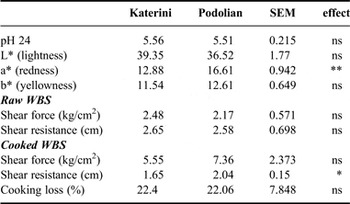
The results of the comparison of raw meat characteristics between the Italian Podolian cattle and the Greek Katerini are presented in Table 1. According to these, Podolian meat was redder (16.61 vs 12.88; P < 0.01), and the cooked Podolian meat was definitely more shear resistant (2.04 vs 1.65; P < 0.05). Concerning the other quality parameters, the observed differences were not statistically significant. Raw meat of Italian Podolian cattle (Table 2) had significantly (p < 0.05) lower moisture (73.69 percent vs 76.36 percent), and (p < 0.01) higher fat percentage (3.11 percent vs 0.71 percent). Furthermore, the meat presented less undetermined acids (0.57 percent vs 1.24 percent), fact that it was confirmed also after cooking, where Italian Podolians show a more fatty meat (3.27 percent vs 1.15 percent) and less rich in indeterminate acids.
Physical parameters of Podolians and Katerinis meat.

SEM, standard error of means; ns, p > 0.05.
* p < 0.05;
** p < 0.01.
Chemical composition % of raw and cooked meat.

SEM, standard error of means; ns, p > 0.05;
* p < 0.05;
** p < 0.01.
Fatty acid composition of intramuscular fat from Longissimus muscle
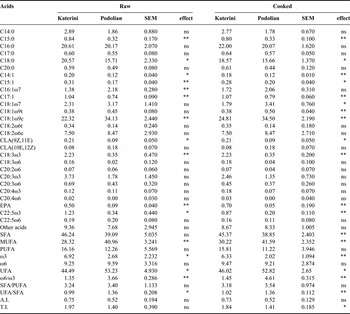
Data referring to the fatty acid profile of intramuscular fat in Podolian and Katerini breed are presented in Table 3. It was found that the fat of raw meat of Greek Katerini cattle, compared with that of the Italian Podolian cattle, was characterized by higher percentage (at p < 0.01 and/or p < 0.05) of C15:0 (0.84 percent vs 0.32 percent), C18:0 (20.57 percent vs 15.71 percent), C15:1 (0.31 percent vs 0.17 percent), C17:1 (1.04 vs 0.74 percent), CLA (9Z,11E) (0.21 percent vs 0.09 percent), C18:3ω3 (2.23 percent vs 0.35 percent), EPA (0.50 percent vs 0.09 percent), C22:5ω3 (1.23 percent vs 0.34 percent) and of lower concentrations of C16:1ω7 (1.38 percent vs 2.18 percent), C18:1ω9c (22.32 percent vs 34.13 percent), monounsaturated fatty acids (MUFA) (28.32 percent vs 40.96 percent), unsaturated fatty acids (UFA) (44.49 percent vs 53.23 percent) and of a lower value in relationship UFA/saturated fatty acids (SFA) (0.99 vs 1.36).
Fatty acid composition.

SEM, standard error of means; SFA, saturated fatty acids; MUFA, monounsaturated fatty acids; PUFA, polyunsaturated fatty acids; T.I., thrombogenicity index; A.I., atherogenicity index; ns, p > 0.05;
* p < 0.05;
** p < 0.01.
Moreover, significant differences (p < 0.01 and/or p < 0.05) were observed in the concentration of some fatty acids of the extracted fat of the cooked meat (Table 3). Katerini cattle cooked meat is characterized by higher percentages of C15:0 (0.80 percent vs 0.33 percent), C18:0 (18.57 percent vs 15,66 percent), C17:1 (1.07 percent vs 0.79 percent), CLA (9Z,11E) (0.21 percent vs 0.09 percent), EPA (0.70 percent vs 0.05 percent) and lower concentrations of C18:1ω7 (1.79 percent vs 3.41 percent).
The observed differences in physico-chemical composition of meat may be attributed to the animal's genetic origin, but they can also be ascribed to the feeding system and, particularly, to the floristic composition of pastures and their quantity. Pastures' characteristics affect the animal's growth rate and fattening, and therefore, the percentage of carcass cuts, on their composition in lean, fat and bone, and finally, on the percentage content of water, protein and fat of meat (Matassino, Casentino and Girolami, Reference Matassino, Casentino and Girolami1985; French et al., Reference French, Stanton, Lawless, O'Riordan, Monahan, Caffrey and Moloney2000; Baublits et al., Reference Baublits, Brown, Pohlman, Johnson, Onks, Loveday, Morrow, Sandelin, Coblentz, Richards and Pugh2004). The feeding system, according to quantity and quality aspects, also has an impact on fatty acid composition and, particularly, on polyunsaturated fraction, and the structure of cell membranes that seems to depend on the quantity of meat's fat (Cerrato, Reference Cerrato2000; Gambacorta et al., Reference Gambacorta, Cosentino, Perna, Palazzo, Gambacorta and Cosentino2005).
Conclusions
The results obtained, based on our experimental conditions, show that the raw meat of Greek Katerini cattle compared with the Italian Podolian cattle is less red, has higher moisture and is leaner. This trend was also confirmed after it was cooked, and it also presented lower shear resistance. In addition, the intramuscular fat of Katerini is richer in ω3 fatty acids and in C18:0, a trend that is confirmed after it is cooked.
The above results indicate that the meat of Greek Katerini cattle can satisfy the dietary needs of the modern consumer. They also support previous work concerning the need to develop initiatives aimed at increasing the viability of raising local cattle by promoting them on the basis of their quality products (Ligda, Reference Ligda2009). Towards this objective, local and collective efforts, including all stakeholders, should be developed aiming at the certification of the specific quality meat of Katerini cattle. Further research is needed, not only on a larger sampling of animals but also on the animals' finishing system in order to fully investigate the meat quality characteristics of these local cattle populations in order to establish successful development schemes.