


Philippe de Vitry was celebrated in his own lifetime, monumentalised from the time of his death onwards, and studied by antiquarians from the seventeenth century and in a modern scholarly tradition from the nineteenth. His standing as a poet and musician, and more, evidently drove this tradition, but the fact of his bishopric at Meaux also helped spread his name, locating his musical and literary output, and polymathic qualities, in historical and wider narratives and serving as (at least) a curiosity for musical and poetic audiences.Footnote 1 But Vitry’s bishopric has also served to shield the last years of his life from musical/poetic attention: many have presumed – perhaps steered by Petrarch’s admonition as his friend took up his bishopric – that Vitry had left the creative world behind. It was only Alfred Coville’s work that finally dispensed with the view that Vitry the poet and musician and Vitry the bishop might be two different people, and demonstrated his continuing presence in the creative circles of 1350s Paris. But even Coville thought that Vitry’s ‘administration épiscopale est de peu d’intérêt et d’ailleurs mal connue’, and that his appointment to the see at Meaux might signal ‘la retraite honorable’.Footnote 2 More recently the assumption has often been, tacitly or openly, not only that Vitry’s output and the period of his episcopate were disconnected, but also that consecration marked the end of the royal connection attendant throughout his career to date, or even a quiet, senescent retirement.
And yet, in the period of Vitry’s episcopate, roughly the 1350s, things are changing. A new fluidity in the musical chronology of the mid-century, driven by new discoveries and analysis, and literary work that has exposed more clearly links between the works of Vitry’s poetic contemporaries, invites a reassessment of his last decade.Footnote 3 The body of literary references to Vitry, and the evidence for his family and other relationships, merit fresh attention in this setting; so does the geopolitical context of Vitry’s work as a bishop. New archival evidence in the records of the Parlement of Paris illuminates not only his work in Meaux but also its linkage with political society, the king and court. It is in this area, Vitry’s life on the fringes of the French government, in Meaux and Paris, that this article particularly focuses. The interplay of career, relationships and output in this period, as in others, sparks numerous questions – demonstrating once more the extraordinary variety and fertility of Vitry as a subject – and here I also offer some wider reflections and perhaps provocations. All of what follows remains work in progress, however: it is a blueprint for a larger canvas, and on most of what I have to say there is more to do.
PROMOTION
Philippe de Vitry was promoted to the Bishopric of Meaux on 3 January 1351, and held this role, at the top of the ecclesiastical hierarchy and in the top tier of French royal government, until his death on 9 June 1361.Footnote 4 There was clearly some foreknowledge of his elevation, probably no later than Jean II’s arrival in Avignon in December 1350. Vitry had been sent to Avignon in September on the king’s ‘certaines besoignes’, having just returned from a mission there as royal nuncio in July/August; it is now clear, from a newly-discovered letter of protection sent by Jean II to the officers of the Parlement, that he remained at Avignon ‘pro negotiis nostris’ after the king returned to Paris, at least until early March and possibly until May 1351.Footnote 5 On accession to his bishopric Vitry simultaneously surrendered his six benefices, for some of which supplications were immediately forthcoming; graces for other benefices now in his gift as bishop were granted on the day of his promotion and shortly after, in one case to a former associate, Evenus Bohic.Footnote 6 He paid the papal taxes arising from his election on 18 January, and was granted access to the temporalities of his see by a royal mandate issued on 27 January: the episcopal estate; temporal jurisdiction, civil and criminal (to which attached a gaol and gallows in Meaux); residences, including hôtels in Germigny and Paris, and a disused palace in Meaux that also housed the episcopal mint. While in Avignon Vitry was involved in the grant of a royal pardon to Theobald Bonnet, a clerk from Meaux. In mid-April he secured the grant of a clerical tenth from the clergy of the city of Meaux, in all probability continuing a standing arrangement whose confirmation was part the process of gaining possession, and Pope Clement VI re-confirmed this grant on 18 January the following year.Footnote 7 Even so, episcopal possessions tended to be extensive, complex and were rarely uncontested across their full range: thus it is unsurprising to find the pope writing in the autumn of 1352, and again a year later, to appoint panels of senior ecclesiastics selected by Vitry to hear future cases that might be brought against him. These included the bishops of Châlons, Chartres, Beauvais and Soissons (two of whom were at the heart of Jean II’s government); in 1351 Vitry was himself appointed in this capacity by the Abbot of St-Denis, and by Robert le Coq, bishop of Laon.Footnote 8
Vitry’s route into the see of Meaux was clearly the product of his relationship with Jean II, who explicitly supported his elevation and in whose service (and that of his father) Vitry had worked as maître des requestes de l’Hôtel – i.e. judge and court counsel.Footnote 9 Vitry was a very senior figure in royal administration: for some time, probably since joining the judiciary in 1340, if not before, his career trajectory had implied scope for further promotion. Alongside the king’s support, however, there are two other French royal relationships that clearly buttressed Vitry’s case, with Pierre, duke of Bourbon, whose father’s will Vitry witnessed in 1342 after c. 20 years’ service, and with Cardinal Guy de Boulogne, who had promoted Vitry’s interests since the mid-1340s.Footnote 10 These relationships, with two of the king’s cousins at the heart of French government, remained powerful into the 1350s. Vitry’s own relationship with Clement VI, his career as a papal chaplain, and connections at Avignon over two decades in or near to diplomatic activity all lent credibility to his case for promotion. There is no sense that Vitry was plucked from obscurity: he was a career official, lawyer and diplomat who had been heading in this direction for the preceding two decades.
What purpose then did Jean II see in advancing Vitry? It would be easy to read into some accounts a view that Vitry’s promotion to Meaux was a reward, sinecure or posting to a retirement backwater; but if such roles were ever this, this was not one of them. Vitry’s close proximity to diplomatic missions in the 1340s, his success at Avignon, and recent direct experience in the conduct of the war with England, at Aiguillon in 1346 (where he was an active member of John Duke of Normandy’s Conseil, and subscribed letters ‘dans noz tentes’) and subsequently, together formed a strong platform for a role in the diplomatic and military work that faced Jean in 1350. As it would appear, his first task as bishop was to continue French royal negotiations, possibly relating to ecclesiastical taxation to support Jean II’s military effort, in which his own personal relationship with Clement VI was an obvious facilitator. His principal supporter at court, Pierre, Duke of Bourbon, was already immersed in negotiations with England. At the outset of his reign, Jean was constructing a strong episcopal cadre in the Grand Conseil, placing the bishops of Châlons and Beauvais in key roles: while Vitry probably never reached the Grand Conseil (hereafter the Conseil),Footnote 11 appointments such as Vitry’s into the northern French episcopate inevitably strengthened the king’s grip on the power-balance between the bishops and secular nobility. Chiefly, however, Vitry’s purpose was to cement a strategically important and politically unstable area of northern France to the core geopolitics of the Île-de-France, holding the ring in a difficult local setting that was periodically further tested by English military action. Vitry was not alone in shouldering this task, surrounded by the apparatus of royal secular authority, but the diocese of Meaux and the church’s role in binding southern Champagne to Paris were his responsibility.
The local setting of Meaux and the history of its bishopric are significant. From the late thirteenth century onwards, the see of Meaux gradually migrated away from a locally-based pastoral office towards a royal fiefdom.Footnote 12 Though of modest size and revenues in the fourteenth century, its location gave it real importance for the French crown. At the extreme of French royal influence, abutting that of the Counts of Champagne and Brie, Meaux was an important trading post on the Senlis–Troyes road and a key link between north-east France and southern Champagne and Burgundy. It was thus strategically important for the provisioning of Paris and, in the Hundred Years War, its importance grew as both a royal fortress city and bishopric. Internally, its political dynamics were characterised by an interplay of interests, between the bishop, the dean and chapter of the Cathedral, the king, the Count of Champagne (until the county merged with the crown in 1314) and, for a critical period up to the 1350s, its bourgeoisie in the shape of the Meaux Commune. Instabilities in royal power across the northern reaches of the Île-de-France shaped the distribution of authority, and most strikingly in the case of the Commune, originally a trading organisation, which aligned itself with the bourgeois of Paris, Étienne Marcel and the Jacquerie, and lost all following the battle in Meaux market in 1358.
In this setting, as well as that of Jean’s nascent government, Vitry’s appointment as bishop was not merely a provincial posting but also a substantially Paris-based role with a significant national dimension. In this, the see of Meaux was not unique: several of the dioceses in the province of Sens fulfilled this role, and their bishops had often been drawn from the ranks of royal councillors, confessors or almoners.Footnote 13 In common with his fourteenth-century predecessors, and certainly his immediate successor, Jean Royer, Vitry was expected to play an anchor role in maintaining royal interests and authority locally, and, in the see closest to Paris, was readily drawn back into the French royal administration and its capital.Footnote 14 Subsequently this became of paramount importance as opposition to the French crown factionalised the political class, giving the King of Navarre’s designs on the French throne a platform, and created the largest internal threat of the century in the wake of the military disaster at Poitiers and capture of Jean II.
VITRY’S EPISCOPATE IN MEAUX
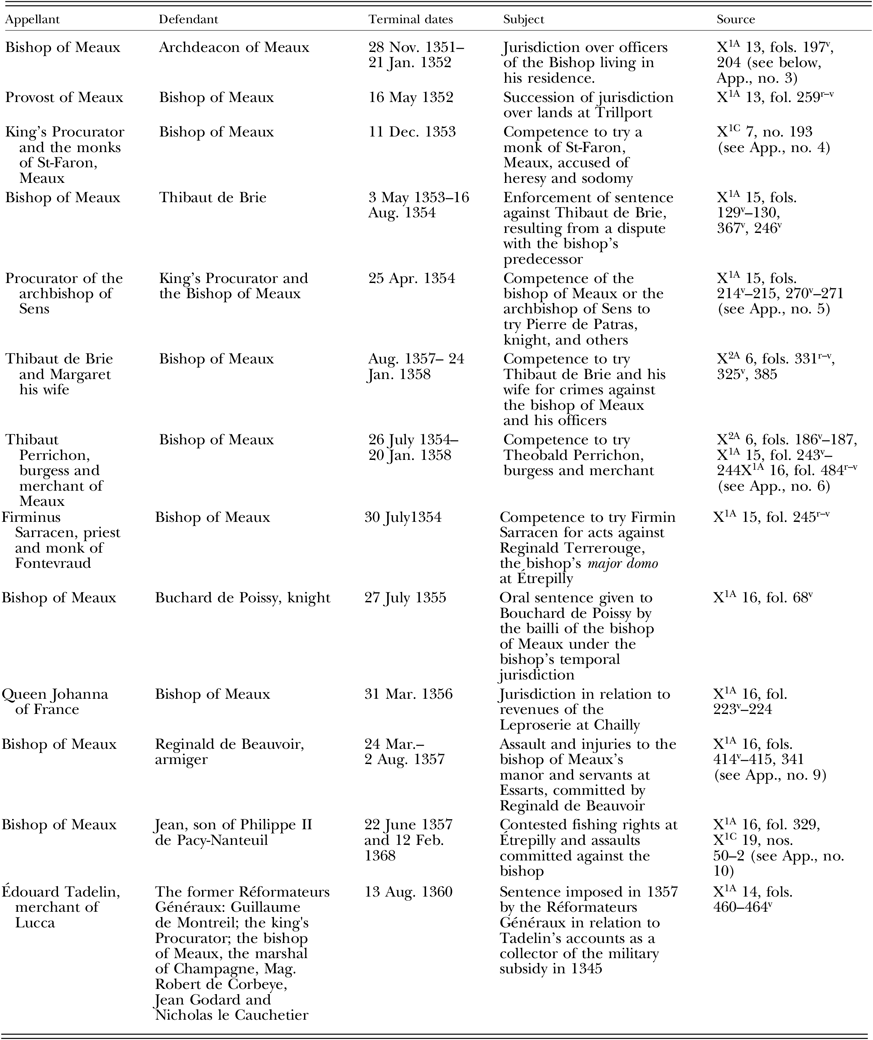
The suits in the Parlement of Paris brought by or involving Vitry number fourteen in all, two of which involved the court’s criminal side (see Table 1). What reached the Parlement was the tip of the iceberg, appealed or referred from subordinate jurisdictions: even before he was a bishop Vitry was heavily involved in cases before the Parlement, as his 1351 protection made clear, with direct experience in its processes as an officer of the court from 1340 and previously.Footnote 15 Most cases originated in the bishop’s spiritual court, whose own registers appear to have been destroyed in 1358;Footnote 16 some were extracted via the Châtelet in Paris, especially where Parisian residents who had fallen into Vitry’s net appealed. The litigants include ecclesiastical officials, but also two bourgeois of Meaux, two armigers, two knights, a noble, and Queen Joanna (via her local officials). The majority of cases were resolved quickly, or at least did not return to the Parlement; there were repeat offenders, and some other cases were probably linked. Mostly these cases involved conflicts of spiritual and secular jurisdiction; some arose from Vitry’s habit of imprisoning offenders (in the hope of a fine) before their clerical status had been determined by a secular court.Footnote 17 Many name Vitry’s officials or instructed legal counsel, or other Paris lawyers appointed by the Parlement to arbitrate. In some instances Vitry clearly attended the court in Paris in person.Footnote 18 The original offences were, unsurprisingly, the standard fare of feudal mayhem – assault, murder, robbery, crimes against property – alongside slanders, heresy and sodomy.
Suits in the Parlement of Paris involving Philippe de Vitry, Bishop of Meaux

The perspective these cases offer on Vitry’s work in Meaux is clearly partial. But they do paint a picture of continual challenge to rights and privileges, and of a substantial estate under constant pressure from local villains. Vitry’s farms, river fisheries and estate officials were attacked, sometimes by the followers of prominent local knights and in one case in 1357 by a noble, Philippe II de Pacy-Nanteuil.Footnote 19 In another case one of Vitry’s clerks, Jaquin Clisse, was abused and beaten by a knight, Pierre de Patras, and his sidekick.Footnote 20 Vitry’s interactions with ecclesiastical parties were more often to do with jurisdiction. At the end of 1351, he settled out of court in a case against the archdeacon of Meaux who, perhaps unwisely, had claimed jurisdiction over officials living in the bishop’s household. Other records reveal conflict with the cathedral chapter over local rights, and with the Abbey of St-Faron in particular. But Vitry’s major domo at his manor at Étrepilly was assaulted by a monk of the Abbey of Fontaines, Firmin Sarracen, whom Vitry promptly imprisoned, as indeed he did most of the perpetrators in these cases, often for long periods.Footnote 21 At the same time, the proximity of Meaux to Paris, and the links there of a number of his prisoners, brought Paris and the jurisdiction of the Châtelet firmly onto Vitry’s radar: one of his prisoners, Guillaume Farcoq, suspected of a murder in Paris was released on the testimony of the deceased’s relatives, who swore not to pursue the accused themselves; Farcoq, seeking a final royal pardon for this incident in 1370, claimed that he had been held without charge in the bishop’s prison for twenty-two weeks in irons, followed by twenty-eight weeks under house-arrest in the bishop’s Hôtel, after which Vitry released him out of pity and compassion.Footnote 22 A couple, Thibaut de Brie and his wife, twice imprisoned by Vitry for robbery and various other crimes (and whose goods Vitry seized), eventually secured a hearing in Paris and were bailed to an address in the Rue Neuve St-Merri.Footnote 23 In one case, in 1357, which resulted in an enormous fine, Vitry and his entourage are described as being in the king’s special protection, and this is the one account that describes the crime committed in detail.Footnote 24 In this case Reginald de Beauvoir, a local armiger, broke into Vitry’s manor at Essarts, beat the wife of the bishop’s farmer there with a naked sword while she was in the house making butter for the bishop, leaving her for dead, and kicked the butter onto the floor. Subsequently imprisoned, he cut his ties with the sword, put the cow in the bishop’s prison, and threatened the farmer with a large armed gang and the destruction of his property if he complained.
Vitry’s legal entanglements are of course not the whole story of his work at Meaux, but they do interact with his known activities there in this period. He was instrumental in 1356 in the establishment of the hospital founded by Jean Rose, a wealthy Meaux bourgeois and grain merchant, who was a supporter of the crown despite the leanings of his Paris confrères and whose monument, made for the chapel of the Holy Spirit in Meaux Cathedral, still survives.Footnote 25 In October of the same year Vitry merged two chapelries, at Montgodefroy and Vinirel, and in 26 February 1353 reached an agreement with the Cathedral Chapter on the rights of presentation to the church of Armentières.Footnote 26 He also put in place arrangements for his own remembrance, securing licences to make a will in June 1352 and to acquire lands to support a foundation in 1354.Footnote 27 The Cathedral obituary records the distribution of 100s. for every 100 l.t. received from his endowment, his bequest of a missal and a breviary, sold for 7 l.t. to buy a house, and the support of three chaplains. In 1353, probably with Vitry’s encouragement, Innocent VI established the office of théologale, i.e. a canon charged with teaching theology, in the Cathedral at Meaux. Alongside these activities ran an administrative routine that included placing his own servants in minor benefices, acting as an executor for papal mandates, and paying clerical taxes – two surviving accounts for which illustrate the ease and facility of his and his officials’ engagements with agents and money-changers in Paris.Footnote 28 Vitry was also ex officio as bishop of Meaux a governor of the College de Navarre in Paris, which, as Nathalie Gorochov shows, is his only known contact with the College.Footnote 29
As a new bishop it is unsurprising to find Vitry dealing with business left unfinished by his predecessor, Jehan de Meulant, and indeed his 1351 protection noted that not all of his ‘plures causas pendentis in Parlamento’ originated from his own episcopacy. His first two recorded cases were settled out of court, and referral to the Parlement may simply have been a device to coerce settlement. But a case against the prévôt of Meaux in May 1352, concerning rights (and presumably revenues) at Trilport, near Meaux, held by the king by virtue of the County of Champagne, also had a wider resonance in the question of royal/comital influence.Footnote 30 In late 1351 Vitry brought to conclusion a more substantial inherited case, resolving a dispute between the monks of St-Faron and the bishopric that had been in stalemate for a generation, likewise with a wider local dimension. The agreement known as the ‘Philippine’, Vitry’s most cited act as bishop, ceded to the abbot part of the jurisdiction over the monks of the abbey and its nine dependent priories in the diocese, retaining civil jurisdiction for the bishop, and cases of heresy and simony.Footnote 31 After this initial period the overriding impression is that the cases Vitry brought to the Parlement more usually had implications well beyond the confines of Meaux, and moreover that their frequency rose in tandem with his own access, influence and prominence at court. To an extent this is to be expected: the risk of failure close to the seat of power probably tempered Vitry’s enthusiasm for local action when his influence at court was weaker, and the converse was also true. But alongside cases of local origin there are other engagements with the Parlement that illuminate Vitry’s wider, national role and consequently leverage. It is to these that we now turn.
POLITICS AND NATIONAL GOVERNMENT
Vitry’s position in French royal government was not prominent at the outset of Jean’s reign. Though doubtless he retained his links with the chancery and judiciary, reflecting his own legal career in the royal household, he shared neither the high birth of the bishops brought in at the outset of Jean’s reign nor their active history in the major offices of state. But he clearly was connected with this group, as a bishop and thus as member of the clerical estates, and through those he had known in earlier roles. Thus, for example, in nominating a panel of senior ecclesiastics to hear appeals against him, he enlisted the support of the bishop of Chartres, Louis de Vaucemain, with whom he served as a maître des requestes in the 1340s; similarly, Denis le Grand, bishop of Senlis – the Dyonisius Magnus of the motet Apollinis eclipsatur, previously Philippe VI’s premier chapelain, and a composer – acted as an executor for the grant of a clerical tenth that he received in April 1351.Footnote 32 Vitry and le Grand were also nominated, with the abbot of St-Magloire, Paris, by the abbot of St-Denis to his appeal panel in February 1351.Footnote 33 His political access, however, saw a step-change with the appointment to Jean II’s government of Cardinal Guy de Boulogne in November 1352, who for the next two years played a central role in the Conseil of Jean II, and who, alongside Pierre, duke of Bourbon, led negotiations with the English.Footnote 34 Vitry was part of the Cardinal’s circle by 1344 at the latest – their relationship was noted by Petrarch – and Guy’s appointment renewed their proximity at the French court. This change to the government strengthened Vitry’s links to the senior clergy around Jean II. It built his access to state institutions, his prominence at court and local leverage. And because his main non-royal patrons, the two royal uncles Guy de Boulogne and Pierre, duke of Bourbon, were now conjoined in the peace project, it also potentially created opportunity to bring his skills to bear in the negotiations between France, Avignon and England (and Navarre).
A striking demonstration of the political traction that Vitry acquired in this period, reflective perhaps of the influence of the two royal uncles, emerges from the ‘grave complaint’ that he made in 1354 against Jean d’Oignon, a Champenoise armiger, for defamation.Footnote 35 This case was doubtless local in origin but, probably with encouragement, Vitry made its resolution explicitly a matter of state, formally published by royal letters. D’Oignon’s offence had been to question Vitry’s fitness for spiritual authority, alleging inter alia that he had committed a murder and had been married. He had given these allegations wide currency among other bishops, nobles and members of the king’s Conseil, and ‘apud vulgum in urbibus et opidis ac locis quamplurimis’. He had done this falsely to denigrate Vitry, his honourable title and good reputation. In the narrative of the royal letters, Vitry asked the king to compel d’Oignon to make amends, noting that in the matters under dispute, since they touched his spiritual authority, he was under the jurisdiction of the pope alone. Guy de Boulogne and the duke of Bourbon were commissioned to hear and resolve the case, which they did by staging a showcase apology by d’Oignon before the Parlement, in the presence of the king and almost the entire Conseil: those present included the archbishops of Rouen and Sens, the bishops of Châlons and Laon, the abbots of Cluny and Ferrières, the Chancellor, Guillaume Flote, the Constable, Gautier de Chatillon, the Presidents of the Parlement, other members of the Conseil, and many others. The Chamberlain, Robert de Lorris, took d’Oignon by the hand and read on his behalf an apology to the king’s uncles, which the royal letters repeated verbatim. In this narrative d’Oignon is made to recognise his crimes against Vitry, stating that the words were untrue and uttered ‘caloris motu’ and that he held Vitry to be a good and true person, and to ask for his pardon. The royal uncles asked d’Oignon for his affirmation of what had been said; d’Oignon knelt on the ground with his head uncovered, handing the front part of his hood to Vitry by way of apology, which he accepted, and the Parlement left d’Oignon’s fine to the disposition and reason of the two royal uncles. To repair any remaining reputational damage the king’s letters were given wide circulation and copied in the register of the royal chancery.
By any standards this event, at which the king and most of the government turned out for the ritualised humiliation of an errant knight, was an epic display. Reputationally and politically, the knight was probably ruined. Vitry may or may not have been the winner to the extent that the narrative would suggest; the cardinal’s influence was already in the wane, since he was known to be returning to Avignon, and Vitry may have been seizing an opportunity. Nor was this Vitry’s last encounter with d’Oignon, who was also a co-litigant with Philippe de Pacy-Nanteuil in 1357 relating to fishing rights at Étrepilly.Footnote 36 But the political capital deployed by Vitry was considerable: the outcome of this case demonstrates not only that he held the king’s favour but also that he could corral broad support across the most senior ecclesiastical tier of the Conseil, named in the official narrative, and beyond this in the court at large. Whether born of panic or of opportunism, the paramount need to squash local unrest and protect royal interests locally by supporting Vitry was met.
Vitry’s legal activity declined sharply in volume after the Cardinal’s departure and the resurgence of secular power in government, with only two cases reaching the Parlement in the following two years, as did his visibility at court. A visit to Avignon in February 1356 may in part account for this.Footnote 37 Striking though the events of 1354 were, however, the apogee of Philippe de Vitry’s political prominence falls later in the decade in the wake of the disaster at Poitiers, in September 1356, where Jean II was captured by the Black Prince and began a four-year period of captivity in England. This event dominates the politics of the late 1350s, sparking leadership and financial crises and successive waves of regime change in government and two major attempts (in addition to those of Edward III) to end the Valois monarchy in France.Footnote 38 The immediate aftermath brought confusion, and for Vitry a double vacuum, with his own metropolitan, the archbishop of Sens, now captive, and most of his reference points in government gone, most critically the duke of Bourbon, who was killed in the battle as was the bishop of Châlons, the president of the Chambre des Comptes. Initially Jean continued to rule in name from Bordeaux, but within a month a new set of relationships formed around Charles, Jean’s eldest son, as regent. A meeting of the États in Paris in late October saw a resurgence of the power enjoyed by this group in 1355, with demands for the destitution of principal royal officials, and rule by a Conseil of twenty-eight chosen by the États. Refusing these demands, Charles re-formed his Conseil in November, including representatives from the États, the heads of offices of state who had taken power in 1354, and those supportive of his bid to seek help from the emperor, Charles IV de Luxembourg, with whom he now set in motion plans to meet in Metz.Footnote 39 This took place between 10 December and 14 January against a background of opposition from the south, and an initial bid for power from Étienne Marcel, but was ultimately inconclusive. A climb-down by Charles ensued and on 20 January 1357, he accepted direct nomination by the États to a certain number of places in his Conseil, and the complete dismantling of the system of government operated by Jean II for the preceding six years. Philippe de Vitry was one of nine thus appointed by the États of March 1357 as Réformateurs Généraux, charged with a purge of the old regime.
The disruption and regime change following Poitiers created new factions and enmities that arguably set the scene for the well-known raid at Vitry’s residence in Paris in December 1356 and may position it as an attempt to eliminate him from political life. The narrative in the French royal letters issued on 23 January 1356, after Charles’s return from Metz, shows him intervening to rescue Vitry from his enemies, and provides a clear picture of Vitry’s immediate circle and domestic circumstances.Footnote 40 One evening, Vitry was dining in his house, by the walls of Paris, with Oudard Levrier and Hugh de Roche, both maîtres in the Chambre des Comptes. Two sergeants of the Châtelet, with sergeants of the prior of St-Éloi, came to the house armed with swords drawn, looking for Guillaume Gentilhomme, clerk and familiar of the bishop, who was alleged to have committed a violent act against a woman. Henri, Jean and Philippe de Brixina – Germans who did not speak or understand French – and Jean Danduisse, a servant from the Auvergne, thought that the officers wished to harm Vitry and his clerk, and went to their defence. The bishop, hearing the tumult, came out of his room to see what the matter was; he spoke to the visitors, who put away their weapons and drank some of his wine, and calmed his servants; the visitors left voluntarily and without noise, freeing Gentilhomme, about whom they accepted the bishop’s assertions of good faith. However, a few days later, on the basis of a secret testimony relating to the first incident, the Procureur Général and about twenty men from the Châtelet broke into the bishop’s house with weapons drawn, attacked his servants, and wounded ‘a man of the bishop’s sister’ in two places, laying bloodied hands on the bishop. Vitry’s servants were taken to the Châtelet, as though guilty of murder, in broad daylight and to the great scandal of the bishop, whose temporalities were seized by the Procureur’s commissioners. Vitry was forced to put up the whole of his temporalities as bail, despite which the Procureur refused to consider releasing his servants before the Friday after the first Sunday of Lent (11 March). The matter was resolved only when Charles returned to Paris and re-established a relationship with the États on 20 January, in a climb-down necessary to his own survival. Vitry’s pardon was issued on 22 January, citing his long and daily service to the crown and Charles’s certain knowledge of his work, and was published by royal letter on the following day.
This episode was described by Coville and also by Charles Samaran, who linked it, in his 1961 study of Bersuire, to either the heightened tension in Paris in December 1356 or some event preceding his tenure as prior of St-Éloi, presuming that it did not challenge his friendship with Vitry. One reading of the case is that after an initial misunderstanding, on the face of it amicably resolved, a ‘secret statement’ was produced as the pretext for a full-scale attack on Vitry, conducted at a point of critical political weakness for Charles and while he was far from Paris.Footnote 41 With Charles back in Paris and in dialogue with the États, whatever opportunity the Procureur Général, Jean de Charny, a strong adherent of Étienne Marcel, spied to ruin Vitry evaporated. What also emerges from this episode is a snapshot of Vitry’s network and of relationships reflective of earlier phases of his career. Alongside family members – his sister’s husband or servant – were his own servants from the Auvergne, the centre of Bourbon power and identity, who were ignorant of ‘oeil’ but probably familiar with ‘oc’, and three men ‘de Brixina’ who spoke no French at all. It is hard to see that non-French speakers were anything but dependent on the bishop’s household; possibly their presence arose from Vitry’s links at Avignon. Within weeks of this fracas, on 28 February, Vitry secured a papal grant for one of these men, Philippe Henri alias scriptoris de Brixina, probably his scribe.Footnote 42 The presence at dinner of two maîtres of the Chambre des Comptes, politically influential in their own right, reflects Vitry’s ongoing relationship with this office of government and perhaps a role in the wider political discussion.Footnote 43 Their political leanings, pro-royal and anti-États and Étienne Marcel, may point to Vitry’s own orientation in the complexity of late 1356 – if indeed they were talking politics – just as de la Roche’s responsibility soon after for ‘Subsides et Trésor’ in the Chambre des Comptes may reflect the subject matter of their meeting. Either way, their discovery at dinner by the sergeants of the Procureur was not propitious, and suspicion of Vitry arguably was responsible for precipitating an attack that only Charles’s return to Paris could stop.
Vitry’s appointment as one of nine Réformateurs Généraux in March 1357 was his most prominent position to date, in the midst of the purge driven by the États.Footnote 44 In a group of three clerics, alongside three nobles and three bourgeois, Vitry was for Raymond Cazelles a surprise choice, on grounds of age, apparent neutrality and his wider reputation as a poet and musician. He may have been a compromise candidate, an acceptable element of royal influence, among several hardliners later purged by Charles, including Robert le Coq, bishop of Laon. In the event, this was a short-term appointment: after a vigorous start, sitting in Paris, their efforts were undermined by the schism between the French King in captivity and the new government in Paris from May 1357, and finally vitiated by the regime’s failure to collect taxation, which came to a head at the meeting of the États on 22 July. The Dauphin then reasserted power, at least temporarily, dismantling the apparatus put in place in March. Later criticized for their excessive vigour, the Réformateurs were relieved of their commission in early August and to some extent abandoned to the mercies of their opponents.
In early May, the Réformateurs can be found directly commissioning informers, but largely the detail of their work emerges from later appeals and royal confirmations of the settlements they reached with those who came before them.Footnote 45 Thus letters of absolution given to Renaud Bernart, collector of the subsidy at St-Quentin, on 27 June 1357, including a fine of 400 deniers d’or, were confirmed in September 1357, and by 30 June the Dauphin had pardoned Nicholas Mirescot, ‘sergent a cheval’ at the Chatellet in Paris, half of a fine of 100 ecus d’or. Similar letters were given to Bonjean de Sissone, receiver of Vermandois, for a fine of 1000 moutons d’or, in August.Footnote 46 As to Vitry’s own role as Réformateur, he struck within a fortnight of appointment in March 1357 against Jean d’Oignon, the slanderer of 1354, recovering long-disputed land rights at Charny and Trilport near Meaux.Footnote 47 A similar sentence, raking up an old case, was handed down to Édouard Tadelin, a merchant from Lucca who had served as collector of the subsidy in 1345, from which emerge some details of Vitry’s work as Réformateur when the sentence was appealed in 1360.Footnote 48 Tadelin was originally accused of failing to pay the subsidy in full, and his case had already been settled three times, twice with the involvement of the Chambre des Comptes, in the late 1340s, 1350 and 1352. His appeal accused the Réformateurs of failing to follow due process and of reaching irrational judgements. As he claimed, his case had been heard by two of the Réformateurs only, who concocted a result and rushed it to Vitry at his house in Paris, late at night on the eve of Pentecost 1357, to secure agreement. Vitry was absent from the hearing, and his role in the suit appears passive (whether owing to pressure of business or to prior links with the Chambre des Comptes).Footnote 49 In the event, Tadelin was able to show that his accounts had been maliciously adjusted to make it appear that the debt was still outstanding. He was exonerated and appointed as Maître des Monnaies and the Réformateurs were censured. By this time, however, it is not clear that Vitry suffered much damage.
Vitry’s profile declined sharply after the Réformateurs Généraux were decommissioned in August 1357, an event coinciding with the rupture in relations between Charles and the city of Paris.Footnote 50 He may have been siding with the royal interest, or as Coville intimated he may have nursed other political sympathies.Footnote 51 A few acts from August and September tidying up (and mainly reversing) the work of the Réformateurs mention Vitry; an enquiry was started into one of Vitry’s cases, and some local cases in Meaux were quickly brought to resolution. An accord of 1368, finally settling his dispute with the heirs of Jean de Pacy-Nanteuil, makes clear that he had unsettled business in the Parlement at his death in 1361.Footnote 52 Politically, however, Vitry is strikingly absent until 1360. He is nowhere in the rebellion of Étienne Marcel and the Jacquerie that enveloped Paris and culminated in the siege of Meaux market in 1358, save for imprisoning an over-enthusiastic purveyor for the Marshall’s lieutenant the following winter. He is absent also from succeeding acts of pacification in Meaux, where the Cathedral chapter was the dominant ecclesiastical voice, perhaps because Vitry was part of Charles’s wider affinity and clearly not a dissenting party.Footnote 53 In March 1359, Charles issued a letter of safeguard to Vitry, his officials, household, lands and judicial powers, which may mark a more public expression of favour or respond to the possibility of attack.Footnote 54 Payments to the apostolic camera in respect of his see apparently stopped in 1356. Only in February 1361 were his temporalities fully restored, in letters of protection granted by Jean II that also brought gains at the expense of the Meaux Cathedral chapter.Footnote 55
A question thus remains: where was Vitry in this period and what was he doing? He may have been unwell, or simply out of favour: the 1359 protection could be read as a rehabilitation, but it may equally have been a routine act of stabilisation as Charles normalised relations across his wider following and beyond. Given that it now appears that Vitry did not join the Grande Conseil in 1361, as Cazelles thought, the case for a dramatic rehabilitation on Jean’s return in late 1360 weakens.Footnote 56 In the immediate period following his removal as a Réformateur in 1357 Vitry may have been inclined to avoid both Meaux and Paris. But his last years did not witness a slow fade-out, as can be inferred from the continued royal support from which he benefitted up to 1361. What is now clear, however, is that in August 1360 he was at Avignon, when he was issued with wood, grain and wine by the papal chamberlain.Footnote 57 The purpose of this visit is not recorded. Yet with Anglo–French negotiations on the implementation of the Treaty of Brétigny in full swing at Calais during that month – a process in which Innocent VI had a stake, and which was delayed so that two papal nuncii could attend – it is quite possible that Vitry was in Avignon to represent the French king’s position and interests.Footnote 58 The papal nuncii in 1360 included Androuin, abbot of Cluny, whom Jean II placed at the heart of his government the following year,Footnote 59 and Vitry’s presence in Avignon may signal a direct engagement with the re-establishment of royal administration on Jean’s return to France. He may also have had contact (though this is so far speculation) with the circle of Jean II while the king was captive in England. Furthermore, Vitry’s visit to Avignon coincided with the presence there of Cardinal Guy de Boulogne, who was issued with supplies by the papal chamberlain on numerous occasions between June and October that year.Footnote 60 It is significant perhaps that the cardinal was also present onevery occasion from 1350 onwards when Vitry is recorded in Avignon.Footnote 61 Vitry’s presence in August 1360 may thus bespeak a continued engagement at the end of his life not only with the politics of the French state and its involvements with the papacy, but also with the other networks and spheres of activity that he inhabited.
RELATIONSHIPS IN PARIS
The picture that emerges of Vitry in his last decade is of a bishop with a role in the outer circles of national government, a moderate aligned to the king and dauphin and with no visible sympathies for either the Navarrese party at court or the adherents of Étienne Marcel, unlike many in a royal government that was full of opposition. His fortunes at court followed those of his patrons until the crisis of 1356–7, where he found, briefly, a much more prominent role. But there is more to say about his relationships in Paris during this period, and about their interplay with his career and, perhaps, his output.
Vitry’s Residence
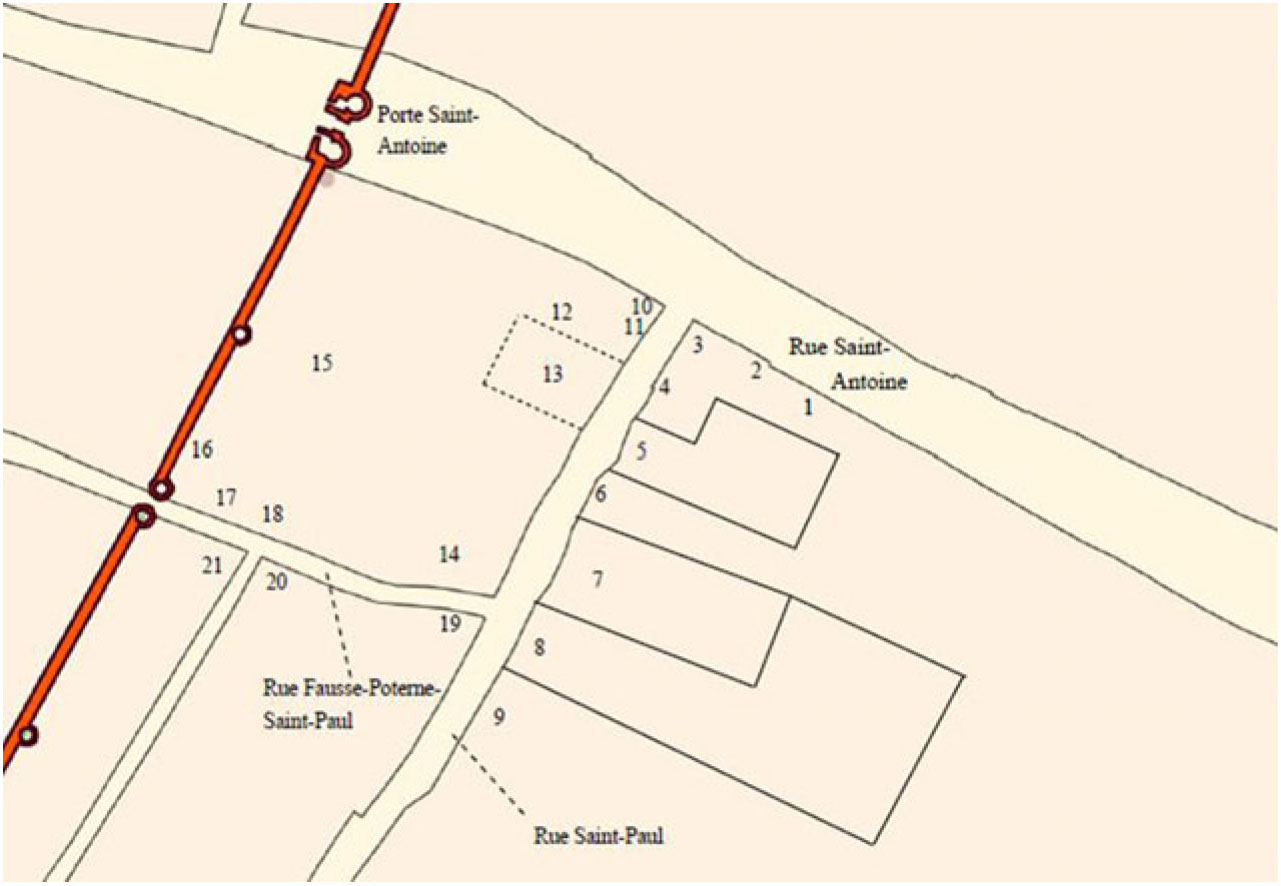
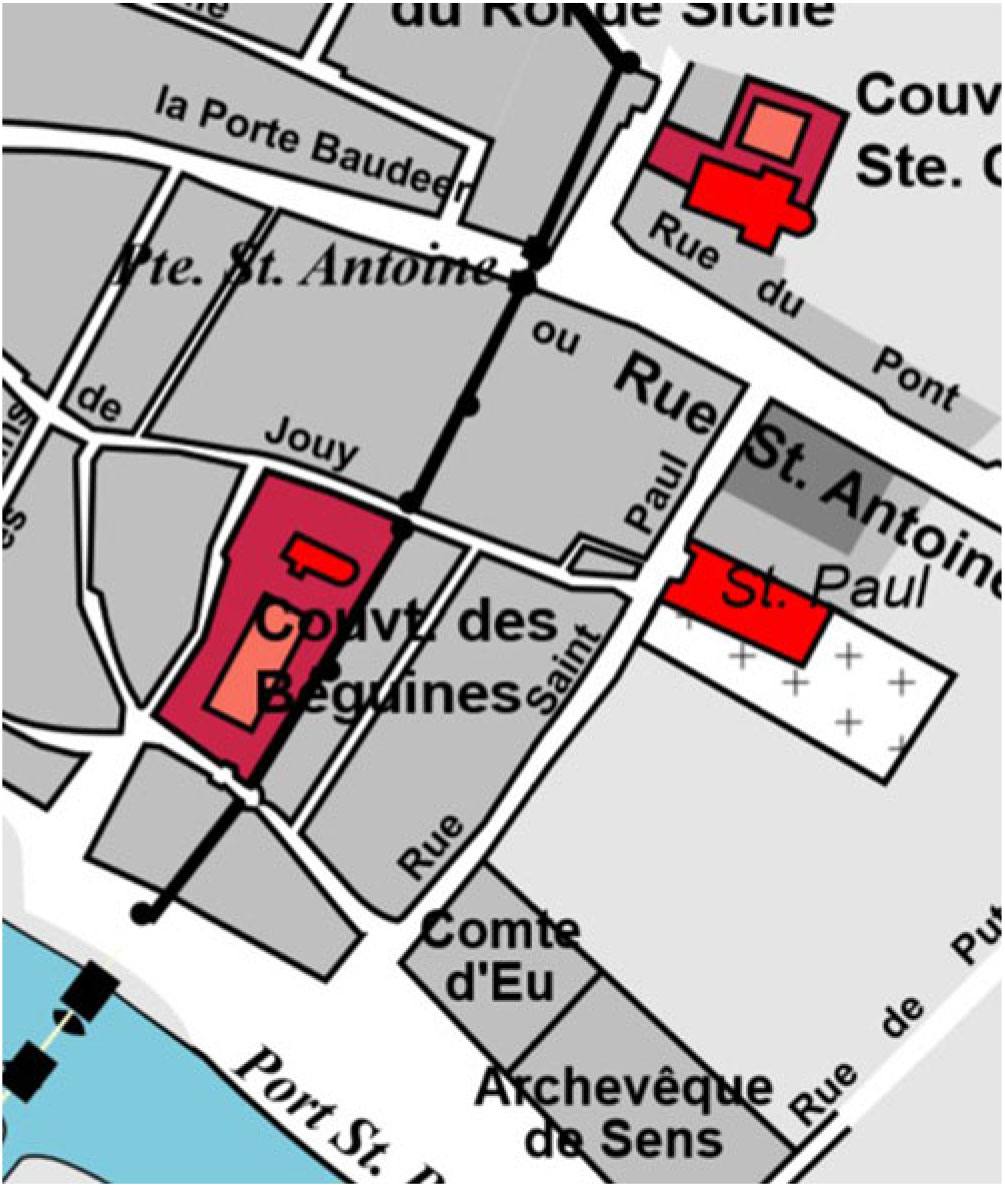
The royal letter narrating the episode of December 1356 makes clear that Vitry had a house, almost certainly the official episcopal residence, ‘prope muros Parisienses’. The accounts of the Prévoté of Paris of 1420 printed by Sauval in 1723 locate the residence of the bishop of Meaux opposite the parish church of St-Paul-des-Champs, in the rue St-Paul. The exhaustive geolocalisation of Paris by the Alpage project shows that this residence was located in the rue St-Paul by 1297, in the censive of St-Éloi, a large sprawling area to the east and north-east of the city wall of Philippe Auguste, some distance from the Priory of St-Éloi on the Île de la Cité.Footnote 62 This picture can now be further elaborated. The terrier of St-Éloi, now Archives Nationales LL 75, confirms the location by the end of the thirteenth century of the bishop’s residence in the northern part of the rue St-Paul, opposite the grange of St-Éloi that stood next to the church of St-Pol. This residence had previously been occupied by the abbot of St-Maur, and to its rear the bishop of Meaux owned an extensive garden emerging into the rue St-Paul immediately after the corner of the street, and extending southwards to the houses on the rue de la Fausse Poterne (now rue Charlemagne); he also owned a house ‘au bout de la rue’, possibly that of the concierge listed in the tailles of 1298–1300 which in 1407 was leased to a Paris bourgeois and merchant, Jean le Pastre (see Figure 1, and for the immediate environs Figure 2).Footnote 63
The location of the bishop of Meaux’s residence in the rue St-Paul (see p. 25 for the key)
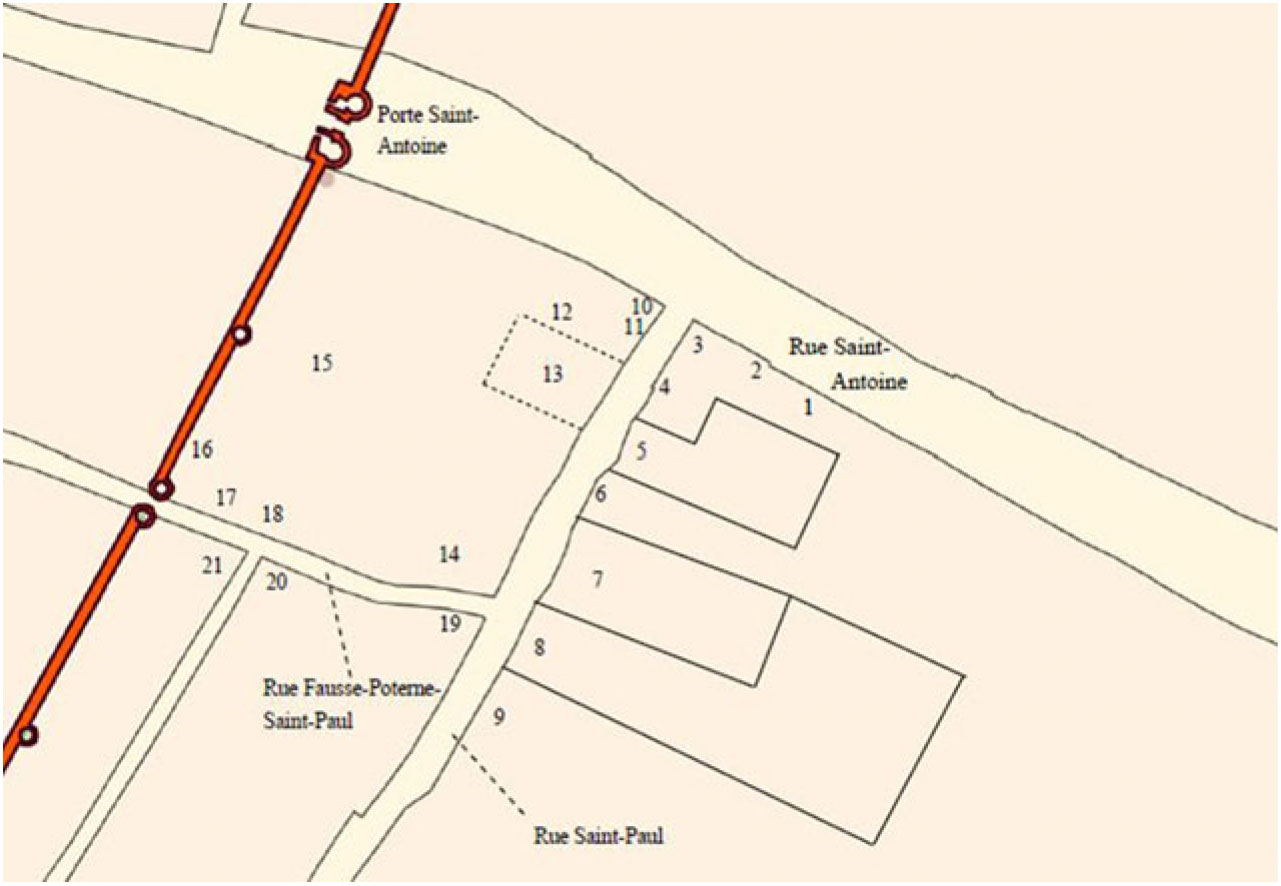
Sources and key to Figure 1
AN, LL75, copied in 1392, contains four partial censiers from 1280, 1300, 1301 and 1319, which when overlaid give a relatively complete picture of the censive of St-Éloi. Each censier includes up to eight iterations, covering fundi terre and augmentati census for up to four terms each (St Remi, Christmas, Easter, and St John/St Paul). The reconstructed sequence of properties in the censive is not a complete listing of the properties in the street, but some gaps can be filled in from the livres de la taille in AN, KK 283 and BN MS fr. 6736.
For the Hotel and garden of the bishop of Meaux, all rents were due at the end of June (described as St Paul term or St Jean term). This term is omitted from the censives for 1300 and 1319, and these payments appear only in 1280 and 1301. In addition, a reference to the garden of the bishop of Meaux, behind the house of Pierre and Nicholas de Cunes, appears in the description of property held by the prior.
Fundi terre for this part of the Rue St-Paul appear in LL 75, fols. 10v, 13, 13v, and 24v (1280) and fols. 53, 71 (1300 and 1301); for augmentati census, see LL 75, fols. 31v–32r, 34r, 37, 39r–v (1280), and fols. 58v–59, 76, 78v–79, 80v–81 (1300 and 1301).
Rue St-Antoine
1 A house ‘a mein destre’ of ‘le coignon qui joint a la granche Saint Eloy’, occupied by Guillaume Gaillart (before1280) and Nicholas Bongredieu (1280–1301)
2 Five ‘camere’
Rue St-Paul, east side
3 The ‘domus a la Bardelle que facit cuneum in vico sancti Pauli’
4 Four ‘camere’, facing the Hotel of the bishop of Meaux
5 Grange Saint-Éloi
6 House of prior of St-Éloi?
7 Église St-Paul
8 House of the priest of St-Paul in 1300
9 Hotel of the Count of Auge
Rue St-Paul, west side
10 House of Michel Peu de Cerf in 1280, and of Robert his son in 1301; house of Harchier Puel de Cerf in 1296
11 House of Margaret Sergier in 1280; heirs of Gandulph Lombari in 1301
12 Bush/shrubbery behind small houses
13 Hotel of bishop of Meaux
14 House of Henricus Alemannicus in 1280; Grange of the Domus Dei of St-Gervais in 1301
15 Garden of bishop of Meaux
Rue Fausse-Poterne-St-Paul
16 House of Jean de Quinzemars, next to the Fausse Poterne St-Pol, the bishop of Meaux’s garden at the back
17 House of Marie de Henaud, and the house of the wife of Godefroy Lescuveeur de la Poterne
18 House of Pierre and Nicholas de Cunes
19 Garden of priest of St-Paul in 1280; two new houses in 1301
20 House of priest of St-Paul in 1280; of a knight 1300
21 Four ‘camere’ of Nicholas d’Auxerre
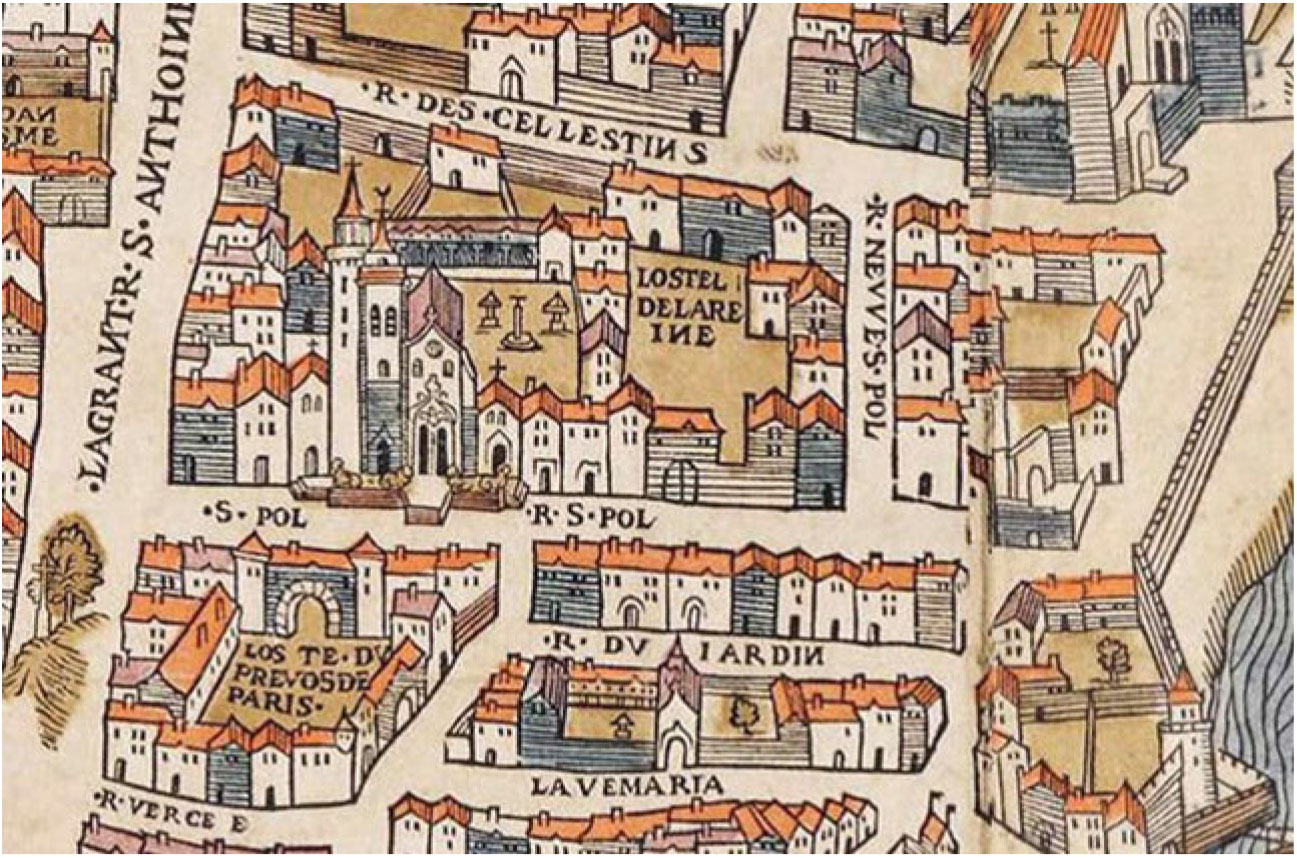
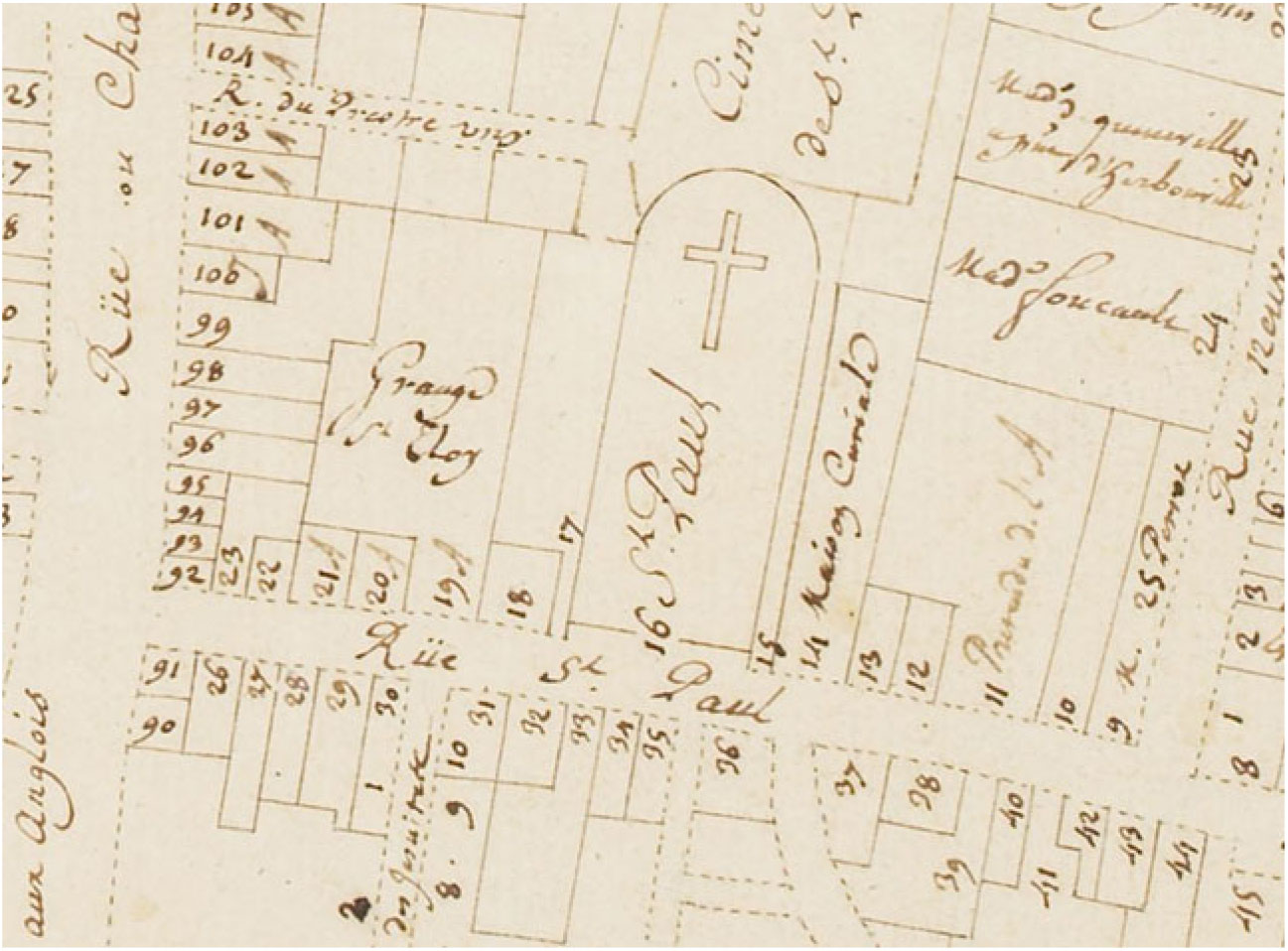
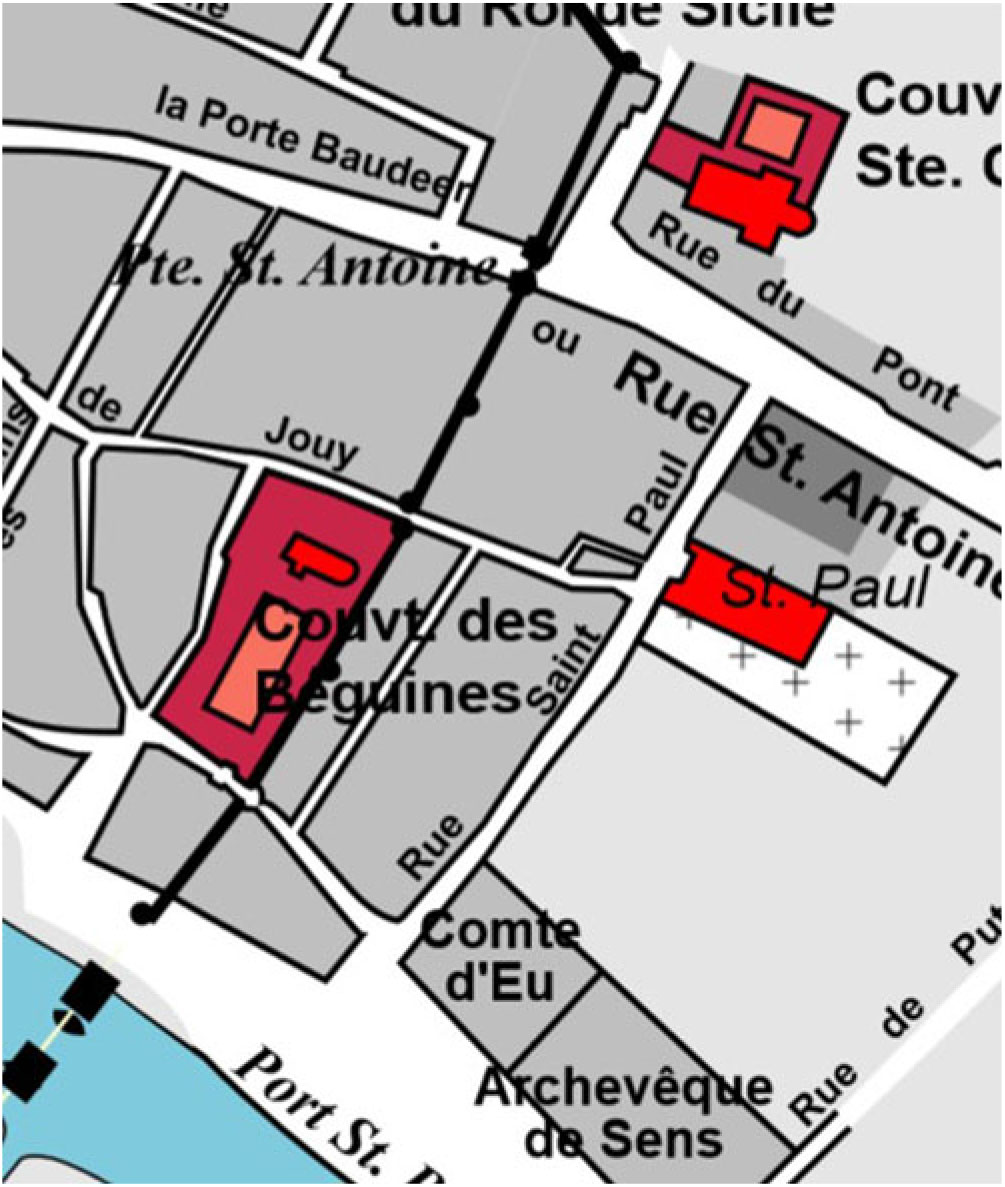
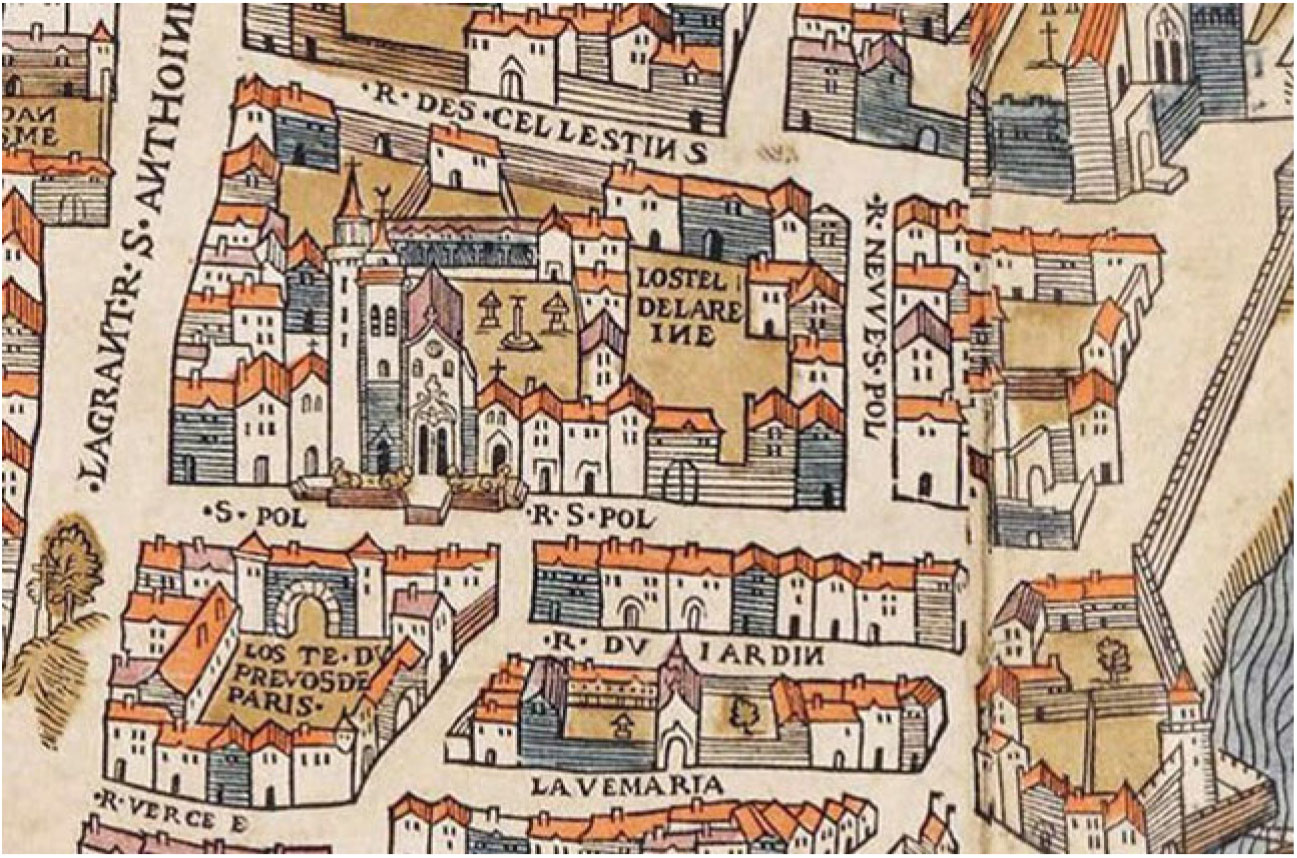
Although the bishops of Meaux had other properties in Paris, and may have moved out during renovations to the Hôtel de Montmorency in 1410,Footnote 64 this Hôtel was still their principal residence in 1450 and perhaps into the late fifteenth century. The bishop’s hotel was demolished in the early sixteenth century but the structure of ecclesiastical property in the street was still recognisable in the early eighteenth century (see Figures 3 and 4). In 1301 the Bishop’s Hôtel, or ‘magno domo’, was already substantial, attracting an annual cens of 7 l.p. (about twenty-eight times that of neighbouring houses), and this sum stood unchanged into the fifteenth century.Footnote 65 It sat in a neighbourhood relatively undeveloped before 1350, whose demography was characterised by stone-masons, carpenters and trades related to the river and by numerous houses owned by religious houses and confraternities. After the troubles of the mid-1350s, when the shortcomings for the king of a central Paris residence became evident, it was developed as the location for a new royal hotel, built by Charles between 1361 and 1365 as the Hôtel St-Pol. Thereafter the court and the apparatus of state moved in en masse. Vitry’s near neighbours included his metropolitan, the archbishop of Sens, and the priory of St-Catherine du Val-des-Écoliers, which, even before the court colonised the neighbourhood, was strongly linked to the royal household and the king’s sergeants in particular, and the Céléstins, in which the confraternity of royal notaries and secretaries was founded in 1352.Footnote 66 As a transaction in 1450 between the parishioners of St-Paul and the bishop of Meaux reveals, next to the parish church of St-Paul, and thus diagonally opposite the bishop of Meaux’s house on the other side of the street, was the ‘hostal’ of the prior of St-Éloi.Footnote 67 Given the longevity of the Priory’s interests in the parish, where it had other buildings including a gaol and a grange, this residence may well have been of long standing. It is therefore at least a candidate for the residence occupied by Pierre Bersuire as prior of St-Éloi after his translation to Paris in 1354.
The rue St-Paul and environs, c. 1300–30, showing the location of the church of St-Paul and the wall of Philippe II Auguste (completed 1209)
Rue St-Paul, c. 1550. Map of Paris by Truschet and Hoyau, c. 1550 (Basel, University Library, Kartenslg AA 124; https://commons.wikimedia.org/wiki/File:Map_of_Paris_by_Truschet_and_Hoyau_-_Basel_University_Library.jpg)
The rue St-Paul in the early eighteenth-century Terrier du Ville. AN, N/III/Seine/421/1
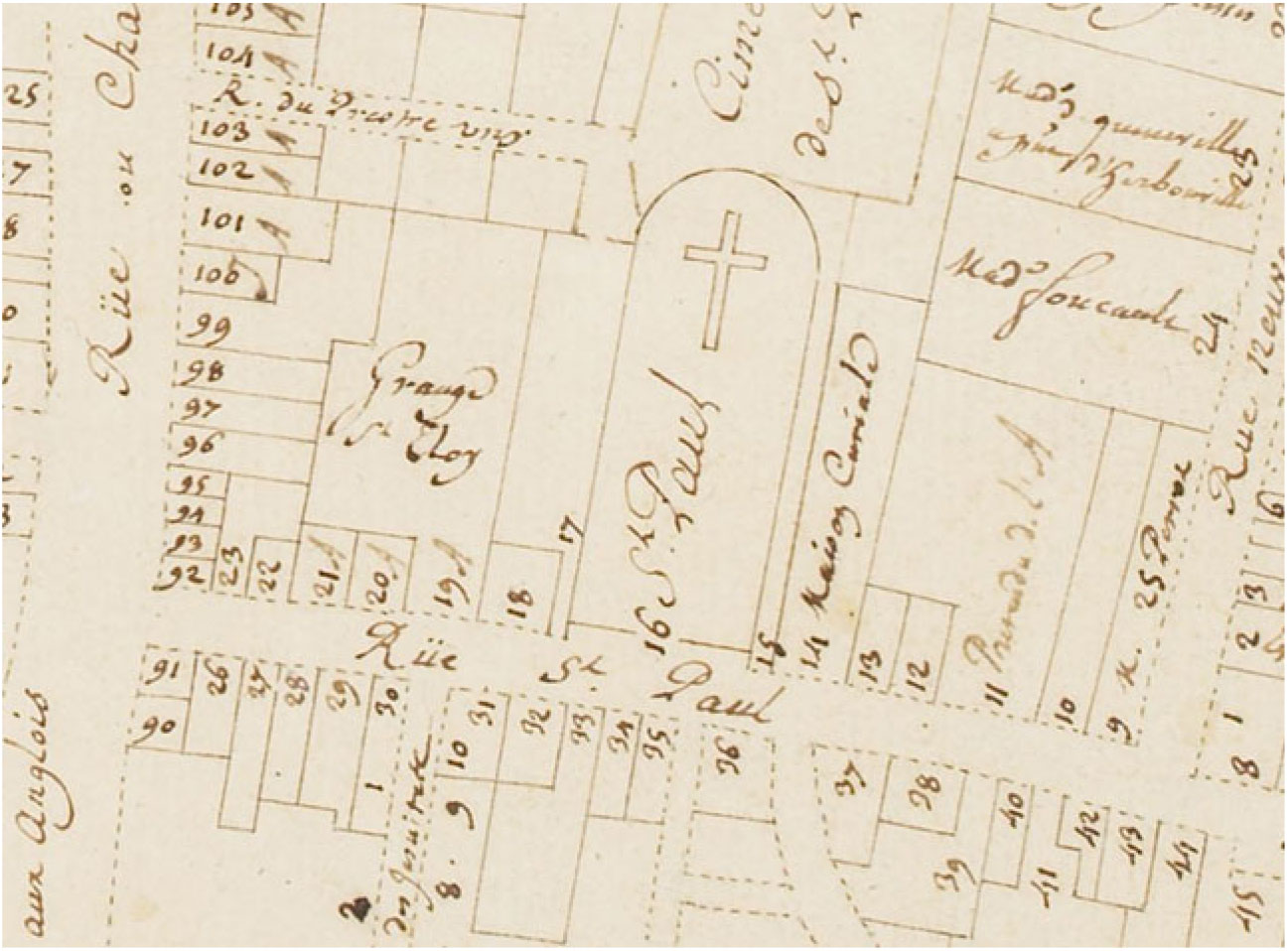
The physical proximity of Vitry’s and Bersuire’s residences could readily have facilitated the offer made by Vitry to Bersuire of an Ovide moralisé in French, which Bersuire recounts took place once he had returned to Paris.Footnote 68 It may also add to the picture of Bersuire’s role in the events of December 1356, when his sergeants accompanied the Châtelet police to Vitry’s house, and help to situate him politically as a concerned supporter. The judgement of Coville and Samaran that the sergeants’ presence was not antagonistic seems convincing:Footnote 69 it may be that they were present to inject restraint, or witnesses, into the first visit of the Procureur’s men, but either way the close proximity of Bersuire’s own residence would go some way towards explaining why they came to be there. It would perhaps also help substantiate Samaran’s presumption that Vitry was among those who, with Bersuire, entertained Petrarch when he visited Paris in early 1361 as the envoy of Galeazzo Visconti, lord of Milan. The centrepiece of the embassy was a dinner in the presence of Jean II and Charles, duke of Normandy, at which Petrarch had planned to deliver an address on Fortune: these plans were thwarted, however, when the king and duke brought the occasion to an abrupt end, whereupon the discussion of Fortune continued between Petrarch, Bersuire and three other unnamed masters for six hours at another location, presumed by Samaran to be Bersuire’s residence. Vitry may well have been among those present, as Samaran suggests. But even if he was not, a residence in the rue St-Paul, close to the new royal Hotel St-Pol and in the same street as Vitry’s residence, would have been a convenient location at which Bersuire could host this conversation. Coville speculated that in the late 1350s Bersuire found a location quieter than the Priory of St-Éloi on the Île, at the centre of the troubles, and this purpose would have been met by a residence in the rue St-Paul. In 1361, within weeks of Vitry’s death, Pierre Bersuire bought a house near the porte St-Victor in the south of the city in 1360, adjoining a house owned by his father or brother, perhaps to fund an obit (as eventually transpired), and where apparently he lived until his own death in 1362.Footnote 70
In the wider locality of the rue St-Paul, Vitry’s relationships with his other near neighbours are also potentially significant across the range of his activities. These neighbours included: religious houses linked with the royal household and University of Paris, the Céléstins and St-Catherine du Val-des-Écoliers in particular; the hôtels of other nobles, the Counts of Étampes and of Joigny (who was with Jean II in England), and those of senior ecclesiastics, the archbishop of Sens, the bishop of Evreux, and the abbot of St-Maur.Footnote 71 The censive of St-Éloi presents another overlay of relationships: it is hard to imagine that Vitry was ignorant of the Puy of St-Éloi, run annually on the Île by the Goldsmiths’ confraternity, whose annual plays form the musically-laden Miracles de Notre Dame.Footnote 72
Family and Networks
The legal episodes in which Vitry became involved as bishop to an extent mirror his earlier career and family relationships. His sister is known from the episode at his house. There were also brothers. Gilles li Muisit mentions the ‘frères’ of Vitry who ‘font choses belles et moult clères’, and as Edmond Pognon showed, it is clear that Vitry had real brothers, one of whom, Adam, wrote ‘Ad te Virgo mater’ in Bibliothèque nationale de France, MS Lat. 3343, and the verse ‘Six choses’ copied later into the 1338 Sorbonne library catalogue.Footnote 73 Adam’s career followed a similar initial path to that of Philippe (who was probably older): he first appears as a canon of St-Géry, Cambrai in 1332, acquiring other benefices at Cambrai shortly thereafter; in the late 1340s he made an exchange of benefices in the same diocese, and was presented to a canonry at Verdun on Philippe’s recommendation in September 1350, and to an expectative canonry at St Donatian, Bruges of which he had full possession by 1354.Footnote 74 His family name was Humbelin; he was granted dispensation for any defect of birth in 1350; he owned a copy of Odo of Meung’s De viribus herbarum which he lent to a canon of Troyes, who still had it when he died in 1368, the year after Adam’s death in 1367.Footnote 75 A Jacques Albriet was recorded as Vitry’s ‘consanguineus’, and Philippe helped him acquire a canonry at St Donatian in 1337, and petitioned to put his brother Adam into this role when Jacques died in 1350.Footnote 76 A number of other Vitrys appear not only in royal and noble service but more specifically working for Philippe’s own royal supporters. A Jacques de Vitry was a clerk of the dowager Duchess of Bourbon in 1342; a Pierre de Vitry who was maître of the Hôtel Dieu in Provins, in the diocese of Meaux, was exonerated by the Parlement in 1352 after falling into a dispute with the new royal almoner.Footnote 77 A Magister Jean de Vitry was a royal clerk by 1336 and until at least 1343 a clerk of Queen Jeanne de Bourgogne between 1347 and 1349, a notary in the service of her son, John Duke of Normandy, in 1349, and held canonries at Chartres (granted shortly after the arrival of Philippe de Vitry’s former colleague Louis de Vaucemain as bishop in 1349), Metz and subsequently Troyes.Footnote 78 In May 1347, John duke of Normandy granted ennoblement to a Nicholas Humbelin de Vitry and to his descendants (in relation to which Adam’s later papal dispensation may have been some form of precaution).Footnote 79
It is not yet possible to establish conclusively that these were all Vitry’s brothers. But a picture potentially emerges of Philippe as the most visible in a minor clerical/legal/civil servant dynasty which, in a familiar pattern, rose through service at court gathering both ennoblement and individual advancement. What is clear, though, is that high-level curial service provided the setting for Philippe’s family and wider networks to overlap, including those he dined and corresponded with in the Chambre des Comptes, networks of senior clergy, and the wider literary and intellectual personalia of the miscellany BN Lat. 3343, in which appears the text of his celebrated late motet Phi millies, probably marking events in 1356–7. Jean de Savoie, the author of the jeu-parti Ulixea fulgens in Lat. 3343, was a secretary and notary in the Requêtes du Palais (part of the Parlement) and notarized over thirty royal acts between 1335 and his death in 1354.Footnote 80 Several in Vitry’s extended network appear by the mid-1350s as canons of St Donatian. In addition to his brother Adam, they include another Vitry, Jacques; Jean Campion; Ludovicus Sanctus, the music theorist and friend of Petrarch; the royal chancery clerk Pierre Verberie, and Cardinal Guy de Boulogne (as provost).Footnote 81 Guy de Boulogne may emerge as a linking figure: as an absentee provost with immense influence over the distribution of benefices he could have used St Donatian to place his own wider entourage, or supported appointments at the prompting of others, including Philippe de Vitry. Among Vitry’s other associates, the circle of Guy de Boulogne in the early 1350s also embraced the composer Denis le Grand, bishop of Senlis, and the circumstances of their interaction (Guy’s involvement in a subterfuge designed to secure Denis’s homage at Reims for the see of Senlis) point to a longer-standing connection.Footnote 82 It would not be surprising if Guy de Boulogne had earlier direct experience of dealings with Denis when he was premier chapelain. Nevertheless, the continuation of long-standing relationships into the 1350s may be one route whereby the identity of the musical grouping later celebrated in Apollinis eclipsatur, including Vitry and Denis le Grand, remained visible. Lastly, Mathieu Savary and Nicole Sailly, to whom the added strophe of the jeu-partie Ulixea fulgens in Lat. 3343 was addressed, were both maîtres in the Chambre des Comptes by 1438.Footnote 83 Perhaps inevitably this remains an embryonic picture, particularly in relation to one key individual not so far linked to this group, Jean de Le Mote, who last appears in the administrative record in 1347, in England, on whose life further work is now an urgent priority.Footnote 84
Paris, Bibliothèque nationale de France, Lat. 3343
Thirdly then, there is the question of the context underpinning the remnants of Vitry’s output in Lat. 3343, the debate with Jehan de Le Mote, and the genesis of the motet Phi millies. Anna Zayaruznaya’s pathbreaking discovery that the music of this motet survives, and her analysis exposing both continuity with earlier works and features aligned with contemporaneous developments in notation, effect a step-change in our understanding of style in the 1350s and of Vitry’s role in it. As she persuasively argues, the motet's text refers to the French disaster at Poitiers, and the great conjunction of 8 June 1357, making it Vitry’s latest work by some way his only surviving music between 1342/3 and his death.Footnote 85 There are various potential settings, all inviting closer work: (1) The relationship with Guy de Boulogne, whose diplomatic role between France, England and Avignon continued into the late 1350s and beyond. (2) What may be a growing focus in Vitry’s Paris networks in the mid-decade: whatever he had been doing in Paris before he became a bishop, a new grand residence, a new role in the political infrastructure, new relationships and new neighbours arguably took time to reach maturity. Bersuire’s move to Paris in 1354 is not a terminus but may coincide with a period of greater connectivity, facilitating this form of poetic exchange, which found one of its last significant expressions, so far as Vitry was concerned, in Petrarch’s visit to Paris in 1361. (3) Ongoing relationships originating in Vitry’s earlier career, which may have continued to bear fruit. The reflection that, professionally, he was primarily a lawyer, as denoted by the title ‘magister’, may help focus the task of navigating these.
What then of Vitry at Meaux? For Vitry the bishopric at Meaux was the platform for a wider role in French royal government, which tended to be shaped by the fortunes of his patrons, Jean II particularly. His role in Meaux formed his work in Paris; but while Meaux was hardly liminal, Paris was arguably the more significant (and doubtless attractive) location, as Petrarch’s admonition foreshadowed. Vitry’s absence from Meaux in 1358 and re-appearance in Avignon in 1360 are consistent with this. More than for most, it can be argued that the politics of the decade create a framework for Vitry’s networks and creative activities, affording an opportunity to create a more defined prosopography of Vitry’s circle, his associates and family. There remain questions about what Vitry did in the immediate aftermath of August 1357, and particularly about the scope his bishopric, skill-set and connections afforded for diplomatic activity, before and after his appearance in Avignon in 1360. Finally, in spite of supposition to the contrary (and as evidence for his musical activity in this decade grows), the patterns of Vitry’s activity as a bishop, in Meaux and Paris, continues to reveal scope for creative engagements, and potentially outputs, as Petrarch’s disbelief and denial when he heard the news of Vitry’s death in August 1361 may indeed imply.
APPENDIX Documents
Angle brackets denote contemporary additions, usually interlineations; further additions are indicated by \ /; square brackets are editorial additions.
1. Letter from Jean II to the officers of the Parlement of Paris; Avignon[?], undated but before 7 March 1351. Paris, AN, U 2013, fols. 382v–383.
U 2013 is a volume in a collection (U 2000–2477) of extracts from the registers of the Parlement of Paris formed for the most part by Jean Le Nain, maître des Requêtes 1613–98. From fol. 281, in a section devoted the registers of the Greffe, it preserves material drawn from the lost successors to Archives nationales X1A 8848, which covered the years 1346–57 (registers originally identified as ‘VI’ and ‘VII’). The extra sigillum clause states that the letter was sent on the advice of the Chancellor of France, and a note by a parliamentary official notes that it was fomally read and published in the Parlement on 7 March 1351.
Johannes etc., dilectis et fidelibus etc. Cum dilectus et fidelis consiliarius noster Magister Philippus de Vitriaco electus confirmatus Meldensis habeat plures causas pendentes in Parlamento nostro et alibi tam nomine episcopatus sui predicti quam aliis de quibus dicti episcopatus causis merita nondum scire potuit quia in viagio Avignionensi post recessum nostrum pro negotiis nostris remansit, mandamus vobis et vestrum cuilibet prout ad eum pertinuerit quatenus omnes causas dicti electi tam dicti episcopatus sui nomine quam [fol. 383] alias coeptas et non coeptas contra quoscumque adverarios suos in statu tenentis usque ad quindenam festi Pasche proximo futuri non permittentes hoc pendente contra ipsum nomine quo supra aliquid attemptari aut etiam innovari sed attemptata et innovata si quae sint ad statum pristinum et debitum reducatis aut reduci faciatis indilate, et si dictus Electus coram vobis seu aliquibus vestrum in iudicio voluerit experiri agendo et defendendo ipsum per procuratorem admitti quod eidem concessimus de gratia speciali. Datum Av. Per regem ad relationem nostram. Mareul. Lecta et publicata fuit haec littera in curia 7 die Martii anno domini 1350. [7 March 1351]
2. Letter from Jean II to the Provost, Dean, Cantor and Canons of the Cathedral of Senlis, 17 October 1351. Senlis, Bibliothèque municipale, MS Afforty 18, p. 452.
This letter appears in a collection of transcripts assembled by Charles-François Afforty, 1706–86, canon and Cantor in the Collegiate Church of St-Rieul, in response to a state initiative of 1762 to bring together materials in the Cabinet des Chartes in Paris with collections in the provinces. It is based on a manuscript provided to him by Pierre Cocquault, canon of Reims. The metropolitan see of Reims was vacant when the letter sent, and was filled a week later with the appointment of Humbert, Dauphin de Viennois and Patriarch of Alexandria as administrator of the church of Reims.
Lettre du Roy Jehan au Prevost, Doyen, Chantre et Channoines de Reims en faveur de Denys Eveque de Senlis.
Vous avez de nouvel ecrit a vostre bien ame leveque de Senlis que il et tous autres evesques suffragans de leglise de Reims avant quils doivent entrer en leurs eglises sont tenus de visiter la dicte eglise de Reims et faire certains devoirs a larcheveque, a vous et aux autres personnes dicelle, lesquels il na mie fait et pour ce lavez supplier par vos dittes lettres quil les veuille brievement faire si que les autres eveques suffragants de laditte eglise y doivent prendre bon exemple. Sy voulons que vous scachiez que de notre volente et expres commandement ledit eveque en la presence de notre tres cher oncle le Cardinal de Boulogne fit son entree lorsquil la fit en sadicte eglise et si tres soudainement quil nen scavoit rien la veille du jour quil y entra. Pourquoy nous vous prions que sil devoit aucunes choses faire a ladicte eglise de Reims a vous ou a aucunes personnes dicelle lesquelles il nait mie faites vous le veuillez tenir et avoir pour excuse, et comme pour certaines causes lesquelles il vous ecrit il ne peut encore accomplir ce que dit est combien il ait moult bonne volente et intention de le faire sitost comme il pourra bonnement nous vous prions que pour amour de nous vous le veuillez encore deporter et attendre selon ce quil vous en requiert par ses lettres, et de ce ne nous veuillez faillir. Donné a Saint Christophe en Halatte le dix sept jour d’octobre.
3. Arrêt and accord relating to a new case between the bishop of Meaux and the archdeacon of Meaux, concerning whether the episcopal residence of the bishop and his servants are exempt from the jurisdiction of the archdeacon and his officers, who have troubled Jehan Bertaut, the bishop’s bailli living in the residence.
(A) AN, X1A 13, fol. 197v; 28 November 1351
Notum facimus quod in causa que in curia nostra vertitur in causa novitatis inter episcopum Meldensem agentem ex una parte, et archidiaconum Meldensem deffendentem ex altera. Super eo quod dictus archidiaconus seu eius gentes Johannem Bernardi infra domum episcopalem de Meldis existentem contra officialem dicti archidiaconi adiornaverant seu fecerant adiornari ipsa curia nostra dictis partibus licentiam concordandi sine emenda concessit ac ipsas partes licenciavit. Die xxviija Novembris. <Rougemont>
(B) AN, X1A 13, fol. 204; 21 January 1352
Notum facimus quod viso quodam accordo curie nostre a partibus infrascriptis tradito cuius tenor talis est. Comme entre messire levesque de Meaulz dune part et larcediacre de Meaulz dautre feust meuz plait et pendist en parlement sur ce que messire levesques se dit estre en possession et saisine de tenir sa maison episcopal de Meaux exempte de toute jurisdiction du dit arcediacre et de son officier et que le dit arcediacre ou son dit officier avoit fait cemondre Jehan Bertaut Bailli dudit evesque demourant en sa dicte maison episcopal en lui troublant et empeschant en sa dicte possession et saisine indeuement et de nouvel. Et sur ce eust fait adiourner en parlement larcediacre et son officier qui lors estoient, et depuis eust fait adiourner en ce present Parlement aus jours de la prevoste de Paris, Messire Jehan Rogier a present arcediacre de Meaulz et son officier pour reprendre ou delaissier le dit proces, les dictes parties sont dacort de eulx departir du proces de la nouvellete dont la complainte fait mention, si requierent les dictes parties estre mises hors de court sus esperance de pais. Dicta curia nostra dedit eisdem partibus licentiam impugne adinvicem concordandi. Datum Parisius in Parlamento nostro de consensu Magistrorum Symonis Dathielu dicti episcopi ac Raymundi Raynaldi dicti archidiaconi procuratorum. xxja die Januarii. Clavel.
4. Final accord in a dispute between the bishop of Meaux and the monks of the Abbey of St-Faron, concerning the right to try a monk of St-Faron accused of heresy and sodomy. The procurator’s complaint is dismissed but the question of jurisdiction in relation to the charge of sodomy, and whether it touches the abbey of St-Faron, is remitted to a commission; the charge of heresy is reserved to the bishop. Various notes and drafts of a royal letter publishing the outcome of the case appear on the dorse of the document: (B) below is a first abstract of, or set of notes towards, the more substantial draft royal letters in (C), intended to incorporate the accord on the face of the document.
(A) AN, X1C 7, no. 193; 11 December 1353
Sur le descort meu entre monseigneur levesque de Meaulz dune part, et les religieus de Saint Faron de Meaulz et le procureur du Roy pour cause de la prise dun religieux dicelle esglise apelle messire Mile de Servenay pour crime de heresie et de sodomie dautre part. Accorde est dicellez partiez en la maniere qui sensuivent. Cest assavoir que lesploit fait en tant comme il touche le procureur et la complaincte empetree par le dit procureur du Roy soit reputee pour non fait. Aussi que se onques ne fu avenu sans point preiudice au Roy ne au dit evesque. Item icelli religieus sera restabli realement et de fait au dit evesque prisonnier pour les dis cas et sera tenus en prison honeste. Et du temps que il y demourra et de leslarglissement dicelle, il en sera en lordonnance de discretez personnes Monseigneur Jaque de Audelicourt doyan de Lengrez, Monseigneur Guy de Saint Sepulcre, Monseigneur Jehan de la Ferte, doyan de Troiez et Monseigneur Philippe de Troismons,Footnote 1 les quelz iiij ou les iij ou les ij diceulz si les autrez ny pucent entendre ordonneront et determineront, veue la composicion, et les partiez oyez, se la cognoiscence du cas de sodomie en tant comme il touche le dit religieus, appartient ou doit appartenir au dit evesque ou non. Et se il dient ou determinent que la cognoiscence doit appartenir au dit evesque, le dit moinne prisonnier li sera baillez a plein pour en ordonner sicomme bon li semblera par raison. Et se il determinent que le dit evesque nen doit pas cognoistre le dit evesque sen deportera. Et pour ce que le dit religieus a este blasmez en Parlement par le Plaidoirie qui faicte a este ou autrement du dit cas les iiij dessus nommez ou les iij ou les ij diceulz se les autres ny pucent estre entendre, ordonneront devant qui le dit religieus se purgera. Neantmoins la cognoiscence du cas de heresie dessus dit sera reservee au dit evesque selon la dite composicion, et vaudra lordonnonce des dessus dis comme arrest de Parlement et durra leur povoir iusques a noel prouchain et sil ne purroit dedens lors determiner, il pourront proroguer le dit temps iusquez a la chandeleur prouchain venant. Et se determine non ont dedens le jour de la dicte chandeleur, les dictez partiez revendront landemain dicelle chandeleur. en point et estat quellez sont ad present, ou Parlement present. <xj die decembris mcccliij°>
(B) Johannes etc. Universis etc. Notum facimus quod a procuratoribus et procuratoris [sic] nomine partium infrascriptarum concordatum extitit in nostra curia de licentia ipsius curie prout in quadam cedula eidem curie per dictos procuratores tradita continetur cuius tenorem presentibus inseri fecimus qui est talis. Sur le descort meu etcetera. ponatur totus tenor <+> In cuius rei testimonium <Ad que omnia prout superscripta sunt \peragenda/ curia nostra dictas partes ad requisitionem \procuratorum/ earumdem condempnavit per arrestum> etcetera. Datum Parisius in Parlamento nostro de consensu talis [] dicti episcopi et talis [sic for talium] dictorum religiosorum procuratorum xj die decembris sub sigillo Castelleti nostri Parisiensis maiore absente anno domini mocccoliijo
Nescio si per partes ante per procuratores ista cedula fuit concordata quia non recolo me vidisse nisi dominum Meldensem in iudicio
(C) Johannes etc. Universis etc. Notum facimus quod lite pendente in Parlamento nostro inter dilectum et fidelem Consiliarium episcopum Meldensem Consiliarium nostrum ex una parte et procuratorem nostrum pro nobis ac religiosos priorem et Conventum monasterii sancti Pharonis Meldensem ex altera, partes ipsi contra super lite huiusmodi concordaverunt adinvicem in nostra <curia> de licentia eiusdem curie prout in quadam Cedula eidem curie per episcopum et nostrum procuratorem <predictos> ac Guillelmum de Bosco dictorum religiosorum procuratorem tradita continetur cuius cedule tenorem presentibus inseri fecimus qui est talis. Sur le descort etc. Ponatur totus tenor accordi ad que omnia prout superscriptas et peragenda Curia nostra dictas partes ad requisitionem earundem condempnavit per arrestum. In cuius rei testimonium presentibus literis nostrum fecimus apponi sigillum <presentium> Castelleti nostri Parisiensis maiore nostro absente sigillo duximus appondendum. Datum Parisius in Parlamento nostro de consensu episcopi et procuratorum in dicto…xj die decembris anno domini MCCC quinquagesimo tertio.
Endorsed: (i) ‘Concordia inter episcopum Meldensem, et religiosos sancti Faronis Meldensem’; (ii) ‘Passe par monseigneur de Meauls en sa personne et le procureur du Roy en sa personne, et Guillemin du Bois procureur des religieus … pour paiement dautre’; (iii) [s. xviii] ‘sodomie’.
5. Judgement in a case to determine whether the crimes of Pierre de Patras, knight, Aubert de Charmaia alias le Pourpense and their clerks against Jaquin la Clisse, who is in the king’s protection, are tried under the ecclesiastical jurisdiction of the bishop of Meaux or under that of the archbishop of Sens. Excepting the crime of breaking the king’s protection, which is reserved to the royal court, the determination is made in favour of the bishop of Meaux. The same document, substituting Aubert de Charmaia for Pierre de Patras, is AN, X1A 15, fols. 270v–271.
AN, X1A 15, fols. 214v–215; 25 April 1354
Notum facimus quod cum procurator noster et Jaquinus la Clisse in nostra curia Petrum de Patras militem adiornari, et contra eum proponi fecissent plures verberationes iniurias et excessus per eum tanquam complicem Stephani de Charmaia alias dicti Pourpense factos et perpetratos in personam supradicti Jaquini in nostra protectione et salvagardia ut fertur tunc existentis temere dictam gardiam nostram infringendo, dilectusque et fidelis consiliarius noster episcopus Meldensis, qui occasione dictorum excessuum supradictum Petrum tanquam clericum suum et in sua iurisdictione ecclesiasticam commorantem conveniri fecerat in dicta sua iurisdictione ecclesiastica, in dicta nostra curia instanter requisierit dictum Petrum tanquam clericum suum et in sua iurisdictione [fol. 215] et [sic] iusticiabilem sibi reddi et in dicta sua iurisdictione rem ecclesiastica remicti; procuratore dilecti et fideli consiliarii nostri archiepiscopi Senonensis econtra proponente quod idem Petrus sibi et non dicto episcopo reddi, et in sua curia ecclesiastica remicti debebat iusticiam recepturus, eo quod excessus et delicta supradicta per ipsum Petrum ut fertur perpetrata in diocesi et iurisdicione ecclesiasticam Senonensis facta fuerant et perpetrata; tandem, procuratoribus dictarum partium auditis dictus Petrus dicto episcopo Meldensi tanquam suus clericus redditus fuit con [sic for cum] cognitione dicte cause, hoc tamen salvo quod dicta curia primitus habebit cognitionem infractionis salve gardie nostre supradicte et eius dependenciarum, quo cognito episcopus sepedictus dictum Petrum tanquam suum clericum in causam trahere in sua iurisdictione ecclesiastica et contra ipsum procedere occasione predictorum poterit ut sibi visum fuerit expedire. xxva die Aprilis liiijo. <J. clerici>
6. (A) An arrêt of July 1354 releasing Theobald Perrichon, who had been arrested and imprisoned by the bishop of Meaux to be tried with various of his ‘amicis carnalibus’ for crimes under ecclesiastical law, pending a conclusion by the Provost of Paris and the royal procurator on whether he should instead be tried under royal jurisdiction. (B) Mandate to the Baillis of Troyes and Meaux appointing Magister Jean de Chambon to determine whether Thibaut should be condemned or released, and whether temporal jurisdiction has been usurped. (C) An arrêt of early 1358 returning Perrichon to the bishop’s jurisdiction, following proof, including a letter from a former abbot of St-Denis, that he had committed perjury in falsely claiming lay status and that he was never tonsured.
(A) AN, X2A 6, fols. 186v–187; 26 July 1354
Cum per officiarios servientes sive gentes dilecti et fidelis episcopi Meldensis consiliarii nostri Theobaldus Perichonis de Meldis, sub eo pretextu quod dictus episcopus aut eius gentes asserebant dictum Theobaldum per quosdam malefactores suis exigentibus demeritis per prepositum nostrum Parisiensem ultimo supplicio traditos, de quibusdam maleficiis et criminibus fuisse accusatum, nuper captus et in carceribus ipsius episcopi curie sue spirituali retrusus longoque tempore ibidem absque aliquali expeditione vel elargamento quocumque eidem faciendis detentus et deinde per baillivum nostrum Trecensem et Meldensem, idem Theobaldus, tanquam more laycus, burgensis ac iusticiabilis et subiectus noster coniugatus, mercator publicus, ac sine tonsura et habitu clericali deprehensus, et carceri predicto mancipatus, eidem baillivo pro et nomine nostro reddi atque restitui requisitus, et demum ex ordinatione curie nostre prefato episcopo ac procuratori nostro, necnon quibusdam prenominati Theobaldi amicis carnalibus super premissis in dicta nostra curia auditis, ad eandem curiam adductus extitisset, in qua quidem curia prenominatis episcopo ex una parte, et procuratori nostro ac Theobaldo ex altera, postmodum comparentibus, dictoque episcopo eundem Theobaldum tanquam suum clericum iusticiabilem atque subiectum sibi reddi et remitti requirente, procuratori nostro et Thebaldo predictis contrarium asserentibus; tandem ipsius partibus super hoc litigantibus et auditis, fuisset per curiam nostram memoratam de consensu procuratoris episcopi predicti ordinatum quod cognicio punicio et correctio eiusdem [fol. 187] Theobaldi tanquam subiecti et iusticiabilis nostri in ipsa nostra curia, absque aliquali remissione eidem episcopo aut officiali vel gentibus suis pro ipso facienda, remaneret, et super factis de quibus dictus episcopus dicebat prenominatum Theobaldum erga prepositum nostrum Parisiensem fuisse ut predicitur accusatum, dictus procurator noster cum dicto preposito et aliis prout sibi videretur expedire se diligenter informaret, et ipsum Theobaldum in eadem nostra curia prosequeretur prout iusticia suaderet fuisset insuper dictus Theobaldus per eandem nostram curiam sub certis fideiussionibus obligationibus et submissionibus prestitis per eundem usque ad beneplacitum eiusdem curie intra quatuor portas ville Parisiensis prisonarius arrestatus, comparente igitur in prefata nostra curia die date presencium Theobaldo memorato et a quocumque crimine aut delicto se purum et innocentem bonorumque nominis fame ac vite fore asserente, expedicionem quoque sui corporis ac bonorum aut quod prefatus procurator noster quare hoc sibi minime deberent diceret et proponerret cum instancia requirente, qua requesta necnon ipsius procuratoris nostri asserentis ipsum de presenti dictum Theobaldum prosequendo fuisse minime sufficienter informatum reversione, necnon ipsius prepositi nostri relacione super premissis per curiam nostram sepedictam auditis, ipsa curia per arrestum eundem Theobaldum a dicta prisione et elargamento eiusdem unacum omnibus bonis suis quo ad presens pro premissis, ad plenum liberavit salvo et reservato eidem procuratori nostro quod ipsum Theobaldum in prefata nostra curia prosequi valeat, dum et quociens alias fuerit debite informatus et sibi videbitur expedire. xxvj die Julii mo ccco liiijo
(B) AN, X1A 15, fols. 243v–244; 4 August 1354
Baillivio Trecensi et Meldensi aut eius locumtenenti salutem. Cum dilectus et fidelis consiliarius noster episcopus Meldensis in suis prisionibus Meldis Theobaldum Perrichon, quem tunc fore clericum asserebat, prisionarium detineret tanquam criminosum, ac super pluribus delictis et criminibus accusatum, datoque per ipsum episcopum commissario Magistro Johanne [fol. 244] ChambonioFootnote 2 legum professore qui de et super ipsis delictis cognita causa servatoque iuris ordine dictum Theobaldum absolveret vel etiam condampnaret, quia huiusmodi pendente processu dictus Theobaldus ad nostram aductus fuit parlamentum in quo tanquam merus laycus et sine tonsura clericali se iusticiabilem nostrum advoavit [= avoua], ob hoc de ipsius episcopi consensu et sine emenda dicti Theobaldi cognicio nostre remansit curie Parlamenti, cum que premissorum causa temporalitatem dicti Magistri Johannis de Cambonio, quam in diocese seu baillivia Meldensem dicitur habere, posueris ad manum nostram impositiones eidem quod iurisdictionem nostram temporalem usurpando processerat indebite contra dictum Theobaldum et tenere cognitionem visus fuerat huius cause, tibi ex ipsius ordinacione curie mandamus committentes quatenus occasione sive causa detencionis vel capcionis ipsius Theobaldi, necnon processus contra ipsum in curie dicta episcopi ecclesiastica facti per dictum Magistrum Johannem, aut alias gentes episcopi memorati deinceps eosdem episcopum et Johannem vel alias gentes et officiariis dicti episcopi minime trahas in causam aut molestes nec molestari patiaris per alium quovismodo. Quamprimo dicti magistri Johannis temporalitatem et aliorum quorumcumque de gentibus episcopi supradicti in manu nostra premissorum occasione vel pro dependentibus ex eisdem per te vel de mandato tuo positam et detentam protinus amoveas, et una cum fructibus inde perceptis si qui sunt liberes ex integre. Die iiija mensis Augusti liiijo. Fouvanz
(C) AN, X1A 16, fol. 484r–v; 20 January 1358
Notum facimus quod cum Theobaldus Perruchon burgensis Meldensis quandam requestam in scriptis curie nostre tradidisset, contra dilectum et fidelem consiliarium nostrum episcopum Meldensem inter cetera continentem quod licet dudum dictus episcopus visus fuisset ipsum Theobaldum corrigere et punire super certis casibus ex parte dicti episcopi impositis eidem Theobaldo quem dicebat esse et fuisse suum subditum et iusticiabilem tanquam clericum ac in possessione tonsure et habitus clericalis existentem, prefato Theobaldo contrarium asserente ac se advoante hospitem subditum et iusticiabilem nostrum, prestitoque a dicto Theobaldo iuramento sibi delato quod nunquam tonsuram clericalem ab episcopo habuerat cum quibusdam aliis rationibus in curia nostra propositis [fol. 484v] dictum fuisset per arrestum quod dictus Theobaldus remaneret hospes iusticiabilis et subditus nosteri et quod dictus episcopus erga dictum Theobaldum et vice versa idem Theobaldus erga dictum episcopum quitti penitus recederent, nichilomenus dictus episcopus indignatione sua postmodum semper vigente contra dictum Theobaldum ad sentencias excommunicacionis et aliis per censuram ecclesiasticam procedere satagebat contra textum et verum intellectum prefati arresti indebite veniendo ut dicebat, quare petebat ex parte nostra eidem inhiberi sub magnis penis super temporalitate dicti episcopi levandis, ne dictum Theobaldum contra tenorem dicti arresti ulterius molestare presumeret, dicto episcopo ostensa sibi dicta requesta respondente quod pro eo quod idem Theobaldus ante dictum iuramentum ab eo prestitum pluries et longo tempore dictam tonsuram detulerat, et falso dictam tonsuram detulerat vel deieraverat, contra eundem Theobaldum ut de predictis portacione vel periurio ad forum ecclesiasticum pertinentibus, per eundem episcopum puniretur et corrigeretur in curia sua ecclesiastica secundum quod ei licebat debite ex suo officio procedebat, requirendo dictum Theobaldum per arrestum curie nostre ad dictam curiam suam remitti, super premissis processurum et iusticiam recepturum; tandem, visis requesta et arresto predictis ac litteris cuiusdam Abbatis quondam sancti Dyonisii in Francia continentibus quod idem Abbas ex indulto sibi et ecclesie sue privilegio apostolico eidem Theobaldo homini suo de corpore domini ante datum iuramentum per eundem Theobaldum in curia nostra prestitum pietatis intuitu tonsuram contulerat clericalem, et consideratis omnibus que curiam nostram movere poterant et debebant, per arrestum curie nostre dictum fuit quod dictus Theobaldus remittetur ac ipsum curia nostra remittit ad curiam spiritualem dicti episcopi pro cognoscendo et determinando vocatis evocandis de et super premissis contra dictum Theobaldum prout fuerit racionis. Datum xx die Januarii lvijo.
7. Royal letters recording the resolution in Parlement of the dispute between Philippe, bishop of Meaux and Jean d’Oignon, armiger (for whom see also no. 10 below), relating to defamatory statements made and published by him against the bishop.
AN, JJ 82, fols. 220v–221; 31 July 1354
Philippus episcopus Meldensis. Johannes dei gratia francorum Rex. Notum facimus universis tam presentibus quam futuris quod cum dilectus et fidelis consiliarius noster Philippus Meldensis episcopus coram nobis nuper gravem querimoniam proposuisset contra Johannem Doignon armigerum super eo, quod idem consiliarius noster dicebat prefatum Johannem certa verba diffamatoria protulisse contra eundem episcopum, partem suum spiritualem et dominum ligium et inter cetera quod ipse consiliarius noster fuerat in causa cuiusdam homicidii dudum perpetrati necnon quod erat coniugatus, que verba publicaverat dictus Johannes coram certis prelatis et proceribus consiliariis nostris et apud vulgum [sic] in urbibus et opidis ac locis quamplurimis et ea falso ac mendaciter confinxerat idem Johannes in iniuriam dicti consiliarii nostri ut laudabilem titulum ac bonam famam ipsius episcopi denigraret prout dicebat noster consiliarius antedictus, supplicando nobis quod dictus Johannes per nos compelleretur ad faciendum eidem consiliario nostro competentem emendam de predictis, protestato per dictum consiliarium nostrum quod quo ad personam suam solum summum pontificem habebat in iudicem, premissa omnia ac dependencia ex eisdem carissimis avunculis nostris Guydoni dei gratia Portuensis episcopo Cardinali ac duci Borbonesii commisimus oretenus et eis iniunximus quod audirent dictas partes et ordinarent de predictis prout videretur rationabiliter ordinandum; tandem, dictis partibus constitutis in nostri Parlamenti camera coram dictis avunculis nostris assistentibus ibidem dilectis et fidelibus consiliariis nostrisFootnote 3 Petro Rothomagensis, Guillelmo Senonensis archiepiscopis, Reginaldo Cathalanensis, Roberto Laudunensis episcopis, Clunciacensis atque Ferrariensis Abbatibus, Guillelmo Flote domino de Revello, Galchero de Castellione domino de Firmitate, Flamingo domino de Cannyaco, atque Symone de Buciaco et Jacobo Lavache presidentibus in nostro Parlamento militibus et aliis quamplurimis consiliariis nostris, et quammultis aliis, dilectus et fidelis miles et Cambellanus ac consiliarius noster Robertus de Lorriz tenens per manum dictum Johannem Doignon, nomine ipsius et pro ipso protulit verba que secuntur: ‘Domine mi Meldensis episcope, ecce Johannem Doignon qui audivit et intellexit quod male contentamini de eodem, quia relatum est vobis quod certa verba iniuriosa, protulit contra personam vestram, videlicet quod vos fuistis in causa certi homicidii dudum perpetrati, et quod erat [sic] coniugatus. Sciatis quod dicta verba dixit quodam caloris motu et tenet dicta verba pro non veris vosque tenet et habet pro bono et probo viro atque ab illis innocente vosque rogat quatenus premissa velitis eidem indulgere.’ Et hiis dictis direxit dictus cambellanus noster verba sua ad avunculos nostros supradictos, dicens quod si videretur eis quod dictus Johannes Doignon ultra predicta aliqua facere deberet paratus erat facere quicquid per eos ordinaretur de quibus omnibus dictis ipse miles cambellanus ac consiliarius nostris fuit per dictum Johannem Doignon advocatus. Quibus sic factis prefatus cambellanus noster adduxit dictum Johannem Doignon coram episcopo Meldensi predicto consiliario nostro. Et tunc dicto Johanni precepit prefatus avunculus noster Dux Borbonesii quod emendaret predicta episcopo Meldensi sepedicto. Et statim dictus Johannes Doignon flexis genibus ad terram nudato capite anteriorem partem sui capucii dicto episcopo tradens premissa emendavit. Qua emenda per dictum episcopum admissa voluit et consensit dictus episcopus quod ipsa taxaretur iuxta disposicionem et arbitrium avunculorum nostrorum predictorum. Quod ut firmum et stabile [fol. 221] permaneat in futurum, presentibus literis nostrum fecimus apponi sigillum. Actum Parisius in dicta nostri parlamenti camera ultima die Julij. Anno domini millesimo ccco quinquagesimo quarto. Per consilium in quo erant domini, in presentibus nominati, et alii quamplurimi. Tassin.
8. Royal letters in favour of Philippe, bishop of Meaux, releasing him from all penalties arising from a disturbance at his episcopal residence in Paris. Index (fol. xxir):‘Carta pro episcopo Meldensi’.
AN, JJ 84, fol. 354v–355 (no. 707). 23 January 1357, the Louvre
Episcopus Meldensis. Karolus regis francorum primogenitus ipsiusque locum tenens, dux Normanie et Dalphinus Viennensis, Universis presentes litteras inspecturis salutem. Notum facimus quod audita supplicatione dilecti et fidelis consiliarii carissimi domini nostri progenitoris et nostri Philippi episcopi Meldensis super eo quod ipse in domo sua qua prope muros Parisienses inhabitat, ac secum dilectis et fidelibus consiliariis dicti domini nostri et nostris, magistris Odardo Levrier et Hugone de RochaFootnote 4 magistris camere compotorum Parisius nostri domini supradicti prandentibus, duo servientes Castelleti Parisiensis, cum servientibus prioris Sancti Eligii, armati armis discoopertis et gladiis evaginatis dictam domum impetuose intrantes Guillelmum dictum le Gentilhomme clericum familiarem dicti episcopi occasione certe violencie in quandam mulierem per eum ut dicebant commisse capere volebant [MS volunter] quibus Henricus, Johannes et Philippus de Brixina alamanni non intelligentes nisi parum nec scientes loqui gallicum et quidem famulus parvi status de longuinqua Alvernia natus vocatus Johannes Danduisse familiares dicti episcopi, credentes quod vellent dictum episcopum et dictum Guillelmum iniuriare, cum eo tunc villa Parisiensis esset aliquentulum [sic] cum armis perturbata, pro deffensione ipsius episcopi atque ipsius Guillelmi cum suis ensibus obviam astiterunt, et maxime quia non cognoscebant dictos servientes neque ipsos credebant esse domini nostri aut alterius cuilibet servientes. Et tunc dictorum servientium impetuoso tumultu audito, dictus episcopus et consiliarii predicti cameram ipsius exierunt, ut scirent quid esset, quibus visis servientes predicti, post aliqua colloquia, dictum familiarem pacifice dimiserunt, et cultellum suum quem sibi abtulerant voluntarie restituerunt et de vino predicti episcopi potaverunt, et absque alia rebellione vel offensa abinde recesserunt, que quidem assertivo testimonio fidedignorum accepimus. Postquam pretextu alicuius informationis secrete super predictis de precepto procuratoris generalis nostri domini predicti circiter viginti servientes dicti Castelletti armati armis discoopertis ad domum dicti episcopi accesserunt pluraque hostia ipsius fregerunt, et eius gentes quas omnes nudas invenerunt omnibus armaturis, exceptis cultellis parvis communiter portari solitis cum caxetis, de quorum uno quidem de illis servientibus vulneravit virum sororis dicti episcopi in duobus locis et suam manum ex ipsius vulnerati sanguine cruentatem ad personam dicti episcopi contumeliose apposuit atque statim duos capellanos et dictum fratrem dicti episcopi, et ceteras eius gentes ceperunt, et cum magno scandalo de die palam et publice tamquam homicidas, in dictum Castelletum duxerant et ibi imprisionaverunt, ac Johannem Donduise familiarem dicti episcopi predictum ipsum ducendo in dictum Castelletum absque hoc quod ipsis aliquam rebellionem faceret verberaverunt et vulneraverunt et hiis non contenti, dictus procurator ad dyocesim Meldensem certos misit commissarios, qui totam temporalitatem dicti episcopi in manu nostra saisiverunt, et exinde pro suis expensis et salariis circiter quadraginta scuta receperunt, et infra octo dies post adventum nostrum Parisius a viagio Metensi, dicte gentes sepedicti episcopi, que in dicto Castelleto imprisionate fuerunt, et postea alargari debebant, se restituere prisonarios in ipsum Castelletum sub certa pena pro qua dictus episcopus fideiussit et totam suam temporalitatem obligavit quod et parati erant facere et fecissent, nisi dictus procurator ipsum terminum prorogasset ad diem veneris post brandones super quibus dictus episcopus nobis humiliter supplicavit quatinus dignaremur eidem providere de remedio oportuno. Nos vero, attendentes gratuita servicia que domini dictus episcopus nostro domino predicto et nobis fideliter impendit, et de die in diem impendere non desistit, omnem penam vel emendam criminalem et civilem, si quam dictus episcopus, eius gentes, seu earum aliquis occasione predicte rixe quomodolibet erga nos aut dictum dominum nostrum incurrerunt aut incurrere potuerunt, eisdem de nostra certa scientia, speciali gracia, plenitudine potestatis remittimus et quittamus, omnem impedimentum quodcumque in temporalitate dicti episcopi seu in corporibus et bonis suis et suarum gentium quomodolibet actione predictorum appositum penitus amovendo, et silencium super predictis dicto procuratori perpetuo imponendo. Mandamus preposito Parisiensi ceteris iustitiariis regni et eorum locatenentibus quatinus predictum episopum, eius gentes, et quamlibet earundem, nostra presenti gratia uti faciant et permittant, et in contrarium aliquathenus non molestent aut perturbent. In cuius rei testimonium sigillum [fol. 355] Castelleti Parisiensis magno sigillo dicti domini genitoris nostri absente presentibus literis duximus apponendum. Datum apud Luperam prope Parisius, die xxiij Januarii anno domini millesimo trecentesimo quinquagesimo sexto. Per dominum ducem. Tourneur Fulco.
9. (A) Arret pronouncing sentence against Regnaud de Beauvoir for injuries to the bishop of Meaux’s manor and servants at Essarts, breaking the royal protection that he, his people and goods enjoy, and to his honour. (B) Mandate to royal officials to enforce payment by Regnaud de Beauvoir to the bishop of Meaux, of 17 l. 6 s. 10 d. parisis, if necessary by disposing of his goods.
(A) AN, X1A 16, fols. 414v–415; 24 March 1357
Cum dilectus et fidelis noster episcopus Meldensis in nostris protectione et salva <ac speciali> gardia una cum eius gentibus rebus et bonis existentibus nobis conquestus fuisset super eo quod ipse dicebat cum ipse ad causam sui episcopatus esset, et predecessores sui episcopi Meldenses a quibus causam habet fuissent, in possessione et saisina a tanto tempore quod de contrario hominum memoria non extabat seu quod sufficiebat ad bonam possessionem et saisinam acquirendam et retinendam habendi et exercendi solus et insolidum per se et gentes suas [omni]modam iurisdictionem altam mediam et bassam in domo sua de EssartisFootnote 5 et pertinencia eiusdem, nichilominus Reginaldus de Bellovidere armiger ad dictam domum accedens quamdam mulierem uxorem firmarii ipsius episcopi seu maioris dicte domus et pertinenciarum valde senem et debilem tunc pro dicto episcopo butirum facientem in ipsa domo invenerat dictumque butirum per vim et violentiam eripiens ad terram cum pedibus in despectu dicti episcopi calcaverat ac dictum vetulam cum nudo gladio atrociter verberaverat, et eam quasi mortuam dimiserat, quandamque vacam ibidem in prisione detentam amputata ligatura ipsius cum gladio extra prisionem domum et iurisdictionem predictos quo voluerat duxerat dicendo quod si illum qui dictam vaccam in prisionem posuerat invenisset male eidem accidisset, filiumque dicti firmarii ibidem repertum prosequens cum gladio et expellens, ac insuper vulneraverat quemdam bovem dicti episcopi comminando quod si de predictis clamor esset dicto firmario peiora contingerent, quodque si dictus episcopus de hiis mencionem faceret tantam multitudinem armatorum ante portas ipsius adduceret quod non inmerito terreretur, prefatum episcopum in dictis suis possessione et saisina impediendo et perturbando indebite et de novo, ac dictam salvam gardiam nostram temere infringendo, dictusque armiger certa informatione de mandato nostro premissa tamquam culpabilis de predictis repertus seu suspectus adiornatus fuerat per certum servientem ad hoc deputatum ad domicilium suum in persona uxoris sue ad comparendum personaliter in parlamento nostro ad dies Baillivie ViromandieFootnote 6 nostri tunc futuri parlamenti, procuratore nostro et dicto episcopo super predictis responsuris et dicto episcopo assecuramentum daturis et ulterius processuris ut esset rationis, et quod dictus armiger ad dictos dies se non presentaverat nec comparuerat, ad instantiam dictorum procuratoris nostri et episcopi quantum quemlibet tangebat positus fuerat per curiam nostram in deffectu. Adiornatusque fuerat ad diem martis post festum purificationis beate marie virginisFootnote 7 anno lvjo visuris adiudicari quomodum [possibly a miscopying of ‘adiudicaturisque modum’] dicti deffectus et ulterius processuris, ut esset rationis, ad quam diem dictus armiger per se vel per alium minime se presentans aut comparens iterum positus fuerat in deffectu ut ipsi procuratoris nostri et episcopus dicebant, Super et de quibus dicti procurator et episcopus requirebant talem sibi adiudicari utilitatem [sic] que dictus episcopus amoto impedimento et manu nostra levata ad utilitatem dicti episcopi teneretur et servaretur in possessione et saisina suis predictis, et quod idem episcopus pro assecurato haberetur et teneretur, et quod dictus armiger ad curiam nostram prisionarius adduceretur dicto episcopo assecuramentum daturis, et in casu quo reperiri non posset quod commestores in domo sua et super ipsius bovis [sic] ponerentur quousque assecuramentum ipso episcopo in curia nostra dedisset, ac quo ad iniurias excessus et oppressiones dampna et salvam gardiam ut predicitur infractam, dictus armiger de ipsis pro convicto haberetur et reputaretur, dictus [fol. 415r] etiam armiger condempnaretur et compelleretur ad reddendum et restituendum dictam vaccam in loco de Essartis predicto, et ad emendandum in ipso loco de emenda notabili, et dicto episcopo honorabili, ac eciam pro iniuriis et excessibus predictis eidem episcopo in mille libris, et pro dampnis predictis in quingentis libris vel saltem quod dictus armiger a suis deffensionibus cecidisset, et quod in suis expensis condampnaretur vel [sic] talem utilitatem qualis curia nostra videretur; tandem, visis literis super querimonia adiornamenti et defectibus confectis et utilitate per dictos procuratorem nostrum et episcopum requisita et in scriptis tradita ac consideratis omnibus que curiam nostram movere poterant et debebant per arrestum curie nostre dictum fuit quod dicti procurator nostri et episcopus talem ex dictis defectibus reportabunt utilitatem quod dictus episcopus pro assecurato habetur et quod in hiis possessione et saisina <predictis> tenebitur et fornabitur, impedimentum per ipsum armigerum et manus nostra in ipsis apposita amovebuntur et levabuntur [-bantur corrected in MS to -buntur both times] ac ipsum et ipsam amovit et levavit ipsa curia ad utilitatem dicti episcopi, et quod dictus armiger compelletur per commestores apponendos et multiplicandos in domo ipsius et super bonis suis, ac et [sic for etiam] per discopertores donec eidem episcopo in ipsa curia assecuramentum dederit <prout est in talibus fieri consuet[um]> et quo ad iniurias excessus et oppressiones et dampna atque fractionem dicte nostre gardie, dictus armiger a suis deffensionibus cecidit, et super factis dictorum procuratoris nostri et episcopi iuncta litis contestacione dicti armigeri inquiretur veritas et fiet ius, dicta eciam curia nostra ipsum armigerum in expensis eidem episcopo condempnavit taxatione curia reservata. <pronunciatum xxiiija die martii lvjo.>
(B) AN, X1A 16, fol. 341; 2 August 1357
Primo servienti nostro ad quem presentes littere pervenerint salutem. Mandamus tibi si necesse fuerit committentes quatenus Reginaldum de Bellovidere armigerum ad reddendum et solvendum dilecto et fideli episcopo Meldensi consiliario nostro seu eius certo mandato summam decem et septem librarum sex solidorum cum decem denariis Parisiensibus monete nunc currentis pro certis expensis per curiam nostram in contumacia dicti armigeri taxatis, in quibus idem armiger per arrestum in nostro presenti Parlamento latum prefato episcopo extitit condempnatus per captionem venditionem et explectationem bonorum suorum quorumcumque viriliter et debite compellas, ab omnibus autem justiciariis et cetera. Die secunda Augusti.
10. (A) Arrêt in June 1357 noting that a case between the late Philippe de Pacy and others, and the bishop of Meaux – relating to contested fishing rights at Étrepilly and assaults committed against the bishop – has been resumed by Philippe’s son Jean, on behalf of Philippe’s widow, Colaye, and son-in-law, Gautier de Châtillon, knight. (B) Royal letters of 1368 confirming that the case was adjourned; that, now the former bishop and most of the defendants have died, the current bishop and Jean de Pacy have concluded an accord settling the case, that their court fees are waived. (C) draft royal mandate giving effect to the accord, set out in the schedule (D). (C) is written on the dorse of a royal stable account, probably from the late 1330s.Footnote 8
(A) AN, X1A 16, fol. 329; 22 June 1357
Notum facimus quod Johannes dictus de Paciaco miles filius defuncti Philippi quondam domini dicti loci militis arramenta certe cause in nostra parlamenti curia pendentis et que pendere solebat inter dilectum et fidelem consiliarium nostrum episcopum Meldensem et procuratorem nostrum generalem pro nobis in quantum quemlibet ipsorum tangit ex una parte, et dictum patrem domini Johannis tempore quo vivebat, et plures alios ex altera, resumpsit, et ob hoc dicta nostra curia, audito dicto Johanne, concessit Colaye dicti Philippi quondam uxori et Galtero de Castellione militi, marito cuiusdam filie dictorum Philippi et Colaye, ut ipsi a dicta curia sine emenda, et expensis valeant recedere. Die xxija Junij. Tassin.
(B) AN, X1C 19, no. 50; 8 February 1368
Karolus dei gratia francorum Rex Dilectis et fidelibus gentibus nostrum presens Parisiis parlamentum tenentibus salutem et dilectionem. Cum deffunctus Magister Philippus de Vitriaco quondam episcopus Meldensis et procurator noster generalis pro nobis, Philippum quondam dominum de Paciaco, patrem Johannis ad presens domini de Paciaco, Johannem de Braio militem aliosque eorum consortes defensores in nostra parlamenti curia fecissent adiornari super eo quod dicti episcopus et procurator noster contra dictos defensores proponebant quod ipsi cum armis in certa riperia [sic; e written over correct a] dicto episcopo spectante ut dicebant piscati erant, et quod ipsi plures iniurias fecerant et dicerant [sic for dixerant] dicto episcopo et eius gentibus, dictis defensoribus ad suas defensas proponentibus quod quidquid fecerant bene et iuste et suas possessiones et saisinam in quibus erant in dicta riparia piscandi continuando et conservando fecerunt, dicteque partes in factis contrariis tam super excessibus quam super casu novitatis in nostra curia parlamenti appunttate fuerunt et commissarii dati, et postmodum dictus episcopus viam universe carnis sit ingressus et eciam dictus Philippus de Paciaco [et] maior pars dictorum defensorum decesserint, episcopusque moderanus et dicti defensores inter se libenter concordarent dumtamen nostrum eisdem prebere vellemus assensum, supplicarunt eisdem de gracioso remedio providere. Quocirca nos eorumdem supplicationi favorabiliter annuentes partibus antedictis concedimus per presentes licentiam et congedum in et super premissis et dependentibus et ea tangentibus, inter se concordandi et a dicta curia nostra recedendi absque aliqua emenda nobis pro premissis solvenda tam propter factum principale quam alias dicto nostro procuratori perpetuum silencium imponentes, mandantes vobis et dicto nostro procuratori quatinus dictas partes nostra presenti gracia uti pacifice faciatis et gaudere ipsos in contrarium nullatenus molestando, quod sic fieri volumus et eisdem de gratia concessimus et concedimus speciali per presentes. Datum Parisius die viijo februarij. anno domini millesimo trecentesimo sexagesimo septimo, et regni nostri quarto. Volumus tamem accordum quod inde factum fuerit curie nostre reportari. Datum ut supra.
In requestis hospicii ~Feracas~ <Et fieri>
(C) AN, X1C 19, no. 52
Karolus etc. Universis etc. salutem. Notum facimus quod de licentia curie nostre ac virtute aliarum literarum nostrarum factarum continentium subsequentem, Karolus, etc. Inter dilectum et fidelem consiliarium nostrum <episcopum Meldensem> ex una parte, et dilectos ac fideles nostros Johannem dominum de Paciaco ac Reginaldum de Acyaco dominum de Tirciaco milites, necnon Johannem de Calvomonte armigerum, quatenus quemlibet eorum tangit et tangere potest, ex altera, in dicta nostra curia proper hoc personaliter constitutos, vocato ad hoc et consentiente procuratore nostre generali pro nobis, tractatum concordatum et pacificatum extitit prout in quadam cedula ab ipsis partibus dicte curie nostre tradita continetur unanimiter et concorditer tradita continetur cuius cedule tenor sequitur in hec verba – Sur le descort et debat, etc. – Quaquidem cedula prefate nostre curie ut predicitur tradita, ipsa curia nostra partes predictas et earum quamlibet prout unamquamque ipsarum tangit et tangere potest, ad ipsarum partium supplicationem et requestam, ad omnia et singula in cedula suprascripta contenta tenenda complenda ac firmiter et inviolabiliter observanda, per suum arrestum condempnavit et condempnat, ac ea ut arrestum dicte nostre curie teneri compleri et executione demandari voluit et precepit. In cuius etc. Datum Parisius in parlamento nostro de procuratoris nostri, episcopique militum et armigeri superius nominatorum ad hoc ut dictum est presentium consensu. xij. die Februarii anno domini mocccolxvijo. Et regni nostri quarto.
(D) AN, X1C 19, no. 51; 12 February 1368
Sur le descort et debat ja pieca meu et pendent en parlement entre feu messire Philippe de Victri pour le temps de lors Evesque de Meaux, et le procureur du Roy nostre seigneur, demandeurs et impetrans en cas de nouvellette dune part, et feu messire Philippe de Pacy chevalier pere de messire Jehan seigneur de Pacy a present, messire Jehan de Bray chevalier, Jehan de Chammont, feu Jehan Doignon, feu Regnaut de Chenevieres, feu Gille de Montabis et aucuns autres defendeurs <et opposans> dautre part sur ce, que ledit evesque disoit et maintenoit que il estoit par li et ses devanciers dont il avoit cause de si lonc temps quil nest memoire du comme et quel souffisant abonne possession et saisine avoir acquise et retenir de peschier et faire peschier a tous harnas ou engains quelconques et en tous temps et saisons, en la riviere fleue ou ruissiau courant par la ville terroir justice et seigneurie de Estrepilly et environ tant comme le dit ruissiau f[leue] ou riviere sestent et comporte <franc et exempt de pescherie envers tous autres et> senz ce que les dessus dis ou aucuns deux, ou temps quil viverent, ou les aiens a present cause deux, y puisse pescher ou faire pescher ne aucun deux, en quelconque maniere que ce soit, et auxi pour cause de ce que les dessus nommes defendeurs oue ou aucuns deux agens darmes <a armes> avoient este audit lieu contentieux et dit plusieurs iniuries et villenies dudit feu Evesque et de ses gens, en enfraigner la saulve garde du Roy nostre seigneur. Sur lesquelles choses apres ce que par les dis defendeurs fu propose que ce quil avoient fait, ce avoit este fait en continuant et gardant leur possession et saisine <deuement et loisiblement> les dictes parties cheirent en fais contraires tant sur la dicte nouvelle comme sur les exces dessus dis. Et il soit ainsi que depuis le dit messire Philippe lors Evesque et plusieurs des dis defendeurs soient alez de vie a trespassement, pour bien de pais traictie est entre levesque qui est a present et les dis deffendeurs sil plait a la court, pour nourrir bonne amour et transquilite ensamble, considerans que sur ce il ont lettres du Roy nostre seigneur par les quelles leur est octroie que il puisse pacifier et actorder [sic for accorder] en samble sens amende, en la maniere que sensuit, cest assavoir, que le dit Evesque pour lui et son dit Eveschie sera tenus et gardesFootnote * en <la> <en sa dicte> possession et saisine paisible de la pescheri dessusdicte et que <et selon ce que dessus est maintenue et renuncie que les dessusdits a leur opposition et propos> le comble et empeschement mis en ce par les dis defendeurs est des maintenant ostes au proufit dudit Evesque et la main du Roy nostre seigneur mise en la chose contentieuse levee au proufit dicelluy et ce qui a este recue ou leve pendent le dit proces li sera baillie comme en main de partie et mis a plaine deliverance et parmi ce les dictes parties se partiront de court, senz demander despens dune partie ou dautre.
Concordatum in curia de licentia curie virtute literarum Regis etcetera et de consensu procuratoris Regis, episcopi, et Johannis <domini> de Pacyaco militis. T. ad hoc presentum cum condempnacione per arrestum. xij. die Februarius mocccolxviio. <Dyonisius>
Dorse: de parlamento lxvijo. Concordia inter episcopum Meldensem ex una parte, et Johannem dominum de Paciaco, ac Reginaldum de Acyaco milites, et Johannem de Calvomonte armigerum ex altera.
11. Royal letters of Jean II confirming a discharge given at Paris 28 September 1357, by the wife, brother-in-law and nephew of the late Alexandre du Platrier, formerly living at St-Sulpice, Paris, to Guillaume Farcoq le Jeune, who is accused of murdering Alexandre and who has been detained for almost a year in the prison of the bishop of Meaux. Index (fol. iiiv): ‘Remissio pro Guillermo Farcoq’.
AN, JJ 89, fol. 75 (no. 161); October 1357
Guillelmus Farcoq. Johannes dei gracia francorum Rex. Notum facimus universis tam presentibus quam futuris nos quasdam litteras patentes vidisse sigillo nostro Castelle nostri Parisiensis inpendenti ut prima facie apparebat sigillatas non vitiatas non cancellatas nec in aliqua parte suspectas tenorem qui sequitur continentes. A tous ceulx qui ses presentes lettres verront, Guillaume Scaise garde de la prevoste de Paris salut. Savoir faisons que pardevant Jehan Postel et Raoul Lavenant clers notaires jurez du Roy nostreseigneur establiz depar ycelli seigneur en son Chastellet de Paris, furent present Thomas Lavanceur demourant a Saint Soupples, Jehanne sa fame, seur de feu Alixandre le Platrier iadis demourant audit Saint Soupples, et Guillou Picart autrement dit de Jargnary demourant a Cuisi, neveu dudit feu Alixandre, et tous amis plus plus [sic] prochains dicelli feu Alixandre sicomme il disoient a laquelle Jehanne, iceluy Thomas Lavanceur son mari donna et elle receut agreablement en elle en la presence des diz notaires iurez povoir licence et auctorite de faire passer et acorder avecq luy ce qui sensuit et affermerent en bonne verite par devant les diz notaires iurez les dessusnommez Thomas, Jehanne et Guillot que comme pour souspecon de la navreure de la mort et occision dudit feu Alixandre le Plastrier Guillaume Farcoq le jeune fust et ait este <aprochie> detenu prisonnier et lespace dun an ou environ es prisons de Reverent Pere en Dieu monseigneur levesque de Meaulx toutes voies les dessus nommez amis dudit feu Alixandre navoient sceu ne trouve en aucune maniere que ledit Guilllaume Farcoq en fust ou soit coulpables, ne quil fust au fait aidanz ne consentanz ia soit ce que de ce en eussent grandement enquis et sen fussent soufissement enfourmez, mes avoit este ycellui Guillaume delivrez tout a plain des dictes prisons dudit evesque comme pur et innocent dudit fait. Et pour ce yceulx amis dudit feu Alixandre sur ce bien avisiez et conseilliez sicomme il disoient nentendoient ne entendent a faire pour cause dicelle mort navreure et occision dicelui feu Alixandre <aucune> poursuite ou demande, ne eux faire partie en aucune maniere contre ledit Guillaume Farcoq aincors les dessus nommez amis meuz de bonnefoy de leur bons grez certaines sciences et propres movemens, senz aucune fraude forte errour decevante ou induction dautruy, en tant comme ileur peut ou pourroit touchier, quitterent en la presentes des diz notaires jurez et par ces presentes quittent et clament quittes bonnement et absoluement des maintenant a touz jourz ledit Guillaume Farcoq de ladicte mort navreure et occision dudit feu Alixandre et de tout ce qui sen est ensuy ou pourroit ensuir, sauf le droit du Roy nostreseigneur sil y eschiet et lautruy en tenant et reputant ledit Guillaume Farcoq pour innocent et non coulpable des choses dessusdictes et en li promettant porter desorenavant bonne pais et bone amour senz rancune ou malevolence a navre. Et promistrent les diz Thomas, Johanne et Guillot par leurs seremens et par la foy de leur corps pour ce donnee corporelement es mains des diz notaires jurez ceste presente quittance et toutes les autres choses et chascune en ces lettres contenues, tenir guarder et avoir fermes et estables senz venir ne fere venir ou dire encontre en aucune maniere par raison de decevance ne autrement par aucun droit quele que il soit commun ou especial, et rendre et paier toutaplain audit Guillaume Farqoc touz cous despans mises et interez qui faizenz entornuz ou soustenuz seroient en ce par leur fait par leur coulpe ou par leur deffaut obligent quant a ce les dessusnomes amis et du tout souzmettant a la jurisdicion et contrainte de la Prevoste de Paris et chacun endroit soy pour tant comme il li touche et peut toucher eulx leurs hoirs leurs biens et les biens de leurs hoirs meubles et nonmeubles, quelz et ou quil soient presens et avenir, a justice exploitier vendre et despendre tantost et senz dellay par nous per noz successeurs Prevoz de Paris et par toutes autres justices sous qui jurisdicion il seront et pourront estre trouvez. Et renoncient expressement en ce fait les dessusnomez amis <par leurs diz seremens et foy> a toutes excepcions de deception de mal de fraude de errour dignorance de lesion et de decevance, a toutes franchises libertez a convencion de lieu et de juge, a touz us et coustumes a touz droiz escriz et non escripz a la dispensation et absolution de leur prelat, et generalement a toutes autres choses tant de fait comme de droit de us et de coustumme qui valoir et aidier leur pourroient a venir ou a dire contre ces lettres ou contre aucune des choses contenues en ycelles et au droit disant general renunciation non valoir. En tesmoing de ce nous a la relation des diz notaires jurez avons mis a ces lettres le scel de la Prevoste de Paris, Lan de grace mccclvij le jeudi xxviije jour du mois de Septembre Lavenent Ipostel. Nos autem quittacionum predictarum prout superius continentur. In quantum rite et iuste facta extitit ratam et gratam habentes eam laudamus et approbamus ac tenorem presentis de speciali gratia confirmamus, nostro et omnium aliorum in dicta quittacione non moniatoris quorum interest vel interesse poterit in omnibus iure salvo, mandantes baillivo Meldensi et Preposito Parisiensi ceterisque iusticiariis nostris vel eorum locatenentium quatenus dictum Guillelmum Farcoq ad requisicionem vel instantiam Thome et eius uxoris et Guilloti prenominatorum propter factum predictum in persona vel bonis contra tenorem quittacionis huiusmodi aliquatenus non molestent, sed siquid in contrarium factum fuerit illud ad statum reducant pristinum indilate. Quod ut ratum et stabile permaneat in futurum sigillum Castelli nostri Parisiensis in absentia nostri magni sigilli presentibus duximus apponendum. Datum Parisius anno domini mocccolvijo. mense Octobris.
Per consilium in quo erant dominus de Revello et magister Petrus de Mediavilla. Dereng’.
Demee ville ~
Collacio facta est cum originali.