Introduction
The whitefly Bemisia tabaci (Gennadius) is one of the most devastating agricultural pests of tropical and subtropical areas. It is present in America, Europe, Africa, Asia and Oceania (Brown et al., Reference Brown, Frohlich and Rosell1995a; Oliveira et al., Reference Oliveira, Henneberry and Anderson2001; Boykin et al., Reference Boykin, Shatters, Rosell, McKenzie, Bagnall, De Barro and Frohlich2007) and causes serious damage to vegetables, ornamental crops and cotton by direct feeding (Yokomi et al., Reference Yokomi, Hoelmer and Osborne1990), the promotion of sooty moulds which exploit excreted honeydew and inhibit photosynthesis (e.g. Byrne et al., Reference Byrne, Bellows, Parrella and Gerling1990) and the transmission of plant viruses (e.g. the begomoviruses: Feng et al., Reference Feng, Yang, Xie and Yang2001; Oliveira et al., Reference Oliveira, Henneberry and Anderson2001; Rekha et al., Reference Rekha, Maruthi, Muniyappa and Colvin2005).
B. tabaci exists as a number of genetically distinct groups (Boykin et al., Reference Boykin, Shatters, Rosell, McKenzie, Bagnall, De Barro and Frohlich2007) which are distinguishable through the analysis of biochemical markers, such as esterases (Perring et al., Reference Perring, Cooper, Rodriguez, Farrar and Bellows1993; Brown et al., Reference Brown, Coats, Frohlich, Bedford and Markham1995b, Reference Brown, Perring, Cooper, Bedford and Markham2000), and through molecular diagnostics, such as restriction fragment length polymorphism (RFLP: Abdullahi et al., Reference Abdullahi, Atiri, Thottappilly and Winter2004), random amplified polymorphic DNA (RAPD: Gawel & Bartlett, Reference Gawel and Bartlett1993; Bellows et al., Reference Bellows, Perring, Gill and Headrick1994; De Barro & Driver, Reference De Barro and Driver1997; Qiu et al., Reference Qiu, Ren, Wen and Mandour2003; Chu et al., Reference Chu, Chen, Xu, Wu and Zhang2007), amplified fragment length polymorphism (AFLP: Cervera et al., Reference Cervera, Cabezas, Simón, Martínez-Zapater, Beitia and Cenis2000; Zhang et al., Reference Zhang, Zhang, Zhang, Wu, Xu and Chu2005), mitochondrial CO1 gene sequencing (Frohlich et al., Reference Frohlich, Torres-Jerez, Bedford, Markham and Brown1999; Boykin et al., Reference Boykin, Shatters, Rosell, McKenzie, Bagnall, De Barro and Frohlich2007, Dinsdale et al., Reference Dinsdale, Cook, Riginos, Buckley and De Barro2010) and ribosomal ITS1 gene sequencing (De Barro et al., Reference De Barro, Driver, Trueman and Curran2000).
The phylogenetic relationships between these different biotypes remains under investigation, but one recent analysis of CO1 and ITS1 sequences supported the existence of 12 major forms (Boykin et al., Reference Boykin, Shatters, Rosell, McKenzie, Bagnall, De Barro and Frohlich2007) whilst Dinsdale et al. (Reference Dinsdale, Cook, Riginos, Buckley and De Barro2010) identified 24 distinct forms by COI analysis alone. As there remains confusion over whether the groupings differentiated by these methods correspond to biological species, we refer to them in this paper as biotypes.
Among these, the B biotype is one associated with ‘silver leaf’ symptoms (Costa & Brown, Reference Costa and Brown1991; Delatte et al., Reference Delatte, Reynaud, Granier, Thornary, Lett, Goldbach and Peterschmitt2005; Sseruwagi et al., Reference Sseruwagi, Legg, Maruthi, Colvin, Rey and Brown2005). It has a very broad geographical distribution, widespread resistance to older insecticide groups and causes serious economic damage (Yokomi et al., Reference Yokomi, Hoelmer and Osborne1990; Horowitz et al., Reference Horowitz, Kontsedalov, Khasdan and Ishaaya2005). Boykin et al. (Reference Boykin, Shatters, Rosell, McKenzie, Bagnall, De Barro and Frohlich2007) showed that it originated from the Middle East or Asia Minor. The Q biotype has also received widespread attention because of its recent and rapid global spread and its broad-spectrum resistance to both older insecticides and relatively novel insecticide groups, such as the juvenile hormone analogues and neonicotinoids (Horowitz et al., Reference Horowitz, Gorman, Ross and Denholm2003, Reference Horowitz, Kontsedalov, Khasdan and Ishaaya2005, Reference Horowitz, Kontsedalov, Khasdan, Breslauer and Ishaaya2008; Luo et al., Reference Luo, Jones, Zhang, Denholm and Gorman2010). A number of indigenous Chinese B. tabaci biotypes have also been described (Zang et al., Reference Zang, Liu, Liu, Ruan and Wan2005a; Liu et al., Reference Liu, De Barro, Xu, Luan, Zang, Ruan and Wan2007, Dinsdale et al., Reference Dinsdale, Cook, Riginos, Buckley and De Barro2010). Some of these appear less competitive and less polyphagous than B or Q biotypes (Zang et al., Reference Zang, Liu, Liu, Ruan and Wan2005a; Liu et al., Reference Liu, De Barro, Xu, Luan, Zang, Ruan and Wan2007).
The B biotype invaded China in the mid-1990s (Luo et al., Reference Luo, Yao, Wang, Yan, Hu and Zhang2002) and caused major agricultural losses in the eastern part of the country, where it appeared to displace the indigenous ZHJ1 biotype (Luo & Zhang, Reference Luo and Zhang2000; Liu et al., Reference Liu, De Barro, Xu, Luan, Zang, Ruan and Wan2007). Another highly invasive form, the Q biotype, was recently identified from Beijing, Yunnan, Henan and Zhejiang provinces (Chu et al., Reference Chu, Chen, Xu, Wu and Zhang2007; Hsieh et al., Reference Hsieh, Wang and Ko2007). These Q biotypes were separated into two subclades, both indigenous to the Mediterranean (Chu et al., Reference Chu, Wan, Tao, Liu, Fan and Bi2008), which implies that they were introduced, possibly, through the importation of plant material. In recent years, B. tabaci of unidentified biotype have continued to have a serious impact upon vegetable and cotton production in Hubei province, central China (Zhou & Dong, Reference Zhou and Dong2006).
In this paper, we document the distribution of B. tabaci biotypes in Hubei and its surrounds over a three year period, and we provide evidence of rapid and ongoing changes in biotype composition. We characterised 191 B. tabaci samples by RAPDs. The mitochondrial CO1 genes of a subset of 56 samples were also examined. This allowed a phylogenetic analysis of the biotypes that we collected and the corroboration of our RAPD results with a more repeatable technique.
Materials and methods
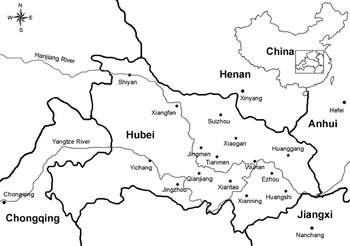
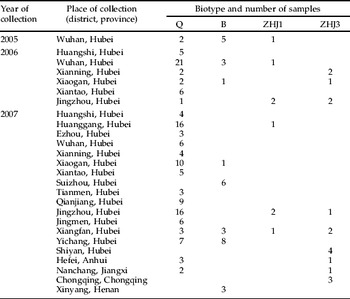
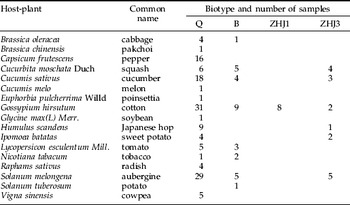
From September 2005 to October 2007, we collected B. tabaci from 15 districts in Hubei and four surrounding provinces (Henan, Anhui, Chongqing, Jiangxi; fig. 1, table 1). In total, 191 samples were taken, each from a specific crop or weed host (table 2). These were stored in 75% ethanol at −20°C.
Distribution of B. tabaci samples from 15 districts of Hubei province and four districts of neighbouring Chinese provinces 2005–2007. Insert is a sketch map of China highlighting the area sampled.

Biotype and location of 191 B. tabaci samples.

Host-plants and biotypes of 191 B. tabaci samples.

DNA extraction
Total DNA was extracted from each sample (Luo et al., Reference Luo, Yao, Wang, Yan, Hu and Zhang2002). Individuals were homogenized in 20 μl extraction buffer (50 mM Tris-HCl, pH 8.0, 20 mM NaCl, 1 mM EDTA, and 1% SDS) on parafilm. The extract was incubated at 60°C for 3 h, and then 2 μl of proteinase K was added. Distilled water (78 μl) was added and incubated at 100°C for 5 min. After incubation, 100 μl of the extract was mixed with 200 μl absolute alcohol. The sample was then placed at −20°C for 2 h and centrifuged at 12,000 rpm for 20 min. The suspensions were decanted and the DNA samples were re-suspended in 20 μl TE buffer (pH 8.0) and stored at −20°C.
RAPD-PCR reaction
The samples of B. tabaci were analysed by RAPD-PCR to detect B, Q and other biotypes according to the methods of De Barro & Driver (Reference De Barro and Driver1997) and Chu et al. (Reference Chu, Chen, Xu, Wu and Zhang2007). Known samples of B, Q and indigenous biotypes (ZHJ1, ZHJ2 and ZHJ3, respectively) were used as standards. And the mtDNA CO1 sequences analysis was employed to identify the ambiguous samples. The primer H16 (5′-TCTCAGCTGG-3′) was used as a marker to generate the RAPD profile. RAPD-PCR reactions were carried out in a final volume of 25 μl containing 2.5 μl of 10×PCR buffer, 0.25 mM of each dNTP, 0.25 mM of MgCl2, 20 ng of primer, 1.5 U Taq DNA polymerase and 10–20 ng of DNA. The amplification was done according to the following parameters: 5 min at 94°C, 2 min at 40°C and 3 min at 72°C, followed by 39 cycles of 1 min at 94°C, 1.5 min at 40°C and 2 min at 72°C. The products of amplification were analyzed on 1.5% agarose gels.
PCR and sequence analysis of mtDNA CO1 genes
One individual from each of a subset of 56 samples was used for the analysis of the mtCO1 gene sequence. DNA was extracted as above and PCR reactions (Luo et al., Reference Luo, Yao, Wang, Yan, Hu and Zhang2002) were carried out in a final volume of 20 μl containing 1 U Taq DNA polymerase, 2.5 mM MgCl2, 0.25 mM dNTP, 2 mg ml−1 BSA, 2 μl of DNA and 2.5 ng μl−1 of each primer (Cl-J-2195: 5′-TTGATTTTTTGGTCATCCAGAAGT-3′ and L2-N-3014: 5′-TCCAATGCACTAATCTGCCATATTA-3′) (Simon et al., Reference Simon, Frati, Beckenbach, Crespi, Lui and Flook1994; Frohlich et al., Reference Frohlich, Torres-Jerez, Bedford, Markham and Brown1999). The amplification followed these steps: 5 min at 94°C, followed by 35 cycles of 1 min at 94°C, 1 min at 50°C, 1 min at 72°C and a final elongation during 5 min at 72°C. The products of amplification were analyzed on 1.6% agarose gels. The amplified products were gel-purified using DNA Clean/Extraction Kit (Promega, Madison, WI, USA) and sequenced in one direction on an ABI 3730XL DNA analysis system using TIAN gel Mini/Midi Purification Kit (Tiangen, Beijing, China).
Data analysis
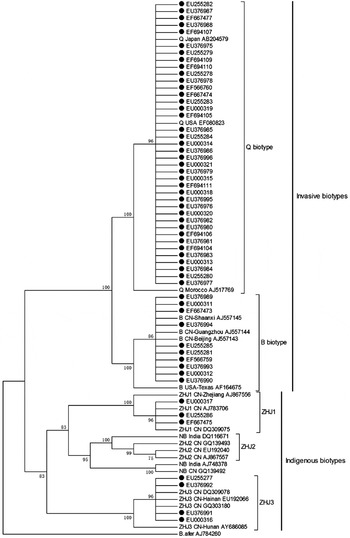
The sequence fragments that resulted from the mtDNA CO1 assay were aligned using ClustalX (Thompson et al., Reference Thompson, Gibson, Plewniak, Jeanmougin and Higgins1997). Different locations and haplotypes were chosen for phylogenetic analysis. mtDNA CO1 sequences were obtained from several additional B. tabaci collections to serve as geographic references. One sequence of Bemisia afer (Priesner & Hosny) (AJ784260) was also used as an outgroup (see fig. 2). The evolutionary divergence of different samples of B. tabaci based on mtDNA CO1 used the Kimura 2-parameter model and an unweighted pair-group method analysis (UPGMA) to build a dendrogram using the software MEGA 3.0 (Kumar et al., Reference Kumar, Tamura and Nei2004). One thousand bootstrap replicates were performed for each analysis.
Phylogenetic tree of mtDNA CO1 sequences for B. tabaci using UPGMA method with bootstrap test of phylogeny. The outgroup was B. afer. The code of sequences from GenBank includes the biotype, location and Genbank accession number. •, sequences of mitochondrial cytochrome oxidase DNA from this study; CN, China; NB, no B/Q biotype.

Nucleotide sequence accession numbers
Nucleotide sequence accession numbers for the sequences submitted to the GenBank nucleotide sequence database are shown in fig. 2.
Results
Identification of biotypes
Using primer H16, four different biotypes were identified by RAPD-PCR. These were subsequently confirmed by mtCO1 sequencing as representing two exotic biotypes (B and Q) and two indigenous ones (ZHJ1 and ZHJ3). Consistently reproducible banding patterns of 250–1000 bp fragments differentiated the biotypes. Of the 191 samples analysed by RAPD-PCR, the ratio of Q:B:ZHJ1:ZHJ3 was 136:30:8:17.
Sequence analysis of mtCO1 gene of B. tabaci
The sequences of the mitochondrial CO1 genes of a subset of 56 of the 191 Chinese samples were analysed (fig. 2). All samples of B. tabaci fell into one of four clusters representing the B, Q, ZHJ1 and ZHJ3 biotypes (fig. 2). A B. afer sample clustered separately as an out-group, sharing 77–74.8% of its identity with all B. tabaci. The B biotype cluster comprised samples from the USA, Beijing, Shaanxi and Guangzhou, and ten central Chinese samples. These shared 99.7–100% of their nucleotide sequence. The Q biotype cluster contained samples from USA, Morocco, Spain and Japan, and 42 central Chinese samples. These shared 99.5–100% of their nucleotide sequence. Individuals belonging to each indigenous cluster were almost identical (ZHJ1: 99.5–100%; ZHJ3: 99.5–100%). Overall, the sequence variation indicated four different biotypes among the samples, commensurate with the four groupings identified through RAPD analysis. There were no discrepancies. A phylogenetic tree was developed using a 602 bp portion of the CO1 sequence (fig. 2).
Trends in spatial distributions
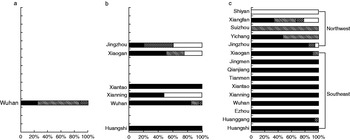
The first samples of B. tabaci were collected from Wuhan, Hubei province in 2005 (fig. 1). Eight samples were analysed and separated into the categories Q, B, ZHJ1 and ZHJ3 in the ratio 2:5:1:0. In 2006, a further 49 samples from six districts of Hubei (including the sites sampled in 2005) were analysed. These samples had a Q:B:ZHJ1:ZHJ3 ratio of 37:4:3:5. The Q biotype of B. tabaci was clearly predominant at this stage (fig. 3). In 2007, a still more extensive survey was undertaken to determine the spread of the Q biotype. The 134 samples sampled from 19 districts comprised Q:B:ZHJ1:ZHJ3 in the ratio 97:21:5:11. The ratios differed between the southeast and the north and west (figs 1 and 3). All samples from the southeast were ⩾90% Q biotype. In the northwest, non-Q biotype samples were more common than in the southeast: Q:B:ZHJ1:ZHJ3; 7:8:0:0 (Yichang); 16:0:2:1 (Jingzhou); 3:3:1:2 (Xiangfan); 0:6:0:0 (Suizhou); and 0:3:0:0 (Xinyang) (fig. 3). Samples from Shiyan (0:0:0:4) and neighbouring Chongqing (0:0:0:3) province were exclusively of the ZHJ3 biotype.
The mean proportions of B. tabaci biotypes from samples sampled in Hubei province: (a) 2005, (b) 2006, (c) 2007 (▪, Q;  , B;
 , ZHJ1; □, ZHJ3).

Over the course of the study, the proportion of the B biotype in the southeast of Hubei steadily decreased as the Q biotype became dominant (fig. 3). This is most obvious in the Wuhan samples collected over all three years (χ2=13.7, df=4, P=0.008). The proportion of indigenous biotypes in Jingzhou, Xiaogan, Xianning and Wuhan also decreased steadily as the Q biotype increased (e.g. the Jingzhou samples, χ2=8.19, df=2, P=0.017) (fig. 3). Our sampling also revealed that, as expected, Q and B biotypes are broadly polyphagous. With a single exception, all biotypes collected from the weed Humulus scandens L. were of the Q form (n=9). ZHJ1 was not found on any plant except Gossypium hirsutum L. (n=8), while ZHJ3 was found on a wide range of hosts. Overall, the ratio of Q:B:ZHJ1:ZHJ3 samples on different host plant groups was: cotton 31:9:8:2, weeds 9:0:0:1, vegetables 95:19:0:14 and tobacco 1:2:0:0 (see table 2).
Discussion
This study presents a detailed characterisation of the temporal and spatial dynamics of B. tabaci biotypes in central China. Analysis of RAPD banding patterns and cluster analyses of mtDNA CO1 sequences revealed the presence of four different groupings of B. tabaci in the region. These results confirm that the B biotype has a nationwide distribution in China (Luo et al., Reference Luo, Yao, Wang, Yan, Hu and Zhang2002; Qiu et al., Reference Qiu, Ren, Wen and Mandour2003; Zhang et al., Reference Zhang, Zhang, Zhang, Wu, Xu and Chu2005; Ma et al., Reference Ma, Gorman, Devine, Luo and Denholm2007). Sequencing of the CO1 gene showed that all B samples from around the world, including our own, share 99.7%–100% nucleotide identities. The B biotype insects in China have clearly resulted from one, or a number, of invasive events, beginning at least as far back as the 1990s (Luo et al., Reference Luo, Yao, Wang, Yan, Hu and Zhang2002; Zhang et al., Reference Zhang, Zhang, Zhang, Wu, Xu and Chu2005; Hsieh et al., Reference Hsieh, Wang and Ko2007; Liu et al., Reference Liu, De Barro, Xu, Luan, Zang, Ruan and Wan2007).
Dalmon et al. (Reference Dalmon, Halkett, Granier, Delatte and Peterschmitt2008) found that Q had spread very quickly and that the lack of spatial genetic structure among all Q populations again indicates recent colonization events and a massive competitive advantage. The Q biotype invaded more recently (Zhang et al., Reference Zhang, Zhang, Zhang, Wu, Xu and Chu2005; Hsieh et al., Reference Hsieh, Wang and Ko2007) and, during the course of our study, has become increasingly dominant in Hubei province. It is now distributed widely over the Jianghan plain (Hubei), an agricultural area with highly developed transport links and intensive and extensive farming.
In 2005, our own farmer surveys in Hubei suggested that B. tabaci was strongly associated with severe effects on vegetable and cotton production. This realisation was the trigger for our initial brief survey of the Wuhan area. Between 2005 and 2007, the Q biotype established and became dominant over a large area of central China. In the north and west of our study area, fragmented agricultural landscapes and mountainous regions appeared to hinder the spread of the Q biotype and indigenous B. tabaci biotypes continued to persist in this more isolated region. The presence of ZHJ1, ZHJ2 and ZHJ3 biotypes in Hubei, Shandong and Zhejiang has been noted previously (Zhang et al., Reference Zhang, Zhang, Zhang, Wu, Xu and Chu2005; Zang et al., Reference Zang, Jiang, Xu, Liu and Zhang2006; Liu et al., Reference Liu, De Barro, Xu, Luan, Zang, Ruan and Wan2007). More recently, Dinsdale et al. (Reference Dinsdale, Cook, Riginos, Buckley and De Barro2010) described the COI sequences of a number of other indigenous biotypes from China. Most of these sequences originated from individuals collected from south and east China. Only the ZHJ3 group was described from central China. The non B or Q COI sequences described in the current paper clustered only with the ZHJ1 and ZHJ3 sequences described by Dinsdale et al. (Reference Dinsdale, Cook, Riginos, Buckley and De Barro2010).
The spread of the Q biotype has been associated with the global trade in ornamental plants (Brown et al., Reference Brown, Perring, Cooper, Bedford and Markham2000; Horowitz et al., Reference Horowitz, Kontsedalov, Khasdan and Ishaaya2005). Hsieh et al. (Reference Hsieh, Wang and Ko2007) suggested that the Q biotype in Taiwan had entered on poinsettia plants originating from Italy in 2006. Chu et al. (Reference Chu, Wan, Tao, Liu, Fan and Bi2008) showed that Chinese Q biotype from the northeast Pacific region clustered with Q biotype from the Mediterranean. We suggest that the Q biotype from central China also originated from the Mediterranean, having spread throughout the Chinese mainland via the transport of vegetables, seedlings and ornamental crops.
All eight samples that were identified as ZHJ1 were taken from cotton. This suggests a narrow host range, and a strong association with G. hirsutum. This was also reported by Zang et al. (Reference Zang, Liu, Liu, Ruan and Wan2005a). All other biotypes (B, Q and ZHJ3) were more polyphagous, again in agreement with previously published data (Bellows et al., Reference Bellows, Perring, Gill and Headrick1994; Perring, Reference Perring2001; Zhang et al., Reference Zhang, Zhang, Zhang, Wu, Xu and Chu2005). It is notable that, in our survey, the Q biotype had a stronger association with weed hosts than the other biotypes. In Spain, the Q biotype was also better adapted to weed hosts and highly competitive with the B biotype on some commercial crops (Nombela et al., Reference Nombela, Beitia and Muniz2001; Muniz & Gloria, Reference Muniz and Gloria2001). The increasing rarity of indigenous biotypes in central China, driven by alien invasions, is mirrored in eastern China, where the B biotype may outcompete the indigenous ZHJ1 on a variety of commercially grown plants (Liu et al., Reference Liu, De Barro, Xu, Luan, Zang, Ruan and Wan2007; Zang et al., Reference Zang, Liu, Liu, Ruan and Wan2005a,Reference Zang, Liu, Liu and Chenb). The B biotype has been shown to be more fecund than Chinese and Australian biotypes and neither is there any introgression between them (Liu et al., Reference Liu, De Barro, Xu, Luan, Zang, Ruan and Wan2007). A combination of these competitive advantages and mating interactions appears to have led to the effective extinction of indigenous genotypes in some regions.
One factor that we suspect is of key relevance to the distribution of biotypes in central China relates to insecticide use patterns and the differential presence of resistance mechanisms in the various biotypes. B and Q biotypes have both evolved resistance to neonicotinoids through the overexpression of a P450 gene, CYP6CM1, but resistance is particularly potent and widespread in the Q biotype (Karunker et al., Reference Karunker, Benting, Lueke, Ponge, Nauen, Roditakis, Vontas, Gorman, Denholm and Morin2008). In a recent comparison of B and Q biotypes from China (Luo et al., Reference Luo, Jones, Zhang, Denholm and Gorman2010), the Q biotype exhibited far higher resistance to neonicotinoids than B biotype. When resistance to a key insecticide is associated with a single biotype, insecticide use will be a powerful determinant of biotype composition. We would, therefore, expect the Q biotype to predominate in regions where its common hosts are regularly treated with neonicotinoids. The manufacture of imidacloprid in China began in 1992 and was first used in Hubei to control the plant hopper Nilaparvata lugens. It has since become a standard treatment for many sucking pests, including whitefly, on a variety of crops. Approximately 650,000 kg of neonicotinoids were used annually between 2005 and 2008 and the area under neonicotinoid treatment in Hubei is 6500 km2 per year (Peng, personal communication). This reflects multiple applications to the same areas.
The overall ascendancy of the Q biotype on the agricultural plains of central China probably results from its biotype-specific ability to withstand neonicotinoid treatment, its polyphagous and competitive nature and perhaps its reproductive isolation. Its presence has profound implications for the sustainability of insecticide use and for the agricultural economy of the region.
Acknowledgements
The authors thank Drs Akinkurolere Rotimi Oluwafemi, Sebastien Boyer and Ian Denholm for their critical comments on the manuscript. This paper was supported, in part, by grants from National Basic Research and Development Program of China (2009CB119200), National Natural Science Foundation of China (30400291), the earmarked fund for Modern Agro-industry Technology Research System, the Key Science and Technology Program of Hubei Province (2007AA201C74) and Wuhan (200720422145-2). Rothamsted Research is an institute of the Biotechnology and Biological Sciences Research Council of the United Kingdom.