Introduction
Policy background
The notion of ‘active ageing’ permeates policy and practice discourse about the ageing population and the welfare of older people in the United Kingdom (Age Concern Scotland 2005; Audit Commission 2003; Department of Health 2001, 2005a; Department for Work and Pensions 2005), and is a central theme in policies promulgated by the European Commission (EU), the United Nations Organisation's World Assembly on Ageing of 2002, and the World Health Organisation (WHO) (UNO) (EU 1999a, 1999b; WHO 1999, 2002, 2005a, 2005b). ‘Active ageing’ is also a prominent theme in major research initiatives, such as the United Kingdom Research Councils' New Dynamics of Ageing five-year programme, though the prospectus stresses that ‘both the concept and the various factors that interact to determine it are inadequately understood’ (Economic and Social Research Council 2005: 2).
Walker (Reference Walker2006) has traced the history of the concept of ‘active ageing’, from its emergence in the United States during the early 1960s as the antithesis of the theory of disengagement, through its resurfacing in the guise of ‘productive ageing’ during the 1980s, to the contemporary usage that emphasises the vital connection between activity and health. Other commentators have recently questioned whether the levels of activity amongst older people have changed through time. Agahi and Parker (Reference Agahi and Parker2005) noted the complexity of the associations between older people's participation in activities and their well-being (Litwin and Shiovitz-Ezra Reference Litwin and Shiovitz-Ezra2006), and asked how older people may live longer lives more positively or to the full (Chong et al. Reference Chong, Ng, Woo and Kwan2006). According to the WHO definition (2002), which is influencing European usage, ‘active ageing’ enables individuals, including frail and disabled people in need of care, to realise their potential for physical, social and psychological well-being throughout the life course. The word ‘active’ is not intended simply to refer to an individual's ability to be physically active or to participate in the labour force, but to participate in society according to his or her needs, desires and capabilities (WHO 2002: 12).
Nevertheless, as Davey (2002: 98) pointed out, the Organisation for Economic Co-operation and Development (OECD 1999) emphasised the economic aspects of active ageing, and the national governments of affluent countries also place these to the forefront of their policies for ‘an ageing population’. Although the latest normative representations of the concept combine elements of both ‘productive ageing’ and the promotion of the quality of life and mental and physical well-being, Walker (Reference Walker2006) criticised ‘active ageing’ as a policy goal for being incoherent, and noted that too often it is either little more than empty rhetoric or focuses exclusively on increasing the participation of older (and late middle-aged) people in employment. He subsequently proposed seven key principles as pre-requisites for a well conceived ‘active ageing’ policy including: applicability to the entire lifecourse, the inclusion of all older people – not least the oldest and those who are frail and dependent – and respect for diversity, viz. inclusion of those whose conceptions of ‘activity’ differed from policy norms (Walker Reference Walker2002, Reference Walker2006).
In the United Kingdom, the Opportunity Age programme (Department for Work and Pensions (DWP) 2005) identifies being actively involved in local decisions about personal safety, housing, transport, learning, volunteering and leisure as important for older people, but sees looking ahead primarily in terms of planning for retirement, specifically with regard to income and health. Moreover, commentators have noted that expectations for ‘active healthy ageing’ are typically framed by policy makers, researchers and service planners, who tend to define activity from middle-aged or youthful perspectives that may not be congruent with older people's experiences (Howarth Reference Howarth1998; Reed et al. Reference Reed, Cook, Childs and Hall2003). Even where the dynamic nature of policy constructs is recognised and older people's perspectives are directly sought, research on their activities is often conducted using pre-determined questions and primarily with people in early old age (cf. Gabriel and Bowling Reference Gabriel and Bowling2004; Wiggins et al. Reference Wiggins, Higgs, Hyde and Blane2004; Wilhelmson et al. Reference Wilhelmson, Andersson and Allebeck2005). The Older People Shaping Policy and Practice report argued that seldom is the focus on what older people themselves desire, and more often on ‘what you think we need’ (Joseph Rowntree Foundation 2004: 39). The older people in Reed et al.'s (Reference Reed, Cook, Childs and Hall2003) reference group preferred the idea of ‘comfortable healthy ageing’ to ‘active ageing’. To them, living well was not simply about physical health, but about enjoying friendships and taking pleasure in everyday activities. Similarly, Qureshi and Henwood (Reference Qureshi and Henwood2000) found that older people were most concerned with ‘achieving ordinary things in life’.
Aims and design
This paper provides new evidence from an in-depth, biographical study of the extent to which current socio-cultural expectations, stereotypes and sociological theories about ageing and later life are reflected in the experiences and attitudes of a sample of older people living in northern England (Clarke Reference Clarke2001).Footnote 1 The life stories of ‘ordinary’ older people were sought in order to develop a better understanding of the ways in which experiences and attitudes throughout life affect individual circumstances and perceptions in later life (Hazan Reference Hazan1994; Midwinter Reference Midwinter1991; Bernard and Meade Reference Bernard and Meade1993). The aspiration was to explore whether people responded to ageing in different ways, as well as to identify what was unique and what was shared about later life. Biographical approaches generally view later life as both a process and a stage of life during which personal development and engagement continue, see withdrawal and disengagement as far from inevitable, even if they are experienced by some people (Slater Reference Slater1995) and may be used to explore the extent and the ways in which individuals continue to participate in social, economic, cultural, spiritual and community affairs until the end of their lives.
Methods
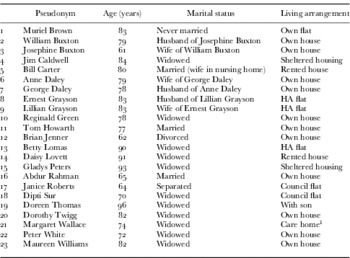
Older men and women living in South Yorkshire in the north of England were recruited to the study through local voluntary groups, religious and cultural organisations, luncheon and other social clubs, appeals in community magazines, and through referral by other participants.Footnote 2 The search for participants referred to ‘older people’ rather than a chronological age; it was left to individuals to define themselves as ‘old’. Although it has been suggested that a reference to chronological age perpetuates ‘the myth that knowing an individual's year of birth supplies information on which to base concrete beliefs and expectations about another person’ (Matthews Reference Matthews1979: 59), the participants' ages are given in the paper on the grounds that, if not stated, age-based stereotypes cannot be challenged. The achieved sample comprised 10 men and 13 women (18 were White-British, three Jamaican and two Bangladeshi) (Table 1). Their ages ranged from 60 to 96 years, and most were not receiving health-care or social services.Footnote 3
Age and living arrangements of the participants

Notes: HA: Housing Association (non-profit social-housing provider). 1. Moved from own flat to care home.
Three rounds of in-depth, tape-recorded interviews were undertaken in the participants' homes during 1997–99, the intervals between the rounds being approximately one and then six months. The successive purposes of the three interviews were to obtain: (1) the participants' life stories; (2) in-depth personal accounts of growing older (which followed-up themes from the first interviews); and (3) the participants' views about the research process, partly by discussing (and therefore verifying and when appropriate elaborating) the themes that the researchers derived from the first- and second-round interviews.Footnote 4 The opening question in the first interview was: ‘Can you tell me something about your life? It's up to you what you tell me, when and where you start’. During the second interviews, the participants were asked specific questions about later life, beginning with: ‘Can you tell me how you feel about growing older?’ (Wengraf Reference Wengraf2001).Footnote 5 Altogether, 55 interviews with an average duration of 90 minutes were conducted.
The detailed coding frame was developed by thorough reading and re-reading of the transcripts and iterative refinements (Miles and Huberman Reference Miles and Huberman1984).Footnote 6 All participants were offered a copy of their audio-tapes, given the opportunity to amend the transcripts, and encouraged to comment on the main themes. The themes and sub-themes therefore emerged partly from the responses to specific questions, partly from the participants' spontaneous expressions, and partly from their reflections on feedback reports of the emergent themes. The iterative application of a biographical approach provides people with the opportunity to talk about what is important to them, rather than being guided exclusively along paths conceived by the investigator; in this way, the themes to a great extent emerge from, and are validated by, the participants' life stories (Chambers Reference Chambers1994).
Findings: looking forward
The paper first examines several topics (or sub-themes) that emerged under the umbrella theme ‘looking forward’. The participants' expressions in this group centred on their activities, and the ways in which most continued to live engaged lives. They showed, however, great diversity and referred to many different activities. Four sub-themes were identified and will be considered in turn.
Thinking about the future
Some participants said that they found living in the present more meaningful than thinking about the future, but for others what was to come was salient: they talked about their fears (such as physical and cognitive decline, dependency and decreased income), and about their hopes and expectations (living longer, plans for the future, and generativity). One participant, Brian Jenner, thought it was ‘pointless’ to look forward at all; his story, together with that of Abdur Rahman's, reveals the importance of exploring active ageing in the context of the whole of people's lives.
‘It's all pointless’
Different perceptions of the future may partly be explained by people's past and present experiences and attitudes. Brian Jenner (aged 62 years) held the most overtly pessimistic views about the future. He remarked, ‘from now on, it's downhill all the way’. Brian could see ‘no point’ in looking forward, since ‘there's nothing to look forward to’; he explained, ‘I'm more involved in the present than for large stretches of [my earlier] life, because I'm busy. It's just boring, everyday stuff that everybody has. I don't sit here thinking, making plans, I can't really think more than a week or two ahead somehow, I never have done’. Brian's statement has two points of particular interest: because he was busy doing ‘everyday stuff’ (cf. Reed et al. Reference Reed, Cook, Childs and Hall2003; Qureshi and Henwood Reference Qureshi and Henwood2000), he argued that he had little time to think about the future, but he also admitted that he had never planned long ahead, so Brian's disinclination to look ahead cannot be attributed to growing older. Brian continually explored existential issues, about life, death and identity, and repeatedly asked rhetorical questions, such as ‘Why am I here?’ and ‘Is this all there is to life?’, to which his own answer was that the search was ultimately ‘all pointless, everything's pointless … it's pointless getting up in the morning if you don't subscribe to a religion or anything’.
As Brian had negative views about life in general it was hardly surprising that he also had pessimistic views about the future. For Brian, to look forward positively was futile because illness and death were the only certainties. Abdur Rahman's feelings of pointlessness, in contrast, had more to do with his life ‘not being fulfilled’ in the way that he had expected. Abdur was born in Pakistan and emigrated to England in the 1960s to get a ‘good job’ and earn money, but during the late 1970s he suffered an industrial accident for which he received little compensation; he believed that he was taken advantage of because of his inability to speak and understand English. Subsequently, he had remained unemployed, despite being willing to accept any type work, ‘even road-sweeping’. Abdur was frustrated at being unable to honour what he saw as his role in life, to be the family provider. His view of the future was bleak, and he closed his life story by saying, ‘there are no jobs for me in this country’.
‘This is it, this is how it is’
In contrast to pointlessness, other participants' views of the future were characterised by the senses of inevitability, completeness, acceptance or satisfaction (cf. Ågren Reference Ågren1998; Bury and Holme Reference Bury and Holme1991; Moloney Reference Moloney1995). As Freeman (Reference Freeman1997) also found, the oldest respondents thought that nothing more of significance would happen to them and that the rest of their lives was predetermined. Although many said that they ‘had seen it all before’, one of the youngest participants, Janice Roberts, at 64 years of age, most clearly articulated this internalised image. She reflected, ‘In the future, whatever happens would be a bonus. It would be great if something lovely happened, but I'm not foreseeing that … [I am] just living now for whatever has got to be’. Janice's attitude is understandable when seen in the context of her life, which had been dominated by the deaths of her mother, husband and best friend, and by the dramatic circumstances of her escape from her second marriage in Asia, which left her physically and emotionally ill, homeless for a time and in debt. Just as she never anticipated her past life, Janice believed that there was no point in looking forward. Perhaps because of these disappointments and losses in the past, Janice did not look to the future with eager anticipation; she was content to ‘just live for now’. She said of her present life, ‘It's nothing to what I did have, but I'm okay, I never want for anything’. For Janice, ‘living now’ and getting through each day were more important than anticipating the future.
‘Taking a day at a time’
When expressing views similar to Janice's, other participants used the common phrase, ‘taking one day at a time’ (cf. Ågren Reference Ågren1998; Bamford Reference Bamford1994; Nilsson et al. Reference Nilsson, Sarvimaki and Ekman2001; Rubenstein Reference Rubenstein1986). As a strategy, this may allow a sense of some control over what a few regarded as the increasing ‘unpredictability’ of their lives (discussed more fully below). When asked if there was anything that she looked forward to, Maureen Williams (aged 82 years) replied, ‘I try to live more day-by-day’, which she thought was an approach people learnt as they grew older: ‘you do learn more to live a day at a time, which you don't do when you're younger’. Lillian and Ernest Grayson (both aged 83 years), who were interviewed together, agreed that ‘we always think one day at a time. That's the only thing you can do when you're living on borrowed time’. Gladys Peters (aged 93 years) simply looked forward to the day. She said:
Every morning, I open the window and put my head out for 10 minutes, get the fresh air and say, ‘Right, today's another day’. … I believe that you cannot stand still, you have to advance or deteriorate, you do not stand still … and I like the advancement that comes with age, you go up and up and up. If you stand still, you go down and down and down.
Gladys's sense of ‘going up’ can be seen, not as the idealised scenario of a hearty, heroic elder, but as the progressing ‘ordinary’ life of someone who has lived long and survived many experiences (Bytheway Reference Bytheway1995: 128).
Some participants related that in retirement they were once more able to enjoy their activities, such as caring for family members (cf. Howarth Reference Howarth1998). Jim Caldwell (aged 84 years), who lived in sheltered housing, had learnt to relax since he had retired and his wife had died. He said, ‘When I retired, my wife was a chronic diabetic and I used to do the cooking; it stopped me leading the active life I had when I was down the pit [working in a coal-mine]. I always used to go out with mates every night, and this had to stop when I was looking after the wife’. Jim added that he was now free to spend most evenings in the local pub. Maureen Williams was widowed and she missed her husband, but she liked the freedom that came from living alone: ‘It's a lovely feeling, that you can do what you want. I tell myself sometimes, “You've only got to please yourself”’. Similarly, when Peter White (aged 72 years) was asked what he enjoyed most about his life, he said, ‘freedom – I have freedom to do exactly what I like’. Having cared for his terminally-ill wife, he said that since her death:
[I have] learnt to relax by reading and watching television: I can pick my programmes. I'm not blaming Jill for this, but my time was so involved looking after her, that my leisure just didn't exist, so I'm able to enjoy life better. I'm learning every day – I'm now doing crosswords and I went walking on Monday – it was a delightful day.
Peter's comment makes clear that enjoying an active life does not necessarily mean participating in the activity-driven goals of younger people, but rather that much satisfaction can be obtained from ‘ordinary’ everyday activities that most take for granted (Howarth Reference Howarth1998).
‘I just hope I live longer’
Many participants explicitly stated that they wished to live longer and, although many added the caveat, ‘as long as I'm healthy and independent’, in most cases chronic ill-health or disability did not change this aim. William Buxton (aged 79 years) admitted that he could not ‘see anything straight in front at all’, but he was not worried about the future. He said, ‘I just hope I live longer. Nobody wants to be dead … so long as I'm healthy’. Daisy Lovett (aged 91 years) lived an independent life, alone in a rented, terraced house, and wanted to live longer provided that she ‘kept well’. Peter White said that he wished to ‘live at least as long’ as his father and mother, who had died at 86 and 93 years-of-age respectively. Although Peter had suffered a heart attack, he said, ‘I have no fears now about another attack. I've realised that life's for living. If it happens, it happens’. He attributed what he saw as his positive outlook on life and old age to his father's determination in later life, and remarked:
If I'm feeling a bit slothful, I think, ‘Get up’. If I feel as if I'm going to go to sleep, I say, ‘Out Peter’, and I get up and put my coat on, weather permitting. Otherwise, I go upstairs and get on the (exercise) bike.
Muriel Brown (aged 83 years) was thankful that she had survived a stroke and had twice been successfully treated and operated on for cancer. She now found walking painful, but was determined that this should not affect her independence. Muriel did not ‘want to go yet’, and explained, ‘this day and age, 83 is nothing is it?’ Reginald Green (aged 78 years) was of a similar mind; although he had undergone surgery for cancer (and died before the study concluded), he emphatically and repeatedly said: ‘Life is for living. … When I'm in the pub, I always remind the landlord, that he's going to buy me a pint when I'm 100’. This is not to say that participants were in denial of the end of life: Gladys Peters had remarked that she was ‘taking a day at a time’ and Peter White commented that he was ‘accepting death’. Rather, it is to emphasise that they still felt very much alive and had plenty to achieve, but crucially they focussed on ordinary, everyday activities and events (cf. Howarth Reference Howarth1998; Qureshi and Henwood Reference Qureshi and Henwood2000; Reed et al. Reference Reed, Cook, Childs and Hall2003). For example, Reginald's attitude that he had ‘lots to do’ and ‘everything to live for’ included keen anticipation of reading the many books piled high in his front room and, less ordinarily, sitting as a model for a local artist. A sculpted bust of Reginald sat imposingly in his sitting room.
Celebrating future events and activities
Concentrating on the ‘small achievements’ of daily life did not preclude seeing the future as a time for activity (cf. Erikson, Erikson and Kivnick Reference Erikson, Erikson and Kivnick1986). When Reginald was interviewed just before Christmas, there were fairy-lights around the front window and a small Christmas tree on the piano. He looked forward to this time of year: ‘I love Christmas’, he said. Peter White and others were enthusiastic about marking the new millennium, and several talked about birthday celebration plans (cf. Bytheway Reference Bytheway2005). Gladys Peters repeatedly discussed animatedly the plans for her 100th birthday, which she intended to celebrate with a party similar to the one she had organised on her 90th birthday. Daisy Lovett and Dorothy Twigg both described the birthday surprises organised each year by their respective daughters – each one more elaborate than the one before.
Gladys Peters, who lived in sheltered housing, talked about her holidays and thought that her fellow residents would enjoy a change of scene: ‘A lot of these people are confined to four walls. I think it would do them good’. Like the Graysons, Gladys planned her holidays well in advance, as did Jim Caldwell. Jim suffered from various chronic illnesses related to his previous job as a miner, but looked forward to his annual trip to France. The enthusiasm for holidays of the Graysons, Gladys Peters and Jim Caldwell may be linked to their life experiences; they all reflected that only since retirement did they have the time and money to go on holiday. Poverty and hard work had dominated the Graysons's and Jim Caldwell's early lives. The Graysons said that since retiring they were ‘better off’ financially than they had ever been. Gladys Peters's work as a shopkeeper meant that she rarely had time for a holiday before she was forced to retire, following illness at 74 years-of-age. In contrast, Muriel Brown (aged 83 years) had travelled abroad all her life, and wanted to continue to travel as long as her health allowed. A retired teacher, she had always been single and had decided to live alone rather than with her sister, to keep the freedom to do what she chose.
Josephine Buxton (aged 61 years) looked forward to having time to study and to travel, but was restricted by her commitment to her grandchildren. Having spent her whole life supporting others – which paradoxically had prevented her from training as a registered nurse – Josephine hoped to relinquish her caring role when her grandchildren grew up, and then to travel and to study counselling at a college. Other participants, however, were more focused on activities with others, especially their children and grandchildren. For example, Maureen Williams anticipated seeing her grandchildren settle down and marry, and Anne Daley (aged 79 years), who was terminally ill, similarly wanted to see her grandchildren grow-up before she died. Dipti Sur (aged 70 years) expressed the same views:
I've got hope and look forward. I'm looking forward to my youngest son's marriage and his happiness. Humans always look forward to something; I look forward to every day.
Dipti seemed to suggest that the need to look forward was intrinsic to the human condition, and that our lives have a certain form that continues into the future (MacIntyre Reference MacIntyre1981: 201). Many older people, as they approach death, see their children and grandchildren as projections of themselves into an indefinite future (cf. Erikson, Erikson and Kivnick Reference Erikson, Erikson and Kivnick1986). Dipti was consistently positive, but her reference to ‘looking forward to every day’ alluded to the notion of ‘taking a day at a time’ more than to looking far ahead to an increasingly uncertain future.
Planning for the future
Anticipating feared changes
Many participants reflected that later life was often unpredictable. George and Ann Daley (aged 78 and 79 years respectively), interviewed together, worried about living in a rural area since, if one became ill and dependent, the other would be isolated, and low income was another concern. George reflected, ‘as you get older, you think about what might happen. You try to plan for it to some extent, but it isn't easy’. Given that Tom Howarth (aged 77 years) had been an insurance salesman, it was not surprising that he and his wife had tried to plan for their financial security, but he nonetheless observed, ‘I don't think we can make any definite plans because you don't know what's going to happen’. Several participants also worried about declining health, disability and dependency as they grew older, and most said that they had planned as best they could for illness and some for their deaths (discussed more fully below). Tom Howarth said:
I do one or two little jobs, treasury jobs for organisations. I'm beginning to shed them; I feel that younger people should be taking them on. … The fact is, I could pop my clogs, couldn't I? Or I could have a serious illness, and I'd leave them in a right mess.
Later on in his interview, Tom was adamant that ‘the past doesn't matter’ and that it is ‘living in the future that matters’. He implied, however, that the future was for younger people. Tom's statement reveals that he chose to disengage from his jobs, but other participants' fears about needing care in the future implied a lack of choice and a desire to remain independent for as long as possible, attitudes that have been frequently identified by many previous studies (Allen et al. Reference Allen, Hogg and Peace1992; Bamford Reference Bamford1994; Bury and Holme Reference Bury and Holme1991; Coleman et al. Reference Coleman, Ivani-Chalina and Robinson1998; Feldman Reference Feldman2001; Nilsson et al. Reference Nilsson, Sarvimaki and Ekman2001; Tinker and Askham Reference Tinker, Askham, Dickenson, Bartlett and Wade2000). Peter White commented, ‘I don't for choice wish to finish up in an old people's home, but if that's what God's got in store for me, you can't do anything about it’. Muriel Brown did not want to dwell on the prospect of going into a home, but felt that she would accept it if she really had to. She told the interviewer, ‘it would annoy me very much if you can't have a cup of tea when you want one. You're restricted aren't you?’ Betty Lomas (aged 90 years), a retired post-woman, had lived independently in her flat for many years following her husband's death. Her fears about going into a care-home were based on her experience of two-weeks respite residence following a fall. Although she felt that the rest ‘did me good’, she had ‘tried to forget the experience’ because ‘it was an eye-opener’. Betty's concerns were linked to her observation that many of the residents quickly became inactive and dependent on the staff:
It was sad, they were well looked after and they were well dressed. It seems such a shame, you get repetition, the same thing every day. I took my word-book in and I'd done five pages one morning.
Bill Carter (aged 80 years) described visiting his wife who lived in a nursing home. He said that he felt sorry for those he saw:
I go down Sunday because I have my dinner at my daughter's. I don't like to be there when they're having their tea, but if I'm there on my own, they give me my tea as well. There's some rough cases down there. Some over 90 and all … makes you wonder. Never done anyone any harm. Poor souls, but I suppose you can't do without those places.
As a result, Bill said that he was determined to live independently in his own home for as long as he was able. In contrast, Margaret Wallace (aged 74 years) said that she was unworried about going into residential care, perhaps because she had looked around and considered various options before it became necessary to sell her house. When interviewed for a second time, Margaret was surrounded by brochures advertising private care-homes. Just as Tom Howarth could afford to give up his jobs, so Margaret had the finances to choose where she lived (cf. Gabriel and Bowling Reference Gabriel and Bowling2004). For other participants, however, the resistance to entering a care home was linked to their wish to hold on to what they saw as their lifelong independence. Margaret felt that she had never been independent, so being cared for by others was of little concern. She did not like living alone and was anxious that she would become increasingly physically disabled and more isolated. Margaret had actively chosen to place the aspects of her care that she could no longer fulfil herself into the hands of others (cf. Stevenson and Parsloe Reference Stevenson and Parsloe1993).
‘Looking forward’ to death
The participants were not asked a direct question about death or dying, but some alluded to it with phrases such as ‘living on borrowed time’, ‘we're all born to die’, and ‘if we live longer’, but none seemed preoccupied with death (Clarke and Hanson Reference Clarke, Hanson, Warnes, Warren and Nolan2000). Attitudes towards death, when expressed, were very diverse: some participants did not refer to death at all (either directly or indirectly); some perceived and accepted death as a ‘natural’ part of life; others worried about the process of dying or being left alone after their partner had died; whilst those with a religious belief seemed to find a source of comfort in their faith (cf. Coleman et al. Reference Coleman, Seiger and Sherbourne1990, Reference Coleman, Ivani-Chalian and Robinson2004, Reference Coleman2005; Erikson, Erikson and Kivnick Reference Erikson, Erikson and Kivnick1986; Help the Aged 2005a, 2005b; Kirkby et al. Reference Kirkby, Coleman and Daley2004; Koenig et al. Reference Koenig, Kvale and Ferrel1988).
Accepting death
Peter White's view was that although ‘we are born to die’, death was not something that younger people think of. He said, ‘I think all of us, as we get older, realise that we're born to die and if we get to three-score-and-ten years, we've achieved quite a lot’. Josephine Buxton's references to death were spontaneous and informed by both her former work as a nursing auxiliary and the fact that several years before, following surgery she had almost died. Josephine thought about dying because, in her words, ‘I am fortunate, I've got to this age and a lot of people haven't. So I give thanks to God every day for bringing me this far, and I'm prepared whenever the time for death comes’.
Having religious faith seemed to help some participants accept their past lives, give them strength in the present, and make them less anxious about the future. Doreen Thomas (aged 96 years) said that her Christian beliefs had helped her since her stroke. She believed that, ‘the Lord is taking care of me. He promised me in the Bible that when I'm old and grey-headed and lose strength, he will not leave me comfortless’. Doreen felt that her faith had become stronger as she had grown older and indicated that she was not worried about the future: ‘I'm not frightened about death. If it comes tonight, I am ready, I am ready’. Maureen Williams had been a church-goer all her life, attending meetings midweek and twice on Sundays. As a widow, she looked forward to meeting her husband in heaven when she died. Dipti Sur, a Hindu, claimed not to think about the future. Her opinion was that, ‘whatever will happen, will happen, it was in the hands of the Gods’. At first sight, this appeared to contradict her view that looking forward was inherent in human nature, but taken as a comment on her own future, Dipti may have been thinking about death or other feared changes to come. In other words, to some people when referring to themselves, the phrase ‘the future’ could be a euphemism for death. Whichever, Dipti's faith clearly helped her to accept her life and whatever happened in the future. For Brian Jenner, an atheist, there was no future to look forward to and no after-life. He said, ‘all that awaits us in the end is death’, but he felt that death was still some way off, and equated death with ‘being really old’ (Clarke and Hanson Reference Clarke, Hanson, Warnes, Warren and Nolan2000).
Anticipating death
Personal illness or declining abilities, as well as the deaths of relatives and friends, frequently brought the thought of death into people's minds (cf. Clark and Seymour Reference Clark and Seymour1999; Unruh Reference Unruh1983). Daisy Lovett, who had stopped going to funerals because there were so many to attend, observed that ‘the older you get, the nearer to the front of the church you get’. It was the process of dying more often than death itself that seemed to concern some participants (cf. Bamford Reference Bamford1994; Howarth Reference Howarth1998; Erikson, Erikson and Kivnick Reference Erikson, Erikson and Kivnick1986; Sidell Reference Sidell1995). Maureen Williams, Lillian Grayson and Daisy Lovett were all concerned about dying alone (cf. Rubinstein Reference Rubenstein1986; Williams Reference Williams1990; Young and Cullen Reference Young and Cullen1996). In her third interview, Daisy repeated this fear, in saying ‘you wonder where you are going to finish up. When you get as old as I am, at the bottom of it, what worries you more than when is how’. It was clearly something that had been preying on her mind.
Some participants were fearful that they might be kept alive against their will. For example, Margaret Wallace had been diagnosed with Parkinson's disease and, at 71 years-of-age had suffered a stroke. Although she felt that she had made a good recovery, Margaret was worried that she might have a ‘big stroke’ (Clarke and Hanson Reference Clarke, Hanson, Warnes, Warren and Nolan2000). She had arranged a living will because she did not want ‘to be kept alive and plugged into something or another if I'm paralysed permanently. … I just wish and hope with all my heart that I can die quickly’ (cf. Elder et al. Reference Elder, Schneider, Zweig, Peters and Ely1992; Gamble et al. Reference Gamble, McDonald and Lichstein1991). Margaret expressed the view that writing a living-will had made her feel more in control of her life. She felt that this decision was influenced by her father's slow and painful death from cancer (cf. Schiff et al. Reference Schiff, Rajkumar and Bulpitt2000; Nahm and Resnick Reference Nahm and Resnick2001; Carrese et al. Reference Carrese, Mullaney, Faden and Finucane2002).
While Margaret was the only participant to mention a living-will, several had made funeral plans. Maureen Williams said that the death of her husband had encouraged her to plan for her own funeral. Muriel Brown was aware that her terminally ill sister had made a will, but she would ‘leave that to the executors’. Josephine Buxton was concerned not to be a burden on her family. As she said, ‘I wouldn't like to leave my family with confusion that they were short of things like money. I wouldn't like to leave a burden on them – so I'd like to have my life in order … be prepared’. Similarly, Maureen Williams had taken action to prepare for her death by writing a will and planning her funeral. She felt that, ‘you should make provision, look to when you won't be here and make things as easy as you can for the person who has to see to things. I plan for that’.
Beyond death: generativity
Towards the end of their lives, people may hope to leave something behind by which they may be remembered. One way in which this can be achieved is through telling life stories. Following the first research visit, Daisy Lovett requested a copy of her interview tapes and subsequently telephoned to say how much she had enjoyed listening to them. She said, ‘I don't like to brag, but I feel so clever really’. Daisy later asked for a copy of the transcript and said how pleased she was that she could ‘pass on something’ to her family so they could ‘remember me when I'm gone’. Peter White said that he enjoyed telling stories of his past to younger people and hoped that they would have ‘some worth’. When asked how he had felt about telling his life story, Peter replied, ‘the only way we're going to learn for the future is through our experience, in my opinion, in the past’. Doreen Thomas said that she enjoyed telling stories from her life and passing on advice to the family (cf. Moloney Reference Moloney1995). In contrast, Margaret Wallace felt that she had little to pass on to the next generation, and thought that older people should ‘give way’ to younger people:
Old-age pensioners are always complaining. They're very well looked after now, but they're always complaining about something and we really shouldn't begrudge the young people the money they spend on them, because they're the future generation. We're the ones that are dying off and we should realise that and give way. People don't; they're very selfish.
Margaret's view was the exception, however, and most participants thought that they had something of value to share with others. William Buxton felt that he could pass on his experience to his family:
When you are young, you just don't think about what's happening next. As you get older, you weigh up, because you have experienced things along the way so you know that you shouldn't walk that road and I'm here to guide my family.
Margaret seemed to want to ‘give way’ to younger people through actively choosing to go into a care home. William wished to share the lessons learnt from his past mistakes with his family and was actively engaged in generativity.
Discussion
Most of the participants in this study portrayed later life as a period in which they continued to live engaged lives. The diversity and subtlety of their responses strongly contrast with the material frameworks of productivity, income and public expenditure found in much public policy for older people. Qualitative research into older people's perceptions reveals various understandings and representations of old age, from being without meaning (Kaufman Reference Kaufman1986), through a direct continuation of the lives they have always lived or of their current daily activities, to, in some cases, a time for long-term plans (Erikson, Erikson and Kivnick Reference Erikson, Erikson and Kivnick1986). Attitudes towards older age included the positive assessments that it brought an end to the pressures earlier in life and welcome changes and adjustments (Bamford Reference Bamford1994), and attitudes towards the future included ‘it is what you make it’ (Johnson and Barer Reference Johnson and Barer1997). Some participants said that living in the present was more meaningful than thinking about the future. Echoing the findings of other studies, some preferred to live a day at a time (Ågren Reference Ågren1998; Bamford Reference Bamford1994; Nilsson et al. Reference Nilsson, Sarvimaki and Ekman2001; Rubenstein Reference Rubenstein1986). Others considered various fears, hopes and expectations, which indicated that the future was salient.
Brian Jenner had the most overtly pessimistic views about the future, reflecting his assumption that physical and mental infirmity, dependence and death would be problematic (Matthews Reference Matthews1979: 140). Brian's reflections support other research that has suggested that older people with strong religious beliefs do not experience, or are less likely to experience, depression or to lack perceived meaning in life (Coleman et al. Reference Coleman, Ivani-Chalian and Robinson2004). Brian's views also raise questions about conceptualisations of ‘active ageing’ in terms of psychological well-being: mental-health problems are more common, but also more neglected, among older adults (Department of Health 2001, 2005b). Mental ill-health is a key factor in the quality of old-age lives, for it may prevent people from participating in activities in which they wish to engage (Beaumont and Kenealy Reference Beaumont and Kenealy2004). Brian's views contrasted with those of Abdur Rahman, whose apparent despair about his present life and future concerns seemed to be linked to structural factors, such as his unemployment and financial difficulties, and underpinned by institutionalised racism. Like many of Fenton's (Reference Fenton1987) interviewees who had immigrated to Britain from South Asia and the Caribbean, Abdur spoke about his industrial accident and its effect on his health. Fenton noted the participants' feelings of disappointment, sense of loss and pessimism for the future because of their unfilled expectations.
Arguably, younger people facing disadvantage may see the future as a time when things can only get better. The deleterious effects of health and material disadvantage and of racism on quality of life have been made clear in several studies (Bajeklal et al. Reference Bajeklal, Blane, Grewal and Karlsen2004; Moriarty and Butt Reference Moriarty and Butt2004; Nazroo et al. Reference Nazroo, Bajekal, Blane, Grewal and Lewis2003). Older people who are dissatisfied with the present are unlikely to feel positively about the future (Bamford Reference Bamford1994), perhaps because they have little on which to base a positive outlook. Freeman (Reference Freeman1997) described ‘narrative foreclosure’; the idea that as some people age they acquire an internalised image of their lives in which nothing more can happen and the rest of their lives must be a ‘foregone conclusion’. The statements of Abdur Rahman and Janice Roberts were consistent with such foreclosure. In contrast, Ågren's (Reference Ågren1998) study of Swedes aged in their nineties identified a common lack of expectation about the future, partly reflecting the participants' general satisfaction with their long lives.
Although the participants in Clarke's (Reference Clarke2001) study sometimes spoke of their goals having changed since their youth, this did not mean that they were no longer able to pursue goals, nor that they were disengaged from the present or uninterested in the future (cf. Cumming and Henry Reference Cumming and Henry1961; Howarth Reference Howarth1998; Lidz Reference Lidz1968; Nilsson et al. Reference Nilsson, Sarvimaki and Ekman2001). Some participants looked ahead through the lives of their children and grandchildren; others looked forward more egocentrically by focusing on birthday celebrations and other significant calendar events. Freed from certain responsibilities, such as work or caring for family members, many participants had re-engaged with the present (Howarth Reference Howarth1998). Indeed, although some participants expressed fulfilment in caring for grandchildren, supporting Havighurst's (Reference Havighurst, Williams, Tibbits and Donahue1963) view that ‘successful ageing’ involves replacing lost roles, others looked forward to the time when freedom from such roles would enable them to pursue other activities, such as travel or further education.
Alternatively, some older people may actively choose to completely relinquish certain tasks that worry them (cf. Barnes and Warren Reference Barnes and Warren1999). This may be prompted by the notion that later life can be more unpredictable than other stages in life, and by the difficulties both of staying positive in the face of the unknown and of planning for the future given the increasing likelihood of illness or death (Bamford Reference Bamford1994; Erikson, Erikson and Kivnick Reference Erikson, Erikson and Kivnick1986; Feldman Reference Feldman2001). This was reflected by this study's participants when they referred to passing on jobs to younger people and their concerns that ill-health or disability might preclude them from activity. While most participants viewed having to enter a care home as a threat to their lifelong independence, Margaret Wallace preferred to place those care needs that she could no longer manage into the hands of paid carers (Barnes and Warren Reference Barnes and Warren1999). This informed choice was enabled by her ability to pay the fees at the private home she had selected. Indeed, having enough money to retain control over one's life emerged as an important factor in maintaining a good quality of life in the survey of older people's perspectives by Gabriel and Bowling (Reference Gabriel and Bowling2004). Our findings emphasise the importance of understanding ‘active ageing’ in terms of individual views and preferences: disengagement and dependency are not necessarily the negative and passively experienced states that are commonly described. The diverse views of older people reflect their health and social circumstances, and it is important to interpret them from a life-course perspective.
Planning for the future is not just about anticipating ill health and handing over tasks; it also requires consideration of death. Despite its ultimate inevitability and finality, death was an aspect of the future that generated activities. Some participants had planned their funerals, written wills or, in Margaret Wallace's case, a living-will. Decisions to undertake these activities were prompted by the participants' experiences and values, or by those of their families. Doukas et al. (Reference Doukas, McCullough, Gallo, Reichel and Andersen1998) and Docker (Reference Docker2000) emphasised the importance of noting the personal values that influence decision-making about end-of-life care. These concerns show the importance of actively engaging in something – such as planning one's death – in which it might appear that individuals have little control. In this sense, the decision whether or not to make advance directives for the end-of-life may be seen as part of active ageing, and such activities should not necessarily be seen as only appropriate for people who have become terminally ill (Clarke et al. Reference Clarke, Seymour, Welton, Sanders, Gott, Cock, Franklin, Richards, Sharpe and Thompson2006; Neuberger Reference Neuberger1996).
Not only do some older people contemplate and plan for their death; active ageing in this respect may extend to preparing for a time in the future that excludes themselves. McAdams (1993: 230) described how, in later life, people may ‘refashion’ their life stories ‘to ensure that something of personal importance is passed on’, thereby hoping to achieve ‘symbolic immortality’ (cf. Erickson et al. Reference Erikson, Erikson and Kivnick1986). The desire to pass something on to the next generation is crucial, since it takes into account the value and authenticity of lifetime projects and experiences. McAdams employed Erikson's definition of generativity; that is, as ‘primarily the concern in establishing and guiding the next generation’ (p. 230). Callahan argued the ‘unique capacity’ that older people have to see the way in which the past, present, and future interact ‘provide the foundation for the contribution they can make to the young and to future generations’ (1987: 45–7). Generativity, in terms of passing on experience and life stories, is something in which everyone can participate – if they so desire – whatever their age or capabilities.
Conclusions
A clearer understanding of what people want in the present can be gained if their lives are seen in the context of their past and if we listen to what they say, or do not say, about the future. We argue that there is a need for more subtle ways of comprehending activity that go beyond emphasising structural factors (such as finance, employment and retirement) and physical functioning – although these are important – and to examine other ways in which individuals ‘actively age’. The emphasis should be to integrate past experiences and concomitantly to acknowledge ‘the value of living in the present with an eye on the future’, both immediate and long-term (Coleman Reference Coleman1986: 127).
When people talk about their lives, they reveal not only information about their past and present but also how they feel about the future: ‘Reconstruction of the past goes along with anticipation of the likely life trajectory of the future’ (Giddens Reference Giddens1991: 72). Giddens's claim that thinking about time in a positive way – as allowing for life to be lived, rather than consisting of a finite quantity that is running out – allows one to avoid a ‘helpless-hopeless’ attitude. Indeed, the findings of this study demonstrate that older people consider and plan their futures, and that health, mobility and social interaction are not prerequisites for ‘active ageing’. In this respect, we must be wary of equating an anti-ageist stance with thinking positively (Bytheway Reference Bytheway1995: 128). Commentators have pointed out the tyrannical, salvationist zeal that characterises the ‘use it or lose it’ prescriptive slogans of ‘positive ageing’ (and which taint the notion of active ageing) (Blaikie Reference Blaikie1999; Bytheway Reference Bytheway1995; Gott Reference Gott2005). As the older people in this study showed, keeping their minds active and passing the time in interesting ways commonly involved everyday activities: reading, using an exercise bike, completing a puzzle book or crossword, and even sitting as a sculptor's model (cf. Heikkinen Reference Heikkinen2004).
This has clear implications for policy with respect to ‘active ageing’. The use of biographical approaches should ensure the development of policies, including approaches to end-of-life care, which centre on the individual's needs and draw from life-course perspectives. The current emphasis in policy encourages older people to engage as citizens in local communities and wider society (DWP 2005; WHO 2002). Engagement need not, however, be so ambitious. Slater (Reference Slater1995: 123) emphasised the political potential of biographical approaches: ‘Life history can be conceived as oral history with a political agenda wherein older people are recast as the actors who should help shape the future’. Older people may prefer to pass on their experiences and knowledge to the younger generation through telling stories, an activity meaningful both for the narrator and the listener: (telling a story) makes it possible to recover a living past, to believe again in the future and to perform acts that have significance for the person who acts (Crites Reference Crites1971: 31).
Acknowledgements
We thank warmly all the participants in Clarke's doctoral study who volunteered their time and were willing to share their life stories, and also Dr Elizabeth Hanson of ÄldreVäst Sjuhärad, University College of Boras, Sweden, and Professor Jenny Hockey, Department of Sociological Studies, University of Sheffield, who commented on a draft of this paper.