

Introduction
Immune response is broadly defined as the defence of the host as a result of its immune system to pathogens and parasites (Geng, Reference Geng2007). Improvement of disease resistance might be achieved through selection for increased immune response (Bovenhuis et al., Reference Bovenhuis, Bralten, Nieuwland and Parmentier2002; Dorshorst, Siegel and Ashwell, Reference Dorshorst, Siegel and Ashwell2011). Improving genetic resistance to disease would reduce the cost of vaccination and other disease prevention procedures and reduce mortality and loss in performance during disease outbreaks (Li et al., Reference Li, Nestor, Saif and Anderson2000; Siwek, Reference Siwek2005; Barbour et al., Reference Barbour, Itani, Sleiman, Saade, Abdel, Nour and Shaib2012). The World Health Organization (WHO) has encouraged the use of poultry vaccination together with biosecurity measures to counteract H5N1 outbreaks (Pose et al., Reference Pose, Gómez, Alina Venereo Sánchez, Redondo, Elsa Rodríguez, Seguí, Ramos, Moltó, Elaine Santana Rodríguez, Cordero, Mallón and Nordelo2011). Although vaccines and medicines are widely used for prevention and treatment, they represent an expense and leave residues in meat and other products. Therefore, a reduction in their use may be required for ethics, food safety and health concerns of consumers. It is important to find effective methods to reduce chronic use of antibiotics and enhance the effectiveness of vaccine protection by improving, via genetic selection, the innate ability of birds to respond to antigenic challenges.
Environmental stress can alter the susceptibility of animals to infective agents and it is therefore important to learn how stress affects the immune system of food animals, the adaptive capacity of animals to respond and the time it takes for animals to return to homoeostasis (Hangalapura et al., Reference Hangalapura, Nieuwland, de Vries, Heetkamp, van den Brand, Kemp and Parmeentier2003). Local breeds raised in natural environments have the potential to offer more flavourable products for the increasingly health-conscious consumer (Moula et al., Reference Moula, Antoine-Moussiaux, Decuypere, Farnir, Mertens, De Baerdemaeker and Leroy2009). Genetic selection for resistance of chickens to major infectious agents has been recognized for a long time as an adjunct to non-genetic means of disease control (Boa-Amponsem, Dunnington and Siegel, Reference Boa-Amponsem, Dunnington and Siegel1997; El-Safty, Ali and Fathi, Reference El-Safty, Ali and Fathi2006; Chatterjee et al., Reference Chatterjee, Sharma, Reddy, Niranja and Reddy2007). Genetic resistance has several advantages including enhancing response to vaccines (Gavora et al., Reference Gavora, Spencer, Okada and Grunder1990) and can be improved indirectly by selecting for broad immune response (Dorshorst, Siegel and Ashwell, Reference Dorshorst, Siegel and Ashwell2011).
Many kinds of antigens have been used to monitor immune responsiveness in poultry (Li et al., Reference Li, Nestor, Saif and Anderson2000). Non-infectious antigens can be used to mimic and measure the response of the immune system as an estimate of the predicted immune activity level that would occur in an actual challenge situation (Lamont et al., Reference Lamont, Pinard-van der Laan, Cahanner, van der Poe, Parmentier, Muir and Aggrey2003). The use of red blood cells (RBC) from a different host as an antigen to compare RBC-specific humoural immunities in different breeds of animals is well documented (Barbour et al., Reference Barbour, Itani, Sleiman, Saade, Abdel, Nour and Shaib2012). The sheep RBC (SRBC) (Van der Zijpp and Nieuwland, Reference Van der Zijp and Nieuwland1986) antigen is one of the most frequently used antigens because it is non-pathogenic, does not interfere with the measurement of antibody response, is a multi-determinant and strongly immunogenic (Geng, Reference Geng2007).
Little work has been carried out on natural disease resistance abilities of local chicken ecotypes of Ghana. The purpose of this study therefore was to characterize the immune response of local chickens, commercial broilers and Sasso T-44 chickens. The results of the study will provide information on disease resistance for development of sustainable breeding programmes for local chickens in line with the Global Plan of Action for Animal Genetic Resources (FAO, 2007).
Materials and methods
An immunological study to determine the response of chickens to SRBCs was undertaken on local chickens from the forest and savannah zones of Ghana, commercial broilers and Sasso T-44 chickens from France. The experimental chickens were kept at the University of Ghana Livestock and Poultry Research Centre, Legon under the same management practices as described by Osei-Amponsah, Kayang and Naazie (Reference Osei-Amponsah, Kayang and Naazie2012). Birds aged between 8 and 9 months old were injected with 0.1 ml of either 0.25 percent or 1.00 percent suspension of SRBC diluted in phosphate buffered saline (PBS) (Pinard et al., Reference Pinard, van Arendonk, Nieuwland and van der Zjipp1992) into the brachial vein (Boa-Amponsem et al., Reference Boa-Amponsem, Larsen, Dunnington and Siegel1998). Ten birds from each genotype were inoculated with one concentration of the SRBC antigen (0.25 percent or 1.00 percent). The antibodies in the serum agglutinate to SRBC when added in a test tube, resulted in a specific pattern at the bottom of the tube.
Blood was drawn after 5 days from the inoculated birds to determine haemagglutination or total SRBC haemagglutinating antibody response. If RBC are used as a source of antigen, the assay is called haemagglutination (Schulten, Yates and Taylor, Reference Schulten, Yates and Taylor2007). Haemagglutination measures the relative concentration of antibody in serum and is expressed as titre (Boa-Amponsem et al., Reference Boa-Amponsem, Price, Dunnington and Siegel2001). Total antibody titres to SRBC were determined by agglutination with routine procedures (Van der Zijpp and Leenstra, Reference Van der Zijpp and Leenstra1980). Primary immune response was measured as antibody titres against SRBC expressed as log2 of the reciprocal of the highest plasma dilution giving complete agglutination. Only primary immune response was measured. Antibody titres of the chicken ecotypes were analysed using analysis of variance (ANOVA) procedures in GENSTAT for Windows (Payne et al., Reference Payne, Harding, Murray, Soutar, Baird, Welham, Kane, Gilmour, Thompson, Webster and Wilson2007).
The model used for the analysis was:
 $$Y_{ijk} = \mu + G_i + S_j + C_k + GS_{ij} + GC_{ik} + SC_{\,jk} + GSC_{ijk} + e_{ijkl}\comma \;$$
where Y ijk is the antibody titre value, μ is the overall mean, G i is the genotype, S j is the sex, C k is the SRBC concentration, GS ij is the ecotype–sex interaction, CG ik is the genotype–SRBC concentration interaction, SC jk is the sex–SRBC concentration interaction, GSC ijk is the genotype–sex–SRBC concentration interaction and e ijkl is the error.
Results
There were significant differences (P < 0.05) in antibody response among the chicken ecotypes (Table 1). In the female population, the differences in response to SRBC antigens of the local chickens and the broiler were statistically significantly (P < 0.05) but not in the male population. Males of the local and Sasso T-44 chicken populations had significantly lower immune response than the females.
Antibody response of chicken genotypes to SRBC inoculation by sex 1

1 Within columns means followed by different superscripts are significantly different (P < 0.05).
n = sample size.
Variations between the Ghanaian local chickens and the Sasso T-44 chicken in terms of response to SRBC antigens were not significant (P > 0.05).
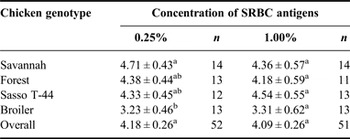
Response of local chickens to SRBC antigen decreased with increased dosage of the antigen, while for the broiler and Sasso T-44, the response increased (Table 2). Furthermore, irrespective of the dosage level, response to SRBC antigen dosage was lowest in the broiler.
Antibody response of chicken genotypes to different concentrations of SRBC 1 .

1 Within columns means followed by different superscripts are significantly different (P < 0.05).
n = sample size.
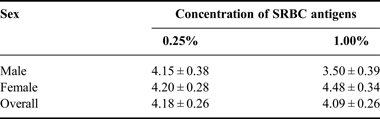
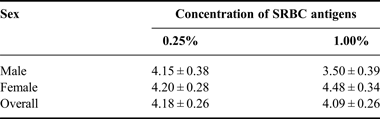
Antibody titre values decreased with increased SRBC concentration in males (negative correlation) but increased in females (positive correlation) with increased SRBC concentration (Table 3).
Antibody response of male and female chicken to different concentrations of SRBC antigens.
Discussion
Antibody levels are important dynamic parameters of immune response as they partially reflect the potential of an animal to resist pathogen infection (Geng, Reference Geng2007). Immune response provides vertebrates with an important mechanism to fight pathogens and reduce disease incidence. Local, Sasso T-44 and broiler chickens responded differently to inoculation of SRBC antigens. Local and Sasso T-44 chickens showed the best immune response to inoculation with SRBC antigens compared with commercial broilers. This could be attributed to the fact that the Sasso T-44 is a scavenging chicken genotype in France and therefore could have similar immunological abilities as local Ghanaian chickens. Local chickens raised in extensive scavenging systems are likely to face more health challenges and hence are likely to be more immunocompetent. For instance, Egyptian indigenous naked neck and normally feathered chickens have been reported to have better immune response than commercial chicken lines (El-Safty, Ali and Fathi, Reference El-Safty, Ali and Fathi2006). Rajkumar et al. (Reference Rajkumar, Reddy, Rama Rao, Radhika and Shanmugam2011) also reported higher antibody response in naked-neck breeds of chicken. In a study on antibody responses to different dosages of SRBC in lines of chickens selected for high and low antibody response to SRBC, Boa-Amponsem et al. (Reference Boa-Amponsem, Dunnington, Pierson, Larsen and Siegel2000) found differences in patterns of antibody response to SRBC according to line, resulting in interactions of line by dosage by day.
Results of antibody titre values reported for the experimental chickens in the present study (3.27–4.54) are higher than the range of 1.2–2.8 reported for white leghorns for inoculation periods of between 3 and 10 days (Boa-Amponsem et al., Reference Boa-Amponsem, Dunnington, Pierson, Larsen and Siegel2000). This can be attributed to both genotype and environment and their interaction specifically for the imported Sasso T-44 chicken. Antibody titre values for the male experimental chicken ranged from 3.16 to 4.15 and this falls within the 1.3–8.9 range reported for White Leghorn male chicken (Kuehn et al., Reference Kuehn, Price, Honaker and Siegel2006). However, average antibody titres of 0.3–2.5 recorded for White Leghorn males (Syrjanen and Naukkarinen, Reference Syrjanen and Naukkarinen1982) and 1.4–3.0 (Boa-Amponsem et al., Reference Boa-Amponsem, Dunnington, Pierson, Larsen and Siegel2000) are below what was observed for males (3.16–4.15) in the present study due probably to the higher immune response status of local chickens. Results of the present study confirm previous findings that highly selected chicken populations have less immunity than unselected stocks (Siwek, Reference Siwek2005). This can be attributed to the fact that intensive selection for production traits impairs the capability of poultry to generate protective immune response and disease resistance (Adriaansen-Tennekes et al., Reference Adriaansen-Tennekes, de Vries Reilingh, Nieuwland, Parmentier and Savelkoul2009) The local chicken ecotypes, therefore, have good immune status that should be maintained or improved through selection. Chickens selected for high antibody response to SRBC showed higher resistance to some infectious diseases such as Marek's and Newcastle diseases (Gross et al., Reference Gross, Siegel, Hall, Domermuth and DuBoise1980; Dunnington et al., Reference Dunnington, Martin, Brilles, Brilles and Siegel1986).
Differences were observed in antibody titres between male and female local chickens; hens had higher antibody titres against SRBC than cocks. This finding agrees with the results of other studies and might be because of male and female antibody titres being genetically different traits, because of the genes being located on the sex chromosome (Bovenhuis et al., Reference Bovenhuis, Bralten, Nieuwland and Parmentier2002). Our results of antibody titre values reported for local chickens and Sasso T-44 chicken are also higher than the range of 1.2–2.8 reported for White Leghorns for inoculation periods of between 3 and 10 days although the titre value of the broiler fall within this range. Kuehn et al. (Reference Kuehn, Price, Honaker and Siegel2006) reported antibody titre values in response to SRBC inoculation ranging from 1.3 to 8.9 for White Leghorn males which captures our observed values for the male chicken population.
Conclusions
Local chicken ecotypes and Sasso T-44 chicken have comparable primary sensitivity to SRBC inoculation. This sensitivity is higher compared with broilers because of the adaptability of local chickens to environmental stressors including disease antigens. Female chickens express more antibodies when inoculated with SRBC than their male counterparts. Increasing the concentration of SRBC antigens was responded to positively with increased antibody titres in all the ecotypes except the savannah local chickens. In addition male chickens responded negatively to increased SRBC inoculation. It is recommended that further work be carried out to determine secondary immune responses in local chicken as well as genetic correlations between immune response and production traits especially on farm. For instance, it will be useful to know if the low immune response of broilers is a result of their superior growth rates. This information will be vital for the development of a breed improvement programme for local chickens.
Acknowledgement
Appreciation is expressed to the Project on Promoting Sustainable Development in Agricultural Research Systems in the South (DURAS) for permission to use data and the University of Ghana Graduate Fellowship Programme for award of fellowship to R. Osei-Amponsah.