INTRODUCTION
Across the first year of life, infants demonstrate capacities for rapid learning of input regularities (Saffran, Aslin & Newport, Reference Saffran, Aslin and Newport1996). Perceptual capacities enabling learning of these regularities have been demonstrated in experimental laboratory paradigms. However, to fully investigate the role of input in early learning of ambient language regularities, the nature of segmental distribution patterns available to infants in their natural communication environment should be investigated.
Previous studies of early ambient language learning have primarily focused on phonological structures in adult-directed speech (ADS) or used language dictionary counts (e.g. Boysson-Bardies, Halle, Sagart & Durand, Reference Boysson-Bardies, Halle, Sagart and Durand1989; Levitt & Aydelott-Utman, Reference Levitt and Aydelott-Utman1992; Teixeira & Davis, Reference Teixeira and Davis2002). In the daily communication environment between caregivers and infants, however, caregivers talk to their infants using a speech register termed infant-directed speech (IDS) (Fernald, Reference Fernald, Barkow, Cosmides and Tooby1992; Fernald, Taeschner, Dunn, Papousek, Boysson-Bardies & Fukui, Reference Fernald, Taeschner, Dunn, Papousek, Boysson-Bardies and Fukui1989). IDS is described as being redundant and simplified as well as containing modifications tuned to the child's level of language capacity (e.g. Snow, Reference Snow1972). Studies investigating infants' early ambient language learning have made the assumption that segmental distribution patterns are consistent across ADS and IDS (Boysson-Bardies et al., Reference Boysson-Bardies, Halle, Sagart and Durand1989; Levitt & Aydelott-Utman, Reference Levitt and Aydelott-Utman1992; Teixeira & Davis, Reference Teixeira and Davis2002). Comparison of phonetic properties of connected speech samples in ADS and IDS within one language environment can help to describe more closely the nature of naturally occurring input from the ambient language available to the infant in this early period.
Infant-directed speech and baby talk
A number of studies have examined semantic, syntactic and acoustic characteristics of IDS (Fernald et al., Reference Fernald, Taeschner, Dunn, Papousek, Boysson-Bardies and Fukui1989; Newport, Gleitman & Gleitman, Reference Newport, Gleitman, Gleitman, Snow and Ferguson1977; Snow, Reference Snow1972). These results suggest that mothers modify their speech to facilitate their infant's learning of speech and language. Fernald & Morikawa (Reference Fernald and Morikawa1993) have noted that mothers exhibit certain intuitive skills that compensate for their child's limited cognitive and linguistic abilities when they adjust their language input to their infant's developmental level. However, few studies of segmental characteristics of IDS are available and the role of segment input in IDS has not been comprehensively addressed. If mothers use simplistic syntactic structures and limited lexicons focusing on activities and events in the immediate surroundings of their infants, do these input alterations affect phonetic features in mothers' speech?
Three decades ago, Ferguson (Reference Ferguson, Snow and Ferguson1977) qualitatively described phonological characteristics of baby talk (BT) style across fifteen languages. He analyzed phonological processes in words which were modified and spoken to infants. Ferguson proposed that baby talk includes several simplification processes: any difficult, complex and marked sounds are often substituted with easier, simpler and less marked ones. According to Ferguson, “sounds of adult speech which require more delicate adjustments in articulation (e.g. fricatives) or are marked by having special added features (e.g. glottalization) are low frequency in BT, reflecting either avoidance of these sounds in the selection and creation of words or a process of substitution which replaces them by simpler sounds in BT” (p. 217). While labial and apical stops and nasals predominate, /r/could be replaced by either apical stops (i.e. /d/and /t/) or the liquid consonant /l/. Otherwise /r/becomes a semi-vowel (i.e. /y/and /w/) or is entirely omitted.
Ferguson (Reference Ferguson, Snow and Ferguson1977) also reported that various assimilatory processes such as consonant and vowel harmony occurred often, resulting in reduplicated canonical forms in the BT register. He noted that the middle consonant or both consonants in canonical forms may be geminated. For example, in Japanese and Syrian Arabic, geminate consonants could be often found in BT such as pop:o ‘birdie’ (Japanese), dud:u ‘butter’ and p:ap:a ‘bread’ (Syrian Arabic). Ferguson reported detailed phonological processes of BT in various languages but he only provided qualitative descriptions, without statistical analysis. Further, his observations were based on the words modified for infants in BT. He did not describe words that were not modified. IDS may include both baby-talk words and other unmodified words. In order to obtain a comprehensive understanding of the phonological characteristics of IDS, quantitative analysis of all consonant and vowel properties in the course of mother–infant interaction should be conducted.
Vihman and colleagues have characterized phonetic input such as consonant place and manner and phonotactic structures in IDS for English, French and Swedish (Vihman, Kay, Boysson-Bardies, Durant & Sundberg, Reference Vihman, Kay, Boysson-Bardies, Durand and Sundberg1994). The speech of fifteen mothers (five per language) whose infants were aged 1 ; 0–1 ; 1 was analyzed. Three categories of the mothers' speech (i.e. running speech, content words and initial consonants) were compared with target words attempted by the children. One of the main purposes of the study was to address whether the sample of target words used in previous studies (e.g. Boysson-Bardies & Vihman, Reference Boysson-Bardies and Vihman1991) was a representative sample of the natural input to infants. Vihman and colleagues found that content words in mothers' IDS speech were significantly different in both consonant manner and place from the citation forms of the target words.
Zamuner (Reference Zamuner2003) reported number and percentage of coda consonants among language samples including dictionaries, words in the MacArthur Communicative Development Inventory (CDI), and Child Directed Speech (CDS) from the CHILDES database. She did not include comparative analysis of ADS. Two dictionaries, the Random House Dictionary (Flexner, Reference Flexner1987) and the Webster's Dictionary (Webster, Reference Webster1964), showed similar percentages of each phoneme. Based on the Random House Dictionary, /l/(11·5%), /n/(10·3%), and /t/(10·2%) were ranked as the three most frequent among twenty-one possible coda consonants. In contrast, /t/(25·4%), /r/(12·9%) and /n/(10·2%) were the three most frequent consonant codas in CDS. Zamuner only reported coda consonants. She did not analyze overall characteristics of consonants and vowels in CDS.
Ferguson (Reference Ferguson, Snow and Ferguson1977) suggested that a promising approach for describing mothers' speech to infants would be to compare mothers' speech to other adults and mothers' speech to infants. Previous studies of segmental distribution of IDS have described characteristics of specific segments without a comparison group of ADS within the same language. To precisely characterize the learning model for ambient language phonology available to the child in naturally occurring connected speech input, differences between IDS and ADS should be outlined.
Infant speech production
In contrast to the infant's early ability to rapidly learn to perceive ambient language regularities, production patterns in spontaneously produced vocalizations show considerable restriction through the entire period of babbling (e.g. Davis & MacNeilage, Reference Davis and MacNeilage1995; Locke, Reference Locke1983). For example, there is a predominance of occlusive (stops and nasals) rather than constrictive (e.g. fricatives) consonants, and of vowels in a restricted region of the vowel space (e.g. mid, low-front and central). These restricted patterns have been termed a ‘motor core’ (MacNeilage, Davis, Kinney & Matyear, Reference MacNeilage, Davis, Kinney and Matyear2000).
A recent study of six Korean-learning infants' babbling (Lee, Reference Lee2003) reported that labial consonants predominated in babbling, followed by coronals and dorsals. For consonant manner, stops, nasals and glides were predominant. Fricatives, affricates and liquids together accounted for only 6% of sounds. Low vowels were most frequent, followed by mid vowels. High vowels were least frequent. In the front–back dimension, central vowels were most frequent, followed by front and back. The frequencies of occurrence of Korean-learning infants' speech production were not significantly different from English-learning infants, reinforcing the motor-core perspective for the earliest prelinguistic period of acquisition.
Infant production patterns during babbling may also be influenced by perceptual input from the ambient language (Boysson-Bardies et al., Reference Boysson-Bardies, Halle, Sagart and Durand1989; Boysson-Bardies & Vihman, Reference Boysson-Bardies and Vihman1991; Levitt & Aydelott-Utman, Reference Levitt and Aydelott-Utman1992). Boysson-Bardies & Vihman proposed that the rank order of labial consonants in babbling was the same as the target language, arguing that infants' babbling resembles ambient language characteristics. Lee (Reference Lee2003) reported that language-specific sounds in Korean such as fortis and geminate consonants appeared by age 0 ; 10–1 ; 0. These sounds can be observed in English-learning infants' babbling because fortis-like and geminate consonants are within an infant's motoric capacities during babbling (see Vihman & Velleman, Reference Vihman, Velleman, Burton-Roberts, Carr and Docherty2000, for a review of geminate consonants). However, fortis-like and geminate consonants were produced more frequently in Korean-learning infants' babbling than in English-learning infants' babbling (Lee, Reference Lee2003). The early presence of fortis and geminate consonants has also been noted in other studies of Korean infants (Cho, Reference Cho2002; Jun, Reference Jun, Kuno, Lee, Whitman, Maling, Kang, Sells and Sohn2006).
Predominance of a motor core of similar patterns during this earliest developmental period suggests that initial speech-like vocal output is based primarily on characteristics of the infant human's production system. Appearance of ambient-language-specific patterns in infant production systems within or outside of the motor core potentially reveals early learning of salient sound properties for coding meanings in the ambient language context. In considering the earliest appearance of ambient language patterns, two questions may be raised. What is the role of IDS in supporting the emergence of ambient-language-specific sound qualities in infants' babbling? Do caregivers provide any modifications in their infant directed speech to support infants in learning ambient language patterns? One preliminary step toward understanding emergence of precise learning of ambient language regularities is to consider the overall nature of naturally occurring input available to the infant in connected speech, from both IDS and ADS.
Korean IDS is of interest because unique properties of Korean phonology (i.e. the three-way contrast of obstruents and the geminate vs. singleton nasal distinction) have been shown to play a prominent role in baby talk in Korean (Lee & Nakayama, Reference Lee and Nakayama2000). Lee & Nakayama also reported that Korean-speaking mothers' speech was characterized by isolated words and use of a limited number of function words and grammatical morphemes. If certain phonemes frequently appear in these words, they may affect segmental distributions in Korean ADS and IDS.
Linguistic characteristics of Korean
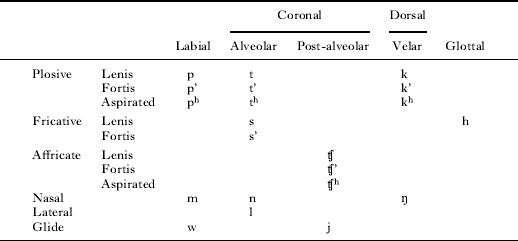
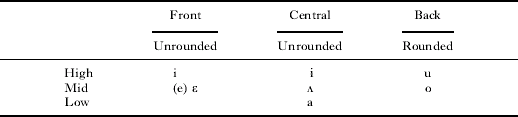
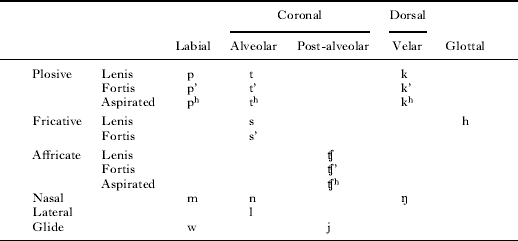
A review of Korean phonology is necessary to evaluate potential differences between Korean IDS and ADS styles. Korean belongs to the Altaic family of languages, including Turkic, Mongolic and Japanese. It has nineteen phonemic consonants and eight monophthong vowels (Hur, Reference Hur1985; see also Tables 1 and 2 in this article). The two mid-front vowels are no longer distinguishable in contemporary Korean; the distinction exists only in orthography. One unique aspect of Korean consonants is that stops and affricates at each place of articulation include three-way distinctions: lenis, fortis and aspirated. Fricatives include only lenis and fortis distinctions. Unlike English, which has only a two-way voiced and voiceless distinction, the three-way distinctions in Korean are based on multiple aspects, but are mainly determined by both voice onset time (VOT) and fundamental frequency (F0). Lenis consonants contain long VOT and low F0, fortis have short VOT and high F0, and aspirated have long VOT and high F0 (see Cho, Jun & Ladefoged, Reference Cho, Jun and Ladefoged2002, for more information). Another unique aspect of Korean phonology is that the same sound in Korean is allowed at the coda of the first syllable and at the onset of the second syllable, resulting in geminates, for example, /mamma/‘meal’ in baby talk, /ʌmma/‘Mommy’. English also has a geminate nasal, such as in roommate, but it appears only in a compound word.
Several studies have reported frequency of occurrence for Korean phonemes based on dictionaries (Yoo, Reference Yoo1985), elementary school textbooks, manuscripts from radio programs (Jin, Reference Jin1993) and conversational speech (Park, Reference Park2000). Across these contexts, stop consonants are the most frequent manner followed by nasals. Liquids, fricatives and affricates follow, although the order is slightly different across studies. Coronal place (including alveolars and post-alveolars) is most frequent, followed by dorsals, labials and glottals. Among obstruents, lenis is the most frequent. Fortis and aspirated are less frequent, showing similar percentages of occurrence (Park, Reference Park2000). The low central /a/is the most frequent vowel in Korean. Next in order of frequency are the high front /i/, mid-central vowel /ʌ/and high-back vowel /u/. One difference in dictionary-based studies versus textbooks or narrative materials is that vowel /ɨ/is frequently observed in textbooks and narrative materials, but not in dictionary counts, since /ɨ/often occurs in Korean function words (Jin, Reference Jin1993).
Morphosyntactic issues may also influence segmental properties in Korean. A brief discussion of Korean syntactic and morphological structures follows. Korean is an agglutinating language, with a Subject-Object-Verb sentence structure. A long chain of particles or suffixes may be attached to nominals or predicate stems. Korean case particles are postpositional function words that indicate the syntactic relation or delimit the meaning of the element with respect to other constituents of the sentence (Sohn, Reference Sohn1999). In the sentence Chelswu-ka sakwa-lul mekkeyo ‘Chulsoo eats an apple’, ka represents a subject particle and lul represents an object particle. Sohn lists thirty-eight case particles for Korean (see Appendix A). The agglutinative nature of Korean is reflected in inflectional suffixes attached to predicate stems (see Sohn, Reference Sohn1999). Annyeng-ha-sey-yo? ‘How are you?’ is composed of four morphemes: annyeng ‘peace’, ha ‘be’, sey ‘subject honorific’ and yo ‘polite sentence ender’. Annyengha is an adjective stem which is formed by attaching ‘ha’ to noun ‘annyeng’. These morphosyntactic characteristics may make sound properties different between ADS and IDS. Certain case particles (e.g. objective case particle) and inflectional suffixes (e.g. subject honorific) are not often produced in IDS.
Goals of study
The purpose of this study is to precisely characterize the nature of connected speech input available to infants for learning from ambient language patterns. Frequency of each consonant and vowel category in Korean infant-directed speech and adult-directed speech will be compared. The three types of obstruents and the presence of geminates are of interest with respect to Korean phonological input frequency, as they represent unique aspects of the ambient language. Specific aims in this study are to compare frequencies of the following sound characteristics between Korean ADS and IDS: (1) general consonant categories, grouped by place and manner of articulation; (2) lenis–fortis–aspirated distinctions; (3) geminate/singleton nasal consonants; and (4) vowel categories, grouped according to vowel height and front/back dimensions. Frequency of certain semantic and morphological properties will be also analyzed. This analysis will examine whether the frequencies of these morphological and lexical characteristics of input affect the frequency of IDS and ADS sound categories.
METHOD
Participants
Ten native Korean-speaking mothers and their infants, living in Austin and Fort Worth, Texas, participated. Three criteria were applied to select participants. Mothers had infants who were aged approximately 1 ; 0. They spoke only Korean to their infants and had experienced limited exposure to American culture and the English language. Mothers were wives of graduate students at either the University of Texas at Austin or Southwestern Baptist Seminary in Fort Worth, Texas. Ten Korean-speaking women in the Milwaukee, Wisconsin, area were also employed for the ADS sample. All were native Korean speakers, either students or wives of graduate students at various universities in the Milwaukee area. Five were married and had children ranging in age from five to thirteen years. All participants had at least a high school education and had been in the US for only two to three years.
Data collection
IDS samples
IDS recordings took place in each participant's home. Mothers wore a small traveling bag on their waist holding a Sony Minidisc Recorder MZ-N10. A MM-Lapel-1 microphone connected to the recorder was clipped to their clothing. First, the mothers were asked to play with their infants for approximately one to two minutes as they normally did, using naturally available toys. Subsequently, four specific types of toys were provided for further conversational samples. Toys included a pair of stuffed animals (e.g. a dog and a pig), a pair of vehicles (e.g. truck and car), toy foods (e.g. fruits and vegetables) and a miniature house with family members (e.g. Daddy, Mommy and baby). Stuffed animals and vehicles were selected because they are the most popular toys which mothers use in their interactions with children across various cultures (Fernald & Morikawa, Reference Fernald and Morikawa1993). Toy foods and a miniature house with family members were used because infants' daily activities with their primary caregivers can be reflected through play. These types of toys have also been used in several previous studies investigating mothers' speech characteristics (e.g. Fernald & Morikawa, Reference Fernald and Morikawa1993). Mothers were asked to play with their infants for approximately five minutes with each set of toys. However, they were allowed to incorporate their infant's own toys or other objects if they wished. Conversational content of the play samples was not directed by the researchers. Approximately twenty to thirty minutes was taken to complete the session per participant.
ADS samples
A twenty- to thirty-minute conversational interview between each Korean-speaking female and the primary investigator, a native Korean speaker, was conducted. Interviews occurred in either the participant's home or the Speech Acoustics Lab at the University of Wisconsin-Milwaukee. A Sony Minidisc Recorder MZ-N10 with a MM-Lapel-1 microphone clipped to the speaker's clothing was used for recording. The session began with a five-minute introduction period to explain the procedure. The same toys used for the IDS sample were provided to avoid any possible bias created by different conversational topics. Each speaker was asked to talk about any idea which came to mind when she saw each set of test materials. Samples were not otherwise controlled by the researcher.
Data analysis
IDS and ADS samples were transcribed using IPA symbols by the primary investigator. English words, interjections and infant names including case particles were initially excluded. Only few English words (less than five words per subject) were produced and eliminated from analysis. The first 250 syllables produced with each set of test materials in the ADS and IDS samples were selected. In total, 10,000 syllables of ADS and 10,000 syllables of IDS were obtained for analysis (i.e. 250 syllables∗4 types of test materials∗10 participants). A previous study reported no significant difference in phoneme frequency between 1,000 and 2,000 syllables in Korean (Park, Reference Park2000). Thus, 1,000 syllables per participant were considered valid for examining segmental distribution in Korean.
All transcribed data were analyzed using the Logical International Phonetic Program computer software (LIPP; Oller & Delgado, Reference Oller and Delgado1990). The Korean consonants and vowels listed in Table 1 and 2 were transcribed. In addition, the most frequently produced allophones [b, d, g, ʃ, ʤ, ɾ ] were also transcribed. The lenis [p, t, k, ʧ ] sounds become voiced [b, d, g, ʤ ] between vowels. Korean /s/and /l/are pronounced as [ʃ ] and [ɾ ] in certain contexts. All transcribed consonants were characterized for place of articulation as labials ([m, b, p, p', pʰ, w]), coronals ([n, d, t, t', tʰ, j, s, s', ʃ, ʤ, ʧ, ʧ ', ʧ ʰ ]), dorsals ([ŋ, g, k, k', kʰ ]) and glottal [h]. Manner of articulation categories included stops ([b, p, p', pʰ, d, t, t', tʰ, g, k, k', kʰ ]), nasals ([n, m, ŋ ]), fricatives ([s, s', ʃ ]), affricates ([ʤ, ʧ, ʧ ', ʧ ʰ ]), glides ([w, j]) and liquids ([ɾ, l]). Nasal consonants were categorized as singleton ([n, m]) or geminate ([nn, mm]) consonants. Obstruents (stops, fricatives and affricates) were grouped into lenis, fortis and aspirated. Vowels were categorized into seven categories: high-front [i], mid-front [ε ], high-central [ɨ], mid-central [ʌ], high-back [u], mid-back [o] and low-central [a]. As mentioned earlier, the mid-front vowels /e ε /were considered as [ε ]. These consonant and vowel categories were used for both speech styles.
Inventory of Korean consonants
Inventory of Korean monophthong vowels
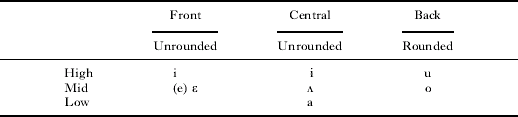
note: (e) only exists in orthography in contemporary Korean.
Mixed ANOVAs and t tests were conducted for consonant and vowel categories to compare ADS and IDS categories at α=0·05. Using Bonferroni correction, a new alpha level was determined by 0·5, divided by the numbers of main effects for each analysis category. New alpha levels are indicated in Tables 3 and 4.
A second native Korean speaker, a trained phonetic transcriber who was blind to the study's hypotheses, conducted transcription reliability for all samples using a point to point agreement method. This method compared agreement between transcribers based on an all or none principle for each consonant and vowel category (McReynolds & Kearns, Reference McReynolds and Kearns1983). Twenty percent of the utterances were randomly selected for transcription. Average reliability for consonants was 98·2% for ADS and 98·5% for IDS. Vowel reliability was 96·5% and 96·1% for ADS and IDS, respectively. Reliabilities for fortis and geminate consonants were calculated separately. On average, 95% (ADS) and 91% (IDS) agreements for fortis and 97% (ADS) and 98% (IDS) for geminate consonants were obtained.
RESULTS
Overall characteristics
The mean number of utterances across speakers was 76 in ADS and 185 in IDS. IDS contained significantly simpler and shorter utterances than ADS (t(18)=10·22, p<0·001). On average, each utterance in ADS and IDS was composed of 13·3 (SD=2·38) and 5·4 (SD=0·51) syllables, respectively. IDS contained significantly more isolated words/phrases than ADS (t(18)=−8·02, p<0·001). ADS averaged 10·2 isolated words/phrases (SD=3·01); IDS contained 78·2 (SD=26·66).
Consonants
A total of 12,500 consonants in ADS and 11,800 consonants in IDS were analyzed. The total exceeded 10,000 based on the presence of consonant clusters. A t test revealed that consonants in ADS (M=1,250, SD=24·07) were significantly more frequent than in IDS (M=1,180, SD=43·36) (t(18)=4·48, p=0·001). ADS contained more clusters (e.g. /kwan/) and final consonants per syllable/word than IDS.
Consonant manner
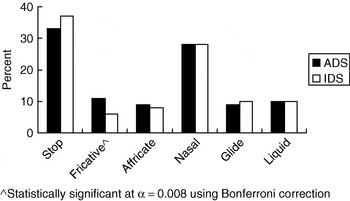
Figure 1 shows the percentages of each consonant manner in the two samples. Stop consonants (33% for ADS and 37% for IDS) were the most frequent category, and nasals were second in frequency (28% for both ADS and IDS). The third most frequent consonant manner in ADS was fricative (11%). In contrast, fricatives accounted for 6% in IDS, the smallest percentage. Percentages of glide (9% for ADS, 10% for IDS), liquid (10% for both) and affricate (9% for ADS, 8% for IDS) manners were similar in both speech styles.
Percent of each consonant manner of articulation.

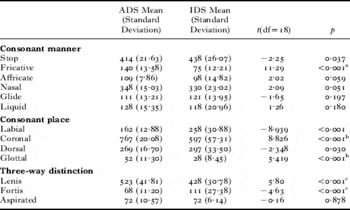
A two-way mixed ANOVA with group as a between-subject factor (two levels: ADS, IDS) and consonant manner as a within-subject factor was completed. A significant two-way interaction (F(5, 90)=14·77, p<0·001, η2=0·451) was present, as well as a significant main effect for consonant manner (F(5, 90)=1280, p<0·001, η2=0·986) and a significant main effect for group (F(1, 18)=20·14, p<0·001, η2=0·528). Six independent t tests for each consonant manner were conducted comparing ADS and IDS to analyze frequency of each consonant category. Mean, standard deviation, t and p values are shown in Table 3. Using Bonferroni correction, alpha level was set at 0·008. There was a significant difference for fricative manner. However, no other manner categories showed significant differences between the two speech styles.
Consonant ADS and IDS comparisons

a Statistically significant at α=0·008 using Bonferroni correction.
b Statistically significant at α=0·0125 using Bonferroni correction.
c Statistically significant at α=0·0167 using Bonferroni correction.
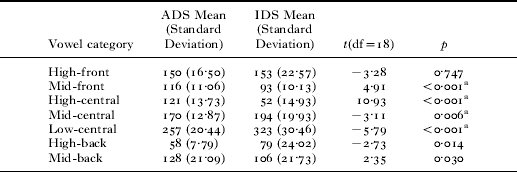
Vowel ADS and IDS comparisons
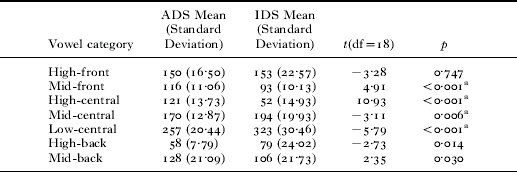
a Statistically significant at α=0·007 using Bonferroni correction.
Consonant place
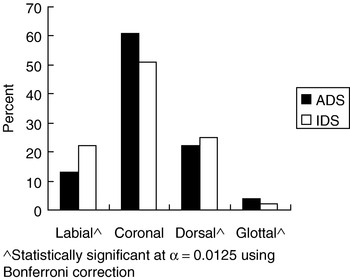
Figure 2 shows the percentages of the four consonant places analyzed in the ADS and IDS samples. Coronal place was the most frequent in both ADS (61%) and IDS (51%). Dorsal (22% for ADS, 25% for IDS), labial (13% for ADS, 22% for IDS) and glottal (4% for ADS, 2% for IDS) consonants were produced in that order of frequency in both speech styles.
Percent of each consonant place of articulation.

A two-way mixed ANOVA indicated significant main effects for group (F(1, 18)=19·18, p<0·001, η2=0·516) and for consonant place (F(3, 54)=1545·12, p<0·001, η2=0·988) as well as a significant interaction (F(3, 54)=65·72, p<0·001, η2=0·785). Independent t tests revealed significant differences for all places except for dorsal between the two speech styles. Mean, standard deviation, t and p values are shown in Table 3. Coronal and glottal places were significantly more frequent in ADS and labial place was significantly more frequent in IDS.
Fortis–lenis–aspirated distinctions
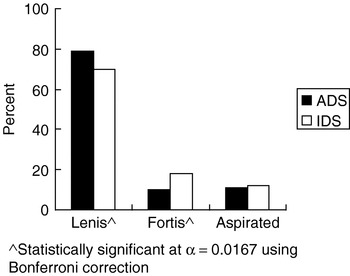
Figure 3 shows the percentage of the three-way stop and affricate distinctions analyzed in ADS and IDS. The most frequent sound occurrence was lenis for both speech styles (79% for ADS, 70% for IDS). The fortis and aspirated sounds were almost equally present in ADS (10% for fortis, 11% for aspirated). In IDS, the fortis sound was more frequent (18%) than the aspirated (12%).
Percent of the three-way distinction in Korean obstruents.

A mixed ANOVA revealed significant main effects for group (F(1, 18)=11·72, p<0·001, η2=0·394) and for three-way distinctions (F(2, 36)=1397·68, p<0·001, η2=0·987), as well as a significant interaction effect (F(2, 36)=33·91, p<0·001, η2=0·653). Independent t tests indicated that there were significant differences between IDS and ADS relative to the frequency of lenis and fortis sounds (see Table 3). Lenis consonants were significantly more frequent in ADS while fortis consonants were significantly more frequent in IDS. However, aspirated consonants were not significantly different between the two speech styles.
Geminate nasal consonants
The majority of nasal consonants were produced as singleton (non-geminates) in both speech styles. The mean frequency and standard deviation of singleton nasals in ADS was 290 (23·75). In IDS there were 212 (29·46). The mean frequency and standard deviation of geminate nasals in ADS were 9·6 (5·16); in IDS there were 24·7 (7·66). A mixed ANOVA showed significant main effects for speech style (F(1, 18)=2661·24, p<0·001, η2=0·668) and for geminates (F(1, 18)=1128·68, p<0·001, η2=0·984) as well as a significant interaction effect (F(1, 18)=44·27, p<0·001, η2=0·711). Geminate nasal consonants were significantly more frequent in IDS. Singleton non-geminates were more frequent in ADS.
Vowels
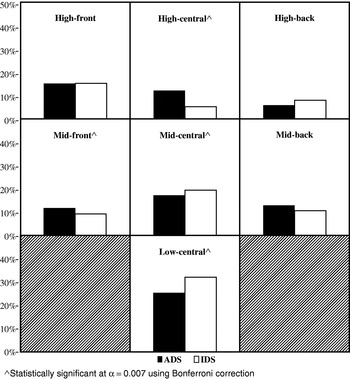
Figure 4 shows the percentages of each vowel category in ADS and IDS. The order of frequency in the two speech styles was very similar except for the high-central vowel category. The high-central vowel [ɨ] was the fifth most frequent vowel in ADS while it was the least frequent in IDS. Low-central [a] was most frequent and mid-central [ʌ], high-front [i] and mid-back [o] appeared in descending order in both speech styles. In ADS, mid-front [ε ] appeared as second least frequent and high-back [u] was the least frequent vowel. In IDS, the mid-front and high-back vowels were produced a bit more frequently than the high-central [ɨ] vowel.
Percent of vowels in each category.

Seven independent t-tests were conducted to examine whether the percentage of each vowel category was significantly different between ADS and IDS. Mean, standard deviation, t, and p values are shown in Table 4. Four out of seven vowel categories were different between the two types of speech. Mothers produced more mid-central and low-central vowels in IDS, while ADS speech resulted in more mid-front and high-central vowels. There were no differences in high-front, high-back, and mid-back vowels.
Lexical and morphological factors
To investigate whether these segmental differences between the two types of speech were influenced by Korean lexical and morphological characteristics, frequencies of occurrence of baby-talk words, case particles and the types of words containing fricative consonants in ADS and IDS were compared.
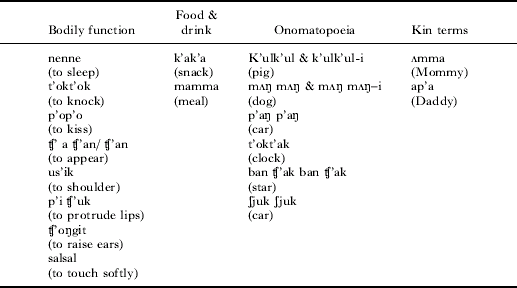
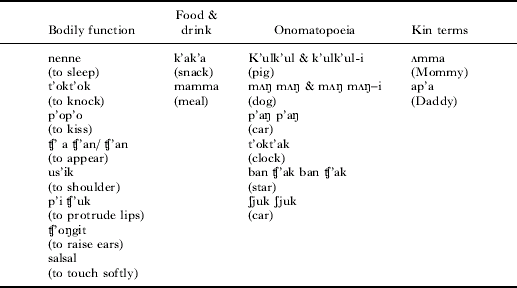
Baby-talk words. Various baby-talk words were observed in Korean mothers' speech to their infants. Reduplication of identical or non-identical syllables frequently occurred (e.g. /mamma/, /k'ak'a/and /k'ulk'ulk'ulk'ul/), resulting in multisyllable words. These words can be categorized into bodily function, food and drink, onomatopoeia, and kin terms (see Table 5). On average, 130 syllables (13% of the total syllables) were composed of baby-talk words in Korean IDS (SD=33). Among the 130 syllables, on average, 34 fortis and 14 nasal geminate consonants were found. Korean adult speakers only produced kin terms in ADS (e.g. /ʌmma/‘Mommy’ and /ap'a/ ‘Daddy’). On average, 5 kin terms (10 syllables) were produced.
Baby-talk words in Korean IDS
Case particles
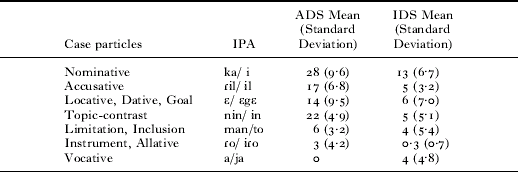
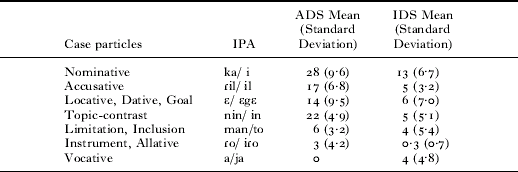
The most frequent case particles (i.e. nominative, accusative, dative, goal, locative, topic-contrast, instrument, limitation and vocative) were calculated for both ADS and IDS. Table 6 shows means and standard deviations. The average number of case particles in ADS and IDS were 89 and 38, respectively. Nominative case particles, which include [a] and [i] vowels, were the most frequent in both ADS and IDS. Topic contrast, accusative and instrument case particles, which contain the high-central vowel [ɨ], and locative, dative and goal case particles, which contain the mid-front vowel [ε ], were frequent in ADS. However, the case particles with [ε ] and [ɨ] vowels were not frequent in IDS.
Comparison of ADS and IDS case particles
Lexical items with fricatives
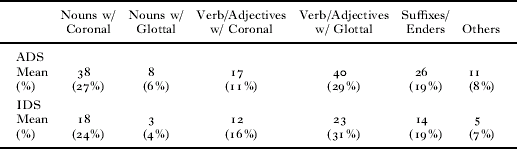
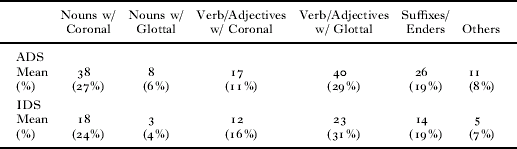
Because fricative manner in IDS was significantly different from ADS, the frequency of lexical items containing fricative consonants was additionally analyzed to examine whether the different frequencies of fricatives in ADS and IDS could be attributed to types of words. Words containing fricatives were categorized as noun, verb, suffixes/enders and others. Nouns and verbs were further categorized into words containing coronal fricatives [s] and [s'] and words containing glottal fricative [h] (e.g. hada ‘do’). The frequency of suffixes and clause enders which contained coronal fricatives was calculated. The suffixes included the perfect/past tense suffix ess, the past past/past perfect suffix ass-ess or ess-ess and the honorific suffix si. The embedded clause enders included conjunctor enders such as se or kose ‘and then or so’, myen-se ‘while … at the same time’ and past prospective relativizer ender ess-ul. The ‘other’ category includes adverbs and lexical items, which do not belong to the other categories.
Table 7 shows mean frequencies and percentages of the six morphemes. The mean frequencies of all six types of morphemes in ADS were higher than in IDS. Almost twice as many fricatives were produced in nouns and ‘others’ in ADS than in IDS. In addition to frequency, various types of words were produced in ADS while more limited types were observed in IDS. Table 8 shows the total number of nouns with coronal and glottal fricatives, verb/adjectives with coronal and glottal fricatives, and adverbs produced in ADS and in IDS.
Lexical items containing fricative consonants
Word types containing fricative consonants

Only 22 nouns with coronal fricatives were produced in IDS while 83 nouns with coronal fricatives were present in ADS. The 22 IDS nouns were restricted in terms of target objects, such as subak ‘watermelon’ sakwa ‘apple’, son ‘hand’ and onomatopoeia. However, the 83 ADS noun types included abstract nouns such as sako ‘thinking’, silmang ‘disappointment’ and siya ‘vision’. In ADS, adult speakers attached hada to various nouns to form adjectives and verbs; for example, talkhomhada ‘be sweet’, kongkyekhada ‘attact’. In contrast, mothers only used five types of verbs or adjectives ending with hada in IDS; for instance, saranghada ‘love’, coahada ‘like’, chayngphihada ‘be shameful’, p'op'ohada ‘kiss’, salsalhada ‘do softly’ and t'okt'okhada ‘knock’. Finally, ADS speakers used various types of adverbs while IDS speakers used only three adverbs, such as usen ‘first of all’, tasi ‘again’ and salc'ak ‘softly’.
Discussion
The role of input is considered as an important variable in understanding the nature of early learning of ambient language regularities. Laboratory studies have indicated that children display sophisticated capacities for learning from input regularities in experimental settings by age 0 ; 10. The nature of input in natural communication settings has often been assessed in terms of descriptions of the ambient language phonology of ADS. However, the potential for phonological properties of IDS to influence infants' learning of ambient language regularities in a natural communication environment has not been frequently assessed.
The purpose of this study was to compare the characteristics of consonants and vowels in IDS with those of ADS in Korean in order to examine frequency distribution patterns between the two types of speech. Of particular interest was the three-way (lenis–fortis–aspirated) obstruent distinction, and geminate nasal consonants. The effect of lexical and morphological characteristics on the frequency of sound categories was also observed. Results revealed that Korean-speaking mothers use simpler speech forms in IDS compared to ADS. In terms of consonants, Korean-speaking mothers using IDS displayed more labial consonantal place and less frequent coronal and glottal place and fricative manner than in ADS. With respect to vowels, Korean-speaking mothers showed more use of mid- and low-central vowels in IDS than in ADS. Analyses of the lenis–fortis–aspirated distinction and the geminate nasal consonant revealed that in IDS, Korean-speaking mothers produced significantly more fortis and geminate and less lenis consonant phonemes than in ADS. In terms of the lexicon and grammatical morphemes, IDS speakers used more frequent baby-talk words than ADS speakers, but produced lexical and grammatical morphemes containing fricative consonants and case particles containing the mid-front vowels [ε ] and [ɨ] less than ADS speakers.
The differences observed may be related to the relative complexity demands associated with production of these manner and place classes. Fricatives are relatively complex in that they require very precise articulatory positioning and aerodynamic control (Kent, Reference Kent, Ferguson, Menn and Stoel-Gammon1992). In contrast, labials are relatively simple. In infants they may be produced simply with the usual elevation phase of the mandible for consonants, and typically involve a neutral tongue position. They therefore require relatively less articulatory precision than fricatives (Davis & MacNeilage, Reference Davis and MacNeilage1995). Also, labials are produced with a lip-rounding gesture, which may provide visual support for perception (Vihman, Reference Vihman1996).
Clearly, Korean-speaking mothers could produce the articulatorily complex phonemes in their speech to infants, as they produced them in ADS. However, they employed less articulatorily complex consonants. What might be the basis of these differences? Such differences may be due to the fact that mothers may tend to match phonetic propensities that are present in infant production repertoires during their interactions with infants. Fernald & Morikawa (Reference Fernald and Morikawa1993) suggest that mothers modify and adjust their speech to complement the perceptual and cognitive immaturity of their infants. They note that mothers are linguistically advanced while infants have limited skills. To reduce the production ability gap between two speakers, mothers may intuitively match their infant's production capacities, thus providing compensation for the asymmetry. Previous studies of infants' babbling (Boysson-Bardies & Vihman, Reference Boysson-Bardies and Vihman1991; Davis & MacNeilage, Reference Davis and MacNeilage1995; Lee, Reference Lee2003) reported that infants produced more labial than dorsal place and more stop than fricative manner of articulation. By producing less articulatorily complex sounds in IDS, Korean mothers may match their articulation characteristics to those of their infants in IDS, adjusting their speech patterns differently than when they employ ADS.
Such segmental modification in Korean IDS is mediated by lexical choice. When mothers interact with their infants, they adjust their conversation to the infant's level by choosing words and grammatical structures appropriate to the infant's level of development. These Korean-speaking mothers chose baby-talk words and simple sentences, which may also underlie the different segmental distributions in IDS and ADS. As Ferguson (Reference Ferguson, Snow and Ferguson1977) noted, baby-talk words included simplifications rather than the articulatorily complex sounds found in ADS. This study also found that thirteen of the eighteen baby-talk words used by mothers in this study contained stop and nasal consonants (see Table 5). However, these findings also suggest that not only baby-talk words but also other words mothers use in IDS are largely composed of sounds that match descriptions of child speech in this developmental period. Only 13% of the total utterances were accounted for by baby-talk words in these samples of Korean IDS. Thus, these Korean IDS patterns are not accounted for only by a high frequency of baby-talk words, as claimed by Ferguson. Rather, choice of words in general involves a more frequent occurrence of articulatorily simple sounds.
The segmental modification of Korean-speaking mothers was not attributed to sound substitution and omission in IDS. Ferguson (Reference Ferguson, Snow and Ferguson1977) reported liquid substitution by glides (e.g. wabbit for rabbit) or omissions as examples of such simplifying processes in English IDS. These Korean-speaking mothers did not show evidence of creating new words or of using these types of substitutions or omissions to replace articulatorily complex sounds with simpler sounds in IDS. The absence of differences in liquid and glide consonant frequencies between ADS and IDS supports the assertion that there were no sound substitutions in Korean IDS. If Korean-speaking mothers substituted glides for /l/or omitted /l/, the frequency of liquid consonants in IDS should be significantly lower than in ADS. However, no omissions or substitutions were found. Since Ferguson's report was conducted almost three decades ago, it might be necessary to investigate if the substitution of sounds still exists in contemporary American IDS. However, it should be noted that the lack of liquid substitution in Korean IDS may be due to the fact that Korean phonology avoids initial liquid consonants by changing them to nasal consonants.
In contrast to words often used in IDS, ADS words more frequently contained articulatorily complex sounds such as fricatives. For example, on average these Korean ADS speakers employed thirty-six nouns containing coronal fricatives while IDS speakers used only fifteen nouns containing coronal fricatives. ADS speakers also used more verbs/adjectives with coronal fricatives than IDS speakers. Thus, the frequency of fricatives may be attributed to the higher frequency of fricatives in ADS speaker's lexicons. Another reason for more fricative consonants in ADS was due to the grammatical differences between the two types of speech. Previous studies have found that mothers' speech is composed of simple grammatical sentences (Newport et al., Reference Newport, Gleitman, Gleitman, Snow and Ferguson1977). Korean ADS speakers used varied tense/aspect while IDS speech was limited to the immediate context. ADS speakers also used compound sentences more often, where IDS speakers used simple sentences. Korean tense/aspect suffixes and embedded-clause endings include coronal fricative consonants, which may affect the overall frequency distribution between ADS and IDS. Lastly, when Korean adults speak to other adults, they usually use the honorific suffix si unless the listener is a familiar younger person. The adult participants in this study often used the subject or addressee honorific suffixes in their ADS speech. Therefore, the difference in fricative consonants between ADS and IDS could be considered a composite of all of these lexical and grammatical differences between the two types of speech.
In addition to mothers matching their speech to infants' speech output, mothers may provide more frequent input of certain sounds in IDS than in ADS in order to enhance infants' learning of precise ambient language sound regularities. Previous studies of Korean-learning infants' speech patterns indicate that they produce frequent fortis and geminate consonants (Cho, Reference Cho2002; Jun, Reference Jun, Kuno, Lee, Whitman, Maling, Kang, Sells and Sohn2006; Lee, Reference Lee2003). The frequent fortis and geminate use by infants may be related to the more frequent presence of fortis obstruents and geminate nasal consonants input in IDS. It should be noted, however, that more frequent fortis and geminate consonants in IDS only occurred compared with Korean ADS. These sounds are generally less frequent compared with other consonants produced in IDS where lenis is more frequent than fortis. The tense consonant is not considered as an easy sound to articulate (Jun, Reference Jun, Kuno, Lee, Whitman, Maling, Kang, Sells and Sohn2006). Then, why might Korean-learning infants produce these sounds early and frequently? It may be due to the fact that the acoustic signature of the sounds may be more perceptually prominent to infants. Fortis is produced by longer duration of stop closure and greater linguopalatal contact, which makes them considered as articulatorily strong stops, compared to the lenis stop (Cho et al., Reference Cho, Jun and Ladefoged2002). When the obstruction is released, the acoustic amplitude and vocal pitch of the following vowel becomes higher than for lenis sounds due to the longer duration of stop closure. These differences result in a sound quality which may be perceptually more prominent for infants (Jun, Reference Jun, Kuno, Lee, Whitman, Maling, Kang, Sells and Sohn2006). Jun addressed several examples where perceptual saliency of tense consonants has been used in adult phonology. In order to intensify expressions, Korean speakers replace the lenis by the fortis consonant. In this study, Korean mothers and adult speakers used tensification (e.g. /pap-to/→[papt'o] ‘rice-also’). The geminate nasal consonants are also called ‘double’ consonants, because the duration of nasal segments is longer compared to singleton counterparts. The longer duration may also result in a more perceptually prominent durational quality for the infant listener. Similar to fortis consonants, nasal geminates could be driven by a phonological process called nasal assimilation (e.g. /ʧ ip-mun/→[ʧ immun] ‘house-door’).
The more frequent fortis and geminate consonants observed in IDS are also related to the frequency of sound tokens which include fortis and geminate qualities. Baby-talk words in Korean IDS often contain fortis and geminate consonants. As can be seen in Table 5, with few exceptions, almost all baby-talk words produced by Korean-speaking mothers contained either fortis or geminate consonants. Therefore, when certain acoustically prominent sounds have high token frequency, infants may incorporate them earlier in their production repertoires. Findings of significantly more frequent fortis and geminate sounds in IDS in addition to the more frequent labial and less frequent fricative consonants suggest that Korean-speaking mothers may not only tend to minimize articulatory complexity, but also maximize perceptual saliency for important ambient language contrasts in IDS.
The frequency of fortis and geminate consonants in IDS may not be due only to mothers' provision of perceptually salient sounds, but also result from mothers matching infants' speech production because these consonants are often observed in Korean-learning infants' speech (Jun, Reference Jun, Kuno, Lee, Whitman, Maling, Kang, Sells and Sohn2006; Lee, Reference Lee2003). In this regard, speech production and perception mechanisms have been considered as two major elements for both adult and child in communication interactions. Vihman's articulatory filter model (Vihman, Reference Vihman, de Boysson-Bardies, de Schonen, Jusczyk, MacNeilage and Morton1993) and Lindblom's H & H theory (Lindblom, Reference Lindblom, Hardcastle and Marchal1990) suggest prominent roles of both production system and auditory perceptual effects in determining the nature of the acquisition process in early periods. Lindblom (Reference Lindblom, Hardcastle and Marchal1990) extends his hypothesis to include these complementary forces as driving the nature of sound systems in languages. His H & H theory hypothesizes articulatory ease and perceptual distinctiveness as two driving forces that interact to maintain intelligible human vocal communication. Therefore, ease of articulation and perceptual salience are not contradictory, rather they complement one another in learning relevant sound contrasts and in maintaining effective communication. In IDS, caregivers may also employ these two mechanisms simultaneously to maximize infants' learning of ambient language regularities.
The aspirated consonant may be also considered as a perceptually salient sound because it is considered as an articulatorily strong sound and is accompanied by high amplitude and pitch of the following vowel onset (Cho et al., Reference Cho, Jun and Ladefoged2002). Then, why do mothers not provide aspirated consonants in IDS more often than in ADS? As mentioned earlier, fricative consonants were not frequently spoken to infants although alveolar fricative /s/and /s'/may be considered as perceptually salient. Perhaps mothers did not employ the aspirated sounds because these sounds are not frequent in infants' speech production output.
If mothers take into account articulatorily easy as well as perceptually salient segments in IDS, an important next question would be how mothers implement both factors. In other words, what factors determine mothers' speech behaviors? Mothers' speech behaviors may be modified according to their infant's age and developmental level of speech. This study focused on infants at age 1;0. In this period, typically developing infants often start to produce their first words. Mothers may be sensitive to infants' speech development and provide articulatorily easier and perceptually salient sounds to enhance their production of early speech forms in first words. Such mothers' modifications, however, may not be seen with very young infants who are not at the onset of word production. Fernald & Morikawa (Reference Fernald and Morikawa1993) also observed developmental changes of mothers' verbal behaviors.
Like consonants, vowel distributions in IDS significantly differed from ADS, although the order of frequency was similar between the two speech styles. Korean-speaking mothers produced significantly more low- and mid-central vowels, and fewer mid-front and high-central vowels in IDS. Although the low-central [a] vowel was frequently produced in the particle ka, which was the most frequent case particle, in ADS, the less frequent use of low-central vowels in ADS compared to IDS suggests that the low-central vowel is strongly preferred in IDS. Low- and mid-central vowels are produced with a relatively neutral tongue movement and mid- and low-central vowels are frequently observed in infant vowel repertoires (Boysson-Bardies et al., Reference Boysson-Bardies, Halle, Sagart and Durand1989; Lee, Reference Lee2003; MacNeilage & Davis, Reference MacNeilage, Davis, Hardcastle and Marchal1990). In the production of low vowels, the jaw is lower, producing a more apparent visual cue. Korean IDS may emphasize such vowels to match infants' articulatory propensities. This type of pattern mirrors the frequency of labial consonants in IDS, which also matches infant's patterns.
Like the low frequency of fricatives in IDS, the lower frequency of mid-front and high-central vowels in Korean IDS may be partially attributed to the low frequency of function words in IDS. These IDS samples contained more isolated words without grammatical case particles than ADS. Among case particles in IDS, nominative case particles were relatively frequent while other case particles were rarely produced. As shown in Table 6, these less frequent case particles are typically composed of high-central or mid-front vowels. Mid-front vowels have been reported in infants' early speech in English and other language environments (Davis & MacNeilage, Reference Davis and MacNeilage1995; Davis, MacNeilage & Matyear, Reference Davis, MacNeilage and Matyear2002; Teixeira & Davis, Reference Teixeira and Davis2002). However, Lee (Reference Lee2003) found that Korean-learning infants produced significantly lower percentages of front vowels compared to English-learning infants. That finding is consistent with the relatively low frequency of front vowels in Korean IDS. Frequency of mid-front vowels could provide a promising avenue to examine the relative role of IDS versus ADS in early speech acquisition.
In summary, this study found differences in consonant and vowel frequency patterns between IDS and ADS. The results of this study have important implications for early speech acquisition. How does a child acquire speech capacities for sounds in the ambient environment? What is the role of IDS? A number of cross-linguistic studies report universal as well as language-specific patterns in infants early speech production patterns by the later babbling period, close to age 1 ; 0. Regardless of ambient language patterns, the early prominence of relatively universal patterns in infants' speech output indicates that infants' production is largely determined by biological capacities related to the production mechanism. By providing words composed of articulatorily simple and acoustically prominent sound patterns, IDS input may serve the function of matching adult input speech to infant sound production capacities. It may also enhance infant learning of ambient language sound properties that are accessible to the infant production mechanism.
The construct of ‘bootstrapping’ may be relevant when considering the influence of IDS input on early infant learning of segmental patterns. Bootstrapping, at the most general level, suggests that infants employ available capacities to extract environmental regularities and enhance their learning process. It has been widely explored relative to syllable and phoneme boundaries and syntactic regularities (see Weissenborn & Höhle, Reference Weissenborn and Höhle2001, for more information). In the present results, prelinguistic Korean infants might be seen as employing both available production output capacities and sensitivity to perceptually salient sound properties to bootstrap their way into the precise nature of their ambient languages.
These results also provide additional evidence relative to the nature and potential importance of input frequency on infant speech acquisition. Most previous studies of segmental analysis have not found consistent similarities between consonant and/or vowel patterns between infants and their ambient phonology, relying on comparisons between infant patterns and ADS or dictionary counts (e.g. Boysson-Bardies et al., Reference Boysson-Bardies, Halle, Sagart and Durand1989; Levitt & Aydelott-Utman, Reference Levitt and Aydelott-Utman1992; Teixeira & Davis, Reference Teixeira and Davis2002). This lack of consistency may be due to the fact that ADS may not represent the usual speech input to children in the formative periods of speech acquisition. Recently, researchers have employed infant- or child-directed speech (CDS) instead of ADS or dictionary counts. These studies have observed closer relationships between input frequency and children's output patterns (Beckman, Kiyoko & Edwards, Reference Beckman, Kiyoko and Edwards2003; Zamuner, Reference Zamuner2003). These studies, however, did not directly compare IDS and ADS. The results of this study comparing IDS and ADS within one language provide evidence that there are differences in phonetic distributions between these two input styles. Future cross-linguistic comparison studies investigating relationships between infant output patterns and naturally occurring ambient speech input should take IDS into account in considering input available to children.
IDS is not necessarily the sole source of input in infant speech acquisition. Both ADS and IDS may be possible influences (see Weijer, Reference Weijer2002). However, a number of studies have shown that speakers modify their speech when addressing an infant (Fernald, Reference Fernald, Barkow, Cosmides and Tooby1992). Thus, IDS is likely to be an input speech style that infants hear the most frequently in early periods of speech and language acquisition. It is important to understand whether ADS and IDS are similar or different in terms of sound distribution frequencies to consider potential effects of this prominent aspect of speech input on infant acquisition of ambient language regularities.
This study examined only Korean. It is not certain whether the same patterns of association for IDS and ADS will be found in other languages. Korean mothers produced less fricative consonants because Korean has only two fricatives. Speakers in other language environments may show different patterns. Also, this study characterized mothers' speech to infants at age 1 ; 0. Further studies should investigate whether mothers' modifications change according to infants' age and developmental level. Ranking of frequency within category may be affected by the number of phonemes and the precise phonotactic rules in a language. For example, the greater frequency of stops than fricatives in IDS may be due to the fact that Korean has nine stop consonants but only two fricatives. These aspects were not considered as significant in this study because the two types of speech are from the same language. The main goal of this study was to compare ADS and IDS segmental frequencies, not to compare frequency of each category within a speech style. However, when this issue is examined cross-linguistically, normalization should be taken into account to obtain more valid comparison of characteristics of input speech patterns. Also, languages have different lexicons, as well as morphosyntactic conventions, which may yield different comparisons between IDS and ADS frequencies. Only a limited set of lexical and morphological issues was analyzed here in order to examine their effects on segmental frequencies. Future studies should include more comprehensive analyses of relationships between lexical and morphological factors and segment distributions.
CONCLUSION
Korean-speaking mothers produced more sounds consistent with infant production patterns as well as perceptually more prominent sound qualities in IDS. These IDS modifications may facilitate speech acquisition by matching input production patterns to infant capacities, as has been shown in other dimensions of input language to infants. Differences between IDS and ADS relative to interactions between semantic and syntactic aspects of language and consonant and vowel frequencies may also be important factors as well. Further studies investigating the role of ambient language input in natural communication environments relative to acquisition of spoken phonology should include consideration of IDS.
APPENDIX A: KOREAN CASE PARTICLES