Introduction
Spermatogonial stem cells (SSCs) have the ability to self-renew and offer a pathway for genetic engineering of the male germ line (Dym & Fawcett, Reference Dym and Fawcett1971; Dym, Reference Dym1994; Encinas et al., Reference Encinas, Crowder, Milbrandt and Johnson2004). In order to maintain the continuous spermatogenic differentiation process, SSCs must give rise to committed spermatogonia (Nagano et al., Reference Nagano, Ebata, Yeh and Zhang2011). Meanwhile, SSCs can provide the foundation for spermatogenesis and they are unique tissue-specific stem cells that have the ability to transfer genetic information to offspring (Schlatt, Reference Schlatt2002; Hofmann, Reference Hofmann2008). As the pluripotent property, SSCs have great potential to be utilized in generating transgenic animals.
Keeping pace with the development and improvement of cryopreservation technology, the preservation of SSCs also becomes the basis of some research areas. It is beneficial to preserve fertility of young males who are subjected to the treatment of Hodgkin's lymphoma, testicular cancer or leukemia (Gouk et al., Reference Gouk, Loh, Kumar, Watson and Kuleshova2011). Moreover, cryopreservation of SSCs has potential values for the spermatogonial transplantation and the analysis of germ cells development as well as the generation of pluripotent cells (Schlatt, Reference Schlatt2002). The cryopreservation of testis cells is first utilized in germ cell transplantation in mice, which generates functional spermatogenesis (Avarbock et al., Reference Avarbock, Brinster and Brinster1996). Meanwhile, it is reported that frozen testis tissues can ultimately harvest SSCs (Bahadur et al., Reference Bahadur, Chatterjee and Ralph2000; Hovatta, Reference Hovatta2001; Keros et al., Reference Keros, Rosenlund, Hultenby, Aghajanova, Levkov and Hovatta2005). However, enriched SSCs from cryopreserved testis are not purified and the efficiency of cryopreservation recoveries is not examined. The cryoprotectants and the cryopreservation protocols used conventional options for freezing–thawing of SSCs (Brinster & Nagano, Reference Brinster and Nagano1998; Schlatt, Reference Schlatt2002; Jahnukainen et al., Reference Jahnukainen, Ehmcke, Hergenrother and Schlatt2007; Gouk et al., Reference Gouk, Loh, Kumar, Watson and Kuleshova2011). Although the most frequently used and conventional cryoprotectant is glycerol, it has potential toxicity (Jones et al., Reference Jones, Chantrill and Cokinakis1992; Buhr et al., Reference Buhr, Fiser, Bailey and Curtis2001). Therefore, information on alternative protocols and efficient cryoprotectants is scarce.
During freezing–thawing, induced cryo-damage can be minimized by utilizing optimized cryoprotectants (Holt, Reference Holt2000). Non-permeable and non-poisonous cryoprotectants play key roles in preserving somatic cells and spermatozoa. Low-density lipoproteins (LDL), composed of lipids and proteins and presenting a spherical shape (Anton et al., Reference Anton, Martinet, Dalgalarrondo, Beaurnal, David-Briand and Rabesona2003), are responsible for the gelation process in freezing–thawing because they can form a protective film at the surface of sperm membranes (Cookson et al., Reference Cookson, Thomas and Foulkes1984; Moussa et al., Reference Moussa, Martinet, Trimeche, Tainturier and Anton2002; Hu et al., Reference Hu, Li, Gang, Chen, Hai, Zhang and Wang2006; Prathalingam et al., Reference Prathalingam, Holt, Revell, Mirczuk, Fleck and Watson2006; Hu et al., Reference Hu, Jiang, Lv, Li, Zhang, Zan, Li and Li2011). Trehalose can promote cell dehydration, which reduces the negative effects of water flow through the sperm membrane and the formation of ice crystal during freezing (Aisen et al., Reference Aisen, Quintana, Medina, Morello and Venturino2005; Hu et al., Reference Hu, Li, Jiang, Yang, Zhang and Zhao2009), and provides the membrane with more flexibility against cryo-injuries (Aisen et al., Reference Aisen, Medina and Venturino2002; Bucak et al., Reference Bucak, Atessahin, Varish, Yuce, Tekin and Akcay2007). Similar ingredients such as from egg yolk or soybean lecithin from soybean have been used in protecting spermatozoa from cold shock in semen cryopreservation (Thun et al., Reference Thun, Hurtado and Janett2002; Aires et al., Reference Aires, Hinsch, Mueller-Schloesser, Bogner, Mueller-Schloesser and Hinsch2003).
Commonly, research on SSCs is focused on transgenes, germ cells development and spermatogonial transplantation. However, infertile males can benefit by cryopreservation of SSCs. Furthermore, cryopreservation of SSCs may add to the variety of cryoprotectants used and improve the optimization of cryopreservation protocols for stem cells. In summary, although investigations on cryopreservation of SSCs are important, studies of cryoprotectants and optimal cryopreservation protocols are still limited. Even though LDL, trehalose and soybean lecithin have been reported in the cryopreservation of spermatozoa, few studies have utilized these cryoprotectants to freeze murine SSCs. Therefore, in this study, the cryoprotectants LDL, trehalose and soybean lecithin were used to freeze murine SSCs at –80°C or –196°C. The aim of this study was to optimize these cryoprotectants and acquire more information on the preservation of murine SSCs.
Materials and methods
All chemical agents used in this study were purchased from Sigma Chemical Co. (St. Louis, MO, USA). LDL was extracted from fresh egg yolk according to the method described by Moussa et al. (Reference Moussa, Martinet, Trimeche, Tainturier and Anton2002).
Experimental animals
Mice aged 6–10 days were obtained from the Experimental Animal Center of Medical College of Xi'an Jiaotong University, P.R. China for use in this study.
Isolation and purification of murine SSCs
In total, 40 ICR (Institute for Cancer Research) background male mice (6–10 day old) were used for each experiment. The testes of murine were excised and the albuginea testis was carefully removed. A two-step enzymatic digestion was used to prepare single cell suspensions from testis tissues (Herrid et al., Reference Herrid, Davey and Hill2007). The cell suspension was placed into cell culture flasks and maintained at 37°C in a humidified 5% CO2 and 95% air atmosphere. Based on differential plating, SSCs of about 80–85% purity were gained by eliminating adherent Sertoli cells every 6–8 h. The medium was changed every 2–3 days.
Cryopreservation and viable analysis of SSCs
The freezing media was composed as follows: Dulbecco's minimal essential medium (DMEM) supplemented 10% FBS with 0.2 M of LDL, trehalose and soybean lecithin, respectively, for 100 ml sterile non-pyrogenic water. Meanwhile, cell suspensions were adjusted to the required densities by the addition of DMEM + 10% FBS and kept in 50 ml tubes in a refrigerator at 4°C for at least 10 min. Then, an equal volume of two times freezing medium (4°C) was added over a period of about 2 min. All freezing straws were also kept at 4°C before loading the cells. The straws were made using standard conditions (1°C/min, −80°C plunge temperature). Straws were distributed equally into two groups. The first group was frozen initially in the vapour above liquid nitrogen in a styrofoam box. The starting temperature of vapour cooling was around −130 to −140°C. After vapour cooling for 5 min, the straw was fully immersed in liquid nitrogen and stored in a liquid nitrogen tank. Meanwhile, a second group of straws was made using standard conditions (1°C/min, −80°C plunge temperature) in 24 h. Finally, the straw was put in an ultralow temperature refrigerator.
For each extender, three straws were thawed separately by immersion in a water bath at 38°C for 40 s. The cell suspensions were transferred into a new tube and diluted by adding DMEM + 10% FBS at a rate of 1 ml per 30 s. The diluted mixture was then centrifuged at 400 g for 5 min. The supernatant was discharged and the cells were re-suspended with DMEM + 10% FBS to acquire a concentration of 6 × 10⁶ cells/ml. The post-thaw viability of SSCs was determined using trypan blue exclusion: viable cells were not stained by trypan blue, while apoptotic cells were stained blue. The number of murine SSCs was 1 × 10⁴ per slide. All treatments were replicated three times.
Statistical analysis
All results were expressed as mean values ± SEM. The mean values of the percentages of viable of murine SSCs were compared using Student's two-tailed t-test. A P-value of <0.05 was considered to be significant. All statistical analyses were performed using Statistical Product and Service Solutions software (SPSS 11.5 for Windows; SPSS, Chicago, IL, USA).
Results
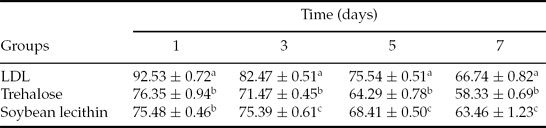
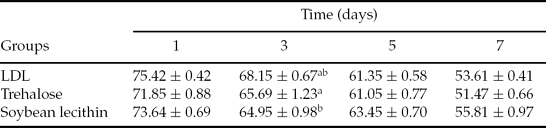
The effects of 0.2 M LDL, trehalose and soybean lecithin on frozen–thawed murine SSCs were investigated. The results showed that the recovery rates of murine SSCs frozen with 0.2 M LDL were overall higher than that of 0.2 M trehalose and soybean lecithin (Fig. 1) (P < 0.05). The recovery rates of murine SSCs in different storage time and temperature are shown in Tables 1 and 2, respectively. The results indicated that the optimal recovery rates of murine SSCs in cryoprotective medium supplemented with 0.2 M LDL, trehalose and soybean lecithin were 92.53, 76.35 and 75.48% in −80°C, respectively. The recovery rates of murine SSCs frozen with 0.2 M LDL at −80°C was significant higher than that of the other cryoprotectants (P < 0.05), while the recovery rates of murine SSCs frozen with 0.2 M LDL at −196°C were not significantly different than that of 0.2 M trehalose and soybean lecithin (P < 0.05). Compared with a temperature of −196°C, the optimal improvement of recovery rates of murine SSCs were 17.11, 6.68 and 10.44% in three different cryoprotectants at −80°C, respectively. The recovery rates were demonstrated to be greater at −80°C compared with −196°C (P < 0.05). LDL was an excellent cryoprotectant and the highest recovery rate was 92.53% at −80°C. Therefore, 0.2 M of LDL could significantly protect murine SSCs frozen at −80°C.
Effects of 0.2 M of LDL, trehalose and soybean lecithin on recovery rates following freezing–thawing of mouse SSCs at –80°C (N = 3, %)

a,b,c Lowercase letters stand for significant difference (P < 0.005).
Effect of 0.2 M of LDL, trehalose and soybean lecithin on recovery rates following freezing–thawing mouse SSCs at –196°C (N = 3, %)
a,b Lowercase letters stand for significant difference (P < 0.005).
The effects of 0.2 M of LDL, trehalose and soybean lecithin on recovery rates following freezing–thawing of mouse SSCs at –80°C or –196°C. (See online for a colour version of this figure.)
Discussion
Cryopreservation of SSCs has an essential role in protecting fertilizing cells, producing transgenic animals, analysing development of SSCs and so on. However, studies on effects of different cryoprotectants on SSCs are still limited. In our study, the non-permeant cryoprotectants of LDL, trehalose and soybean lecithin were utilized to protect murine SSCs from cold shock during the freezing–thawing process. The results indicated that the optimal recovery rates of murine SSCs frozen by extender supplemented with three different cryoprotectants of LDL, trehalose and soybean lecithin were 92.53, 76.35 and 75.48 at −80°C, respectively. Compared with processing at −196°C, the optimum improvement of recovery rates of frozen murine SSCs using LDL, trehalose and soybean lecithin were 17.11, 6.68 and 10.44%, respectively. LDL could significantly protect murine SSCs at −80°C compared with at −196°C. This result is similar to that reported by Redden et al. (Reference Redden, Davey, Borjigin, Hutton, Hinch, Hope, Hill and Herrid2009). In addition, Seo et al. (Reference Seo, Sohn, Suh, Atala, Yoo and Shon2011) reported that the use of 0.2 M trehalose could greatly improve the long-term post-thaw survival of mammalian cells during cryopreservation (Seo et al., Reference Seo, Sohn, Suh, Atala, Yoo and Shon2011). However, only a few reports have suggested the optimum dose of cryoprotectants of LDL and soybean lecithin in cryopreservation of SSCs. Therefore, 0.2 M LDL, trehalose and soybean lecithin were supplemented to freeze murine SSCs according to previous studies (Jiang et al., Reference Jiang, Li, Hu, Li, Zhao and Zhang2007; Hu et al., Reference Hu, Li, Jiang, Yang, Zhang and Zhao2009, Reference Hu, Li, Zan, Jiang, An, Wang and Jia2010; Seo et al., Reference Seo, Sohn, Suh, Atala, Yoo and Shon2011).
LDL is an optimal cryoprotectant and the unique composition has an essential role. LDL is composed of about 87% lipids and 12% proteins, the lipids can form a protective film and the proteins can form a gel. In recent years, many studies have demonstrated that LDL plays an efficient role in the protection of spermatozoa during the freezing–thawing process (Moussa et al., Reference Moussa, Martinet, Trimeche, Tainturier and Anton2002; Amirat et al., Reference Amirat, Tainturier, Jeanneau, Thorin, Gerard, Courtens and Anton2004; Hu et al., Reference Hu, Li, Gang, Chen, Hai, Zhang and Wang2006). During the gelation process, the structure of LDL is disrupted, so that triglycerides and phospholipids are able to be liberated into the medium, and proteins can form a gel. Meanwhile, a protective film at the surface of spermatozoa membranes can be formed by phospholipids after disruption of LDL (Quinn et al., Reference Quinn, Chow and White1980). In addition, phospholipids from LDL can replace some phospholipids in sperm membrane, which can decrease their phase transition temperature (Ghosh & Graham, Reference Ghosh and Graham1987). LDL can also adhere to cell membranes and preserve the membrane integrity during the freezing–thawing process (Bergeron et al., Reference Bergeron, Crete, Brindle and Manjunath2004). It is assumed that a protective film can also be yielded by LDL, involving phospholipids at the surface of murine SSCs membranes. Furthermore, phospholipids from LDL may replace some phospholipids in the SSCs membrane and then decrease the phase-transition temperature, which is a probable mechanism of how LDL protects SSCs in cold shock. The interaction and unification of lipids and proteins enhances the LDL protection effects.
The important role of trehalose is to minimize the intracellular freezable water, cold shock and ice crystallization injury degree (Storey et al., Reference Storey, Noiles and Thompson1998). As direct interaction with phospholipid polar head groups of membrane phospholipids, trehaloses can stabilize cell membrane, promote cell dehydration and reduce the negative effects of water flow through the sperm membrane as well as the formation of ice crystals during the freezing–thawing process (Aisen et al., Reference Aisen, Medina and Venturino2002, Reference Aisen, Quintana, Medina, Morello and Venturino2005). Compared with LDL, trehalose promotes cell dehydration in order to reduce the negative effects of water flow through the membrane during freezing. In this process, ice crystals could injury the cell membrane. The hypothesis that trehalose protects SSCs is described as follows: water at the membrane of a solution interface can be replaced by trehalose and form a protection film. In addition, SSC membranes are stabilized by the trehalose. During freezing, as well as the formation of ice crystals, trehalose interacts directly with phospholipid polar head groups of membrane phospholipids, a process that reduces the negative effects of cell membrane water flow.
These two hypotheses probably explain the protective mechanism of soybean lecithin. Soybean lecithin can enter the cell to decrease the freezing point of ice crystals by replacing plasmalogens and relieve mechanical damage to bio-membranes of spermatozoa (Graham & Foote, Reference Graham and Foote1987; Giraud et al., Reference Giraud, Motta, Boucher and Grizard2000; Waterhouse et al., Reference Waterhouse, Hofmo, Tverdal and Miller2006). Another hypothesis considered that soybean lecithin phospholipids may integrate with sperm membrane to protect sperm membrane from mechanical damage during the freezing–thawing process and form a protective film against the formation of lethal intracellular ice crystals (Quinn et al., Reference Quinn, Chow and White1980). Owing to the unclear mechanism by which soybean lecithin protects SSCs during the freezing–thawing process, it is inferred that it is similar to that of spermatozoa. It is believed that soybean lecithin may reduce the cholesterol/phospholipids ratio of SSCs membranes by permeating the membrane and that phospholipids may replace some phospholipids in the SSCs membrane to maintain its structure and function. As few details exist about soybean lecithin protection of SSCs, hypotheses are needed as well as more evidence to support these hypotheses. Soybean lecithin contains phospholipids, while LDL contains phospholipids and proteins that form a protective gel. Thus, LDL has better a cryopreservation effect when compared with soybean lecithin.
Obviously, compared with SSCs, spermatozoa have different structures. In contrast, stem cells have similar structural and biological characteristics compared with many typical cells, spermatozoon have a unique morphology, nuclear DNA condensation and loss of cytoplasm (Anton et al., Reference Anton, Martinet, Dalgalarrondo, Beaurnal, David-Briand and Rabesona2003). Furthermore, there are still many problems associated with spermatozoa such as hereditary damage, complexity of germ cell mutagenesis, germ cell stage response, differences in DNA synthesis activity, changes in degree of ploidy during gametogenesis, and the ability for DNA repair (Vogel & Natarajan, Reference Vogel and Natarajan1995). All these characteristics probably explain the main differences in the ability of SSCs and germ cells to cope with cold shock. However, these differences are still unclear, and more data are needed.
The results from our study showed that the recovery rates of murine SSCs frozen in −80°C were greater than that of cells kept at −196°C. There are probably reduced amounts of ice crystals and lower levels of osmotic pressure for SSCs frozen at −80°C than from cells frozen at −196°C. Another potential explanation may be that warming rate influences the devitrification of extra- or intracellular glass that forms during the plunge into ultralow temperatures. While cell dehydration occurs during the slow freezing step, the cells still contain freezable water at −40°C. It is possible that the warming rate of approximately 700°C/min is still inadequate for the prevention of ice recrystallization during the warming process, an aspect that would have negative effects on cell survival (Benson et al., Reference Benson, Benson and Critser2008). Freezing–thawing of SSCs at −196°C takes more time, which prolongs the negative effects of ice recrystallization. Therefore, SSCs incur more cryo-damage and recovery rates are reduced.
In addition, recovery rates of murine SSCs are decreased with the prolonged storage time in our study. First, the metabolites of oxygen are adverse to modify cell functions, which ultimately endanger the survival of the cell. Second, it is well known that the slow accumulation of direct damage to the cell can be occured by ionizing radiations. Third, the warming rate of approximately 700°C/min is still inadequate for the prevention of ice recrystallization during the warming process. The prolongation of storage time, the toxicity of the oxygen metabolites, the accumulation of ionizing radiation and an inadequate warming rate probably all damage the cell during the freezing–thawing process. However the definitive reason for this phenomenon is still unclear.
To our knowledge, this study is the first to evaluate the effects of LDL, trehalose and soybean lecithin on frozen–thawed murine SSCs. The number available reports on cryoprotectants and the optimal cryopreservation protocols for SSCs is very limited, therefore our study provides needed basic original research data. Further research is required to obtain more information on cryoprotectants and to explain the protective mechanisms during the freezing–thawing process of SSCs.
Acknowledgements
This research was supported by the Youth Extra Fund of Northwest A & F University (Z111020905), the Special Research Subsidy Project of Northwest A & F University (07ZR002) and the Basic Scientific Research Expense of Sci-Tech Innovation Major Project of Northwest A & F University (QN2011061), P.R. China.