Introduction
Emerging economies (Brazil, Russia, India, China and other countries) can be defined as nations with social or business activity in the process of rapid growth and industrialization. As of May 2010, Dow Jones classified 35 countries as emerging economies. These nations are expected to play major roles in the global economy during the 21st century. Some of these countries have exceptional soil and climate characteristics and vast land extensions that determine evident advantages for food production. Indeed, an analysis of their contribution to world production of all major crops (i.e. soybean, maize, sunflower and wheat) reveals that some of these emerging economies have a great share in global food production. For such reasons, many of these economies are strongly based on the production of food commodities (agriculture represents 18.3, 12.6, 9.4 and 8.1% of the gross domestic product (GDP) of India, China, Argentina and Brazil, respectively).
In addition to the above-mentioned agro-ecological advantages, a rapid adoption of technologies generated by ‘old’ economies (i.e. transgenic crops and others) has been instrumental for the fast expansion of agricultural production in recent years in these emerging economies. For example, soybean RR (Round-Up Ready) was released in 1997 in Argentina; 3 years after the introduction, 90% of the surface devoted to soybean was sown with soybean RR. Something similar occurred with other biotech-crops, such as maize and cotton, which were rapidly adopted. Moreover, the expansion of biotech-crops in the world during the past decade is explained, to a large extent, by the adoption in emerging countries.
It should be noted, however, that the incorporation of new technologies never comes alone but is usually accompanied by changes in other components of the production system, with impacts at different levels. For example, introduction of soybean RR came together with adoption of no-tillage systems and a massive increase in the use of the herbicide glyphosate.
Since the adoption of RR transgenic technology, soybean production in Argentina has increased threefold, in part due to an increase in yield per surface area, and in part due to the incorporation of new lands for the production of this crop. Something similar has occurred with this and other crops in other emerging countries. Therefore, if the combination of outstanding agro-ecological conditions and rapid adoption of technologies generated in industrialized economies has led to agricultural success in these emerging economies, it is pertinent to ask whether it is necessary to carry out basic research in agricultural sciences in these countries. Two main reasons might support an affirmative answer to this question: (1) the sustainability of these new production systems (present and future) need to be guaranteed (for example by detecting the components of these new systems that need to be adjusted); and (2) to add value to agricultural production (by means of, for example, royalties or technologies generated with local criteria). Hence, the possibility of achieving these aims relies on research carried out in areas such as crop science, biotechnology, ecology, plant breeding and, of course, seed science. One way of measuring the scientific outcome of a country is through the number of scientific articles produced by its scientific system. It could be argued that there should be a balance between the contribution of a country to world production of a certain food commodity, and its contribution in terms of knowledge about the crop that mediates the production of that commodity. In other words, if the production of a certain crop is such an important economic activity for a nation, this should be reflected in the amount of knowledge generated about that crop by its local scientific system.
This article, then, is divided in two major sections. In the first, we analyse the relationship between the physical and the scientific production of major crops in emerging and industrialized economies that are producers of food commodities. In the second section we discuss four examples in which seed science (through any of the approaches the discipline has to offer): (1) has identified subtle but crucial components of newly adopted production systems; (2) has proposed means for their adjustment in order to secure the sustainability of those systems; and (3) might help to add value to agricultural production through the development of new germplasm displaying specific features (e.g. timing of dormancy release adjusted to industrial necessities).
Generation of agricultural knowledge in emerging and industrialized nations: a ‘bibliometric’ analysis
The countries considered for the analysis were the United States of America, France and Canada (representing industrialized economies), and Argentina, Brazil, China, India and Ukraine (representing emerging economies), all world leaders in the production of soybean, maize, sunflower and wheat during the period 2000–2006. The analysis consisted of establishing a relationship between the physical and the scientific production for each crop, the latter measured through the number of articles published in scientific journals (Bollani, Reference Bollani2008).
When gross scientific production was considered (i.e. without discriminating between articles published in indexed and non-indexed journals), the analysis showed a positive relationship between crop production (as a proportion of the total produced in the world) and generation of knowledge (as a proportion of the total number of articles published). In general terms, there was an agreement between the physical and the scientific production: the USA produces 41%, 40%, 5% and 10% of the soybean, maize, sunflower and wheat of the world, respectively, and 41%, 57%, 38% and 26% of the total scientific articles in relation to each crop. On the other hand, Brazil, an emerging economy, contributes 24% and 6% of global soybean and maize production, respectively, and with 19% and 13% of the scientific articles regarding each crop. Possibly, the most noticeable imbalance was detected in the case of Argentina, producing 16.2% of the soybean (third producer, after USA and Brazil) of the world but only 2% of the scientific literature related to this crop in its many aspects (Bollani, Reference Bollani2008).
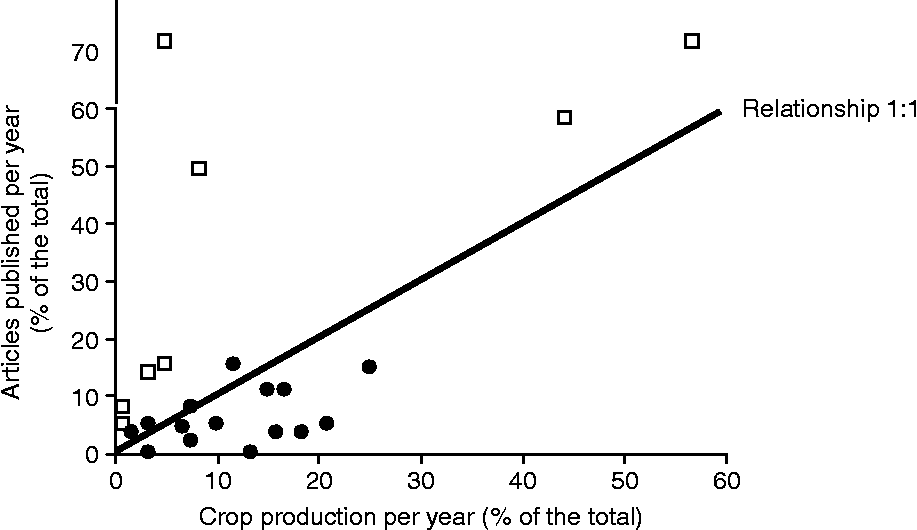
Publication of scientific articles in well-established, indexed journals could be considered a measurement of scientific quality (Oesterheld et al., Reference Oesterheld, Semmartin and Hall2002). The survey carried out indicates that, in industrialized economies that are producers of food commodities, the vast majority of the agricultural science is published in indexed journals, whereas in emerging economies (with Argentina as an exception), most of this science is published in non-indexed journals (Bollani, Reference Bollani2008). When only scientific articles published in indexed journals were considered for the analysis, important differences arose between emerging and industrialized economies. If the number of scientific articles related to a crop (as a percentage of the total produced in the world) produced by a country is plotted against its physical production of the crop (as percentage of the total produced in the world), then a relationship 1:1 should reflect the perfect balance between physical and scientific production. In the case of industrialized economies, all the points were above the 1:1 relationship, whereas most of the points were beneath it in the case of emerging economies (Fig. 1). This shows that, in industrialized economies, the central role of science as a tool for economic growth is clearly understood. This is reflected, to an important extent, by the amount of money invested in research in industrialized economies in comparison to that invested in emerging economies: the USA, France or Canada invest more than 2% of their GDP in research activities, against half or even less than half of GDP in emerging producers of food commodities (China, Brazil, Ukraine, India and Argentina). The positive relationship found by Bollani (Reference Bollani2008) between money invested in research and production of articles of high scientific quality, suggests a functional explanation to the differences displayed in Fig. 1. Moreover, the same author found a positive relationship between money invested in research and stability in time in the generation of knowledge (Bollani, Reference Bollani2008). In summary, this imbalance between the weight that agricultural production has on these emerging economies and generation of knowledge in the related disciplines, threatens the sustainability of these economic models and, therefore, of global food production.
The relationship between crop production per year (as % of the total world production) and generation of knowledge (measured as % of the total number of articles produced in the world in relation to each crop) for emerging (closed circles) and industrialized (open squares) countries, producers of food commodities. The period considered for the analysis was 2000–2005. The straight line shows the relationship 1:1 between the variables.

The role of seed science in emerging economies
As mentioned before, two final objectives of research in agricultural sciences should be: (1) to guarantee the sustainability of new production systems (adopted or generated locally) by, for example, detecting the components of these new systems that need to be adjusted; and (2) to add value to agricultural production through royalties or technologies generated with local criteria. Seed science (as for other sciences related to agriculture), then, is called to play a major role in these emerging economies. This section is devoted to illustrating, with four examples, the way in which seed science could, or can, achieve these major goals, through the different approaches (i.e. ecological, physiological, agronomical and molecular) that the discipline has to offer.
The introduction of soybean and the irruption of Datura ferox L.: a seed dispersal study
Soybean (Glycine max L.) was introduced as a crop in Argentina in the 1970 s. Until then, the two summer crops sown in the humid pampa were maize and sunflower. At that time Datura ferox L. was regarded as a common but non-noxious weed of summer crops. Indeed, this species has poor dispersal capabilities, is easily controlled with herbicides, fecundity is severely affected by plant density, and only a small fraction of the seed bank is able to germinate every year (Ballaré et al., Reference Ballaré, Scopel, Ghersa and Sánchez1987a). However, D. ferox seeds contain dangerous alkaloids and are contaminants of soybean grains. Soybean lots can be docked or even rejected due to the presence of these seeds and, for that reason, farmers started to use combined harvesters with a double cleaning system. A few years after the introduction of soybean, farmers realized that it was very difficult to avoid contamination with D. ferox seeds because the infestation level in the fields was increasing by the year. Ballaré et al. (Reference Ballaré, Scopel, Ghersa and Sánchez1987a) carried out a demographic study of D. ferox in soybean crops. This study determined demographic rates common to other similar works (i.e. seed-bank size, germination percentage from the seed bank, seedling survival, seed production, etc.) but incorporated seed dispersal by combine harvesters, a previously unexplored demographic feature. The study considered both the capture efficiency of the combine harvesters and their cleaning system. This approach determined that the capture efficiency of the platform used for harvesting soybean, was much higher than that of platforms used for harvesting other summer crops, and that harvesters with double cleaning systems dispersed D. ferox seeds 100 m away from the source, thus enhancing fecundity of the next generation through avoidance of density stress (Ballaré et al., Reference Ballaré, Scopel, Ghersa and Sánchez1987a). A seed dispersal study, then, provided the clue about the component of the production system responsible for making D. ferox a troublesome weed upon the introduction of soybean. As a result, farmers avoided the use of combined harvesters with double cleaning systems, or cleaning too thoroughly while harvesting soybean. The quantification of the dispersal pattern produced by each type of harvester allowed the construction of a simulation model of D. ferox population dynamics in time and space, which is the basis for the generation of ‘weed maps’ that are essential for weed control in modern ‘precision agriculture’ systems (Ballaré et al., Reference Ballaré, Scopel, Ghersa and Sánchez1987b).
The introduction of soybean RR (Round-Up Ready) and the ‘inactivation’ of Datura ferox
The introduction of transgenic soybean RR (Round-Up Ready) in the 1990 s enabled no-tillage to replace conventional soil cultivation systems, and a massive increase in the use of herbicide glyphosate. This lack of soil disturbance resulted in the disappearance from the production system of weedy species whose germination depends on the light flash provided by cultivation (Scopel et al., Reference Scopel, Ballaré and Radosevich1994). This is the case for D. ferox, whose seeds can attain a sufficiently low dormancy level after several months of burial, so as to respond to the extremely low levels of Pfr (the active form of phytochrome for germination) imposed by a light flash as a result of cultivation (Scopel et al., Reference Scopel, Ballaré and Sánchez1991). For this reason, D. ferox plants are scarcely seen in this production system. This ‘very low fluence response’ (VLFR) is common in seeds of many arable weeds and, for that reason, night tillage has been thought of as a way of controlling their emergence in the field (Botto et al., Reference Botto, Scopel, Ballaré and Sánchez1998). Hence, within this new ‘no-tillage’ scenario, the possibility of irruption of new weeds without strict light requirements for germination should be considered and, eventually, predicted. This poses a new challenge for seed science: to predict the acquisition of extreme sensitivity to light or the capacity to germinate in the dark, so as to optimize weed management under new soil cultivation regimes. The concept of ‘stratification thermal time’ developed by Batlla and Benech-Arnold (Reference Batlla and Benech-Arnold2003) is a step in that direction. The stratification thermal time index considers the accumulation of thermal time below a ceiling temperature, above which dormancy release does not take place (Batlla and Benech-Arnold, Reference Batlla and Benech-Arnold2003). It quantifies the effect of time and temperature on the dormancy level of seed populations that require low temperatures for dormancy alleviation (i.e. summer annuals). This stratification thermal time index has been used to predict the acquisition of a VLFR and capacity to germinate in the dark of Polygonum aviculare seeds (Batlla and Benech-Arnold, Reference Batlla and Benech-Arnold2005). Therefore, stratification thermal time indexes, or similar approaches, are examples of the kind of contribution expected from seed science, for the adjustment of new technologies that involve changes in the soil cultivation regime (i.e. weed management under no-tillage + soybean RR).
Barley, a crop grown in Argentina responding to a regional demand: doing agronomy with seed science
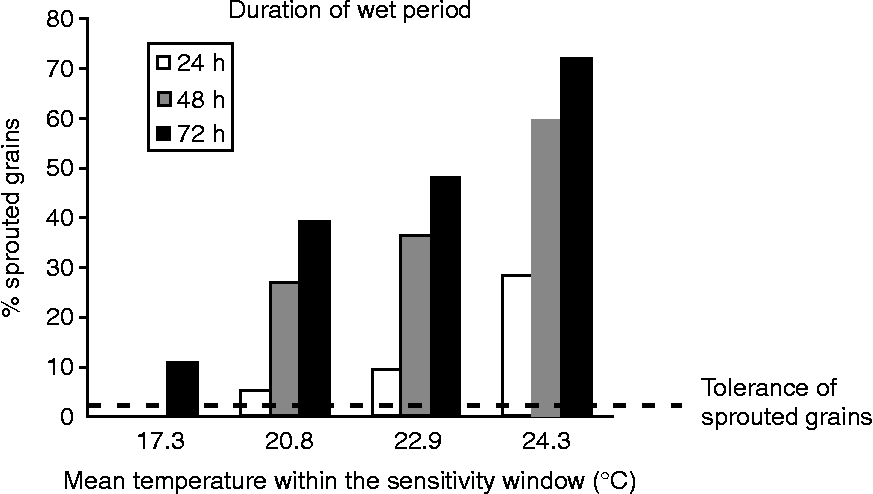
Although it has always been a winter crop alternative for wheat, barley was massively introduced in Argentina after the creation of Mercosur (the South American market). Indeed, Brazil has a large demand for malting barley but the country lacks the temperate, agro-ecological conditions for its production. Therefore, an important number of barley genotypes, not necessarily adapted to the conditions prevailing in the humid pampa, were introduced during the 1990 s. Since the malting process requires grain germination, barley is bred to have low dormancy at harvest. This, combined with damp conditions and temperate temperatures prior to harvest, leads to pre-germination or pre-harvest sprouting, which was the main problem encountered by the newly introduced barley cultivars. The barley grain is released from dormancy after physiological maturity (PM) with a velocity that depends on the temperature experienced by the crop during seed maturation (Benech-Arnold et al., Reference Benech-Arnold, Giallorenzi, Frank and Rodriguez1999; Rodriguez et al., Reference Rodriguez, González Martín, Insausti, Margineda and Benech-Arnold2001). This dependence is the basis of a model that predicts the susceptibility of a crop to suffer pre-harvest sprouting damage. The model was built after the determination of a ‘sensitivity window’ within which the thermal environment imposes a velocity of dormancy release after PM and, consequently, the sprouting behaviour of the crop. Indeed, Rodriguez et al. (Reference Rodriguez, González Martín, Insausti, Margineda and Benech-Arnold2001) determined that temperature experienced by the crop during the ‘sensitivity window’ (300–350°C.day after anthesis) explains 95% of the variability in grain dormancy before harvest maturity between years. The location of this ‘sensitivity window’ within the seed development period was found to be almost the same for the commercial genotypes introduced in Argentina (Gualano and Benech-Arnold, Reference Gualano and Benech-Arnold2009). The model allows prediction of the percentage of sprouted grains after different durations of a wet period, as a function of temperature experienced by the crop during the ‘sensitivity window’ (Fig. 2). This model is used by the malting industry to recommend early harvest of the crop when a prediction of susceptibility is combined with a forecast of rain. But, in addition, the identification of a common ‘sensitivity window’ for the determination of the pattern of dormancy release in so many cultivars, suggests that a major physiological event controlling dormancy might be taking place during this window. This could be a milestone in the search for the ideal barley genotype from a dormancy standpoint: a genotype whose grains are released from dormancy immediately after harvest.
Percentage of sprouted barley grains in relation to the temperature experienced by the crop during the ‘sensitivity window’, after different durations of a wet period. The dotted line indicates the tolerance of sprouted grains.

Dormancy as a trait with agronomic importance for grain crops: translating seed biology from model organisms to crop improvement
The necessity of adjusting the timing of dormancy release is clear from the barley example depicted in the previous section. But in addition to the tools that seed science offers us to develop agronomic practices for managing problems derived from untimely dormancy release, dormancy could be manipulated after a detailed understanding of the physiological and molecular mechanisms involved in the control of dormancy. As in other areas of plant science, most of our present knowledge of these mechanisms has been derived from studies with model organisms, such as Arabidopsis thaliana. As in many major cereals, dormancy in Arabidopsis is coat imposed and is modulated hormonally by the antagonistic effects of abscisic acid (ABA) and gibberellins (GAs). From such a model organism, genes involved in both signalling and metabolic pathways of these hormones have been identified. In an attempt to translate that information to crop improvement, we have been using grain sorghum (Sorghum bicolor L. Moench.) as a model system for the study of the hormonal control of dormancy in cereal crops. The system is composed of a high-dormancy genotype (IS 9530) and a low-dormancy one (Redland B2). Both a differential sensitivity to ABA and a differential capacity of GA synthesis explain the difference in dormancy between these two genotypes (Steinbach et al., Reference Steinbach, Benech-Arnold, Kristof, Sánchez and Marcucci Poltri1995, Reference Steinbach, Benech-Arnold and Sánchez1997). Gene expression analysis of positive regulators of ABA signalling revealed a synchronized up-regulation in IS 9530 (high dormancy), whereas almost no changes were detected in the expression of the same genes in Redland B2 (low dormancy) during grain incubation (Rodriguez et al., Reference Rodríguez, Mendiondo, Maskin, Gudesblat, Iusem and Benech-Arnold2009). One of these positive regulators, ABI5, was investigated at the protein level: while the protein disappeared almost immediately upon grain imbibition in Redland B2, it persisted for at least 72 h in IS 9530 (Rodriguez et al., Reference Rodríguez, Mendiondo, Maskin, Gudesblat, Iusem and Benech-Arnold2009). Preliminary data also show differential expression patterns of GA biosynthesis between these two genotypes (Pérez-Flores et al., Reference Pérez-Flores, Carrari, Osuna-Fernández, Enciso, Stanelloni, Sánchez, Bottini and Benech-Arnold2003) and suggest a possible involvement of ABI5 in this differential expression. Therefore, expression of genes coding for enzymes committed to GA metabolism, or its control by other proteins (ABI5), appears as a regulation site of GA content and a potential site for the manipulation of timing of dormancy release.
Conclusions
Throughout this article it has been shown that there is an imbalance between the weight that agriculture has in some emerging economies and the amount of knowledge generated by these countries in agricultural sciences or related areas. This threatens the sustainability of these economic models. Seed science (as well as other related disciplines) has a role in bridging this gap by guaranteeing the sustainability of production systems designed on the basis of adopted technologies and generating new technologies that would add value to the agricultural production of these emerging economies. This role can be played through the multiplicity of approaches that the discipline has to offer. This article has attempted to illustrate, with examples representing each type of approach, the way in which this role can be played by seed science during the 21st century.