Even here, in Indochina, the necessity to bring to the natives the aid of European science for regulating and increasing the yield has imposed itself for a long time on the mind of those who were interested in the development of an essentially agricultural country.Footnote 1
Introduction
This paper proposes to study rural life and technological change in French colonial Vietnam during the colonial period by revisiting cultural productions of French colonial officials and Vietnamese elites. In particular, this paper studies the efforts (and ultimate failure) to create smallholder rubber producers in eastern Cochinchina (or southeastern Vietnam) during the colonial period (and afterwards). Past studies of rubber production have largely assumed that there was little attempt to introduce rubber-producing technology to the Indochinese countryside. While it is true that efforts to introduce this technology were inconsistent and often haphazard, this paper argues that there was interest on the part of officials and the elite in encouraging smallholder production. It was believed that these producers (or consumers of rubber-producing technology) could play a part in more ambitious projects aimed at creating indigenous capitalists. Such entrepreneurs would feed medium- and large-scale (mostly European but also some Vietnamese) enterprises with materials for export (and profits). The rural indigenous capitalists would also be largely self-governing and demand little of the colonial state. This paper argues that although few farmers adopted rubber-producing technology, it was not because the French and Vietnamese elite did not try to introduce it.
The absence of smallholder producers, despite the desire of some French officials and Vietnamese elite to spread the cultivation of rubber, must be explained. The first reason for the failure of the will to improve came about in part because of the strength of the planters’ association.Footnote 2 This enabled the planters to effectively lobby the government for crucial support, including loans during the 1930 rubber crisis. Furthermore, the association helped planters take advantage of technological improvements—such as grafted trees and clones—and make use of these advances with capital.Footnote 3 For poorer planters, Vietnamese in particular, the technical innovations involved in grafting were a barrier to entry. While such advances did not shield estates from fluctuations in the price of rubber on the world market, they did address some of the weaknesses of estate production.
Second, there were limitations inherent in the practices of the programmer, or those who attempted to take concrete improvement measures. To begin with, programmers had to identify problems to be solved. From the perspective of colonial officials in Indochina, these problems included resettling the Red River Delta's ‘surplus’ population, expanding the use of the ‘under-populated’ uplands, and reforming ‘traditional’ farming techniques. The first two of these problems were better solved with estate rubber than with smallholder production and officials often encouraged industrial developments that were not useful for smallholders.Footnote 4 Officials used soil sciences, climatology, demographics, and allied natural and social sciences to help define technical approaches to diffuse problems such as disease, agricultural backwardness, and poverty. These solutions were more available and of more use to larger scale planters connected to colonial networks, including rich, Francophone Vietnamese. Time and again officials failed to meet objectives of ‘native improvement’ in part because ‘the bounding and characterization of an “intelligible field” appropriate for intervention anticipates the kinds of intervention that experts had to offer’.Footnote 5 In other words, imaging technical solutions for complex situations helped colonial officials to act, even as it severely circumscribed the scope of their solutions. Despite continued interest in smallholder production, hévéa never became an everyday agricultural technology for the majority of Vietnamese smallholders.Footnote 6
The term ‘everyday’ has rarely been used to analyse rubber production technology and its effects on Vietnamese society.Footnote 7 ‘Everyday’ was a subjective term; and for a technology to be labelled everyday, it needed to meet the following three criteria: the technology was ubiquitous and used every day; it had traditionally been used in the past; and its use was uncontroversial (i.e. it faded into the background, with its existence no longer meriting explicit comment). If a technology failed to meet any one of these criteria, then its status as everyday was open to challenge.
Recent work on colonial situations has tended to focus on the consumption, rather than production, of culture.Footnote 8 This has been the case for studies of Vietnamese farmers and their use of the agricultural technologies made available to them by French colonization. In general, peasant life has been difficult to reconstruct as rural residents left little written material. In the main, scholars have attempted to gain a sense of farmers’ thoughts concerning agricultural technologies through three types of sources: first, the writings of others about farmers; second, farmers’ material culture; and third, farmers’ actions as recorded by statistics and similar methods. Each of these tools has received considerable scholarly attention and, while they have been separated for clarity in this paper, they are complementary rather than mutually exclusive ways of knowing the past.Footnote 9
This paper is divided into three parts. The first part reviews the data for the lack of smallholders. Looking for a desire on the part of the rubber industry to better rural conditions may seem perverse, given the fact that estates, or large plantations, have often been taken as a paradigmatic case of the excesses of capitalism in French Indochina.Footnote 10 Yet estates represented only one possible way to make rubber and the introduction of latex-secreting hévéa brasiliensis does fit, even if uncomfortably, within programmes of ‘native improvement’.Footnote 11 Both colonial officials and Vietnamese intellectuals each envisioned possible uses of rubber to better the lives of Vietnamese peasants. In order to understand the tension between a colonial desire to improve living standards and the drive for profit, this paper tests a theoretical framework developed in recent scholarship that has taken seriously the desire of many colonizers to better the lives of the colonized.Footnote 12
The second part of this paper analyses the discourse in Cochinchina that formed around attempts to improve native lives by popularizing agricultural sciences and technologies through education and journals. Administrators claimed that they were simultaneously acting in the interest of native improvement and creating an environment conducive to capitalist profits.
The third part of this paper examines the goals of Vietnamese elite. They, too, evinced interest in changing rural conditions and, while they largely agreed with colonial officials about the necessity of agricultural improvements, they wrote at times of national strengthening.Footnote 13
The absence of smallholder rubber production
With peasants, everything remained as it was fifty years ago, a time when nothing was known about Western civilisation. Always the same stagnant pools from which people got drinking water, the same hovels built in mud or on dirty areas.Footnote 14
The rural stagnation described in this 1923 Nam Phong article was not uniform throughout the countryside, as shown by the formation of agricultural cooperatives, the rapid increases in industrial crops such as cotton, and other such innovations. The rate and character of change provide insights into the meanings of everyday agricultural technologies. In the case of rubber, estates helped define the everyday. This paper first examines the patterns of hévéa's spread in light of the improvement measures introduced by colonial officials and Vietnamese intellectuals discussed below. The political economy of the improvement measures played a key role in retarding the uptake of rubber production among non-French smallholders. And, in a time of intense regional and class divisions in Vietnamese society, the introduction of new rubber-producing technology only served to widen these fissures and not bridge them.
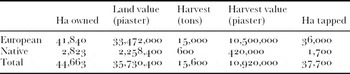
By the late 1930s, the attempt to encourage Vietnamese smallholder production of rubber had clearly failed.Footnote 15 Although it appeared as if quite a few Vietnamese grew hévéa—over 50 per cent of rubber operations were ‘native’ owned in 1937—they accounted for less than 10 per cent of the cultivated surface area.Footnote 16 As Bonneuil concludes, ‘it was the Europeans who undertook the first [efforts] in this culture [of rubber] and who subsequently remained the masters. The Vietnamese economic elite started to assert themselves with regards to Chinese and French businesses, but this rather tentative movement had almost no effect on hévéaculture.’Footnote 17 The 1937 Guernut Commission investigation, and other reports on rubber, point to official anxiety about an absence of smallholders, a situation that only worsened during the 1930s. Indeed, numbers from the province of Thủ Dầu Một, which encompassed about one-third of the hévéa-growing land in all of Indochina, show the great divide that had opened up between European and Vietnamese land ownership and production (see Table 1).

Further breaking down the native planter category shows an even greater disparity in production. Bonneuil usefully divides hévéa exploitations into four types: the smallest plots of land, smaller than five hectares, on which rubber was grown to supplement the family income derived from other agricultural crops; a small plantation that was managed by a Vietnamese cai (caporal, corporal) and a few workers, and owned by local notables, rich Vietnamese, or what the French called ‘Sunday planters’; medium plantations that were either owned by a full-time European planter or managed by a salaried European; and the estates, consisting of more than 1,000 hectares, located far from urban centres on ‘red earth’ and run by companies based in Saigon and Paris.Footnote 19
Planters of the first type had to be relatively close to urban areas if they were to continue to exist. They did not have the resources to carry out large clearing operations, they more than likely used previously built roads to gain access to markets, they were closer to urban health facilities, and they did not have to deal with the explosion of malaria that followed land clearing in the regions far from traditionally settled towns and villages. Their overhead costs were few: the trees, a cutting knife, a container, and their individual labour. This group, however, did not exist in any appreciable numbers.Footnote 20
Vietnamese hévéa growers from the second group were more visible and their holdings were often listed in the Annuaire, a record of rubber-producing operations in Indochina.Footnote 21 The records of Guernut provide further information on how the richest owners of hévéa trees might have lived and material evidence of this wealth can still be found near the Biên Hòa city centre (see Figure 1). The head of Bến Cát lists the income and expenses of an extremely wealthy rubber planter. The 46-year-old planter lived with his wife, six children, one son-in-law, two nephews, a chauffeur, and three servants. He earned a total income of 75,400$ (piasters), including 72,000$ from rubber, 1,000$ from renting rice fields, and 2,400$ from renting rooms.Footnote 22 Among the many expenses incurred by his 500-hectare plantation, 24,000$ was spent on labour, which meant hiring about 160 ‘coolies’ (probably fewer when it is taken into account that the cai and the managers of the plantation earned a higher salary). For the province of Thủ Dầu Một, this one grower's land and income comprised about one-fifth of the total recorded for local growers.Footnote 23 It is now time to examine French officials' discourse of improvement.
House of a former Vietnamese rubber planter in Biên Hòa.
Source: Photo in author's collection.

Plantation rubber production and attempts to modify ‘native mentality’
Our neighbours in the Far East, the English and the Dutch, have since several years established in their colonies agricultural instruction and it has yielded, by the test of accepted results, a development that they themselves had not predicted in the beginning.Footnote 24
As for other colonial powers at the turn of the twentieth century, education was a key component of the French empire's civilizing mission.Footnote 25 A 1904 report discussing the opening of a collège (a term used to describe any higher level of training), which was designed to train Vietnamese assistants for government employment, sheds light on educational aims in Indochina. This collège, noted the author, would have a physics room and a chemistry laboratory in order to meet the requirements of a scientific education. ‘It appeared useful,’ the author continued, ‘to try, by the diffusion of elementary scientific knowledge and by the usage of experimental methods, to modify the brain and the mentality of the native in developing among him to a greater degree his intellectual powers.’Footnote 26 Such an education encouraged an inquisitive, questioning mind, at least in theory.
French authorities began to take a serious look at educational reorganization in the wake of anti-colonial uprisings that took place in 1908 and were connected to schoolteachers in northern and central Vietnam.Footnote 27 The direction that these educational reforms took was later altered in the wake of the First World War. Partly as a result of this conflict, attempts to alter ‘native mentality’ increasingly gave way to the aim of increasing export agriculture as the leaders of French colonization adopted a programme of mise-en-valeur and a politics of association.Footnote 28 Imperial powers such as Britain, France, and the Netherlands adopted a colonial policy that spoke of native development as much as of imperial gain.Footnote 29
Although a strong school system remained low on the priority list of a tight-fisted colonial government, the farm-school of Bến Cát was established by decree in 1917 and charged with two tasks: to train assistants and technicians to help run the Indochinese agricultural economy; and to transform ‘timeless’ Vietnamese farming practices, thus improving native welfare.Footnote 30 This section examines efforts such as Bến Cát in relation to the concept of trusteeship, which at the time referred to the attempt of one society to develop the abilities of another.Footnote 31
Early in August 1918, the Courrier Saigonnais reported on the official ceremony that inaugurated a new agricultural school a few kilometres north of the rural population centre of Bến Cát in Thủ Dầu Một province (now Bình Dương). In attendance were top regional government officials, including the Governor of Cochinchina, Georges Maspéro (1872–1942), regional leaders of industry such as the president of the association of rubber planters, members of the local Vietnamese elite, and teachers. Termed ‘grand in its simplicity’, the official ceremony consisted of several people, some still sleepy from the 40-kilometre trip northeast from Saigon on Colonial Route 13, standing around in an empty field in the middle of nowhere in the cool morning mist of the summer day. Yet, despite the sense that this gathering was a rather modest, and long delayed, beginning to the project of providing agricultural education in Indochina, its significance should not be dismissed.Footnote 32
One of the French goals expressed in the speeches given that day was the need to train the Vietnamese to assist with the running of the colonial economy. Morange, the Head of Agricultural and Commercial Services, for example, emphasized the expansion of rubber and rice production, and the need for Vietnamese personnel to manage the growing numbers of labourers on the rubber plantations in the surrounding countryside. He went straight to the heart of the matter when he said ‘the principal role of the school will be to train assistants for the European plantations and native farms’.Footnote 33 This sentence captured the belief that the role of education in Indochina was to create technicians who could assist engineers and managers trained in France. Because these assistants lived locally, they would be much cheaper to employ, as their salaries would be lower and they would not need to be housed and fed in a European manner. The hope of those who established the school was that these assistants would work on either European-owned plantations (including rubber, coffee, tea, and rice) or on Vietnamese-owned rice growing lands, thus helping to improve agricultural techniques, and, the government hoped, yield.
Another French goal articulated that day in August was the need to change the agricultural techniques of Vietnamese farmers. Reflecting a view common among French and Vietnamese elites, Maspéro depicted these farming techniques as ‘timeless’, as he spoke of primitive ploughing instruments, poor seed selection, non-controlled cattle genetic crossings, non-grafted fruit trees, lack of fertilizer, lack of crop rotation, and reliance on the spirits to deal with problems in silk-production. Illustrating his opinion rather harshly, Maspéro claimed that a Vietnamese family from the ‘time of heroes’ would, upon rising from the dead, have no problem recognizing current agricultural practices. As a consequence, Maspéro concluded, the riches of the land were left undeveloped and the task of improvement, taken up by science and capital, was all the harder. Notably, the speech focused on rice and not rubber. ‘Traditional’ crops such as rice, and even newly introduced fruits, were what Vietnamese farmers should grow—not rubber.
As administrators and the Council Colonial had been calling since at least 1911 for the creation of a school such as Bến Cát, why was it finally established in 1918? In addition to the imperatives of mise-en-valeur and programmes such as Albert Sarraut's ‘Pháp Việt Đề Huề’ (meaning Franco-Vietnamese collaboration) at the end of the First World War, an important immediate stimulus was the expansion of regional rubber production. The area's agriculture had long consisted of a mixture of fruits for the Saigon market, rice, and forest products, with no dominant crop. Furthermore, the Ong Yêm experimental field site had existed in the area for a number of years and had grown rubber, coffee, tea, pineapples, and other plants. However, after the establishment of the first commercially successful latex-producing operation in 1909–10, and a steady (if modest) rate of growth, by 1917 rubber was clearly the most important regional product. Of course, students of the school were to be taught both rice and hévéa growing techniques but the administrators hoped that many students would go on to work in the latex industry.Footnote 34
While attendance at Bến Cát appears to have remained fairly steady during the early years of its existence, the number of students was far smaller than administrators had hoped for. In both 1918 and 1925, close to 30 students (apparently all male) enrolled at the school. Despite some interest in improving agricultural techniques among elite Vietnamese, there was little enthusiasm for sending (male) children to this new agricultural institution.Footnote 35 As for children from poor families, even with the assistance of government scholarships, they were rarely prepared to attend higher levels of education. It is most likely that the school drew the majority of its students from the limited pool of small local property owners.Footnote 36 Of the 59 graduates during this time, almost none went to work for the rubber plantations, one of the main reasons for establishing the school.Footnote 37
Most French explanations for the lack of Vietnamese interest in agricultural education assumed a cultural aversion to manual labour.Footnote 38 This so-called aversion, however, was less a reason than an assumption made by the French to explain why the Vietnamese did not go along with French schemes. Many elite were reluctant to send their children to these schools as they realized that they would receive a limited education there. Aware of the French educational hierarchy, the elite understood that for their offspring to gain success in the colonial society, they needed to attend educational centres in Montpellier and Paris that trained agricultural engineers and not schools such as Bến Cát that were the equivalent of provincial farm-schools. Not only did the education offered at Bến Cát provide limited career prospects, but a penitentiary for wayward children and orphans that ran a similar farm-school opened nearby in the 1920s. It would not be surprising if the two schools became closely associated, if not synonymous, in the minds of the Vietnamese living in Saigon.Footnote 39
There were other colonial government ventures that specifically focused on helping Vietnamese farmers to grow hévéa, but only a few. For a French-speaking potential planter, there were a plethora of sources. The Bulletin du syndicat des planteurs de caoutchouc de l'Indochine, for example, which ran from 1911 to 1940, was a monthly journal on hévéa growing, tapping techniques, and other industry-related information.Footnote 40 Yet, in general, there was little information on hévéa growing published in Vietnamese. One of the only sources with information on hévéa growing was a bilingual journal called La Cochinchine Agricole: Bulletin mensuel de renseignements et d'informations, à l'usage des colons et planteurs français et annamites. It was funded by the Chambre d'Agriculture de la Cochinchine and ran from 1927 to 1930.
The purpose of the journal was similar to that of government-run agricultural schools such as Bến Cát. First, the journal aimed at promoting the ‘circulation of ideas’, both to introduce new planters to the field of agriculture and keep veterans abreast of the latest techniques. By learning from the ‘science and experience of others’, beginning planters could cut down the amount of time and money they wasted in the learning process and veteran planters could work out problems in their own agricultural activities. The journal stated that agricultural activity was growing quickly and aiding planters would help both individuals and the state grow rich. The journal claimed to be for both French and Vietnamese planters, but the extent to which this is true is difficult to say, even though the journal retained its dual language format throughout its existence.Footnote 41
The start of the journal followed not long after a major boom in latex production beginning around 1926. Thus, one of the first articles was entitled ‘Pour les jeunes planteurs d'hévéas’. This six-part series covered the basics of starting a plantation, including how to choose soil and seeds, how to select proper land for ‘coolie’ housing, and how to combat the effects of malaria on productivity. The advice given by the journal on growing reflected the dominant paradigms of the day. For example, planters were told that if they did not have access to fertilizer, they could use the burn-beating method (slash-and-burn or écobuage) to produce fertile soil. While this technique was not universally accepted, the largest Indochinese plantations, following the example of Ceylon and the Federated Malay States, had been using this method, especially for red earth land.Footnote 42
The articles were aimed at fairly well-off young planters who would own and manage their own plantations. In this article, for instance, planting calculations were made for a landowner with 50 hectares, which was within the range of a well-off Vietnamese plantation, though too large for a poorer farmer without hired help. The information, too, was mostly concerned with management skills rather than technical details. There was little of use, such as diagrams of instruments, tapping techniques, etc. for a farmer growing only a few trees on their plots. And, after this initial series of articles, information on rubber was limited to monthly statistics, price information, and advertisements for skilled labour seeking employment on plantations. When the economic crisis began in 1930, the journal folded.
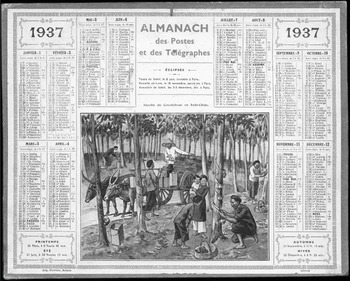
The 1930s also witnessed much social unrest across Southeast Asia. Goss has convincingly shown that Dutch officials in the Dutch East Indies turned to pure science in an attempt to deal with this unrest and, more importantly, appeared to be doing so decently in international opinion.Footnote 43 Unlike the Dutch, French officials continued to rely on estates to address native improvement (as shown in Figure 2). A scandal among colonial officials showed the weakness of pure science in Indochina. Some time in 1932, an anonymous pamphlet came out attacking Yves Henry, the Head of the Department of Agriculture, Forestry, and Commerce. While the main thrust of the publication, associated with the Presse Indochinoise, was that Henry had been using the Department as his personal research laboratory in order to advance his career, the charges contained in Les Scandales raised broader questions about the proper role of the Department. Henry, who had won international prizes for his work in rural economics, was accused of having fine theories but of not taking any practical measures to advance agricultural production.Footnote 44 Administrators were not the only ones who spoke of improving the lives of peasants. This paper will now compare the ways in which the programmes for improvement issued by Vietnamese intellectuals differed and were similar to those just discussed.
1937 Almanac, Rubber plantation in Indochina.
Source: 1937 Almanach des Postes et des Télégraphes, from Joconde at <http://www.culture.gouv.fr/documentation/joconde/fr/pres.htm>, [accessed 4 October 2011]. (Original held at the Musée national des Arts et Traditions Populaires.)

Plantation rubber production and efforts to make agricultural practices scientific
The introduction of new cultures following the European methods is wished for in order to show the population the French agricultural sciences. Up to now, one cultivates the earth according to the principles left by the ancestors, without searching for how and why. Thus, one cultivates in order not to die of hunger.Footnote 45
As with colonial officials, several generations of elite Vietnamese, such as the instructor quoted above, were motivated to popularize agricultural technologies.Footnote 46 By the beginning of the twentieth century, for Confucian-trained literati, whose knowledge of the ancient texts was beginning to be seen as irrelevant, science offered a powerful means to participate in broader communities. Armed with scientific knowledge, literati could join in anti-colonial struggles such as those carried out by the Modernisation Society, Duy Tân Hội, whose purpose was to support the use of science and technology to combat Western imperialism.Footnote 47 This agenda, which loaded scientific popularization with the weight of saving the nation, did not spend much time on agriculture. In these early efforts to popularize scientific knowledge, emphasis was placed instead on translating terms and concepts from French into quốc ngữ, the written script of the vernacular language, a task that continued into the late 1930s.Footnote 48
After the French crackdown on Vietnamese-run educational institutions such as the Đông Kinh Nghĩa Thục, those seeking to strengthen Vietnam by popularizing science were pushed to pursue publishing activities. These journals offered an inroad into the countryside for intellectuals looking to connect with the people. In these venues, the Vietnamese elite often wholeheartedly embraced the goal of using scientific knowledge to improve farming techniques. Yet, one of the most successful efforts to spread science to the countryside through journals came not from the intelligentsia but from a publication that discussed farming and was aimed at small businessmen. Though Hữu Thanh (The Voice of Friendship, 1921–1924), the journal of the Hội Bắc Kỳ Công Thương Đồng nghiệp (Association of the Industrial and Commercial Employees of Tonkin), with about 2,000 members in 1923, dealt most often with business-related topics, there were also discussions of experimentation and education relevant to agriculture.Footnote 49
In the 1920s and 1930s, a less overtly anti-colonial (though still politically active) generation of French-trained engineers, scientists, and physicians began to publish in Vietnamese on agricultural technologies. One journal that discussed agricultural improvements was Khoa học tạp chí (Revue de vulgarisation scientifique, the equivalent of Popular Science), which appeared briefly in Saigon between 1923 and 1926.Footnote 50 A few years later, a journal called Khoa học phổ thông, which ran from 1934 to 1958, offered practical and specific advice dealing with topics such as fruit and coffee plant grafts, agricultural credit cooperatives, and tobacco production.Footnote 51
Although these journals tended to focus more on food crops than on rubber, which indicates that knowledge of the former was seen as more relevant to Vietnamese farmers, they highlight general themes in thinking about agriculture practices. Nguyen Hao Ca, for instance, expressed an appreciation for local techniques, writing that while French agriculture was scientific, Vietnamese agriculture was empirical (empirique) and based on centuries of observation. Citing the Vietnamese use of red ants to protect fruit trees as an example, Ca argued that while French and Vietnamese methods often arrived at the same solution, the former were usually more costly and the latter were often more adapted to local conditions. The solution was a happy marriage between the two, a stance compatible with the politics of association.Footnote 52
To sum up, while many Vietnamese and French shared a common project of improving agricultural practices in Indochina, their overall aims were quite different. The French viewed investments in agricultural science as a way to increase economic productivity and thus government revenue. Crops such as rice and rubber, which provided export earnings and raw materials, received the lion's share of research money. Meanwhile, the Vietnamese viewed investments in science as strengthening the nation. This was true of almost every writer, from anti-colonial to pro-French. It was a competitive world and the only way the nation was going to survive was through the appropriation of science and technology, particularly in the countryside. Yet neither officials nor intellectuals provided much in the way of information about rubber that was useful to Vietnamese farmers.Footnote 53
Failure of rubber plantations as agents of change in everyday technologies
Rubber grows well in this place,
Every tree is fertilised with the body of a worker.Footnote 54
This ca dao, or folk poem, captures one of the accepted stories of the colonial period: the hard lives of rubber estate workers. By the 1930s, critics clearly recognized the failures of the colonial system to deliver on its promises of improvement. For example, an important part of the Indochinese Democratic Party's 1937 platform, as expressed to the Commission of Colonial Inquiry (Guernut), was the improved physical health of the race, stemming from hygiene education and a more fully realized medical assistance. In addition, the authors discussed the importance of scientific research into the improvement of agricultural products, including those for export such as rice, rubber, and maize, the results of which should be publicized.Footnote 55
Just how limited the French response to Vietnamese political assertiveness could be was shown in December 1938, when top government officials met at the Botanical Garden of Hanoi to inaugurate the latest version of the Higher Indochinese College of Agriculture and Forestry (ESASI). The French had recognized the need to offer educational and career opportunities to the elite youth of Vietnamese society, as many of them were becoming disillusioned and susceptible to subversive ideologies such as communism and other anti-colonial rhetoric.Footnote 56 The wet chill of the Red River Delta winter's day could not dampen the high hopes officials had for the project. According to Louis Réteaud, Head of the Department of Agriculture, Breeding, and Forestry, the school ‘marks a new stage on the road of progress of the educated youth of Indochina’.Footnote 57 And, as the speech of Nguyen-Kim-Oanh, given in beautiful French, revealed, young women were slowly gaining places among the advanced students.Footnote 58
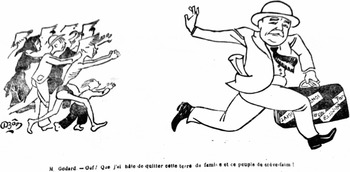
Reaction among at least some Vietnamese, however, was guarded. In 1938, Vủ Đình Đại a former student, argued that the French needed to provide opportunities for College graduates. He spoke of the frustration of many Vietnamese students who, having learned French, found themselves without jobs. In the spirit of cooperation promoted by the Popular Front government, Đại pointed to the closing cultural gap between the Vietnamese and French: ‘Our rulers are not unaware that the more a native enters into western culture, the smaller is the gap that separates Annamites and French. Raise the intellectual level of the Annamese people; and there you have it, the best way to help the French and the natives, who live side by side, to understand and love each other.’Footnote 59 While the consequences of a lack of understanding were not spelled out, the failure of the French government to institute meaningful reforms was captured in this cartoon from L'Effort indochinois (see Figure 3).
Godart running away.
Source: L'Effort indochinois; photo in author's collection.

Conclusion
This paper has focused on a few of the conscious efforts to introduce new techniques to the countryside and to evaluate why these efforts were not effective. In particular, this paper has shown that for many French officials, technical education was designed to create a limited number of assistants for the scientists and engineers trained in France to help run the colonial economy. Schools were also meant to inculcate a ‘scientific’ way of thinking in Vietnamese agricultural workers, but not to give them the means of production. In addition, education was seen as one way to spread new methods for cultivating certain crops among Vietnamese farmers, and not others. In particular, many interests in French colonial Vietnam worked against the potential spread of rubber-producing knowledge and technologies.
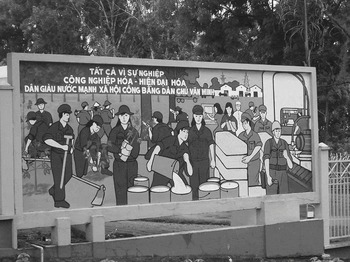
In this paper smallholder rubber production is viewed as having had the potential for becoming ‘everyday’. Yet, during the colonial period, rubber estates, along with other typically ‘big’ technologies, such as railways, most often defined the everyday (which can still be the case, see Figure 4).Footnote 60 In contrast with rice, rubber-producing technology was neither actively taken up by Vietnamese farmers nor was it subject to much exchange between farmers and researchers. Today, in networks connecting rubber production and the successors to Bến Cát, such exchanges seem to take place. Sitting very near the location of this school is the agricultural research station at Lai Khê (Ong Yêm).Footnote 61 Partially destroyed during the fighting of the 1960s, these research buildings now house the surviving records of the station, and it is the site of ongoing agricultural research using advanced biological techniques. Lai Khê also serves as a rural extension centre and occasionally agricultural entrepreneurs arrive to find out from experts how to plant hévéa.
‘All for the cause of industrialization and modernization. Rich people, Strong country, Just, Democratic, and Civilized society.’
Source: Photo in author's collection.