Introduction
Diplycosia Blume (Ericaceae) has always been considered to have its main centre of diversity on the island of Borneo with 51 recorded species, nearly half the total number in the genus as a whole. Mount Kinabalu in Sabah (Malaysian Borneo) is the richest single location with at least 27 species, which is not surprising as it is not only the highest mountain in Borneo but by far the best collected (Beaman et al., Reference Beaman, Anderson and Beaman2001). The Meratus mountains of South Kalimantan (Indonesian Borneo), by contrast, are of much lower altitude and have been infrequently visited by botanists although the area is recognised as one of floral distinctiveness (MacKinnon et al., Reference MacKinnon, Hatta, Halim and Mangalik1996). These mountains form an isolated group which has already yielded endemics such as Rhododendron alborugosum Argent & J.Dransf., Adinandra meratusensis Sugau and Polyalthia myristica I.M.Turner. The lowlands also host interesting endemics such as the palm Salacca dransfieldiana Mogea. The number of new endemics described from this region suggests that it is quite likely that other undescribed species await discovery from this poorly explored part of Kalimantan.
This new species does not match any described Diplycosia species. It will not key out in Sleumer (Reference Sleumer1966–67). It keys relatively satisfactorily to the second lead of couplet 39 but then does not easily fit the leaf size criteria of couplet 41. Besides, no Bornean species are found beyond this point in the key. In Argent’s key to Bornean Diplycosia (Argent, Reference Argent1989, Reference Argent2002), our material keys to D. pseudorufescens Sleumer but this species has stems with patent bristles and a fine patent under-pubescence. Diplycosia pseudorufescens also has the ovary ‘densely greyish-pubescent’ (Sleumer, Reference Sleumer1966–67) and much smaller flowers with shorter styles.
Taxonomic Treatment
Diplycosia kalimantanensis P.Wilkie & Argent, sp. nov.
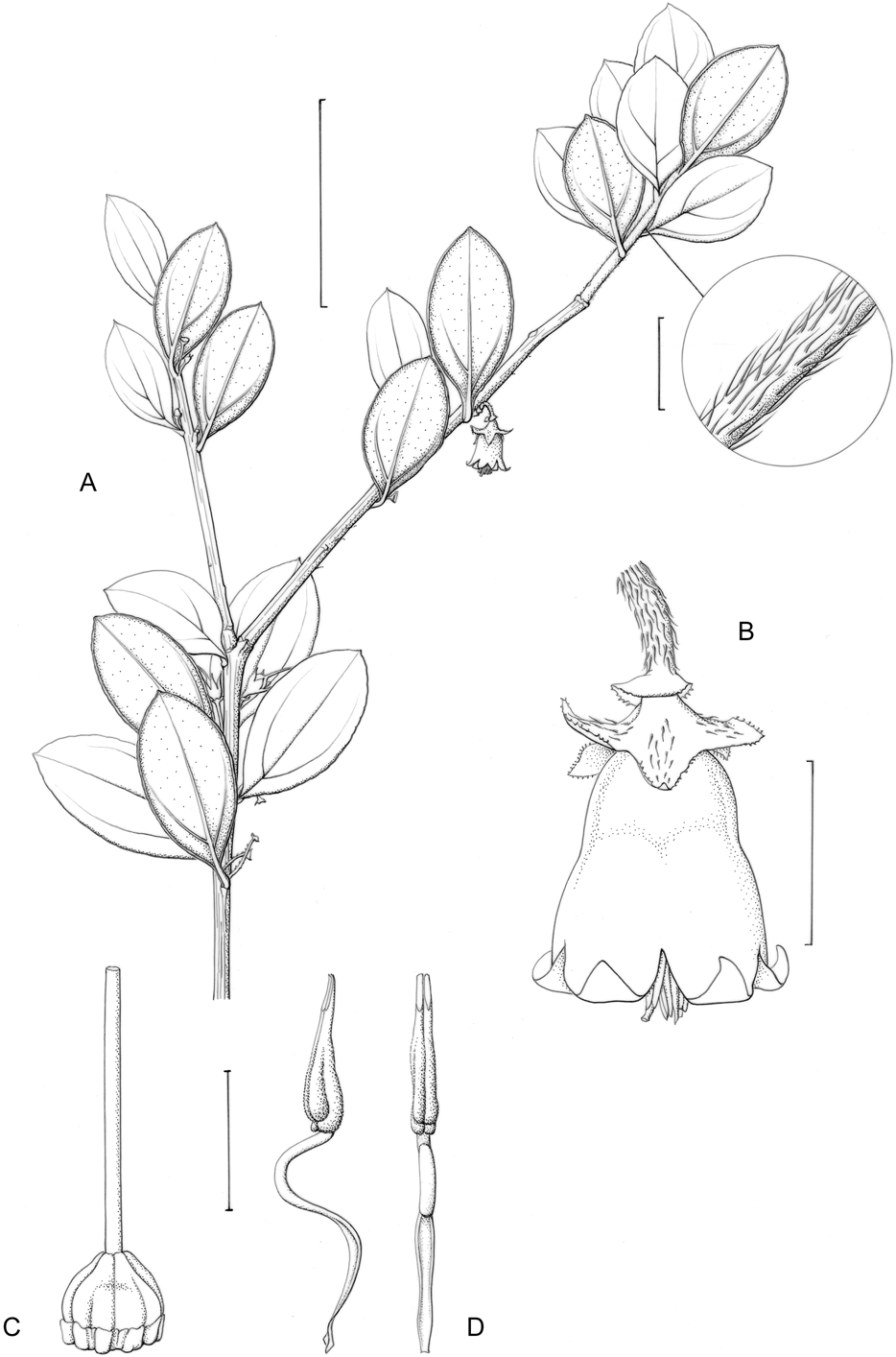
This new species is superficially most similar to Diplycosia pseudorufescens Sleumer but is distinct in having: stems with appressed bristles without a fine patent under-pubescence; small leaves up to 26 × 14 mm, with only very slender faint lateral veins; flowers 1–2 per axil; the pedicels up to 5 mm long, with densely crisped hairs; the calyx without bristles; the corolla, ovary and style glabrous. – Type: Indonesia, South Kalimantan, Meratus Mts., Gunung Besar, c.2°40′S 155°45′E, c.1800 m, 20 x 1996, Argent & Wilkie 9670 (holo BO!; iso A!, E!, L!, SING!). Fig. 1.
Diplycosia kalimantanensis P.Wilkie & Argent. A, habit with inset to show stem indumentum; B, flower; C, pistil; D, stamens, front and side views. Scale bars: A = 3 cm; B = 5 mm; A-inset, C & D = 2.5 mm.

Erect shrub to 2 m tall, branches rounded. Youngest twigs with moderately dense, appressed bristles, up to 2 mm long, without fine patent under-pubescence; lateral buds hemispherical but small and inconspicuous. Leaf blade leathery, 17–26 × 10–14 mm, elliptic, the base broadly tapering, the apex obtusely pointed, the terminal gland small, slightly protruding from the apex, margin entire, with bristles when young, narrowly revolute, when very young minutely glandular hairy above, these hairs disappearing without leaving any trace; appressed bristly below, the bristles quickly disappearing to leave a black punctate surface; mid-vein minutely impressed above, weakly raised beneath; the lateral veins slender, faint, if visible one or two per side arising above the base and then subpinnate, at first straight but distally curving upwards before disappearing before the margin, flat above, minutely raised beneath. Petiole 2–3 × c.1 mm, moderately densely appressed bristly, glabrescent. Flowers 1–2 per axil, scented. Pedicels at anthesis 3–5 × c.1 mm, densely covered in crisped hairs and with several minute bracts at the base; bracteoles c.1 × 1.5 mm, semicircular, rough with a warty surface abaxially, glabrous adaxially, fringed with glandular hairs along the margin. Calyx tube c.2 × 3 mm, glabrous, the lobes c.2 × 2 mm, triangular, glabrous except for the ciliate margins and a few abaxial appressed hairs. Corolla (rehydrated) c.8 × 6 mm, translucent white to pale pink, campanulate, glabrous inside and out, lobes 5, c.2.5 × 2.5 mm, broadly triangular with broadly acute reflexed tips. Stamens 10, c.8 mm long, slightly protruding; filaments c.5 mm long, filamentous, sigmoid, white, glabrous; anthers c.3 mm long, only minutely echinulate, cells c.1.8 mm long, the tubules c.1.4 mm long, with very obliquely cut pores. Disc a series of small heart-shaped, glabrous lobes. Ovary c.2 mm in diameter, glabrous; style c.5 mm long, cylindrical, glabrous. Fruit not seen.
Distribution. Known only from the type locality.
Ecology. Terrestrial in open submontane shrubbery at c.1800 m. Flowering October.
Conservation status. Least Concern. This species is only known from two collections both from the same mountain. Under IUCN guidelines (IUCN, 2014) this is considered a single location. Criteria A and C cannot be used as no information on population reduction or size and decline of population is available. Criterion B (geographic range – EOO or AOO) although qualifying on the single locality (a) cannot be used as it fails on (b) and (c) due to lack of threats or evidence of fluctuations. Using Criterion D (very small or restricted population) is difficult considering the lack of evidence regarding the number of individuals and the lack of a plausible future threat. Thus the category of Least Concern has been assigned as the species is reported to be common around the summit area, is found in a remote location, there is no particular threat and there have been few botanical collections from the area and it is likely that future collections will find new populations.
Etymology. From Kalimantan, the location of the type.
Notes. The flowers were reported to be scented which is the first record of any species of Diplycosia having fragrant flowers.
Additional specimen. Indonesia. South Kalimantan: Gunung Besar, 18 ii 1979, Gen. Murata, Masahiro Kato & Yohannis Mogea B-3469 (BO!, E!).
Acknowledgements
We are grateful to Herbarium Bogoriense for logistical support and Claire Banks for the illustration. The Royal Botanic Garden Edinburgh is supported by the Scottish Government Rural and Environmental Science Analytical Services Division.