One hallmark of free and fair elections is that the election rules must be known in advance and set for the period of the election. Contemporary democracies have little problem making credible commitments to abide by such practices. Authoritarian regimes, however, may change the rules in mid-campaign to influence the outcome. Some have argued that the development of online social media will help opposition groups overcome authoritarian regimes despite these challenges; others are less sanguine (Lynch Reference Lynch2011). When does social media help political movements succeed in otherwise dictatorial regimes?
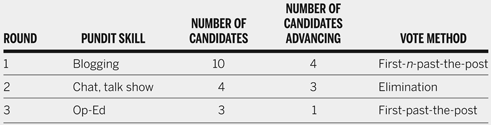
Experience from a contrived election leads to some answers. In the autumn of 2010, the Washington Post held its second annual “America's Next Great Pundit” contest on its website. The straightforward process is summarized in table 1.
Summary of Washington Post Pundit Contest Rounds and Rules

Notes: Five of the 10 quarterfinalists were chosen by the editors from the pool of 1,500 entrants; the remaining five were picked by visitors to the Post's website from a pool of 50. The blogging round involved the contestants' blogging about different topics during the course of a workweek; the live chat and talk show round featured the contestants' ability to react to questions from an online audience and in a televised Crossfire-style show respectively; and the op-ed round saw the three finalists publish a column in the print edition of the Post's Opinion section.
The contestants did not know the rules in advance, beyond a general understanding that there would be several rounds of voting and elimination. Although the Post advertised the contest as being decided by the newspaper's readers at large, the candidates and their supporters acted on the assumption that get-out-the-vote efforts would prove decisive. Certainly, the vote totals suggest that mobilization by candidates was far more important than any spontaneous mobilization of the newspaper's audience. The Post has a circulation of nearly 600,000 print readers, and its website attracts many more, but fewer than 3,500 votes were cast in the contest's final and most popular round (Peters Reference Peters2010). Accordingly, the contestants quickly developed and used Facebook “fan” pages, Twitter feeds, mass e-mails, blogs, and (in the case of one contestant, a reporter for a Boston television station) a professionally produced 45-second video.
As in many authoritarian elections, candidates' style of campaigning could prompt the overseeing authority to change the election's rules. Given this endogeneity, social media can be less effective. Consequently, traditional face-to-face organizing (which opposition groups hope is unobservable to the regime, and which may also be unobservable to political scientists) will be relatively more valuable.
CHOOSING A PUNDIT
Along with a handful of colleagues, I served as a manager for the initially quixotic campaign of Conor Williams, a political theory PhD student. (Williams won the contest and its prize, a 12-week contract writing for the Post's op-ed pages. Williams (Reference Williams2010) has written his own account of the contest from a more normative perspective. See also Rosenberg's (Reference Rosenberg2010) reflections on the implication of the contest for the representation of women and minorities in the Post.) Much of this brain trust's time was spent suggesting ideas and political science findings that a general audience might find interesting, a project inspired by (and sometimes a direct imitation of) the blog The Monkey Cage (http://www.themonkeycage.org). As political aficionados as well as political scientists, we also spent much time hashing out campaign strategy. When it became clear that our candidate could win, we turned to our knowledge of the American politics literature to guide the campaign.
Our original expectation was that each round would be a test of sheer mobilization ability. Consequently, we recruited campus media outlets, e-mailed our individual networks of contacts, and even sought to drum up hometown support by putting stories in Williams's hometown newspaper (Mack Reference Mack2010). The strategy paid off in the Round 1, but the Post upset our plans in Round 2 by changing the structure of voting from a first-n-past-the-post rule to a rule in which the candidate with the highest number of votes would be eliminated.
We were faced with two immediate concerns. First, whom should we target for elimination? Our instinct was to concentrate on our apparently strongest rival candidate for elimination, in the hopes that this would put our candidate in the best position in the final round, Round 3. As I demonstrate, this was, in fact, the correct strategy.
The second concern was more troublesome. How could we communicate our strategy to our Facebook friends and Twitter acquaintances? We assumed that other competitors were reading our communications, as we were theirs; the point of Facebook pages and tweets, after all, is to disseminate a message to as large an audience as possible. We further assumed that the Post staff were keeping up with such messages, and that the judges (who could expel competitors, grant Survivor-style immunities, and add rounds as they pleased) would be dismayed to find outright negative campaigning in their contest.
These whims of the judges were no idle concern. Angry judges could act as rational or irrational gods of vengeance and reward. The judges had already suspended several candidates in an earlier, “play-in” round for suspected vote fraud; they had also granted one competitor in Round 1 an automatic right to advance to the next round. This hindered our evaluations of the relative strengths of other candidates, because we lacked any evidence to suggest whether that candidate would be weak or strong. Indeed, as the next rounds unfolded, one candidate turned out to be much stronger than we had anticipated, which is a complication I ignore in the model exposition.
Exploring these questions leads to a surprising conclusion. In some situations, and particularly in those in which vote shares are relatively evenly distributed or in which players have asymmetric abilities to communicate via traditional, face-to-face networks, reliance on Internet-based social networks can be a liability. This article seeks to isolate the effect of the differential ability of such networks to coordinate mobilization activity.
THEORY
Analyzing the contest's dynamics is simple. Although it is formally a game (the outcome depends on the interactions of the players), the mathematics are straightforward because the prize is indivisible and because we assume that voters and players are motivated solely by their own candidate's chances of success (that is to say, there is no coalition-building or ideological voting at work).
Consider a simple example. In a multistage voting process with m players, n players will be advanced to the next round. Each player P i commands V i voters. Players are ranked by the size of their voting bloc, V 1 > V 2 … > V m. In a simple nth-past-the-post system, all players through and including the nth-ranked player will advance to the next stage. When n equals 1, it is obvious that we are simply dealing with the familiar first-past-the-post system, and that—assuming sincere voting—P 1 will win the day. (The paradoxes and incentives for strategic voting produced by systems that require electors to vote for a candidate are well understood thanks to the efforts of theorists such as Borda, Condorcet, Dodgson, Arrow, and others. For an accessible review of the history of the mathematics of voting, including arguments about why the assumption of sincere voting is problematic, see Szpiro (Reference Szpiro2010). More technical arguments about the implications of sequential voting for Condorcet and other criteria can be found in Bag, Sabourian, and Walsh (Reference Bag, Sabourian and Walsh2009) and the references therein.)
Let us consider a different example. Here, of the m players, n will be eliminated. For convenience's sake, assume n equals 1 throughout. All other definitions and assumptions remain the same. Assume further that voters are loyal: V i will not vote “against” (for the elimination of) P i and that all players want to be in the strongest position in the subsequent round. That implies that all players want to eliminate their strongest rival, which is P 1 for everyone but Player 1 and P 2 for Player 1.
Why should voters care about how their player places if he doesn't win? There are at least two plausible stories. First, it is better to be next-to-last than last, and thus even players who have no chance of coming in first may still want to improve their relative showing. Second, the sizes of each player's voting bloc may be determined in expectation, and thus, in any given draw, a player may still have a chance of outperforming his or her expected rank depending on turnout. Thus, players should still want to eliminate their most highly ranked rivals, because that will maximize their chances of winning.
In an environment in which P i can directly tell his or her supporters V i for whom to vote, the number of votes accumulated will be given by:


Consequently, Player 1 will be eliminated if he or she has less than half of the voters and Player 2 will be eliminated if Player 1 has more than half of the voters. These results are intuitive. If Player 1 has a majority of voters, then the moves of the other players' voters will be irrelevant.
Now, let us consider a situation in which voters cannot communicate with their player; that is, all they know is that they should vote for someone other than their player. This is most easily modeled as assuming a random draw for voters' behavior from a uniform distribution—that is, that voters are equally likely to vote for any of the other candidates. The distribution of votes will now be:


…

Note that the weakest player is eliminated because that player has the fewest loyal voters, although that outcome is none of the players' preference.
What happens if there are some voters who have perfect information and others who are uninformed? Let us now redefine V i = V ip + V if where V ip represents the share of voters with perfect information and V if is the share of voters with imperfect information. Let us consider again the one-person elimination scenario:


In this situation, Player 1 will be eliminated when

The importance of considering heterogenous classes of voters becomes more apparent if we examine a game in which V 1p = V 2p = ··· = V (m−1)p = 0—that is, in which only the weakest player numerically has informed voters. The expected vote totals are now:


…

When will the perfectly informed voters for Player M be able to tip the balance? Solving for V mp we find that the perfectly informed voters for Player M will be able to tip the balance when V mp = (V 1f − V mf)/(n − 1). Thus, there is a range of values for which the player with the fewest but best-informed voters can decide the outcome of the round. Note that this is identical to the earlier example in which Player M was eliminated except that we have allowed for some of Player M's voters to cast their ballots in accordance with M's unobservable instructions.
EMPIRICAL IMPLICATIONS AND TESTING
The simple model illuminates one important aspect of how the contest unfolded. Although we were unsure of our exact ranking in terms of raw voters, we were confident that we were not the strongest team (e.g., other candidates had access to Twitter feeds with tens of thousands of followers) and that we had the lowest transaction costs for old-fashioned, face-to-face campaigning because of our preexisting campaign structure and our presence on a college campus: we could organize and inform many voters quickly and securely.
This last point proved key. Using our public social-networking outlets, we asked voters to go to the contest website and vote “ABC”—“Anybody But Conor.” These measures were necessary because we wanted to raise other candidates' vote totals and because we needed to make sure that none of our supporters (a coalition ranging from tech-savvy doctoral students to grandparents) inadvertently cast a ballot “for” our candidate. In private, however, we named names and directed votes against the candidate we wanted to eliminate. We assume all of the other candidates similarly encouraged their supporters to vote for anyone but themselves. The other contestants' workplaces (a small nonprofit, a television station, and a home office) apparently lacked ready, cheap, and unobservable access to thousands of undergrads, grad students, and faculty. The vast majority of their voters, in other words, were therefore likely ignorant of their candidate's preference ranking.
Although I argue that its omission does not significantly affect this analysis, the model omits one important potential factor: coordination of individual actions without overt communication is possible if individuals can use “focal points” instead (Schelling Reference Schelling1960). In this case, it is likely that gender served as a focal point for at least one contestant's supporters, who largely came from feminist blogs and Twitter feeds (Chloe 2010). Surprisingly, women qua women (or, perhaps, feminists qua feminists) may be more likely to engage in conscious discriminatory voting using gender as a focal point than men. This was shown in two different investigations of strategy on the early 2000s television game show The Weakest Link (which featured sequential elimination rounds in which the contestants were also voters) (Antonovics, Arcidiacono, and Walsh Reference Antonovics, Arcidiacono and Walsh2005; Boston Reference Boston2003). In a more searching examination of the show, Levitt (Reference Levitt2004) finds some evidence of gender-based discrimination and a substantively large potential evidence of discrimination against Hispanics and older players.
Because all players in the Post's elimination round were white and none were (apparently) older than middle-aged, gender-based discrimination may have played some role for some voters, but in the absence of information about the voter pool it is difficult to say how influential such effects were. Gender is a weak focal point in this case because there were two male candidates and two females in Round 3. Furthermore, a voter who wanted to ensure that a woman won might strategically vote against a weak female candidate to guarantee that only the strongest female candidate would be present in the final round and hence reap the focal point benefits when it counted.
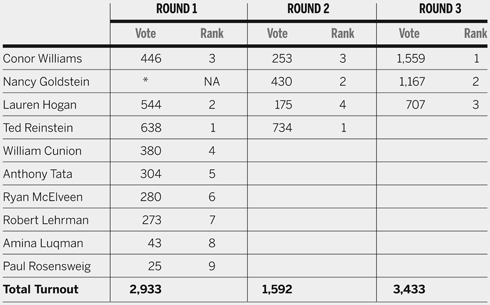
On the whole, despite the obvious data limitations and minor points like the presence or absence of focal points, the simple model works fairly well. The model's prediction that the higher costs of coordination in the unique conditions of Round 2 and the consequential returns to having informed voters appear to be born out. As table 2 shows, the theory and the model are consistent with the observation that turnout fell precipitously in Round 2, with all candidates except the top-ranked entrant receiving fewer votes than they had in Round 1 or would in Round 3. One implication of the model is that it is harder to use social networks to campaign against someone than to campaign for them, and the turnout figures support that claim. Further, the vote-total patterns for Ted Reinstein do indicate that informed voters were casting their ballots as the model predicts.
Results of Washington Post Pundit Contest Rounds

Notes: The judges chose one contestant, Nancy Goldstein, to automatically advance from Round 1 to Round 2. Note that the total votes cast in Round 1 for the three candidates who were also present in Round 2 is 1,628—higher than the votes cast for all four candidates in Round 2.
CONCLUSION
In an update on the contest's blog announcing the exit of the apparently top-ranked contestant, the Post's contest impresario wondered: “Was there strategic voting in this round, in which we asked readers to vote to eliminate rather than to advance a contestant?” Of course there was. The contestants and informed, committed voters would have been foolish to act otherwise. Rather, the question is whether such strategic voting altered the outcome. It is likely that such voting, at least, changed the identity of the contestant who was eliminated in that particular round. My model suggests that, in the absence of the ability to coordinate voting, the weakest player should be eliminated and the strongest ones should remain. If a weaker player has more, better-informed voters, one of the strongest players should be eliminated. The latter scenario, of course, is what came to pass.
The larger question, however, is one the Post did not ask: To what extent did the Post's desire to guarantee a smooth process and produce an interesting winner influence the outcome of the election? What I argue is that, at a minimum, there are strong reasons to think that these effects were large enough to tip the election from one outcome to another.
In fact, important, larger lessons can be learned from this toy example. Varian (Reference Varian2010) suggests that an underappreciated aspect of information technology revolutions is their ability to foster development in types and ways of contracting and managing firm-customer and worker-worker relationships. Political scientists are aware of how the use of new media has affected campaigns and their research about the use of campaign websites, Twitter feeds, and YouTube ads; the acceleration of the news cycle has proceeded apace. Yet, more systematic study of the differentiation of message via channels according to their degree of observability is needed. Certainly, for example, the Republican or Democratic message presented via television advertisements or candidates' public speeches is vastly different than that which the party faithful consume via targeted and often informal outlets.
More intriguing, such targeted outlets may allow groups otherwise barred from formally coordinating their efforts (such as the Koch brothers-linked Americans for Prosperity) to do so via “public” channels. For instance, in Reference Kristol2010 William Kristol—the editor of the Weekly Standard and an influential neoconservative—suggested that the campaign for Dennis Kucinich's seat “could be an interesting race for people to consider last-minute contributions to—or even IE expenditures, perhaps focused on national security, where Kucinich's militant hostility to American victory abroad, and to supporting the troops, is probably at odds with his blue-collar constituents.” (“IE” stands for “independent expenditure” groups, like the Karl Rove-linked group American Crossroads.)
A similar phenomenon appears to have played out during the Egyptian protests in January and February 2011. Youth activists publicly called for rallies to be held at 20 protest sites scattered throughout Cairo to distract security forces while privately reconnoitering a candy shop whose large sidewalk plaza made it suitable as a mustering point for activists. Recruiting protestors for this twenty-first site was conducted entirely by word of mouth. Consequently, a core of 300 demonstrators free from police control (as the security forces had deployed to the publicly announced sites) instantly became a focal point for hundreds, and then thousands, of marchers who headed toward Tahrir Square (Levinson and Coker Reference Levinson and Coker2011).
The larger point is that researchers should consider carefully what is and is not observable in communications, as well as how variations in communications technology affect political processes. In the highly stylized example presented in this article, it appears that the Post's rule change may have altered the ultimate outcome in a way that the contest's organizers may or may not have expected. Similar changes undoubtedly take place in a variety of political fora, from public elections to legislative rule-making to bureaucratic signaling, where the stakes are greater.
ACKNOWLEDGMENTS
The author thanks Conor Williams, Clyde Wilcox, and an anonymous reviewer for their helpful comments and support.