Introduction
Lentil (Lens culinaris Medikus subsp. culinaris) is an ancient crop of the old world and continues to play an important role in agriculture. In India, lentil is cultivated in rabi season on an area of 1.45 million ha with production of 1.10 million ton and productivity of 760 kg/ha (FAO, 2009). It is mainly cultivated in Uttar Pradesh, Madhya Pradesh, Bihar, West Bengal, Assam, Rajasthan, Jharkhand, Haryana, Maharashtra and Punjab. These states contribute 90% of total area and 87% production in the country (Tickoo et al., Reference Tickoo, Sharma, Mishra and Dikshit2009). Unfortunately, the average yield of lentil is low in India. The genetic improvement of this crop is constrained by availability of appropriate germplasm and by the narrow genetic base of the varieties developed so far (Kumar et al., Reference Kumar, Sanjeev Gupta, Suresh Chandra, Singh, Masood Ali, Singh, Shiv Kumar and Vishwa Dhar2004). Plant genetic resources are valuable sources of gene and gene complexes for various stresses and provide basic raw material for genetic improvement of crops. Therefore, the collection of lentil germplasm and its evaluation, conservation and utilization in crop improvement programmes are of considerable significance, in view of environmental stress, especially moisture regime, leading to frequent failure of the crop.
Historical overview
Lentil has been grown in India since time immemorial (Vishnu-Mittrre, Reference Vishnu-Mittrre and Hutchinson1974). The earliest report of lentil germplasm collection in the Indian literature is by Shaw and Bose (Reference Shaw and Bose1929). A lot of natural variability was captured from various regions, and during the early phase of collection, the landraces with wide adaptability were selected for commercial cultivation in the country.
In India, the plant exploration and collection work was initiated in a systematic way with the establishment of a central agency for this purpose, during 1946, in the Division of Botany, Indian (the then Imperial) Agricultural Research Institute (IARI), New Delhi and later upgraded as the Plant Introduction Division in 1961. Dr. Harbhajan Singh referred to as the ‘Indian Vavilov’ had strengthened the germplasm exploration programme through introduction and indigenous collection. During 1960–1970, special efforts were made under PL 480 (a scheme under collaboration with ICAR and USDA project on food security in Haiti, using Public Law 480) to collect the local germplasm from various states of India.
Realizing the importance of plant genetic resources and their enhanced activities, the Plant Introduction Division of IARI was developed into an Independent Institute known as National Bureau of Plant Genetic Resources (NBPGR) in 1976. The Bureau currently has 10 regional stations and 59 national active germplasm sites (NAGS) located in various agroclimatic zones of country. This network carries out the activities of genetic resources research and maintenance for various crop plants including lentil through exploration and collection, introduction and exchange under strict phytosanitory regulations, evaluation and characterisation, documentation and conservation of germplasm. The Indian Institute of Pulses Research (IIPR) at Kanpur has been designated as the NAGS for pulse crops including lentil in India.
Explorations and collection
The collection of genetic resources of lentil and its wild species from different agro-ecological, phyto-geographical regions is an important aspect of augmenting its germplasm. After the inception of NBPGR in 1976, systematic explorations, both crop- and region-specific, were conducted to augment lentil germplasm. The area surveyed for collection of lentil germplasm comprised parts of Uttar Pradesh (particularly the Central and Eastern parts), Uttaranchal, Northern districts of Himachal Pradesh, adjoining parts of Jammu and Kashmir, Eastern Madhya Pradesh, parts of Bihar, Haryana and Rajasthan (Malik et al., Reference Malik, Srivastava, Tomar, Bhandari, Pandey, Hore, Dikshit, Dhillon, Varaprasad, Srinivasan, Singh, Archak, Srivastava and Sharma2001). The efforts for exploration and collection of lentil germplasm were further intensified under a National Agricultural Technological Project (2000–2005). To date, a total of 1958 indigenous collections have been made. These collections exhibited significant variation mostly for growth habits, seedling colour, stem and foliage colour, pods/plant, grain size and seed-coat colour (Singh and Rana, Reference Singh, Rana, Asthana and Ali Masood2006). The collections from the Bundelkhand region of Uttar Pradesh showed variation in seed-coat colour, represented by grey, mottled grey, brown, mottled brown, mottled black and black.
Plant introduction and conservation
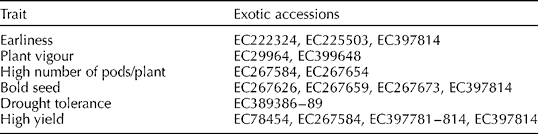
The NBPGR is catering to the needs of lentil breeders by introducing important genetic resources from Syria, Bangladesh, Turkey, Canada and Afghanistan. The primary area of diversity of lentil is considered to be South-West Asia and Mediterranean region. Archaeological evidence indicates that lentil was one of the earliest domesticates in the Near-East Arc (Zohary, Reference Zohary1972). So far, 7533 accessions (including trials) have been introduced under strict quarantine measures. They have been conserved for present-day use and for posterity. Lentil has orthodox seeds that can be dried and stored for a long period with a minimum loss of seed viability. For conservation, accessions are assigned a national identity number, dried to seed-moisture of around 5 ± 2% and stored at 18°C and 15% relative humidity. The accessions meeting international standards, i.e. seed viability more than 85% and quantity of about 2000 seeds, are transferred to long-term storage. The most recent inventory that includes 2353 accessions comprising 1826 indigenous and 527 exotic introductions have been conserved in the National Seed Genebank of NBPGR. Duplicate safety samples (7712) from International Center for Agricultural Research in the Dry Areas are also maintained in the National Gene Bank. Active collections are being stored under medium-term storage at NBPGR, New Delhi. The IIPR, Kanpur, a NAGS for pulses and its Co-ordinating centres also maintains over 5000 working accessions of lentil. National germplasm collections are important resources and a prime source of adapted genetic material for breeding programmes. Some of the promising exotic germplasm introductions for different traits in lentil are presented in Table 1.
Promising exotic germplasm introduced in India

Germplasm evaluation
Non-availability of data for characters of economic importance is one of the major constraints to effective utilization of lentil genetic resources. Therefore, a large number of accessions were evaluated nationally and internationally and are being used in crop improvement programmes. These data are summarised below.
Molecular characterization
Molecular markers are very useful in elucidating the genetic diversity of germplasm and in tagging genes of economic importance. Sharma et al. (Reference Sharma, Chahota and Lal Chuni1995) studied relationships among cultivated and wild lentils using random amplification of polymorphic DNA (RAPD) markers. The results revealed that, of the taxa examined, orientalis ssp. is the most similar to cultivated lentil. Lens ervoides was the most divergent wild taxon followed by Lens nigricans. The genetic similarity between the latter two species was of the same magnitude as between orientalis ssp. and cultivated lentil. They have also studied amplified fragment length polymorphism (AFLP) technique and its comparison with RAPD markers for diversity analysis and phylogeny of 54 accessions of cultivated lentil and its wild relatives. The level of variation detected within the cultivated lentil with AFLP analysis indicates that it may be a more efficient marker technology than RAPD analysis for the construction of linkage maps (Sharma et al., Reference Sharma, Knox and Ellis1996). Genetic diversity assessment of indigenous lentil germplasm was also performed by National Research Centre on DNA Fingerprinting, Pusa campus, New Delhi and recorded certain level of polymorphism using AFLP and simple sequence repeat markers.
Variation for agro-morphological traits
Sharma and Kant (Reference Sharma and Kant1975) studied 3000 lines of lentil and reported wide variation for flowering time (60–160 days) and seed weight (11.5–74 g/1000 seeds). Variation for different characters was reported by several workers (Singh and Singh, Reference Singh and Singh1991; Pandey et al., Reference Pandey, Singh and Singh1992; Chahota and Sharma, Reference Chahota and Sharma1993; Singh and Singh, Reference Singh and Singh1993; Thakur and Bajpai, Reference Thakur and Bajpai1993; Negi et al., Reference Negi, Muneem, Sapra and Chande1996; Sardana et al., Reference Sardana, Gautam, Kumar, Sapra and Mithal1998). Mahajan et al. (Reference Mahajan, Sapra, Srivastava, Singh and Sharma2000) characterized and evaluated large number of accessions using International Plant Genetic Resources Institute/NBPGR descriptors.
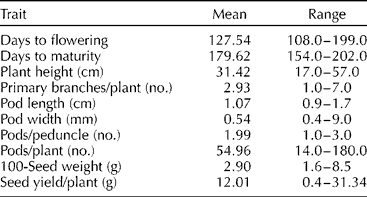
Sharma et al. (Reference Sharma, Chahota and Lal Chuni1995), Vir and Gupta (Reference Vir and Gupta2000) and Kishore and Gupta (Reference Kishore and Gupta2002) reported significant variation in macrosperma- and microsperma-derived gene pools of lentil and suggested that introgression of desirable genes of these types may prove to be useful for seed size and earliness. In a study by Rodriguez et al. (Reference Rodriguez, Paredes and Becerra1999) on isoenzyme genetic diversity of 91 representative Chilean and exotic landraces, they did not detect a clear-cut separation between macrosperma and microsperma genotypes. Sapra et al. (Reference Sapra, Kumar and Mehra1984), Sardana et al. (Reference Sardana, Gautam, Kumar, Sapra and Mithal1998) and Ramesh et al. (Reference Ramesh, Kumar and Kumar2000) also observed no correlation between genetic and geographic diversity. However, Piergiovanni et al. (Reference Piergiovanni, Laghetti, Olita, Monti, Preiti and Prima1998) reported strong association between genetic and geographic diversity in lentil. Solanki et al. (Reference Solanki, Kapoor and Singh1999) evaluated 21 lentil genotypes for nutrition-related parameters such as protein, crude fibre, fat, ash (total mineral matter), carbohydrates, moisture, total energy and metabolizable energy. Tullu et al. (Reference Tullu, Kushmenoglu, McPhee and Muehlbauer2001) evaluated a core collection of lentil germplasm comprising 287 accessions and observed significant variation for biomass, seed yield and residue amounts that warrant their use in lentil breeding programmes. Several other workers have also reported genetic variation for yield and other component traits (Agrawal and Lal, Reference Agrawal and Lal1985; Sharma and Luthra, Reference Sharma and Luthra1987; Swarup and Lal, Reference Swarup and Lal1987; Ramgiry et al., Reference Ramgiry, Paliwal and Tomar1989; Singh, Reference Singh1991; Singh and Rana, Reference Singh, Rana, Erskine and Saxena1993; Negi et al., Reference Negi, Muneem, Sapra and Chande1996; Asthana and Chandra, Reference Asthana, Chandra, Asthana and Ali1997; Ramesh et al., Reference Ramesh, Kumar and Kumar2000). The mean performance and range of expression for important quantitative traits are presented in Table 2.
Average and range for different economic traits in lentil germplasm

Induced variations
The primary strategy in mutation breeding research has been to upgrade the well-adapted varieties by altering one or two major traits, which limit their productivity or enhance their quality value. Mutations have also been used to widen the genetic base of cultivated lentil. Gamma rays have been most frequently used techniques to alter genes and variation was created and observed for various agro-morphological traits using different mutagens (Sharma and Kant, Reference Sharma and Kant1975; Sharma and Sharma, Reference Sharma and Sharma1978a,b; Sharma and Sharma, Reference Sharma and Sharma1981a,b; Dixit and Dubey, Reference Dixit and Dubey1986; Singh, Reference Singh1988; Sinha and Chaudhary, Reference Sinha and Chaudhary1991; Tyagi and Gupta, Reference Tyagi and Gupta1991; Vandana et al., Reference Vandana, Tripathy and Dubey1994; Sharma and Chahota, Reference Sharma and Chahota2000; Solanki and Sharma, Reference Solanki and Sharma2001a,b; Solanki and Sharma, Reference Solanki and Sharma2002; Solanki, Reference Solanki2005).
Resistance to biotic and abiotic stresses
Fusarium wilt (Fusarium oxysporum f.sp. lentis) is considered to be one of the most important biotic stresses affecting lentil productivity in India. A number of studies have reported lentil germplasm resistant to fusarium oxysporum (Khare and Sharma, Reference Khare and Sharma1970; Kannaiyan and Nene, Reference Kannaiyan and Nene1976; Singh et al., Reference Singh, Singh, Maurya, Rai and Gupta1977; Pandey et al., Reference Pandey, Pandey and Singh1980; Tiwari and Singh, Reference Tiwari and Singh1980; Khare, Reference Khare, Webb and Hawtin1981; Chandra, Reference Chandra, Sexana and Verma1983; Nene, Reference Nene1988; Saxena and Khare, Reference Saxena and Khare1988; Singh, Reference Singh1991; Khare et al., Reference Khare, Bayaa, Beniwa, Singh and Saxena1993; Singh et al., Reference Singh, Singh, Singh and Chauhan1994; Gaur and Chaturvedi, Reference Gaur, Chaturvedi, Masood Ali, Singh, Shiv Kumar and Vishwa Dhar1994). Bayaa et al. (Reference Bayaa, Erskine and Singh1997), in a study of 577 lentil germplasm accessions representing 33 countries, reported that accessions possessing resistance originated from Chile, Egypt, India and Romania.
Lentil rust is another important biotic stress. Shukla (Reference Shukla1984) screened 250 accessions and rated 2 to be immune and 61 as resistant. Mishra et al. (Reference Mishra, Kotasthane, Khare, Gupta and Tiwari1985) observed 25 of 110 germplasm accessions resistant for rust. Kumar et al. (Reference Kumar, Singh, Singh and Sugha1997) screened 321 lines under field conditions at two locations and identified some resistance to rust. Mishra et al. (Reference Mishra, Sarker, Singh, Basandrai and Basandrai2005) evaluated 260 lines and found 101 to be highly resistant. Many other workers have also reported accessions resistance to rust (Nene et al., Reference Nene, Kannaiyan and Saxena1975; Agrawal et al., Reference Agrawal, Khare and Agarwal1976; Khare et al., Reference Khare, Agarwal and Jain1979; Chandra, Reference Chandra, Sexana and Verma1983; Singh and Sandhu, Reference Singh and Sandhu1988; Singh and Singh, Reference Singh and Singh1990; Singh and Singh, Reference Singh and Singh1994; Guar and Chaturvedi, 1994; Asthana and Chandra, Reference Asthana, Chandra, Asthana and Ali1997; Reddy and Vishwa Dhar, Reference Reddy, Vishwa Dhar, Asthana and Ali Masood1997; Sardana et al., Reference Sardana, Dhillon, Singh Mahindra, Mishra, Gurdial, Harbhajan and Jaspinder2005; Tickoo et al., Reference Tickoo, Sharma, Mishra and Dikshit2009).
Studies on the evaluation of ascochyta blight have also been conducted. Khatri and Singh (Reference Khatri and Singh1975) screened 947 accessions and found only one to be resistant. Singh et al. (Reference Singh, Singh, Gill and Brar1982) reported 11 lines resistant to ascochyta blight. Kapoor et al. (Reference Kapoor, Singh and Gill1990) evaluated 1147 germplasm lines and 306 advanced breeding lines at two locations and reported two varieties (HPL 5 and LG 171) and two lines (L442 and L448) highly resistant to the disease. Sugha et al. (Reference Sugha, Singh and Sharma1991) found only 2 among 105 to be moderately resistant. Nasir and Bretag (Reference Nasir and Bretag1998) evaluated 488 accessions obtained from 25 countries for resistance to three Australian isolates of Ascochyta lentis and observed twenty-six of them resistant to all isolates. Many other workers have also evaluated lentil germplasm for identifying resistant donors for fungal diseases including ascochyta blight (Singh et al., Reference Singh, Singh, Gill and Brar1982; Iqbal et al., Reference Iqbal, Bakhsh and Malik1990; Sugha et al., Reference Sugha, Singh and Sharma1991; Andrahennadi et al., Reference Andrahennadi, Slinkard and Vandenberg1996; Asthana and Chandra, Reference Asthana, Chandra, Asthana and Ali1997; Ye et al., Reference Ye, McNell and Hill2002); powdery mildew (Mishra, Reference Mishra1973); collar rot (Agrawal et al., Reference Agrawal, Khare and Agarwal1976; Kannaiyan and Nene, Reference Kannaiyan and Nene1976; Mohammad and Kumar, Reference Mohammad and Kumar1986) and wet root rot (Kapoor et al., Reference Kapoor, Singh and Gill1990).
Among the various insect pests of lentil, pod borer, aphid, weevils and bruchids are considered to be of significance. Very limited work on resistance to insect pests has been reported. Sandhu and Malhotra (Reference Sandhu, Malhotra and Gill1980) reported two lines (P 942 and P 202), while Chhabra (Reference Chhabra and Gill1981) reported seven lines with resistance to pod borer. Chopra and Rajni (Reference Chopra and Rajni1987) observed resistance of bruchids, while Sharma and Yadav (Reference Sharma and Yadav1993) reported resistance to aphids in some of the lentil accessions.
Pre-breeding and genetic enhancement
The existing variability among indigenous germplasm has been exploited to reach to a desirable level of productivity today. However, to attain further breakthrough in increasing yield and improving stability in future cultivars, new variability needs to be tapped and incorporated into Indian germplasm. Lentil wild species and exotic cultivated germplasm hold a wealth of alleles that can help break yield barriers and enhance tolerance to stresses for stability. Wild lentils also possess substantial genetic diversity (Muehlbauer, Reference Muehlbauer, Singh and Saxena1993; Muehlbauer et al., Reference Muehlbauer, Kaiser, Clement and Summerfield1995; Fergueson et al., Reference Fergueson, Morag Larry and Robertson1999) and are potentially important resource for the genetic improvement of cultivated lentils in India. Bayaa et al. (Reference Bayaa, Erskine and Singh1997) screened 219 accessions of wild lentil against a Syrian isolate of fusarium wilt and identified four lines, viz. ILWL 79, ILWL 113 (L. culinaris ssp. orientalis) and ILWL 138 (L. nigricans ssp. ervoides) to be resistant. Fergueson et al. (Reference Fergueson, Morag Larry and Robertson1999) observed wide variation for phenological and agro-morphological traits in 310 accessions of wild lentil species, including L. culinaris subsp. orientalis, L. odmensis, L. ervoides, L. nigricans and L. lamottei. Gupta and Sharma (Reference Gupta and Sharma2006) evaluated 70 wild accessions for agro-morphological traits belonging to L. culinaris subsp. orientalis, L. odmensis, L. ervoides and L. nigricans. They suggested that the valuable variation existing among wild accessions can be exploited following introgression with cultivated lentils. They also evaluated four wild Lens subsp. (L. culinaris subsp. orientalis, L. odmensis, L. ervoides and L. nigricans) and identified a few promising resistant and moderately resistant accessions for rust, powdery mildew and wilt.
Registration and documentation of germplasm
Germplasm registration is considered essential for systematic and effective utilization in crop improvement programmes. The NBPGR, New Delhi has been designated as a nodal institute for registering the germplasm. Three germplasm accessions of lentil have been registered. These are: (1) IC 296883 (LH-92-27) with INGR no. 02 006 for its multiple resistance to Meloidogyne incognita, M. javanica, Botrytis grey mould and lentil pod borer, (2) IC 296884 (LH-90-54) with INGR no. 02 005 for its bright dark green leaves, (3) INGR 08 026 for resistance to rust. The NBPGR have also published two catalogues describing 240 and 456 accessions for 14 and 33 descriptors, respectively (Kumar et al., Reference Kumar, Mehra and Sapra1983; Negi et al., Reference Negi, Muneem, Sapra and Chande1996).
Germplasm utilization
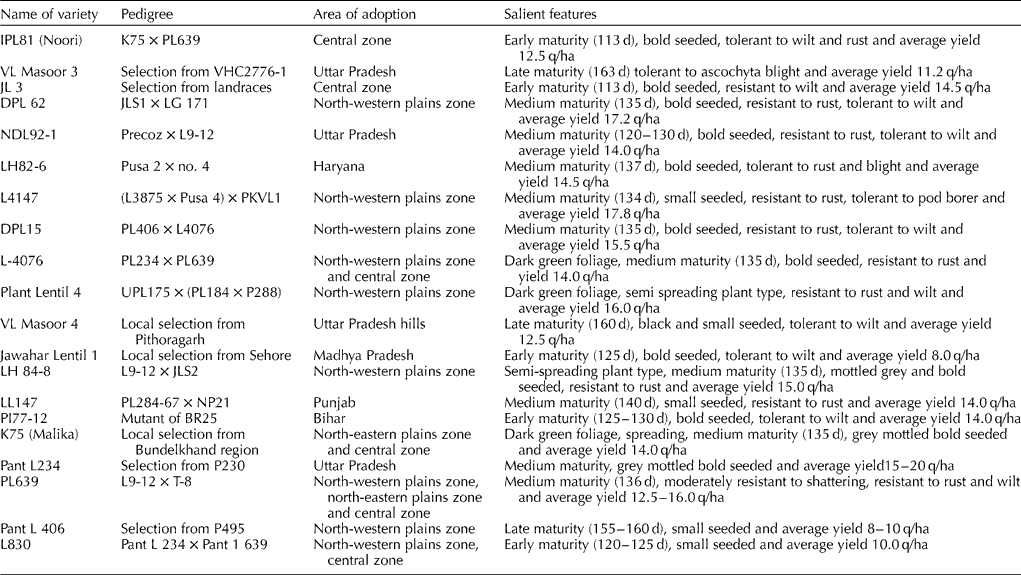
Direct utilization of lentil germplasm resulted in release of about 20 varieties since 1950 in India. Some varieties with wide adaptability are still in vogue, notably type 36, L 9-12, PL 406, Asha, K 75, JLS 1 and VL 4. In addition, a number of germplasm lines possessing desirable agronomic traits were used in hybridization and mutation breeding programmes to develop varieties with high yield, desirable plant type and resistance to biotic and abiotic stresses. This led to release of about 40 varieties. Some of these have resistance to rust, namely Pant L 639, PL 406, 1PL 15, LH 84-8, DPL 15, DPL 62, Lens 4076, Pant L4, LL147, LH 84-8, L4147, JL 4IPL 81 (Noori), KLS 218, HUL 57, VL 507 and IPL 82. The genetically improved varieties and some promising selections of lentil are presented in Table 3.
List of some released varieties and their salient features

Issues for future
(1) The introduction process of germplasm should continue the inclusion of wild species and must be given high priority in order to collect and conserve diverse germplasm of lentil.
(2) Endangered and wild relatives from threatened areas of genetic diversity should be collected on a priority basis and conserved for future crop breeding programmes.
(3) Multi-location characterization and evaluation of important parameters should be taken up on a priority basis to enhance their utilization.
(4) DNA fingerprinting of promising materials, including cultivars and registered germplasm, for the exact identification.
(5) Research on pre-breeding and genetic enhancement should be taken up on priority basis for widening the genetic base.
(6) Screening of germplasm for quality parameters and their response to biotic and abiotic stresses under artificial conditions to identify potential donors for specific traits/purpose.
(7) Genetic dissection of the heritable components of agronomic characters should be given top priority for their effective utilization in further breeding programmes.