Introduction: The Nameless Tragedy
Vast territories along the Volga River and its tributaries were submerged during the titanic transformation that was known as the forced modernization drive. It began in the 1930s and, within a few decades, uprooted what had been a peasant society at the beginning of the twentieth century. The emergence, from the 1930s to the 1980s, of large hydroelectric complexes and reservoirs, forming the Volga hydropower system, forcibly displaced about 700,000 people from their homes and farms, affected the graves of their ancestors and had a devastating impact on vast adjacent areas, livelihoods and the environment (Burdin Reference Burdin2005a). The resettlement became a tragedy not only morally, but also economically: a lack of male labour due to post-war evictions, a lack of time to dry timber or rebuild houses, as in the Mologa case, and a lack of financial support led to homelessness and extreme poverty (Burdin Reference Burdin2005a). This Soviet project has radically transformed the landscape of the main Russian River, destroying the famous Volga floodplain meadows, its forests and fauna (Ivanov Reference Ivanov2007, Lukyanenko Reference Lukyanenko and Alekseev2003, Rivyer Reference Rivyer and Luk’yanenko2003) as well as ancient cities and monasteries, subsequently drowning a unique historical heritage (Tretyakova Reference Tretyakova and Grechuhin2001).
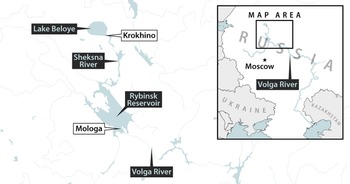
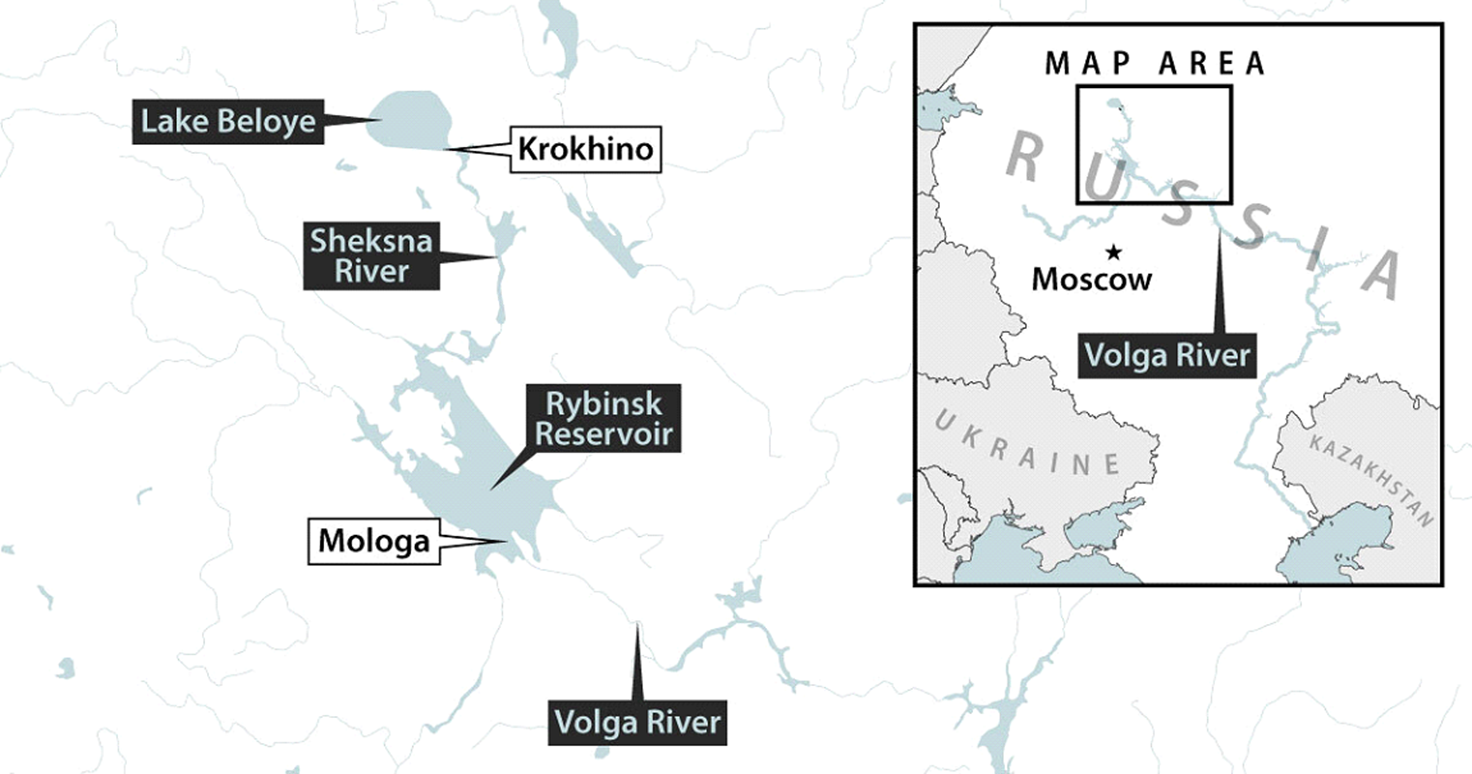
However, these events haven’t formed a strong public narrative nor have they been framed as a tragedy: during the Soviet period researchers and media reporting on construction work on the Volga focused on the technical side, merely addressing displacement as collateral damage (Burdin Reference Burdin2010b). In addition, processes such as the demolition of religious architecture for ideological purposes, as well as the abandonment or destruction of historical buildings and old settlements for the sake of modernization, were normalized in Soviet politics. In Russian public discourse there isn’t even a vernacular name for those submersions caused by the Volga hydropower cascade construction, as such submersions occurred over time and included different territories. Researchers, public historians and media might call the submerged landscape, poetically, the ‘Russian Atlantis’ or the ‘Volga Atlantis’, however, the exact area may vary from the most well-known of the flooded cities such as Mologa (Gessat-Anstett Reference Gessat-Anstett2007) to the area submerged during the 1930s to 1940s (Tarasova Reference Tarasova2018) (see Figure 1).
The location of the Krokhino church (MONITOR).
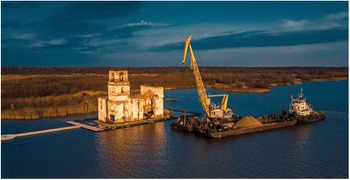
In this article, we examine the case of a small group of enthusiasts who have been trying for over a decade to salvage the very last church left standing in the water after these submersions. The Church of Nativity in the village of Krokhino was flooded in 1964 to build the Sheksna (a tributary of the Volga River) hydropower plant. Although only slightly submerged, the church has been gradually crumbling over the years due to the impact of ice and water. Preservation activities are conducted by the Krokhino Foundation, founded by Anor Tukaeva. The foundation gathers professionals as well as volunteers for preservation work to prevent the Krokhino church from further destruction, including building a hand-made dam around it (Figure 2). They also collect and study the intangible legacy of the region, working in archives and gathering interviews from the descendants of the Krokhino village.
The Krokhino church with a dam and a pier constructed by the Krokhino Foundation.

The lack of acknowledgement of this tragedy at a state level has created a space for grassroots initiatives. A classic case of collective memory (Halbwachs Reference Halbwachs1992) constituting the identity of a group can be found in the Mologa descendants (Gessat-Anstett Reference Gessat-Anstett2002), who perform collective commemorative practices and institutionalize themselves as a public organization. In the current case, there are various people from different social groups who have no direct connection to the submersions themselves, so their communicative memory (Assman and Czaplicka, Reference Assmann and Czaplicka1995) does not derive from their personal stories; however, they find these narratives to be highly significant and are trying to include them into the cultural memory of society. This small group of enthusiasts uses the landscape to leverage the importance of this still-overlooked tragedy: a ruined church standing in the middle of the river is regarded as a powerful statement and a provocative symbol that can hardly be ignored. A prominent role in this case is played by an individual (Anor Tukaeva), who had the ‘will to remember’, which Nora (Reference Nora1989) finds crucial for the emergence of ‘lieux de mémoire’.
The article is based on public interviews and fieldwork observations, conducted in the spring – summer of 2021; all original quotations are given in the author’s translation.
A Will to Remember: A Man and the Landscape
‘The museum is an artistic mending of our historical memory which has been torn in various places’ – this quotation from the Russian writer Leo Rubinstein can be thought of as the emergence of the Krokhino project. Anor Tukaeva first visited Krokhino during a trip inspired by watching a documentary film about the submerged Volga territories. She describes her encounter with the submerged church as like seeing someone severely injured on the street where no one was around to help, so she took the responsibility on herself (Anor Tukaeva, KROKHINO). It is the marked landscape, the ruins of a church standing in the waters that she found crucial for the preservation of the fading memory:
When I tried to find out about it [the church], it shocked me that there was almost no information at all about those submerged territories […] As we began to gather information about it, we realized there is a real historical vacuum. It was a trauma that affected many, many people and is not spoken about at all. (Anor Tukaeva, MONITOR)
The ruined church was also about to disappear if no action was taken to save it: the landscape was in the process of transformation, where the marks of the past would be erased once there were no caretakers left. And it still is being transformed, although the caretakers are fighting against time and erosion: ‘I am afraid we won’t make it: we are working, but it is crumbling. However, even if it’s only one wall left – what’s important is that this place lives’ (Mikhail, volunteer, May 2021, author’s notes).
This accentuated fragility is the reason Anor was attracted to this place and became the keeper of the memory: ‘The feeling of the imminent doom when you’re facing it [the church] made it impossible for me to leave. I knew that if I did nothing now, after a while there would be nothing left and nothing to salvage’ (Anor Tukaeva, ASI). Unlike the Mologa case, at Krokhino there was no collective from which to gain public support. Anor was a stranger both to the place and to the events: ‘I was all alone. It so happened that no one supported me at the time. Everyone was afraid to get involved in a utopian story’ (Anor Tukaeva, ASI). It seems incomprehensible that a single person, without significant symbolic or social capital, not representing any community or institution, but motivated only by their own perception of what is to be a part of cultural memory, might affect such significant structures as the landscape, and yet that is the very reason why such acts are performed by a singular individual in the first place.
The historical heritage of repression and anti-religious campaigns in Russia sometimes becomes a contested space between secular and religious narratives, as on the Solovetsky islands, famous both for the Solovetsky monastery and for the Solovetsky labour camp, from which the entire Gulag grew (Bogumił et al. Reference Bogumił, Moran and Harrowell2015). However, Krokhino lacked such symbolic meaning and public attention, and thus was abandoned by the powerful stakeholders. The architectural dominance of the Sheksna River, which seemed so important for Anor, remained literally unseen by both the state and the church: Anor claims it took her nine years to make state officials acknowledge the existence of the ruins and to register them (Anor Tukaeva, HSE 33:44), while Russian Orthodox Church officials ignored the ruin because it had no potential to become a church with a parish and, for a long while, they even refused to give their blessing for the preservation work (Anor Tukaeva, HSE 42:05). This powerful neglect gave Anor space to interpret both the symbolic meaning and the visual appearance of this unique memorial in a way that resonated most with her.
It is interesting how an individual can feel and fulfil this crucial ‘will to remember’ despite the lack of public support and even the resistance of large institutions that seem to have a ‘will to forget’. It therefore means we need to take into consideration the connection between emotions and heritage. Many studies have examined how visitors emotionally engage with heritage in a variety of ways (Smith Reference Smith, Witcomb and Message2015) or how heritage incorporates emotional narratives of the past (Marchant 2018). In this case, we see how affect makes a person perceive a material object as heritage that is to be taken care of. Anor describes this affect as the ‘inner knowing’ and states that ‘I just had an unambiguous reaction: it [the church] has to be preserved’ (Anor Tukaeva, author’s notes April 2021).
However apparent this emotion may be to the bearer of the cultural memory, it might be inaccessible to the people directly affected by the traumatic event and to the so-called ‘secondary witnesses of trauma’ (Felman and Laub Reference Felman and Laub1992), who tend to form communities of loss and who are usually both the primary authors and the primary addressees of trauma narratives (Karut Reference Karut, Oushakin and Trubina2009). In this case, both the author and the main addressee of the trauma narrative are the ‘outsiders’, while the descendants of the evicted often show indifference to their own history:
‘What do you know about the submersion?’ I asked at the museum of the town that survived […] ‘There were no submergences here, and in general, do not bother us with such questions’, – I understood that rebuff, I felt it very clearly. […] It so happened that our project, in fact, had the courage to talk about this story and about its importance to the people who seemed to deny it. (Anor Tukaeva, BSSP, 25:03-25:15)
Medical and psychological anthropology, which study collective trauma in individual manifestations, note that
the failure of the non-participating part of the society to recognize the complex, deep and contradictory experiences of the participants, the inability to experience traumatic experiences with the same intensity as the participants, leads to the formation of the collective PTSD. (Miskova Reference Miskova2019)
This may explain the locals’ apparent apathy and unwillingness to talk about traumatic events, as well as the resulting inability to initiate the work with the difficult heritage:
And it seems to me that the reaction of the local people […] was caused by the colossal pain this story evokes, by the struggle with the state narrative […] they’ve accepted it, but inside they perceive everything differently, inside it hurts, it’s probably the biggest drama of their life (Anor Tukaeva, BSSP 26:07 – 27:42).
The work with personal stories and private memories might have the power to change the attitudes of the locals and involve them in working with the territory. In many modern museums that deal with difficult heritage, the tendency is to focus on private memory: ‘the aim is not to offer authoritative master narratives but to concentrate on everyday life, personal stories and individual biographies, in order to present diversified memories’ (Arnold-de Simine Reference Arnold-de Simine2013). The Krokhino Foundation made a film that contained interviews with Krokhino descendants, and claims that only after watching it did the locals begin to say: ‘now we understand why this church is essential, now we understand why you are doing this’ (Anor Tukaeva, BSSP 31:24 – 31:40). The opportunity to hear your own story from an outsider’s viewpoint, to hear your own voices in a museum or in a film, makes it possible to see the value of the events of your personal story – bridging the gap between the traumatic experience and its perceived insignificance, and, as a result, overcoming any internal rejection.
Ruins as Marks and Symbols
According to the Krokhino Foundation, the territory of the submerged Krokhino village is to become a place of recreation and commemoration, with the ruins of the church acting as the dominant architectural structure in the surrounding landscape. The Foundation intends to place a light source in the bell tower (as a reference to the times when this church was used as a lighthouse), to create a small exhibition inside, and build a platform and a pier for boats around the church. They intentionally choose to maintain the form of a ruin, not wanting to fully restore the building:
It will pose questions: why is this church in this condition, where did the water come from? Since our problem, I mean our contemporaries’ [problem], is that we take the landscape that exists on the Volga–Baltic waterway as is. It’s very hard to imagine that once the banks were different, that once it was not all submerged. And only such monuments, and unfortunately there are very few of them, can give a hint […]. I want people to see this place. (Anor Tukaeva, ZONE 27:32-28:38).
According to Anor, this will differentiate the Krokhino church as a monument from the fully restored bell tower of the submerged monastery of Kalyazin on the same waterway, which, ‘given its external preservation, does not speak in a visual sense, does not express as much as it could […] it is a mere gingerbread house on water’ (Anor Tukaeva, author’s notes, April 2021). For Russia, the practice of preserving a ruin just to let it remain a ruin is uncommon: ‘there is a practice of preserving ruins as a temporary measure, for objects that have a prospect of restoration; there is no practice of preserving ruins [as ruins]’ (Anor Tukaeva, HSE 35:53).
A ruin has a complex symbolic meaning: it may be perceived as picturesque in a way that was inherent to the European culture of the eighteenth century, and ‘emanate an atmosphere of peace because it represents an equilibrium of potentialities: between purpose and chance, nature and spirit, past and present’ (Zill Reference Zill2011: 813–815). Ruins also embody memories both of the times when they were functional objects as well as the memories of events that caused their destruction, reminding everyone who observes them that something is missing, and something has drastically changed. They mark the landscape as having been transformed while preventing what Gunter Anders (1985, as cited in Zill Reference Zill2011: 815) has called the ‘second dying’ of a cultural phenomenon: ‘Where something no longer exists, soon the not-being-there-anymore is not there anymore. All that existed dies for a second time. […] Ruins hinder this second dying. Or they at least postpone it’ (Zill Reference Zill2011: 815). Moreover, ruins address the general landscapes of abandonment that appear due to evictions, submersions and other traumatic events yet to be overcome:
Why do we deal with ruins at all? Because the Russian province – small towns and rural settlements – is in many ways a ruined space that is filled with historical and spiritual meaning, and, therefore, with heritage. (Anor Tukaeva, RG)
The main meaning for Anor, as she claims, is that ruins become a memorial of the current times of stagnation (bezvremenye), of ‘all those years we have been working here with no help, of times of disregard, when this memory and this church is being neglected’ (Anor Tukaeva, author’s notes, May 2021). The ruin in this sense indicates not only the catastrophe when the church was submerged but it embodies time as a destructive power; it represents the attitude to itself, to the historical heritage and to the politics of remembering over a long time span, being a material memorial to immaterial factors.
The materiality of such rescued heritage reveals a considerable power, offering an immediacy of experience communicating the past. The ruins cease to be a mere symbol of the to-be-remembered events and become a being we can connect with sensorily and emotionally:
When you come into contact with some antiquity, some physical object, architecture – you can touch it, then your sense of time disappears, it seems to you that you are in some kind of eternity, in all times at once, you have a feeling you are in the space’; ‘touch the stone, touch the wood – it is warm, and where warmth is there is the soul, heart, and all the rest. Well, you cannot let it crumble and disappear. (Volunteers, HSE 22:50; 23:31)
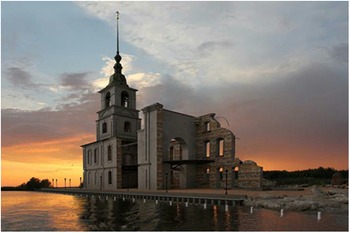
Those ruins are inscribed into modern and neat architectural forms for a reason. Unlike the Kaiser-Wilhelm-Gedachtniskirche that is left standing as an accusatory witness of its own murder within modern surroundings, which otherwise hold no traces of the tragic events (Zill Reference Zill2011: 815), the Krokhino church is a part of an abandoned, ruined, ‘chthonic’ (as Anor calls it) landscape (Anor Tukaeva, author’s notes, April 2021). To stand out, as the Kaiser-Wilhelm-Gedachtniskirche does, Krokhino church has to oppose the surrounding atmosphere of decay with a vital impulse (Figure 3). That is why the ruins have to be accompanied by modern architectural forms – so they can be seen to be taken care of.
Project of the Krokhino church reconstruction.

The Many Layers of Landscape
Landscape exists on two levels – as real and as imagined. Culturally contextualized landscape exists as metatext, where socio-historical processes produce meanings; being familiar with culture’s written or oral texts enables one to ‘read’ the landscape (Claval, Reference Claval, Moore and Whelan2007). This imaginary layer of the landscape appears at the ‘third level’ of the heritage process, according to the classification of Smith (Reference Smith2012) – that is, at the individual level of each visitor’s perception. The visitor’s work of imagination is important for the perception of a place, and it is activated by the narrative. Telling the story of the church to the newcomers, Anor urges:
Imagine that to the left and to the right there were villages, to the left there was a whole town, to the right there was a village, and once altogether it was the ancient town of Beloozero. (Anor Tukaeva, BSSP 24:29 – 24:42)
The observer’s gaze is necessary for the existence of the landscape in its proper, ideal, timeless form. In doing so, visitors are not seen as a passive, perceptive party. On the contrary, in order to see this second layer of the landscape, the visitor has to be an active subject; they are only provided with the material to assemble their own vision. As in communities with a shaman, where there is a circle of ‘initiated’ and profane people whose ways of seeing differ while the shaman influences the images that are assimilated by the ‘initiated’ (Kharitonova Reference Kharitonova2004), we might distinguish three groups of people who see the landscape differently: ‘uninitiated’ tourists who see the place from a distance, passing by the Krokhino church on the ship and who only have access to the material layer of the landscape; those who come specifically to the site and see it up close, and through personal interaction and interaction with caretakers assimilate images, moods, sensations of the place; and the caretakers themselves, who act as visionary guides. Anor has defined the Krokhino church as a lighthouse temple; and although currently the lighthouse-like arrangement in the church’s bell tower exists only on paper, some volunteers see the church this way:
Everyone who goes there, or who comes into contact with you [with Anor – author], has this image of the lighthouse temple that keeps you on your path, gives you hope and strength […] for me it’s really symbolic, it’s not a place, it’s a place outside time and space […] it can only be felt. (Volunteer, LDCH 43:28-45:17)
Krokhino is not a mere gravestone honouring the dead; for their caretakers and the majority of the audience of those projects, it is ‘a place of power’ where people come to gain strength for their personal lives. In Krokhino it is common for volunteers to refer to the church or a place as a non-human living entity. The place gives those caretakers the power to protect and develop the place:
Those who come there once and are able to experience it – they would not leave this project, they come back, they draw strength from it. So, I hope it, I mean the church – it won’t let us give up (Anor Tukaeva LDCH 39:35-40:04).
Memory preserves the vitality of these places: ‘Water can swallow villages, hamlets, and destroy entire towns. But the memory they contain is unsinkable’ (Anor Tukaeva, MUSEUM). Along with preservation work to secure the materiality of the church, much work is being done to collect the intangible heritage of the Krokhino village. This work has already transformed swamps of the submerged village into a structured landscape. In a photo project of Krokhino volunteers, you can see two layers of past and modern landscape combined: former streets appear in the woods, and brick piles on the shore transform into a former school (and only the church is timeless). A virtual museum further collects local folklore, memoir interviews with the descendants and old photos of the village – all this work adds layers to the landscape as well as to the story, making it more complex and more real:
At the end of our own perception of this story, when we were able to switch from the church to something bigger, or deeper, we moved on to start working with the memories of the descendants, so as in this picture [an iceberg with the Krokhino Church on top, a background image of the Krokhino virtual Museum], on top is a little bit of what is visible, what we can perceive, and on the bottom is a huge depth of these stories that keep this church on the surface, and they probably play the most meaningful role. (Anor Tukaeva, LDCH 28:36–29:02)
Conclusion
Preservation work on the Krokhino church, led by Anor Tukaeva, is gradually transforming the landscape of the Sheksna River, making it in turn a memorial to the transformed landscape of the Volga basin. This unique project, aiming to preserve ruins and inscribe them into modern architectural forms, offers an interesting visual language that might be useful in many other places in Russia. There are many ruined churches and mansions of the old elites that have no prospects of restoration, and are thus left unattended. Preserving ruins could become a way to salvage what is left of the tangible heritage, unless they are too powerful as thought-provoking symbols that do not favour the current official ideology. Unlike fully restored churches and mansions or abandoned and thus neglected ones, the intentionally preserved ruin with an infrastructure of a memorial place around it raises many challenging questions for the difficult heritage of Russian history that is yet to be conceptualized. Preserving ruins and collecting and representing private memories that put private feelings first, are complementary ways of opposing the authoritative official narrative and can make an individual impact on the collective memory.
Acknowledgement
This work was carried out within the framework of the Russian Science Foundation’s project ‘Anthropology of Extractivism: Research and Projection of Social Change in Regions of Resource Type’ (Grant No. 20-68-46043, supervised by D.A. Funk).
Competing Interests
The author declares none.
About the Author
Alevtina Borodulina is a social anthropologist and an independent researcher, formerly at the Institute of Ethnology and Anthropology in the Russian Academy of Science, and is interested in museum anthropology. She also acts as an independent museum and exhibit curator (e.g. ‘Old ladies about Love’, Uchma Museum).