





1 Introduction
The dynamical properties of a rational map
$f: \mathbb {P}^1_{\mathbb {C}} \to \mathbb {P}^1_{\mathbb {C}}$
 are determined, to a large extent, by its critical orbits. Therefore, parameter spaces are frequently explored by studying the loci of maps with a prescribed critical orbit behavior. Here we focus on quadratic rational maps. Specifically, our interest is in the moduli spaces
${\mathcal {S}}_p$
 of quadratic maps with a marked periodic critical point of period p, for any
$p \ge 1$
 . These moduli spaces are punctured Riemann surfaces, often called periodic curves. Periodic curves and related spaces, including critical orbit relation curves, have received considerable attention in the literature (see, for example, [Reference Buff, Epstein and KochBEK22, Reference De Marco, Wang and YeDMWY15, Reference Firsova, Kahn and SelingerFKS23, Reference Hironaka and KochHK17, Reference MilnorMil93, Reference RamadasRam24, Reference ReesRee03, Reference ReesRee95, Reference Ramadas and SilversmithRS24, Reference StimsonSti93]). However, for general p, basic questions about the global topology of
${\mathcal {S}}_p$
 remain open. Is
${\mathcal {S}}_p$
 connected? If so, what is the genus
$g_p$
 of
${\mathcal {S}}_p$
 ? What is the number of punctures
$N_p$
 of
${\mathcal {S}}_p$
 ? Our main result is a formula for the Euler characteristic of
${\mathcal {S}}_p$
 . In particular, provided that
${\mathcal {S}}_p$
 is connected, this establishes the equivalence between computing
$g_p$
 and computing
$N_p$
 . Our result arises from a precise control of the dynamical and parameter space scales near the punctures, with the aid of non-Archimedean dynamics.
In order to state the main result, we need to introduce two numbers:
$\eta '(p)$
 and
$\eta ^{\prime }_{\mathrm{II}}(p)$
 . The first of these,
$\eta '(p)$
 , is the number of parameters in the quadratic family
${Q_c(z):=z^2 + c}$
 such that the critical point
$z=0$
 is periodic of exact period p. The second,
$\eta ^{\prime }_{\mathrm{II}}(p)$
 , is the number of parameters in
${\mathcal {S}}_p$
 such that the two critical points lie in the same periodic orbit; that is, the number of type II or bitransitive centers in
${\mathcal {S}}_p$
 . A formula for
$\eta '(p)$
 follows from well-known results about the quadratic family, due to Douady, Hubbard and Gleason [Reference Douady and HubbardDH85]. In [Reference Kiwi and ReesKR13], with M. Rees, we obtained a formula for
$\eta ^{\prime }_{\mathrm{II}}(p)$
 . These formulas are discussed in §§2.2 and 2.3.
Theorem A. Let
$\chi ({\mathcal {S}}_p)$
 denote the Euler characteristic of
${\mathcal {S}}_p$
 . Then, for all
$p \ge 3$
 ,

The curves
${\mathcal {S}}_1$
 and
${\mathcal {S}}_2$
 are isomorphic to
$\mathbb {C}$
 and
$\mathbb {C}^* =\mathbb {C}\setminus \{0\}$
 , respectively.
Denote by
$\widehat {{\mathcal {S}}_p}$
 the smooth compactification of
${\mathcal {S}}_p$
 obtained by filling each puncture with an ideal point. Then, for
$p \ge 3$
 ,

As mentioned above, we lack formulas and general methods to compute
$N_p$
 .
There is a strong analogy between the study of cubic polynomials and quadratic rational maps. In both cases, two critical points are relevant in phase space and moduli spaces are complex two-dimensional. However, substantially more is known about cubic polynomials. In fact, with Arfeux, we proved that the moduli space
${\mathscr {S}}_p$
 of cubic polynomials with a marked periodic critical point, of period p, is connected [Reference Arfeux and KiwiAK23]. With Bonifant and Milnor, we obtained a formula for the Euler characteristic of
${\mathscr {S}}_p$
 in [Reference Bonifant, Kiwi and MilnorBKM10]. Schiff and De Marco [Reference DeMarco and SchiffDMS10] produced an algorithm to determine the number of punctures of
${\mathscr {S}}_p$
 , but no general formula is known.
The strategy to compute the Euler characteristic of
${\mathcal {S}}_p$
 is similar to that employed for cubic polynomials in [Reference Bonifant, Kiwi and MilnorBKM10]. It consists in computing the degree of a naturally defined meromorphic
$1$
 -form
$d \tau $
 on
$\widehat {{\mathcal {S}}_p}$
 with all its zeros and poles located at the punctures of
${\mathcal {S}}_p$
 . Near the punctures, elements of
${\mathcal {S}}_p$
 correspond to conjugacy classes of maps close to infinity in the moduli space of all quadratic rational maps. Our computation of the order of
$d \tau $
 at the punctures of
${\mathcal {S}}_p$
 relies on the study of degenerate rational maps with tools from non-Archimedean dynamics. We reinterpret the formulas for the order of
$d \tau $
 at the punctures, obtained in [Reference Bonifant, Kiwi and MilnorBKM10]. Our contribution is to show that the underlying principle is that the order at the punctures of a parameter space derivative and a dynamical space derivative agree, modulo a minor correction factor (see Lemma 3.1). This may be interpreted as an equation for the asymptotics (at the punctures) of the transversality responsible for the smoothness of
${\mathcal {S}}_p$
 . It would be interesting to investigate the extent to which similar equations for the asymptotics of transversality hold for general critical orbit relation curves.
The paper is organized as follows.
In §2, we introduce the basic notation and background results regarding quadratic rational maps and the curves
${\mathcal {S}}_p$
 .
In §3, we introduce the meromorphic
$1$
 -form used to compute the Euler characteristic of
${\mathcal {S}}_p$
 . Our main lemma, Lemma 3.1, is stated; however, its proof is postponed until §5. Assuming the main lemma, we prove Theorem A.
In §4, we summarize some results regarding the punctures of
${\mathcal {S}}_p$
 . The emphasis is on parabolic rescaling limits, following the works of Stimson, Epstein, Rees, and De Marco [Reference DeMarcoDeM07, Reference EpsteinEps00, Reference ReesRee03, Reference StimsonSti93].
In §5, we prove the main lemma. We start by translating it into a lemma regarding quadratic rational dynamics over the field of Puiseux series. To prove it, we make abusive use of the detailed knowledge of quadratic rational dynamics over this field obtained in [Reference KiwiKiw14]. Dynamics over non-Archimedean fields is better understood in the Berkovich projective line. However, since the main lemma involves only quantities related to the (classical) projective line, we have chosen for the sake of simplicity to do most of our work without reference to Berkovich spaces. Nevertheless, at some points, we have to translate results from [Reference KiwiKiw14], written in the language of Berkovich spaces, to our context. As a byproduct of the proof of the main lemma, we obtain Mandelbrot tori embedded in quadratic rational moduli space reminiscent of those obtained by Branner and Hubbard [Reference Branner and HubbardBH88] for cubic polynomials (see Corollary 5.19).
2 Preliminaries
2.1 Moduli space
Denote the moduli space of quadratic rational maps with a marked critical point by
${\mathcal {M}}_2^{\mathrm{cm}}$
 . More precisely, consider dynamical pairs
$(f\!,\omega )$
 where
${f: \mathbb {P}^1_{\mathbb {C}}~\to \mathbb {P}^1_{\mathbb {C}}}$
 is a quadratic rational map and
$f'(\omega )=0$
 . We say that two such pairs
$(f\!,\omega )$
 and
$(g,\omega ')$
 are conjugate if there exists a Möbius transformation
$\gamma $
 such that
$\gamma \circ g = f \circ \gamma $
 and
$\gamma (\omega ') = \omega $
 . According to Lemma 6.1 in [Reference MilnorMil93], the moduli space of critically marked quadratic rational maps
${\mathcal {M}}_2^{\mathrm{cm}}$
 is an algebraic surface with a unique singular point at the conjugacy class of
$(z \mapsto z^{-2},\omega =0)$
 . We refer to the elements of
${\mathcal {M}}^{\mathrm{cm}}_2$
 simply as maps. Also,
${\mathcal {S}}_p$
 is an algebraic subvariety of
${\mathcal {M}}_2^{\mathrm{cm}}$
 , for all
$p\ge 1$
 . The curves
${\mathcal {S}}_p$
 are known to be smoothly embedded in
${\mathcal {M}}_2^{\mathrm{cm}}$
 , with the sole exception of
${\mathcal {S}}_2$
 at the singular point of
${\mathcal {M}}_2^{\mathrm{cm}}$
 (see, for example, [Reference EpsteinEps, Reference Levin, Shen and van StrienLSvS19]; cf. [Reference Kiwi and ReesKR13, Theorem 2.5]). Conjecturally
${\mathcal {S}}_p$
 is irreducible for all
$p\ge 1$
 (cf. [Reference RamadasRam24]).
2.2 Counting in the quadratic family
Abstractly, for
$p \ge 1$
 , the numbers
$\eta '(p) \in \mathbb {N}$
 are defined by

Therefore,

where
$\mu $
 is the Möbius function.
It is, however, convenient to relate
$\eta '(p)$
 with quadratic polynomial dynamics, as in the introduction. Recall that
$Q_c(z) := z^2 +c$
 denotes the quadratic family. Then

In fact, according to Gleason (see, for example, [Reference Douady and HubbardDH85, Exposé XIX]), all the roots of the degree
$2^{p-1}$
 polynomial
$Q_c^{\circ p-1}(c)$
 are simple. Thus, (2.1) holds.
In order to write a formula for
$\eta ^{\prime }_{\mathrm{II}}(p)$
 , we need to define
$\nu _q(k)$
 for
$k \ge 1$
 . Let r be such that
$ r = k \mod q$
 and
$0 \le r < q$
 . If
$q \ge 2$
 , then

For example,

The numbers
$\nu _q(k)$
 are also closely related to the quadratic family. More precisely,
$\nu _q(k)$
 is the number of parameters c in the
$1/q$
 -limb of the Mandelbrot set for which the critical point
$z = 0$
 is periodic of period dividing k. Indeed,
$2\nu _q(k)$
 is exactly the number of angles
$\theta \in [1/(2^q-1),\,2/(2^q-1)] \subset \mathbb {R}/\mathbb {Z}$
 which are periodic and whose period divides k, under angle doubling. By the description of the Mandelbrot set due to Douady and Hubbard, this implies that
$\nu _q(k)$
 counts parameters c in the
$1/q$
 -limb for which
$z=0$
 is
$Q_c$
 -periodic with the corresponding periods (see [Reference Douady and HubbardDH85, Exposé XIV]; cf. [Reference MilnorMil00]).
Lemma 2.1. Let
$\nu _2'(p)$
 be such that

Then
$\eta '(p) = 3 \nu ^{\prime }_2(p)$
 , for all
$p\ge 3$
 .
Proof. It is sufficient to prove that, for all
$p \ge 3$
 , we have

Indeed, from (2.2), for p even,

A similar identity holds for p odd.
2.3 Counting in
${\mathcal {S}}_p$


A map
$f \in {\mathcal {M}}_2^{\mathrm{cm}}$
 is hyperbolic if both of its critical orbits are in the basin(s) of some attracting cycle(s). A connected component of hyperbolic maps is called a hyperbolic component. Following Rees [Reference ReesRee90], hyperbolic components are classified into four types according to the relative position of the critical points in the attracting basins. Here we are mainly concerned with type II components, also known as bitransitive or type B components. A type II hyperbolic component consists of maps having a unique attracting cycle of period
$p \ge 2$
 such that both critical points belong to periodic Fatou components. These Fatou components are necessarily distinct. Each type II hyperbolic component
${\mathcal {H}}$
 of period p contains a unique postcritically finite map
$f_0$
 called the center of
${\mathcal {H}}$
 . The critical points of
$f_0$
 lie in the same orbit of period p. In particular,
$f_0 \in {\mathcal {S}}_p$
 .
In [Reference Kiwi and ReesKR13] we obtained a formula for the number
$\eta _{\mathrm{II}}'(p)$
 of type II hyperbolic components in
${\mathcal {M}}_2^{\mathrm{cm}}$
 of exact period p. It is not difficult to check that the formula written below is equivalent to the one obtained in [Reference Kiwi and ReesKR13, Theorem 1.2].
Theorem 2.2. For
$p \ge 3$
 , let
$\delta (p) = 1$
 if p is even, and
$\delta (p)=0$
 otherwise. Then

where

and
$\phi $
 denotes the Euler totient function.
The Möbius inversion formula yields

2.4 Partial parametrization of
${\mathcal {M}}_2^{\mathrm{cm}}$

The complement of
${\mathcal {S}}_1 \cup {\mathcal {S}}_2$
 in
${\mathcal {M}}_2^{\mathrm{cm}}$
 is identified with
$\mathbb {C}^* \times \mathbb {C}$
 via the family

with marked critical point
$\omega =0$
 . That is,

In fact, observe that if
$[(f,\omega )] \in {\mathcal {M}}_2^{\mathrm{cm}} \setminus ({\mathcal {S}}_1 \cup {\mathcal {S}}_2)$
 , then
$\omega , f(\omega )$
 and
$f^{\circ 2}(\omega )$
 are distinct. Normalizing so that
$\omega =0$
 ,
$f(\omega )=\infty $
 and
$f^{\circ 2}(\omega )=1$
 , we have that
$f=f_{a,b}$
 , for some
$(a,b) \in \mathbb {C}^* \times \mathbb {C}$
 .
Regard the projective plane
$\mathbb {P}^2_{\mathbb {C}}$
 as a compactification of
${\mathcal {M}}_2^{\mathrm{cm}} \setminus ({\mathcal {S}}_1 \cup {\mathcal {S}}_2)$
 via the inclusion
$\mathbb {C}^* \times \mathbb {C} \hookrightarrow \mathbb {P}^2_{\mathbb {C}}$
 given by
$(a,b) \mapsto [a:b:1]$
 . Thus,
${\mathcal {M}}_2^{\mathrm{cm}} \setminus ({\mathcal {S}}_1 \cup {\mathcal {S}}_2)$
 is identified with the complement, in
$\mathbb {P}^2_{\mathbb {C}}$
 , of the lines

and

From now on we regard
${\mathcal {S}}_p$
 , for any
$p \ge 3$
 , as a subset of
$\mathbb {P}^2_{\mathbb {C}}$
 and denote its closure by
$\overline {{\mathcal {S}}}_p$
 .
Milnor [Reference MilnorMil93] introduced a compactification of the moduli space of quadratic rational maps, without critical markings, by a line at infinity corresponding to pairs
$\{\unicode{x3bb} ,\unicode{x3bb} ^{-1}\}$
 where
$\unicode{x3bb} \in \overline {\mathbb {C}}$
 . Points in moduli space close to
$\{\unicode{x3bb} ,\unicode{x3bb} ^{-1}\}$
 have two fixed points with multipliers close to
$\unicode{x3bb} $
 and
$\unicode{x3bb} ^{-1}$
 . Silverman [Reference SilvermanSil98] showed that, in fact, Milnor’s compactification is the geometric invariant theory compactification of unmarked moduli space. Maps close to
${\mathcal {L}}_-$
 and
${\mathcal {L}}_+$
 in marked moduli space, after forgetting the marking, become maps in unmarked moduli space close to infinity. The line
${\mathcal {L}}_-$
 should be regarded as a blow-up of
$\{-1,-1\}$
 . More precisely, as
$[a:b:1]$
 approaches
$[1:m:0] \in {\mathcal {L}}_-$
 with
$m \neq 0$
 , the multipliers of two fixed points of
$f_{a,b}$
 converge to
$-1$
 . Also, as
$[a:b:1]$
 approaches
$[0:m:1] \in {\mathcal {L}}_+$
 with
$m\neq 0$
 , the multipliers of two fixed points of
$f_{a,b}$
 converge to reciprocal complex numbers in
$\mathbb {C} \setminus ~\{0,-1\}$
 .
2.5 Degree of
${\mathcal {S}}_p$

Lemma 2.3. [Reference Kiwi and ReesKR13, Lemma 3.1]
For all
$p \ge 3$
 ,

Moreover, none of the points
$[1:0:0],[0:1:0],[0:0:1]$
 belong to
$\overline {{\mathcal {S}}}_p$
 .
Lemma 2.1 yields

We remark that [Reference Kiwi and ReesKR13, Lemma 3.1] states an equivalent assertion but for
$\overline {{\mathcal {X}}_n}:=\bigcup _{3 \le p|n} \overline {{\mathcal {S}}_p}$
 instead of
$\overline {{\mathcal {S}}}_p$
 .
2.6 Punctures
Recall that the smooth compactification
$\widehat {{\mathcal {S}}_p}$
 of
${\mathcal {S}}_p$
 is obtained from
${\mathcal {S}}_p$
 by filling each of its punctures with an ideal point. Equivalently, it is the normalization of the projective curve
$\overline {{\mathcal {S}}}_p$
 . The punctures of
${\mathcal {S}}_p$
 correspond to germs of branches of
$\overline {{\mathcal {S}}}_p$
 at the lines
${\mathcal {L}}_+$
 and
${\mathcal {L}}_-$
 . A representative of the branch corresponding to a puncture x will be denoted by
${\mathcal {E}}_x$
 . A punctured neighborhood of x in
$\widehat {{\mathcal {S}}_p}$
 is
${\mathcal {E}}^*_x := {\mathcal {E}}_x \setminus {\mathcal {L}}_\pm $
 .
Let
$\pi : \widehat {{\mathcal {S}}_p} \to \overline {{\mathcal {S}}}_p$
 be the natural projection. It is a bijection in
${\mathcal {S}}_p$
 and maps each puncture
${x}$
 onto the intersection
$\pi (x)$
 of the corresponding branch with
${\mathcal {L}}_+$
 or
${\mathcal {L}}_-$
 . We will systematically abuse notation and simply say that
$x \in {\mathcal {L}}_+$
 or
$x \in {\mathcal {L}}_-$
 .
We define the multiplicity
$\mu _x$
 of a puncture x as the intersection multiplicity of the branch
${\mathcal {E}}_x$
 corresponding to x with the lines
${\mathcal {L}}_+, {\mathcal {L}}_-$
 .
As a direct consequence of Bézout’s theorem and Lemma 2.3 we have the following result.
Lemma 2.4. For all
$p \ge 3$
 ,

where the sums are taken over
$ x \in \widehat {{\mathcal {S}}_p} \setminus {\mathcal {S}}_p$
 .
3 Asymptotics of transversality
Following [Reference Bonifant, Kiwi and MilnorBKM10], in §3.2 we introduce a meromorphic
$1$
 -form
$d \tau $
 on
$\widehat {{\mathcal {S}}_p}$
 which is holomorphic in
${\mathcal {S}}_p$
 . The Euler characteristic of
$\widehat {{\mathcal {S}}_p}$
 is the difference between the number of poles and zeros of
$d \tau $
 , counted with multiplicities. The key to computing this difference will be our main lemma stated in §3.1. Then we prove Theorem A in §3.2, assuming the main lemma.
3.1 Statement of the main lemma
For
$(a,b) \in \mathbb {C}^* \times \mathbb {C}$
 , and for all
$n \ge 0$
 , let

Partial derivatives will be denoted by
$\partial _a \omega _n$
 and
$\partial _b \omega _n$
 . In dynamical space, we are concerned with the behavior of

under the agreement that the above quantity is the derivative of
$f^{\circ p-1}_{a,b} (1/z)$
 at
$z=0$
 . Then
$\partial _b \omega _p$
 and
$ ({d f^{\circ p-1}_{a,b}}/{dz}) (\infty )$
 are meromorphic (rational) functions from
$\widehat {{\mathcal {S}}}_p$
 to
$\overline {\mathbb {C}}$
 . Given a meromorphic function
$h: \widehat {{\mathcal {S}}}_p \to \overline {\mathbb {C}}$
 , we denote by
$\mathrm {ord}_y\ h \in \mathbb {Z}$
 its order at
$y \in \widehat {{\mathcal {S}}}_p$
 . The order at a zero of h is positive and at a pole is negative.
The key to computing the Euler characteristic is to understand the asymptotics of
$\partial _b \omega _p$
 at the punctures.
Lemma 3.1. (Main)
Let
$x \in \widehat {{\mathcal {S}}_p}$
 be a puncture of
${\mathcal {S}}_p$
 . Then

The lemma is proved in §5.
3.2 Meromorphic
$1$
-form and Euler characteristic

The curve
${\mathcal {S}}_p$
 is contained in the vanishing locus of
$\omega _p(a,b)$
 . The gradient of
$\omega _p$
 is non-vanishing in
${\mathcal {S}}_p$
 (see [Reference EpsteinEps, Reference Levin, Shen and van StrienLSvS19]). Thus, the differential of
$\omega _p$
 yields a meromorphic
$1$
 -form in
$\widehat {{\mathcal {S}}_p}$
 as follows.
Proposition 3.2. For all
$(a,b) \in {\mathcal {S}}_p$
 ,

Moreover,

is a well-defined non-vanishing holomorphic
$1$
 -form in
${\mathcal {S}}_p$
 which extends to a meromorphic
$1$
 -form in
$\widehat {{\mathcal {S}}_p}$
 .
We omit the proof of the proposition which is a direct consequence of the transversality results cited above.
Proof of Theorem A, assuming Lemma 3.1
We prove the formula for the Euler characteristic. To simplify notation let

The number of zeros and poles of the rational map
$G:\widehat {{\mathcal {S}}}_p \to \overline {\mathbb {C}}$
 agree, taking into account multiplicities. By the chain rule, the zeros of G in
${\mathcal {S}}_p$
 are located at the parameters where the free critical point is in the orbit of
$\omega =0$
 . That is, the zeros of G are the centers of type II components of period p. We postpone proving that all the zeros of G are simple to the lemma below. Since the remaining poles and zeros of G are at the punctures, we have

Now we compute the total degree of the
$1$
 -form
$d \tau $
 . Let x be a puncture of multiplicity
$\mu _x$
 . If
$x \in {\mathcal {L}}_\pm $
 , then there exists a local uniformizing parameter s such that
$s^{\pm \mu _x} =a$
 (cf. §4.3). Therefore,

Hence,

In view of Lemma 3.1,

From Lemma 2.4, the sum of the multiplicities of the punctures in each line is
$\eta '(p)/3$
 and we obtain:

The desired formula for
$\chi ({\mathcal {S}}_p)$
 follows.
Lemma 3.3. Let
$G: {\mathcal {S}}_p \to \overline {\mathbb {C}}$
 be as above. Then the zeros of G are simple.
Proof. Let
$\nu =\nu (a,b):=-2a/b$
 be the free critical point of
$f_{a,b}$
 and
$\nu _j := f^{\circ j}_{a,b} (\nu ).$
 Given a zero
$c=(a,b)$
 of G, there exists
$1 \le j < p$
 such that
$\omega _j(a,b) = \nu (a,b)$
 . Close to c, there exists a non-vanishing holomorphic function
$u(a,b)$
 such that

Since
$\nu (c)$
 is a simple critical point of
$f_c$
 , the multiplicities of
$c \in {\mathcal {S}}_p$
 as a zero of
$\omega _j - \nu :{\mathcal {S}}_p \to \mathbb {C}$
 and as a zero of G coincide. According to [Reference Levin, Shen and van StrienLSvS19], the intersection at c of the curves
$\omega _j-\nu =0$
 and
${\mathcal {S}}_p$
 (i.e.,
$\omega _p-\omega _0=0$
 ) is transversal. Hence,
$c \in {\mathcal {S}}_p$
 is a simple zero of
$\omega _j-\nu :{\mathcal {S}}_p \to \mathbb {C}$
 , and therefore it is a simple zero of G.
4 Parabolic rescalings
Our asymptotics of transversality lemma is closely related to rescaling limits. Following Rees and Stimson [Reference StimsonSti93], as one approaches a puncture along
${\mathcal {S}}_p$
 , an appropriate iterate in appropriate coordinates converges to a parabolic quadratic rational map. This phenomenon was notably exploited by Epstein in [Reference EpsteinEps00], and further studied by De Marco [Reference DeMarcoDeM07], Nie and Pilgrim [Reference Nie and PilgrimNP22], Luo [Reference LuoLuo22], and the author [Reference KiwiKiw15], among others. The aim of this section is to state related results, all of them well known, which will be used to prove the main lemma.
Consider


The family
$\{R_v\}$
 is a parametrization of
$\mathrm {Per}_1^{\mathrm{cm}}(1) \subset {\mathcal {M}}_2^{\mathrm{cm}}$
 , the curve formed by critically marked quadratic rational maps with a multiple fixed point. The maps
$R_v$
 are normalized so that the multiple fixed point is
$z=\infty $
 and
$z=-1$
 maps to
$z=\infty $
 . We regard
$\omega =0$
 as the marked critical point. Note that the other critical point of
$R_v$
 is
${\omega ^\prime }:=-2$
 .
The quadratic family
$\{Q_c\}$
 is
$\mathrm {Per}_1^{\mathrm{cm}}(0)$
 , the curve formed by critically marked quadratic rational maps with a superattracting fixed point. For
$Q_c$
 , the superattracting fixed point is at
$\infty $
 and the marked critical point
$\omega =0$
 .
The main lemma is, in a certain sense, a manifestation of well-known transversality results for the families
$\{R_v\}$
 and
$\{Q_c\}$
 . This manifestation is through (parameter) rescaling limits. A version of the following result is contained in Stimson’s thesis [Reference StimsonSti93]; its proof is also sketched in [Reference ReesRee03, §7.4] (cf. [Reference DeMarcoDeM07, Reference EpsteinEps00]).
Theorem 4.1. Consider a puncture x of
${\mathcal {S}}_p $
 . Then there exist
$q_x \ge 2$
 ,
$v_x \in \mathbb {C}$
 and a holomorphic family of Möbius transformations
$\{M_f\!\}$
 parametrized by
$f \in {\mathcal {E}}_x^*$
 such that
$M_f(\omega )=0$
 and

uniformly in compact subsets of
$\mathbb {C} \setminus \{-1\}$
 . Moreover, under iterations of
$R_{v_x}$
 , one of the following properties holds:
-
• the critical point $\omega =0$
of
$R_{v_x}$
has period
$p/q_x$
; -
• the critical point $\omega =0$
of
$R_{v_x}$
eventually maps onto the multiple fixed point
$\infty $
.


The aim of this section is to state the well-known parameter space version of the above result, also contained in Stimson’s thesis. However, for the purpose of our calculations, we need to explicitly write the dependence of
$M_f$
 and of
$v_x$
 on the asymptotics of
${\mathcal {E}}_x^*$
 at
${\mathcal {L}}_\pm $
 . There is no claim to originality of these results.
A detailed study of the case in which
$\omega $
 is eventually fixed by
$R_{v_x}$
 will be discussed in §5. It is closely related to rescaling limits which are quadratic polynomials
$Q_c$
 for which
$\omega =0$
 is periodic.
4.1 Fixed point multipliers
Generically a quadratic rational map has three fixed points. According to Epstein [Reference EpsteinEps00, Proposition 1] (cf. [Reference MilnorMil93, Lemma 4.1]), as
$f \in {\mathcal {S}}_p$
 converges to a puncture, one of the fixed point multipliers converges to
$\infty $
 , while the other two converge to conjugate roots of unity of order
$q \ge 2$
 . Observe that as
$(a,b) \equiv [a:b:1]$
 converges to
$[1:\gamma : 0]\in {\mathcal {L}}_-$
 , we have convergence of
$a^{-1/2}f_{a,b}(a^{1/2} z)$
 to
$1/z$
 , uniformly in
$\mathbb {C}^*$
 . Therefore,
$f_{a,b}$
 has a pair of fixed point multipliers converging to
$-1$
 . As
$(a,b) \to (0,b) \neq (0,0)$
 , we have convergence of
$f_{a,b}$
 to
$1 +b/z$
 , uniformly in
$\mathbb {C}^*$
 . Thus, the fixed point multipliers of f converge to
$\infty $
 and to the fixed point multipliers of
$1+b/z$
 . If the map
$z \mapsto 1+b/z$
 has finite order, then its order is at least
$3$
 . A straightforward calculation, (see, for example, [Reference Kiwi and ReesKR13, Lemma 3.4]) yields the following lemma.
Lemma 4.2. Consider
$\theta \in \mathbb {Q} / \mathbb {Z}$
 of order
$q \ge 3$
 . The fixed point multipliers of
${z \mapsto 1 +b/z}$
 are
$\exp (\pm 2 \pi i \theta )$
 if and only if

For
$\theta \in \mathbb {Q}/\mathbb {Z}$
 of order at least
$3$
 , let

Every point in
$\overline {{\mathcal {S}}}_p \cap {\mathcal {L}}_+$
 is of the form
$[0:c_\theta :1]$
 for some
$\theta \in \mathbb {Q} / \mathbb {Z}$
 of order at least
$3$
 .
4.2 Parabolic parameter rescalings
Loosely, the term ‘parameter rescalings’ refers to families of maps that arise in suitable partial compactifications of moduli space. For example, De Marco [Reference DeMarcoDeM07] has shown that the resolution of moduli space iterate maps (for quadratic rational maps) is achieved exactly in the compactification of moduli space by all parabolic rescaling limits. A nice illustration of this phenomenon comes from a straightforward computation which we leave to the reader.
Proposition 4.3. Assume that
$(a,b) \equiv [a:b:1]$
 converges to
$[1:\gamma : 0]\in {\mathcal {L}}_-$
 with
$\gamma \neq ~0$
 . Then

uniformly in compact subsets of
$\mathbb {C} \setminus \{-1\}$
 .
That is,
${\mathcal {L}}_-$
 is identified with
$\mathrm {Per}_1^{\mathrm{cm}}(1) \setminus {\mathcal {S}}_1$
 via a period
$2$
 rescaling limit.
The corresponding result for
${\mathcal {L}}_+$
 can be roughly described as follows. Let
$b_0 \in \mathbb {C}$
 be such that
$z \mapsto 1+b_0/z$
 has order
$q \ge 3$
 . If we blow up
$\mathbb {P}^2_{\mathbb {C}}$
 once at
$[0:b_0:1]$
 , then the exceptional divisor is naturally identified with
$\mathrm {Per}_1^{\mathrm{cm}}(1)$
 via a period
$q$
 rescaling limit.
Proposition 4.4. Consider
$\theta \in \mathbb {Q} / \mathbb {Z}$
 of order
$q \ge 3$
 . Let

Then there exists an invertible affine function
$v(\gamma )=A\gamma +B$
 such that, for all
$\gamma \in \mathbb {C}$
 , as
$a \to 0$
 ,

uniformly in compact subsets of
$\mathbb {C} \setminus \{-1\}$
 .
This proposition is a result by Stimson, but in different coordinates. The required change of coordinates is discussed in [Reference Kiwi and ReesKR13]. We deduce the proposition from the results in [Reference Kiwi and ReesKR13]. Equivalent discussions are included in [Reference DeMarcoDeM07, Reference EpsteinEps00].
Proof. Consider the family of (totally marked) quadratic rational maps
$h_{\rho ,\zeta }$
 , defined for
$(\zeta ,\rho ) \in \mathbb {C}^* \times \mathbb {C} \setminus \{0,-1,-2\}$
 by

Here, critical points and fixed points are marked. Indeed,
$h_{\zeta \!,\rho }$
 has a fixed point at
$z=0$
 with multiplier
$\zeta $
 , another fixed point at
$z=\infty $
 , a critical point at
$1$
 , and another critical point at
$1+\rho $
 . For
$\rho $
 small, the third fixed point is close to
$z=1+\rho /2$
 . Note that
$h_{\zeta \!,\rho } \to ~\zeta z$
 , as
$\rho \to 0$
 , uniformly in compact subsets of
$\overline {\mathbb {C}} \setminus \{1\}$
 .
There exists a sufficiently small a neighborhood
$U \subset \mathbb {C}^2$
 of
$(\exp (2\pi i \theta ),0)$
 such that, for all
$(\zeta ,\rho ) \in U$
 with
$\rho \neq 0$
 , we have that
$1, h_{\zeta \!,\rho }(1)$
 and
$h^{\circ 2}_{\zeta \!,\rho }(1)$
 are pairwise distinct. Thus, for all
$(\zeta ,\rho ) \in U$
 with
$\rho \neq 0$
 , there exist unique
$a=a(\zeta ,\rho )$
 and
${ b=b(\zeta ,\rho )}$
 such that
$h_{\zeta \!,\rho }$
 is conjugate to
$f_{a,b}$
 , via the Möbius conjugacy mapping
$1$
 ,
$h_{\zeta \!,\rho }(1)$
 and
$h^{\circ 2}_{\zeta \!,\rho }(1)$
 to
$0$
 ,
$\infty $
 and
$1$
 , respectively. It is not difficult to conclude that the map
${(\zeta ,\rho ) \mapsto (a(\zeta ,\rho ),b(\zeta ,\rho ))}$
 extends to a biholomorphic map H from U onto a neighborhood
$U'$
 of
$(0,c_\theta )$
 (see, for example, the proof of Lemma 3.7 in [Reference Kiwi and ReesKR13]). Under H, the line
$\rho =0$
 maps into
$a=0$
 .
According to Stimson (Theorem 3.6 in [Reference Kiwi and ReesKR13]), for any
$m \in \mathbb {C}$
 , if

then

uniformly in compact subsets of
$\mathbb {C} \setminus \{1/2\}$
 . Note that the limit is conjugate to
$R_v(w)$
 with
$v=-2 q m + 1$
 via the change of coordinates
$z=-w/2$
 . Using the derivative of the biholomorphic map H, given
$\gamma $
 , there exists an invertible map
$m(\gamma ):=\alpha \gamma +\beta $
 such that if

then

as
$a \to 0$
 . Hence, there exists
$M_{a,b}$
 such that

as
$a \to 0$
 , where

Moreover, note that
$M_{a,b}$
 can be chosen such that
$M_{a,b}(0)= 0$
 ,
$M_{a,b} (-2a/c_\theta ) = -2$
 and
$M_{a,b}(\infty ) = \infty $
 . Thus, we may choose
$M_{a,b} (z)=a^{-1}c_\theta z=M_a(z)$
 .
4.3 Local parametrization
To compute the order of various quantities at a puncture x it is convenient to work with a local parametrization of
${\mathcal {E}}_x$
 .
Denote by
$\pi _a: \mathbb {C}^* \times \mathbb {C} \to \mathbb {C}$
 the projection onto the first coordinate. Then the multiplicity of x, denoted by
$\mu _x$
 , is the degree of the covering
$\pi _a : {\mathcal {E}}_x^* \to D^*$
 where
$D^*$
 is a sufficiently small punctured disk neighborhood of
$0$
 or
$\infty $
 and
${\mathcal {E}}_x$
 is a suitable representative of the branch corresponding to x. Note that
$D^*$
 is a neighborhood of
$0$
 if
$x \in {\mathcal {L}}_+$
 , and of
$\infty $
 if
$x \in {\mathcal {L}}_-$
 . Since all degree
$\mu _x$
 coverings of a punctured disk are equivalent, it follows that there exist
$\varepsilon>0$
 and a power series

convergent in
$\mathbb {D}_\varepsilon ^*$
 such that

is a conformal isomorphism, for a choice of
${\mathcal {E}}_x$
 . The series
$b_x(s)$
 is unique up to a
$\mu _x$
 -root of unity
$\eta $
 . That is, up to replacement of
$c_j$
 by
$\eta ^{\pm j} c_j$
 , for all j. We say that
$(s^{\pm \mu _x}\!, b_x(s))$
 is a local parametrization of
${\mathcal {S}}_p$
 at x, and sometimes we will just say that
$b_x$
 is a local parametrization.
For future reference, we record a direct consequence of Lemmas 2.3 and 4.2.
Lemma 4.5. If
$(s^{-\mu },b(s))$
 is a local parametrization of a branch at
${\mathcal {L}}_-$
 , then, as
$s \to 0$
 ,

If
$(s^{\mu },b(s))$
 is a local parametrization of a branch at
${\mathcal {L}}_+$
 , then, as
$s \to 0$
 ,

Proof. In the first case
$[s^{-\mu }:b(s):1] = [1: s^{\mu } b(s) : s^\mu ] \subset {\mathcal {S}}_p$
 for all
$s \neq 0$
 . Hence, as
$s\to 0$
 , we have that
$s^{\mu } b(s) \not \to 0$
 , by Lemma 2.3. The second case is similar.
4.4 Complex transversality
The main lemma is, in a certain sense, a manifestation of the following transversality results for the families
$\{R_v\}$
 and
$\{Q_c\}$
 .
Lemma 4.6. Consider
$c_0 \in \mathbb {C}$
 and
$q_0 \ge 1$
 such that
$Q_{c_0}^{\circ q_0} (0) =0$
 and
$q_0$
 is the smallest positive integer with this property. Then

Consider
$v_0 \in \mathbb {C}$
 and
$\ell _0 \ge 1$
 such that
$R_{v_0}^{\circ \ell _0} (0) = 0$
 or
$-1$
 and
$\ell _0$
 is the smallest positive integer with this property. Then

Proof. For the quadratic family
$\{Q_c\}$
 , the lemma follows from a result by Gleason or by Douady and Hubbard’s parametrization of hyperbolic components (see, for example, [Reference Douady and HubbardDH85, Exposé XIX]). For the parabolic family
$\{ R_v\}$
 , if
$\omega =0$
 is periodic under
$R_{v_0}$
 , then Douady and Hubbard’s parametrization of hyperbolic components applies. If
${R_{v_0}^{\circ \ell _0} (0) = -1}$
 , then we have the critical orbit relation
$R_{v_0}^{\circ \ell _0+2} (0)= R_{v_0}^{\circ \ell _0+1} (0)$
 . Consider the critical orbit relation curve
${\mathcal {X}}$
 contained in
${\mathcal {M}}^{\mathrm{cm}}_2$
 formed by all maps such that the marked critical point maps in
$\ell _0+1$
 iterates to a fixed point. According to [Reference Levin, Shen and van StrienLSvS19],
${\mathcal {X}}$
 is smoothly embedded near
$R_{v_0}$
 . Note that
$R_{v_0} \in \mathrm {Per}^{\mathrm{cm}}_1(1) \cap {\mathcal {X}}$
 . It is sufficient to show that the intersection is transversal. Otherwise, for
$\unicode{x3bb} <1$
 , sufficiently close to
$1$
 ,
$\mathrm {Per}^{\mathrm{cm}}_1(\unicode{x3bb} ) \cap {\mathcal {X}}$
 has at least two parameters close to
$R_{v_0}$
 , where
$\mathrm {Per}^{\mathrm{cm}}_1(\unicode{x3bb} )$
 is the curve of maps with fixed point of multiplier
$\unicode{x3bb} $
 . As an application of [Reference Haïssinsky and TanHT04], these two parameters are hybrid equivalent in a neighborhood of the Julia set and conformally equivalent in the complement. Hence, these two elements of
${\mathcal {M}}_2^{\mathrm{cm}}$
 are in fact the same. This contradiction shows that the intersection is transversal.
5 Puiseux series dynamics
An algebraic closure of the field of formal Laurent series
$\mathbb {C}((t))$
 with coefficients in
$\mathbb {C}$
 is the field of formal Puiseux series
$\mathbb {C} \langle \langle t \rangle \rangle $
 (see, for example, [Reference Casas-AlveroCA00]). One may realize
$\mathbb {C} \langle \langle t \rangle \rangle $
 as the injective limit, with respect to the obvious inclusions, of the fields
$\mathbb {C}((t^{1/m}))$
 for
$m \in \mathbb {N}$
 . Given a non-zero element

its order at
$t=0$
 is

It endows
$\mathbb {C} \langle \langle t \rangle \rangle $
 with the non-Archimedean absolute value

Local parametrizations of plane algebraic curve germs are closely related to Puiseux series. In our case, consider a puncture x with multiplicity
$\mu _x$
 and a local parametrization
$(s^{\pm \mu _x},b_x(s))$
 where

Then the series

is called a Puiseux series for the branch
${\mathcal {E}}_x$
 . A Puiseux series for
${\mathcal {E}}_x$
 is unique up to multiplication by a
$\mu _x$
 -root of unity. Namely, given such a root of unity
$\eta $
 , the series with coefficients
$\eta ^j c_j$
 is also a Puiseux series for
${\mathcal {E}}_x$
 . All the Puiseux series for
${\mathcal {E}}_x$
 are of this form.
Regard rational functions
$\varphi \in \mathbb {C} \langle \langle t \rangle \rangle (z)$
 as dynamical systems acting on the projective line over
$\mathbb {C} \langle \langle t \rangle \rangle $
 . The Puiseux series for branches of
${\mathcal {S}}_p$
 at
${\mathcal {L}}_\pm $
 are dynamically defined parameters in a family of quadratic rational maps
$\varphi _\beta \in \mathbb {C} \langle \langle t \rangle \rangle (z)$
 . More precisely, given
$\beta \in \mathbb {C} \langle \langle t \rangle \rangle $
 , let

and

Note that
$\unicode{x3c9} :=0$
 is a critical point of
$\varphi _\beta $
 , for all
$\beta $
 . The other critical point is
${\unicode{x3c9} ':= -2t/\beta }$
 if
$| \beta |_{\mathrm {o}}\le 1$
 and
$\unicode{x3c9} ':=-2/t\beta $
 , otherwise.
Lemma 5.1. A branch of
${\mathcal {S}}_p$
 at
${\mathcal {L}}_\pm $
 has Puiseux series
$\beta _0$
 if and only if the critical point
$\unicode{x3c9} $
 has period exactly p under iterations of
$\varphi _{\beta _0}$
 .
We postpone the proof of this lemma to §5.1 and proceed towards stating the Puiseux series version of the main Lemma 3.1.
For a rational map
$\psi \in \mathbb {C} \langle \langle t \rangle \rangle (z)$
 such that
$\psi (\infty ) \neq \infty $
 , by definition, the derivative of
$\psi $
 at
$\infty $
 will be the derivative of
$\psi (1/z)$
 at
$z=0$
 .
Given
$\beta $
 , we write

Different ‘normalizations’ arise according to whether
$| \beta |_{\mathrm {o}} \le 1$
 or not. It is therefore convenient to introduce

When clear from context, to ease notation, we simply write
$\tau $
 for
$\tau (\beta )$
 .
Below, in §5.1, we show that our next result is equivalent to the main Lemma 3.1.
Lemma 5.2. (Main lemma, à la Puiseux)
Assume
${\beta _0} \in \mathbb {C} \langle \langle t \rangle \rangle $
 is such that
$\unicode{x3c9} $
 has period p under
$\varphi _{{\beta _0}}$
 . Then

We will prove (5.1) working our way towards the pth iterate, establishing a similar formula for some lower iterates. This will require some knowledge about the non-Archimedean dynamics of
$\varphi _{\beta _0}$
 , discussed in §§5.2 and 5.3. The substantial part of the proof is contained in §§5.5–5.9.
5.1 From Puiseux series to complex numbers
Let us first prove that parameters
${\beta \in \mathbb {C} \langle \langle t \rangle \rangle }$
 such that the critical point
$\unicode{x3c9} $
 is periodic under
$\varphi _\beta $
 are in correspondence with parametrizations of branches of periodic curves at
${\mathcal {L}}_\pm $
 . The proof is essentially an immediate consequence of the fact that formal solutions
$\beta \in \mathbb {C} \langle \langle t \rangle \rangle $
 to the equation
$f_{t^{\pm 1},b}^{\circ p}(0)=0$
 , in the unknown b, are automatically ‘convergent’ (see, for example, [Reference FischerFis01, §7.2]).
Proof of Lemma 5.1
It is sufficient to show that
$\beta _0$
 is the Puiseux series of a branch of a periodic curve with period dividing p if and only if
$\unicode{x3c9} =0$
 is periodic of period dividing p under
$\varphi _{\beta _0}$
 .
Assume that
$(s^{\pm \mu }, b(s))$
 is a local parametrization of
${\mathcal {E}}_x$
 for some puncture x at
${\mathcal {L}}_\pm $
 of a periodic curve of period dividing p. Then
$f_{s^{\pm \mu }, b(s)}^{\circ p} (0) =0,$
 where

Via the isomorphism
$\bar {\iota }: \mathbb {C}((s))(z) \to \mathbb {C}((t^{1/\mu }))(z)$
 that sends s to
$t^{1/\mu }$
 , we have that
$f_{s^{\pm \mu }, b(s)}(z)$
 becomes
$\varphi _{\beta _0}(z)$
 , where
$\beta _0 = b(t^{1/\mu })$
 . Thus,
$\varphi _{\beta _0}^{\circ p} (0) =0$
 . Hence,
$\unicode{x3c9} =0$
 is periodic with period dividing p, under iterations of
$\varphi _{\beta _0}$
 .
Conversely, assume that
$\unicode{x3c9} =0$
 has period dividing p, under
$\varphi _{\beta _0}$
 , for some
$\beta _0\in \mathbb {C} \langle \langle t \rangle \rangle $
 . Let
$\mu \ge 1$
 be minimal such that

Via
$\bar {\iota }^{-1}$
 , we have that
$\varphi _{\beta _0}(z)$
 becomes
$f_{s^{\pm \mu },b_0(s)}(z)$
 where

Hence,
$(s^{\pm \mu }, b_0(s))$
 is a formal solution of
$f_{s^{\pm \mu },b(s)}^{\circ p}(0) =0$
 . Every formal solution is convergent, for
$|s|$
 sufficiently small (see, for example, [Reference FischerFis01, §7.2]). Since
$\mu $
 is minimal,
$(s^{\pm \mu }, b_0(s))$
 is a parametrization of
${\mathcal {E}}_x$
 for some puncture x of a periodic curve with period dividing p.
We now show that the Puiseux series version of the main lemma (i.e., Lemma 5.2) is equivalent to the main lemma itself (i.e., Lemma 3.1). Given a puncture x with local parametrization
$(s^{\pm \mu }, b_x(s))$
 , any meromorphic function
$w:{\mathcal {E}}_x \to \overline {\mathbb {C}}$
 has a Laurent series expansion in the local parameter s. That is,
$w$
 is an element of
$\mathbb {C}((s))$
 . Under the morphism determined by
$s \mapsto t^{1/\mu }$
 between
$\mathbb {C}((s))$
 and
$\mathbb {C}((t^{1/\mu }))$
 , the order at
$0$
 is divided by
$\mu $
 . This simple observation leads to the equivalence between the two versions of the main lemma.
Lemma 5.3. Let
$\beta _0$
 be a Puiseux series for a puncture x. Then (3.1) holds if and only if (5.1) holds.
For simplicity, we use partial derivatives notation. In particular, the derivatives involved in (5.1) will be denoted by
$\partial _\beta \unicode{x3c9} _p (\beta _0)$
 and
$\partial _z \varphi ^{\circ p-1}_{\beta _0} (\infty )$
 .
Proof. We drop the subscript from the multiplicity
$\mu _x$
 and simply write
$\mu $
 . Denote by
$\iota : \mathbb {C}((s)) \to \mathbb {C}((t^{1/\mu }))$
 the isomorphism defined by
$s \mapsto t^{1/\mu }$
 . Consider a local parametrization
$(s^{\pm \mu }, b_0(s))$
 at x with associated Puiseux series
$\beta _0$
 . Then
$\iota (b_0) =\beta _0$
 . Given
$z \in \mathbb {C}((s))$
 (respectively,
$\iota (z) \in \mathbb {C}((t^{1/\mu }))$
 ), denote by
$\mathrm {ord}_0\ z$
 (respectively,
$\mathrm {ord}_0\ \iota (z)$
 ) the order at
$s=0$
 (respectively,
$t=0$
 ). Then, obviously,
$\mathrm {ord}_0\ z = \mu \cdot \mathrm {ord}_0\ \iota (z)$
 .
Let
$\mathrm {ev_s}: \mathbb {C}[a,b] \to \mathbb {C}((s))$
 be evaluation at
$a=s^{\pm \mu }, b =b_0(s)$
 and
${\mathrm {ev}_t: \mathbb {C}[a,b] \to \mathbb {C} \langle \langle t \rangle \rangle }$
 be evaluation at
$a=t^{\pm 1}, b = \beta _0$
 . Then
$\mathrm {ev}_t = \iota \circ \mathrm {ev}_s$
 .
Now
$\varphi _{\beta _0}(z) \in \mathbb {C} \langle \langle t \rangle \rangle (z)$
 is the image of
$f_{a,b}(z) \in \mathbb {C}[a,b](z)$
 under the morphism (induced by)
$\mathrm {ev}_t$
 . Therefore,
$\varphi _{\beta _0}^{\circ n}(z)$
 is the image of
$f^{\circ n}_{a,b}(z)$
 under
$\mathrm {ev}_t$
 . Also,
$\mathrm {ev}_t$
 maps
$\partial _b \omega _p$
 and
$\partial _z f^{\circ p-1}_{a,b}(1/z)$
 onto
$(\partial _\beta \unicode{x3c9} _p)(\beta _0)$
 and
$\partial _z \varphi _{\beta _0}^{\circ p-1}(1/z)$
 , respectively. Similarly,
$\mathrm {ev}_s$
 maps
$\partial _b \omega _p$
 and
$\partial _z f^{\circ p-1}_{a,b}(1/z)$
 onto the Laurent series around x, in the local parameter s, of the meromorphic functions
$\partial _b \omega _p(a,b)$
 and
$\partial _z f^{\circ p-1}_{a,b}(1/z)$
 for
$(a,b) \in \overline {{\mathcal {S}}}_p$
 . Since
$\mathrm {ev}_t = \iota \circ \mathrm {ev}_s$
 and
$\mathrm {ord}_0\ z = \mu \cdot \mathrm {ord}_0\ \iota (z)$
 , it follows that equation (3.1) is equation (5.1) multiplied by
$\mu $
 .
5.2 A complete field
Recall that
$\mathbb {C} \langle \langle t \rangle \rangle $
 is endowed with the non-Archimedean absolute value

The metric induced by
$| z |_{\mathrm {o}}$
 in
$\mathbb {C} \langle \langle t \rangle \rangle $
 is particularly suited to understanding the orders of dynamically defined quantities around the punctures of
${\mathcal {S}}_p$
 . However, endowed with this metric,
$\mathbb {C} \langle \langle t \rangle \rangle $
 is not complete. We let
$\mathbb {L}$
 be the field obtained as the completion of
$\mathbb {C} \langle \langle t \rangle \rangle $
 . It follows that
$\mathbb {L}$
 is also algebraically closed (see, for example, [Reference CasselsCas86]). Moreover, each element z of
$\mathbb {L}$
 can be represented by a series of the form

where
$\unicode{x3bb} _n \in \mathbb {Q}$
 and
$\unicode{x3bb} _n \to +\infty $
 as
$n \to +\infty $
 . Both
$\mathrm {ord}_0\ z$
 and
$| z |_{\mathrm {o}}$
 naturally extend to
$\mathbb {L}$
 . The value group
$| \mathbb {L}^\times |_{\mathrm {o}}$
 of
$\mathbb {L}$
 is
$\exp (\mathbb {Q})$
 .
We regard rational maps
$\varphi \in \mathbb {L}(z)$
 as dynamical systems acting on the projective line
$\mathbb {P}^1_{\mathbb {L}}$
 over
$\mathbb {L}$
 , and sometimes on the Berkovich projective line
$\mathbb {P}^{1, {an}}$
 over
$\mathbb {L}$
 . For our purpose here, passing from
$\mathbb {C} \langle \langle t \rangle \rangle $
 to
$\mathbb {L}$
 is not essential. However, non-Archimedean dynamics is better understood with the aid of Berkovich spaces over complete fields. For background about non-Archimedean dynamics see [Reference BenedettoBen19, Reference Baker and RumelyBR10]. In fact, we intensively employ the full description for quadratic rational dynamics over
$\mathbb {L}$
 given by the author in [Reference KiwiKiw14]. Although we summarize the main facts about quadratic dynamics in §5.3, for a detailed exposition we refer the reader to [Reference KiwiKiw14].
In §§5.2.1–5.2.3 we summarize basic facts about non-Archimedean analysis that will be used frequently in the rest of the paper.
5.2.1 Spherical metric
The projective line
$\mathbb {P}^1_{\mathbb {L}}$
 is identified with
$\mathbb {L} \cup \{ \infty \}$
 via
${[z:1]\mapsto z}$
 and
$[1:0] \mapsto \infty $
 . In
$\mathbb {P}^1_{\mathbb {L}}$
 we work with the spherical metric which, for
$z, w \in \mathbb {L}$
 , is given by

It naturally extends to
$z=\infty $
 or
$w=\infty $
 .
In dynamical space, we will compute the size of derivatives in the spherical metric and denote them by
$\| \cdot \|$
 . For example,
$\|\partial _z \varphi _\beta (\infty )\|=| \beta |_{\mathrm {o}}$
 , for all
$\beta \neq 0$
 . In parameter space, we work in the standard coordinate of
$\mathbb {L}$
 . For example,
$\| \partial _\beta \varphi _\beta (z) \|$
 is
$| \partial _\beta (1/\varphi _\beta (z)) |_{\mathrm {o}}$
 if
$| \varphi _\beta (z) |_{\mathrm {o}}>1$
 . In this language, the main lemma states that for
$n=p$
 ,

Our strategy will be to prove (5.2) for an increasing sequence of values of n, finishing with
$n=p$
 .
5.2.2 Reduction: from Puiseux series to
$\mathbb {C}$

Often we will pass from dynamics over
$\mathbb {L}$
 to dynamics over
$\mathbb {C}$
 via reduction. Intuitively, reduction amounts to replacing t by
$0$
 . More precisely, the set of elements
$z= \tilde {z}+o(1) \in \mathbb {L}$
 is the ring of integers

The elements of its unique maximal ideal

are of the form
$z=o(1)$
 . The quotient
$\mathfrak {O}/\mathfrak {M}$
 is canonically identified with
$\mathbb {C}$
 via

for
$\tilde {z} \in \mathbb {C} \subset \mathbb {L}$
 . The quotient map naturally extends to

by declaring
$\mathrm {red}(z) =\infty $
 when
$| z |_{\mathrm {o}}> 1$
 . This map is called the reduction map. Note that each spherical open ball of radius
$1$
 maps onto a point under reduction. The obvious inclusion
$\mathbb {P}^1_{\mathbb {C}} \hookrightarrow \mathbb {P}^1_{\mathbb {L}}$
 is a right inverse of
$\mathrm {red}$
 .
Although we mostly work with non-homogeneous coordinates, to understand the effect of reduction on rational maps it is convenient to work in homogeneous coordinates. Any rational map
$\varphi : \mathbb {P}^1_{\mathbb {L}} \to \mathbb {P}^1_{\mathbb {C}}$
 can be written as a quotient of degree d homogeneous polynomials
$P, Q$
 with coefficients in
$\mathfrak {O}$
 and with at least one coefficient of absolute value
$1$
 . The polynomials
$\tilde {P}, \tilde {Q}$
 obtained after reducing the coefficients of P and Q might have a common factor, say H. Then there exist relatively prime polynomials
$\widehat {P},\widehat {Q}$
 with complex coefficients and a maximal degree common divisor H of
$\tilde {P}, \tilde {Q}$
 such that
$\tilde {P} = H \cdot \widehat {P}$
 and
$\tilde {Q} = H \cdot \widehat {Q}$
 . We say that

is the reduction of
$\varphi $
 . When convenient we denote
$\mathrm {red}(z)$
 by
$\tilde {z}$
 and
$\mathrm {red}\ \varphi $
 by
$\tilde {\varphi }$
 .
The reduction map semiconjugates
$\varphi : \mathbb {P}^1_{\mathbb {L}} \to \mathbb {P}^1_{\mathbb {L}}$
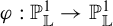 with
$\mathrm {red}\ \varphi : \mathbb {P}^1_{\mathbb {C}} \to \mathbb {P}^1_{\mathbb {C}}$
 for all
$z \in \mathbb {P}^1_{\mathbb {L}}$
 outside a finite collection of disjoint open balls of spherical radius
$1$
 . In fact,

for all
$z \in \mathbb {P}^1_{\mathbb {L}}$
 such that
$H(\tilde {z}) \neq 0$
 . Moreover, if
$\deg \tilde {\varphi } \ge 1$
 , then
$\varphi $
 maps the ball
$\mathrm {red}^{-1} (\tilde {z})$
 onto the ball
$\mathrm {red}^{-1}(\tilde {\varphi }(\tilde {z}))$
 with degree
$\deg _{\tilde {z}} \tilde {\varphi }$
 , provided
$H(\tilde {z})\neq 0$
 .
5.2.3 Action on balls and annuli
A ball B in
$\mathbb {L}$
 is a set of the form

for some
$z_0 \in \mathbb {L}$
 and some
$r>0$
 . In the former case we say that B is an open ball, in the latter it is a closed ball. All balls are topologically open and closed. If
$r \notin |\mathbb {L}^\times | = \exp (\mathbb {Q})$
 , then the open ball and closed ball of radius r around
$z_0$
 coincide. If
$r \in |\mathbb {L}^\times |$
 , then we say that the corresponding balls are rational open or rational closed balls.
An analytic function
$\varphi : \mathfrak {O} \to \mathfrak {O}$
 is a power series
$\sum c_i z^i$
 with coefficients in
$\mathfrak {O}$
 such that
$| c_i |_{\mathrm {o}} \to 0$
 ; equivalently, the series converges for all
$z \in \mathfrak {O}$
 . The reduction
${\tilde {\varphi } = \sum \tilde {c}_i \tilde {z}^i \in \mathbb {C}[\tilde {z}]}$
 is a polynomial. Moreover,
$\deg \tilde {\varphi } \ge 1$
 if and only if
$\varphi $
 is onto. In this case,
$\deg \varphi = \deg \tilde {\varphi }$
 is the number of preimages under
$\varphi $
 , counting multiplicities, of points in
$\mathfrak {O}$
 . Moreover,
$\varphi $
 maps the maximal open ball
$\tilde {z} + \mathfrak {M}$
 onto
$\tilde {\varphi }(\tilde {z}) + \mathfrak {M}$
 with degree
$\deg _{\tilde {z}} \tilde {\varphi }$
 . Note that
$\deg \varphi $
 is the number of critical points of
$\varphi $
 , counting multiplicities, plus
$1$
 . This is true since the residue field
$\mathfrak {O}/\mathfrak {M}=\mathbb {C}$
 has characteristic zero.
We identify
$\mathbb {P}^1_{\mathbb {L}}$
 with
$\mathbb {L} \cup \{\infty \}$
 . If
$\varphi : \mathbb {P}^1_{\mathbb {L}} \to \mathbb {P}^1_{\mathbb {L}}$
 has no poles in a ball B, say of radius r, then
$\varphi (B)$
 is a ball of the same type (rational, open, closed), say of radius
$r'$
 . Moreover, the Schwarz lemma holds; that is, for all
$z \in B$
 ,

with equality if and only if
$\varphi : B \to \varphi (B)$
 is a bijection; equivalently,

for all
$z,z' \in B$
 . Furthermore, since the residue field has characteristic zero, the mean value theorem also holds: if
$\varphi :B \to \mathbb {L}$
 and
$| \varphi '(z) |_{\mathrm {o}} \le C$
 for all
$z \in B$
 , then for all
$z,z' \in ~B$
 ,

In general, a (respectively, rational, open) closed ball B in
$\mathbb {P}^1_{\mathbb {L}}$
 containing
$\infty $
 is the complement of a (respectively, rational, closed) open ball in
$\mathbb {L}$
 . Given a rational map
$\varphi : \mathbb {P}^1_{\mathbb {L}} \to \mathbb {P}^1_{\mathbb {L}}$
 and a ball B, then
$\varphi (B)$
 is a ball of the same type or
$\varphi (B)=\mathbb {P}^1_{\mathbb {L}}$
 . If B is a ball and
$\varphi (B)$
 is a ball, then
$\varphi : B \to \varphi (B)$
 has a well-defined degree which is the number of critical points in B, counting multiplicities, plus
$1$
 . If, moreover, B is a closed rational ball, then each maximal open ball in B maps onto a maximal open ball in
$\varphi (B)$
 .
If
$\mathbb {L} \supset B \supset B'$
 are nested balls, then
$A=B\setminus B'$
 is an annulus. Its modulus is
$\mathrm {mod}(A):=\log \mathrm {diam}(B) - \log \mathrm {diam} (B')$
 . These definitions easily generalize to
$\mathbb {P}^1_{\mathbb {L}}$
 . If A is an annulus and
$\varphi : \mathbb {P}^1_{\mathbb {L}} \to \mathbb {P}^1_{\mathbb {L}}$
 is a rational map such that
$\varphi (A)$
 is again an annulus, then
$\varphi : A \to \varphi (A)$
 has a well-defined degree
$d_A\ge 1$
 and
$d_A \cdot \mathrm {mod}(A) = \mathrm {mod}(\varphi (A))$
 .
5.3 Quadratic rational dynamics over
$\mathbb {L}$
: limbs

In our family
$\varphi _\beta $
 we restrict our attention to certain subsets of parameter space that we call limbs, by analogy with complex dynamics. More precisely, given
$\theta \in \mathbb {Q}/\mathbb {Z}$
 of order
$q \ge 2$
 , we define the non-Archimedean limb
${\mathcal {L}}_\theta \subset \mathbb {L}$
 by:

where
$c_\theta := -(2 \cos \pi \theta )^{-2}.$

By Lemmas 4.5 and 5.1, limbs contain the parameters of interest to us. Indeed, any
$\beta _0$
 for which
$\unicode{x3c9} $
 is periodic of period
$p \ge 3$
 is contained in some limb. In this section, we introduce basic results about the dynamics of
$\varphi _\beta $
 with a focus on parameters that lie in a limb.
Below, we show that all maps
$\varphi _\beta $
 in a limb have an invariant Rivera domain
$U_0$
 . Although Rivera domains are easier to understand in Berkovich spaces, we will keep our discussion in the classical line
$\mathbb {P}^1_{\mathbb {L}}$
 . In this context, an invariant Rivera domain
$U_0$
 is the complement of finitely many pairwise disjoint rational closed balls such that
$\varphi : U_0 \to U_0$
 is a bijection and
$U_0$
 is maximal with respect to these properties.
To describe the dynamics and the invariant domain
$U_0$
 of
$\varphi _\beta $
 when
$\beta $
 lies in an order q limb
${\mathcal {L}}_\theta $
 , we define q closed balls
$B_0, \ldots , B_{q-1}$
 , subscripts mod q, and a maximal open ball
$D_0$
 contained in
$B_0$
 . We do not make the dependence of
$B_j$
 on
$\theta $
 explicit. The open ball
$D_0$
 is independent of
$\beta $
 , except in the case
$q=2$
 .
Given
$\beta =\gamma t^{-1} \in {\mathcal {L}}_{1/2}$
 , let

Given
$\theta \in \mathbb {Q} / \mathbb {Z}$
 of order
$q \ge 3$
 , consider
$\beta = c_\theta + o(1) \in {\mathcal {L}}_\theta $
 . Recall that
$\unicode{x3c9} _j(c_\theta )$
 denotes the jth iterate of
$\unicode{x3c9} =0$
 under
$\varphi _{c_\theta }$
 . Let

Note that the critical points of
$\varphi _\beta $
 lie in
$B_0$
 and the critical values in
$B_1$
 .
Proposition 5.4. Consider a parameter
$\beta $
 in a limb
${\mathcal {L}}_\theta $
 of order q. Let

Then the following assertions hold:
-
(1) $\varphi _\beta : U_0 \to U_0$
is a bijection; -
(2) if $j\neq 0$
, then
$\varphi _\beta : B_j \to B_{j+1}$
is a bijection; -
(3) $\varphi _\beta : B_0 \setminus D_0 \to B_1$
has degree
$2$
; -
(4) $\varphi _\beta : D_0 \to \mathbb {P}^1_{\mathbb {L}} \setminus B_1$
is a bijection.


Proof. We assume that
$q \ge 3$
 . The case
$q=2$
 follows from a similar argument.
Consider a parameter
$\beta \in {\mathcal {L}}_\theta $
 . To simplify notation write
$c:=c_\theta $
 . Hence,
$\varphi _c$
 is the map corresponding to
$\beta =c$
 . Also,

is an order q Möbius transformation.
The semiconjugacy between
$\varphi _\beta $
 and M, furnished by reduction, holds for all
$z \notin \mathfrak {M}$
 . Hence, the open ball
$\tilde {z} + \mathfrak {M}$
 of radius
$1$
 is mapped isometrically (in the spherical metric) onto
$M(\tilde {z}) + \mathfrak {M}$
 , for all
$\tilde {z} \in \overline {\mathbb {C}} \setminus \{0\}$
 . In particular,
$\unicode{x3c9} _j(\beta ) \notin \mathfrak {M}$
 , for
$1\le j< q$
 . Furthermore, a ball of spherical radius
$| t |_{\mathrm {o}}$
 around
$\unicode{x3c9} _j (\beta )$
 maps onto a ball with the same spherical radius around
$\unicode{x3c9} _{j+1} (\beta )$
 , for all
$1 \le j < q$
 .
We postpone the proof of (1). To prove (2), let
$\gamma \in \mathfrak {O}$
 be such that for
$\beta = c + \gamma t \in {\mathcal {L}}_\theta $
 . We claim that, for all
$2\le j \le q$
 ,

Indeed, this is trivially true for
$j=2$
 and we proceed by induction. Suppose it is true for some j such that
$2 \le j< q$
 . Then

since
$\varphi _\beta $
 is an isometry on open balls of radius
$1$
 disjoint from
$\mathfrak {M}$
 . Moreover,

From the strong triangle inequality, (5.3) holds for
$j+1$
 . Therefore, (2) holds for
${1 \le j \le q-2}$
 . To prove (2) for
$j=q-1$
 , we must show that
$\unicode{x3c9} _q(c)=\unicode{x3c9} +O(t)$
 . In fact, a straightforward induction shows that for
$2 \le j \le q$
 ,

Since
$ M^{\circ q-2} (1) =0=\unicode{x3c9} $
 , assertion (2) holds.
For (3) and (4), note that

It follows that
$D_0 = \{z: z= -c^{-1} t + o(t)\}$
 maps bijectively onto
$\mathfrak {M}$
 by
$t \varphi _\beta $
 , which proves (4). For all
$\tilde {z} \neq -c^{-1}$
 , the open ball of the form
$\tilde {z} t + o(t)$
 is mapped by
$\varphi _\beta $
 onto the open ball of spherical radius
$| t |_{\mathrm {o}}$
 centered at
$h(\tilde {z})/t$
 with degree
$\deg _{\tilde {z}} h$
 , which yields (3).
To finish, we deduce (1). First observe that every element of
$\mathbb {P}^1_{\mathbb {L}} \setminus U_0$
 has two preimages, counting multiplicities, in
$\mathbb {P}^1_{\mathbb {L}} \setminus U_0$
 . Thus,
$\varphi _\beta (U_0) \subset U_0$
 . By (4), a point
$z \in U_0$
 has exactly one preimage in
$D_0$
 . By (2) and (3), no preimage of z is contained in
${B_1, \ldots , B_{q-1}, B_0\setminus D_0}$
 . Hence, z has exactly one preimage in
$U_0$
 . That is,
$\varphi _\beta (U_0) = U_0$
 and
$\varphi _\beta $
 is injective in
$U_0$
 .
We gather together basic consequences about the action of
$\varphi _\beta $
 on balls and annuli.
Corollary 5.5. Consider
$\beta $
 in an order q limb. Then the following assertions hold.
-
(1) If B is a ball properly contained in $B_j \setminus D_0$
, then
$\varphi _\beta (B)$
is a ball contained in
$B_{j+1}$
. Moreover,
$\varphi _\beta : B \to \varphi _\beta (B)$
has degree
$1$
if B is critical point free, and degree
$2$
otherwise. Furthermore, every maximal open ball contained in
$B_j$
distinct from
$D_0$
maps onto a maximal open ball contained in
$B_{j+1}$
. -
(2) For $1 \le j <q$
, $$ \begin{align*}C_j := (\varphi_\beta|_{D_0})^{-1} (B_{j+1})\end{align*} $$is a ball which maps bijectively onto $B_{j+1}$
.
-
(3) If $A=B \setminus B'$
is a critical point free annulus such that B is properly contained in
$B_j \setminus D_0$
or in
$C_j$
, for some j, then
$\varphi (A)$
is an annulus. Moreover,
$\varphi : A \to \varphi (A)$
has degree
$2$
if
$B'$
contains a critical point, otherwise it has degree
$1$
. -
(4) $U_0$
is an invariant Rivera domain.


We omit the proof of the corollary which is an application of §5.2.3 and Proposition 5.4. To prove (4) it is not difficult to check that
$U_0$
 is maximal with respect to the property of being a complement of finitely many balls such that
$\varphi _\beta :U_0\to U_0$
 is bijective.
5.4 Parabolic rescaling
The balls
$B_0, \ldots , B_{q-1}$
 correspond to a ‘parabolic rescaling limit’. That is, according to [Reference KiwiKiw14, Theorems 1 and 2], after a change of coordinates mapping
$B_0$
 onto the ring of integers
$\mathfrak {O}$
 , the map
$\varphi ^{\circ q}_\beta $
 reduces to a complex quadratic rational map with a parabolic fixed point. We will need to be precise about the dependence of the complex parabolic map on the parameter
$\beta $
 . Although one could implement a non-Archimedean version of the computations leading to Proposition 4.4, for simplicity, we prefer to employ this complex dynamics result.
To write down the dependence on
$\beta $
 , we introduce parametrizations for the limbs and convenient coordinate changes. Given
$\theta \in \mathbb {Q}/\mathbb {Z}$
 of order
$q \ge 3$
 , we let

Also,

We abuse notation and consider the dependence of
$L_{1/2}$
 on
$\gamma $
 implicitly. Observe that
$\unicode{x3bb} _\theta $
 is the natural parametrization of the
$\theta $
 -limb
${\mathcal {L}}_\theta $
 .
Consider

Then, given
$\beta \in {\mathcal {L}}_\theta $
 , the map
$\varphi _\beta ^{\circ q} : B_0 \setminus D_0 \to B_0$
 is semiconjugate, via
$\pi _0$
 , to a complex quadratic rational map R with a parabolic fixed point [Reference KiwiKiw14, Theorems 1,2]. Moreover, the parabolic fixed point of R is at
$\pi _0(U_0)=\infty $
 with preimage
$\pi _0(D_0)=-1$
 and R has a critical point in
$\pi _0 (\unicode{x3c9} ) =0$
 . Hence, R is an element
$R_v$
 of the parabolic family (4.1) and

for
$z \in B_0 \setminus D_0$
 . Equivalently,

where

The following lemma says that the assignment
$\beta \mapsto v$
 induces an isomorphism of complex affine lines.
Lemma 5.6. Given
$\theta \in \mathbb {Q}/\mathbb {Z}$
 of order
$q \ge 3$
 (respectively,
$q=2$
 ), there exists a non-constant function
$v_\theta (\tilde {\gamma }) = A \tilde {\gamma } +B \in \mathbb {C}[\tilde {\gamma }]$
 (respectively,
$v_\theta (\tilde {\gamma })={\tilde {\gamma }}$
 ) such that, for all
$\gamma \in \mathfrak {O}$
 (respectively,
$\gamma \in \mathfrak {O} \setminus ~\mathfrak {M}$
 ),

for all
$z \in B_0 \setminus D_0$
 or equivalently for all
$\tilde {z} \in \mathbb {C}\setminus \{-1\}$
 .
Proof. When
$\theta =1/2$
 , a straightforward direct computation proves the assertion.
If
$\theta $
 has order
$q \ge 3$
 , then the function

is well defined. Therefore,

and

only depends on
${\tilde {\gamma }}$
 . That is,
$w(\gamma ) = v_\theta ({\tilde {\gamma }})$
 for some
$v_\theta ({\tilde {\gamma }}) \in \mathbb {C}[{\tilde {\gamma }}]$
 . We must show that
${\tilde {\gamma }} \to v_\theta ({\tilde {\gamma }})$
 is an affine isomorphism.
According to Proposition 4.4, there exists a non-constant complex affine map
${{\tilde {\gamma }} \mapsto A{\tilde {\gamma }} + B}$
 such that if
$\unicode{x3bb} _\theta (\gamma )= c_\theta + {\tilde {\gamma }} t$
 , then

Since reduction coincides with the limit as
$t \to 0$
 ,

Corollary 5.7. Consider
$\beta _0 =\unicode{x3bb} _\theta (\gamma _0)$
 in an order q limb
${\mathcal {L}}_\theta $
 . Assume that
$\unicode{x3c9} $
 has period p under
$\varphi _{\beta _0}$
 . Then there exists a minimal
$\ell _0 \ge 1$
 such that one of the following holds:
-
• $q \ell _0 =p$
and
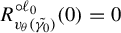
$R_{v_\theta (\tilde {\gamma _0})}^{\circ \ell _0}(0) =0$
; -
• $q \ell _0 < p$
and
$R_{v_\theta (\tilde {\gamma _0})}^{\circ \ell _0}(0) =-1$
.



Proof. Write
$\varphi :=\varphi _{\beta _0}$
 and
$R_v := R_{v_\theta }({\tilde {\gamma }}_0)$
 . Denote by D the maximal open ball contained in
$B_0$
 around
$\unicode{x3c9} $
 . By Lemma 5.6, reduction is a semiconjugacy outside
$D_0$
 . If the orbit of
$\unicode{x3c9} $
 is disjoint from
$D_0$
 , then D is periodic, say of period
$\ell _0\ge 1$
 , under
$\varphi ^{\circ q}$
 . Moreover,
$\unicode{x3c9} $
 is the unique periodic point of
$\varphi ^{\circ q \ell _0 } : D \to D$
 , by the Schwarz lemma. Therefore,
$q \ell _0 =p$
 and D is contained in the basin of attraction of the critical orbit under
$\varphi $
 . Also, the critical point
$\omega =0$
 has period
$\ell _0$
 under
$R_v$
 . If the orbit of
$\unicode{x3c9} $
 is not disjoint from
$D_0$
 , then there exists a minimal
$\ell _0\ge 1$
 such that
$\unicode{x3c9} _{q\ell _0}(\beta ) \in D_0$
 . In this case,
$\omega =0$
 hits
$z=-1$
 in
$\ell _0$
 iterates under
$R_v$
 .
For a parameter
$\beta $
 in an order q limb, we say that
$\unicode{x3c9} $
 has a non-central return if
${\unicode{x3c9} _{q\ell } (\beta ) \in D_0}$
 for some
$\ell \ge 1$
 . In this case, we say that
$q\ell _0$
 is the first non-central return time if
$\ell _0$
 is minimal such that
$\unicode{x3c9} _{q\ell _0} (\beta ) \in D_0$
 .
A parameter without non-central returns is called a satellite parameter.
Remark 5.8. In Berkovich space language, one can phrase Lemma 5.6 as follows. Denote by
$\mathrm {Per}_1(1)$
 the space of critically marked complex quadratic rational maps with a parabolic fixed point. Note that
$\mathrm {Per}_1(1)$
 is an affine line over
$\mathbb {C}$
 . Consider an order
$q \ge 3$
 limb
${\mathcal {L}}_\theta $
 ; denote by
$\unicode{x3bb} _0$
 the type II point
$\partial \overline {{\mathcal {L}}_\theta }$
 and by
$T_{\unicode{x3bb} _0} \overline {{\mathcal {L}}_\theta }$
 the space of (finite) directions at
$\unicode{x3bb} _0$
 , naturally endowed with the structure of an affine line over
$\mathbb {C}$
 . Let
$x_0$
 be the type II point
$\partial \overline {B_0}$
 . Denote by
$T_{x_0} \varphi _\beta ^{\circ q}: T_{x_0} \mathbb {P}^{1, {an}} \to T_{x_0} \mathbb {P}^{1, {an}}$
 the corresponding action on the set of directions at
$x_0$
 . Note that
$T_{x_0} \varphi _\beta ^{\circ q}$
 is a well-defined conjugacy class of maps acting on the
$\mathbb {P}^1_{\mathbb {C}}$
 -structure of
$T_{x_0} \mathbb {P}^{1, {an}}$
 . Moreover, it belongs to
$\mathrm {Per}_1(1)$
 . The lemma, stated in this language, says that
${\mathcal {L}}_\theta \ni \beta \to T_{x_0} \varphi _\beta ^{\circ q} \in \mathrm {Per}_1(1)$
 projects to an affine isomorphism
$T_{\unicode{x3bb} _0} \overline {{\mathcal {L}}_\theta } \to \mathrm {Per}_1(1)$
 . The fact that this map is an isomorphism is of central importance for us. We will prove a similar result for ‘polynomial rescaling limits’. (For
$q=2$
 , with minor modifications, an analogous statement is also true.)
5.5 Preliminary bounds
The rest of the paper is devoted to the proof of the main Lemma 5.2. Here we list some basic preliminary bounds. Specifically, for future reference, we record the size of
$\partial _z \varphi _\beta (z)$
 and
$\partial _\beta \varphi _\beta (z)$
 . Then, in §5.6, our work towards proving (5.2) for
$n=p$
 will start (and finish) at
$n=p$
 , for satellite parameters, and at
$n=q \ell _0+1$
 , for parameters with non-central returns.
The critical points of
$\varphi _\beta $
 are
$\unicode{x3c9} =0$
 and
$\unicode{x3c9} ' = -2t/\beta $
 (respectively,
$-2t^{-1}/\beta $
 ) if
${| \beta |_{\mathrm {o}}\le 1}$
 (respectively, if
${| \beta |_{\mathrm {o}}> 1}$
 ). Assuming that
$\beta $
 lies in some limb
${\mathcal {L}}_\theta $
 , denote by
$D^{\prime }_0$
 the maximal open ball contained in
$B_0$
 such that
$\unicode{x3c9} ' \in D_0'$
 . Let

and

where
$C_j$
 for
$1\le j < q$
 are the disks from Corollary 5.5 (2). Note that
$B_{1/2}$
 is the union of
$q-1$
 balls that depend on
$\beta $
 , but we omit this dependence in the notation. If
$\beta _0$
 is such that
$\unicode{x3c9} $
 is periodic, then
$\unicode{x3c9} _n(\beta _0) \in B_{1/2}$
 whenever
$\unicode{x3c9} _n(\beta _0) \in D_0$
 , for otherwise
$\unicode{x3c9} _{n+1}(\beta _0) \in U_0$
 .
Lemma 5.9. Let
${\mathcal {L}}_\theta $
 be a limb of order
$q \ge 2$
 . Assume
$\beta \in {\mathcal {L}}_\theta $
 .
If
$q=2$
 , then


If
$q \ge 3$
 , then


Proof. The computations are straightforward and are left to the reader.
Denote by
$\mathrm {diam} (B)$
 the spherical diameter of a ball contained in
$\mathfrak {O}$
 or in
$\mathbb {P}^1_{\mathbb {L}} \setminus \mathfrak {O}$
 . Observe that if
$z \in B_j$
 for some
$j\neq 0$
 , then

subscripts mod q. If
$z \in B_0'$
 and
$| z |_{\mathrm {o}} = \mathrm {diam} (B_0)$
 , then

This can be checked directly as an application of Lemma 5.9 or from the Schwarz lemma.
The semiconjugacy
$\mathrm {red}(L_\theta (z))$
 furnished by Lemma 5.6 maps the open ball
$D_0'$
 onto a critical point
$\omega '$
 which lies in the basin of the multiple fixed point, under the corresponding parabolic map. Hence, the orbit of
$\unicode{x3c9} $
 is disjoint from
$D_0'$
 and every point in
$D_0'$
 has an infinite orbit.
5.6 Satellite and first non-central return
We now prove the initial cases of (5.2) according to whether a first non-central return exists or not.
Lemma 5.10. Consider a parameter
${\beta _0}$
 in an order q limb such that
$\unicode{x3c9} $
 has period p. Then the following statements hold.
-
(1) If $\beta _0$
is a satellite parameter, then $$ \begin{align*} \|{\partial_\beta \unicode{x3c9}_{p}(\beta_0)}\| = \|{\partial_z \varphi^{\circ p-1}_{\beta_0} (\infty)}\| \cdot | \tau |_{\mathrm{o}}^2. \end{align*} $$
-
(2) If $q\ell _0 \ge 1$
is the first non-central return time of
$\unicode{x3c9} $
under
$\varphi _{\beta _0}$
, then $$ \begin{align*} \| \partial_z \varphi^{q \ell_0-1}_{\beta_0} (\infty) \| &= | \tau |_{\mathrm{o}}^{-1}, \\ \|{\partial_\beta \unicode{x3c9}_{q \ell_0+1}(\beta_0)}\| \cdot | \tau |_{\mathrm{o}} &=\|{\partial_z \varphi^{\circ q\ell_0}_{\beta_0} (\infty)}\|\cdot | \tau |_{\mathrm{o}}^2. \end{align*} $$


Proof. If
$\beta _0$
 is a satellite parameter, it will be convenient to let
$\ell _0=p/q$
 . Otherwise, the first non-central return is
$q\ell _0$
 as is in the statement of the lemma.
We consider first the case in which
$\beta _0$
 lies in the
$1/2$
 -limb. In this limb, for
$| \gamma |_{\mathrm {o}}=1$
 , let
$\unicode{x3bb} (\gamma ):= \gamma /t$
 . Then
$\unicode{x3bb} (\gamma _0) = \beta _0$
 for
$\gamma _0 := t \beta _0$
 . In view of Lemma 5.6, for all
$z \in B_0 \setminus D_0$
 ,

Hence,

The first line is an immediate consequence of the product and chain rules, taking into account that
$\beta =\gamma /t$
 . Reduction and derivatives commute in
$B_0 \setminus D_0$
 , which yields the second line. Reduction and iteration also commute in
$B_0 \setminus D_0$
 , thus the third line follows. Finally, note that
$R^{\circ \ell _0}_{{\tilde {\gamma }}_0} (0) =0$
 or
$-1$
 , so the last line is a consequence of Lemma 4.6.
If
$2 \ell _0 =p$
 , then
$\unicode{x3c9} _{2 \ell _0} (\beta _0) =0$
 . We conclude that

If
$2 \ell _0 <p$
 , then

Therefore,

Hence,

since
$\unicode{x3c9} _{2 \ell _0 + 1} (\beta _0) \in B_0$
 .
By (5.4),

and the lemma follows for
$q=2$
 .
Now consider the case in which
$q \ge 3$
 . For
$\gamma \in \mathfrak {O}$
 , let
$\unicode{x3bb} (\gamma ) := c_\theta + \unicode{x3bb} t$
 be the standard parametrization of
${\mathcal {L}}_\theta $
 . Then
$\unicode{x3bb} (\gamma _0) = \beta _0$
 for
$\gamma _0 := (\beta _0-c_\theta )/t$
 . Recall that for all
$z \in B_0\setminus D_0 $
 ,

where,
$v({\tilde {\gamma }})$
 is a
$\mathbb {C}$
 -affine automorphism (Lemma 5.6). As above, the chain rule and the commutative properties of derivatives, reduction, and iteration yield

If
$q \ell _0 =p$
 , then
$\unicode{x3c9} _{q \ell _0} (\beta _0) =0$
 . We conclude that

If
$q \ell _0 <p$
 , then

Therefore,

Moreover,
$\unicode{x3c9} _{q\ell _0} (\beta _0) ,\unicode{x3c9} _{q\ell _0 + 1} (\beta _0) \notin B_1$
 , so

Furthermore,

by (5.6). For
$q \ge 3$
 , the lemma now follows from the chain rule.
5.7 Geometry of polynomial rescaling limits
Given
$\beta $
 in an order q limb
${\mathcal {L}}_\theta $
 , the filled Julia set of
$\varphi _\beta $
 is

We are interested in the geometry of
${\mathcal {K}}(\varphi _\beta )$
 around
$\unicode{x3c9} $
 for parameters with non-central returns.
Proposition 5.11. Let
$\beta _0$
 be a parameter of period p in an order q limb such that
$\unicode{x3c9} $
 has a non-central return. Then there exists a periodic rational closed ball
$X_0$
 around
$\unicode{x3c9} $
 of period
$q'>q$
 . Moreover,
$\varphi ^{\circ q'}_\beta : X_0 \to X_0$
 has degree
$2$
 .
Clearly,
$X_0 \subset {\mathcal {K}}(\varphi _{\beta _0})$
 and
$q'$
 divides p.
Proof. The proposition is a consequence of results from [Reference KiwiKiw14]. Let D be the maximal open ball such that
$\unicode{x3c9} \in D \subset {\mathcal {K}}(\varphi _\beta )$
 . Let
$X_0$
 be the closed ball containing
$\unicode{x3c9} $
 of diameter
$\mathrm {diam} (D)$
 . By [Reference KiwiKiw14, Proposition 5.3],
$X_0$
 is a rational closed ball and either
$X_0=B_0$
 or
$X_0$
 is periodic, say of period
$q'$
 . We now prove by contradiction that
$X_0 \neq B_0$
 . Suppose
$X_0=B_0$
 . Then D is a maximal open ball in
$B_0$
 . Since
$\beta _0$
 has a non-central return, D eventually maps onto
$D_0$
 . This is impossible because
$D_0$
 contains a preimage of
$U_0$
 . Therefore,
$X_0$
 is a periodic ball. Moreover,
$q'>q$
 , since
$X_0$
 maps into
$D_0$
 in
$q\ell _0$
 iterates, for some
$\ell _0 \ge 1$
 . Furthermore, the unique critical point of
$\varphi ^{\circ q'}_\beta : X_0 \to X_0$
 is
$\unicode{x3c9} $
 , so it has degree
$2$
 .
Lemma 5.12. Suppose that
$\beta $
 is a parameter in an order q limb. If there exist
$q' \ge 1$
 and a ball
$X_0 \ni \unicode{x3c9} $
 such that
$\varphi ^{q'}_\beta (X_0) = X_0$
 , then either
$X_0$
 is an open ball and
$\mathrm {diam} (X_0) = \mathrm {diam} (B_0)$
 , or
$X_0$
 is the unique periodic closed ball containing
$\unicode{x3c9} $
 ,
$q'>q$
 and
$\unicode{x3c9} $
 has a non-central return.
Proof. Since
$\partial \overline {X_0} \subset \mathbb {P}^{1, {an}}$
 is a (Berkovich) repelling periodic point of
$\varphi _\beta : \mathbb {P}^{1, {an}} \to \mathbb {P}^{1, {an}}$
 , according to [Reference KiwiKiw14, Theorem 1], we have that
$\partial \overline {X_0} = \partial \overline {B_0}$
 or
$X_0$
 is a closed rational ball properly contained in
$B_0$
 . In the first case, taking into account that some points of
$B_0$
 map into
$U_0$
 , we have that
$B_0$
 is not a periodic ball, so
$X_0$
 is a maximal open ball of
$B_0$
 . In the second case, we claim that
$\unicode{x3c9} $
 has a non-central return. By contradiction, suppose that
$\beta $
 is a satellite parameter; then
$\varphi _\beta ^{\circ q'}(D') =D'$
 , where
$D'$
 is the open ball around
$\unicode{x3c9} $
 of diameter
$\mathrm {diam}(B_0)$
 . By the Schwarz lemma,
$\varphi ^{\circ q'}_\beta (X_0) \subsetneq X_0 \subsetneq D'$
 which is a contradiction. Therefore,
$\unicode{x3c9} $
 has a non-central return and
$q'>q$
 .
The size of the balls in the orbit of
$X_0$
 is controlled by the following result.
Lemma 5.13. Let
$\beta $
 be a parameter in an order q limb. Suppose that
$X_0$
 is a periodic rational closed ball of period
$q'$
 containing
$\unicode{x3c9} $
 and
$q\ell _0$
 is the first non-central return time of
$\unicode{x3c9} $
 . Given
$0 \le j <q'$
 , consider k such that

and let

Then

for all
$j=q \ell _0 +1, \ldots , q'$
 .
Given a parameter
$\beta $
 with a periodic ball
$X_0$
 as above, we will freely use the notation for
$X_j$
 and
$L_j$
 introduced in the lemma, subscripts mod
$q'$
 .
Proof. Given
$X_j$
 , let k be such that
$X_j \subset B_k$
 and

We use reverse interval notation in
$\Gamma _j$
 , which is totally ordered by inclusion. That is,
$[A,B] \subset \Gamma _j$
 consists of all the balls C such that
$A \supset C \supset B$
 . Moduli of annuli give a natural parametrization of
$\Gamma _j$
 by a subinterval of
$\mathbb {R}$
 (corresponding to the hyperbolic distance in
$\mathbb {P}^{1, {an}} \setminus \mathbb {P}^1_{\mathbb {L}}$
 ):

We simply say that the length of
$[A,B]$
 is the modulus of
$A \setminus B$
 , so the parametrization preserves length.
We omit the subscript
$\beta _0$
 and simply write
$\varphi $
 . We will analyze the dynamics induced by
$\varphi $
 on
$\cup \Gamma _j$
 . Its action in
$\Gamma _j$
 will be also denoted by
$\varphi $
 . Recall that
$\varphi $
 maps
$D_0 \setminus \cup C_j$
 bijectively onto
$U_0$
 . Denote by D the open ball around
$\unicode{x3c9} $
 of diameter
$\mathrm {diam} (B_0)$
 .
If
$X_j \subset D_0$
 , then
$X_j \subset C_k$
 for some k and the portion
$]B_0,C_k[$
 of
$\Gamma _j$
 maps outside of
$\cup \Gamma _j$
 ; that is,
$\varphi (B) \notin \cup \Gamma _j$
 , for all
$B\ {\in}\ ]B_0,C_k[$
 . Moreover,
$[C_k,X_j]$
 maps bijectively onto
$\Gamma _{j+1}\ {=}\ ]B_{k+1},X_{j+1}]$
 . Furthermore,
$\varphi : [C_k,X_j] \to \Gamma _{j+1}$
 is length preserving since
$C_k$
 maps bijectively onto
$B_k$
 .
If
$X_j \subset B_k$
 for some
$k \neq 0$
 , then
$\varphi : \Gamma _{j} \to \Gamma _{j+1}\ {=}\ ]B_{k+1},X_j]$
 is a length-preserving bijection, since
$\varphi $
 maps
$B_k$
 onto
$B_{k+1}$
 bijectively.
The interval
$]B_0,X_0]$
 consists of balls contained in D and
$\varphi : A \setminus B \to \varphi (A)\setminus \varphi (B)$
 is a degree
$2$
 map if
$]A,B] \subset\ ]B_0,X_0]$
 . Therefore,
$\varphi :\Gamma _0 \to \Gamma _1$
 is a bijection that multiplies lengths by a factor of
$2$
 .
If
$X_j \hspace{-0.5pt}\subset\hspace{-0.5pt} D$
 for some
$j\neq 0$
 , then
$\Gamma _j \hspace{-0.5pt}\cap\hspace{-0.5pt} \Gamma _0 \,{=}\,]B_0, S_j]$
 for some
$S_j$
 . Hence,
${\varphi : \Gamma _j \to \Gamma _{j+1}}$
 is a bijection that multiplies the length of subintervals of
$]B_0,S_j]$
 by a factor
$2$
 and preserves lengths of the subintervals of
$[S_j,X_j]$
 .
Note that
$\varphi (\Gamma _j) \supset \Gamma _{j+1}$
 for all j and equality holds only if
$X_j$
 is not contained in
$D_0$
 .
We are now ready to compare lengths of
$\Gamma _j$
 with
$\Gamma _1$
 . We claim that, for all
$j \ge 1$
 , there exists an injective piecewise continuous and length-preserving map
$\psi : \Gamma _j \to \Gamma _1$
 . Indeed, given
$B \in \Gamma _j$
 , let
$n=n(B) \ge 0$
 be minimal so that there exists
$B' \in \Gamma _1$
 with the property that
$\varphi ^{\circ n}(B') =B$
 . Such a number
$n(B)$
 always exists. In fact, B has a unique preimage C in
$\Gamma _{j-1}$
 . If
$C \in \Gamma _0$
 , then
$B\in \Gamma _1$
 and
$n(B)=0$
 . Otherwise, C maps injectively onto B. Taking preimages recursively, we obtain
$n(B)$
 and
$B' \in \Gamma _1$
 . Let
$\psi : \Gamma _j \to \Gamma _1$
 be the map that sends B to
$B'$
 . Note that
$n(B) < j$
 . Moreover,
$n(B)$
 is non-decreasing. Given
$n \ge 0$
 , let

If
$B'=\psi (B)$
 for some
$B \in I_n$
 , then
$B', \varphi (B'), \ldots , \varphi ^{n-1}(B') \notin \Gamma _0$
 , for otherwise
$n(B) < n$
 . Hence,
$\psi : I_n \to \Gamma _1$
 preserves length. Moreover,
$L_1 \le L_j$
 , since from the definition of
$n(B)$
 we have that
$\psi (I_n) \cap \psi (I_m) = \emptyset $
 if
$n \neq m$
 .
If
$n(B)$
 is constant, say n, in
$\Gamma _j$
 , then
$\varphi ^{\circ n}: \Gamma _1 \to \Gamma _j$
 is a bijection. This can only occur if
$L_1=L_j$
 and
$j \le q \ell _0$
 .
If
$j> q\ell _0$
 , then
$n(B)$
 is not constant. Consider
$n'> n$
 such that the intervals
$I:=I_n$
 ,
$I':=I_{n'}$
 are not empty. Let
$J = \psi (I)$
 and
$J' = \psi (I')$
 . We claim that the endpoint B of J cannot be the initial point of
$J'$
 . Otherwise,
$\varphi ^{\circ n}(B)$
 would be periodic of period dividing
$n'-n$
 , contradicting Lemma 5.12. It follows that
$\psi (L_j)$
 omits intervals of
$L_1$
 and, therefore,
$L_j < L_1$
 .
The dynamical space derivative at
$\infty $
 is controlled by the diameters of
$X_j$
 .
Lemma 5.14. Assume that
$\beta _0$
 is a parameter in an order q limb such that
$\unicode{x3c9} $
 is periodic of period p under
$\varphi _{\beta _0}$
 and
$\{X_0,\ldots , X_{q'-1}\}$
 is its cycle of periodic closed balls such that
$\unicode{x3c9} \in X_0$
 . Then, for all
$j \le p$
 ,

Proof. This is an application of the Schwarz Lemma. Indeed, since
$\varphi _{\beta _0}^{\circ j-1}$
 maps
$X_1$
 onto
$X_j$
 , it maps the open ball
$D_1$
 of diameter
$\mathrm {diam}(X_1)$
 containing
$\infty $
 onto the open ball
$D_j$
 of diameter
$\mathrm {diam}(X_j)$
 containing
$\unicode{x3c9} _{j}(\beta _0)$
 . Every element of
$D_1$
 is in the basin of attraction of the periodic critical orbit from the Schwarz Lemma. Therefore,
$D_1, \ldots , D_{p-1}$
 cannot contain a critical point. Hence,
$\varphi _{\beta _0}^{\circ j-1}:D_1\to D_j$
 is a bijection for all
$j \le p$
 and the desired equation follows from the Schwarz Lemma.
5.8 Polynomial parameter rescaling
Consider a parameter
$\beta _0$
 such that
$\unicode{x3c9} $
 has period p and a non-central return. Recall that
$X_0, \ldots , X_{q'-1}$
 denotes the periodic closed balls under
$\varphi _{\beta _0}$
 where
$\unicode{x3c9} \in X_0$
 . Our analysis will show that there exists a parameter space ball
$\Lambda _0$
 , around
$\beta _0$
 , such that
$\{X_0, \ldots , X_{q'-1}\}$
 is a periodic orbit of closed balls for all
$\beta \in \Lambda _0$
 . We say that parameters
$\beta $
 with such an orbit of periodic closed balls, have a period
$q'$
 primitive renormalization.
Before proving the existence of
$\Lambda _0$
 , we need to prove that (5.2) holds for
$n=q'$
 .
Lemma 5.15. Assume that
$\beta _0$
 is a parameter in an order q limb such that
$\unicode{x3c9} $
 is periodic of period p under
$\varphi _{\beta _0}$
 . Suppose that
$\varphi _{\beta _0}$
 has a primitive renormalization of period
$q'$
 . Let
$\ell _0 \ge 1$
 be such that
$\unicode{x3c9} _{q \ell _0}(\beta _0)$
 is the first non-central return of
$\unicode{x3c9} $
 . Then, for all
$q \ell _0 + k \le q'$
 ,

Moreover,

Proof. From Lemma 5.10, recall that
$ \|\partial _z \varphi _\beta ^{\circ q \ell _0-1} (\infty )\| = | \tau |_{\mathrm {o}}^{-1}$
 . Thus, the second formula follows from the first. To prove the first formula we proceed by induction. In view of Lemma 5.10, the case
$k=1$
 is already proven.
For
$ q \ge 3$
 , all the balls
$B_0, \ldots , B_{q-1}$
 have the same diameter. Hence, from Lemma 5.13, we conclude that
$\mathrm {diam}(X_{q\ell _0}) < \mathrm {diam}(X_{q\ell _0 +k}).$
 For
$q=2$
 , the same holds unless
$X_{q\ell _0+k} \subset B_1$
 ; in this case,
$| t |_{\mathrm {o}} \cdot \mathrm {diam}(X_{q\ell _0}) < \mathrm {diam}(X_{q\ell _0 +k}).$
 For all
$k\le q'-q\ell _0$
 , since
$\varphi ^{\circ k}_{\beta _0}: X_{q\ell _0} \to X_{q \ell _0 +k}$
 is a bijection, the Schwarz lemma yields

Let
$z =: \unicode{x3c9} _{q \ell _0 +k} (\beta _0)$
 . If
$q \ge 3$
 , or
$q=2$
 and
$X_{q\ell _0+k} \subset B_0$
 , then

The first inequality can be checked case by case by applying Lemma 5.9. The second is a consequence of (5.8).
Similarly, if
$q=2$
 and
$X_{q\ell _0+k} \subset B_1$
 , then

In both cases, the inductive hypothesis yields

By the chain rule, the strong triangle inequality, and the inductive hypothesis, we have

Proposition 5.16. Let
$\beta _0$
 be such that
$\unicode{x3c9} $
 has period p under
$\varphi _{\beta _0}$
 . Suppose that
$\{X_0, \ldots , X_{q'-1}\}$
 is a periodic cycle of (rational) closed balls where
$\unicode{x3c9} \in X_0$
 . Consider

Then all of the following statements hold.
-
(1) For all $\beta \in \Lambda _0$
, we have
$\varphi _\beta (X_j)=X_{j+1}$
, subscripts modulo
$q'$
. -
(2) The map $\unicode{x3c9} _{q'}: \Lambda _0 \to X_0$
is a bijection. -
(3) For $j =0,1$
, let
$\rho _j\in \mathbb {Q} / \mathbb {Z}$
be such that
$\mathrm {diam} (X_j) =| t |_{\mathrm {o}}^{\rho _j}$
. Consider $$ \begin{align*} M_0(z) &:= t^{\rho_0} z,\\ \mu_0 (\gamma) &:= \beta_0 + \tau^{-2} t^{\rho_1} \gamma \text{ for } \gamma \in \mathfrak{O}. \end{align*} $$
Then there exist $A,B,C \in \mathbb {C}$
with
$A,B \neq 0$
, such that $$ \begin{align*}\mathrm{red}( M_0^{-1} \circ \varphi^{\circ q'}_{\mu_0 (\gamma)} \circ M_0(z)) = A \tilde{z}^2 + B {\tilde{\gamma}} + C,\end{align*} $$for all $z \in X_0$
and
$\gamma \in \mathfrak {O}$
. Moreover,
$\omega =0$
has period
$p/q'$
under
$\tilde {z} \mapsto A \tilde {z}^2 + C$
.


Remark 5.17. In Berkovich space language, Proposition 5.16(3) says that the following map is an affine isomorphism:

where
$\zeta _0 \in \mathbb {P}^{1, {an}}$
 is the
$\sup $
 -norm in
$X_0$
 ; equivalently,
$\{\zeta _0\} = \partial \overline {X}_0$
 .
Before proving Proposition 5.16 we need the following lemma.
Lemma 5.18. Suppose that
$\{X_0, \ldots , X_{q'-1}\}$
 is a periodic cycle of (rational) closed balls under iterations of
$\varphi _{\beta '}$
 , for some
$\beta '$
 in a limb with
$\unicode{x3c9} \in X_0$
 . Consider

Then, for all
$\beta \in \Lambda _0$
 , we have
$\varphi _{\beta } (X_j)\subset X_{j+1}$
 for all j.
Proof. Consider
$\beta \in \Lambda _0$
 . Our proof is a case-by-case analysis according to the position of
$X_j$
 . From Lemma 5.13,

Suppose
$X_j \subset B_0' \setminus D_0$
 . Then
$X_{j+1} \subset B_1$
 . By (5.5) and (5.7),
$\|\partial _\beta \varphi _\beta (z)\| \le |\tau |^2$
 for all
$z \in B^{\prime }_0$
 . Thus, by the mean value theorem,

for all
$\beta \in \Lambda _0$
 and
$z \in X_j$
 . That is,
$\varphi _\beta (X_j) \subset X_{j+1}$
 .
Suppose
$X_j \subset B_1$
 . Hence,
$X_{j+1} \subset B_0$
 if
$q=2$
 and
$X_{j+1} \subset B_2$
 , otherwise. Moreover, by (5.5) and (5.7), if
$z \in X_j$
 and
$\beta \in \Lambda _0$
 , then
$\|\partial _\beta \varphi _\beta (z) \| \le | t |_{\mathrm {o}}$
 . Therefore,

That is,
$\varphi _\beta (X_j) \subset X_{j+1}$
 .
Suppose
$q \ge 3$
 and
$X_j \subset B_k$
 for some
$2 \le k <q$
 . If
$z \in X_j$
 and
$\beta \in \Lambda _0$
 , then
$\|\partial _\beta \varphi _\beta (z) \| = 1$
 and

Thus,
$\varphi _\beta (X_j) \subset X_{j+1}$
 .
Finally, suppose that
$X_j \subset B_{1/2}$
 . By (5.4)–(5.7),
$\|\partial _\beta \varphi _\beta (z) \| = 1$
 and
$\|\partial _z \varphi _{\beta _0} (z)\| =| t |_{\mathrm {o}}^{-2} \cdot | \tau |_{\mathrm {o}}$
 , for all
$z \in X_j$
 and all
$\beta \in \Lambda _0$
 . Thus,

and

Therefore,
$\mathrm {dist}_s(\varphi _\beta (z),\varphi _{\beta _0} (z)) \le \mathrm {diam}(X_{j+1})$
 and
$\varphi _{\beta }(X_j) \subset X_{j+1}$
 .
Proof of Proposition 5.16
Given
$\beta \in \Lambda _0$
 , by the previous lemma, we have that
$\varphi _\beta (X_j) \subset X_{j+1}$
 for all j. It follows that
$\unicode{x3c9} $
 has a non-central return under
$\varphi _\beta $
 . To prove that
$\varphi _\beta (X_j) = X_{j+1}$
 , we proceed by contradiction. If
$\varphi _\beta (X_j) \subsetneq X_{j+1}$
 for some j, then there exists a closed ball
$X_0' \supsetneq X_0$
 which is periodic under
$\varphi _\beta $
 , possibly of smaller period. Let
$X_j' := \varphi ^{\circ j}_\beta (X^{\prime }_0)$
 and note that
$\mathrm {diam}(X_1')> \mathrm {diam}(X_1)$
 . Therefore,

Again by the previous lemma, for all
$\beta ' \in \Lambda _0'$
 , we have that
$\varphi _{\beta '}(X_j') \subset X^{\prime }_{j+1}$
 . Since
${\beta _0 \in \Lambda _0'}$
 , it follows that
$\varphi ^{\circ q'}_{\beta _0}(X_0') \subset X_0'$
 . But
$X_0$
 is properly contained in
$X_0'$
 . By the Schwarz lemma,
$X_0$
 is in the basin of
$\unicode{x3c9} $
 under
$\varphi _{\beta _0}$
 , which contradicts the periodicity of
$X_0$
 . Hence, (1) holds.
For
$0\le j < q'$
 , we have proven that
$\omega _{q'} : \Lambda _0 \to X_{0}$
 is well defined. Observe that
$\varphi ^{\circ q'-1}_{\beta _0}: X_1 \to X_{q'}=X_0$
 is a bijection. By the Schwarz lemma,

Thus, Lemma 5.15 yields

By the Schwarz lemma, again,
$\omega _{q'} : \Lambda _0 \to X_{0}$
 is a bijection. That is, (2) holds.
Taking into account that
$\mu _0 (\gamma )$
 is a parametrization of
$\Lambda _0$
 by
$\mathfrak {O}$
 , that the map
${\varphi _\beta ^{\circ q'} : X_0 \to X_0}$
 has degree
$2$
 , and that
$M_0 (\mathfrak {O}) = X_0$
 , for all
${\tilde {\gamma }} \in \mathbb {C}$
 ,

is a quadratic polynomial. Moreover, its critical point is at
$z=0$
 and its coefficients are polynomials in
${\tilde {\gamma }}$
 . That is,

for some
$A({\tilde {\gamma }}), V({\tilde {\gamma }}) \in \mathbb {C}[{\tilde {\gamma }}]$
 . Since
$A({\tilde {\gamma }})$
 has no roots, it must be constant, say A. The critical value
$V({\tilde {\gamma }})$
 is
$ \mathrm {red}\ \omega _{q'} (\mu _0(\gamma ))$
 , which has degree
$1$
 by the already proven assertion (2). That is, the first part of assertion (3) holds. If
$\omega =0$
 has period
$p'$
 under
$Q_{\tilde {\gamma }}$
 . Then the open ball
$D'$
 of diameter
$\mathrm {diam}(X_0)$
 containing
$\unicode{x3c9} $
 has period
$q'p'|p$
 . By the Schwarz lemma every element of
$D'$
 is attracted to
$\unicode{x3c9} $
 , hence
$q'p'=p$
 , which finishes the prove of (3).
From the viewpoint of complex dynamics, Proposition 5.16 proves the presence of a Mandelbrot torus around
${\mathcal {E}}^*_x$
 in
${\mathcal {M}}^{\mathrm{cm}}_2$
 . This Mandelbrot torus is analogous to the ones obtained by Branner and Hubbard [Reference Branner and HubbardBH88], in the parameter space of cubic polynomials, close to infinity.
Let us be more concrete and consider a puncture x of
${\mathcal {S}}_p$
 of multiplicity
$\mu $
 with associated Puiseux series
$\beta _0$
 , and
$\mathrm {diam}(X_i)=| t |_{\mathrm {o}}^{\rho _i}$
 for
$i=0,1$
 , as in the statement of the proposition. Consider the associated parametrization
$(s^\mu , b(s))$
 of
${\mathcal {E}}_x$
 . Since
$L_1=2 \cdot L_0$
 , there exists
$m_0 \ge 1$
 such that
$\rho _0=n_0/m_0$
 and
$\rho _1=n_1/m_0$
 for some
$n_0,n_1\ge 1$
 . Let

From Proposition 5.16(3) it follows that, uniformly in compact subsets of
$\mathbb {C}$
 , as
$s \to 0$
 :

We extend the family
$g_{s,c}$
 to
$s=0$
 by declaring
$g_{0,c}(z):= z^2 + AB c + C.$
 Hence, there exist
$R> 0$
 and
$\varepsilon>0$
 such that, if
$|s| < \varepsilon $
 and
$c \in \Lambda := \{ c \in \mathbb {C} : |AB c + C|\le 4 \}$
 , we have that
$g_{s,c}: U_{s,c}' \to \mathbb {D}_R$
 is a quadratic-like map, where
$\mathbb {D}_R:=\{ z \in \mathbb {C} : |z| <R\}$
 and
$U_{s,c}'$
 is the preimage of
$\mathbb {D}_R$
 . Moreover,
${\mathcal {G}}_{s_0}:=\{g_{s_0,c}: c \in \Lambda \}$
 is a full and unfolded quadratic-like family, for all
$s_0$
 , in the sense of Lyubich [Reference LyubichLyu99, §4.11]. The connectedness locus
${\mathcal {M}}_s$
 of
${\mathcal {G}}_s$
 moves holomorphically with s, for
$|s|<\varepsilon $
 , and
${\mathcal {M}}_0$
 is an affine copy of the Mandelbrot set. In other words, the straightening of
${\mathcal {M}}_s$
 is realized as the limit (as
$s \to 0$
 ) of a holomorphic motion inside the moduli space of quadratic rational maps.
Thus, we have established the following corollary.
Corollary 5.19. Let x be a puncture with associated Puiseux series
$\beta _0$
 that has a period
$q'$
 primitive renormalization. For all
$r>0$
 sufficiently large, there exist a (punctured) neighborhood
${\mathcal {E}}_x^*$
 of x and a holomorphic family of critically marked quadratic rational maps
$(F_\unicode{x3bb} ,\omega )$
 parametrized by
${\mathcal {E}}^*_x \times \mathbb {D}_r$
 such that all of the following assertions hold.
-
(1) $\{ [(F_\unicode{x3bb} ,\omega )] \in {\mathcal {M}}^{\mathrm{cm}}_2 : \unicode{x3bb} \in {\mathcal {E}}^*_x \times \mathbb {D}_r\}$
is a neighborhood of
${\mathcal {E}}_x^*$
and
${\mathcal {E}}_x^* = \{ [(F_\unicode{x3bb} ,\omega )] \in {\mathcal {M}}^{\mathrm{cm}}_2 : \unicode{x3bb} \in {\mathcal {E}}^*_x \times \{c_0\}\}$
for some
$c_0$
such that
$z=0$
has period
$p/q'$
under
$Q_{c_0}$
. -
(2) There exist continuously varying smooth Jordan domains $U^{\prime }_\unicode{x3bb} , U_\unicode{x3bb} $
such that
${F^{\circ q'}_\unicode{x3bb} : U^{\prime }_\unicode{x3bb} \to U_\unicode{x3bb} }$
is a quadratic-like map, for all
$\unicode{x3bb} \in {\mathcal {E}}^*_x \times \mathbb {D}_r$
. -
(3) The family of quadratic-like maps $(g_\unicode{x3bb} ):=(F^{\circ q'}_\unicode{x3bb} : U^{\prime }_\unicode{x3bb} \to U_\unicode{x3bb} )$
extends analytically to
${\mathcal {E}}_x \times \mathbb {D}_r$
by the quadratic family. Specifically, for all
$(x,c) \in \{x\} \times \mathbb {D}_r$
, we may define
$g_{(x,c)}$
as a quadratic-like restriction of
$Q_c$
and obtain an analytic family parametrized by
${\mathcal {E}}_x \times \mathbb {D}_R$
.


5.9 Proof of (main) Lemma 5.2
Assume that
$\beta _0$
 is a parameter in an order q limb such that
$\unicode{x3c9} $
 is periodic of period p under
$\varphi _{\beta _0}$
 . We must show that

This was proved, when
$\beta _0$
 is a satellite parameter, in Lemma 5.10. Thus, we may assume that
$\varphi _{\beta _0}$
 has a periodic ball
$X_0$
 containing
$\unicode{x3c9} $
 of period
$q'>q$
 dividing p (Proposition 5.11). In this case, the lemma is ultimately a consequence of the simplicity of the roots of Gleason polynomials. Consider
$M_0$
 ,
$\mu _0$
 ,
$A,B,C$
 as in Proposition 5.16. Let

Then

Indeed, the first line is obtained by changing the order of reduction and derivation. The second line is the aforementioned result by Gleason (Lemma 4.6). By the chain rule,

From Lemma 5.14,

Acknowledgements
Part of this work was done when the author was visiting the Institute for Mathematical Sciences (IMS) at Stony Brook University and the Institut de Mathématiques de Toulouse (IMT). The author is grateful to the IMS and IMT for their hospitality.


 Open access

