


1. Introduction
The Epistle of Barnabas is among the least studied and understood of the texts comprising the Apostolic Fathers. Of various interpretive conundrums, chapter 10 is perhaps the most intransigent. In this chapter, the writer discusses food laws, cuing an allegorical interpretation by stating that Moses spoke ἐν πνεύματι (10.2).Footnote 1 He then offers an allegorical discussion of the laws against eating pig, vulture and eel (representing land, sky and sea), followed by hare, hyena and weasel (all three ‘cave-dwelling’).Footnote 2 Psalm 1 interprets the first triad on ethical grounds; the second triad receives no corresponding interpretation.Footnote 3 Parallel allegorical interpretations of the Jewish food laws are present in the Letter of Aristeas and Philo, On the Special Laws 4. In addition, such quasi-scientific observations about animals can be found in texts ranging from the rabbis to Physiologus. Although much could be said about each animal discussed in the two triads, this essay focuses on the rabbit, attempting to reconstruct the literary and historical background for the reference to its annual multiplication of orifices.Footnote 4
2. History of Scholarship
A brief overview of the history of scholarship suggests uneven interest in the significance of this section. Robert Kraft (1965) views chapter 10 as a compilation of traditions and commentary.Footnote 5 In its comparison of immoral men who obey ritual laws with the ‘half clean’ hare, Kraft identifies T. Ash. 2.8 as an important Jewish parallel to this section. Kraft also notes the alacrity with which later Christian authors (e.g. Theophilus, Irenaeus, Tertullian, Novatian, Lactantius, Aphrahat, Chrysostom, Methodius) adopted a similar comparative approach.Footnote 6 About the hare, Kraft characterises the following four traits as universal:
Despite the attempts of Aristotle and others to correct some of these stories, it was fairly common knowledge that the hare (1) adds a new anal opening each year to accommodate its excessive defecation; (2) is hermaphroditic; (3) simultaneously carries different sets of young in different stages of development in its womb (‘superfetation’), and thus can conceive when it already is pregnant; and (4) has many exits to its home.Footnote 7
As he adduces no ancient parallels for these points, it is unclear what evidence Kraft would use to support contentions (1) and (4) above.
Working with Kraft, Pierre Prigent contributes to the discussion by acknowledging the possibility of interpretations of παιδοφθόρος different from those of Clement of Alexandria. He reasons that if multiplying anuses refers to illicit couplings, then παιδοφθόρος may signify abortion or refusal to procreate as opposed to sodomy.Footnote 8
Of recent commentators, Ferdinand R. Prostmeier demonstrates most interest in the animal triads. He observes similarities with Physiologus – the didactic Christian collection of moralised animal tales.Footnote 9 Prostmeier also emphasises the rhetorical value of the section for the author's overall ethical argument.Footnote 10
Finally, in his treatment of 10.6, Klaus Wengst says little about the specific animals. Focusing primarily on source critical issues of the passage,Footnote 11 he sees the chapter as a stockpile of variously reliable traditions.Footnote 12
Although Prigent and Kraft caution that παιδεραστία is not the only possible connotation of παιδοφθόρος,Footnote 13 in addition to Clement of Alexandria (e.g. Paed. 2.6, 10; Strom. 2.7; 3.9, etc.) and the Latin version of Barnabas (L: corruptor puerorum), T. Levi (17.11.2) supports this connotation.Footnote 14 If pederasty is not implied by παιδοφθόρος, the absurdity of a rabbit's annual accrual of a new anal orifice is even more acute. This orifice tradition is examined in detail following a brief exegetical analysis of the passage.
3. Text and Context
3.1 Text
Barn. 10.6 has three parts: prohibition, interpretation and rationale. It begins by citing the law (Lev 11.6) proscribing rabbit meat: ἀλλὰ καὶ τὸν δασύποδα οὐ φάγῃ.Footnote 15 A question follows: πρὸς τί; ‘Why not?’ or ‘What does this mean?’ An answer is provided: ‘It means: do not be, or be like, a child-slayer’ (οὐ μὴ γένῃ, φησίν, παιδοφθόρος οὐδὲ ὁμοιωθήσῃ τοῖς τοιούτοις). An explanation is then offered: ὅτι ὁ λαγωὸς κατ᾿ ἐνιαυτὸν πλεονεκτεῖ τὴν ἀφόδευσιν· ὅσα γὰρ ἔτη ζῇ, τοσαύτας ἔχει τρύπας. The first phrase states that the hare accumulates ‘gougings’, ‘holes’, ‘exits’ or possibly ‘droppings’ (i.e. pellets) annually. An epexegetical statement clarifies the author's meaning: ‘for as many years as it lives, it has that many holes’. Τρύπη explicates ἀφόδευσις.
On one hand, the meaning of this passage is clear: Barnabas allegorises the prohibition against eating hare meat from Lev 11.5–6 by arguing that eating refers to being or acting.Footnote 16 Eating hare meat refers to behaving like hares – animals that Barnabas characterises as παιδοφθόροι.Footnote 17 Clement of Alexandria interprets this expression as παιδεραστία, an association that is understandable given that παιδοφθορέω in Barn. 19.4a clearly refers to pederasty.Footnote 18 Likewise, in Did. 2.2 this verb probably denotes sexual misbehaviour, since it is mentioned between committing adultery and committing fornication. In Tatian (8.1), too, it suggests a form of sexual misbehaviour, occurring in a list between μοιχεύω ‘to commit adultery’ and γαμέω ‘to marry’ – for the ascetic Tatian, also a sexual sin. Similarly, παιδοφθόροι in T. Levi 17.11 must refer to ‘abusers of children’ because it is paired with κτενοφθόρος, ‘those who commit bestialities by having intercourse with animals’. In Justin, Dial. 95.1 the meaning of παιδοφθόροι is less clear, but on a whole, Clement's interpretation of παιδοφθόρος in Barn. 10.6a as ‘pederast’ is understandable.
That said, this interpretation is not self-evident. The locus classicus for corruption of youth is the allegation against Socrates, which Plato describes as διαφθείρει τοὺς νέους (Apol. 9d). Pseudo-Zonaras employs παιδοφθόροι to define παιδολετήρ (‘child-slayer’) in the context of a lexicon.Footnote 19 Pseudo-Polemon lists παιδοφθόροι immediately following patricide and matricide, suggesting the meaning parricide or infanticide.Footnote 20 And, the Pentateuchal context of the dietary prohibition in Lev 11.5–6 (cf. Deut 14.7) might imply a Jewish biblical context such as Pharaoh's genocidal threat or the tenth plague (Ex 1.4–6, 22; 12.29).Footnote 21
Two source-critical observations further complicate the interpretation. First, v. 1 announces three teachings (δόγματα) of Moses, listing the prohibitions against eating pig, eagle-hawk crow and fish without scales. Reflecting back on v. 1, v. 9 again describes Moses’ foregoing teachings as three in number: περὶ μὲν τῶν βρωμάτων λαβὼν Μωϋσῆς τρία δόγματα, after which v. 10 states that David received the same three teachings: λαμβάνει δὲ τῶν αὐτῶν τριῶν δογμάτων γνῶσιν Δαυίδ. If only the teachings in vv. 3–5 are counted, the sum total is three; but if those in vv. 6–8 are included, the total is six.Footnote 22 For this reason, some commentators postulate that the second triad represents a later addition.Footnote 23
Second, although v. 10 offers an interpretation of vv. 3–6 (pig, vulture, eel) by means of Psalm 1, vv. 6–8 (hare, hyena, weasel) receive no parallel ethical explanation. It is possible that the author intends Psalm 1 to interpret both triads, but the passage specifies only the animals listed in the first triad (fish, pig, birds) albeit in a different order. Correspondence of these animals to sea, land and sky might further be seen to exclude the second triad since the three animals of the second group dwell in caves (i.e. beneath the ground), a distinctly different topographical feature from the three that are listed (i.e. sea, ground, sky vs beneath the ground).Footnote 24
3.2 Context
3.2.1 Aelian
A few ancient writers discuss hare physiology and behaviour. In terms of the interpretation of Barnabas, Aelian's account is often regarded as the most valuable. The ostensible correspondence is traced to an emphasis on the rabbit's lustfulness.Footnote 25 According to Aelian, rabbits tend to be darker in colour, with smaller tails and heads than hares. They also possess greater libido:
But [the rabbit] is more lustful [or: ‘whiter’] than the rest [i.e. hares] … which causes it to go raving mad when it goes after the female. (De anim. 13.15)Footnote 26
At three points, the manuscript is corrupt.Footnote 27 According to A. F. Scholfield ‘more lustful’ (λαγνότερος), if correct, may reflect the anthropomorphising (i.e. moralising) tendency of one or more copyists.Footnote 28 In place of λαγνότερος, others restore λευκότερος implying that mad behaviour typifies the ‘whiter’ snow hare. In his report about the hare, Barnabas does not mention lust per se, only that these animals annually add an orifice and thus represent child-slayers (or child-abusers). Apart from the assumption that παιδοφθόρος denotes sexual deviance, the connection between Aelian's testimony and Barn. 10.6 is, at best, general.
3.2.2 Pliny the Elder
Pliny the Elder also records information about rabbits.Footnote 29 In book 8 of the Natural History he discusses land animals. Following a discussion of apes (8.81.217–20), he considers two types of hares. The first type, Alpine rabbits, reportedly change colour seasonally in relation to their diet. Feeding on snow, they turn white during the winter; a shift in diet during the spring produces reddish-colour fur. The second type, Spanish hares, occupy the rest of the discussion. Pliny is particularly interested in their legendary fecundity. At one time, in the Balearic Islands of Spain (archipelago in the western Mediterranean near the eastern coast of the Iberian peninsula), these animals became so prolific, they ravaged local crops to the point of famine. Their fetuses, he next remarks (in either an insensitive or ironic aside), are a popular delicacy:
Their young cut out from the mother before birth or taken from the teat are considered a very great delicacy, served without being gutted; the name for them is laurex.
As for the famine, the Balearic people petitioned (the late) Augustus for military help in reducing their rabbit population. Thinking of population reduction, Pliny then notes the effectiveness of ferrets for hunting rabbits, describing how, when tossed into a rabbit hole, they immediately drive all inhabitants to the surface. Rabbit warrens, he reports (albeit falsely), account for the etymological derivation of the expression ‘conies’ (cuniculi) for rabbits, the Latin word cuniculum meaning ‘tunnel’.Footnote 30
As a source on the taxonomic order of Lagomorpha, Pliny next turns to Archelaus of Chersonesus in Egypt (3rd cent. bce). Surviving fragments indicate that Archelaus recorded quasi-scientific zoological curiosities in the form of epigrams under two different titles, περὶ θαυμασίων and ἰδιοφυῆ; the former may have comprised epigrams, and the latter prose. Archelaus was part agricultural scientist and part paradoxographer. Both qualities are detectable in a comment he makes about goats cited by Varro:
There is a remarkable thing about these animals, and even Archelaus is authority for the statement: some shepherds who have watched quite closely claim that goats do not breathe, as other animals do, through the nostrils, but through the ears. (Agr. 2.3)Footnote 31
According to Pliny, Archelaus (Nat. 8.81)Footnote 32 makes two comments about the hare: first, it possesses a caverna ad excrementa for every annus of its life; and second, it is a hermaphrodite, reproducing with or without a sire. The second observation, concerning hare hermaphroditism, has a natural place in Pliny's discussion, since the primary focus is fecundity. Connection of the observation concerning the rabbit's age to the discussion is, however, unclear.
Returning to the topic of rabbit as a delicacy, Pliny next expresses gratitude to Nature for both the hermaphroditism and the superfetation of the rabbit, since together they afford an ample supply of delicious meat to humans and other predators. Superfetation, he explains, is the combined result of a brief gestation period and the ability to breed while nursing.Footnote 33 He concludes his report with a comment on the poor quality of hare fur for garments (i.e. neither soft, nor long enough for comfortable, durable clothing).
In conclusion, Pliny's report has three foci: (1) social-economic disaster (i.e. famine); (2) Nature's beneficence (i.e. rabbit meat as delicacy); and (3) biological mechanisms (i.e. hermaphroditism and superfetation). Discerning a rabbit's age – not least by inspecting its caverna ad excrementa – has no discernible relationship to the topic. Why would a farmer, veterinarian or even an haruspex need to know a rabbit's age, let alone count bodily orifices to figure it out? Furthermore, the expected lifespan of most rabbits is only one year.Footnote 34 To be sure, paradoxographical reports abounded during the second and third centuries and many of their claims were far more audacious than this one,Footnote 35 but Pliny's report bears few of the typical features of these narratives.Footnote 36 Focusing on the details of this brief part of the account may help to clarify its purpose.
3.2.3 Digging Deeper: Rackham's Translation and Astral Biology
Pliny cites Archelaus’ report about the hare as follows:
Archelaus auctor est quot sint corporis cavernae ad excrementa lepori totidem annos esse aetatis: varius certe numerus reperitur. idem utramque vim singulis inesse ac sine mare aeque gignere.
Harris Rackham (LCL, 1940) translates corporis cavernae ad excrementa lepori as ‘folds in the bowel’.Footnote 37 A literal translation of the phrase might be, ‘hollows in the rabbit's body for excretion’. Perhaps Rackham's translation is informed by the astral (or lunar) biology of a passage in Plutarch (Commentary to the Works and Days, fr. 101),Footnote 38 stating that mice acquire a new liver lobule for every day that the moon waxes, shedding them when it wanes:
Everybody says, too, that the eyes of cats and the entrails of mice contract as the moon wanes, and increase as it grows to full moon. If <…> should be taken up at the full moon it still retains its principle of growth and sprouts again at the proper season but if taken up when the moon is waning, it is sterile.Footnote 39
John Lydus (6th cent. ce) traces a similar tradition to Archelaus.Footnote 40 In this passage, Archelaus states that mice livers accrue fifteen lobules by the full moon, from which point the process reverses until (by the new moon) the lobules completely disappear.
Elsewhere Plutarch alleges that the total number of kittens a female cat brings forth corresponds to the number of days of the lunar month:
For the cat is said to bring forth first one, then two and three and four and five, thus increasing the number by one until she reaches seven, so that she brings forth in all twenty-eight, the number also of the moon's illuminations. (Is. Os. 376E)
And, although he decries this cat theory as bunk (τοῦτο μὲν οὖν ἴσως μυθωδέστερον), Plutarch agrees that a cat's pupils wax and wane with the moon:
But the pupils in the eye of the cat appear to grow large and round at the time of the full moon, and to become thin and narrow at the time of the waning of that heavenly body. (Is. Os. 376 F)
The astral component of Archelaus’ and Pliny's hare biology is their reference to the ‘cyclical’ (annus) acquisition of holes.Footnote 41 Such statements might reflect straightforward chronological information without any lunar biological overtones. Data adduced from Plutarch is insufficient to make the case. A closer look at the precise language of Pliny's report in its context sheds light on this question.
3.2.4 Stylistic Observations of the Natural History
A generation of text critics and commentators exaggerated not only errors in the transmission of the Natural History, but the clumsiness of Pliny's prose style.Footnote 42 Eduard Norden's comment is representative:
Sein Werk gehört stilistisch betrachtet, zu den schlechtesten, die wir haben. Man darf nicht sagen, daß der Stoff daran schuld war, denn Columella hat vortrefflich, Celsus gut geschrieben, und daß gerade eine Naturgeschichte stilisiert werden kann, hat Buffon gezeigt. Plinius hat es einfach nicht besser gekonnt, so wenig wie Varro, an den er überhaupt erinnert: wer so unendlich viel las, wie diese beiden, der konnte nicht gut schreiben.Footnote 43
Similarly, Francis Richard David Goodyear writes:
Pliny is one of the prodigies of Latin literature, boundlessly energetic and catastrophically indiscriminate, wide-ranging, and narrow-minded, a pedant who wanted to be a popularizer, a sceptic infected by traditional sentiment and an aspirant of style who can hardly frame a coherent sentence.Footnote 44
Subsequent scholarship has corrected for exaggeration, explaining how, for example, the Latin language, while rich in the vocabulary of government and war, was deficient in the areas of nature and the universe.Footnote 45 Nevertheless, Pliny's style is still at issue in various passages – particularly as regards technical terminology in science and philosophy. Both Seneca and Lucretius comment on their struggles expressing such ideas. The title of Pliny's work (a hybrid) offers the first piece of evidence from his writings.Footnote 46 For much of the technical language on agriculture and viticulture, Pliny relies on Cato, Virgil, Varro and Columella – the authors who created the Latin lexicon for these topics.Footnote 47 Since Varro also cites Archelaus on rabbits, we turn to his account before drawing conclusions about Pliny's meaning.
3.2.5 Marcus Terentius Varro (116–27 bce)
Varro's work Res rusticae comprises three books of dialogues about agriculture. The first book primarily treats farm management, the second, sheep and oxen, and the third, poultry and the keeping of other large and small animals, including bees and fish. In the third book (Rust. 3.12.4), Varro cites the same passage from Archelaus on the superfetation of rabbits in Pliny's work that is addressed above. The context is construction and development of rabbit warrens. According to Appius, Varro's interlocutor, farmers would be wise to append domestic rabbit warrens (leporaria) to their villas wherever possible. With the construction of fences and walls, forest of an acre or two can be cordoned off for exclusive breeding and hunting of rabbits (stags and roes can be incorporated also, space permitting). According to Appius, Quintus Fulvius Lippinus created such a preserve near Tarquinii also incorporating sheep. In Transalpine Gaul, Titus Pompeius had so much land that he dedicated four square miles to an enclosure for raising rabbits and other animals. Appius recommends building high walls around the enclosure to keep out weasels, badgers and foxes. Trees and other brush are necessary to protect the bunnies from eagles.
In book 2, Varro provides a methodological overview of his agricultural treatise. The sequence, he says, of topics to be addressed for each animal – geese, ducks, snails, mice etc. – will be: pasturage, breeding, feeding (e.g. often how they are best fattened up) and issues of overall health.Footnote 48 Therefore, after Appius reports on rabbit pasturage, he turns to the subject of fecundity:
Who does not know that if he puts in a few hares, male and female, in a short time the place will be filled? Such is the fecundity of this animal. For place only four in a warren and it is usually filled in a short time; for often, while they have a young litter they are found to have others in the womb. (Rust. 3.12.4)Footnote 49
Following this statement, Appius cites Archelaus. The citation is intended to bolster Appius’ argument for the establishment of rabbit warrens. Although he usually discusses the age of an animal under the topic of pasturageFootnote 50 (since animals should not be purchased if they cannot breed effectively due to age)Footnote 51 in the case of rabbits, age arises in the context of breeding:
And so Archelaus writes of them that one who wishes to know how many years should examine the foramina naturae, for undoubtedly one has more than another.Footnote 52
Having concluded the section on breeding, Appius offers a comment on feeding. Once your rabbit warren has achieved multiple rabbit litters, some kits can be fattened:
There is a recent practice of fattening these, too, by taking them from the warren and shutting them up in hutches and fattening them in an enclosed space.Footnote 53
3.2.6 Synoptic Comparison of Varro and Pliny
While Varro's and Pliny's citations of Archelaus share significant similarities, a synoptic presentation highlights three important differences:
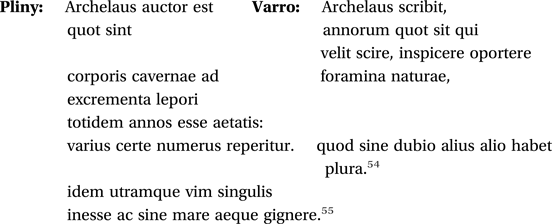
First, although both authors cite Archelaus, Pliny preserves two traditions: (1) rabbit cavernae as equal to age (literally ‘years’ or perhaps ‘cycles’) and (2) rabbit hermaphroditism. Varro preserves only one tradition: Nature's foramina as indicative of age. Varro may even explicitly deny the second tradition when he specifies that both a female and male rabbit are required for reproduction.
Second, the two writers use different expressions to refer to the object that is being counted. Pliny uses cavernae (‘hollows’ or ‘caves’, i.e. indentations not holes). Varro refers to foramina (‘holes’).
Third, Pliny emphasises counting and observing variation among rabbits, whereas Varro explains that some rabbits have more than other rabbits.
3.2.7 Pliny's Use of foramen
Although it is possible that Pliny translates Archelaus from Greek into Latin, it is more likely that he relies on Varro. In this case, he changes foramina to cavernae. Examining occurrences of these two words across Natural History, we see that in all but one instance Pliny uses foramen to refer to holes in a human or animal body, such as ears and nostrils.Footnote 56 In book 11 with reference to cicadas, Pliny uses foramen together with corpus and the prepositional phrase ad excrementa.Footnote 57 This insect, he says, lives on liquid as proven by the fact that it sweats (or possibly vomits, reddunt) only liquid (umor) and possesses no aperture of excretion:
excitatae cum subvolant, umorem reddunt, quod solum argumentumFootnote 58 est rore eas ali; isdem solis nullum ad excrementa corporis foramen. (Nat. 11.32)
When they are disturbed and fly away, they give out moisture, which is the only proof that they live on dew; moreover they are the only creatures that have no aperture for the bodily excreta.
If Pliny's observation first strikes us as false, modern research demonstrates that the fungus Massospora cicadina infects a large percentage of cicadas causing their abdomens to split – literally exploding their back ends off their bodies. The burst does not kill them: they continue to fly around as usual. Pliny's statement implies that he observed or relied on a source attesting an infected cicada post-explosion.Footnote 59
3.2.8 Pliny's Use of caverna
Alternatively, Pliny uses caverna with three primary meanings: (1) human or animal abodes; (2) bodily orifices; and (3) cavities bored in soil or elsewhere.Footnote 60 Since a majority (69%) of the occurrences refer to animal homes, we turn to these references first.
The context of Pliny's discussion is a mouse habitat. Similar to his passage on rabbits, he discusses the best means of capture. For mice, he advises inserting asphodel root into their hole: mures eadem fugantur, caverna praeclusa moriuntur (‘the root keeps away mice, which also die if their holes are closed up with it’, Nat. 22.32).Footnote 61 If, in Pliny's passage on rabbits, corpus can (metonymically) imply animal colony as opposed to animal flesh,Footnote 62 then this evidence on the mouse hole could suggest that, in his passage about rabbits, Pliny uses caverna to refer to a rabbit warren. In this case, ad excrementa could signal Pliny's (or Archelaus’) recognition (accurate) either: (1) that rabbits defecate in their holes and thus, cyclically, dig new ones, or (2) that rabbits give birth in holes, digging a new hole for each new litter. If option 2 were possible then the passage would be coherent: unlike calculating a rabbit's age based on bodily holes for excretion, annual proliferation of warren entrances for each new litter of kits is consistent with Varro's and Pliny's discussion of fecundity.Footnote 63 If Varro understood Archelaus as referring to warrens – perhaps Archelaus used a general expression such as τρύπη that is open to more than one translationFootnote 64 – then Varro's expression ‘foramen of nature’Footnote 65 would not denote a hole in the animal, but a hole in the ground.Footnote 66 Such an interpretation conforms to Varro's mise en scène, namely farmers discussing the benefits of warrens (i.e. how to approximate total warren occupancy of burrow-dwelling animals). Moreover, in the discussion of fattening rabbits (Rust. 3.12), Varro contrasts foramina naturae with a man-made cavi, where rabbits are placed to be fattened up and sold: cum exceptos e leporario condant in caveis et loco clauso faciant pingues.Footnote 67 Both foramina and cavi are used for the breeding and raising of domestic rabbits, but whereas foramen denotes a pen or warren, cavus indicates a hutch.
Elsewhere Pliny uses caverna to refer to one of two enlarged scales beneath the male lizard's tail (sub cauda unam cavernam). Here the expression refers to either of two enlarged plates (either single or divided) posterior to the anus or cloacal region visible on adult male lizards. These are not holes or indentations, but enlarged scales – cosmetic features of the male lizard.Footnote 68 For the present argument, it is important that, in this case, caverna indicates an anatomical feature possibly related, but not identical, to an anus and indicative of the male of the species.
In terms of bodily orifices, in addition to ears, Pliny also uses caverna to refer to the lowest quadrant of a hyena's rectum. Worn around the neck as an amulet, he reports that it caused women to be attracted to men. Like the auditory canal (i.e. external acoustic meatus), here caverna connotes the opening to a constricted space (i.e. anus). Since an opening qua opening cannot be worn, question remains as to what was strung around the neck. The female hyena possesses an enlarged clitoris or pseudopenis capable of erection.Footnote 69 Through it she urinates, has sexual intercourse, and gives birth. This trait gave rise to the legend that hyenas are hermaphroditic (Nat. 8.44, 81).Footnote 70 A desiccated pseudopenis could be used as an amulet.
Scientific literature uses caverna to refer to a variety of body parts.Footnote 71 The metaphor of a cave was not uncommon for the rectum. In a significant majority of references to the anus, Pliny uses either sedes (‘anus’)Footnote 72 or condyloma (‘swelling of the anus’).Footnote 73 When refuting the claim that hyenas are hermaphroditic (i.e. androgynous), Aristotle refers to the reproductive organs of both genders with the ambiguous term αἰδοῖον (‘private parts’).Footnote 74 It is often translated in Latin as pudenda, which Pliny reserves for referring to testicles. Unless Pliny relies on an unknown Latin source for this technical term denoting a hermaphroditic anus, cavernae may imitate Aristotelian usage – comparable to ‘private parts’ and denoting the ambiguous nature of this animal's genitalia.Footnote 75
As noted, Pliny preserves Archelaus’ characterisation of the rabbit as a hermaphrodite. Albeit based on superfetation (rabbit) not an enlarged clitoris (hyena), caverna with reference to genitalia is the same for both animals.Footnote 76 Pliny's translation may even take into account how a hermaphrodite gives birth if ad excrementa – widely attested with reference to any bodily emission – can be extended to include a litter in the case of hermaphrodites, which technically speaking neither conceive nor give birth.Footnote 77
It remains to solve the question of what Pliny means by saying that the cavernae of the rabbit's body accrue annually indicating its age. According to modern veterinary science, the weight of a rabbit's eye lens predicts its age if it is younger than a year.Footnote 78 Certain skull characteristics in young rabbits (under 170 days) and growth lines in the lower jawbones of adult hares and rabbits can also situate these animals in broad age categories. However, these metrics must be obtained from dead specimens, whereas Varro's and Pliny's contexts involve living ones.
Thus far, we have assumed, perhaps correctly, that by annus Pliny refers to a ‘year’. It can, however, indicate a cycle – such as a season or phase of life.Footnote 79 In addition, the referent of numerus in the phrase totidem annos esse aetatis: varius certe numerus reperitur is not specified.Footnote 80 Pliny may wish to communicate that by palpating the hermaphroditic ‘private parts’ (qua womb)Footnote 81 of a rabbit during a late phase of pregnancy the number of kits in its litter (usually between one and four) can be predicted. This is advice that – unlike that about a rabbit's age – clearly relates to the topos of fecundity and may also reflect astral biological assumptions of the type discussed by Plutarch.Footnote 82 This reading admittedly presses hard against the plain senses of the words and phrase, but some level of compromise is necessary given the farcicality of the plain reading.
Summing up, Archelaus preserved two traditions about rabbits. The first most likely conveyed that warren occupancy can be estimated from the number of surface entrances to a burrow (‘holes’). Varro adopts this tradition. The second explains lagomorphic fecundity by hermaphroditism. Varro corrects this tradition, specifying that both male and female rabbits are required for breeding. Pliny borrows both traditions, modifying (or misunderstanding) the former based on the latter and thus interpreting what were originally burrow openings as the ‘private parts’ of a hermaphrodite.
3.2.9 Barn. 10.6
It is impossible to know whether Barnabas relied on Archelaus or Varro directly or through Pliny for his information. Intermediate texts and collections (i.e. Jewish) beyond those mentioned are also possible. That said, on the following four points, Barnabas’ version appears to know a stream of tradition closer to Pliny than Varro.
(1) The fact that Varro passes over the hermaphroditic tradition and Pliny adopts it (for both hyenas and rabbits) suggests Barnabas’ reliance on Pliny or a tradition close to Pliny.Footnote 83
(2) Whereas Varro allows the context to dictate the subject, Pliny and Barnabas explicitly denote rabbits (lepus, λαγωός).
(3) Ἀφόδευσις may derive from ad excrementa.Footnote 84 By this phrase Pliny may have indicated hermaphroditic parturition vis-à-vis the hyena. Nevertheless, Barnabas took it to indicate excrement. Varro does not mention an excretory function of the foramina.
(4) Κατ᾿ ἐνιαυτὸν πλεονεκτεῖ (Barn. 10.6), together with the epexegetical phrase's denotation of life (i.e. ὅσα γὰρ ἔτη ζῇ, τοσαύτας ἔχει τρύπας), resembles quot sint corporis cavernae … totidemannos esse aetatis (Pliny) slightly better than annorum quot sit (Varro).
Barnabas’ interpretation of the hare as a παιδοφθόρος is not explained by either tradition. However, giving birth in dens may have given the impression that mother rabbits bury (i.e. kill) their young. Each day when a mother rabbit leaves the den she seals off the entrances to prevent predators from entering. When she returns to nurse the newborns, she reopens the entrance. To the outside observer, this too gives the impression that she is burying her kits alive. This tradition is attested in the Middle Ages.Footnote 85 What Barnabas had in mind by qualifying rabbits as ‘child-slayers’ goes beyond the scope of this essay although it should be mentioned that ἀφόδευσις and τρύπημα are both attested as sexual slang (‘anal sex’ and ‘cunt’ respectively).Footnote 86 As noted above, Barnabas’ usage may be influenced by subsequent moral castigations in 10.7, 8. Nevertheless, Clement of Alexandria's view that παιδοφθόρος refers to pederasty should not limit the investigation of alternatives.Footnote 87
3.2.10 Rabbits in Egypt
Finally, if, as many presume, Barnabas’ context is Egyptian, interest in the taxonomic order Lagomorpha may have a few additional implications. The Egyptian word for rabbit (un) means ‘opening’ or ‘the opener’, indicating that hares are born with their eyes open.Footnote 88 This word also refers to a woman's menstrual cycle. As ‘openers’ hares symbolise both life and afterlife. The goddess Wenet/Wenut (transliteration is usually wnw.t) is a minor regional deity about whom not much is known. She is associated with the 15th Upper Egyptian nome – literally the Hare Nome.Footnote 89 The root of the word ‘hare’ is wn. Because of this, the consonant group wn is written with a hare- or rabbit-shaped hieroglyph in unrelated words as well. In Wenut's name the first sign is the wn-bunny followed by some phonetic complements plus the feminine ending plus the snake determinative signalling that she is a goddess. One of the verbs meaning ‘to open’ in Egyptian is also wn. It is probably unrelated to wn (‘hare’) and presumably the two words were vocalised differently, but it is written with the wn-bunny as well.Footnote 90
It is unclear whether Wenut was originally conceived of as a hare-headed goddess. Whether her name was originally meant to signify ‘hare’ or ‘opener’ or something about ‘existence’ (the verb, ‘to exist’, is also wn written with the same sign) is likewise uncertain. However, it may not really matter because the Egyptians loved their puns, especially in religious contexts. It is very common for hymns and temple inscriptions to tie together phonetically and/or orthographically similar words in significant ways. I am not aware of any Coptic text about Wenut, and would be surprised if there were any, since as a deity she is minor and localised, but it is possible that one might find a name containing a form of Wenut in Coptic or in Greek texts from the Hermopolis area.Footnote 91
4. Conclusion
The Epistle of Barnabas (10.6) alludes to a tradition attested in Pliny and Varro of the rabbit's cyclical acquisition of a hole. Commentators allow Clement of Alexandria's interpretation of Barnabas’ moralisation of this tradition as pederasty to guide understanding of this passage.Footnote 92 Varro and Pliny cite Archelaus as their source. Archelaus probably discussed rabbit superfetation together with its widespread hermaphroditic explanation. Varro adopted the information about superfetation, but rejected hare hermaphroditism. Pliny accepted both traditions with modifications. A dearth of Latin agricultural terminology, a plethora of Latin sexual vocabulary and the conundrum of the hermaphroditic anatomy frustrate a clear solution. If Barnabas’ context is Egyptian, his interpretation may be further complicated by a connection to Ut-Wenet, the goddess of ‘openings’.
A few overarching observations may be drawn from this study. First, texts of the ancient natural historians are extremely difficult to translate with security. Second, scholars have a tendency to allow the sexiest (often homosexual) interpretations of the most opinionated authors to guide the understanding of a wide variety of texts, to the peril of sound historical interpretation. Third, it remains an open question what Barnabas imagines that possessing multiple holes has to do with destroying children. Finally, Clement of Alexandria's opinions on hares may constitute an outlier. Other ancient sources are resoundingly positive. In the redactio secunda (Physiologus), the hare is an example for Christians to follow in its tendency to run uphill to avoid hunters (cf. Aelian, Nat. an. 13.14). It is entirely within the realm of possibility that the original Epistle of Barnabas intended something different from what later redactions of the letter, Clement and later Christian writers assume.


