Introduction
The number of people being classified as obese or overweight has doubled in the past 20 years in the United States, encompassing almost two-thirds of the adult population (NCHS, 2006), rendering it the fifth leading cause of mortality worldwide (World Health Organization, 2009). Despite concerted governmental efforts to combat obesity in the United States (Khan et al., Reference Khan, Sobush, Keener, Goodman, Lowry and Kakietek2009), prevalence remains high (Ogden, Carroll, Kit, & Flegal, Reference Ogden, Carroll, Kit and Flegal2014). Obesity contributes to the manifestation of several adverse health outcomes, including diabetes, cardiovascular and gall bladder diseases, cancer, and overall mortality (Kopelman, Reference Kopelman2000). Recent evidence has shown similar adverse effects of obesity on the brain (Gustafson et al., 2004). Being classified as obese is linked to increased risk of dementia (Gustafson et al., 2003) and poorer performance on cognitive tasks (Stingl et al., Reference Stingl, Kullman, Ketterer, Heni, Haring, Fritsche and Preissl2012), particularly tasks that evaluate executive function (Elias, Elias, Sullivan, Wolf, & D’Agostino, Reference Elias, Elias, Sullivan, Wolf and D’Agostino2003; Waldstein et al., 2006).
Executive function is an umbrella term that refers to a cluster of functions such as planning, working memory, processing speed, mental flexibility, and the initiation or monitoring of action (Lezak, Howieson, Loring, Hannay, & Fischer, Reference Lezak, Howieson, Loring, Hannay and Fischer2004). Data from the Framingham Heart Study highlight deficits in working memory and verbal fluency in obese middle-aged and older men (Elias et al., Reference Elias, Elias, Sullivan, Wolf and D’Agostino2003). The combination of obesity and hypertension is associated with poorer performance on the Stroop interference test (Waldstein et al., 2006). In children and adolescents, obesity is linked to poorer mental flexibility by Cserjesi, Molnar, Luminet, & Lenard (Reference Cserjesi, Molnar, Luminet and Lenard2007) and complex attention, mental flexibility, and disinhibition by Lokken, Boeka, Austin, Gunstad, & Harmon (Reference Lokken, Boeka, Austin, Gunstad and Harmon2009). However, the mechanisms that lead to this cognitive decline are poorly understood. As dementia treatments are limited at present, and no cures are available, it is crucial to identify the mechanisms underlying this relationship so that targeted preventative measures may be developed and launched.
The distribution of adipose tissue appears to selectively impact cognitive function (Cereda, Sansone, Meola, & Malavazos, 2012). In particular, abdominal adiposity is a more salient predictor of cognitive decline and dementia compared with whole-body adiposity as assessed by body mass index (BMI) (Cereda et al., Reference Cereda, Sansone, Meola and Malavazos2007; Kanaya et al., Reference Kanaya, Lindquist, Harris, Launer, Rosano, Satterfield and Yaffe2009; Kerwin et al., Reference Kerwin, Gaussoin, Chlebowski, Kuller, Vitolins and Coker2011). Higher levels of abdominal fat have been correlated with insulin resistance (Raji, Seely, Arky, & Simonson, Reference Raji, Seely, Arky and Simonson2001), a phenomenon that has been shown to affect cerebral glucose metabolism (Doyle, Cusin, Rohner-Jeanrenaud, & Jeanrenaud, Reference Doyle, Cusin, Rohner-Jeanrenaud and Jeanrenaud1995), and mediate the inverse relationship between BMI and working memory-related functional activation (Gonzales et al., Reference Gonzales, Tarumi, Miles, Tanaka, Shah and Haley2010). Insulin resistance is also positively correlated with levels of circulating brain-derived neurotropic factor (BDNF) (Levinger et al., Reference Levinger, Goodman, Matthews, Hare, Jerums, Garnham and Selig2008), a key neurotrophin crucial for neuronal regeneration and survival (Mattson, Maudsley, & Martin, Reference Mattson, Maudsley and Martin2004). Infusion of BDNF into the lateral ventricles of diabetic mice normalizes glucose regulation (Nakagawa et al., Reference Nakagawa, Ono-Kishino, Sugaru, Yamanaka, Taiji and Noguchi2002). Mouse models have also depicted higher levels of obesity and hyperactivity as a result of conditional deletion of BDNF in the brain (Kernie, Leibl, & Parada, Reference Kernie, Leibl and Parada2000; Rios et al., Reference Rios, Fan, Fekete, Kelly, Bates, Kuehn and Jaenisch2001). There is thus a plausible link between the BDNF and insulin regulation mechanisms, and central adiposity could cause disruption in BDNF production and distribution in the central nervous system.
BDNF has been consistently linked to brain health. BDNF is found in high levels in hippocampal pyramidal cells (Gall & Lauterborn, Reference Gall and Lauterborn1992; Lang et al., Reference Lang, Gunther, Scheuch, Klein, Eckhart, Hellweg and Oehler2009). Furthermore, treatment with BDNF enhances hippocampal long-term potentiation in BDNF knockout mice (Patterson et al., Reference Patterson, Abel, Deuel, Martin, Rose and Kandel1996). Postmortem research has revealed reduced BDNF levels in the hippocampi of donors with diagnosed Alzheimer’s disease (Phillips et al., Reference Phillips, Hains, Armanini, Laramee, Johnson and Winslow1991). Exercise also induces increases in BDNF mRNA expression in rat hippocampi (Oliff, Berchstold, Isackson, & Cotman, Reference Oliff, Berchstold, Isackson and Cotman1998) and hippocampal volume in older adults (Erickson et al., Reference Erickson, Voss, Prakash, Basak, Szabo, Chaddock and Kramer2011). Recent work by Beckinschtein et al. highlights the importance of hippocampal BDNF for long-term memory storage by transforming a non-lasting long-term memory trace into a persistent one (Bekinschtein, Cammarota, Igaz, et al., Reference Bekinschtein, Cammarota, Igaz, Bevilaqua, Izquierdo and Medina2007; Bekinschtein, Cammarota, Katche, et al., 2007).
In addition to the documented effects of BDNF on hippocampal function and memory, BDNF is also associated with poorer performance in executive function tasks. Serum BDNF levels mediate the positive effects of exercise interventions on task switching in older adults (Leckie et al., Reference Leckie, Oberlin, Voss, Prakash, Szabo-Reed and Erickson2014). Presence of the Met allele in the val66met polymorphism, a genetic marker linked with lower levels of peripheral and cortical BDNF (Chen et al., Reference Chen, Patel, Sant, Meng, Teng, Hempstead and Lee2004; Ozan, Okur, Eker, Gonul, & Akarsu, Reference Ozan, Okur, Eker, Gonul and Akarsu2010), is associated with poorer performance on tasks of processing speed (Miyajima et al., Reference Miyajima, Ollier, Mayes, Jackson, Thacker, Rabbitt and Payton2008) in older adults and higher levels of perseverative responses on the Wisconsin Card Sorting Test (Marques-Iturra et al., Reference Marques-Iturra, Garolera, Pueyo, Segura, Hernan, Garcia-Garcia and Jurado2014) in participants aged between 12 and 40 years.
However, some researchers have reported no relationship between serum BDNF and genetic risk in patients with prodromal Alzheimer’s disease (Langbaum et al., Reference Langbaum, Chen, Launer, Fleisher, Lee, Liu and Reiman2012). Furthermore, the literature on the relationship between genetic risk for low BDNF and executive function has been inconsistent, with recent meta-analytic work showing no effect of the polymorphism on most measures of cognition (Mandelman & Grigorenko, Reference Mandelman and Grigorenko2012). It would thus be necessary to use a direct measure of BDNF to examine the relationship between adiposity driven low BDNF and executive function. However, to our best knowledge, no studies have directly addressed this hypothesis. As BDNF levels can be modified through dietary restriction (Duan, Lee, Guo, & Mattson, Reference Duan, Lee, Guo and Mattson2001) and regular exercise (Wrann et al., Reference Wrann, White, Salogiannis, Laznik-Bogoslavski, Wu, Ma and Spiegelman2013), it is vital to tease out the impact of BDNF on central nervous system functioning before neurodegeneration. This knowledge could promote the development of targeted interventions involving BDNF infusion and incorporation of non-pharmacological interventions that increase BDNF into existing cognitive rehabilitation programs.
In the present study, we used a ratio of waist circumference to hip circumference (WHR) as a proxy for central adiposity. The Framingham Heart Study revealed that individuals with high central obesity performed poorly the Trail Making Test, Part B, a measure of cognitive flexibility, switching, and working memory. Others have also highlighted a relationship between high visceral fat and poorer executive function (Schwartz et al., Reference Schwartz, Leonard, Perron, Richer, Syme, Veillette and Paus2013). Previous work has highlighted a relationship between circulating BDNF and performance on several executive function tasks, such as task switching (Leckie et al., Reference Leckie, Oberlin, Voss, Prakash, Szabo-Reed and Erickson2014) and perseveration (Marques-Iturra et al., Reference Marques-Iturra, Garolera, Pueyo, Segura, Hernan, Garcia-Garcia and Jurado2014).
Based on the above literature, we hypothesized that individuals with higher abdominal adiposity would demonstrate poorer performance on cognitive tests that evaluate different aspects of executive function. We further hypothesized that these relationships would be accounted for (statistically mediated by) by serum levels of BDNF. A successful statistical mediation would suggest that central adiposity-related declines in executive functioning occur primarily in the context of lower levels of circulating BDNF.
Materials and Methods
Sixty-one adults between the ages of 40 and 60 years were recruited from the community through electronic and print advertisements. All potential participants underwent a telephone screening carried out by trained research assistants and completed a medical history questionnaire to establish eligibility. Exclusionary criteria (Gonzales et al., Reference Gonzales, Tarumi, Kaur, Nualnim, Fallow, Pyron and Haley2013) included a positive medical history for overt coronary artery disease, neurological disease (e.g., stroke, Parkinson’s disease, clinically significant traumatic brain injury), major psychiatric illness (e.g., schizophrenia, bipolar disorder), and substance abuse (i.e., diagnosed abuse and/or previous hospitalization for substance abuse). All participants were nonsmokers. Participants who passed the initial screen were enrolled in the study after providing written consent. The ethnic distribution of the participants was 82.0% Caucasian, 6.6% Hispanic, 4.9% African-American, and 6.5% Other/Did Not Specify.
Procedures
This study was conducted in accordance with the Helsinki Declaration and with approval from the local Institutional Review Board. All volunteers provided written informed consent before enrollment. Participants underwent three separate study visits: a general health assessment, a neuropsychological assessment, and a cardiorespiratory fitness assessment.
General Health Assessment
Participants abstained from caffeine and exercise for at least 24 hr and fasted for at least 4 hr before assessment. Waist circumference was measured at the midpoint between the iliac crest and lower rib during exhalation as recommended by the World Health Organization (World Health Organization, 2008). Hip circumference was measured at the broadest portion around the buttocks. Brachial systolic and diastolic blood pressure was assessed with a semi-automated device (VP – 1000plus, Omron Healthcare, Bannockburn, IL) after 15 min of rest. A fasting blood sample was also collected from the antecubital vein by venipuncture. Serum was separated within 2 hr of the collection, and aliquots were stored at −80°C until later analysis. Fasting levels of glucose, total cholesterol, and triglycerides were measured using the standard enzymatic techniques. Serum concentration of BDNF was measured using high sensitivity enzyme linked immunosorbent assays (ELISA kits, R&D Systems Inc., Minneapolis, MN).
Neuropsychological Assessment
Participants completed a battery of standard clinical neuropsychological assessments with established reliability and validity (Lezak et al., Reference Lezak, Howieson, Loring, Hannay and Fischer2004), details of which have been described elsewhere (Gonzales et al., Reference Gonzales, Tarumi, Kaur, Nualnim, Fallow, Pyron and Haley2013). Based on published literature linking obesity (Schwartz et al., Reference Schwartz, Leonard, Perron, Richer, Syme, Veillette and Paus2013) and BDNF (Leckie et al., Reference Leckie, Oberlin, Voss, Prakash, Szabo-Reed and Erickson2014; Marques-Iturra et al., Reference Marques-Iturra, Garolera, Pueyo, Segura, Hernan, Garcia-Garcia and Jurado2014) to executive function decline, several tests that tap specific domains of executive function were selected for this analysis: Trail Making Test (TMT) Part B time to completion, corrected for processing speed by subtracting time to completion for TMT Part A (Reitan, Reference Reitan1958), a measure of working memory, cognitive flexibility, and set shifting; Controlled Oral Word Associations test (COWA) (Ruff, Light, Parker, & Levin, Reference Ruff, Light, Parker and Levin1996), a measure of verbal fluency; and Wechsler Adult Intelligence Scale III Digit Span Forward and Backward Subtests (Weschler, Reference Weschler1997), measures of working memory and attention. Global cognitive function was screened using the Wechsler Test of Adult Reading and the Mini-Mental State Examination (Lezak et al., Reference Lezak, Howieson, Loring, Hannay and Fischer2004).
Cardiorespiratory Fitness Assessment
Participants abstained from caffeine and physical exercise for 24 hr and fasted for at least 12 hr before the visit. Maximal oxygen consumption (VO2 max) was assessed with a graded treadmill exercise test during a modified Bruce protocol. Following a 5-min warm-up period, participants ran or walked at a speed that corresponded to 60–70% of their age-predicted maximal heart rate. The treadmill slope was increased 2% every 2 min until volitional exhaustion. Oxygen consumption (indirect calorimetry via respiratory gas measurements; Physio-Dyne, Quogue, NY) and heart rate were measured throughout the protocol. At the end of each 2-min stage, participants rated their perceived exertion using the original Borg scale (Borg, Reference Borg1982).
Statistical Analyses
Statistical analyses were conducted in three steps: first, associations between WHR and performance on each executive function test were examined using linear regressions. Clinically relevant covariates (age, years of education, systolic and diastolic blood pressure, total concentrations of glucose, total cholesterol, and cardiovascular fitness) were included in these analyses because of their published relationships with obesity (Alberti et al., Reference Alberti, Eckel, Grundy, Zimmet, Cleeman, Donato and Smith2009) and brain health (Gonzales et al., Reference Gonzales, Tarumi, Kaur, Nualnim, Fallow, Pyron and Haley2013; Haley et al., Reference Haley, Gonzales, Tarumi, Miles, Goudarzi and Tanaka2010). To control for multiple comparisons, a Sidak-adjusted two-tailed α-level of 0.01 was used (Sidak, Reference Sidak1967) here. Associations between performance on the one executive function test with significant adiposity effects (COWA) and serum BDNF levels were then assessed using linear regression. Finally, a mediation analysis was performed to test if the association between central adiposity and performance on the COWA is attenuated when considering the role of serum BDNF. For the single mediation analysis, a less conservative α-level of 0.05 was used.
Mediation was assessed using both the traditional causal steps approach and non-parametric bootstrapping procedures (Preacher & Hayes, Reference Preacher and Hayes2004). The causal steps approach posits that four conditions must be met to determine mediation: (1) a significant relationship between the independent variable (WHR) and the dependent variable (executive function), (2) a significant relationship between the independent variable and the potential mediator (BDNF), (3) a significant relationship between the potential mediator and the dependent variable, and (4) a non-significant relationship between the independent variable and the dependent variable after controlling for the potential mediator. While traditional causal steps are a parsimonious method for examining statistical mediation, it is no longer deemed necessary to establish indirect effects (Hayes, Reference Hayes2009). An additional assessment on the significance of the mediation model was conducted by using confidence intervals obtained through Preacher and Hayes bootstrapping method for assessing indirect effects (Preacher & Hayes, Reference Preacher and Hayes2004). A 95% confidence interval that does not include 0 was used as the criterion for significance. All statistical analyses were carried out using IBM SPSS 22.0 software (SPSS Inc.). We further performed secondary analyses assessing the effects of WHR and BDNF on memory [as assessed by long delay free recall score on the California Verbal Learning Test (CVLT-II)].
Results
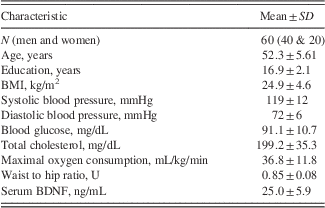
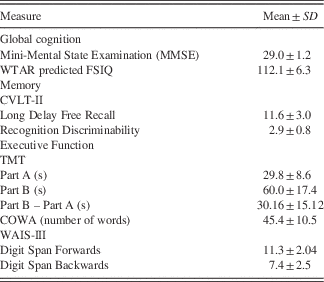
Mean values for demographic and physiological characteristics as well as standard deviations are presented in Table 1. Table 2 presents all raw neuropsychological test scores. Descriptive statistics revealed a highly educated and cognitively intact sample (mean education=16.87 years; SD=2.1); mean estimated Full Scale Intelligence Quotient=112.11; SD=6.25). Participants had a mean WHR of 0.848 (SD 0.076) and mean serum BDNF of 24.99 ng/mL (SD 5.91).
Selected demographic and physiological characteristics

BMI=body mass index; BDNF=brain-derived neurotrophic factor.
Raw scores on neuropsychological assessment measures

MMSE=Mini-Mental State Examination; WTAR=Wechsler Test of Adult Reading; FSIQ=Full Scale Intelligence Quotient; CVLT=California Verbal Learning Test II; TMT=Trail Making Test; COWA=Controlled Oral Word Association; WAIS=Wechsler Adult Intelligence Scale III.
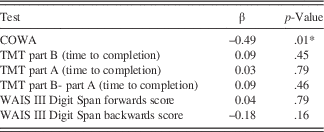
Linear regression models examining the association between WHR and scores on each executive function neuropsychological test were completed, with age, years of education, systolic and diastolic blood pressure, blood concentrations of glucose and total cholesterol, and cardiovascular fitness entered as covariates. Higher WHR was only significantly associated with poorer performance on the COWA (β=−0.55; R2=0.25; p=.001). WHR was not significantly associated with corrected time to completion on Trails B (β=0.09; p=.47) as well as performance on Digit Span forward and backward (β=0.04; p=.79 for digits forward, & β=−0.18, p=.16 for digits backward). These results are depicted in Table 3.
Linear regression statistics for waist to hip ratio and executive function measures

Note. Asterisks indicate values that are statistically significant at the Sidak-adjusted two-tailed α-level of 0.01.
COWA=Controlled Oral Word Association; TMT=Trail Making Test; WAIS=Wechsler Adult Intelligence Scale.
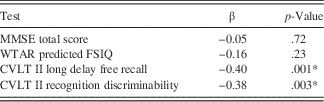
As a secondary analysis, we also looked at the relationships between WHR and performance on all other cognitive tests. These results are presented in Table 4. WHR was also significantly associated with memory performance after a 20-min delay (β=−0.40; R2=0.15; p=.001). As age (t=1.46; p=0.15), education (t=1.22; p=.22), systolic blood pressure (t=1.03; p=.31), diastolic blood pressure (t=−0.75; p=.45), total cholesterol (t=0.34; p=.73), and cardiorespiratory fitness, as measured by maximal oxygen consumption (t=−0.31; p=.76) were not significantly associated with performance on the COWA, these variables were not included in subsequent analyses.
Linear regression statistics for waist to hip ratio WHR and cognitive measures.

Note. Asterisks indicate values that are statistically significant at the Sidak-adjusted two-tailed α-level of 0.01.
MMSE=Mini-Mental State Examination; WTAR=Wechsler Test of Adult Reading; CVLT=California Verbal Learning Test.
Blood glucose concentration was significantly linked with better performance on the COWA (t=2.16; p=.036). However, because this association did not survive correction for multiple comparisons (Sidak, Reference Sidak1967), it was also excluded from subsequent analyses. None of the covariates were significantly correlated with BDNF (r=−0.01, p=.94 for systolic blood pressure; r=−0.02, p=.84 for diastolic blood pressure; r=0.03, p=.82 for total cholesterol; r=−0.02, p=.87 for fasting blood glucose; r=−0.21, p=.13 for cardiorespiratory fitness; r=−0.06, p=.67 for years of education; and r=−0.16, p=.23 for age).
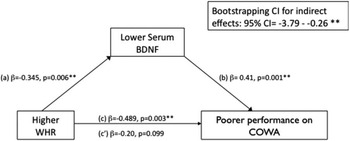
Higher WHR was significantly associated with lower levels of serum BDNF (β=−0.345; R2=0.12; p=.006). Lower levels of serum BDNF successfully predicted poorer scores on the COWA (β=0.41; R2=0.17; p=.001). However, lower levels of serum BDNF did not predict poorer performance on the CVLT-II long delay free recall and recognition discriminability subtests (ps>.05). The relationship between higher WHR and poorer performance on the COWA was completely attenuated when serum BDNF was included in the model (β=−0.20; p=.099), thus fulfilling the requirements of Baron & Kenny’s traditional causal steps approach for statistical mediation (Baron & Kenny, Reference Baron and Kenny1986). The results of these analyses are depicted in Figure 1. The significance of the mediation model was further confirmed by the 95% confidence interval range (−3.79, −0.26), derived by the Preacher and Hayes bootstrapping procedure for detecting indirect effects (Preacher & Hayes, Reference Preacher and Hayes2004).
Multiple linear regression analyses for full statistical mediation model.

Discussion
To our knowledge, this is the first study to highlight BDNF as a possible mediator for the relationship between abdominal adiposity and a classic executive function task. Functional magnetic resonance imaging research on cognitively intact young adults has revealed significant deactivation in the posterior cingulate gyrus during a verbal fluency task (Schlosser et al., Reference Schlosser, Hutchinson, Joseffer, Rusinek, Saarimaki, Stevenson and Brodie1998). Interestingly, we have recently reported changes in cortical thickness in the same region among middle-aged adults with high visceral fat (Kaur et al., 2015). Verbal fluency performance has also been consistently linked with cardiovascular risk factors (Brady, Spiro, McGlinchey-Berroth, Milberg, & Gaziano, Reference Brady, Spiro, McGlinchey-Berroth, Milberg and Gaziano2001), and in cases of post-stroke cognitive decline and vascular dementia, verbal fluency is disproportionately impaired compared with other cognitive functions such as memory (Lafosse et al., Reference Lafosse, Reed, Mungas, Sterling, Wahbeh and Jagust1997; Starkstein et al., Reference Starkstein, Sabe, Vazquez, Teson, Petracca, Chemerinski and Leiguarda1996; Wolfe, Linn, Babikian, & Albert, Reference Wolfe, Linn, Babikian and Albert1990).
Verbal fluency thus appears to be an area of executive functioning uniquely burdened by high cardiovascular risk. Individuals with high central adiposity also tend to have significantly higher risk of cardiovascular events such as coronary heart attacks, stroke, and mortality caused by cardiovascular events (Kannel et al., Reference Kannel, Cupples, Ramaswami, Stokes, Kreger and Higgins1991; Ritchie, & Connell, Reference Ritchie and Connell2007). It is thus possible that high central adiposity drives cardiovascular disease induced declines in verbal fluency that lead to more generalized cognitive impairment. Direct examination of this is, however, beyond the scope of this study.
Based on our results, the BDNF pathway is a plausible mechanism through which abdominal adiposity impinges upon the cognitive function. BDNF stimulates cell differentiation and proliferation by reducing inhibitor proteins and increasing the expression of neuronal nitric oxide synthase (nNOS) in adult mice (Cheng, Wang, Cai, Rao, & Mattson, Reference Cheng, Wang, Cai, Rao and Mattson2003). Examination of cell cultures of rat embryonic neurons deprived of BDNF reveals increases in nNOS and motor neuron apoptosis (Estevez et al., Reference Estevez, Spear, Manuel, Radi, Henderson and Beckman1998). In addition, BDNF infusion has resulted in neurogenesis in mouse hippocampi (Rossi et al., Reference Rossi, Angelucci, Constantin, Brashi, Mazzantini, Babbini and Caleo2006) as well as improvements in long-term memory in mice (Bekinschtein, Cammarota, Katche, et al., Reference Bekinschtein, Cammarota, Igaz, Bevilaqua, Izquierdo and Medina2007), thus further highlighting BDNF as a credible target for intervention.
However, small studies involving BDNF infusion in humans with neurologic conditions such as Parkinson’s disease and amyotrophic lateral sclerosis have not reported significant effects on cognition thus far (Kordower, Palfi, Chen, & Shuang, Reference Kordower, Palfi, Chen and Shuang2001; Ochs et al., Reference Ochs, Penn, York, Giess, Beck, Tonn and Toyka2000). Thus, BDNF is likely to act in synergy with other disease states in humans and the interaction between BDNF and adiposity hormones likely drives the results of our study.
BDNF can also act on central nervous system functioning through N-methyl-d-aspartate (NMDA) receptors. BDNF infusion induces NMDA-dependent long-term potentiation in the insular cortices of adult mice (Escobar, Figuera-Guzman, & Gomez-Palacio-Schjetnan, et al., Reference Escobar, Figuera-Guzman and Gomez-Palacio-Schjetnan2003). The NMDA receptor is the primary molecular device for controlling synaptic plasticity as well as a variety of neurocognitive declines, including verbal fluency (Krystal et al., Reference Krystal, Karper, Seibyl, Freeman, Delaney, Bremner and Charney1994). Thus, BDNF could have a significant effect on cortical activity by acting on NMDA receptors in the left prefrontal cortex, resulting in higher performance on verbal fluency.
A critical next step would be to determine the moderators of BDNF expression in the central nervous system to develop useful targeted interventions. In addition to abdominal adiposity, BDNF levels are modulated by acute and chronic stress (Murakami, Imbe, Morikawa, Kubo, & Senba, Reference Murakami, Imbe, Morikawa, Kubo and Senba2005). Pharmacological interventions aimed at acute stress reduction such as sertraline increased BDNF levels and promoted neurogenesis in Huntington’s disease mouse models (Peng et al., Reference Peng, Masuda, Jiang, Li, Zhao, Ross and Suan2007). Furthermore, chronic stress is associated with higher levels of oxidative stress (Aschbacher et al., Reference Aschbacher, O’Donovan, Wolkowitz, Dhabhar, Su and Epel2013), which interacts with BDNF to ameliorate the deleterious cognitive effects of high fat diet in mice (Wu, Ying, & Gomez-Pinilla, Reference Wu, Ying and Gomez-Pinilla2004). Direct examination of stress-related brain vulnerability mechanisms is beyond the scope of the current study but would be a critical next step in understanding how BDNF affects cognitive function in humans.
The main limitation of this study was the small sample size (N=61), which limited the number and types of analyses. Larger sample sizes would allow us to examine the possible synergistic effects of stress, insulin resistance, and BDNF on cognitive function via moderated mediation or mixed models. The reported effect represents the effect of a statistical mediation procedure and may not be indicative of cause and effect. While higher levels of BDNF may be responsible for better performance on the COWA, it is also possible that both may be driven by genetic factors or developmental factors not examined in the present study. Confidence in the reported mechanism can be gained through longitudinal studies where temporal precedence between elevated BDNF levels and improvement in performance on the COWA can be clearly established. Furthermore, our sample consisted of relatively healthy individuals, with a mean BMI of 24.9. It is possible that including more overweight or obese individuals would lead to stronger cognitive effects seen across a larger variety of measures.
In summary, higher central adiposity significantly predicted poorer performance on the COWA, a measure of verbal fluency. Higher central adiposity was also linked to significantly lower levels of circulating BDNF. Finally, circulating BDNF significantly mediated the relationship between central adiposity and cognitive performance on the COWA. Despite the above-mentioned limitations, this study is a crucial first step in directly identifying a mechanistic pathway through which central adiposity uniquely impinges upon central nervous system functioning.
Acknowledgments
This work was made possible by funding provided by the National Institute of Neurological Disorders and Stroke (R01 NS075565, APH), the American Heart Association (09BGIA2060722, APH), the American Federation for Aging research (8A0024, APH), and the National Institute on Aging (F31AG040890, MMG). The authors declare no conflict of interest.