In-hospital patient tracking during major incident responses is a huge challenge. During disasters, pre-hospital registration of patients is often limited because of the high workload and chaos at the scene. Therefore, hospital disaster plans should focus on optimizing in-hospital patient registration. Most current victim-tracking systems focus on the pre-hospital response, and experience has shown that patients are often untraceable for significant periods, even after they have been admitted to a hospital. This was emphasized during a plane crash in the Netherlands, where it took 4 days to locate 136 victims because of insufficient patient registration, both pre-hospital and in-hospital.Reference Postma, Winkelhagen and Bloemers 1
The development of the Patient Barcode Registration System (PBRS) started in 1993 in the Major Incident Hospital (MIH) of the University Medical Centre Utrecht (UMC Utrecht), the Netherlands, with the aim of improving patient registration during major incidents.Reference Noordergraaf, Bouman and van den Brink 2 The MIH was constructed in 1991 as part of a civil–military cooperative effort. It is a highly prepared, standby, 200-bed buffer hospital for the Dutch health care system that can be deployed within 30 minutes of a major incident or disaster, as described elsewhere.Reference Marres, Bemelman and van der Eijk 3 , Reference Marres, van der Eijk and Bemelman 4 The PBRS was created to optimize the in-hospital disaster response and patient registration. It uses wristbands with barcodes to register and follow patients from the ambulance hall to their final destination. Over the last 20 years the PBRS has proven its value, although the initial version lacked the speed needed to register high numbers of casualties.Reference Bouman, Schouwerwou and Van der Eijk 5 An entirely redesigned version, with new features, was developed in 2014 to match the system to current information technology standards. This article describes the ongoing development of the PBRS, including the results of a feasibility and usability test during a large trauma exercise, and the lessons learned.
METHODS
The MIH was constructed in 1991 in a nuclear shelter under UMC Utrecht. The hospital aims to provide immediate medical emergency care for multiple casualties under exceptional circumstances. This unique facility is strictly reserved for and dedicated to mass casualty care, with the expertise and complete infrastructure to provide large-scale emergency care following disasters and major incidents.Reference Marres, Bemelman and van der Eijk 3
Deployment of the MIH takes place after 5 possible scenarios:
-
1. War (threat), crisis, or conflict management in which large numbers of casualties are in need of care.
-
2. Accidents abroad involving Dutch citizens, civilian or military, in need of repatriation and medical care.
-
3. Specific incidents, attacks, or large-scale accidents in the Netherlands that exceed the regular care capacity.
-
4. International incidents, in which medical assistance is provided by the Dutch government for the treatment of foreign victims.
-
5. Quarantine care for patients with special infectious and highly contagious diseases, such as severe acute respiratory syndrome or viral hemorrhagic fevers such as the Ebola virus.
The MIH deployment procedure is an essential part of the disaster plan of UMC Utrecht and the Central Military Hospital. An emergency response protocol enables up to 100 patients to be admitted to the normally standby hospital after a start-up time of only 15 minutes. With an additional 45 minutes the capacity can be extended to 200 patients, and up to 300 patients can be admitted after 24 hours. Personnel are alerted through a personnel alert system. The organization, infrastructure, and training are all directed around triage to guide patient flow through successive echelons of care in order to deliver the greatest care to the greatest number of people.Reference Marres, Bemelman and van der Eijk 3
The PBRS was developed to optimize patient tracking and tracing during deployment of the MIH. The PBRS functions as an addition to a handwritten or digital hospital information system. It enables quick registration and tracking of patients during the acute phase of an emergency with high patient surge. Development of the PBRS started during 1993, using the dBase database system (dBase LLC, Binghamton, NY). The second version of the PBRS, developed in 2000, used a Microsoft Access database system (Microsoft, Redmond, WA), which limited the number of systems that could be used and the number of users that could simultaneously access the database.Reference Noordergraaf, Bouman and van den Brink 2 , Reference Bouman, Schouwerwou and Van der Eijk 5 The 2014 PBRS was built using the Delphi program language with an SQL server (International Business Machines Corp, Armonk, NY) in the background. The database and the server application can be located on separate devices, and the system has a two-tier architecture.
Barcodes conforming to the GS1-128 (formerly EAN-128) code system (Anonymous, 1996) are used to process data. GS1 Netherlands (GS1 Netherlands, Amstelveen, the Netherlands; formerly EAN Netherlands) participates in GS1, a nonpolitical, not-for-profit, international organization that develops and maintains standards for supply and demand chains across multiple sectors. Barcodes were chosen because of the system’s simplicity, which is the key to success in disaster management.Reference Lennquist 6 Barcodes are easy, quick, and accurate to use; are low-cost; and can be entered manually in case of hardware malfunction.Reference Noordergraaf, Bouman and van den Brink 2 , Reference Bouman, Schouwerwou and Van der Eijk 5 , Reference Marres, Taal and Bemelman 7
When patients arrive at the ambulance hall of the MIH, they receive a wristband with a unique barcode corresponding to a dedicated patient number in the hospital information system. Subsequently, the patient is triaged by the triage doctor and given a triage code and next destination. This can either be the trauma bay for red priority-one and yellow priority-two patients or the low-care ward for green priority-three patients; deceased patients go to the temporary morgue.
Patients’ wristbands are scanned by an administrative officer, followed by the scanning of triage codes and destination codes. The process consists of 5 steps and takes 15 s per patient. At the first scanning station, photos of the patient are taken from 4 different angles for identification purposes. Upon patient arrival in a trauma bay or ward, administrative officers check in the patient again; when leaving a department, the patient is checked out and the next destination is scanned. Patients who arrive at the ward are checked in at a bed location. Personal details are usually gathered in each department by administrative officers, but can be entered into the system at every station. The 2014 PBRS is linked to the hospital’s information system, which enables the exchange of data. The link with the hospital information system is one of the reasons that continuous development is warranted. Furthermore, the PBRS can operate on wireless systems, creating a backup in case of computer malfunction. The layout of the 2014 version of the PBRS is identical to that of the original PBRS; therefore, it can be implemented with limited or no additional staff training.
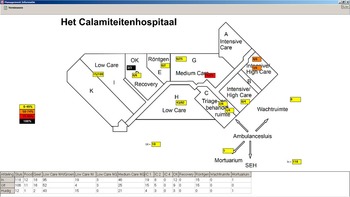
The PBRS has several management features, including real-time monitoring of department capacity for the command team (Figure 1). Each department’s capacity (whether at 50%, 75%, or 100%) is indicated by a color-coded system on the overview screen. In addition, to improve information flow and accommodate announcements from the command team to staff in the various departments, a marquee option has been developed and is shown at the bottom of each screen (Figure 2).
Department Capacity Overview Screen, With Real-Time Color Coding.

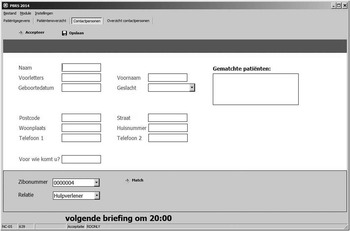
Relative Registration Screen of the 2014 Patient Barcode Registration System. Note the marquee at the bottom of the screen, announcing the next briefing.

An important improved feature is the ability to match relatives to patients. Relatives are taken care of by social workers in a location adjacent to the MIH, but without direct access to the facility so that full access control of the MIH is maintained. After an identity check, the social workers can register relatives in the PBRS, including their relationship to the patient (Figure 2). After relatives have been matched to a patient, the appropriate information is given, and patients and relatives can be reunited when both the overall situation and the medical condition of the patient allow it.
To illustrate the feasibility and usability of the PBRS, we extracted all data processed by this tool during a large trauma drill and reviewed the performance of the registration, tracking, and tracing functions.
RESULTS
A number of small tests were initially performed on concept versions of the 2014 PBRS to optimize workflow and identify minor bugs. The system was made fully operational during a large, real-time trauma drill in November 2014. The drill included 120 casualties from a major incident and 40 individuals reporting to the hospital in search of relatives.
All 120 patients were successfully registered in the system and no patient data were lost. Patients could be tracked and traced in real time by the command team throughout the treatment process.
The pictures taken at the triage station from 4 angles proved to be a major improvement. At least one image of sufficient quality for identification was obtained for each patient.
Management Features
Real-time bed capacity was visualized on a map of all departments, allowing the management team to see the available beds. When the overview screen (Figure 3) showed a high strain on the medium-care capacity, the command team reallocated nursing staff from the low-care wards to the medium-care wards. In addition, the command team decided to prioritize the outplacement of patients to other hospitals. Because the information was shown in real time, decisions could be made well in advance, prior to the exhaustion of capacity.
Capacity Overview Screen After 118 Patients Have Been Admitted.

Based on the displayed data, government agencies were informed of the number and characteristics of the patients. With the click of one button, accurate information could be provided to the press and the community.
Matching With Relatives
During the exercise, 9 relatives were matched to the correct patients. The remaining 31 relatives were registered in the PBRS system but were not matched, because the administrative officers had not yet taken the names and addresses of the patients because medical treatment had priority. The exercise was finished before this process could be finalized.
Evaluation
Hospital responses to major incidents should be properly evaluated to enable future improvements. The data from the 2014 PBRS can, apart from its prospective use, be retrospectively analyzed. One of the most important evaluation goals from a high surge of patients is the identification of bottlenecks in the system. To identify such bottlenecks, the PBRS produces a list showing the time between patient check-in and check-out at any given location. Figure 4 shows the advancement of all red priority-one patients from their first registration in the ambulance receiving area until their definitive station (ie, intensive care unit, operating theatre, or medium care). In this example, all times were balanced; there were no particular bottlenecks. The graph further illustrates the main time-consuming elements of treatment.
Overview of the Flow of Red Priority-One Patients From First Registration in the Ambulance Receiving Area Until Their Definitive Station. Note. The y-axis shows each patient’s barcode number.

In the exercise, 3 patients were scripted to die during treatment in the trauma bays. These patients were not checked out of the trauma bays and into the morgue; as a result, they are shown as being in the trauma bays for the full duration of treatment, which led to misinformation being given to the command team.
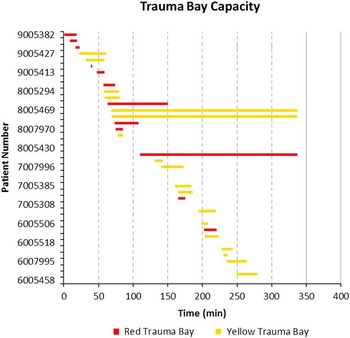
Figure 5 illustrates the advancement of patients in the red and yellow trauma bays. The demand on the trauma bays was highest between 50 and 80 minutes after the beginning of the drill, with 4 priority-one and 5 priority-two patients simultaneously receiving treatment; patients were treated fast enough to accommodate the ongoing victim surge. The time spent in triage and the trauma bays is shown in Figure 6. The first 3 patients were all triaged within 1 minute and left the trauma bays for surgery within 6, 10, and 16 minutes of arrival. The mean time spent in red trauma bays was 20 minutes (range, 2–87 minutes), and the mean time spent in yellow bays was 21 minutes (range, 6–39 minutes). This includes transport to the check-in and check-out location, which took a maximum of 5 minutes. Figure 6 excludes the 3 deceased patients to give a better overview of treatment times. Administrative officers operating the barcode scanners reported improvements in overall system stability and speed.
Red and Yellow Trauma Bay Capacity.

Time Taken for Initial Treatment Steps.

DISCUSSION
The PBRS provides a simple but efficient way of tracking and tracing patients during mass casualty care in hospitals. Developments over the past 20 years have resulted in several considerations for the future improvement of such systems (Table 1). Ongoing development is warranted to withstand the technological changes that will occur over time. Such development should be aimed at expanding such systems’ capabilities and keeping up with technological challenges.
Considerations for the Future Development of Victim Tracking and Tracing Applications

With the recent implementation of management features in the 2014 version of the PBRS, a command team can now use the tool to monitor patient flow in real time, enabling decisions to be made prior to the occurrence of the bottlenecks that can arise with sudden high surges in patient numbers. In addition, matching relatives to patients has now been made possible. This feature, in addition to the ability to provide overviews with patient names and injury-severity characteristics, responds to the need for information from government agencies, relatives, and the general public, which is usually one of the weaker links during mass casualty incidents. Furthermore, the new two-tier design increases the speed and stability of the system.
A large trauma drill demonstrated the superb performance of the 2014 PBRS. No system errors were found in patient registration, and all patients could be identified from a 4-angle picture. User errors did occur, however. For example, 3 deceased patients were not checked out from the trauma bays and checked in to the morgue, leading to a minor misunderstanding with the command team. The overall speed of the system was found to offer major improvements over the former version of the PBRS, and the administrative officers also reported superior system stability. Some modifications have been made after the analysis of this drill and are expected to further improve the efficiency of the indexing system.
The key to successful systems for high patient surge situations, such as disasters and major incidents, is simplicity.Reference Lennquist 6 The choice was made to use barcodes instead of more modern solutions such as radiofrequency identification (RFID) to reduce the risk of system failure during disaster scenarios. RFID is a completely digital system that relies on electromagnetic fields for wireless data transfer and requires dedicated RFID scanners. In contrast, barcode scanners are available in most hospitals and are low-cost. In the case of hardware failure, barcode numbers (but not RFID codes) can be entered manually. Even in regular health care situations the implementation of RFID is slow, as hospitals struggle with cost and complexity issues.Reference Degaspari 8 Furthermore, only a few studies have focused on victim tracking and tracing after disasters with more advanced systems.Reference Pate 9 Another reason to choose barcodes over RFID is that they are used in the UMC Utrecht and the Central Military Hospital, thus matching standard work procedures.
The use of any electronic system is a weak link during disasters, because electronic systems are prone to failure due to power-supply problems or system overloading; however, such events have not yet been encountered in the MIH. All systems running the PBRS are connected with the backup power supply of the hospital.
Ideally, a victim tracking and tracing system should cover both the pre-hospital setting and the in-hospital patient surge. Several systems have been developed for this purpose, but are often not supported by the full chain of medical relief.Reference Marres, Taal and Bemelman 7 The next step in the development of the 2014 PBRS will be introducing it into regular emergency care. This will allow more people to become accustomed to the system, thus enhancing awareness of its use. Ideally, the system will be able to cooperate with a pre-hospital victim tracking and tracing system, thus enabling adequate patient registration and real-time overviews during mass casualty incidents. The technical design of the software system enables it to be run in different institutions with minor modifications since the software itself is designed for generic hardware. The main challenges for introduction in other facilities include the implementation of different layouts and capacities of these hospitals. Therefore, a supra-regional implementation where a further developed version is used in all hospitals and by all regional ambulance services would be possible with the addition of a barcode scanner to the computers that are already used. A basic version of the software without schematic overview would be usable in all other settings such as pre-hospital and field hospital situations where the focus is mainly on the registration and less on the tracing of patients.
CONCLUSIONS
The PBRS is a feasible, usable, and sustainable application with which to track and trace patients and organize the patient surge during a hospital’s response to a major incident. The tool can help to prevent additional suffering caused by a lack of information about patients and their locations, which can lead to suboptimal use of resources and uncertainty among relatives. The benefits of tracking and tracing systems during such situations are not only in patient registration but also in management possibilities, including real-time overviews of hospital capacity and patient characteristics. Data extracted from such systems should be used to meticulously evaluate a hospital’s response in order to optimize care in high-surge situations. Future developments will focus on pre-hospital victim tracking and the application of the 2014 PBRS in regular trauma care.