As one of the most frequently introduced species of birds in the world, house sparrows (Passer domesticus (Linnaeus), Aves: Passeridae) present an excellent opportunity for examining how symbiotic assemblages vary among introduced and native populations of hosts, core and edge populations, and hosts living in mild versus cold climates. House sparrows are non-migratory (Vangestel et al. Reference Vangestel, Mergeay, Dawson, Vandomme and Lens2011), and so their ectosymbionts potentially experience a much wider range of climatic conditions than those associated with migratory host species. Studies evaluating effects of climate have shown that low humidity (Moyer et al. Reference Moyer, Drown and Clayton2002) and colder temperatures (Dubinin Reference Dubinin1951) may reduce ectosymbiont loads on birds. House sparrows were initially introduced to North America from Europe to the eastern United States of America in the 1850s, and to a few western states in the 1870s (Summers-Smith Reference Summers-Smith1963). Data on timing of arrival of P. domesticus in the prairie provinces of Canada are relatively sparse (Houston Reference Houston1978, Reference Houston1979). The earliest report for Manitoba is 1892 at Carberry, for Saskatchewan is 1899 at Carnduff, and for Alberta is 1898 at Red Deer.
Here we examine the diversity and prevalence of symbionts (primarily arthropods) associated with house sparrows from two sites in Alberta, Canada. The first site, Edmonton (53°34′N, 113°31′W), is located in the Central Parkland subregion of Alberta and is largely urbanised (Downing and Pettapiece Reference Downing and Pettapiece2006). The other site, Onefour (49°6′N, 110°28′W), is a rural location in the extreme southeast Dry Mixedgrass subregion of Alberta. The first report of the house sparrow in Edmonton is 1910 (Houston Reference Houston1978). There are no early literature or museum records of house sparrows from the Onefour region, but Houston (Reference Houston1978) mentions a 1907 report from Eastend, Saskatchewan, ∼175 km east of Onefour. We had the following a priori expectations about diversity of house sparrow symbionts from Alberta: (a) richness and prevalence of ectosymbiotic arthropods would be lower in Albertan sparrows than in longer established host populations to the south and east of the province in the United States of America; (b) there would be no symbiont species from Albertan house sparrows that had not already been reported elsewhere in North America.
Fifty-eight house sparrows were collected in Edmonton from June to November 2009 and April to September 2010. Of these, 29 were adults (16 males and 13 females) and 29 were fully fledged juveniles. Birds were captured using a baited walk-in Deluxe Repeating Sparrow Trap (www.sparrowtraps.net/index.htm) and killed by cervical dislocation. An additional 13 birds were collected by shooting in Onefour from June to August 2011 by the manager of the Onefour Agriculture and Agri-Foods Canada field station as part of a pest reduction programme. Seven were adults (four males and three females) and six were fully fledged juveniles. In all cases, each bird's body was placed in an individual plastic bag immediately after death and stored at −20 °C until processed.
Frozen birds were thawed and washed for ectosymbionts as outlined by Knee et al. (Reference Knee, Proctor and Galloway2008). We also opened all primary and secondary flight feathers and examined quills for mites. Ectosymbionts were stored in 75 mL screw-cap containers filled with 80% ethanol until arthropods rehydrated and sank. We examined washings for symbionts using a Leica MZ16 dissecting microscope (Leica Microsystems, Wetzlar, Germany) at 20–25× magnification. Mites (Acari), fleas (Siphonaptera), lice (Phthiraptera), hippoboscid flies (Diptera: Hippoboscidae), and trematodes (Trematoda) were removed from the washings and each taxon was processed separately.
Arthropods were removed from ethanol, cleared in 85% lactic acid, and except for hipposcids, mounted in a polyvinyl alcohol medium (6371A, BioQuip Products, Rancho Dominguez, California, United States of America). Slides were placed on a 40 °C slide warmer for a minimum of four days and once cured were examined using a Leica DMLB compound microscope with differential interference contrast at 200–400× magnification. For mites, identifications were made using relevant literature (Fain Reference Fain1965; Atyeo and Braasch Reference Atyeo and Braasch1966; Moss Reference Moss1968; Fain et al. Reference Fain, Guerin and Hart1988; Gaud and Atyeo Reference Gaud and Atyeo1996; Skoracki Reference Skoracki2002; Knee Reference Knee2007; Krantz and Walter Reference Krantz and Walter2009; Bochkov and Literak Reference Bochkov and Literak2011) and with the help of Dr. David Walter (Royal Alberta Museum, Edmonton, Alberta, Canada) and Dr. Andre Bochkov (Zoological Institute of the Russian Academy of Sciences, St. Petersburg, Russia). We also used specimens of Proctophyllodes troncatus Robin (Acari: Proctophyllodidae) from Romania to compare with the one specimen of Proctophyllodes Robin we found. Fleas and lice were identified by Dr. Terry Galloway (University of Manitoba, Winnipeg, Manitoba, Canada), and hippoboscid flies by Dr. Matthias Buck (Royal Alberta Museum, Edmonton, Alberta, Canada). Trematodes were identified by Dr. Sean Locke (Environment Canada, Montreal, Québec, Canada) (Locke et al. Reference Locke, Lapierre, Byers, Proctor, McLaughlin and Marcogliese2012). Exemplars of all arthropod taxa were deposited in the E.H. Strickland Entomological Museum, University of Alberta, Edmonton, Alberta, Canada except for Hippoboscidae, which were deposited at the Royal Alberta Museum, Edmonton, Alberta, Canada. Exemplars of trematodes were deposited in the Parasitology Collection at the University of Alberta, Edmonton, Alberta, Canada.
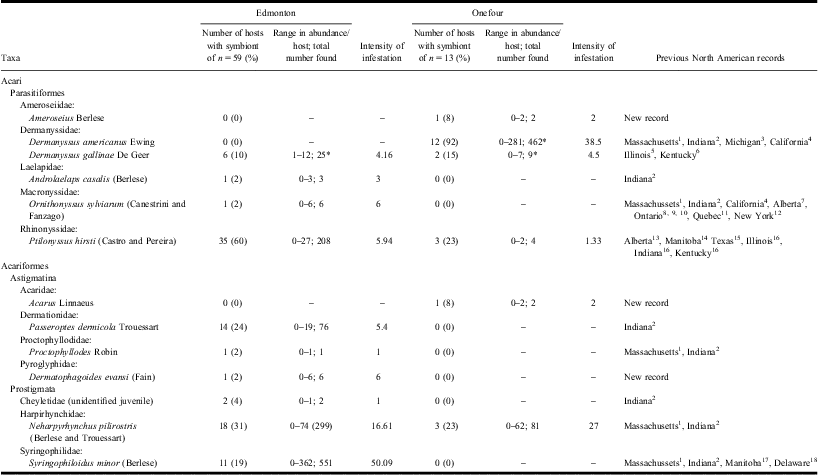
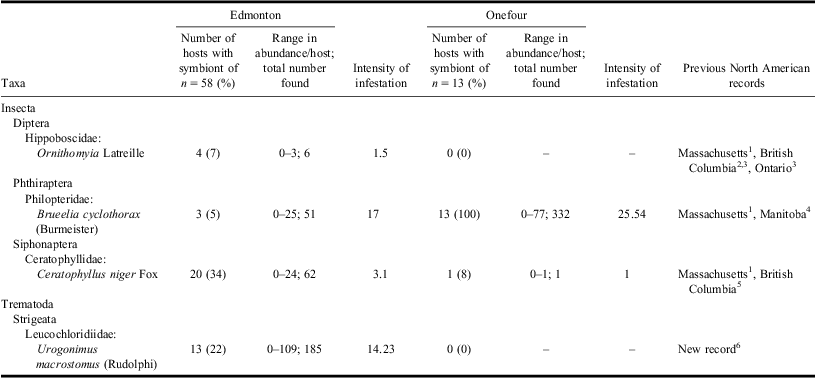
We identified 17 taxa of symbionts from the 71 examined birds. Mites (Acari) had the greatest diversity with 13 species (Table 1). The most prevalent of these were the blood-feeding mites Dermanyssus americanus Ewing and D. gallinae De Geer (Mesostigmata: Dermanyssidae), the nasal mite Ptilonyssus hirsti (Castro and Periera) (Mesostigmata: Rhinonyssidae), the skin mites Passeroptes dermicola Trouessart (Astigmatina: Dermationidae) and Neharpyrhynchus pilirostris (Berlese and Trouessart) (Prostigmata: Harpirhynchidae), and the quill mite Syringophiloidus minor (Berlese) (Prostigmata: Syringophilidae). Five additional species of mites were found on only one or two birds. We compared the one vane-dwelling feather mite we found, a female Proctophyllodes, to specimens of P. troncatus from house sparrows from Romania. Based on the morphology of the copulatory bursa and spermaduct, the specimen from Alberta was not P. troncatus. We also found three species of insects and one species of trematode (Table 2): the hippoboscid Ornithomyia, the chewing louse Brueelia cyclothorax (Burmeister), the flea Ceratophyllus niger Fox, and the trematode Urogonimus macrostomus (Rudolphi). Birds from Edmonton had nine species of symbionts not found at Onefour and Onefour had three taxa not found in Edmonton (Tables 1, 2). Those present both in Edmonton and Onefour were slightly more prevalent on Edmonton birds, excepting the louse B. cyclothorax, which was found on 5% of Edmonton birds and on 100% of those from Onefour (Table 1).
Mite taxa found on house sparrows (Passer domesticus (Linnaeus)) in our study and whether they have been previously recorded on this host in North America.

Notes: For taxa identified only to genus, previous records include those for all species in that genus in North America. List of states of the United States of America may not be exhaustive. Intensity of infection is mean number of symbionts/host excluding zero counts.
*Values are extrapolations determined by identifying all adult females and then applying this proportion to all mites collected of this genus including juveniles and males.
1, Brown and Wilson (Reference Brown and Wilson1975), 2, McGroarty and Dobson (Reference McGroarty and Dobson1974), 3, Phillis (Reference Phillis1972), 4, Reeves et al. (Reference Reeves, Hammon, Furman, McClure and Brookman1947), 5, Ewing (Reference Ewing1911), 6, Wilson (Reference Wilson1958), 7, Knee and Proctor (Reference Knee and Proctor2007), 8, Banks (Reference Banks1909), 9, Jarvis (Reference Jarvis1910), 10, Ewing (Reference Ewing1923), 11, Rayner (Reference Rayner1932), 12, Foulk and Matthysse (Reference Foulk and Matthysse1965), 13, Knee (Reference Knee2007), 14, Knee et al. (Reference Knee, Proctor and Galloway2008), 15, Porter and Strandtmann (Reference Porter and Strandtmann1952), 16, Wilson (Reference Wilson1964), 17, Bochkov and Galloway (Reference Bochkov and Galloway2001), 18, Mellot and Connell (Reference Mellot and Connell1965).
Non-mite taxa found on house sparrows (Passer domesticus (Linnaeus)) in our study.
Notes: For taxa identified only to genus, previous records include those for all species in that genus in North America. Intensity of infection is mean number of symbionts/host excluding zero counts.
1, Brown and Wilson (Reference Brown and Wilson1975), 2, Spencer (Reference Spencer1938), 3, Bequaert (Reference Bequaert1954), 4, T. Galloway (unpublished data), 5, Holland (Reference Holland1949), 6, Locke et al. (Reference Locke, Lapierre, Byers, Proctor, McLaughlin and Marcogliese2012).
Two other published studies from North America have used similar methods of collecting symbionts of house sparrows. Brown and Wilson (Reference Brown and Wilson1975) found three mite taxa on 34 house sparrows caught in Massachusetts, United States of America that were not collected in our study: Microlichus avus Trouessart and Neumann, Analges Nitzsch (Astigmatina: Epidermoptidae, Analgidae) and P. troncatus. Of the taxa reported by McGroarty and Dobson (Reference McGroarty and Dobson1974) from 300 house sparrows in Indiana, United States of America, we found all except Dermanyssus hirundinis, Pellonyssus passeri Clark and Yunker (Mesostigmata: Macronyssidae), P. troncatus and two louse species. See Supplementary Table 1 for a list of these and other symbionts previously recorded for house sparrows in North America that were not found in our study. We also compared our collection to an unpublished list of taxa from the body-washings of 371 house sparrows from in and near Winnipeg, Manitoba, Canada processed by Terry Galloway from 1995 to 2010. Galloway found dermanyssid mites as well as mites occupying the quills, feathers and nasal passages (including Ptilonyssus Berlese and Trouessart). In addition he found Haemaphysalis leporispalustris (Packard) (Ixodida: Ixodidae), Menacanthus eurysternus (Burmeister), B. cyclothorax (Burmeister), and Philopterus (Phthiraptera: Philopteridae), Ceratophyllus gallinae (Schrank) (Siphonaptera: Ceratophyllidae), Ornithomyia anchineuria Speiser (Diptera: Hippoboscidae), and unidentified trematodes.
Contrary to our expectation that richness and prevalence of ectosymbionts of house sparrows in Alberta would be lower than in sparrows from the United States of America, we found a greater richness of mites and insects than reported for birds in Massachusetts (Brown and Wilson Reference Brown and Wilson1975). Our richness of mite symbionts (n = 13) is similar to that reported from Indiana (n = 14, McGroarty and Dobson Reference McGroarty and Dobson1974). There was no consistent geographical pattern with regard to prevalence. Variation in results between Edmonton and Onefour is most easily explained by differences in sampling effort. In future research we hope to increase sample sizes of sparrows, to collect across a wider geographic range of North America, and to compare symbiont assemblages among seasons (e.g. pre-nesting, nesting, post-fledging, winter).
Acknowledgements
House sparrow collection was performed under a University of Alberta Animal Care and Use Committee approved protocol (#7281004) and Alberta Environment and Sustainable Resource Development Collection License 48543 and Research Permit 48544. For their help with various aspects of the study, the authors thank I. Walker (Agriculture and Agri-Foods Canada) P. Pap (Babes Bolyai University), A. Bochkov (Russian Academy of Sciences), M. Buck and D. Walter (Royal Alberta Museum), T. Galloway (University of Manitoba), and S. Locke (Environment Canada). They also thank two anonymous reviewers and K. Floate for their helpful comments. This research was funded by a Natural Sciences and Engineering Research Council of Canada Discovery Grant to H.P.