Surveyed producers from the United States reported that herbicides were applied to 97% to 98% of corn hectares in 2010 and 2014, with 27% to 77% of hectares receiving glyphosate, a photosystem II (PSII) inhibitor, a 4-hydroxyphenylpyruvate dioxygenase (HPPD) inhibitor, or a very long chain fatty acid synthesis (VLCFA) inhibitor (Anonymous Reference Anonymous2017b, Reference Anonymous2017c). Utilization of multiple herbicidal modes of action in a weed management plan, especially those that provide residual weed control, are important in a management program for herbicide-resistant weeds (Norsworthy et al. Reference Norsworthy, Ward, Shaw, Llewellyn, Nichols, Webster, Bradley, Frisvold, Powles, Burgos, Witt and Barrett2012). However, numerous weed species resistant to glyphosate, PSII inhibitors, and/or HPPD inhibitors have been documented in the United States (Heap 2017). In addition, multiple resistance to glyphosate and PSII inhibitors, or HPPD inhibitors and PSII inhibitors, has been documented in Palmer amaranth and tall waterhemp [Amaranthus tuberculatus (Moq.) Sauer]. Furthermore, a population of tall waterhemp in Iowa was documented resistant to glyphosate, PSII, and HPPD inhibitors (Heap 2017). The afore-mentioned herbicide resistance is quite troubling for producers and scientists, because it encompasses one to three of the most widely utilized herbicidal modes of action in corn weed management programs. This highlights the importance of VLCFA inhibitors for weed management in corn.
Acetochlor, dimethenamid-P, and S-metolachlor have a long history of use in corn weed management programs (LSUAC-CES Reference Stephenson2017; MSU-ES Reference Calcote2016). Recently, a new VLCFA inhibitor, pyroxasulfone, was commercialized in the United States (Anonymous Reference Anonymous2017d). Pyroxasulfone is registered for use in corn, cotton (Gossypium hirsutum L.), fallow, soybean [Glycine max (L.) Merr.], and wheat (Triticum aestivum L.), with use rates of 49 and 210 g ai ha−1 (Anonymous Reference Anonymous2017d; Shaner Reference Shaner2014; Tanetani et al. Reference Tanetani, Kaku, Kawai, Fujioka and Shimizu2009, Reference Tanetani, Fujioka, Kaku and Shimizu2011). Mueller and Steckel (Reference Mueller and Steckel2011) evaluated the potential residual control of four VLCFA inhibitors and determined that the half-life (DT50) values of acetochlor, dimethenamid-P, pyroxasulfone, and S-metolachlor were 3.5 to 5 d, 5 to 9 d, 8.2 to 70 d, and 8.7 to 27 d, respectively. Considering the greater DT50 for pyroxasulfone compared to the other VLCFA inhibitors evaluated, these data suggest that pyroxasulfone can potentially provide longer residual control of susceptible weeds than the other herbicides evaluated.
Weeds controlled by pyroxasulfone include field sandbur (Cenchrus spinifex Cav.), Florida beggarweed [Desmodium tortuosum (Sw.) DC.], green foxtail [Setaria viridis (L.) Beauv.], Italian ryegrass [Lolium perenne L. ssp. multiflorum (Lam.) Husnot.], kochia [Kochia scoparia (L.) Schrad.], large crabgrass [Digitaria sanguinalis (L.) Scop.], Palmer amaranth, puncturevine (Tribulus terrestris L.), shattercane [Sorghum bicolor (L.) Moench ssp. arundinaceum (Desv.) de Wet & Harlan], smallflower morningglory [Jacquemontia tamnifolia (L.) Griseb.], Texas millet [Urochloa texana (Buckl.) R. Webster], velvetleaf (Abutilon theophrasti Medik.), and tall waterhemp (Bond et al. Reference Bond, Eubank, Bond, Golden and Edwards2014; Geier et al. Reference Geier, Stahlman and Frihauf2006; Grey et al. Reference Grey, Cutts, Newsom and Newell2014; Hulting et al. Reference Hulting, Dauer, Hinds-Cook, Curtis, Koepke-Hill and Mallory-Smith2012; King and Garcia Reference King and Garcia2008; King et al. Reference King, Ritter, Hagood and Menbere2007; Knezevic et al. Reference Knezevic, Datta, Scott and Porpiglia2009; Steele et al. Reference Steele, Porpiglia and Chandler2005). Crop safety following pyroxasulfone application varies by crop. Pyroxasulfone PRE or POST did not injure corn (Geier et al. Reference Geier, Stahlman and Frihauf2006; Jha et al. Reference Jha, Kumar, Garcia and Reichard2015; King and Garcia Reference King and Garcia2008; Knezevic et al. Reference Knezevic, Datta, Scott and Porpiglia2009; Steele et al. Reference Steele, Porpiglia and Chandler2005). In soybean, no injury was observed following pyroxasulfone PRE; however, 15% injury was reported following POST application (Grey et al. Reference Grey, Cutts, Newsom and Newell2014; Mahoney et al. Reference Mahoney, Shropshire and Sikkema2014; McNaughton et al. Reference McNaughton, Shropshire, Robinson and Sikkema2014; Stephenson et al. Reference Stephenson, Blouin, Griffin, Landry, Woolam and Hardwick2017). Peanut (Arachis hypogaea L.) injury increased from 5% to 48% following pyroxasulfone PRE as silt and clay content in the soil increased; however, pyroxasulfone POST injured peanut ≤10% (Prostko et al. Reference Prostko, Grey, Webster and Kemmerait2011).
The utility of VLCFA inhibitors in corn, and the increased length of residual weed control offered by pyroxasulfone, potentially make it another tool for mitigation or management of herbicide-resistant weeds in corn. Others have reported crop safety and weed control with pyroxasulfone in corn when used along with other weed management methods (Geier et al. Reference Geier, Stahlman and Frihauf2006; Jha et al. Reference Jha, Kumar, Garcia and Reichard2015; King and Garcia Reference King and Garcia2008; Knezevic et al. Reference Knezevic, Datta, Scott and Porpiglia2009; Steele et al. Reference Steele, Porpiglia and Chandler2005), but they evaluated pyroxasulfone only as a PRE treatment. Little information is available concerning pyroxasulfone applied PRE and/or POST in a corn weed management system. Therefore, the objectives of this research were to evaluate crop injury, weed control, and yield following herbicide programs containing pyroxasulfone applied PRE and POST in field corn.
Materials and Methods
Experiments were conducted at the Louisiana State University Agricultural Center Dean Lee Research and Extension Center (31.178°N, 92.411°W) in Alexandria, Louisiana, in 2011, 2012, and 2013, and the Mississippi State University Delta Research and Extension Center (33.442°N, 90.909°W) in Stoneville, Mississippi, in 2011 and 2013. Soil in Louisiana was a Coushatta silt loam (fine-silty, mixed, superactive, thermic Fluventic Entrudepts), with a pH of 8.0 and 1.5% organic matter. Soil in Mississippi was a Dundee very fine sandy loam (fine-silty, mixed, active, thermic Typic Endoaqualf), with a pH of 6.1 and 1.2% organic matter.
The experimental design was a factorial arranged in a randomized complete block design with four replications. Factors consisted of four PRE and four POST treatments. The PRE treatments included atrazine (Aatrex 4L, Syngenta Crop Protection LLC, P.O. Box 18300, Greensboro, NC 27419) at 1,120 g ai ha−1, pyroxasulfone (Zidua 85 WG, BASF Corporation, 26 Davis Dr., Research Triangle Park, NC 27709) at 150 g ai ha−1, atrazine at 1,120 g ha−1 plus pyroxasulfone at 150 g ai ha−1, and no PRE treatment. The POST treatments were atrazine at 1,120 g ha−1, pyroxasulfone at 60 g ha−1, atrazine at 1,120 g ha−1 plus pyroxasulfone at 60 g ha−1, and no POST treatment, applied to 30-cm corn. Glyphosate (Roundup PowerMax 4.5 L, Monsanto Company, 800 N. Lindbergh Blvd., St. Louis, MO 63167) at 870 g ae ha−1 was co-applied with atrazine, pyroxasulfone, and atrazine plus pyroxasulfone POST treatments. Plot size was 9 m long with four 0.97-m rows in Louisiana, and 9 m long with four 1-m rows in Mississippi. Treatments at both locations were applied with a tractor-mounted compressed-air sprayer calibrated to deliver 187 L ha−1 at 5.6 km h−1 at 145 kPa using 11002 flat-fan nozzles (TeeJet Technologies, 200 W. North Ave., Glendale Heights, IL 60139). Dates of planting, emergence, PRE and POST treatment applications, and harvest are shown for each experiment in Table 1.
Dates of planting, emergence, preemergence (PRE) and postemergence (POST) herbicide applications, and harvest for field corn studies conducted at each location.

In Louisiana, ‘Pioneer 31P42’ was planted at 75,370 seeds ha−1 each year. In Mississippi, ‘Pioneer 31G71’ and ‘Terral REV 27HR83’ were planted in 2011 and 2013, respectively, both at 79,100 seeds ha−1. Corn was seeded 4 to 5 cm deep at both locations. All experiments were conducted using conventional tillage methods and fertility programs based upon Louisiana State University AgCenter or Mississippi State University soil test analysis recommendations. Supplemental irrigation was utilized in Mississippi, but was not available in Louisiana.
Control of barnyardgrass and Palmer amaranth was evaluated at both locations. The Palmer amaranth population in Louisiana was susceptible to glyphosate; however, approximately 60% of the individual plants in the Palmer amaranth population in Mississippi were glyphosate-resistant. Browntop millet and ivyleaf morningglory were only evaluated in Mississippi. Weed densities ranged from 10 to 20 plants m−2 at both locations. At the time of POST herbicide application, weed height was 5 to 10 cm, and corn was 30 cm tall.
Visual estimates of corn injury and weed control were recorded 30 d after PRE application and 7, 14, and 28 d after POST application, using a scale of 0 (no injury/control) to 100 (complete death of all plants). Yield was determined using conventional harvesting equipment and was adjusted to 15% moisture before analysis.
Data were subjected to the GLIMMIX procedure in SAS (release 9.2, SAS Institute, Cary, NC). Fixed effects for the analysis of barnyardgrass and Palmer amaranth were PRE and POST treatments and their interaction. Random effects were location, year, replication within location, and year. For browntop millet and ivyleaf morningglory, fixed and random effects were identical, except all random effects containing location were removed. Least square means were calculated and separated with Tukey’s HSD test at P≤0.05 for the effects.
Results and Discussion
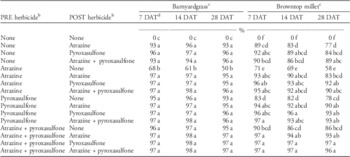
Corn injury was not observed following any PRE or POST treatment at any evaluation (data not shown). Others also reported little to no injury to corn following pyroxasulfone application (Geier et al. Reference Geier, Stahlman and Frihauf2006; Jha et al. Reference Jha, Kumar, Garcia and Reichard2015; King and Garcia Reference King and Garcia2008; Knezevic et al. Reference Knezevic, Datta, Scott and Porpiglia2009; Steele et al. Reference Steele, Porpiglia and Chandler2005). Pyroxasulfone with or without atrazine PRE controlled barnyardgrass ≥93%, while atrazine alone provided ≤69% control 30 d after PRE treatment and 7, 14, and 28 d after POST treatment (Tables 2 and 3). Atrazine provides partial control of barnyardgrass, giant foxtail (Setaria faberi Herrm.), green foxtail, large crabgrass, witchgrass (Panicum capillare L.), and yellow foxtail [Setaria pumila (Poir.) Roemer & J.A. Schultes] when applied PPI or PRE on medium- or fine-textured soils (Anonymous Reference Anonymous2017a), and both soils in Louisiana and Mississippi meet that description. Barnyardgrass control was not improved by following pyroxasulfone alone or atrazine plus pyroxasulfone PRE with any POST treatment; however, all POST treatments increased barnyardgrass control following atrazine PRE to ≥95% at all evaluation times (Table 3). Yamaji et al. (Reference Yamaji, Honda, Kobayashi, Hanai and Inoue2014) reported barnyardgrass control of 100% 45 d after application of pyroxasulfone PRE at 125 and 250 g ha−1. Similarly, pyroxasulfone PRE at 125 g ha−1 controlled green foxtail 95% 75 d after treatment (DAT) (Geier et al. Reference Geier, Stahlman and Frihauf2006).
Barnyardgrass, browntop millet, ivyleaf morningglory, and Palmer amaranth control in field corn with preemergence (PRE) herbicides 30 d after treatment.Footnote a

a Means followed by the same letter within a column are not significantly different according to Tukey’s HSD test at P≤0.05. Nontreated check excluded from analysis of PRE herbicide treatments.
b Atrazine and pyroxasulfone applied at 1,120 and 150 g ai ha−1, respectively.
c Barnyardgrass and Palmer amaranth control was evaluated in Louisiana and Mississippi. Browntop millet and ivyleaf morningglory control was evaluated only in Mississippi.
Control of barnyardgrass and browntop millet in corn 7, 14, and 28 d after postemergence (POST) application in field corn as influenced by preemergence (PRE) and POST application of atrazine and pyroxasulfone.Footnote a

a Means within each column followed by the same letter are not significantly different according to Tukey’s HSD test at P≤0.05.
b Atrazine at 1,120 g ha−1 was applied in both PRE and POST treatments. Pyroxasulfone was applied PRE and POST at 150 and 60 g ha−1, respectively. Glyphosate at 0.77 lb ae ha−1 was co-applied with all POST treatments except the nontreated.
c Barnyardgrass control was evaluated in Louisiana and Mississippi. Browntop millet control was evaluated only in Mississippi.
d Abbreviation: DAT, days after treatment.
The addition of atrazine to pyroxasulfone PRE increased browntop millet control to 92% 30 d after PRE treatment, compared with 86% following pyroxasulfone alone (Table 2). In the absence of a PRE treatment, all POST treatments controlled browntop millet 83% to 92% 7 and 14 d after POST. However, browntop millet control was 89% 28 d after POST following the co-application of glyphosate, atrazine, and pyroxasulfone POST compared to 77% control following glyphosate plus atrazine POST (Table 2), which may be attributed to the residual efficacy of pyroxasulfone. Similarly, Steele et al. (Reference Steele, Porpiglia and Chandler2005) reported 84% Texas millet control 28 DAT following pyroxasulfone PRE at 125 g ha−1. All treatments that contained a PRE followed by POST application controlled browntop millet ≥90% at all evaluations, indicating the potential need for a PRE followed by POST program to control browntop millet in corn.
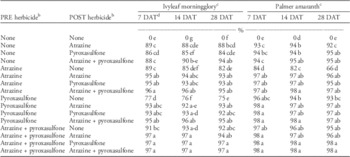
Ivyleaf morningglory control with atrazine plus pyroxasulfone PRE was 94% 30 d after PRE, while atrazine or pyroxasulfone alone PRE provided 88% and 86% control, respectively (Table 2). Yamaji et al. (Reference Yamaji, Honda, Kobayashi, Hanai and Inoue2014) reported 92% ivyleaf morningglory control following pyroxasulfone PRE at 125 g ha−1 28 d after application. In the absence of a PRE application, ivyleaf morningglory control with all POST treatments was similar 7 and 14 d after POST and ranged from 85% to 90% (Table 4). At 28 d after POST, glyphosate plus atrazine plus pyroxasulfone POST provided greater ivyleaf morningglory control than glyphosate plus pyroxasulfone alone POST, indicating the need for atrazine in the POST treatment. All POST treatments increased ivyleaf morningglory control to ≥92% following atrazine or pyroxasulfone alone PRE, but control following atrazine plus pyroxasulfone PRE was similar to or greater than control following all treatments that received a POST application 28 d after POST (Table 4). This observation supports data collected 30 d after PRE that atrazine plus pyroxasulfone PRE provides ≥90% control of ivyleaf morningglory.
Control of ivyleaf morningglory and Palmer amaranth in corn 7, 14, and 28 days after postemergence (POST) application in field corn as influenced by preemergence (PRE) and POST application of atrazine and pyroxasulfone.Footnote a

a Means within each column followed by the same letter are not significantly different according to Tukey’s HSD test at P≤0.05.
b Atrazine at 1,120 g ha−1 was applied in both PRE and POST treatments. Pyroxasulfone was applied PRE and POST at 150 and 60 g ha−1, respectively. Glyphosate at 0.77 lb ae ha−1 was co-applied with all POST treatments except the nontreated.
c Ivyleaf morningglory control evaluated only in Mississippi. Palmer amaranth control was evaluated in both Louisiana and Mississippi.
d Abbreviation: DAT, days after treatment.
All PRE treatments controlled Palmer amaranth 94% to 97% 30 d after PRE (Table 2). In the absence of a POST treatment, pyroxasulfone alone or atrazine plus pyroxasulfone PRE controlled Palmer amaranth 93% to 96% at all evaluation dates, but atrazine alone PRE provided 84%, 82%, and 66% control 7, 14, and 28 d after POST, respectively. Geier et al. (Reference Geier, Stahlman and Frihauf2006) observed 80% to 88% Palmer amaranth control 75 DAT with pyroxasulfone at 166 g ha−1 PRE. However, Steele et al. (Reference Steele, Porpiglia and Chandler2005) reported 97% Palmer amaranth control 63 DAT following pyroxasulfone PRE at 125 g ha−1. Pyroxasulfone plus atrazine PRE controlled Palmer amaranth >96% 63 to 75 DAT (Geier et al. Reference Geier, Stahlman and Frihauf2006; Steele et al. Reference Steele, Porpiglia and Chandler2005). All programs that contained a PRE followed by POST herbicide treatment controlled Palmer amaranth >90% at all evaluations (Table 4). Grey et al. (Reference Grey, Cutts, Newsom and Newell2014) observed 93% control of glyphosate-resistant Palmer amaranth 100 to 124 d after planting following pyroxasulfone PRE at 120 g ha−1. Results from these experiments indicate that pyroxasulfone applied PRE and/or POST is a good option for residual control of Palmer amaranth in corn.
Corn yields were similar following all treatments except atrazine alone PRE and the nontreated check, and ranged from 10,990 to 12,330 kg ha−1 (data not shown). Corn yield was 9,310 kg ha−1 following atrazine alone PRE, which was not different than the nontreated corn yield of 8,340 kg ha−1. Corn yield following 166 g ha−1 of pyroxasulfone was 3,980 kg ha−1, which was similar to yields following S-metolachlor plus atrazine (Geier et al. Reference Geier, Stahlman and Frihauf2006). King and Garcia (Reference King and Garcia2008) reported that corn treated with pyroxasulfone at 166 or 209 g ha−1 PRE, or co-applied with glyphosate POST, yielded 90% to 102% of the weed-free yield. Knezevic et al. (Reference Knezevic, Datta, Scott and Porpiglia2009) found that about 195 g ha−1 of pyroxasulfone PRE was needed to maintain corn yield at 95% of the weed-free yield. In our research, the lack of differences among treatments may be attributed to overall weed control ranging from 90% to 99%. Overall weed control following atrazine alone PRE ranged from 50% to 93%, with poor weed control observed for barnyardgrass, browntop millet, and Palmer amaranth, which supports corn yield data. Residual control of barnyardgrass, browntop millet, ivyleaf morningglory, and Palmer amaranth can be achieved with programs that contain pyroxasulfone PRE and/or POST in corn. In addition, no corn injury was observed following pyroxasulfone PRE or POST, indicating excellent crop safety. This research shows that pyroxasulfone can be a valuable tool for weed management in a corn weed management program.
Acknowledgments
The authors would like to thank the Louisiana Soybean and Feed Grain Research and Promotion Board and the Mississippi Corn Promotion Board for funding this research. In addition, we thank the support staff at the Louisiana State University Agricultural Center Dean Lee Research and Extension Center, the Ben Hur Research Farm, and the Mississippi State University Delta Research and Extension Center for their help with this research. Approved for publication as manuscript no. 2017-263-31206 of the Louisiana State University Agricultural Center.