Ventriculostomy-associated infection (VAI) is one of the most serious complications of external ventricular drain (EVD) use. These infections can result in increased morbidity, mortality, prolonged hospital stay, and higher healthcare costs.Reference Ramanan, Lipman, Shorr and Shankar 1 , Reference Gutierrez-Gonzalez, Boto and Perez-Zamarron 2 The reported incidence of VAI varies from <1% to 45%.Reference Ramanan, Lipman, Shorr and Shankar 1 , Reference Lewis, Wahlster, Karinja, Czeisler, Kimberly and Lord 3 This wide variability in VAI incidence may be due in part to the challenge of diagnosing VAI in the presence of an abnormal cerebrospinal fluid (CSF) profile from underlying central nervous system (CNS) disease, recent surgery,Reference Ramanan, Lipman, Shorr and Shankar 1 , Reference Schade, Schinkel and Roelandse 4 and differences among VAI definitions.Reference Ramanan, Lipman, Shorr and Shankar 1 , Reference Lozier, Sciacca, Romagnoli and Connolly 5
The Centers for Disease Control and Prevention (CDC) National Healthcare Safety Network (NHSN) has defined ventriculitis. 6 A single positive CSF culture or non–culture-based microbiological test meets the NSHN ventriculitis definition. Because CSF samples for culture are generally drawn through the EVD in the course of routine care, intraluminal colonization of the device may result in a positive culture,Reference Ramanan, Lipman, Shorr and Shankar 1 thereby meeting the NHSN definition.
A recent study by Lewis et alReference Lewis, Wahlster, Karinja, Czeisler, Kimberly and Lord 3 compared the performances of multiple VAI definitions. The NHSN definition was not included in the comparison, and the antibiotic length of therapy was used as the gold standard for ventriculitis, which may have introduced bias due to variations in antibiotic prescribing practices.Reference Singh and Yu 7
NHSN surveillance data are increasingly being linked to hospital reimbursement by regulatory agencies and payers (eg, the Centers for Medicare and Medicaid Services). Therefore, understanding the performance characteristics of NHSN definitions is important. In this study, we compared VAI rates using the NHSN definition versus other published definitions.
METHODS
Study Cohort
We conducted a retrospective study of patients who underwent placement of an EVD between January 2009 and December 2014 and were cared for in the Barnes-Jewish Hospital neurological and neurosurgical intensive care unit.
Inclusion and Exclusion Criteria
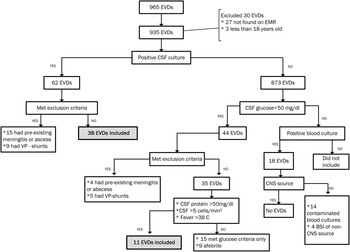
A total of 965 EVDs were identified during the study period. We excluded EVDs placed in patients <18 years old and those who had a permanent shunt, a cerebral abscess, and/or a positive CSF culture at the time of EVD insertion. From the remaining patients with EVDs, we included only those whose EVD and culture status satisfied the NHSN definition for ventriculitis. 6 These included patients having a positive CSF culture while the EVD was in place or an abnormal CSF analysis result or positive blood cultures in the presence of neurological symptoms. We considered only tests that were performed while an EVD was in place and up to 2 days after removal.
NHSN CSF Culture-Positive Episodes
We included all patients with a positive CSF culture during the study period. If multiple organisms grew from a single CSF culture, we considered it a polymicrobial case. If a patient had multiple CSF cultures that grew the same organism, we considered it a single case with the date of initial positive culture as the case date. If a patient had multiple CSF cultures performed and different organisms grew from >1 culture, we considered each culture as a different case. Cultures drawn on the same day or within 1 calendar day were part of the inclusion criteria unless the patient had a pre-existing infection.
NHSN CSF Culture-Negative Cases
Patients with at least 1 CSF glucose measurement <50 mg/dL were included. Patients with all 3 additional criteria were included for further review: CSF protein >50 mg/dL, CSF nucleated cells >5 cells/mm3, and fever >38°C.
Cerebrospinal fluid analysis data (ie, protein level, density of nucleated cells, glucose level) obtained contemporaneously with CSF culture were considered. If no CSF analysis was obtained when the culture specimen was obtained, we considered the CSF analysis temporally closest to the CSF culture performed while the EVD was in place.
To assess the cases of patients who did not meet either the positive CSF culture or the abnormal CSF criteria, we conducted a chart review of all patients with a positive blood culture(s) while the EVD was in place. If there was suspicion of a CNS infectious source, the patient was included for further evaluation.
Other Definitions
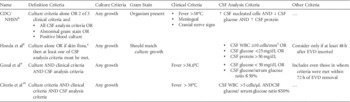
We applied 3 other published VAI definitions (ie, those of Honda et al,Reference Honda, Jones, Craighead, Diringer, Dacey and Warren 8 Gozal et al,Reference Gozal, Farley and Hanseman 9 and Citerio et alReference Citerio, Signorini, Bronco, Vargiolu, Rota and Latronico 10 ) to our cohort (Table 1). 6 All of these definitions required the growth of an organism from a CSF culture; therefore, the patients who met these definitions comprised a subset of the patients who met the NHSN VAI definition by virtue of a positive CSF culture.
Ventriculitis Definitions Used in the Study

NOTE. CDC/NHSN, Centers for Disease Control and Prevention/National Healthcare Safety Network; CSF, cerebrospinal fluid; WBC, white blood cell count; EVD, external ventricular drain.
a Common skin flora: coagulase-negative staphylococci, Corynebacterium, Bacillus, Micrococcus, or Propionibacterium spp.
Data Collection
Patient demographics, CSF testing, culture results, and blood culture data were abstracted from the hospital medical informatics database. We collected the following data from the charts: date of EVD insertion and removal (ie, extracted from the per shift nursing assessment), EVD indication for placement, clinical information (ie, maximal temperature, new meningeal or cranial nerve signs within 72 hours of CSF testing), and systemic antibiotic therapy while the EVD was in place.
We defined treatment as receiving an antibiotic with activity against the organism(s) detected in CSF cultures, based upon susceptibilities. In the case of common commensals with no susceptibilities reported, agents with activity against methicillin-resistant bacteria were considered active. We defined ≥14 days as an appropriate length of antibiotic therapy for ventriculitis. Notably, prior to May 2012, all EVD patients in our study received either cefazolin or vancomycin prior to EVD placement and then as long as the catheter remained in place. After May 2012, patients received only periprocedural antibiotics.
Statistical Analyses
SPSS version 22 software (IBM; Armonk, NY) was used for statistical analyses. Percentage agreements of the Honda, Gozal, and Citerio definitions with NHSH definition were calculated. The unweighted κ statistic was used to assess the agreement between Honda, Gozal, and Citerio definitions.
This study was approved by the Washington University Human Research Protection Office.
RESULTS
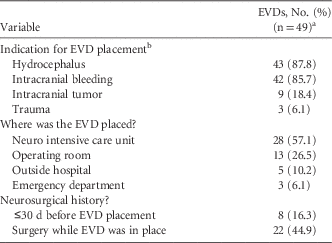
After exclusions, our study cohort included 48 patients with 49 EVDs and 52 cases of ventriculitis, which included 41 culture-positive and 11 culture-negative cases (Figure 1). The median age of the patients was 54 years (interquartile range [IQR], 47–64 years) and 58.3% were female (n=28). Several EVD characteristics are listed in Table 2.
Inclusion of patients in the study. Abbreviations: EVDs, external ventricular drains; EMR, electronic medical record; CSF, cerebrospinal fluid; CNS, central nervous system, BSI, bloodstream infections; VP, ventriculoperitoneal.

Characteristics of External Ventricular Drains in the Study Population

NOTE. EVD, external ventricular drain.
a Includes 48 patients. One patient had 2 EVDs during study period.
b EVDs may have been placed for ≥1 indication.
CSF Culture-Positive Cases
Overall, 37 patients with 38 EVDs contributed to 41 CSF culture-positive cases of ventriculitis. The median time from EVD insertion to first positive culture was 8 days (IQR, 4–12 days). Of the 41 CSF culture-positive samples, 2 were not sent for CSF analysis. The median number of nucleated cells in the remaining 39 CSF samples was 60 cells/mm3 (range, 0–8,440). In total, 30 samples (76.9%) had ≥5 nucleated cells/mm3. The median concentration of protein was 48 mg/dL (IQR, 27–87), and 19 samples (48.7%) had a protein level >50 mg/dL. The median glucose level was 74 mg/dL (IQR, 66–90); only 3 samples (7.6%) had a glucose level <50 mg/dL.
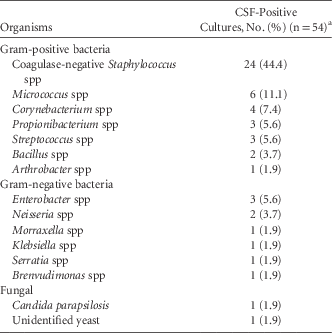
The microbiology of CSF cultures is shown in Table 3. Notably, 20 of 41 culture-positive cases (49%) had an annotation of “1 colony on 1 piece of media” for an organism. The organisms growing only a single colony in culture were coagulase-negative Staphylococcus spp (n=11 cultures), Micrococcus spp (n=4), Corynebacterium spp (n=2), Bacillus spp, Propionibacterium spp, and unidentified yeast.
Characteristics of Cerebrospinal Fluid (CSF)–Positive Cultures

a Of 41 cases, 4 cultures were polymicrobial: 2 cultures had 2 organisms, 1 culture had 4 organisms, and 1 culture had 9 organisms.
Overall, 40 positive-culture CSF (97.6%) case patients received some antibiotic therapy, and 22 patients (53.6%) received appropriate antibiotic for the organisms cultured. The median length of antibiotic use was 5 days (IQR, 3–11 days). In addition, 5 patients received treatment for ≥14 days; 4 of these patients had gram-negative bacteria and 1 had Candida parapsilosis. From the 20 cultures that had the annotation “1 colony on 1 piece of media,” 7 corresponding patients (35%) received an antibiotic with activity against the isolated organism; none received antibiotics for >14 days.
Among the 38 EVDs in patients with ≥1 positive CSF culture, 9 (23.6%) were removed and 3 (7.9%) were exchanged within 48 hours of the positive culture.
CSF Culture-Negative Cases
Overall, 11 patients with 11 EVDs contributed to 11 CSF culture-negative cases (Figure 1). The median number of nucleated cells in these cultures was 375 cells/mm3 (IQR, 100–2,067). The median concentration of protein in patients in this cohort was 113 mg/dL (IQR, 71–332). The median glucose level of this cohort was 45 mg/dL (IQR, 27–48). All 11 case patients received intravenous antibiotics, but none completed 14 days of therapy. Moreover, 2 EVDs (18%) were removed within 48 hours of the abnormal CSF test results. The remaining 9 EVDs (81.8%) were neither removed nor exchanged.
Comparison of Ventriculitis Rates
We identified 52 cases of ventriculitis using the NHSN definition: 41 cases were based on a positive CSF culture, and 11 cases were based on abnormal CSF test results. Of these cases, 31 (59.6%) met the ventriculitis criteria using the Honda definition; 29 cases (55.8%) met the ventriculitis criteria using the Gozal definition; and 12 cases (23.1%) met the ventriculitis criteria using the Citerio definition. The ventriculitis rate varied widely by definition: 6.7 cases per 1,000 EVD days using the NHSN definition; 4.0 using the Honda criteria, 3.7 using the Gozal criteria, and 1.5 using the Citerio criteria. No cases were identified using the other 3 definitions but not the NHSN definition.
Comparing the agreement among the definitions, we found that the Honda and Gozal definitions had moderate agreement (κ=0.528; P<.05). The other comparisons had only fair agreements: Honda versus Citerio (κ=0.338; P<.05) and Citerio versus Gozal (κ=0.384; P<.05).
DISCUSSION
Ventriculitis rates in our study varied widely according to the definition applied. Compared to 3 culture-based definitions in the literature, the NSHN definition resulted in substantially more cases of VAI being identified. This finding is most likely due to the NHSN definition defining any growth on CSF culture, no matter the organism, the number of abnormal CSF cultures or the degree of growth on media as infection. This definition also classified cases as VAI based upon CSF abnormalities plus neurological symptoms, irrespective of culture findings.
In our study, gram-positive commensals were the predominant organisms recovered from CSF cultures (79.3%). These organisms are the most commonly implicated as a cause of VAI,Reference Lozier, Sciacca, Romagnoli and Connolly 5 , Reference Ramanan, Lipman, Shorr and Shankar 1 but they also frequently cause culture contamination or catheter colonization. We found that 45% of the common commensals had an annotation by the laboratory of “1 colony on 1 piece of media,” which calls into question their significance as a pathogen. Of the other VAI definitions available in the literature,Reference Ramanan, Lipman, Shorr and Shankar 1 , Reference Lewis, Wahlster, Karinja, Czeisler, Kimberly and Lord 3 , Reference Gozal, Farley and Hanseman 9 only 1 used quantification of colony forming units, and none required >1 positive culture.Reference Lewis, Wahlster, Karinja, Czeisler, Kimberly and Lord 3 Therefore, most definitions may identify either catheter colonization or contamination during collection as a VAI.
The NHSN definition also includes the presence of new cranial nerve signs, meningeal signs, or headache. Given their underlying pathology, neurosurgical patients may have these signs and symptoms, regardless of infection. Other infection surveillance definitions relying on clinical signs and symptoms have been reported to miss cases. A study examining chart-documented signs and symptoms of catheter-associated urinary tract infections found that only 9.5% case patients had documented dysuria, frequency or urgency, and only 4.1% had suprapubic tenderness or costovertebral angle pain.Reference Meddings, Reichert and McMahon 11 In our cohort, only 9 patients (17.3%) had new or worsening cranial nerve signs, and none had new or worsening meningeal signs.
A surveillance definition that cannot adequately discern VAIs from culture contamination may lead to a misinterpretation of clinical practice patterns. In our cohort, only 53.6% of NHSN-defined VAI cases received organism-specific antibiotic therapy, and only 5 patients received treatment for ≥14 days. Among “1 colony on 1 piece of media” cases, we found a significantly lower proportion of associated CSF protein >50 mg/dL and CSF glucose <50 mg/dL versus other cases (data not shown). Among the NSHN-defined VAI cases that grew 1 colony on 1 piece of culture media, only 35% received organism-specific antibiotic therapy, and in all these cases, treatment duration was <9 days. Analogous to central-line–associated bloodstream infections, EVD removal is recommended in VAI cases.Reference Mermel, Allon and Bouza 12 However, among the EVDs in our cohort with a positive CSF culture, 9 (23.6%) were removed, and 3 (7.8%) were exchanged. Among VAI cases with negative CSF cultures, only 2 EVDs (18%) were removed, and none were exchanged.
Our VAI rate varied considerably, depending on the definition applied. For instance, using the Citerio definition,Reference Citerio, Signorini, Bronco, Vargiolu, Rota and Latronico 10 there were no cases of VAI in 2012; however, using the NHSN definition, there were 12 VAI cases, a rate of 10.7 infections per 1,000 EVD days. When comparing rates among hospitals, this variability becomes problematic.Reference Lozier, Sciacca, Romagnoli and Connolly 5 Currently, US hospitals are mandated to report certain hospital-acquired infections for quality of care metrics, which are linked to reimbursement. 13 Therefore, it is increasingly important that surveillance definitions are reproducible and align well with clinical definitions. We call for refining the NHSN VAI definition and adopting a definition similar to the current NHSN central-line–associated bloodstream infection definition.Reference Gozal, Farley and Hanseman 9 This measure would increase definition specificity, and by removing subjective clinical criteria, would allow for automated surveillance.Reference Woeltje, Lin, Klompas, Wright, Zuccotti and Trick 14
Our study has several limitations. It was conducted in a single care center. Also, it was retrospective and relied on pre-existing documentation. We calculated the Cohen’s κ coefficient for the 3 published definitions, but we could not directly compare them to the NHSN definition because the ventriculitis cases in all 3 definitions were a subset of NHSN-defined VAI cases. The strengths of our study include the placement of a large number of EVDs in our institution and a high number of CSF cultures, which allowed the comparison of various ventriculitis definitions.
The current NHSN ventriculitis definition has limitations that make it difficult to use to compare VAI rates among institutions and for surveillance. Our data suggest that a modification to the current NHSN definition is needed to improve such comparisons in the future.
ACKNOWLEDGMENTS
We thank the Barnes-Jewish Hospital Neurology and Neurosurgical Intensive Care Unit and Infection Prevention staff for providing data for this study. The findings and conclusions in this document are those of the authors who are responsible for its content and do not necessarily represent the official view of the Centers for Disease Control and Prevention.
Financial support: Funding for this project was provided in part by the Centers for Disease Control and Prevention Epicenters Program (grant no. U54CK000162).
Potential Conflicts of Interest. All authors report no conflicts of interest relevant to this article.