By 1970, the linguistically delimited tribe was a familiar concept in Indigenous Australia. That year, Aboriginal cattle station workers explained the local dialect geography to visiting linguists with comments such as, “Well it all depends—we got different sort of tribes,” and “Two nations mixed—two tribes mixed” (Glasgow, Hocking, and Steiner n.d. [Reference Glasgow, Hocking and Steiner1971]). The 1970 East Kimberley survey, with its “conversations on languages and tribes,” came just as a long-running debate in Australian anthropology as to the spatial disposition of Aboriginal political communities spilled over into a newly invigorated public debate over the status of Indigenous Australians in the Commonwealth of Australia. The instigation was Milirrpum v. Nabalco Pty Ltd (1971, 17 FLR 141), the case, heard in the Northern Territory Supreme Court, that marked the onset of Indigenous Australians' efforts to secure legal recognition of claims to land in Australian common law. These efforts culminated in the High Court's recognition of native title in Mabo v. Queensland (No 2) (1992, HCA 23).
Here I trace debates as to the nature of the political collectivity in precontact Aboriginal Australia from the time when anthropology in Australia became professionalized, through the native title era. Mabo hardly marked the end of these debates. If anything, the native title era brought broader jurisdictional scope and a higher degree of public scrutiny to experiments in articulating anthropological accounts of Indigenous land occupancy with the expectations of the common law that had begun under the statutory regime of land claims brought into being by the Aboriginal Land Rights (Northern Territory) Act 1976. These experiments have not uniformly met with success, let alone public approval. Since 2002, the ongoing back-and-forth over whether anything like a linguistically demarcated, genealogically coherent, territorially bounded tribe shaped Australian political life in any part of the continent in the epoch that ended with British colonization has been made more acrimonious by a widely shared sense that somewhere along the way the promise of native title was lost.
The parameters of the debate have been remarkably stable since the 1960s. At various points, both sides have attempted to reframe the question of territoriality in ecological terms. Defenders of the “tessellation-of-tribes” theory argue that ecologically motivated variation in regime of subsistence explains local divergence from a prototypical form of political organization that is valid, in the abstract, across the continent. Deflationists argue that ecologically motivated variation explains why we should expect to find no single prototype of territorial affiliation. Classicists have accused their antagonists of conflating post-contact phenomena with longstanding patterns of social organization whose distinctness comes through in the reports of earlier generations of ethnographers. Revisionists have countered that earlier generations often used the detritus of contact as scaffolding for their investigations, conducting research among those in the Indigenous population who spent the most time at mission stations and other outposts on the colonial frontier.
A running theme of Australian anthropology since its inception has been a concern to distinguish aspects of Indigenous behavior that represented the stable outcome of cultural evolution over the late Holocene durée from those that represented distortions or innovations prompted by settler contact. However, after 1970, establishing dates of first sustained settler contact for the populations in question became something of a fetish. This reflects a convergence of demands imposed by land claims commissions and courts and developments within the human sciences, specifically the influence on social anthropology of a newly vigorous science of human behavioral biology. In Australia, where cultural anthropologists have been receptive to the ecological perspective to a degree uncharacteristic of the discipline elsewhere, biological determinism presents a less clear-cut ideological fracture. Still, accusations of “extreme cultural relativism” and insinuations of science phobia have made their way into the land claims discourse, generally to explain certain anthropologists' reluctance to ascribe to precontact Indigenous behavior the symmetry suggested by models generated from a handful of ecological parameters.
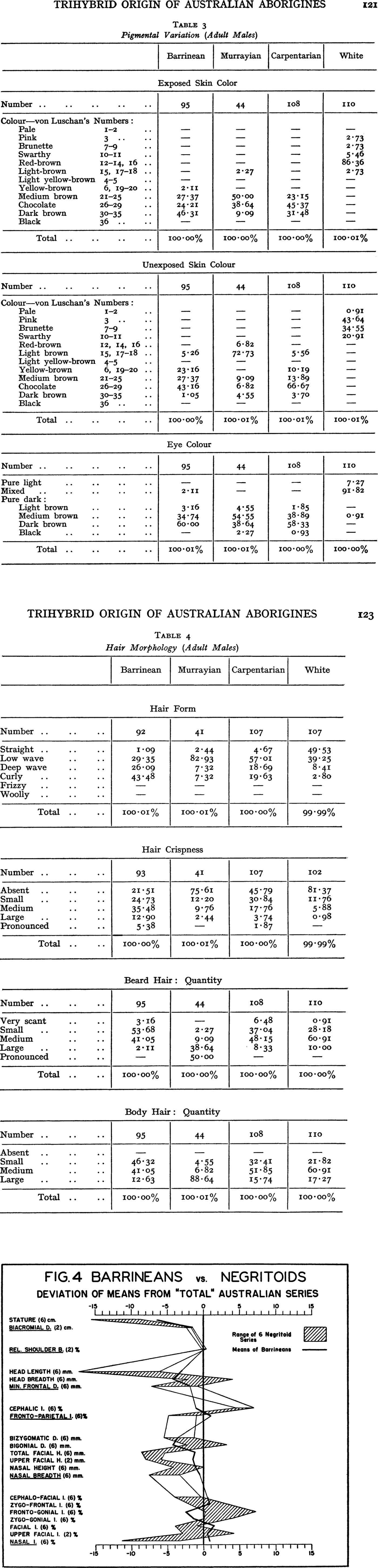
As late as 1976, the question of the racial coherence of the Aboriginal population had a recurring role, with one prominent supporter of the bounded-tribe view using morphological data to play up the character of linguistically delimited populations as discrete breeding pools. While accusations of denying biology, and reifying biology, have subsided since then, it is not difficult to see in these 1960s and 1970s controversies surrounding the nature of the Australian local group a precursor to contemporary debates over the ontological status of kinship—that is, over whether kinship is universally, focally concerned with biological consubstantiality, or alternately, is an idiom of social reproduction in which biological facts represent just one source of relatedness among many.
My aim is not to argue that Australian patterns of inhabitance in no instance and at no scale approximated to the picture I have ascribed to the linguists involved in the 1970 East Kimberley survey, that is, to a situation in which communities marked by uniformities of language and custom occupied contiguous stretches of territory to the exclusion of all others. But my argument with the tessellation view is not simply that its proponents have been too quick to sharpen territorial boundaries that, with the exception of physiographic features such as rivers, would necessarily have been fuzzy. The boundary that classicists have been most inclined to sharpen is that between ideology and practice, that is, between what they take to be (now disintegrated) systems of Aboriginal customary law that had been stable and conservative over the late Holocene, and a more heterogeneous set of coping strategies they assume could only represent ad hoc innovations whose salience in Aboriginal accounts of succession indicates the disruptions of the post-contact era.
The debate over the salience in Australia of the territorial tribe qua proto-nation fits into a broader argument in British social anthropology over the degree to which segmentary social structures in mobile societies afford a window on the social evolution of the state. Over the past twenty years these debates have taken on new relevance as geographers and sociologists of urban form have started asking whether we are witnessing a “deterritorialization” of citizenship, an attenuation of the role played by state control over simply enclosed extents of land in the attribution of legal personae to individuals and collectives. This debate was sparked in part by the breakup of the last of the great Central Eurasian empires, the Soviet Union (Ruggie Reference Ruggie1993). In anthropology, it has been carried forward by concern with how post-Fordist strategies of flexible accumulation shape labor and the legal statuses of mobile labor pools (Ong Reference Ong1999; Sassen Reference Sassen2006). Historians have taken a different tack, asking whether our received understandings of the origins of modern state territoriality—the Peace of Westphalia, the rise of the Schmittian nomos—are in fact myths (Sheehan Reference Sheehan2006). Perhaps, some have proposed, mobility was never the problem for the imperial state that we have made it out to be (Kesaba Reference Kesaba2009). Most recently, anthropologists have turned to anarchist theory to help them understand the evolution of social complexity in the absence of conventional forms of territoriality (Scott Reference Scott2009; Angelbeck and Grier Reference Angelbeck and Grier2012). By exploring how theories of proto-statal land occupancy unfolded within anthropology and were then exported to the legal realm, we can gain a measure of critical traction on debates over the relationship between labor mobility and the stability of legal institutions in our own time.
I have three further points. First, long before the land claims process was imaginable in its procedural specifics, those involved in sociological controversies surrounding Australian patterns of language, kinship, law, and landholding were aware that the outcomes could have profound consequences for the communities whose past behaviors were in question. Prior to 1970, anthropologists generally did not allude to kinship theory's political entailments in published work. But the languages and tribes debates exemplify, as Raymond Firth put it in an editorial marking the one-year anniversary of the debut of the journal Oceania, the “many ways in which a scientific study of native customs and institutions can be of direct practical assistance” in the governing of colonized peoples” (Firth Reference Firth1931: 5).
Second, these debates have continuing significance for the law of self-determination, not just in Australia but also at the transnational level. A close examination of how language, kinship, and territory were bound up in the system of law that anthropologists wrote into the Indigenous Australian past can help us understand certain facts about the emerging global legal ecumene.
Australia was the last of the Anglo-Imperial settlement states to devise a legal framework to deal with indigenous communities' demands for political recognition. In Australia we see “a rigid application of the doctrine of continuity” (McNeil Reference McNeil, Knafla and Westra2010). Applicants for recognition of native title to land must demonstrate that they represent a landholding group defined by a more-or-less fixed body of law and custom continuously exercised on the land (and, in some cases, water) in question since prior to the Crown's acquisition of sovereign dominion. Since 2001, the federal and high courts of Australia have increasingly been inclined to enumerate the specific rights enjoyed by native title-holders with reference to those uses of nature subject to traditional law in continuity. The Native Title Act refers to “societies,” not tribes. But the standards for assessing continuity in these societies make limiting assumptions about the nature of the relationships by which native societies—as opposed to settler societies—are enacted. These are relationships founded on persons' essential statuses, those given by birth and early childhood experience (in particular, first language). There is something distinctly tribal about native societies as formulated in Australian law. In this respect, Australia represents the logical conclusion of a shift in legal ontology that began around the time of the earliest fieldwork described below (Weitz Reference Weitz2008).
My third and most provocative point is that it may not matter so much whether or not we could provide an evidence-based answer to the question, “Who was here first?” That is because pegging a land distribution process to this question is corrosive of claimants' status as legal subjects and human beings. The legitimacy of “We were here first” is the third rail of distributive ethics. In the context of the liberal state it makes no semantic sense to challenge genealogical transmission as a basis for title. Transmission is the source of the moral authority of property, not something whose moral authority can be challenged. This too is an expression of, among other things, the long back-and-forth between anthropology and law.
POPULATIONS AND TRIBES
By 1910, a consensus had emerged among learned consumers of the ethnographic literature that the tribe, in Australia, was something of a vacuous concept. In his 1931 monograph The Social Organization of Australia Tribes, Alfred Radcliffe-Brown, then the primum mobile in social anthropology in Australia, explained that while, “The primary mark of a tribe is that it consists of persons speaking one language,” in Australia it “is not quite accurate” to refer to the tribe as a territorial entity. The “primary land-owning or land-holding group” is the horde. Hordes may straddle the boundary between neighboring tribes. And while patrilineal descent figures in the composition of the horde, the tribe itself is not a genealogical bloc—“A man may have as many kin in another tribe or in other tribes as he has in his own” (Radcliffe-Brown 1931: 4–6).
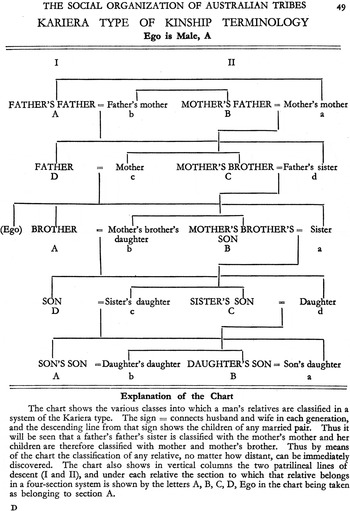
At the same time, the kinship system—“genealogical relationship recognized and made the basis of the regulation of social relations”—is at the root of Australian customary law. What gave Australians an idiom for talking about kinship, and the legal obligations it engendered, was totemism, “a system of customs and beliefs by which there is set up a special system of relations between the society and the animals and plants and other natural objects” essential for material and social sustenance. Totemism encoded a political ideology in which social life and territory were aspects of a single complex of relatedness. The tribe, though neither a territorial nor genealogical unit, was the unit of variation of the kinship system and, by extension, of customary law (see fig. 1) (ibid.: 6, 11–15, 29, 32).
Kariera (modern spelling: Kariyarra) kinship terms (Radcliffe-Brown Reference Radcliffe-Brown1930: 49; or 1931: 18). Much of Brown's 1910–1912 fieldnotes consist of trees like this one. Reproduced by permission of Oceania Publications.

In this way, Radcliffe-Brown left the door open to a flexible interpretation of the status of language as a marker of Australian political differentiation. While the linguistic tribe is insignificant for the purpose of tracking succession of title to land, the tribe becomes critical if what interests us is not simply continuity of title but continuity of the system of law in which that title originated. Since the 1971 Milirrpum decision, commissions and courts charged with hearing land claims in Australia have been concerned with questions of continuity both of title and of legal system. The second question is antecedent: no matter how valid a title may be under a set of local institutions for managing rival claims to land, it is meaningless if that set of institutions is not itself the unbroken and essentially unaltered continuation of institutions predating colonization.
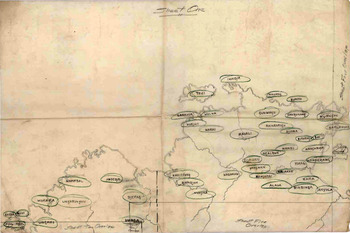
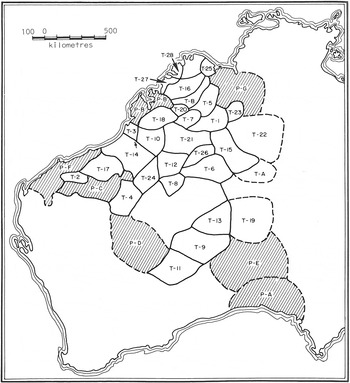
Radcliffe-Brown's own later use of the term “tribe” is consistent with a political cartography in which, notwithstanding so-called half-half hordes, populations delimited by boundaries in language and law occupied more-or-less fixed expanses of territory (see fig. 2).
Sheet One (Western Arnhem Land and East Kimberly) of a map depicting linguistically differentiated tribes of Australia, Alfred R. Radcliffe-Brown, ca. 1925–1930. Sydney University Archives P.130/6/18, “Tribal Distribution maps.”

CLANS AND HORDES
Radcliffe-Brown used “horde,” from a Turkic stem for “camp,” to refer to what he took to be the primary unit of political control of land in Indigenous Australia. The horde stood in contrast to the “clan,” the primary unit of patrilineal kinship. Whatever the tribe's genealogical status was, the clan was exogamous, and marriage uniformly virilocal. At marriage, a woman left her father's horde to join her husband's. For men, clan and horde were isomorphic: a horde was populated exclusively by men of a single clan together with the women who had married in and the children born of these unions. In this way, kinship and co-residence worked together to engender the diffuse bonds of common interest that made up the foundation of the political order. “A corporation,” Radcliffe-Brown explained, “can only form itself on the basis of a common interest”—in “the simplest societies” either locality or kinship or, as in Australia, both (Reference Radcliffe-Brown1935: 288). The horde embodies the origin of modern law in both its private and public aspects, evincing properties we associate both with corporate ownership and state territoriality.
KINSHIP AND THE GENEALOGICAL METHOD
As early as 1913, Radcliffe-Brown (then simply Brown) elaborated a distinction between two systems of kinship in Australia, which he initially referred to as Type I and Type II. Both systems entailed the division of the population into sections. Members of section A, say, could only marry members of section B. Their children would belong to a third section, most often determined by the mother's section, and members of this third section would, in turn, marry members of a fourth. Type I systems featured four sections, while Type II systems added a third generation to the cycle, yielding eight subsections. Radcliffe-Brown understood the section or “skin” system as a classificatory generalization of cross-cousin marriage. Usually the sections and subsections had distinct names in the local dialect, but in some cases the ethnographer had to infer the presence of a four- or eight-division system from informants' explanations as to who they could and could not marry. Though the section and subsection systems predominated, some tribes divided the population into just two moieties. “The study of kinship terminology,” Radcliffe-Brown stressed, “is the only way to any real understanding of Australian social organization” (Reference Radcliffe-Brown1931: 12). Not only did every group that had been canvassed have a system for classifying people along lines derived from the relationships among siblings, between parent and child, and between marriage partners, but the system was also extensible to anyone one came into contact with.
The genealogical method was designed to facilitate rapid surveys of the population in situations where the ethnographer had poor command of his subjects' language or was relying on interpreters. In its proponents' understanding, it presumed that one could identify unproblematic translations for “father” and “mother,” “brother” and “sister,” “husband” and “wife.” By means of these one could then elicit the grid of consanguineal relations among one's informants; metaphoric extensions of these relations; the local kin terms by which individuals referred to their consanguineal or classificatory relationship to specific others; and, with a little prodding, constraints on behavior among individuals who stood in particular relationships in the kinship system.
In Indigenous Australia, the kinship system could serve as an idiom for commenting on chance deviations from a norm relating birth to social location. These deviations posed no obstacle to the social reproduction of customary law, nor did they necessarily hurt the life chances of the individuals whose “skin” was exceptional. Early on, Radcliffe-Brown saw there was no way to be certain that the incidence of these deviations had increased since contact with Europeans. As time went on, he came to emphasize the prescriptive character of subsection filiation to the exclusion of its commentarial role. And while he stressed that social structure was to be regarded as an ongoing process of adaptation to circumstances, he was equally emphatic that it was possible in the case of Australia to identify an underlying unitary type of social organization. The state, by contrast, he saw as an intolerable reification (Reference Radcliffe-Brown, Fortes and Evans-Pritchard1940).
DREAMING AND COUNTRY
By the 1930s, Australianists had come to accept that there was no possibility of arriving at a unified theory of the social function of totemism. It was, rather, a heterogeneous assortment of institutions by which human beings acknowledged enduring bonds between themselves and non-human elements of the material environment, most commonly animals but sometimes plants or even meteorological phenomena such as lightning. For clarity, let us dispense with totemism and focus on the conceptual matrix that gives rise to human/other solidarity in its principal and encompassing form in Australia—the Dreaming.
The Dreaming, a term popularized by W.E.H. Stanner, refers to a cosmogonic epoch in which Ancestors, the progenitors of living things found in the world today, walked the continent performing deeds both heroic and mundane. A record of the Ancestors' wanderings was impressed upon the land. Dreaming sites, places whose distinctive physiographic features—an escarpment, a water hole, a clump of gum trees—marked the peregrinations and land-making activities of Ancestors, were the focus of Australians' ongoing participation in the Dreaming. Affiliates of a particular Dreaming would gather periodically to sing and ritually reenact the Ancestors' travels, thereby recreating the land itself and propagating any natural phenomena associated with particular Ancestors. Multiple Dreaming sites and sites of multiple Dreamings could be found in the area occupied by a single community.
Among participants in a Dreaming, responsibility for “holding up” the country at sites representing stages in the Ancestor's wanderings was held by different groups. In some cases, the initiated men of a local group, or of a single patrilineage represented in that local group, had custodial responsibility for the sites of their Dreaming that fell in the vicinity of their common place of residence. In other cases, custodial responsibility for Dreaming sites was not tied to residence. You might refer to the territory surrounding sites for which you shared responsibility in the Dreaming as “my Country.” Commonly, but not universally, this responsibility was transmitted by patrilineal descent, with the Ancestor whose activities were the subject of the Dreaming understood to be the apex of a descent tree ramifying across groups defined by residence, language, mode of subsistence, customs of dispute resolution, or any other criteria anthropologists have associated with tribal boundaries. In many parts of the continent, you were also tied to Country by conception Dreaming—the Dreaming of the place where you were conceived—though place of conception was open to flexible interpretation to maintain a preferred relationship between conception Dreaming and descent (i.e., inherited) Dreaming. This relationship was usually not one of identity, and under certain circumstances you might assume responsibility for maintaining the site associated with your conception Dreaming in preference to that of your descent Dreaming. Alternatively, you might participate, initially as an outsider, in the ritual work of a Dreaming that was not yours and, over time, come to be entrusted with the songs and other secret knowledge associated with sites in that Dreaming. In other words, there were multiple paths of recruitment to Dreamings, and not all of them revolved around indexical relations of kinship, whether patrilineal descent, matrilineal descent, or conception.
Whether custodial responsibility for particular Dreaming sites conferred ownership of the country around those sites would later become an object of dispute, along with whether paths of recruitment to Country other than patrilineal descent were recognized as valid prior to the destabilizing effects of contact with settlers.
CLANS AND HORDES, AGAIN
In a 1959 article in Oceania, “The Concept of ‘the Tribe’ in the Western Desert of Australia,” anthropologist Ronald Berndt called into question the use of the term “tribe” for the peoples of the Western Desert. Neither autonymy—self-naming—nor mutual attributions of linguistic differences were significant markers of political difference generally associated with “tribe.” In fact, Berndt said, most words identified in the literature as names of Western Desert tribes had “little more than linguistic significance,” amounting to compounds indicating localized forms for common actions: “The name Bidjandja(ra) [contemporary usage: Pitjantjatjara] is based on the stem bida = go; -dja(ra) = having; that is, those people who use bida (or bidja) to refer to the action of ‘going’” (ibid.: 92). The small set of words used to draw these distinctions, in fact, pointed to “a common awareness of belonging to a cultural and linguistic unit, over and above the smaller groups identified by these names,” even if the broader “cultural bloc” remained unnamed.
Berndt stressed that his consultants were “displaced persons” (Reference Berndt1959: 96) who had by and large abandoned precontact habits of subsistence. But he concluded that the tribe concept was not just unworkable in the Western Desert: it served to mask assumptions about the nature of the principal social relations among communities designated “tribal” or “detribalized,” assumptions that had nothing to do with the nominal diacritics (shared territory, common language) of tribal identity. “Tribal,” Berndt argued, denoted a society formed on relations of status as opposed to contract. What anthropologists meant by “the tribe,” he asserted, was just the absence of the legal impartiality they attributed to the state.
Berndt's paper was the opening salvo in a new round of debates on the nature of Aboriginal Australian political life. They would focus on cases from the Western Desert and Arnhem Land and on contrasts of rainfall, modes of subsistence, and salient axes of social categorization between the two areas. Though Berndt expressed frustration with Radcliffe-Brown's failure to consistently distinguish between clan and horde, he did not explicitly challenge the Brownian model. Three years later, however, L. R. Hiatt did, in “Local Organization among Australian Aborigines” (Reference Hiatt1962), which drew on his own fieldwork in both the Western Desert and Arnhem Land, and Mervyn Meggitt's just-published ethnography of the Warlpiri of the north-central desert (Reference Meggitt1962).
Among the Warlpiri, Meggitt argued, custodial responsibility for sites along a Dreaming track did not confer upon the custodians anything like ownership in the common law sense. In fact, he said, transmission of responsibility for specific sites was not linked to residence. Sedentarization had initiated a cascade of changes in Warlpiri strategies for the social reproduction of land. With so many people concentrated in just a few places, shared conception Dreaming was assuming a new salience in social identity that might, with time, overtake patrilineal initiation into Dreamings associated with sacred sites that the young people never got to see. Over time, the rituals for these Dreamings would lose significance as a way of reaffirming custodial responsibility for sites along particular Dreaming tracks (Meggitt Reference Meggitt1962: 63).
Hiatt expanded on Meggitt's argument. He identified four modes of social presentation with widespread salience in Aboriginal Australia: (1) claims to land defined by unchallenged use of the material resources of a particular stretch of country; (2) claims to land defined by custodial responsibility for a set of Dreaming sites; (3) co-residence at various points in the seasonal foraging cycle; and (4) affiliation—by birth, adoption, or common assent—with a particular patrilineage. The relationships among these four styles of relating, Hiatt argued, were manifold and labile, and this, from what anthropologists could tell, had been case in many different parts of tropical and subtropical Australia since well before the coming of Europeans.
Hiatt included his own observations from twenty months' fieldwork at Maningrida Settlement, 500 kilometers east of Darwin, where “patrilineal descent is not the only, or even the outstanding, determinant of residential associations … or of the composition of hunting and foraging parties”—his account is worth quoting at length:
In 1958 a man abandoned his hut in the native village after his infant son died. He built a new hut on vacant land on the outskirts of the village. Certain relatives followed him and by 1960 his dwelling was one of five forming a distinct cluster.
The second man to build was the first man's M.B. [mother's brother], the third the W.B. [wife's brother] of the first man, the fourth man the son of the third man's wife by a previous husband. The older brother of this last man later occupied the hut while the owner was absent in Darwin. The fifth man to build was a classificatory father of the third man, but of a different community. He moved from his previous home after a series of arguments over the bestowal of his eldest daughter; he was followed by his son, his deceased brother's son, and a classificatory brother of his own patrilineal group. When he went back some six months later a close classificatory brother of the third man moved into the empty dwelling. The newcomer and the third man are members of the one patrilineal group (ibid.: 282).
On the basis of comments from his local consultants, Hiatt argued that such a settlement “could have formed and persisted for short periods in the pre-settlement past” and that Maningrida people made flexible use of a range of bilateral kinship ties to legitimate patterns of co-residence arising from circumstance.
Two and a half years later, Radcliffe-Brown's former student W.E.H. Stanner published a response (Reference Stanner1965). He mounted a two-pronged defense of Radcliffe-Brown's system. First, Stanner reframed the debate over the nature of Aboriginal political organization in ecological terms. Then he introduced a metatheoretical critique of what he suggested was his opponents' overly literalistic approach to social ontology.
Aboriginal territoriality, Stanner explained, had to be understood in terms of a distinction between “estate” and “range.” By “estate” he had in mind what anthropologists had sometimes referred to as “Country”: that extent of territory that a political community, defined, say, by patrifiliation or shared Dreaming, could be said to own, possess, or hold. The range, by contrast, “was the tract or orbit over which the group, including its nucleus and adherents, ordinarily hunted and foraged”—generally it would encompass the estate, though Stanner allows for the possibility that estate and range might become “practically dissociated,” as in the case of the Warlpiri described by Meggitt. Ranges, unlike estates, might overlap, and the extent to which this was typical of an area would vary according to the ecological exigencies of subsistence. In the wet-tropical environment of coastal Arnhem Land, where food and the basic necessities of shelter and tool manufacture were plentiful year-round, there was no need for range to extend beyond estate, and interaction among tribes, stimulated by boredom or a desire to trade in food and raw materials whose supply was highly localized, was highly institutionalized. In the Western Desert, by contrast, where for most of the year no single campsite could provide a stable subsistence, it was common for communities with distinct countries to come into contact in the ordinary round of foraging, and to share food not for the aesthetic pleasures of ritualized exchange but rather because reciprocity was critical to survival.
The estate-range distinction, Stanner insisted, together with an ecological theory of patterned variation in Aboriginal mode of subsistence, was “inherent” in the work of Radcliffe-Brown. Hiatt had ascribed to Radcliffe-Brown's concepts a rigidity the latter had never intended. “A general type,” Stanner proposed, “does not have to ‘exist’ except in a distributive sense, which is everywhere yet nowhere in particular” (ibid.: 10). In fact, the Kariyarra and Arrernte, Radcliffe-Brown's type-specimens of Aboriginal social structure, were themselves ecological anomalies, since they inhabited areas that got around one month a year of rainfall sufficient to produce flora and fauna in an abundance equal to the subsistence needs of the tribe. The rest of the year, more-or-less independent bands of foragers were compelled to range far from home in search of food. Ultimately, the tribe was nothing more than a “congeries of bands: it is to the bands that ecological analysis must surely relate” (ibid.: 21). The modal Australian tribe, Stanner estimated, enjoyed five to nine months of effective rainfall annually. Later anthropologists, Hiatt included, had failed to appreciate Radcliffe-Brown's project, which was in the nature not of ethnographic particularity but ontological abstraction.
In fact, Radcliffe-Brown seems to have carried throughout his mature career a conviction that the structure-giving role of classificatory kinship and totemism in Australian political life entailed a rigid adherence to the system in ideology if not in practice. Consider this exchange, from the Q&A period at the end of the eighth and last of a series of lectures Radcliffe-Brown gave on “Primitive Cosmology” (in the event, focusing exclusively on Australia) at Birmingham University in 1951:
Q. I wondered whether there was some feeling of insecurity when they learn their tribe's dying out?
A [Radcliffe-Brown]. Oh yes, the situation of the Australian Blackfellow now, with the land taken away and the population diminishing and he cannot any longer perform rituals, is one of complete depression.
Q. And not evolved any cosmology to help?
A. He cannot even find, so far as I can see, any solution by taking on any other cosmology and become a Christian [pause] very very sad.
Q. Is that not an argument against having a too consistent cosmology?
A. No [pause] an argument against getting exterminated, that is all.Footnote 1
Throughout these lectures, his last major public presentation of his theory of Aboriginal politics, Radcliffe-Brown hammered home the tragic consequences of a community's having committed itself to so marvelously intricate a system of social structure:
Q. You say the blackfellow only has cognizance of own happenings [sic] during his own lifetime. If the species has died out what will the next generation do for a totem?
A. Well, the next generation probably have died out too. You forget that the dying out of animals is only one result of the taking of their land by white men. The dying out of aborigines is another result.Footnote 2
The audience persisted with questions about possibilities for salvage, provoking Radcliffe-Brown to exasperation: “You have got to remember you are dealing with a people that is very rapidly disappearing, and material which I collected in 1910 it would be quite impossible to collect now and material which I might have collected in 1910, if I had had the time will never be collected.”Footnote 3 Twenty years later, Australian courts would take up the question of just how rapidly Indigenous Australians were getting exterminated.
MATHA AND MALA
Milirrpum v. Nabalco Pty Ltd came on the heels of a 1967 referendum in which (non-Indigenous) Australians voted nine to one to amend the 1901 Constitution to include Indigenous populations in the national census and to give the federal government the power to make law with respect to those populations. It also followed the Gurindji walk-off started in 1966 at Wave Hill Station, 1,200 kilometers by road southeast of Yirrkala, the site contested in Milirrpum. Public sentiment in favor of Aboriginal claims had been building since the Yolngu community at Yirrkala had first demanded the withdrawal of a Nabalco bauxite concession in 1963. They did so with a typewritten petition affixed to a Yolngu bark painting, which the initiated men of Yirrkala sent to the Commonwealth Parliament in Canberra, where it was pointedly ignored. The highly publicized wars then unfolding in the Brazilian Amazon and in Biafra, which had inspired the formation of Survival International in London and the Copenhagen-based International Work Group for Indigenous Affairs, contributed to an environment in which Indigenous Australians' demands for restitution attracted a level of public sympathy unimaginable ten years earlier (Merlan Reference Merlan2005). As a matter of law, however, it was not even established that Indigenous collectivities of any kind had standing in Australian courts.
The Commonwealth and Nabalco played this angle, filing a motion for summary judgment on the grounds that there was “no cause of action”; that is, that no legitimate legal actor could be said to be potentially wronged by the Commonwealth's action in granting the mining concession. Justice Blackburn of the Northern Territory Supreme Court rejected this argument. At the same time he found that the complainants had not made clear the basis upon which they presented themselves as a group with collective proprietary interest in the land in question, and he offered the plaintiffs the chance to prepare a new statement of claims (Williams Reference Williams, Hinkson and Beckett2008).
Stanner and Ronald Berndt both served as consultants to the plaintiffs in Milirrpum. The former, secure in his status as the senior figure in Australian anthropology (Mulvaney Reference Mulvaney, Hinkson and Beckett2008), took the lead in preparing the expert evidence on the nature of Yolngu territoriality and estate succession, even though it was Berndt who had extensive fieldwork experience among the people in question. Stanner's own fieldwork for the case amounted to a single week's visit to Yirrkala early in the wet season of 1969. Stanner wrote his own disposition to see landholding agnatic clans everywhere in Australia over Berndt's published accounts of the choreography of linguistic unit and clan—in Yolngu, matha and mala.
For Stanner, matha and mala represented, in practice, parallel nomenclatures with isomorphic scope of reference. Occasionally, he said, a single dialect group might encompass multiple mala. Berndt, by contrast, presented matha and mala as orthogonal systems of classification connected in many-to-many fashion. It was the matha-mala pairing that situated the individual with respect to obligations to others, in terms of subsistence, collaboration in enacting Dreamings and initiation rites, mutual defense, and support in disputes (Reference Berndt and Peterson1976).
Justice Blackburn was annoyed. Stanner's presentation had the advantage of conforming to a common law understanding of “clan,” whereas Berndt's matched up better with what the Yolngu witnesses themselves said. The Yolngu, however, preferred in most cases to use the matha alone, which Berndt confirmed, under questioning, was the customary practice (Williams Reference Williams, Hinkson and Beckett2008).Footnote 4 Ultimately, despite ambiguities over the composition of the territorial entity, Blackburn found that the Yolngu operated under a coherent system of tenure and succession that would have been intelligible to British common law as it was in 1824, the date of onset of Crown sovereignty in the Northern Territory. His decision denying the Yolngu plea for an injunction against mineral development on the Gove Peninsula was formulated on grounds of jurisdiction, standing, and procedure that he derived in part from a just-released provincial high court decision in Calder v. British Columbia (1973, S.C.R. 313; Nettheim Reference Nettheim, Foster, Raven and Webber2008).
TRIBES AND BOUNDARIES, AGAIN
Despite Blackburn's ruling against the plaintiffs in Milirrpum, change was coming to Indigenous-Commonwealth relations. In 1973, Stanner found himself a consultant to a Royal Commission appointed to devise procedures for land claims hearings in the Northern Territory. The Woodward Commission's recommendations would lead to the passage of the Aboriginal Land Rights (Northern Territory) Act 1976 (Commonwealth) and the establishment of land claims commissions for Central Australia and the coast of the Northern Territory. The same year saw a conference at the Australian National University in which the question of the Australian tribe was addressed with uncharacteristic directness—whether such a thing could be specified, and if so whether in terms of bounded extents of language, territory, kinship system, legal tradition, mode of subsistence, ecological constraints, endogamy, or trade. It is not just the timing that makes the symposium on “Ecology, Spatial Organisation and Process in Aboriginal Australia” notable, but also the people involved. The symposium was conceived as a kind of parley between Norman Tindale and Joseph Birdsell, on one hand, and figures closer to the institutional heart of Australian anthropology, among them Hiatt and Ronald Berndt.
If it seems strange that Tindale and Birdsell's work did not enter these debates until now, this is because both led professional lives disconnected from the institutional centers of Australian anthropology. Birdsell was based at UCLA, and his collaboration with Tindale had been his main point of contact with Australian anthropology. This collaboration originated with the 1938–1939 Harvard-Adelaide Expedition, but was renewed after the war via the UCLA-Adelaide Universities Anthropological Expedition of 1952–1954, which sought to canvass parts of the Northern Territory and the northwest that had been ignored by the earlier survey. Over the two decades that followed, Tindale and Birdsell maintained their working relationship via occasional joint seminars in Los Angeles (Tindale Reference Tindale1974: x). Tindale, for his part, was based at the South Australian Museum. His publications appeared in that museum's house organ, the Transactions of the Royal Society of South Australia, and never in Oceania. Anthropologists at Sydney, and later Canberra, tended to treat Tindale's cataloguing enterprise as something they could disregard. But now, between the impending publication, by the University of California Press, of Tindale's Aboriginal Tribes of Australia (Reference Tindale1974) and the rapidly evolving land rights situation in Arnhem Land and the north-central desert, the tribal realists, perennial outsiders, were impossible to ignore.
We need to keep in mind the context for Australianist debates on ecological constraints on human behavior. The proceedings of the 1966 conference “Man the Hunter” (Lee and DeVore Reference Lee and DeVore1969) were making the rounds, and seven of the thirty essays concerned Australia; Meggitt and Birdsell both had contributions, and Les Hiatt had two. Tiger and Fox's The Imperial Animal appeared in Reference Tiger and Fox1972; Wilson's Sociobiology would appear in Reference Wilson1975. The 1973 fellowship that brought Tindale and Birdsell to the ANU was arranged by, not an Australianist, but mid-career anthropologist Derek Freeman, who would soon make a name for himself in public debate over the limits of culture's autonomy from biology (see Shankman Reference Shankman2009).
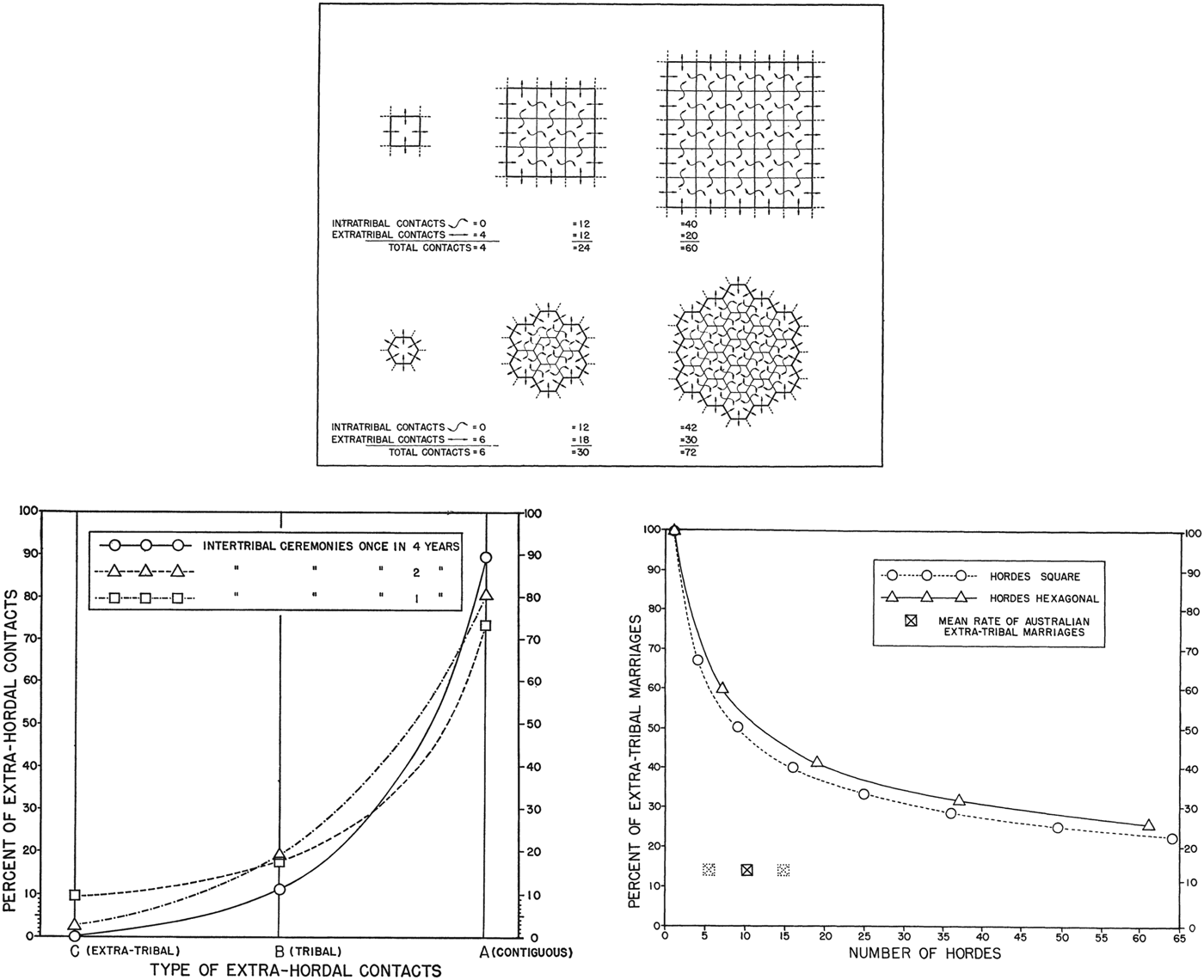
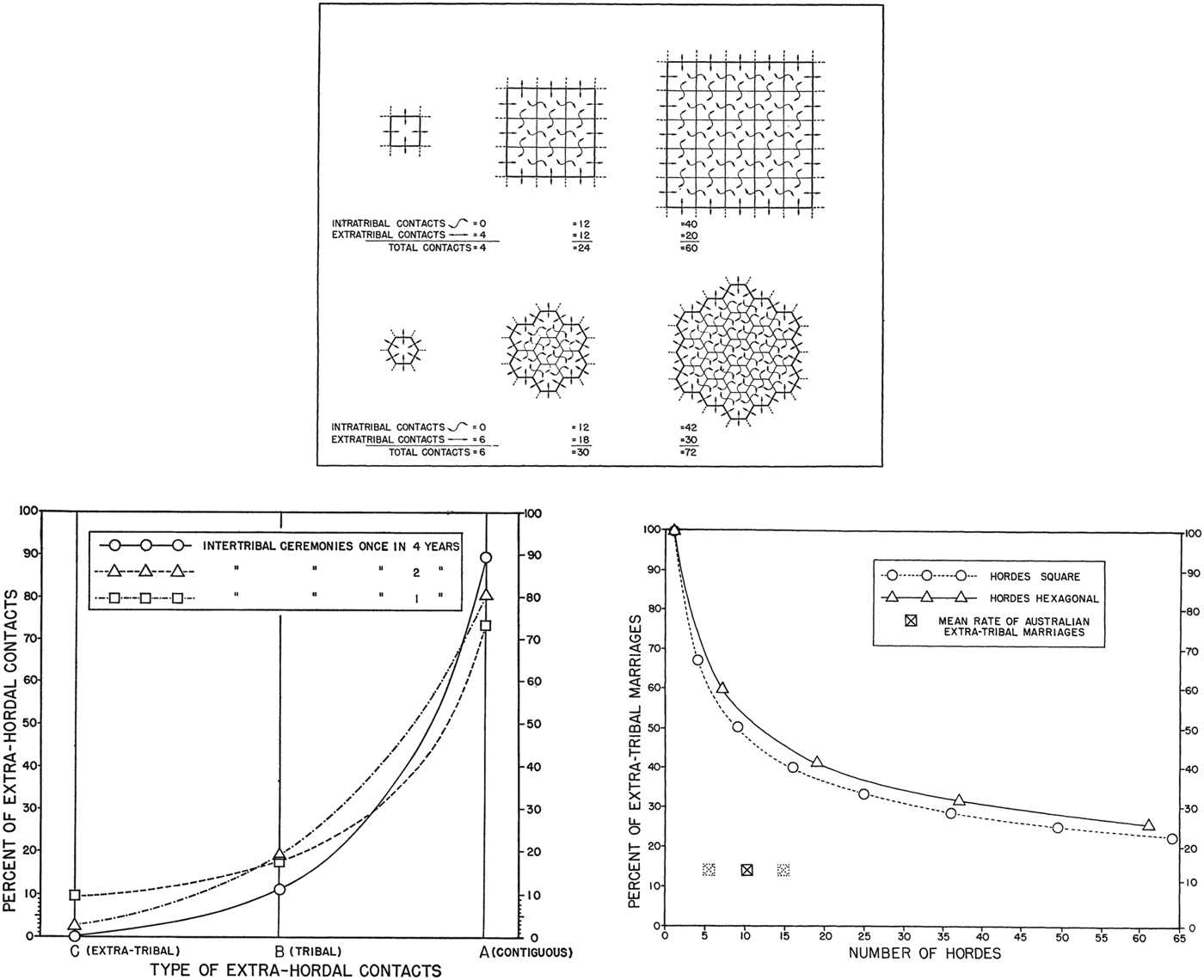
Symposium moderator Nicolas Peterson (Reference Peterson and Peterson1976) was conciliatory, suggesting that, notwithstanding the fluidity of seasonal and annual inter-band relations and the expansiveness of “culture areas” bounded by watersheds, an intermediate formation, comparable to Tindale and Birdsell's tribes, might emerge along the lines suggested by a model of inter-band communication earlier proposed by Birdsell (Reference Birdsell1958; see fig. 3).
Inter-band and intertribal contact (Birdsell Reference Birdsell1958: 197, 198, 202). Unsupported speculation on the role of language in promoting intra-group cohesion continues in paleoanthropology today, as see the remarks on the relative efficiency of language and fingertip grooming as methods of confirming interpersonal bonds in the otherwise cogent Gowlett, Gamble, and Dunbar (Reference Gowlett, Gamble and Dunbar2012: 702). Reproduced by permission of Wiley.
Tindale was less open to compromise: “Since every tribal unit in Australia has an old and clearly Aboriginal name, either their own or bestowed on them by neighbours, tribes have reality.” These “fixed names,” “old enough to have been in existence over time measured in centuries,” are the basis for the “finite line[s]” required in map making. Despite attested instances of tribes' shifting, these boundaries were stable and reflected boundaries in climate, geomorphology, and the ecology of subsistence (Reference Tindale and Peterson1976: 13–14).Footnote 5 The tribe, Tindale said, was a linguistic community, but it was more: it also represented the “largest consistent unit” of ritual, initiatory, and productive life. Those who denied the reality and territorial fixity of the tribe were either ignoring Aboriginal Australians' clear statements on the matter or projecting the influences of contact back into the precontact era (Reference Tindale1974: 33, 18, 115–17).
Ecological barriers, Tindale said, had been reinforced over time by a disposition to view intercourse with strangers in an overwhelmingly hostile light. Along with unfamiliarity as to how to get food from country outside one's own, sources of fear included “differences, large and small, in modes of speech.” Intergroup hostility and the absence of a deep tradition of intertribal contact is a running theme of Tindale's work, which is ironic given that his introduction to the study of tribal boundaries came from an Aboriginal man whom Tindale met in 1921 and who had spent his life as something of an itinerant trader, carrying quartzite blades to communities up and down the western rim of the Gulf of Carpentaria (ibid.: 3).Footnote 6
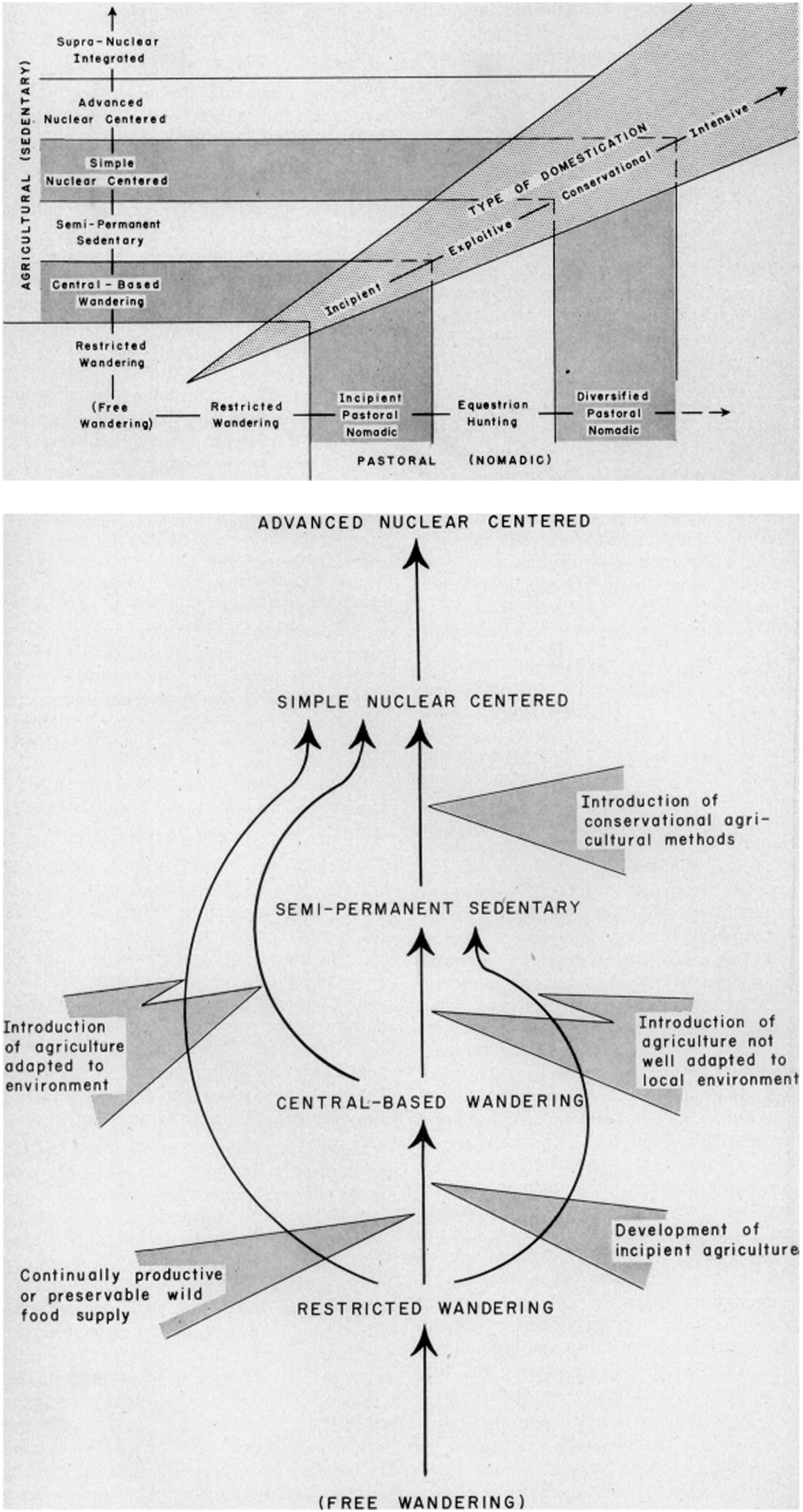
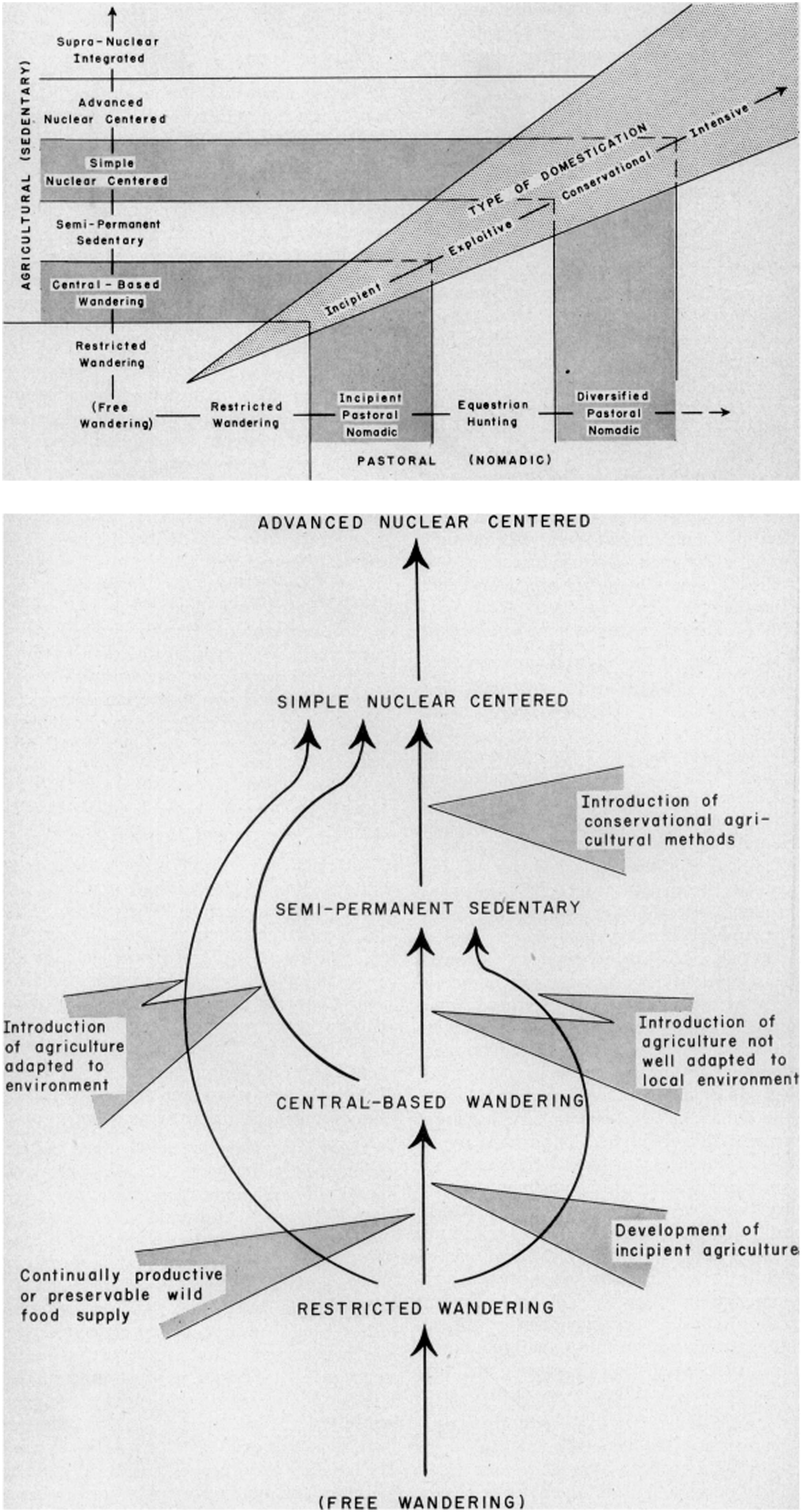
Tindale's data consisted largely of genealogies, together with lists of autonyms that represented, in his view, proof that Aboriginal Australians understood themselves to be arrayed among a number of distinct tribes. To this data he brought a range of speculative theories on the ecology of foraging societies and the evolution of subsistence patterns (see fig. 4). What makes his work compelling is that it represents an unambiguous effort to stake out a position on Australian patterns of language, land use, and social identity consistent with the forms and usages of the law of self-determination that was then taking shape in other settlement states and at the international level. That Tindale's model ultimately had little direct influence—that is, as expert anthropological opinion—on the development of Indigenous land claims law in Australia should not blind us to the fact that its very existence, reaffirmed by the timing of the 1974 publication Aboriginal Tribes of Australia, lent comfort to the many judges and lawyers who felt anthropologists were producing a needlessly complicated picture of how Indigenous Australians related to country.
Gathering the hunters: Beardsley et al.'s (Reference Beardsley, Holder, Krieger, Meggers, Rinaldo and Kutsche1956: 151, 154) seven-fold functional-evolutionary model of community patterning. Tindale argues that most Australian tribes exemplified Beardsley's “Central-Based Wandering” stage, though “In the Western Desert the decline of peripheral tribes, through culture contact with Europeans … has left a few people of the innermost desert areas temporarily in a postclimax phase of free wandering” (Tindale Reference Tindale1974: 10). Reproduced by permission of the Society for American Archaeology from Memoirs of the Society of American Archaeology, No. 11, 1956.
Of greater significance for the intersection of anthropology and policy was the work of Tindale's longtime collaborator, Joseph Birdsell. In his own contribution to the 1973 symposium, Birdsell reasoned that while the tribe was a linguistic entity, its reality could only be measured against “the distinctiveness of reproductive behaviour” among populations so delimited. To this end, he purported to show that, for the Western Desert and Kimberley, the rates of incidence of four blood group alleles (assessed phenotypically) followed mutually independent clines, with the pattern produced by the intersection of these clines closely resembling Tindale's data on tribal territories. In the part of Australia for which Berndt questioned the validity of the tribe concept, “evolutionary events show a marked tendency to operate upon tribes as individual units” (Birdsell Reference Birdsell and Peterson1976: 110; see fig. 5).
The tribe as breeding pool (Birdsell Reference Birdsell and Peterson1976: 98).

Birdsell had been interested in human population genetics since his time with Tindale on the Harvard-Adelaide Expedition, but in the years leading up to the 1973 symposium he had been growing increasingly vocal in his opinions regarding the demographic history of Australia. In a 1967 article, Birdsell detailed findings dating to an unexpected series of observations he had made on the 1938–1939 expedition. Acknowledging that methodological problems stood in the way of rigorous racial taxonomy, he felt he had nonetheless identified regional differences in the racial type of Indigenous Australians consistent with three separate immigration events over the course of the last Pleistocene glacial maximum. In Australia, he said, one could see three late Pleistocene hunting populations “preserved out of time and out of place” (Reference Birdsell1967: 135). One of these resembled the “Veddoid” racial group observable in southern India, another the Ainu, and the third the “Negritoid” foragers to be found in the Andaman Islands and in scattered sites throughout insular Southeast Asia. The racial character of two of the Australian types was explicable, Birdsell proposed, with reference to introgression between modern humans migrating from Sunda into Sahul and relict populations of pithecanthropoids they encountered along the way—“an essentially Caucasoid type … brutalized through absorbing genes from descendants of Sinanthropus” (see fig. 6).
Exposing the fallacy of Australian racial homogeneity (Birdsell Reference Birdsell1967: 121, 123, 141). Reproduced by permission of Oceania Publications.

Critical to Birdsell's method was comparative physiognomy. For his 1967 report, Birdsell selected eighteen individuals from approximately eight hundred photographed during the 1938–1939 expedition. The eighteen ranged in age from their early twenties into their seventies. For each, Birdsell gave a locale, age, height, and weight, and offered clinical commentary; for example: “Clearly Negritoid in appearance.… Note lesions of dermal leprosy and generally infantile features. … Full-blooded in spite of very Caucasoid appearance.… An over-sized, masculinized type whose beard requires shaving.… Again observe cephalo-facial relations and non-European look” (Reference Birdsell1967: 150–52).Footnote 7
Birdsell understood his project to be centrally concerned with identifying the populations associated with specific tracts of land. His oeuvre articulates, in an exceptionally precise way, assumptions about the relationships among language, race, and country that have operated as a working model of demographic history and social structure in postcolonial land law in a wide range of legal settings. For Birdsell, the fact that hunting man—“like most terrestrial vertebrates”—exhibits clear territoriality is given (Reference Birdsell1958: 190). So, too, is the transparent nature of territoriality, which requires no definition but, we may assume, encompasses exclusive claims to the productive resources of a fixed extent of the earth's surface, along with the prerogative to deny access to those resources to all Others—the rivalrousness and excludability of North Atlantic definitions of real property. Of course, practically no group of human beings, and certainly none in Australia, can avoid contact with outsiders. To explain rates of genetic drift across tribal boundaries and to estimate the role of cultural cohesion within the tribe in inhibiting exogamy, we need to know something about the number of hordes per tribe and the frequency, intensity, and duration of inter-hordal and intertribal contacts. Birdsell naturally assumed that to a large extent these depended on and indicated linguistic similarities among the groups in question (Reference Birdsell1958: 201–3; 1970: 118).
“Unhappily,” Birdsell explained, “Australian Aborigines, like men everywhere, have a reality that places them as physical people in a material country with continuous food and water requirements,” not simply “a cultural base upon which to construct formal systems of social behavior.” This was the theme of a 1970 article that echoed Stanner's Reference Stanner1965 paper, “Aboriginal Territorial Organization: Estate, Domain, and Range,” in language derived from behavioral biology. “Ecology in aboriginal Australia,” Birdsell explained, “represented a closed system,” a balance between the carrying capacity of the land and the behavior of its inhabitants (Reference Birdsell1970: 116). In the precontact ecosystem, natural constraints on human behavior had yielded a stable social order in which collectivities of around five hundred persons exhibiting linguistic uniformity, exclusive access to a fixed territory, and an 85 percent rate of endogamy were arrayed in a tessellation across the Australian landmass—Birdsell's “dialectical tribe.”Footnote 8 This stable order quickly disintegrated in the face of white contact. In many cases, settlers instigated the disintegration by bringing livestock into country incapable of supporting intensive pastoralism.
In other cases, Birdsell said, it was Indigenous Australians themselves who initiated the disturbance of the precontact balance, simply by withdrawing from the land to mission stations. Everywhere, “the closed system now becomes open-ended,” even for groups who were still getting a living by foraging. Novel circumstances had altered native attitudes both toward “territorial rights” and linguistic difference. It was dislocation and sedentarization, Birdsell suggested, that had produced the exceptional linguistic situation—family-like languages, and ubiquitous multilingualism—remarked on by so many anthropologists and linguists. By taking genealogies back into the precontact era, he said, it would be possible to reconstruct the linguistic and territorial affiliations of particular breeding pools under late Holocene climax conditions (ibid.: 117–18).
Accordingly, Birdsell was concerned, above all, to specify the onset of sustained contact with settlers for all the populations in the north and west where contact occurred late enough that anthropologists were able to collect genealogies no more than a generation or two after. Here is an excerpt from his account for the Kayadild of Bentinck Island, Gulf of Carpentaria:
A new era in the protocontact period was opened by the officers of the Mornington Island Mission, who commenced systematic efforts in 1920 to establish contact with the Kaiadilt. In that year, they left some gifts on the beach for the natives. In 1926, a Mornington Island Aboriginal fishing for bêche-de-mer came upon an old Kaiadilt woman gathering food on a reef. He attempted to converse with her without success, for she could not understand his Lardiil dialect. The Mission continued these fishing efforts close to Bentinck Island, but no contacts were effected. In 1927, Mission Superintendent Wilson made a visit to Bentinck Island and there saw several men and very young women, all of them exceedingly timid. A photograph revealed 13 natives veering away from his camera. A second contact in the same year, an occasion when further photographs were taken, resulted in his meeting 48 Kaiadilt. Shortly thereafter, the Bentinck Islanders began to steal from the bêche-de-mer fishermen; to prevent hostilities, the Mission suspended these fishing operations, and they were never resumed (Reference Birdsell1970: 139).
Birdsell concludes that “effective definite White contact” began only in 1948, when the Kayadild were removed to Mornington Island.
By pinpointing times of first sustained contact, he hoped to show that the inferences of Berndt and Hiatt reflected an open-ended, post-climax regime of subsistence in which climax-era regularities no longer held. In the case of Berndt's work in the Western Desert, the disagreement was over less the ecological basis of the subsistence regime than the cultural and reproductive entailments of that regime, entailments that came to light not via genealogies or serological data but by inference from bedrock facts about how language works in foraging communities. Observed “linguistic uniformities” had to indicate a “density of face-to-face communications,” which in turn “acted as a partial barrier to cultural exchanges,” including the exchange of women (ibid.: 124). Territorial boundedness, Birdsell asserted, was implicated in the success of the dialectical tribe: “The dialectical tribe … is cohesive because its territorial groups, through their proximity to each other, maintain a rate of face-to-face interaction which produces a generally uniform dialect and a common cultural content” (ibid.: 138).
Birdsell and Tindale's assumption that although the dialectical tribe lacked “political authority” it was, nonetheless, a territorial entity in much the same sense as a state, and could be seen to lend support to Indigenous land claims. The problem, as Justice Blackburn recognized in Milirrpum, was that, in claimants' own accounts of how they related to land, there was no alignment of language, tribe, and country in the way a dialectal tribe model would predict.
LANGUAGE OWNERSHIP
Within five years of the publication of Aboriginal Tribes of Australia, a pair of young linguists proposed that at least in one part of Australia, speakership, far from representing the exemplary diacritic of membership in a well-defined social collectivity with exclusive claims to the productive use of a specific extent of land, was distributed in a fashion orthogonal to other modes of social cohesion. Peter Sutton and Bruce Rigsby found, “The ‘dialectal tribe’ model used in some Australian linguistic and demographic studies has no support whatever from the Wik-speaking area” of Cape York Peninsula (Reference Sutton, Rigsby and Wurm1979: 715).
Fieldwork in Cape York Peninsula led Sutton and Rigsby to wonder where else speech community and breeding pool might fail to align. Cape York, with a climate and physiography not so different from Arnhem Land, might be expected to produce a density of habitation tending to distortions of the ideal-typical dialectal tribe of drier regions. But even in the Western Desert, they concluded, social networks so frequently cut across linguistic communities as to call into question the existence of the tribe (ibid.: 726). A follow-up article introduced the term “language ownership,” which in their usage refers to a range of phenomena in which, in Indigenous Australians' own reckoning, named registers and speech practices come to stand in a metonymic relationship with other elements of the social field, often, though not exclusively, filiation to a particular Dreaming. Language ownership is not necessarily, or even modally, tied to use of the speech form in question, nor by one's place in a classificatory kinship system: you do not own a language by virtue of speaking it, or by virtue of belonging to a particular generation, or by conventions of avoidance and deference—the languages in question are not “women's language” and “men's language,” or “mother-in-law/son-in-law language.” In the Wik-speaking area, they found, ownership of particular speech forms is distributed across co-residence groups in a “somewhat random” fashion (Rigsby and Sutton Reference Rigsby and Sutton1980: 20).Footnote 9
This is not to say possessing language had nothing to do with possessing land. By the time the second of Sutton and Rigsby's articles on language ownership appeared, Sutton was involved in preparing a claim book on behalf of the claimants in one of the early cases brought under the 1976 Aboriginal Land Rights Act. The case concerned the inhabitants of the Daly River vicinity in western Arnhem Land, where Stanner had conducted fieldwork nearly fifty years before. Following Stanner's recommendations to the Woodward Commission, the Land Rights Act had adopted a classic horde-clan model as the standard against which the coherence and antiquity of claims were to be assessed: claimants would have to show they held land in common by virtue of descent from a patriclan that had manifested in one precontact territorial horde. As Stanner himself had noted (Reference Stanner1933), the Daly River region was characterized by an absence of much of the classic apparatus of social structure identified by Radcliffe-Brown. So notwithstanding the terms of the Land Rights Act, in the Daly River (Malak Malak) land claim, language offered the expert witnesses the best hope of making the claim stick. The problem was to reconcile the fact that members of the community in question often identified themselves by language with the fact that speakership and intergenerational transmission of language were in decline. Language ownership offered a flexible account of the relationships of possession that bound the collectivity—not a horde, but, given Sutton's own reservations, not a dialectal tribe either—to the land. “Daly River people often employ the idiom of the named linguistic group in talking about themselves and others,” Sutton and Palmer admit at the start of their discussion of the Malak Malak. Nonetheless, “The linguistic group is a language-owning group, not a language-speaking group,” and the affiliation in question was “normally received through patrifiliation” and “not cancelled by failure to learn the language to which one is affiliated” (Reference Sutton and Palmer1980: 30).
Soon other instances of language ownership began to turn up. Language, it seemed, was something you got with Dreaming. The bond between language and territory arose not from the fact that shared language was both the source and the effect of a cultural cohesion strongly correlated with endogamy and territorial exclusivity, but instead from the fact that your language, like the distinctive physiognomy of your land, was the product of the creative work of your Ancestor. As such, to the extent it makes sense to use language as a metonym for territory, the territories in question will be not parcels but itineraries, cutting across the customary subsistence ranges of a series of communities (Evans Reference Evans and Brenzinger2007).
Language ownership did not displace speakership as a way of identifying an endogamous, territorial population for the purposes of land claim recognition. Still, it did come to represent an alternate way of fixing the linguistic unit in the genealogical gaze. In Ward v. Western Australia (1998, 159 ALR 483), claimants successfully used evidence of language ownership to support their claim. A similar argument was rejected in Yorta Yorta v. Victoria (1998, FCA 1606; and 2002, 214 CLR 422) heard the same year.Footnote 10
KIRTA AND KURTUNGURLU
The same year Sutton and Palmer invoked language ownership in the Daly River case, Jim and Petra Wafer filed a claim book on behalf of the Lander [River] Warlpiri and Anmatjirra at Willowra, 990 kilometers south of Darwin, that introduced another twist. This was the second Aboriginal Land Rights Act action involving Warlpiri claimants. In contrast to the 95,000 square kilometers claimed in the 1977 case, the 1980 Willowra case concerned just 4,885 square kilometers. While the 1977 claim book stresses patrilineal descent as the mode of succession for what the Land Rights Act refers to as “primary spiritual responsibility” for a Dreaming site and the surrounding country, the land commissioner noted that many witnesses claiming responsibility for given sites by patrilineal descent—kirta, often glossed as “owners”—asked to have a second individual with them when they spoke—a kurtungurlu, sometimes translated as “manager,” “worker,” or “policeman.” Kurtungurlu were not attached to Dreaming sites via patrilineal descent but by a subsectional alternation with patrilineal descendents corresponding to descent from a female member of the kirta's patriline. That is, if ego (male) is kirta, his sisters' sons and daughters' sons will be kurtungurlu for the same Dreaming. In the work of keeping up the country, it is the kurtungurlu who play what, from a common law perspective on land title, would appear to be the defining role: refusing access. During reenactments, the kirta perform in the role of the Ancestor, while the kurtungurlu serve in an ancillary capacity: preparing costumes, painting the performers, keeping non-initiates at a safe distance, and making sure food and water are on hand. At other times, kirta are expected to consult kurtungurlu before visiting the sites for which they are jointly responsible.
The kirta-kurtungurlu relationship had been noted earlier but had passed without comment in the debates of the previous twenty years on the role of patrifiliation in succession to country. In the Willowra case, the consulting anthropologists explicitly included kurtungurlu in the list of traditional owners. At the Land Commission's hearing, the Central Land Council, which had filed the claim on behalf of the Willowra Warlpiri and Anmatjirra, arranged for interpretation by a linguist fluent in Warlpiri. This was Ken Hale, whose assistance was noted by the land commissioner as contributing to the Commission's understanding of the distribution of responsibility for the land among kirta and kurtungurlu. Not all anthropologists were in agreement. In another ALRA case heard around the same time, involving Anmatjirra claimants, one outside expert consulted by the land commissioner, observing much the same division of ritual labor, drew a line in the sand: “The rights and interests of patriclan members [kirta] are rights of ownership: the rights and interests of kurtingurla are custodial.”Footnote 11 This expert was Basil Sansom, whom we shall encounter again.
Soon it became apparent that the parceling out of the responsibilities involved in landholding between two categories of person was widespread. Myers (Reference Myers1986) identified a kirta/kurtungurlu distinction among the Pintupi of the eastern Western Desert and stressed that the kurtungurlu role was not auxiliary but one of “two distinct statuses that people take up in regard to a place.” As among the Warlpiri to the east, one's status with respect to a given site depends, to a first approximation, on whether you got the site from your mother or your father. Classificatory kinship has engendered the indefinite extension of landholding: “Participants need not be descendants. A ‘holder’ of a country can invite distant acquaintances of the appropriate [subsection] category to enact the role of ‘owner’ or ‘worker,’ as the case may be. Not only does this procedure expand the ‘holder's’ personal ties, but he can substitute distant relatives to fill the ranks of an estate group depleted of personnel” (ibid.: 147, 149).
THE NATIVE TITLE ERA
Time passed. The statutory regime of corporate fee-simple estate established by the Aboriginal Land Rights Act 1976 gave way to the hybrid common law-statutory-appellate regime of the post-Mabo era. Since 1992, the High Court of Australia has held native title to originate, variously, in a common law disposition to recognize alien systems of law; in common law recognition of effective occupation by prior inhabitants; in the statutory regime of native title enacted by the Commonwealth legislature in 1993 and 1998; and in the specific uses of land anticipated in Indigenous legal systems continuously in operation since prior to colonization. These four doctrinal bases—a law of the interface, common law, statute, and continuity of local tradition—often dictate mutually inconsistent orderings of the claims to land and associated resources brought by Indigenous communities and their state, Commonwealth, Crown, and private lease-holding antagonists. Since 2001, Australian appellate case law with respect to native title has relied increasingly on evidence of continuity of tradition, often couched in terms of deference to criteria for recognition enumerated in the Native Title Amendment Act 1998.Footnote 12
In a 1996 decision in Wik v. Queensland, the High Court held that native title can survive intact alongside the long-term statutory leases that, since the 1840s, have represented the principal form of title for pastoral and extractive concessions in the north and west of the continent. This contributed to a backlash driven by stock station owners and mining companies fearing the vitiation of their leaseholds, and in 1998 the Commonwealth government amended the Native Title Act to cater to the demands of pastoral leaseholders.Footnote 13 The same year, in Yorta Yorta v. Victoria—the first claim in the southeast, the earliest and most intensively colonized part of the continent—the trial judge ignored anthropologists' evidence in favor of the observations of pioneering gentleman lexicographer Edward Curr on the habits of Aboriginal people living on and near his sheep stocking operation on the Murray and Goulburn Rivers in the 1840s. Since the claimants' understanding of Yorta Yorta estate transmission did not agree with Curr's account, Justice Olney reasoned, the tribe's native title had been “washed away by the tide of history.”
In 2002, in Western Australia v. Ward (2002, 213 CLR 1), the High Court suggested that native title did not amount to a property right in the common law sense. The court characterized native title as a “right to speak for country” born of the “connection to land and waters” stipulated by the Native Title Act. In the case of aspects of country not “spoken for” in Indigenous law, or uses of country effectively alienated by “inconsistent grants,” exclusive possessory rights might fall to other parties (Strelein Reference Strelein2009: 55–63). Of particular interest in the Ward appeal were mineral rights, a recurring theme in native title cases in the west.Footnote 14
Many of those involved in preparing native title claim books began to feel that something had gone wrong, not just with public attitudes toward Reconciliation but also with the land claims process itself. In 2007, differences over anthropologists' role in native title came to a head in an argument over who lost Jango v. Northern Territory (2006, FCA 465). At stake in Jango was a site of 104 square kilometers encompassing Yulara township, whose main purpose is to serve as a base for tourists visiting Uluru, Ayers Rock. All were agreed that any native title to the site had been extinguished. The question was when, and by what actions, since the Native Title Act provides for compensation in instances where native title has been extinguished by public works. In Mabo, the High Court had reasoned that native title, not originating with the Crown, is not subject to the protection against derogation by subsequent grant that the Crown owes its own grantees. Up until 1975, the Crown and later the Commonwealth had been free to extinguish native title as they saw fit, by issuing new grants, say, or erecting public works, or simply by statutory declaration. With the passage of the Racial Discrimination Act 1975, Indigenous Australians came under the Crown's fiduciary duty to its subjects to protect property interests from derogation (Strelein Reference Strelein2009: 145). Commonwealth actions since 1975 that bring about extinguishment are subject to compensation.
The cause of extinguishment, the claimants in Jango argued, was construction undertaken between 1979 and 1992 to make Uluru accessible to tourists.Footnote 15 This had included the construction of an airport and roads. This was the first native title case to entertain claims of compensation rather than access. First, the petitioners had to prove that if any community had enjoyed native title to the area, they were its proper descendents. Basil Sansom served as a consultant to the respondent, the Northern Territory. The case never got to the compensation phase, since the trial judge, Justice Sackville, agreed with the Territory that the claimants were not following rules of estate succession that could be traced back to before 1824. It was Sansom who provoked the ensuing controversy, contending that it was not that the territory had won the case but that the opposing anthropologists had lost it.
Sansom distinguishes between two theories of how Western Desert people come to land. One he calls the “patriclan” model. Its basic contours will be familiar: “People of the Western Desert inherit primary rights to land by way of patrilineal descent,” and, “Kinsfolk who hold rights in a single estate by virtue of patrilineal descent are joined to form a patriclan that takes the dominant Dreaming of the clan estate as its clan totem.” The competitor to the patriclan model is the “multiple pathways” model. That model allows for eleven different ways of getting country, including conception Dreaming, cognatic kinship, and long residence, in addition to patrilineal descent. In this model, country cannot be parceled out in estates, each of which is identified with a single corporate owner, since (1) people assert responsibility for particular sites as individuals, and the impression that there exists a group responsible for a specific site is epiphenomenal to the convergence of individual claims, and (2) to the extent that individuals assert responsibility for contiguous sites, these will tend to be arrayed along Dreaming tracks and thus to intersect with the countries claimed by others (Sansom Reference Sansom2007: 73).
Anthropologists for the claimants, Sansom argues, had ignored the “commonsense rule” that earlier sources provide more reliable evidence about precontact behavior.Footnote 16 The patriclan model is what Radcliffe-Brown had laid out in 1930, and it is also what Tindale reported from his own 1933 fieldwork in the area. The multiple pathways model, by contrast, first appeared in the ethnographic literature in 1978. The appearance of plurality and inconsistency in Western Desert peoples' strategies of recruitment to country is, Sansom suggests, an artifact of two concurrent phenomena: The first is decay of the rigorously consistent law by which Western Desert peoples, like people “the world over,” had lived in relation to land prior to colonization; the second is anthropologists' increasing reluctance, since the 1970s, to infer norms of behavior, especially in the domains of kinship and property, in the face of deviation from those norms (ibid.).
Sansom is not arguing against tribal constructionism but against “the postmodern abandonment of canons” (ibid.: 88). Among those responsible, in Sansom's view, for blurring the distinction between normative and statistical norms, is Fred Myers. Myers's Reference Myers1986 account of Western Desert sociality differs from those of previous ethnographers in a number of ways. He stresses the role of conception Dreaming, as opposed to Dreamings conferred by membership in a patrilineage, as the principal source of personal ties to country. The site and the individual represent “transformations of the same Dreaming … an identity of substance” (Myers: 131). Often, Myers said, Pintupi would refer to themselves and others as Dreaming figures, sometimes recounting the Ancestors' wanderings in the Dreaming in the first person. Pintupi emphasis on conception as the primary source of a tie to land was connected to the extensivity of Pintupi sociality. An “emphasis on wide-ranging relatedness among individuals,” conditioned by the demographic constraints of desert life, “provides a basis for a wealth of substantial secondary ties to land” (ibid.: 154). In some cases, through the ebb and flow of resource availability and inhabitance at particular places, a country may “become empty,” come to be without custodians, as Berndt had noted in 1976. The multiple pathways to country attested by Myers's consultants allow individuals to claim responsibility for sites that would otherwise have no one to look after them.
In the eastern Western Desert, the group of individuals responsible for enacting the Dreaming at a particular site or series of sites is not a corporation but an aggregation, an emergent property of individual claims with no basis in a self-perpetuating social formation on the order of a clan. Pintupi men do mention agnatic descent as a central basis for succession to country, but there is no understanding that this is the only legitimate way to come to country. If anything, the role of agnatic descent may express not a social structural reification of kinship but rather a perceived similarity between the work involved in holding country and that involved in holding—raising, caring for—kin (ibid.: 141–46, 152).
Pintupi, in Myers's experience, recognize not just multiple bases for claims to hold country but multiple kinds of holding, and it is not the case that particular recruitment pathways (conception, say) uniformly entail particular kinds of holding (e.g., ritual custodianship). Extended residence in a place can contribute to claims of Dreaming custodianship, since familiarity with local physiography—“details invariably attributed to the Dreaming”—strengthens one's capacity to narrate the Dreaming. “Without explanation, [geographic] details obliquely referred to in songs remain necessarily obscure” (ibid.: 149–50).
Historically, Pintupi accounts of claims to country were anchored in the events and occasions where those claims arose. What contact has brought is not the disintegration of a finely calibrated system of estate transmission, the projection into discourse of a climax subsistence ecosystem unchanged for two hundred generations; rather, it has brought the expectation that rules of tenure should float free of the chain of discourse events by which individuals assert, season by season, “That's our country”—the understanding, that is, that law is a textual enterprise and that genealogies, and word glosses, once written down, are fixed for all time (ibid.: 142).
AGAINST GENEALOGY?
Is it true, as Pierre Clastres proposed in Society against the State (Reference Clastres1974), published the same year as Tindale's Aboriginal Tribes of Australia, that we are so utterly conditioned by the fact of the state that we cannot imagine society without it? Is it the case that in order even to think of Aboriginal Australians, say, as possessed of recognizably political forms of organization, we must first imagine them living in simply-connected spaces marked off by unbroken lines?
Whether one suspects, as David Schneider (Reference Schneider1984) proposed, that the history of kinship theory is, in part, a history of efforts to avoid ascribing property relations to people who do not parcel out property in simply-connected spaces, or whether one feels that proposals to shift kinship studies away from procreation evince a hostility toward family, capitalism, and science (Shapiro Reference Shapiro2008), it is difficult to come away from the story presented above without a sense that genealogy and property are inseparable. It would be equally difficult to imagine scenarios for the recognition of indigenous title that did not to some degree make a fetish of genealogy and first contact. Genealogy is what separates title rectification from land redistribution. If we cannot imagine society without the state, neither can we imagine the state without the priority question: Who was here first? And, are those people still here?
Legal historian Karen Engle contends, “As long as anthropologists and others continue to provide overly stereotyped and unrealistically coherent stories of culture to fit into what they see as the requirements of the law … the law will almost certainly continue to require such narratives” (Reference Engle2010: 12). What is unrealistically coherent about the stories courts expect anthropologists to tell is not simply the extent to which cultures themselves occupy simply-connected spaces, whether of land or language or mode of subsistence. Equally, what Sansom referred to as the “forensic digestibility” (2007: 76) of the claim books anthropologists prepare for native title cases depends on the extent to which they represent the systems of law arising from within those bounded cultures as consonant with expectations about the natural—innate and ecologically given—character of property and accumulation. Absent evidence that the proper rules of title were in place before the arrival of Europeans and that, given the imprimatur of the state, those rules will spring to life again (and with them, it is hoped, a spirit of acquisition that will lift Indigenous Australians out of poverty), the courts cannot recognize what came before colonization as society at all.