Introduction
Sustainable rice production is meaningful for food security in China, where rice is a dietary staple for nearly 70% of the population (Fang et al., Reference Fang, Zhang, Zhang, Zhang, Pan, Cui, Thomsen, Jakobsen, Liu and Pires2021). Soil is the basis of crop production, so improving soil function is necessary to achieve sustainable crop production (Savari et al., Reference Savari, Yazdanpanah and Rouzaneh2022). Cover cropping is an effective agronomic practice for improving soil function through benefits such as erosion control, nutrient retention, and carbon (C) sequestration (Scavo et al., Reference Scavo, Fontanazza, Restuccia, Pesce, Abbate and Mauromicale2022).
Green manures (e.g., Chinese milk vetch) are the most widely used cover crops in rice cropping systems in China (Yang et al., Reference Yang, Zheng, Nie, Liao and Xie2014). However, in recent years, many Chinese rice farmers have not been willing to plant green manures, because (1) they do not have any direct economic return and (2) they require excess labor, but there are labor shortages and increases in labor wages in rural areas due to rapid urbanization (Huang et al., Reference Huang, Tian, Zhou, Gao, Li, Chen, Li, Chen, Liu, Yin and Zou2019). These factors resulted in the planting area of green manures decreasing by about 85% from the 1970s to the 2010s in China (Cao et al., Reference Cao, Bao, Xu, Nie, Gao and Geng2017) and are why fallow fields have substantially increased in the middle and lower reaches of the Yangtze River during the winter (Wang et al., Reference Wang, Zhuang, Jiang, Fu, Yu and Ju2014).
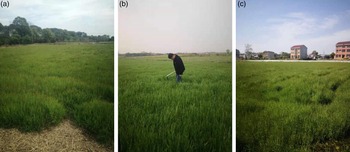
We recently observed that winter fallow weeds, dominated by foxtail grass, were abundant in many rice fields in Hunan Province, China (Figure 1a–c). Our on-farm investigations across six regions in Hunan Province in 2015 showed that the highest biomass of fallow weeds in rice fields reached nearly 500 g m−2 (Huang et al., Reference Huang, Shan, Cao, Chen and Zou2018a), comparable to the biomass of Chinese milk vetch cover crops (Yang et al., Reference Yang, Zhang, Wang, Liu, Fang, Zhang, Liu, Zhang, Zhang and Shi2020). Moreover, our field experiments in Changsha, Hunan Province, from 2008 to 2011 demonstrated that the biomass of fallow weeds was significantly affected by tillage method – no-tillage had 80% higher average biomass of fallow weeds compared to conventional tillage (Huang et al., Reference Huang, Jiang, Zhou and Zou2018b). These findings suggest that allowing the growth of fallow weeds may be an alternative to cover crops in rice cropping systems, especially under no-tillage conditions.
Fallow weeds (dominated by foxtail grass) in rice fields at (a) Yuanjiang (28°55′ N, 112°18′ E, 24 m asl), (b) Yueyang (29°15′ N, 113°5′ E, 11 m asl), and (c) Ziyang (28°39′ N, 112°20′ E, 38 m asl), Hunan Province, China. Photos were taken by the corresponding author in mid-March, 2023.

Fallow weeds provide some similar ecosystem services to cover crops. For example, the meta-analysis of Wortman (Reference Wortman2016) showed that the occurrence of fallow weeds reduced nitrogen (N) leaching from croplands by 60% compared to bare soils, even greater than the effect of cover cropping with legumes (40%) reported in another meta-analysis by Tonitto et al. (Reference Tonitto, David and Drinkwater2006). Chen et al. (Reference Chen, Kang, Cao, Chen and Huang2023) reported that the C capture potential of fallow weeds in rice fields exceeded 110 g m–2 season–1, equivalent to approximately 80% of the average total greenhouse gas emissions during the rice growing season reported in a meta-analysis by Feng et al. (Reference Feng, Chen, Zhang, Song, Deng, Zheng and Zhang2013). However, these results alone are not sufficient to draw a firm conclusion about the feasibility of using fallow weeds as an alternative to cover crops in rice cropping systems. Before implementing this strategy, it is important to understand the effect of fallow weeds on grain yield in rice.
Fallow weeds are like cover crops in rice cropping systems; in that, they are decomposed during the rice growing season and thereby change the soil environment for rice growth. In particular, nutrients in fallow weeds are released into soils as they decompose. N is the most limited nutrient for rice growth and development in almost all soils (Ishii et al., Reference Ishii, Ikeda, Minamisawa and Senoo2011). Our previous studies showed that the highest amount of N in fallow weeds in rice fields was 4.93 g m−2 across six regions in Hunan Province in 2015 (Huang et al., Reference Huang, Shan, Cao, Chen and Zou2018a). Additionally, the amount of N in fallow weeds was 82% higher under no-tillage conditions compared to conventional tillage in field experiments conducted in Changsha, Hunan Province, from 2008 to 2011 (Huang et al., Reference Huang, Jiang, Zhou and Zou2018b). We therefore hypothesized that fallow weeds affect grain yield in rice by altering crop N uptake and growth. To test this hypothesis, the present study determined the effects of fallow weed application on N uptake, biomass production, yield components, and grain yield in rice.
Materials and Methods
Site, soil, and cultivar
Field experiments were conducted in 2020 and 2021. The experimental field was located at the research farm of the Rice and Product Ecophysiology Lab (28°09′ N, 113°37′ E, 43 m asl), Hunan Agricultural University, China. The soil chemical properties in the upper 20 cm layer of the experimental field before transplanting in 2020 were organic matter = 31.3 g kg−1, total N = 1.55 g kg−1, total phosphorus (P) = 0.68 g kg−1, total potassium (K) = 9.45 g kg−1, available N = 136 mg kg−1, available P = 19.4 mg kg−1, and available K = 147 mg kg−1.
A hybrid rice cultivar, Guiliangyou 2 (Guike-2S × Guihui 582), was used in this study. This cultivar was selected because it has good performance in grain yield, physiological N-use efficiency, and lodging resistance (Huang et al., Reference Huang, Chen, Cao, Jiang, Zou and Deng2016; Tao et al., Reference Tao, Lei, Cao, Chen, Yin, Liang and Huang2022).
Experimental design and crop management
Experimental treatments were factorial combinations of two fallow weed application rates and three N application rates. The experiment was arranged in a randomized block design with three replications and a plot size of 20 m2.
The two fallow weed rates were 0 (W0) and 500 g m−2 (sun-dried, W500). The moisture of sun-dried fallow weeds was 10% and 8% in 2020 and 2021, respectively. The N content (oven-dried) in fallow weeds was 9.31 mg g−1 in 2020 and 9.46 mg g−1 in 2021. To ensure a uniform rate of fallow weeds among different plots of each treatment, each plot was kept in dark during the fallow season by covering black plastic films to avoid the occurrence of fallow weeds. During the study, fallow weeds (dominated by foxtail grass) for W500 were collected from other rice fields, sun-dried, mixed, and applied on the soil surface at 7 days before rice transplanting. In addition, to quantify the N release from fallow weeds during the rice growing season, sun-dried fallow weeds were put into nylon mesh bags (15 cm × 15 cm, 1mm mesh size) with 11.25 g per bag (equivalent to the rate of 500 g m−2 in the plots of W500) and randomly placed in the plots of W500 with four bags per plot.
The three N rates were 0 (N0), 150 (N150), and 225 kg ha−1 (N225). The N fertilizer was applied in three splits: 50% as basal (1 day before transplanting), 20% at the early-tillering stage (7 days after transplanting), and 30% at the panicle initiation (PI) stage. P and K fertilizers were applied to all plots at the same rates. The P fertilizer (75 kg P2O5 ha−1) was applied as basal. The K fertilizer (150 kg K2O ha−1) was equally split with half applied as basal and half at the PI stage.
Rice seedlings were raised by sowing pregerminated seeds in a seedbed on 6 May. For land preparation, plots were not tilled and all were soaked with water at a depth of ∼10 cm for 7 days prior to transplanting. Seedlings were transplanted on 3 June at a hill spacing of 20 cm × 20 cm with two seedlings per hill. Herbicides, a powder mixture (2.1 kg ha−1) of bensulfuron-meythyl (1.1% w/w) and butachlor (23.9% w/w), were applied together with N fertilization at the early-tillering stage. All plots were flooded with a water depth of 5–10 cm from transplanting until ∼5 days before maturity, when the plot was drained for harvesting. Insects and diseases were controlled by chemicals as required to avoid yield loss.
Sampling and measurements
One bag of fallow weeds was taken from each plot at mid-tillering (20 days after transplanting, MT), PI, heading (HD), and maturity (MA) stages. Fallow weeds were oven-dried at 70°C to constant weight. N content in dried fallow weeds was measured using a segmented flow analyzer (Skalar SAN Plus, Skalar Inc., Breda, the Netherlands). The amount of N in fallow weeds was calculated by multiplying the dry weight by the N content. N release from fallow weed decomposition from the day of weed application (DWA) to MT, MT to PI, PI to HD, and HD to MA was calculated as the difference in amount of N in fallow weeds between the beginning and ending stages of the corresponding period.
Ten hills of rice plants were sampled from each plot at MT, PI, HD, and MA stages. The rice plants sampled at MT and PI were separated into stems and leaves; plants sampled at HD were separated into stems, leaves, and panicles; and plants sampled at MA were hand threshed after counting panicle number. Filled and unfilled spikelets were separated by submerging them in tap water. Three subsamples of 30 g of filled spikelets and all unfilled spikelets were used to count the number of spikelets. The number of filled spikelets was counted by a digital automatic seed counter (SLY-C, Zhejiang Top Cloud-Agri Technology Co., Ltd., Hangzhou, China). The number of unfilled spikelets was counted manually. All plant organs were oven-dried at 70°C to a constant weight to determine biomass and N content. The N content was measured using a Skalar SAN Plus segmented flow analyzer. Yield components (panicles per m2, spikelets per panicle, spikelet filling percentage, and grain weight), aboveground biomass production, harvest index, and aboveground N uptake were calculated. At the MA stage, rice plants were manually harvested from a 5 m2 area in each plot. Grain yield was adjusted to a moisture content of 14%.
Statistical analysis
Data were analyzed by analysis of variance, using Statistix 8.0 analytical software (Tallahassee, FL, USA). The data of fallow weeds (i.e., N amount in fallow weeds and N release from fallow weed decomposition) were analyzed with a statistical model that included replication, the main effects of year and N rate, and the interactive effect of year and N rate. As the interactive effect of year and N rate was not significant for either N amount in fallow weeds (p = 0.690–0.945) or N release from fallow weed decomposition (p = 0.392–0.851), means of years across three N rates were presented for these two parameters in Figure 2a and b. All crop data were analyzed separately for each year, using a statistical model that included replication, the main effects of fallow weed rate and N rate, and the interactive effect of fallow weed rate and N rate.
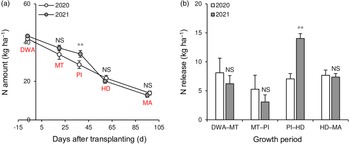
(a) N amount in fallow weeds and (b) N release from fallow weed decomposition in 2020 and 2021. DWA, MT, PI, HD, and MA represent day of weed application, mid-tillering, panicle initiation, heading, and maturity stages of rice, respectively. Each data point is the mean of three N rates and three replications per N rate in each year. Bars are standard errors. ** and NS denote that the difference between means of years is significant at p < 0.01 and not significant at p < 0.05, respectively.

Results
N release from fallow weed decomposition
There was no significant difference in N amount in fallow weeds at MT, HD, and MA stages between 2020 and 2021 (Figure 2a). The amount of N in fallow weeds at the PI stage was 19% higher in 2021 than 2020. The difference in N released from decomposing fallow weeds was not significant during the periods from DWA to MT, MT to PI, or HD to MA (Figure 2b). However, N release from decomposing fallow weeds from PI to HD in 2021 was 99% higher than that in 2020.
N uptake by rice
The effect of fallow weed rate on aboveground N uptake was dependent on growth stage and year (Table 1). Aboveground N uptake at the MT stage was, respectively, 30% and 21% lower under W500 compared to W0 in 2020 and 2021. There was no significant difference in aboveground N uptake at the PI stage between W500 and W0 in either year. Aboveground N uptake at the HD stage was not significantly different between W500 and W0 in 2020, while it was significantly higher by 14% under W500 than under W0 in 2021. W500 had 12% and 26% higher aboveground N uptake than W0 in 2020 and 2021, respectively.
Effects of fallow weed application on aboveground N uptake in rice under three N rates in 2020 and 2021

*and **represent significance at the 0.05 and 0.01 probability levels, respectively. NS represents nonsignificance at the 0.05 probability level.
† W0 and W500 are weed rates of 0 and 500 g m–2, respectively.
‡ N0, N150, and N225 are N rates of 0, 150, and 225 kg ha–1, respectively.
§ PI, HD, and MA are panicle initiation, heading, and maturity stages, respectively.
Biomass production and harvest index in rice
The effect of fallow weed rate on aboveground biomass production depended on growth stage and year (Table 2). W500 had 29% and 27% lower aboveground biomass production at the MT stage than W0 in 2020 and 2021, respectively. Aboveground biomass production at the PI stage was 11% lower under W500 than under W0 in 2020, but the difference was not significant in 2021. The difference in aboveground biomass production at the HD stage was not significant between W500 and W0 in either 2020 or 2021. Aboveground biomass production at the MA stage was not significantly different between W500 and W0 in 2020, whereas it was 13% higher under W500 compared to W0 in 2021.
Effects of fallow weed application on aboveground biomass production and harvest index in rice under three N rates in 2020 and 2021

*and **represent significance at the 0.05 and 0.01 probability levels, respectively. NS represents nonsignificance at the 0.05 probability level.
† W0 and W500 are weed rates of 0 and 500 g m–2, respectively.
‡ N0, N150, and N225 are N rates of 0, 150, and 225 kg ha–1, respectively.
§ PI, HD, and MA are panicle initiation, heading, and maturity stages, respectively.
Yield components and grain yield in rice
The effect of fallow weed rate was significant for spikelets per panicle in 2020 and spikelets per panicle and spikelets per m2 in 2021 but was not significant for other yield components (Table 3). Spikelets per panicle were 7% higher under W500 compared to W0 in 2020. Spikelets per panicle and spikelets per m2 under W500 were, respectively, 6% and 15% higher than those under W0 in 2021. The effect of fallow weed rate on grain yield was not significant in 2020 but was significant in 2021. Grain yield under W500 was 13% higher than that under W0 in 2021.
Effects of fallow weed application on yield components and grain yield in rice under three N rates in 2020 and 2021

*and **represent significance at the 0.05 and 0.01 probability levels, respectively. NS represents nonsignificance at the 0.05 probability level.
† W0 and W500 are weed rates of 0 and 500 g m–2, respectively.
‡ N0, N150, and N225 are N rates of 0, 150, and 225 kg ha–1, respectively.
Discussion
The present study showed that the application of fallow weeds reduced aboveground N uptake and biomass production during the early growth period (from transplanting to MT) in rice. This could be attributable to decomposition of fallow weeds (1) stimulating immobilization of N by soil microorganisms, resulting in N competition between soil microorganisms and rice roots (Cheshire et al., Reference Cheshire, Bedrock, Williams, Chapman, Solntseva and Thomsen1999); (2) reducing soil oxygen content and consequently inhibiting the growth and development of rice roots (Wang et al., Reference Wang, Samo, Zhao, Wang, Yang, Hu, Peng and Rasul2019); and (3) producing reducing substances that have toxic effects on rice roots (Wang et al., Reference Wang, Yang, Wang, Zhao, Muhammad, Chen and Hu2020). These possible contributing factors highlight the need for a fundamental understanding of the effects of fallow weed decomposition on soil biological and chemical properties in rice paddies.
The reduced aboveground N uptake and biomass production during the early growth period did not reduce grain yield when fallow weeds were present, because they were compensated for or even exceeded by increased aboveground N uptake and biomass production during the middle and late growth periods (from PI to MA). A certain amount of N released from decomposing fallow weeds during the middle and late growth periods, that is, 7.1–14.0 kg ha–1 during PI–HD and 7.4–7.7 kg ha–1 during HD–MA (Figure 2b), could be partially responsible for the higher aboveground N uptake and biomass production due to fallow weeds. This characteristic of N release from decomposing fallow weeds during the middle and late growth periods is different from that for crop (rice, wheat, and rape) straw decomposition (Li and Zhong, Reference Li and Zhong2021), which releases little N after 60 days of application (a time point between the PI and HD stages in this study; Figure 2a).
The application of fallow weeds increased spikelets per panicle in rice. This could be explained by the higher aboveground N uptake in rice during the middle growth period (from PI to HD) under the condition of applying fallow weeds. Applying N during the period of panicle development is a feasible practice for increasing spikelets per panicle in rice (Ju et al., Reference Ju, Liu and Sun2021). In addition, delaying N application can lead to delayed N uptake (i.e., lower N uptake during the early growth stage with higher N uptake during the middle and late growth periods) and increased spikelets per panicle in rice (Pan et al., Reference Pan, Huang, Zhai, Wang, Cao, Cai, Zhan and Tang2012).
The effect of fallow weeds on grain yield in rice varied with year, with a lack of significant differences in 2020 but significantly positive differences in 2021. This could be explained by the amount of N released from fallow weed decomposition during the middle growth stage (from PI to HD) differing between the 2 years – it was higher in 2021 compared to 2020. The yearly difference in the amount of N released from fallow weed decomposition during the middle growth stage was attributable to variation in climatic conditions. Daily minimum and maximum temperatures and daily solar radiation from PI to HD were 0.7°C, 1.0°C, and 4.3 MJ m–2 higher in 2021 than in 2020, respectively (data not shown). The decomposition of plant (crop) residues is generally accelerated by higher temperature and solar radiation (Cai et al., Reference Cai, Liang, Zhang, Zhang, Li, Rui, Xu and Luo2018); Araujo et al., Reference Araujo, Grasso, González-Arzac, Méndez and Austin2022. Moreover, residual effects of fallow weeds might be also responsible for the different effects they had on grain yield between 2020 and 2021. Approximately 30% of N in the fallow weeds was not released in season (Figure 2a). These results indicate that (1) delaying N application may increase grain yield of the cultivar used in this study and (2) further investigations are required to determine the long-term effect of fallow weeds on grain yield in rice.
This study was conducted under no-tillage conditions and the fallow weeds decomposed on the soil surface. The findings obtained in the present study may be not applied to conventional tillage (e.g., rotary tillage) systems in which fallow weeds are incorporated and decomposed in the soil. In addition, this study determined the effects of ex situ application of fallow weeds on N uptake and yield formation in rice, which may be not exactly the same as the effects of in situ return of fallow weeds. Therefore, it is required to determine the effects of returning fallow weeds in situ on N uptake and yield formation in rice under both conventional tillage and no-tillage conditions.
Conclusions
This study showed that fallow weed application altered yield formation in rice by changing its N uptake. First, the application of fallow weeds reduced aboveground N uptake and biomass production during the early growth period (from transplanting to MT), but it increased aboveground N uptake and biomass production during the middle and late growth period (from PI to MA) in rice. As a result, fallow weeds did not reduce and in some cases even increased grain yield in rice. Second, the application of fallow weeds improved aboveground N uptake during the middle growth period (from PI to HD) and consequently increased spikelets per panicle in rice. This study provides preliminary evidence that fallow weeds may affect yield formation in rice and highlights that further investigations are required to determine the ecophysiological mechanism underlying the effect of fallow weeds on N uptake in rice.
Acknowledgements
The authors thank other members of the Rice and Product Ecophysiology for their help with this study.
Competing interests
The authors declare none.