Introduction
Infants learn their native language (L1) at a surprisingly rapid pace. Before producing their first words, they have already learned many of the phonetic contrasts that are relevant for distinguishing meaning in their L1. From birth onwards, infants are able to perceive almost any phonetic difference, irrespective of their existence in the L1 (for a review see Werker & Tees, Reference Werker and Tees1992). However, between 6 and 12 months, infants typically begin to perceive phonetic contrasts in accordance with their native phonology. This change or relocation of attention is often called perceptual tuning or perceptual reorganization (henceforth PR). It is a process of perceptual decline, maintenance, or facilitation of phonetic discrimination under the influence of ambient language input. Native vowel perception seems to be in place somewhere between 6 and 8 months of age (e.g. Kuhl, Williams, Lacerda, Stevens & Lindblom, Reference Kuhl, Williams, Lacerda, Stevens and Lindblom1992; Polka & Werker, Reference Polka and Werker1994), whereas attenuation of non-native consonant contrasts appears later, at around 10 to 12 months of age (e.g. Kuhl, Stevens, Hayashi, Degushi, Kiritani & Iverson, Reference Kuhl, Stevens, Hayashi, Degushi, Kiritani and Iverson2006; Tsushima et al., Reference Tsushima, Takizawa, Sasaki, Shiraki, Nishi, Kohno, Menyuk and Best1994).
One of the factors guiding PR is the experience with the ambient language and, at the same time, a lack of experience with non-native speech sounds. However, presenting PR as a process of maintenance and loss under the influence of L1 experience is too limited. Some native contrasts have proven to be rather difficult and are acquired relatively late (e.g. for nasal place discrimination: Narayan, Werker & Beddor, Reference Narayan, Werker and Beddor2010; for discrimination of vowel duration: Sato, Sogabe & Mazuka, Reference Sato, Sogabe and Mazuka2010), whereas certain non-native contrasts remain perceivable into adulthood (e.g. Best, McRoberts & Sithole, Reference Best, McRoberts and Sithole1988). Additional factors that are held responsible for this more nuanced pattern of speech sound perception are acoustic salience, general perceptual maturation, and/or the extent to which non-native sounds are similar to or different from native sounds (Best, Reference Best and Strange1995). The interaction between psycho-acoustic and experiential factors gives way to multiple routes to adult perception of different speech sounds. Best et al. (Reference Best, McRoberts and Sithole1988), for example, showed that American English-learning infants between 6 and 14 months of age, as well as English-learning adults, are able to discriminate non-native Zulu click contrasts. They argue that these contrasts are sufficiently different from English contrasts and are therefore easy to perceive. Polka and Bohn (Reference Polka and Bohn1996) show a similar result for the German front–back high vowel contrast /y/–/u/ with English-learning infants. Narayan et al. (Reference Narayan, Werker and Beddor2010) show that even for native contrasts it depends on their relative acoustic salience how much input is required, or in other words how long it takes for infants to successfully discriminate the respective native contrast.
Apart from the mere experience with certain (non-)native segmental contrasts, their psycho-acoustic salience and the extent to which they are similar to native contrasts might thus determine the pathway to adult perception of these speech sound contrasts.
The case of lexical tone
PR studies on suprasegmental, or prosodic, contrasts are relatively scarce compared to studies investigating segmental contrasts. Examples of suprasegmental contrasts are phoneme duration (i.e. contrasts between long versus short vowels, or single versus geminate obstruents), lexical stress (e.g. English INsight vs. inCITE; capitals indicate the stressed syllable), and lexical tone.
In tone languages, pitch patterns are used to distinguish words, similar to what phonemes do at the segmental level. By some estimates the number of languages using lexical tone is as high as 60–70% (Yip, Reference Yip2002). Some of these languages make extensive use of tone. In the densest case, tone languages like Mandarin Chinese specify every mora for tone (Duanmu, Reference Duanmu2000; Gussenhoven, Reference Gussenhoven, Smelser and Baltes2001). Other tone languages are more restricted in their use of lexically contrastive pitch. These languages, for example Tokyo Japanese, have been referred to as restricted tone languages (Voorhoeve, Reference Voorhoeve1973). From a typological point of view, the phonetic and functional distinction between tone languages on the one hand and restricted tone languages on the other hand is hard to draw (e.g. Gussenhoven, Reference Gussenhoven, Fant, Fujisaki, Cao and Xu2004). Nevertheless, many phonologists still recognize an intermediate type of language, also referred to as pitch-accent languages. According to Yip (Reference Yip2002, p. 257), pitch-accent languages are a subtype of tone languages, and there is no absolute distinction. Hyman (Reference Hyman2009), too, argues against pitch-accent languages as a third prosodic type of language. He states that all languages that appear to be intermediate between tone languages and stress languages (e.g. Tokyo Japanese, Somali, Swedish) do not form a coherent class. All languages that have been called pitch-accent languages can be analyzed as tonal, because what all these languages have in common is that pitch, to a greater or lesser extent, is necessary for determining the meaning of a word (Hyman, Reference Hyman2009; Werth, Reference Werth2011). We will use the term ‘tone language’ for languages that use pitch to signal word-level meaning differences, unless referring to studies that used a different term.
With this study, we want to contribute to the field of lexical tone acquisition by investigating a relatively unknown and understudied population: infants growing up with tonal Limburgian dialects of Dutch. From a typological point of view, these dialects are particularly interesting for two reasons. First, tone in Limburgian has a relatively low functional load compared to many Chinese dialects. Second, there is a complex interaction between lexical and intonational tones, which is unusual for tone languages, leading to many different surface realizations of the underlying tone categories. By looking at the developmental perception of lexical tone in Limburgian infants, we can add to the discussion of the influence of functional load and complexity on the acquisition of a lexical tone system. We compared the Limburgian infants to a control group of infants acquiring Standard Dutch, a non-tonal language. Before we discuss Limburgian in more detail, we will first review the extant work on lexical tone acquisition.
Perceptual reorganization for lexical tones
With respect to the development of native tone and pitch-accent perception, studies have shown good discrimination performance throughout the first year of life (e.g. Sato, Sogabe & Mazuka, Reference Sato, Sogabe and Mazuka2009; Yeung, Chen & Werker, Reference Yeung, Chen and Werker2013). Sato et al. (Reference Sato, Sogabe and Mazuka2009) have looked at native perception of lexical pitch-accent in Japanese, and showed that 4- and 10-month-old Japanese infants could readily discriminate Japanese pitch-accents. However, as previously documented for native segment perception (e.g. Narayan et al., Reference Narayan, Werker and Beddor2010), native perception of lexical pitch also appears to be subject to effects of psycho-acoustic salience. Tsao (Reference Tsao2008) tested Mandarin 10- to 12-month-olds on Mandarin tone contrasts differing in acoustic salience, and indeed attested contrast-dependent differences in performance. For example, tones 1 (high level) and 3 (low dipping) were discriminated with higher accuracy than tones 2 (low rising) and 3.
The existing studies on non-native lexical tone perception in the first year of life have yielded mixed results (for a critical review, see Singh & Fu, Reference Singh and Fu2016). Some studies indicate that non-tone-learning infants show a decline in lexical tone discrimination around 9 months (English and Yorùbá infants, Yorùbá tones: Harrison, Reference Harrison2000; English and Chinese infants, Thai tones: Mattock & Burnham, Reference Mattock and Burnham2006; English and French infants, Thai tones: Mattock, Molnar, Polka & Burnham, Reference Mattock, Molnar, Polka and Burnham2008; English, Cantonese, and Mandarin infants, Cantonese tones: Yeung et al., Reference Yeung, Chen and Werker2013). Other more recent studies by Liu and Kager (Reference Liu and Kager2014) and Chen and Kager (Reference Chen and Kager2016) investigated discrimination of Mandarin tones in Dutch infants and found a maintained sensitivity to non-native pitch patterns. Liu and Kager (Reference Liu and Kager2014) showed that 5- to 18-month-old Dutch infants can readily discriminate Mandarin tone 1 (high level) from tone 4 (high falling). Apparently, the Dutch infants in this study did not go through a process of PR for these tones, or the process was overridden by other factors like psycho-acoustic salience. Indeed, 8- to 15-month-olds did not succeed in discriminating a reduced variant of this contrast in which the difference in fundamental frequency between the two pitch patterns had been made less extreme. However, 5- to 6-month-olds and 17- to 18-month-olds were successful in this condition, leading to a U-shaped developmental pattern. The authors propose that the perceptual salience of a tonal contrast – which may depend on the distance between the pitch patterns – influences the process of PR. The original, non-reduced contrast was apparently salient enough to overcome PR.
Another potential explanation put forward by Liu and Kager (Reference Liu and Kager2014) for the success of the 8- to 15-month-old Dutch infants on the original, non-reduced contrast is that Dutch infants interpret the Mandarin tones as instances of Dutch intonation contours. Dutch has a rich intonation system involving meaningful variation in pitch contours (Gussenhoven, Reference Gussenhoven and Jun2005). Yeung and colleagues (Reference Yeung, Chen and Werker2013) also consider the possible influence of native intonation when discussing their finding that Mandarin and Cantonese Chinese 4- to 9-month-old infants attend differently to one particular Cantonese tone (tone 25). Referring to a study on adult native and non-native tone perception (So & Best, Reference So and Best2010), Yeung and colleagues (Reference Yeung, Chen and Werker2013) attribute this difference in perception to the way in which Cantonese tone 25 relates to the native tone inventories of Cantonese and Mandarin. That tone perception is partly governed by the precise relation between the tones used in an experiment and the learner's native tone or intonation inventory is among others documented by Reid et al. (Reference Reid, Burnham, Kasisopa, Reilly, Attina, Rattanasone and Best2014) and by Schaefer and Darcy (Reference Schaefer and Darcy2014).
In line with Liu and Kager (Reference Liu and Kager2014), Chen and Kager (Reference Chen and Kager2016) also found improvement rather than attenuation in sensitivity towards non-native lexical tones. Dutch 4-, 6-, and 12-month-old infants were tested on the Mandarin tone 2 (low rising) – tone 3 (dipping) contrast, which is assumed to be a non-salient contrast (e.g. Tsao, Reference Tsao2008). Four-month-olds did not show discrimination, whereas 6- and 12-month-olds discriminated the non-native tone contrast both in a condition without token variation, encouraging phonetic listening, and in a condition with token variation that encouraged phonological listening. The authors concluded that this improvement shows that infants improve in perceiving non-native tones acoustically (i.e. phonetically), and that they also become more capable of normalizing variable tokens when they grow older. They attribute this finding to general cognitive/perceptual maturation.
To summarize, psycho-acoustic salience and general perceptual maturation are claimed to play a role in native and in non-native tone perception. In non-native tone perception, the extent to which non-native tones are similar or different to tone or intonation categories from the L1 might also influence the developmental perception of lexical tone contrasts.
However, as is apparent from the above literature, most studies on lexical pitch perception have focused on a small set of target languages that make a rather extensive use of lexical tone (e.g. Cantonese, Mandarin). Granting that all languages that use pitch as a distinctive feature in at least a few words can be considered tone languages, we still have to recognize that, within the family of tone languages, large differences exist. First, they differ with respect to the functional load of tone. The smaller the tonal inventory, the greater the distributional restrictions, and the smaller the number of tonal minimal pairs, the more restricted a tone system might be considered (Voorhoeve, Reference Voorhoeve1973). The functional load of word-level pitch has been assumed to influence listeners’ sensitivity to lexical pitch patterns (e.g. Goss, Reference Goss2015; Schaefer & Darcy, Reference Schaefer and Darcy2014; Wang, Behne, Jongman & Sereno, Reference Wang, Behne, Jongman and Sereno2004; Wu, Tu & Wang, Reference Wu, Tu and Wang2012).
Second, tone languages differ with respect to the complexity of their intonation systems. Intonation is found in all of the world's languages (Singh & Fu, Reference Singh and Fu2016; Yip, Reference Yip2002). It is used to distinguish sentence types, like statements versus questions, to indicate whether a speaker has finished or intends to continue speaking, or to show which parts of an utterance present new or important information. Usually, tone languages do not have complex intonation systems (e.g. Gussenhoven & van der Vliet, Reference Gussenhoven and van der Vliet1999). In Standard Chinese, for example, different intonations only cause changes of pitch register rather than of pitch contours (e.g. Wu, 2000). In Swedish (Bruce, Reference Bruce1977), and even more so in Limburgian (Gussenhoven, Reference Gussenhoven, Fant, Fujisaki, Cao and Xu2004), lexical and intonational pitch patterns interact, leading to various phonetic realizations of an underlying tone category. Ota (Reference Ota2003) states that the reliability of the mapping between underlying tones and their surface realizations has a large impact on the acquisition of a lexical tone system.
This study aims at extending our knowledge about the influence of the functional load of tone and the complexity of the prosodic system on developmental pitch perception. It looks at infants acquiring an understudied language, i.e. a Limburgian dialect of Dutch, and compares them to a control group of infants growing up with non-tonal Standard Dutch. The language under investigation will be discussed in more detail in the next section.
Limburgian dialects of Dutch
The Limburgian dialects of Dutch belong to the Central Franconian dialect-continuum which covers the provinces of Limburg in the Netherlands and Belgium as well as the north of the German Rhineland-Palatinate and the southwest of North-Rhine Westphalia (Fournier, Reference Fournier2008; Gussenhoven, Reference Gussenhoven and Lahiri2000a; see Figure 1).
Geographical distribution of the lexical tone contrast in the Cologne–Trier area (adapted from Gussenhoven & Bruce, Reference Gussenhoven, Bruce and van der Hulst1999).

Approximately 75% of the inhabitants of the Dutch province of Limburg speak a Limburgian dialect (Driessen, Reference Driessen2006). We use the term ‘dialect’ to refer to a regional linguistic variety that differs from the standard language, in this case Standard Dutch, at the phonological, morphosyntactic, and lexical levels (O'Grady, Archibald, Aronoff & Rees-Miller, Reference O'Grady, Archibald, Aronoff and Rees-Miller2001). Still, mutual intelligibility between Standard Dutch and Limburgian is fairly high (van Bezooijen & van den Berg, Reference van Bezooijen, van den Berg, van Bezooijen and Kager1999), probably due to the existence of many cognates, leading to a high degree of phonological overlap. Most Limburgians also speak Standard Dutch, the official language used in formal and institutional settings, and are considered bidialectal (Cornips, Reference Cornips and Grohmann2014). We understand bidialectalism as bilingualism involving closely related linguistic varieties. Children in Limburg thus often acquire a local dialect in addition to the standard language. They may be immersed in one particular dialect from birth and encounter Standard Dutch upon entering the educational system, as well as through media and peers, or alternatively one parent speaks a dialect and the other parent either speaks Dutch (possibly with a Limburgian accent) or a different Limburgian dialect.
Research on the influence of bilingualism on early speech perception is a young area of psycholinguistic research. Extant studies involving both distant- and close-language-bilinguals have yielded mixed results (for a review, see Fennell, Tsui & Hudon, Reference Fennell, Tsui, Hudon, Nicoladis and Montanari2016). To our knowledge, no studies have looked at early speech perception in bidialectal infants (but see Durrant, Delle Luche, Cattani & Floccia, Reference Durrant, Delle Luche, Cattani and Floccia2015, for a study on the specificity of early lexical representations in multidialectal children). Nevertheless, we cannot rule out the possibility that, next to the differences in the native prosodic system that are the topic of this study, additional input-related factors could influence the development of lexical tone perception in Limburgian participants in comparison to their Standard Dutch peers. As a consequence of the highly variable input Limburgians are exposed to, the higher probability of hearing accented speech (e.g. Bosch & Ramon-Casas, Reference Bosch and Ramon-Casas2011), and the large amount of lexical overlap due to many cognates (e.g. Sebastián-Gallés & Bosch, Reference Sebastián-Gallés. and Bosch2009), Limburgian infants might exhibit a greater acceptance of acoustic variation in phonetic categories and show (temporary) discrimination difficulties (Fennell et al., Reference Fennell, Tsui, Hudon, Nicoladis and Montanari2016).
Recently, Limburgian bidialectals have been the subject of studies looking at linguistic development in older children and on the cognitive benefits of bilingualism. Cornips (Reference Cornips and Grohmann2014) looked at vocabulary acquisition and grammatical development in Limburgian four- to six-year-old bidialectal children. They were compared to monolingual Dutch and bilingual peers. The bilingual children had Dutch as their L1, and the other language varied across participants. The bidialectal children did not differ significantly from monolingual Dutch peers, but they did differ from their bilingual peers in that they scored significantly higher on vocabulary and were faster in acquiring grammatical gender in Dutch. From this we might conclude that Limburgian bidialectals, at least with respect to certain vocabulary and grammar development measures, cannot be directly compared to bilinguals. Recent work by Blom, Boerma, Bosma, Cornips, and Everaert (Reference Blom, Boerma, Bosma, Cornips and Everaert2017) also shows that six- to seven-year-old bidialectal Limburgian children differ from Polish–Dutch bilingual peers, but not from monolingual Dutch peers, on a Flanker task tapping into executive functioning. More research is needed to provide insights into the potentially unique acquisition pathways of bidialectal children and into the mechanisms that are responsible for these potential differences. For now, we cannot exclude the possibility that Limburgian infants might differ from Dutch infants with respect to their early phonetic development as a result of their unique input properties.
In this study, the focus is on the Limburgian dialect of Roermond. The choice to focus on one particular dialect instead of on Limburgian as a whole stems from the fact that Limburgian is not a homogeneous linguistic variety. Limburgian is to be understood as an umbrella term for many different dialects. Comparable to the pitch-accents in different varieties of Japanese, Norwegian, and Swedish (Tamaoka, Saito, Kiyama, Timmer & Verdonschot, Reference Tamaoka, Saito, Kiyama, Timmer and Verdonschot2014; Wetterlin, Reference Wetterlin2007), the Limburgian word prosodic contrast may have different phonetic realizations across dialects, be embedded in different intonational systems, or may be absent altogether (e.g. Gussenhoven, Reference Gussenhoven and Lahiri2000a; Gussenhoven & Peters, Reference Gussenhoven and Peters2008). Different ‘dialect regions’ have been classified among others on the basis of shared phonetic–phonological features (e.g. Wijngaard & Keulen, Reference van de Wijngaard, Keulen, Keulen, van de Wijngaard, Crompvoets and Walraven2007). The Roermond dialect belongs to the East-Limburgian dialect region (Bakker & van Hout, Reference Bakker and Hout2012). The realization of the word prosodic contrast within this region does not show much variation (e.g. Heijmans, Reference Heijmans, Fikkert and Jakobs2003). The departure from the dialect of Roermond is partly motivated by the existence of a series of tone perception and production studies with adult speakers of Roermond Dutch (Fournier, Reference Fournier2008; Fournier, Gussenhoven, Jensen & Hagoort, Reference Fournier, Gussenhoven, Jensen and Hagoort2010; Fournier, Verhoeven, Swerts & Gussenhoven, Reference Fournier, Verhoeven, Swerts and Gussenhoven2006). Another reason to choose this particular dialect is the fact that both its vocabulary and (tonal) grammar are well documented (e.g. Gussenhoven Reference Gussenhoven and Horne2000b; Kats, Reference Kats1985).
Lexical tone in Roermond Dutch
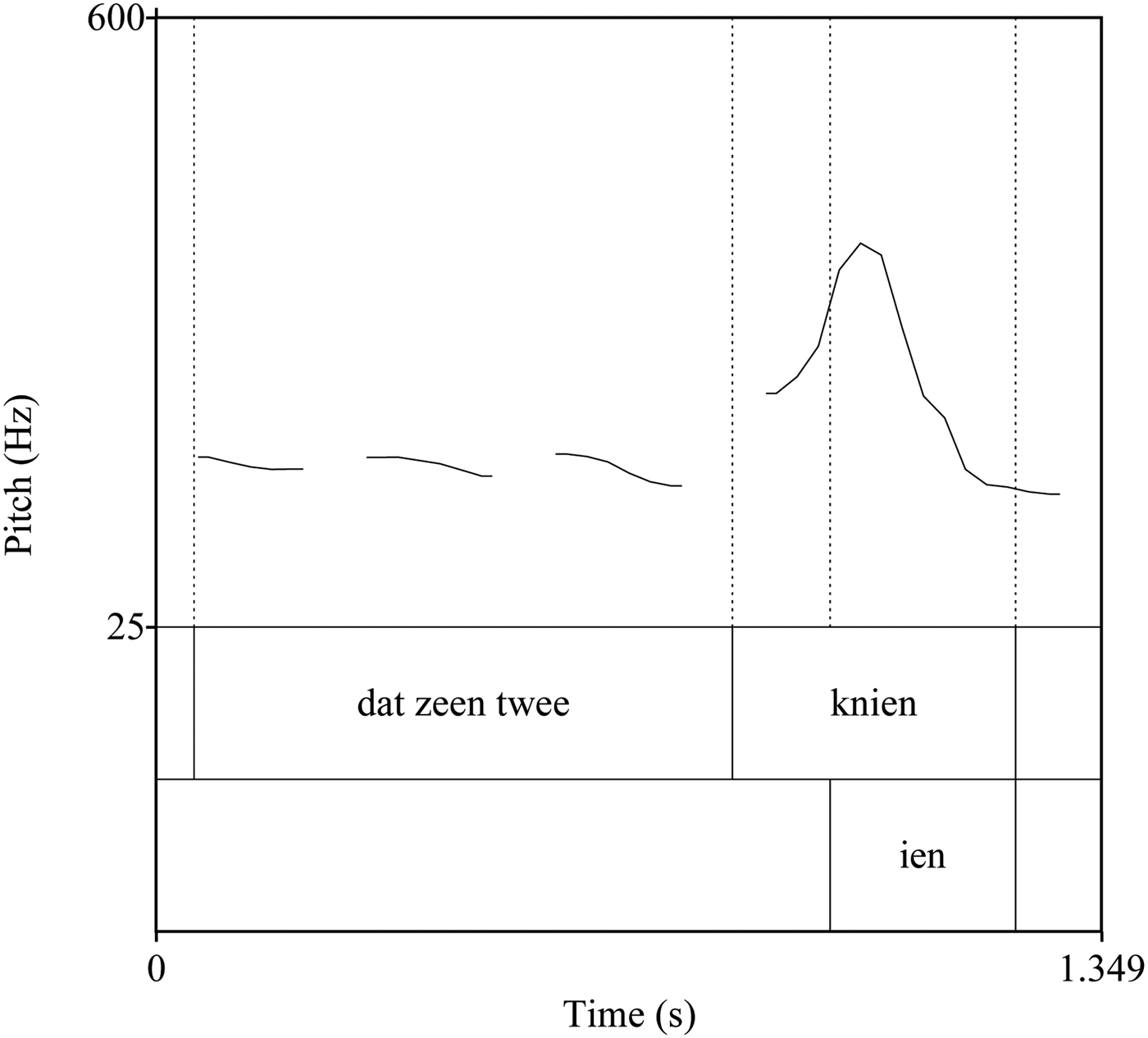
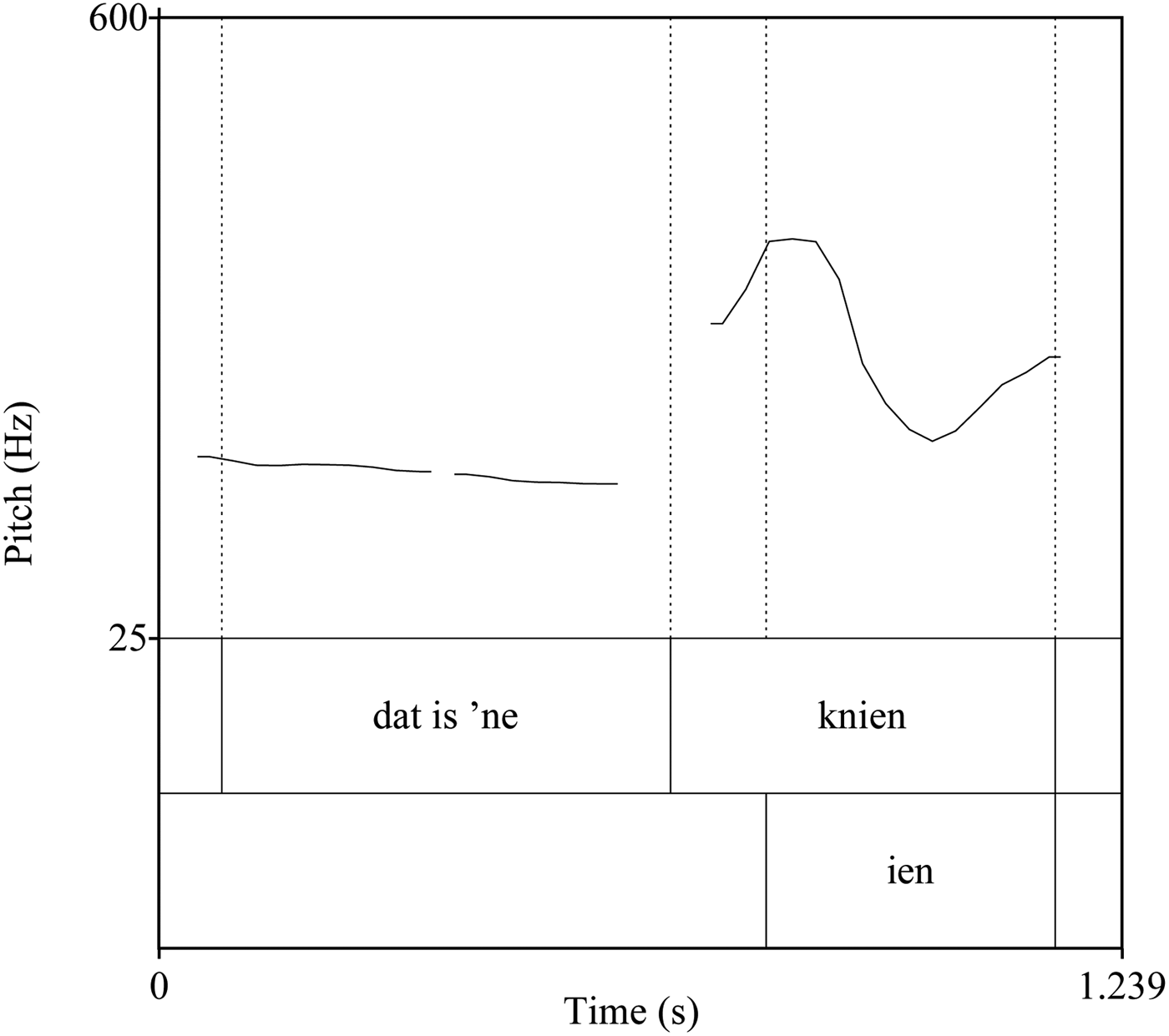
In many Limburgian dialects, word-level pitch patterns signal lexical and grammatical differences. For example, in the dialect of Roermond, haas [haːs] with falling pitch (accent 1) means ‘hare’, whereas haas with falling–rising pitch (accent 2) means ‘glove’. In a small number of frequent nouns in this dialect, pitch also serves a grammatical function, with accent 1 systematically indicating plurality: Knien [kniːn] with accent 2 means ‘rabbit’, but pronounced with accent 1 it means ‘rabbits’ (see Figures 2A and B for the pitch contours of accents 1 and 2, realized on a focal-final target word in a declarative sentence spoken by a female native speaker). Based on perception and production data with adult speakers of the Roermond dialect, Fournier et al. (Reference Fournier, Verhoeven, Swerts and Gussenhoven2006) concluded that pitch is the primary acoustic cue to the Limburgian tone contrast.
F0 contour of the Limburgian sentence dat zeen twee KNIEN ‘those are two rabbits’. The rhyme of the target word carries Accent 1.

F0 contour of the Limburgian sentence dat is ‘ne KNIEN ‘that is a rabbit’. The rhyme of the target word carries Accent 2.

ToneFootnote 1 in Limburgian has a lower functional load than tone in many Chinese dialects. Relative to Mandarin Chinese, there are few tonal minimal pairs: Fournier (Reference Fournier2008) counted around eighty in Kats’ (Reference Kats1985) dictionary of the Roermond dialect. There is just a two-way contrast distinguishing between a fall (H*L, accent 1) and a fall–rise (H*LH, accent 2),Footnote 2 and the contrast can only be realized on bimoraic syllables with primary stress. Any unbound multisyllabic morpheme can only carry one accent. With respect to the functional load of tone, we assume Limburgian to be comparable to Swedish (Gussenhoven, Reference Gussenhoven, Fant, Fujisaki, Cao and Xu2004; Riad, Reference Riad2013) and Norwegian (Kristoffersen, Reference Kristoffersen2000; Wetterlin, Reference Wetterlin2007). However, these languages differ from Limburgian with respect to the temporal domain of tone. In Swedish, and in most cases also in Norwegian, the tone contrast can only appear on minimally bisyllabic words (Wetterlin, Reference Wetterlin2007). In Roermond Dutch, the tone contrast is realized within a single syllable.
As in any other language, pitch in Limburgian also serves postlexical and paralinguistic (i.e. pragmatic) functions. As has been explained earlier, of particular interest is the fact that the Limburgian dialects show complex intonation systems, which is rare for a language that also has lexical tone (Gussenhoven & van der Vliet, Reference Gussenhoven and van der Vliet1999). The Roermond word accents can have drastically different pitch contours depending on whether the tone-bearing syllable is in focus, whether it appears in a question or a statement, and whether the syllable appears in phrase-final or non-final position. In this way, every monosyllabic pitch contour represents a unique combination of intonational and lexical meaning. This is different from Standard Chinese, where different intonations cause changes of register rather than of contours (Wu, Reference Wu2000). From the f0 information on a monosyllabic word, speakers of the Roermond dialect have to decide (i) which lexical tone category it is, (ii) which sentence type it is, and (iii) whether the word is in focus. The fact that the Limburgian accents have many realizations could make it difficult for a language learner to uncover the underlying tone system (Ota, Reference Ota2003). Despite the fact that, on the one hand, these different surface realizations can be regarded meaningless allophonic variants of the underlying lexical tone system, on the other hand they are meaningful at the postlexical level in that they all signal unique information with respect to sentence type and information status. In other words, speakers of Limburgian need to attend to every single aspect of these variants to uncover the differences in intonational meaning. This might (eventually) lead to a greater sensitivity to pitch differences in general.
With respect to the number of surface realizations, the Limburgian lexical tone system is of greater complexity than that of Swedish (Gussenhoven, Reference Gussenhoven, Fant, Fujisaki, Cao and Xu2004). Due to the use of lexical tone, Limburgian is also more complex than closely related Standard Dutch, a system with intonation contrasts only. This difference in complexity has been shown to determine how pitch processing is distributed over the different brain cortices in Limburgian and Dutch listeners, in support of the view that pitch processing is function-driven and language-dependent (Fournier et al., Reference Fournier, Gussenhoven, Jensen and Hagoort2010).
The present study
The aim of the present study is twofold. First, we want to provide insights into the development of lexical pitch perception in Limburgian infants growing up with a restricted tone language (Limburgian) and a non-tone language (Dutch) simultaneously. In accordance with previous results on native tone and pitch-accent perception in the first year of life, we expect that 6- to 12-month-old native Limburgian infants will successfully discriminate the Limburgian tones throughout their first year of life. Because of their daily experience with both lexical tones and intonational tones, we expect their perception of native pitch patterns to be maintained or perhaps even enhanced between 6 and 12 months.
Second, we compare Limburgian infants to Dutch infants learning an intonation language that does not use lexical pitch. Given the differences in complexity of the prosodic systems, we wanted to explore the possibility that Limburgian children's sensitivity to lexical pitch develops differently from that of Dutch children. For the Dutch infants, two outcomes are possible. On the one hand, they could show an age-related performance decline (as the non-native listeners in Mattock & Burnham, Reference Mattock and Burnham2006, Mattock et al., Reference Mattock, Molnar, Polka and Burnham2008, and Yeung et al., Reference Yeung, Chen and Werker2013), which would result in an interaction involving both the language background and the age of the participants. On the other hand, Dutch infants could maintain their discrimination of the Limburgian tones, which would result in the absence of an interaction involving language and age. Maintenance of discrimination could be explained by psycho-acoustic salience, general perceptual maturation, or comparability to the native intonation system overriding PR, as was the case for the Dutch infants in Liu and Kager (Reference Liu and Kager2014) and Chen and Kager (Reference Chen and Kager2016).
METHOD
Discrimination performance of 6-, 9-, and 12-month-old Limburgian and Dutch infants was assessed using the Hybrid Visual Habituation Procedure (HVHP; Houston, Horn, Qi, Ting & Gao, Reference Houston, Horn, Qi, Ting and Gao2007). Visual habituation experiments traditionally consist of two phases: a habituation phase and a test phase. During habituation, the infant is habituated to one particular type of stimulus. In the subsequent test phase, the infant is presented with instances of the habituated stimulus (same trials) and with instances of a different type of stimulus (switch or change trials). If the infant notices the difference between the two types of stimuli, it is expected to look longer in the switch trials than in the same trials. The HVHP is a variant of the traditional VHP (Stager & Werker, Reference Stager and Werker1997), and combines aspects of the Stimulus Alternating Preference Procedure (SAPP; Best & Jones, Reference Best and Jones1998) and of the Oddity Paradigm (Picton, Alain, Otten, Ritter & Achim, Reference Picton, Alain, Otten, Ritter and Achim2000). Houston et al. (Reference Houston, Horn, Qi, Ting and Gao2007) have shown that the HVHP elicits greater mean looking time differences between same and switch trials than versions of the VHP that either incorporate only the SAPP or the Oddity Paradigm. More details follow in the ‘Procedure’ section.
Participants
A total number of 54 Limburgian infants were recruited via health care institutions and daycare centers in the city of Roermond, Limburg, the Netherlands. Thirty-nine full-term infants were included in the analysis: eleven 6-month-olds (range = 6 months, 8 days to 7 months, 11 days; 8 boys), ten 9-month-olds (range = 8 months, 15 days to 10 months, 10 days; 3 boys), and eighteen 12-month-olds (range = 10 months, 28 days to 13 months, 7 days; 8 boys). An additional fifteen infants were tested but excluded from analysis due to failing to reach the habituation criterion (n = 2; both 12-month-olds) or not completing enough test trials (n = 13; 6-month-olds: n = 1, 9-month-olds: n = 4, 12-month-olds: n = 8).
It turned out to be difficult to find infants who had been exposed to only Roermond Dutch. Assuming that the tonal grammar of Roermond Dutch is very similar to the tonal grammar of other dialects from the East-Limburgian dialect region (e.g. Heijmans, Reference Heijmans, Fikkert and Jakobs2003), infants who were exposed to any East-Limburgian dialect spoken by at least one caregiver were allowed to participate. The linguistic backgrounds of the thirty-nine children included in the analysis were (a) both parents speaking a different East-Limburgian dialect (n = 19), (b) one parent speaking an East-Limburgian dialect, the other Standard Dutch (n = 9), (c) both parents speaking the same East-Limburgian dialect (n = 6), and (d) one parent speaking an East-Limburgian dialect, the other a dialect from another Limburgian dialect region (n = 5). Overall, twenty-three of the participants had at least one parent speaking the Roermond dialect.
A total number of 126 Dutch infants were recruited from the subject pool of the Baby Research Center of Radboud University in Nijmegen, the Netherlands. All infants were full-term and grew up in monolingual Standard Dutch-speaking families. Eighty-three infants were included in the analysis, of which twenty-eight 6-month-olds (range = 5 months, 5 days to 6 months, 30 days; 12 boys), twenty-nine 9-month-olds (range = 8 months, 0 days to 9 months, 23 days; 16 boys), and twenty-six 12-month-olds (range = 11 months, 3 days to 12 months, 20 days; 11 boys). An additional forty-three infants were tested but excluded from the analysis due to failing to reach the habituation criterion (n = 4; all 12-month-olds), equipment or experimenter error (n = 7), failing to contribute at least 50% of same and/or switch trials (n = 31; 6-month-olds: n = 10, 9-month-olds: n = 13, 12-month-olds: n = 8), or an inappropriate linguistic background (n = 1).
To make sure that none of the Dutch infants had substantial experience with a Limburgian dialect, their parents were asked questions related to the linguistic input of their child during an intake phone call. An infant was regarded as having substantial experience with Limburgian and thus not suitable for participation if: (a) one of the parents or primary caregivers was a native speaker of a Limburgian dialect; or (b) the infant had weekly contact with a native Limburgian.
Stimuli
Stimuli were two pseudo-words that only differed in tone: taag [taːç]1 and taag [taːç]2.Footnote 3 This minimal pair was created from an existing tonal minimal pair in East-Limburgian, indicating a grammatical difference: daag [daːç]1/2 (‘days’, ‘day’). A female native speaker of Roermond Dutch recorded multiple tokens in declarative sentences in sentence-final, focal position. Stimuli were recorded in context to avoid listing intonation and only in one prosodic context to avoid differences in the phonetic realization of the tones (recall that the phonetic realization of the Limburgian tones depends on the prosodic context). The speaker was selected for her ability to speak both the dialect and accentless Dutch. She was asked to produce the words in a child-directed manner. Recordings took place in a sound-attenuated booth at the Max Planck Institute for Psycholinguistics in Nijmegen. The stimuli were digitized onto a PC using PRAAT (44,1kHz) (Boersma & Weenink, Reference Boersma and Weenink2012). We followed the guidelines presented in Turk, Nakai, and Sugahara (Reference Turk, Nakai, Sugahara, Sudhoff, Lenertová, Meyer, Pappert, Augurzky, Mleinek, Richter and Schließer2006) for excising the pseudo-word stimuli from their carrier sentences.
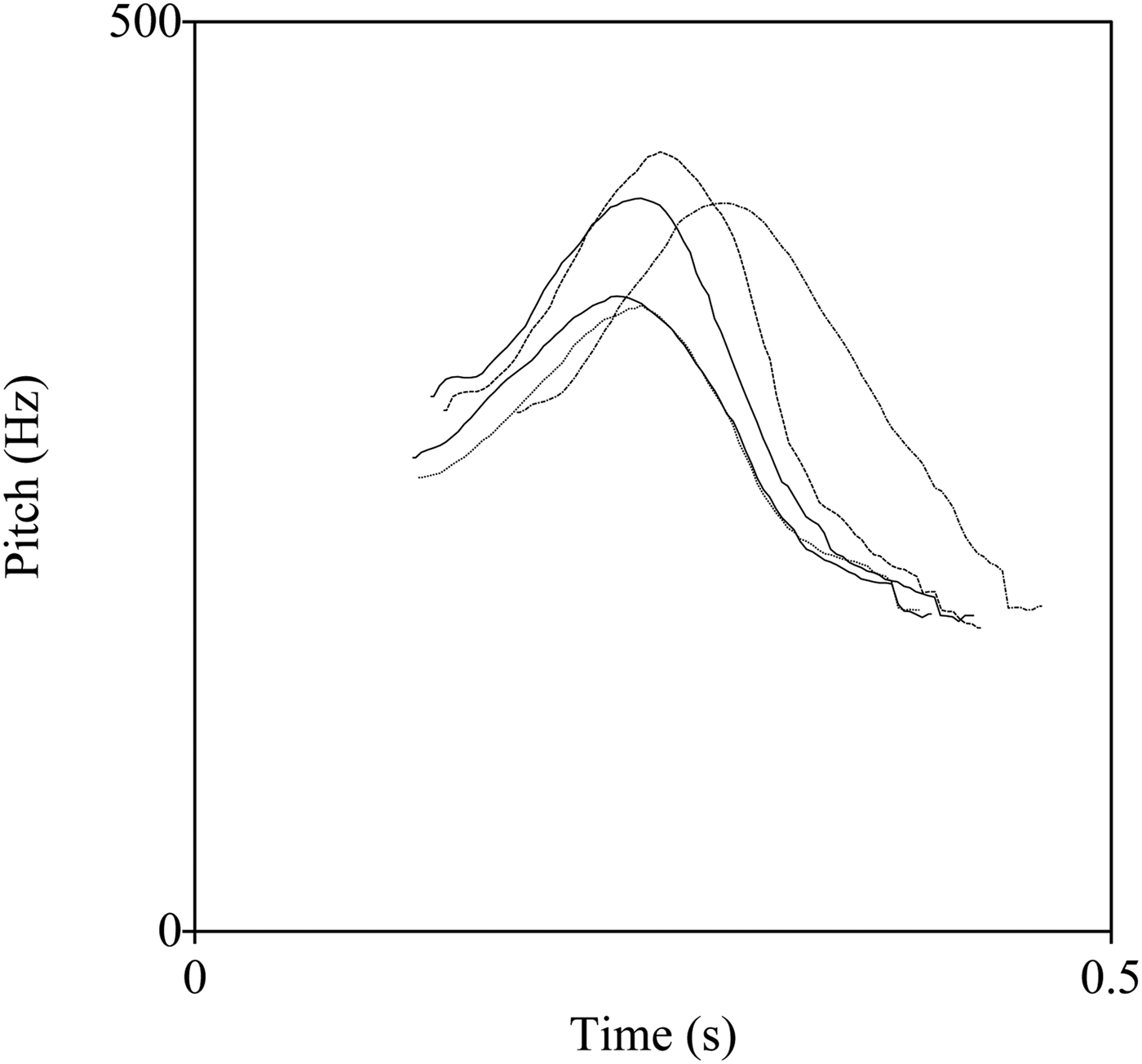
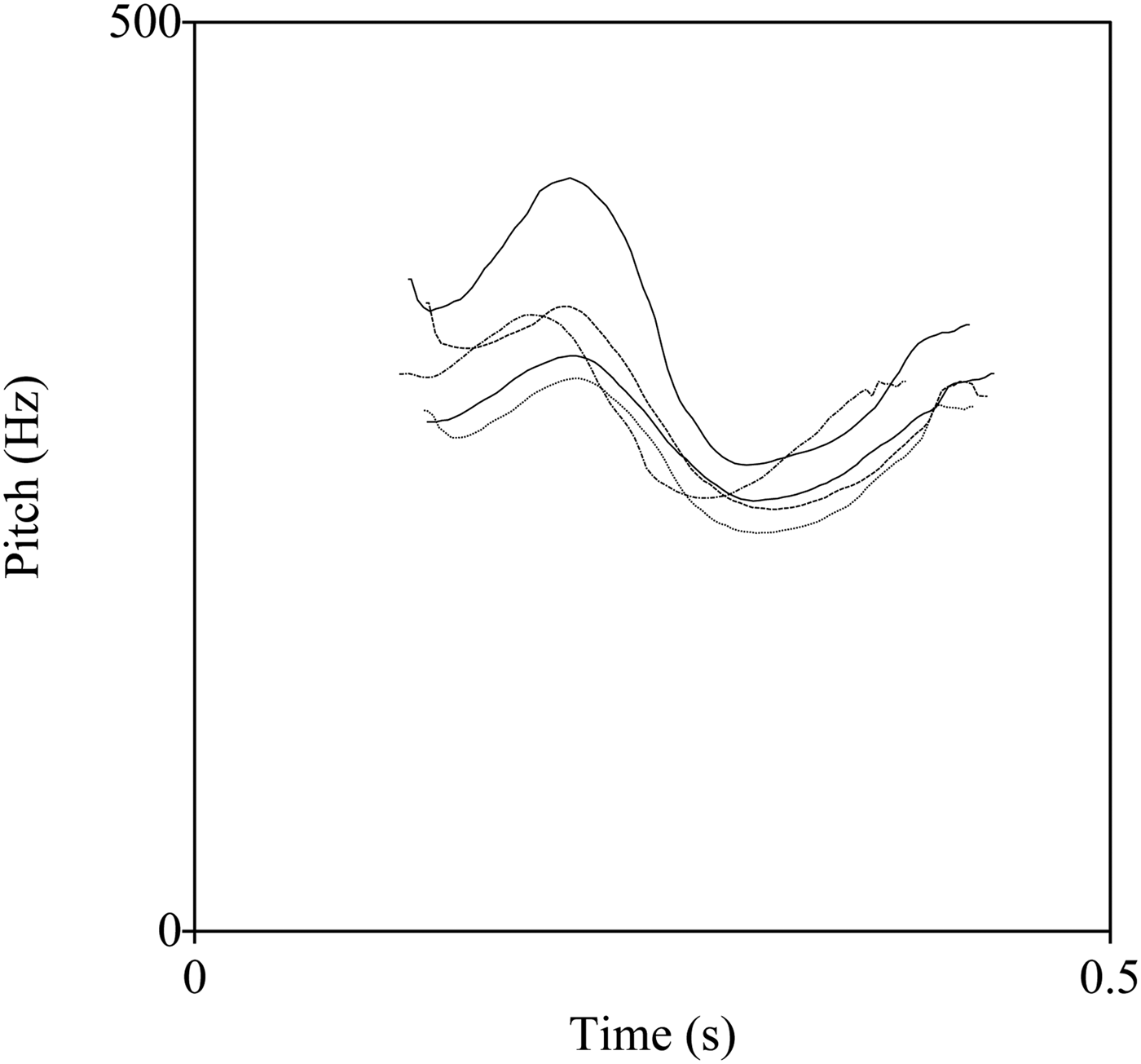
Five tokens per tone type were selected. The selection was based on native intuition of a native speaker of an East-Limburgian dialect [SR] and careful listening of a trained phonetician [Carlos Gussenhoven]. Some variation with respect to absolute pitch height was allowed to introduce minimal variation between tokens of one tone category (see Figures 3A and 3B).
F0 contours of the syllable nuclei of the five different tokens of taag with accent 1.

F0 contours of the syllable nuclei of the five different tokens of taag with accent 2.

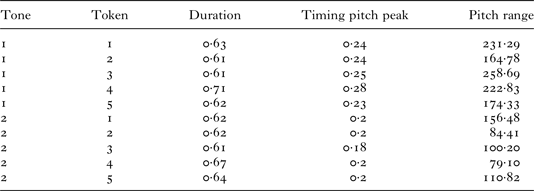
As for between-category variation, we wanted participants to discriminate the contrast based on pitch differences rather than duration differences. Independent samples t-tests showed that accent 1 and accent 2 stimuli did not differ significantly with respect to duration (p = ·86). However, they did differ significantly with respect to the timing of the pitch peak (p = ·001) and the pitch range (p = ·002) as observed in the nucleus of the syllable. See Table A1 in the ‘Appendix’ for the acoustic measurements per token. Tokens with deviant voice quality (e.g. creaky voice) were excluded. We controlled for intensity by equalizing all selected tokens to 65 dB. Discriminability of the tokens was piloted in an ABX-discrimination task with twelve adult speakers of the Roermond dialect. Their mean discrimination accuracy was 87·5%, indicating that they could readily distinguish between accent 1 and accent 2.
Apparatus
Dutch infants were tested in a dimly lit room in the Baby Research Center in Nijmegen. Infants sat on their caregiver's lap in a baby car seat to reduce external distraction. The experiment was run in a test booth (size: 128 × 177 cm), which was partly closed by black wooden partitions, left and right from the 47-inch television screen (LG 47LK530 ZC). A digital video camera (Sony Handycam DCR_HC85E PAL) was placed 30 cm below the screen, hidden by a black curtain with an opening for the lens. The video camera provided a broadcast of the infant's behavior to a monitor behind the TV. Recordings of the infant for offline coding were made using Virtual Dub (Version 1.9·11). The experiment was controlled using the LOOK software (Meints & Woodford, 2008). Both the experimenter and the parent wore noise-cancelling headphones (Sennheiser HMEC 300) that played masking music.
Limburgian infants were tested in an office in a daycare center in Roermond. They sat in front of a 24-inch LCD screen (Philips 249C4QHSB) and were recorded via a digital video camera (Sony HC40) mounted on a tripod below the table. Behind the monitor were two speakers (Logitech Z130). The video camera broadcast the recording to a 13-inch Apple MacBook Air. Recordings were made with the video software Vidi (version 0.4·7). The experiment was presented using the same software as in Nijmegen, run on a laptop (HP EliteBook Folio 9470 m). To mimic the set-up in Nijmegen, the monitor was placed inside a wooden frame. During testing, the experimenter and the parent listened to masking music through noise-cancelling headphones (Sennheiser HME 110).
Procedure
Infants’ discrimination was assessed using the HVHP (Houston et al., Reference Houston, Horn, Qi, Ting and Gao2007). The experiment was divided into a habituation phase and a test phase. The habituation phase consisted of maximally twelve trials. Habituation trials consisted of four of the five selected tokens, repeated blockwise in pseudo-random order with a maximum of thirty-two stimuli per trial (eight repetitions of four tokens). As soon as the mean looking time in three consecutive trials had reached less than 65% of the looking time on the first three trials, the habituation criterion was met and the infant would proceed to the test phase. If a child did not habituate in twelve trials, the habituation criterion was not met and the infant was excluded from the analysis. Half of the infants were habituated on [taːç]1 and half of the infants on [taːç]2 to test for a possible perceptual asymmetry (e.g. Tsao, Reference Tsao2008).
The test phase consisted of four switch trials and eight same trials. Same trials consisted of alternations between the fifth and thus novel token of the habituated type and the four tokens the infant was habituated on (Houston et al., Reference Houston, Horn, Qi, Ting and Gao2007, call these trials non-alternating). Switch trials were made up of alternations between one token of the novel type (thus carrying the tone the infant was not habituated on) and the four tokens from the habituation phase (Houston et al., Reference Houston, Horn, Qi, Ting and Gao2007, call these alternating). Thus, in same trials there was token alternation whereas in switch trials there was type alternation. Which type of trial was presented first was counterbalanced between infants. As a result, there were two pseudo-random trial orders, with switch trials never occurring twice in a row.
The visual stimulus in both phases was a dynamic checkerboard pattern (e.g. Horowitz, Reference Horowitz1975; Stager & Werker, Reference Stager and Werker1997). Trials were separated with a visual attention getter consisting of a purple flashing light. The inter-stimulus interval in all trials was one second.
Online looking time was recorded by pressing a designated key whenever the child was looking at the image on the TV. A trial was initiated as soon as the infant fixated the attention getter. If the infant looked away for more than two seconds, the trial was aborted. If looking time within a trial did not exceed two seconds, the trial was restarted.
Data preprocessing
Infants’ video recordings were coded offline using ELAN (version 4.5·0; Wittenburg, Brugman, Russel, Klassmann & Sloetjes, Reference Wittenburg, Brugman, Russel, Klassmann and Sloetjes2006) with a resolution of 40 frames per second. A random 20% of the videos was re-coded by a second experienced coder. Inter-coder reliability was very high for both same and switch trials (Pearson's r = ·995, p = ·01).
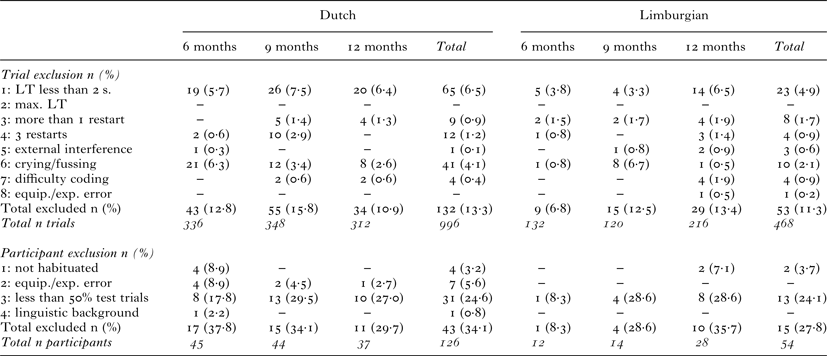
Next to participant exclusion criteria, which have already been mentioned in the ‘Participants’ section, we adopted a series of trial exclusion criteria. A trial was excluded if (i) offline coded looking time within the trial was less than two seconds and (ii) a trial was restarted more than once. Moreover, (iii) all trials after three restarted trials were excluded as well, as we thought three restarts signal a serious decrease in attention and engagement. Trials could also be excluded as a consequence of (iv) technical error, (v) external interference, (vi) crying/fussing of the child, or (vii) difficulty in coding looking behavior. The eighth and last trial exclusion criterion was maximum looking time within a trial (54 seconds), which could signal that the infant is staring and not really paying attention to the experiment. This criterion did not apply to any participant. For a detailed overview of trial and participant exclusion per language and age group, see Table A2 in the ‘Appendix’.
Infants’ mean looking time during the switch trials was compared to their mean looking time in the same trials. In this procedure, a significant main effect of trial type indicates that the child discriminates between same and switch trials. If this is the case, children are expected to show a novelty effect and thus attend longer to switch trials.
RESULTS
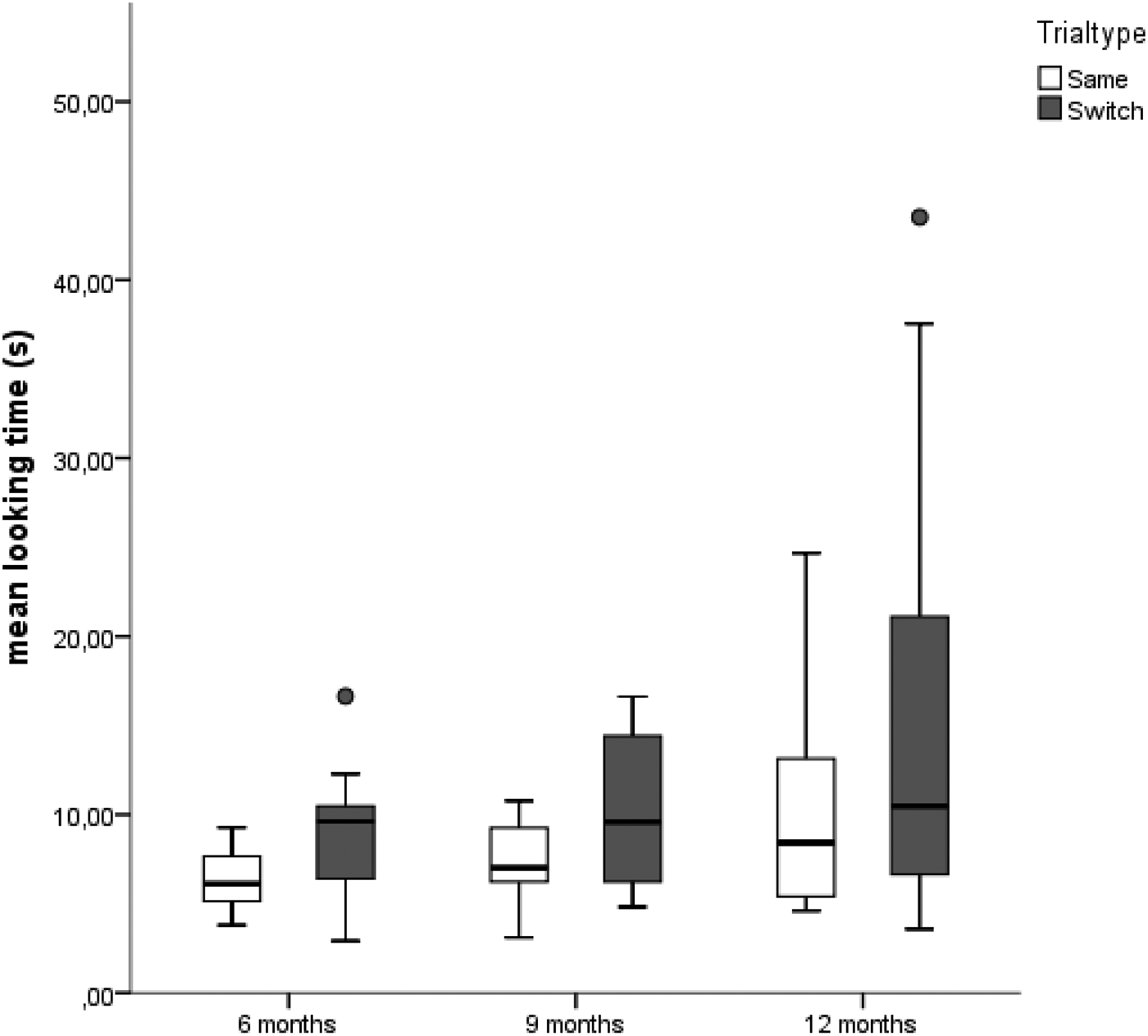
Figures 4A and 4B show infants’ average looking times (LT) to same and switch trials, split by age group and language background. Discrimination of Limburgian accent 1 and accent 2 was analyzed in a three-way mixed ANOVA with trial type (switch vs. same) as the within-subjects factor and language (Limburgian vs. Dutch) and age (6-month-olds vs. 9-month-olds vs. 12-month-olds) as between-subjects factors. The dependent variable was mean looking time.
Mean looking time in same and switch trials for Limburgian infants at age 6, 9, and 12 months.

Mean looking time in same and switch trials for Dutch infants at age 6, 9, and 12 months.

Because the assumption of normality was not met, the raw mean looking times towards switch and same trials were logarithmically transformed to fit a normal distribution. After transformation, Levene's test indicated equal variances (p > ·05). The analysis was run on the transformed data. To enable a more straightforward interpretation of the data, however, we will report the raw means.
Results showed a significant main effect of trial type, indicating that infants looked significantly longer to switch (M switch = 11·9 s, SD = 8·2 s) than to same trials (M same = 9·2 s, SD = 5·6 s; F(1,116) = 15·90, p < ·001, partial η 2 = 0·12, observed power = 0·977). We also found a marginally significant main effect of age, showing that overall looking times increased with age (F(1,116) = 2·94, p = ·057, partial η 2 = 0·05, observed power = 0·563). No other main effects nor interactions reached significance (all ps > ·1).Footnote 4
DISCUSSION
The current study explored the developmental pattern in infants’ native and non-native perception of East-Limburgian lexical tones between 6 and 12 months of age. We expected that native Limburgian infants would discriminate the Limburgian tones throughout their first year of life. Non-native Dutch babies could either show a performance decline or they could maintain their sensitivity to the Limburgian contrast.
The main effect of trial type and the absence of any significant interactions indicates that both Limburgian and Dutch babies are able to discriminate the Limburgian tonal contrast throughout their first year of life, meaning that our hypothesis with respect to the development of the Limburgian infants is met. Because of their daily exposure to lexical tones, we expected them to discriminate the native tonal contrast at all the ages at test. This finding is in line with earlier research on native lexical pitch-accent and tone acquisition (e.g. Sato et al., Reference Sato, Sogabe and Mazuka2009; Yeung et al., Reference Yeung, Chen and Werker2013). Note, however, that the sample sizes per age group for the Limburgian sample were relatively small. We cannot exclude the possibility that larger sample sizes could have yielded a more nuanced developmental pattern.
The present data, however, provide no support for PR in non-native tone perception, since there was no interaction involving age and/or language background. Although the interaction with age was not significant, visual inspection of the data suggests that Dutch infants’ discrimination at 6 months is weaker than their discrimination at 9 and 12 months (see Figure 4B). Our failure to find an interaction with age and/or language background, which needs to be interpreted with caution because of the relatively small Limburgian sample size, is in line with recent studies by Liu and Kager (Reference Liu and Kager2014) and Chen and Kager (Reference Chen and Kager2016) in showing persistent sensitivity to non-native pitch patterns in Dutch infants.
These findings complement results from a vast number of studies on adult non-native tone perception, demonstrating persistent tone sensitivity in speakers of non-tone languages (e.g. Hallé, Chang & Best, Reference Hallé, Chang and Best2004; So & Best, Reference So and Best2010, Reference So and Best2014). Singh and Fu (Reference Singh and Fu2016) propose that the developmental pathway of tone perception should therefore not be compared to the development of phonetic segment perception, but should rather be studied and described as a phenomenon in its own right, because tone appears to stand out among other phonological categories.
Several explanations can be put forward for our finding that Dutch infants maintain sensitivity to Limburgian lexical tones: the influence of acoustic salience, general perceptual maturation, and the influence of native intonation. Regarding acoustic salience, because of the fact that there is a wide variety of phonetic contrasts available in the world's languages, it stands to reason that some of these contrasts will be perceptually easier to differentiate than others. A number of studies on the development of (non-)native infant speech perception have shown that factors like psycho-acoustic salience can indeed affect the developmental perception of segmental and suprasegmental contrasts in the first year of life (e.g. Best et al., Reference Best, McRoberts and Sithole1988; Narayan et al., Reference Narayan, Werker and Beddor2010; Polka & Bohn, Reference Polka and Bohn1996; Tsao, Reference Tsao2008).
Liu and Kager (Reference Liu and Kager2014) have shown that 5- to 18-month-old Dutch infants can readily discriminate Mandarin tones 1 (high level) and 4 (high falling). However, 8- to 15-month-olds did not succeed on a reduced variant of this contrast in which the difference between the contours had been made less extreme. The authors suggest that the perceptual salience of a tonal contrast influences the process of PR. The original, non-reduced contrast was apparently salient enough to be resistant to perceptual tuning. It is possible that the perceptual difference between accents 1 and 2 in Limburgian – at least in their citation form – is also salient enough to override experience-based PR.
Recall that our data suggest weaker performance of the Dutch infants at 6 months, whereas their discrimination performance is strong at 9 and 12 months. If perceptual salience were the explanation for maintenance of discrimination by non-natives in the second half of the first year of life, we would also expect salience to affect discrimination in a positive way at a younger age. Since this seems not to be the case, we would like to put forward other explanations which might be more consistent with the Dutch infants’ results.
One alternative explanation for the perceptual pattern found in our Dutch infants is general perceptual maturation. Chen and Kager (Reference Chen and Kager2016), reporting similar results, propose that general auditory development and the acquisition of language-specific acoustics might complement each other. When infants grow older, they get better at perceiving acoustical information in general.
Another alternative explanation is the influence of native postlexical prosody. Dutch has a rich intonation system. Importantly, similarities can be observed between the Limburgian tones and Dutch intonation contours. Limburgian accent 1 is similar to the highly frequent falling H*L nuclear pitch-accent in Dutch. Accent 2 also occurs in Dutch as intonational H*LH%, which is quite frequent both in utterance-final and non-final position. A fall–rise can signal a question, a reminder, a suggestion, or non-finality. It can appear on monosyllabic words as well as on multiword utterances (Gussenhoven, Reference Gussenhoven, Fant, Fujisaki, Cao and Xu2005). However, as accent 2 in Limburgian or Limburgian-accented Dutch can also occur in prosodic contexts that are unexpected for Dutch listeners (e.g. in declaratives), it is usually the tone that is perceived as ‘foreign’ by speakers of Dutch.
An infant exposed to an intonation language like Standard Dutch thus receives input that contains melodies applied to both one-word or multiword utterances. Importantly, infant directed speech (IDS) tends to consist of short utterances (Fernald & Hurtado, Reference Fernald and Hurtado2006; Snow, Reference Snow1977). Frota, Butler, and Vigário (Reference Frota, Butler and Vigário2014) examined the input directed to four European Portuguese infants ranging from 11 to 16 months of age and found that 43% of the intonational phrases in IDS consisted of single prosodic word utterances. Nearly half of these utterances were of the declarative or question sentence type (27·3 and 19·4%, respectively). Van de Weijer (Reference van de Weijer2001) investigated single-word utterances in IDS directed to a Dutch infant between 6 and 9 months old and showed that almost 40% of all utterances were single-word utterances. Most of these utterances were either fillers (e.g. ‘Yes’, ‘Hm’), social expressions (e.g. greetings), or vocatives (e.g. name of the addressee). The percentage of declaratives, interrogatives, and imperatives was only 8·6%. However, van de Weijer ‘s (Reference van de Weijer2001) findings apply to only one child. For now we assume that Dutch infants are probably also regularly exposed to various intonation contours realized on single-word utterances, which is exactly the kind of stimuli that have been used in the current experiment.
The Dutch infants in our experiment could thus perceive the Limburgian tones, which were instantiated on isolated words, as instances of native sentence-level intonation, which they probably also frequently encounter on single-word utterances in their daily lives (Frota et al., Reference Frota, Butler and Vigário2014). This possibility is also put forward by Liu and Kager (Reference Liu and Kager2014) in explaining the maintenance of Mandarin tone discrimination in Dutch infants. Best et al. (Reference Best, McRoberts and Sithole1988) had already suggested that, at least for consonants, around 10–12 months of age “a phonemic process appears that assimilates speech sounds to native categories whenever possible” (p. 345). In her Perceptual Assimilation Model (PAM), Best (Reference Best and Strange1995) offers an explanation for the process that phonetic and phonological properties of the L1 influence perception in a foreign language. The model proposes that non-native sound contrasts tend to be perceived according to their degree of similarity to native sounds. The perceived distance between the non-native contrast and the closest native sound(s) (if any) leads to differences in non-native contrast discriminability. The first applications of PAM concerned auditory perception of consonants and vowels, but it has also successfully been extended to the perception of suprasegmentals (PAM-S; Hallé et al., Reference Hallé, Chang and Best2004; Reid et al., Reference Reid, Burnham, Kasisopa, Reilly, Attina, Rattanasone and Best2014; So & Best, Reference So and Best2010, Reference So and Best2014). The PAM-framework has also been applied to infant speech perception development (Best, Reference Best, Goodman and Nusbaum1994; Yeung et al., Reference Yeung, Chen and Werker2013).
In the first year of life, infant perception of speech contrasts shifts from phonetic (or universal) to phonological (or language-specific) due to growing experience with the native phonological system. Despite infants’ sensitivity and preference to the prosodic properties of language at birth (e.g. Nazzi, Floccia & Bertoncini, Reference Nazzi, Floccia and Bertoncini1998), a number of studies have shown that infants’ perception of certain aspects of prosody reflect the nature of the native prosodic system only at around 9 months of age (e.g. Höhle, Bijeljac-Babic, Herold, Weissenborn & Nazzi, Reference Höhle, Bijeljac-Babic, Herold, Weissenborn and Nazzi2009; Jusczyk, Cutler & Redanz, Reference Jusczyck, Cutler and Redanz1993; Skoruppa et al., Reference Skoruppa, Pons, Christophe, Bosch, Dupoux, Sebastián-Gallés, Alves Limussuri and Peperkamp2009; but see Frota et al., Reference Frota, Butler and Vigário2014). Our data suggest that Dutch infants’ discrimination of the Limburgian tones was less strong at 6 months than at 9 and 12 months. This pattern might reflect their accumulating knowledge of native sentence-level prosody. Frota et al. (Reference Frota, Butler and Vigário2014) have shown that English infants can discriminate segmentally varied, single-prosodic word utterances presented with statement or yes/no question intonation at 6 and 9 months of age. At 9 months, Dutch infants might also have accumulated enough knowledge of native sentence-level intonation to enable them to distinguish questions from statements. Other studies on infant discrimination of sentence-level intonation did not offer direct evidence of intonation discrimination because their (whole-sentence) stimuli differed in both intonation and word order (Geffen & Mintz, Reference Geffen, Mintz, Biller, Chung and Kimball2011), or because they found an overall preference for stimuli with question intonation (Soderstrom, Ko & Nevzorova, Reference Soderstrom, Ko and Nevzorova2011).
It has already been stated that the Limburgian tones are quite similar to frequent Dutch intonation contours. PAM-S (So & Best, Reference So and Best2010, Reference So and Best2014) outlines a number of different patterns of perceptual assimilation. These patterns go with different expectations regarding discriminability. If two non-native sounds are similar to two native sounds, two-category (TC) assimilation applies. Following PAM-S, Limburgian accent 1 and accent 2 could both be classified as instances of TC assimilation: two non-native categories, accent 1 and accent 2, assimilate to two native categories, the Dutch sentence-level intonation contours H*L and H*LH%. TC assimilation typically leads to high discrimination performance (e.g. Best, McRoberts & Goodell, Reference Best, McRoberts and Goodell2001). A discrimination paradigm with Limburgian and Dutch adults similar to Braun and Johnson (2011) could provide insights into the relative contribution of psycho-acoustic salience and assimilation to native prosody.
Another interesting question for future research is whether the Limburgian tones are interpreted as lexically relevant by native speakers of Limburgian. We expect tones to be part of the phonological representation of Limburgian words that meet the segmental requirements for the tone contrast to appear (see the ‘Introduction’). In Dutch, however, pitch differences are not contrastive at the word level, so we expect at least Dutch listeners not to attribute lexical relevance to tones. The interpretation of Limburgian tones in children and adults acquiring Limburgian or Dutch is currently under study in our laboratory. Previous word learning studies with English children (e.g. Hay, Graf Estes, Wang & Saffran, Reference Hay, Graf Estes, Wang and Saffran2015; Quam & Swingley, Reference Quam and Swingley2010; Singh, Hui, Chan & Golinkoff, Reference Singh, Hui, Chan and Michnick Golinkoff2014) have indeed shown that around 20 months of age, when word learning is well under way, non-tone-language children treat pitch differences as not lexically contrastive.
In conclusion, the present study contributes to the field of lexical tone acquisition by studying a relatively unknown and understudied population: infants growing up with restricted tonal Limburgian dialects of Dutch. We compared them to non-tonal Dutch peers growing up with an intonation language. Both Limburgian and Dutch infants perceive Limburgian accents 1 and 2 throughout their first year of life. For future research it is important to disentangle the relative contribution of acoustic salience and linguistic experience to these results, as well as to provide insights into the function or importance that both of these populations assign to pitch contour differences at the word level.
APPENDIX
Acoustic measurements of the accent 1 and accent 2 tokens of taag used during habituation and test phase. Duration in seconds, timing of the pitch peak measured from word onset in seconds, pitch range in Hz.

Number and percentage of excluded trials and participants per language and age group