INTRODUCTION
Over the past two decades, scholars and the popular press have turned their attention to religion to explain major divisions in party support among the United States voting public. Since the “religio-political earthquake of the 1960s,” evangelical Christians have emerged as an important voting bloc for the Republican Party (Olson Reference Olson2012, 105; see also Layman Reference Layman2001). In the Presidential election of 2012, both candidates downplayed religious affiliation to some extent, but Republican Mitt Romney carried the votes of evangelicals by a wide-margin, garnering more than 75% of evangelical votes. Although some evangelicals align with the political left, scholars of religion and politics observe that the majority are conservative and that they “now constitute a key GOP voting bloc in both national and local politics” (Fowler et al. 2010, 35). This is apparent in a comment by Ralph Reed, former Executive Director of the Christian Coalition, who underscored the continuing influence of evangelical Christians in the 2014 midterm elections. Citing a Public Opinion Strategies post-election survey, Reed noted that “self-identified conservative Christians made up 32 percent of the electorate and voted 86 percent Republican and only 12 percent Democrat. These voters contributed roughly 52.4 percent of all the votes received by Republican candidates” (Reed Reference Reed2014).
We have learned much about the role of evangelicals in American politics from examinations of the links between religious affiliation and political attitudes (Olson and Green [Reference Olson and Green2006]; and Putnam and Campbell [Reference Putnam and Campbell2012] provide excellent syntheses of the literature). Many scholars of religion and politics observe that at the end of the 1960s, attitudes about race and sex were changing sharply and these transformations “triggered a return to evangelical Protestantism in American political life that hit a high-water mark in the first decade of the 21st Century” (Putnam and Campbell Reference Campbell and Putnam2012; Campbell and Putnam Reference Campbell and Putnam2012, 24). Study after study shows a strong association between evangelical identity and conservative political attitudes (Smidt Reference Smidt1987). Smidt (Reference Smidt and Wilson2007), for instance, argues that evangelical Protestants constitute a distinct religious tradition in United States society because of unique theological beliefs and worship style (33–34) and further contends that adherents will share a set of conservative political beliefs (47).Footnote 1 Clyde Wilcox and Carin Robinson (Reference Wilcox and Robinson2010) contend that religious orthodoxy helps to explain distinct patterns of political conservatism among evangelicals. And Jelen and Chandler (1996) posit that evangelicals' conservative political attitudes result in part from messages from elites, such as national leaders, religious media, and pastors. Based on much of the literature on religion and politics then, one might assume that evangelical identity would have a uniform association with political attitudes due to shared theological beliefs, cultural commitments, and religious messages (Smith et al. Reference Smith, Emerson, Gallagher, Kennedy and Sikkink1998).
Yet scholars and the public at large have come to anticipate a Black-White divide in American politics, including within the evangelical community. Those who study religion and politics observe that White and Black evangelicals share much in common as far as placing an emphasis on sharing one's faith, beliefs that the Bible is the ultimate authority, and the need to accept Jesus as one's personal savior in order to achieve salvation, an act of faith often referred to as being “born-again” (Kellstedt and Smidt Reference Kellstedt and Smidt1991; Noll Reference Noll2008, 13; Emerson and Smith Reference Emerson and Smith2001, 3). At the same time, it has long been observed that in terms of their political orientations, the two groups could not be more different. From 2004 to 2012, nearly 80% of all White evangelicals supported the Republican candidate for President. In contrast, more than 85% of Black Protestants (the vast majority of whom identify as evangelical) backed the Democrat (Pew Forum 2012).
The Black-White divide within the evangelical community is attributed by Kenneth Wald (Reference Wald2003, 171–72) to the “historical situation, social role, and organizational independence,” of Black Protestant churches. But expectations related to race become less clear when we move beyond a Black-White dichotomy. In fact, perhaps because they were published in the 1990s, the most highly cited articles on evangelical identity and politics do not seriously attend to significant waves of immigration from Asia and Latin America that have occurred in the post-1965 era (c.f. Layman and Carmines Reference Layman and Carmines1997; Wilcox and Jelen Reference Wilcox and Jelen1990). Even in later, influential studies on the topic, such as Layman and Green (Reference Layman and Green2006) and Campbell and Monson (Reference Campbell and Monson2008), Latino evangelicals are either grouped together with White evangelicals or undifferentiated from other Latinos.
To be fair, most scholars of evangelical identity and politics would expect that the effects of religion on political attitudes would vary by race and ethnicity. For example, in a relatively recent essay on “Evangelical and Mainline Protestants at the Turn of the Millennium,” Corwin Smidt (Reference Smidt and Wilson2007) writes that “a growing number of Hispanic and Asian immigrants in this country is coloring evangelical Protestantism in new, and different, ways … such growing diversity will likely make it more difficult for the tradition to maintain its relatively high levels of issue and voting cohesion politically” (47). But, the extent and nature of potential variation in the effects of evangelical identity on political attitudes among not only Whites and Blacks, but also growing numbers of Latinos and Asian Americans, has not been studied systematically.
This article aims to fill that gap. It compares the effects of evangelical identity on political attitudes across a range of groups to better address the conditional effects of religious identity on political orientations in an increasingly diverse context. The primary research question driving the study is: Does born-again identity play a consistent role across racial groups in determining political attitudes?
GROWING DIVERSITY IN EVANGELICAL AMERICA
The evangelical population in the United States is by no means monolithic or static. The proportion of White evangelicals is, in fact, slowly, but steadily, declining in the United States (Lugo Reference Lugo2013). In contrast, Latinos and Asian Americans constitute a growing constituency in religious America more broadly and in evangelical America, in particular. The proportion of Latinos in the United States identifying as evangelical or born-again rose from 12% to 16% between 2010 and 2013 (Jones et al. Reference Jones, Cox and Navarro-Rivera2013; Pew Research Center 2014). The proportion of Asian Americans identifying as evangelical or born-again rose from 16% in 2008 to about 25% in 2012 (Pew Research Center 2012, 45; Ramakrishnan et al. Reference Ramakrishnan, Junn, Lee and Wong2008).
Evangelical churches are without a doubt the largest, fastest growing Asian and Latino organizations in the United States. The National Hispanic Christian Leadership Conference and the National Latino Evangelical Coalition estimate that there are at least 15,000 Hispanic Evangelical congregations in the United States. Templo Calvario, an Assemblies of God church in Santa Ana, California, includes a membership of more than 10,000 Spanish-speakers. No fewer than 8,000 Spanish-speakers attend Lakewood Church in Houston every Sunday, in the remodeled arena that previously housed the Houston Rockets basketball team. Hundreds of Latino storefront and homefront churches have transformed religious cityscapes (Hadley Reference Hadley2012).
A staggering increase in numbers of evangelical worshippers within the Asian American community can also be observed in various parts of the country. Korean Central Presbyterian Church, in Centreville, Virginia, boasts 4,600 Sunday worshippers. New Song Community Church, in Irvine, California, attracts approximately 3,000 Asian American worshippers every Sunday. On many college campuses, evangelical Christian organizations have become predominantly Asian American (Kim Reference Kim2006). Rebecca Kim (Reference Kim2006) notes that “there are more than fifty evangelical Christian groups at the University of California (UC) at Berkeley and the University of California at Los Angeles (UCLA),” and that “the percentage of Asian Americans at InterVarsity (a popular campus fellowship organization) chapters on some West Coast and Northeast campuses and throughout parts of the Midwest is often as high as 80 percent” (2–3). Even in 2007, reports showed that there were as many as 7,000 predominantly Asian American churches nationwide (Chuang Reference Chuang2007). More recently, mainstream evangelical seminaries have established programs dedicated to Asian American ministries. In 2013, the largest evangelical seminary in the United States, Fuller Seminary, established a new program — the Asian American Initiative — dedicated to training students who would “critically and theologically address the issues and concerns of the Asian American community” (Fuller Reference Fuller2013). In fact, between 2009 and 2013, a period of time when enrollment among Whites was declining, Asian American enrollment at evangelical seminaries grew almost 20% (Jameson Reference Jameson2014).
Together, Asian American and Latino evangelicals constitute about 13% of all evangelicals in the United States. This proportion is surely going to increase as new immigrants enter the United States from Asia and Latin America and the number of White evangelicals remains steady or even falls (Putnam and Campbell Reference Campbell and Putnam2012, 34). The Public Religion Research Institute highlighted this demographic trend in its 2014 American Values Atlas analysis:
“Today, roughly two-thirds (66 percent) of Protestants who identify as evangelical or born again are non-Hispanic whites. Black evangelical Protestants make up 21 percent of all evangelical Protestants in the U.S., while nearly 1-in-10 (9 percent) are Hispanic. Among evangelical Protestants under the age of 30, only 52 percent are non-Hispanic whites” (Public Religion Research Institute 2014)
Robert P. Jones (Reference Jones2014), Chief Executive Officer of the Public Religion Research Institute, shows that the proportion of White evangelicals in the population declined from 22% in 2007 to 18% in 2014. Growing diversity among those who identify as evangelical Christians presents an important opportunity to take a closer look at the association between evangelical identity and political attitudes.
Because they are emerging groups in American politics, the political attitudes and behavior of Latino and Asian American evangelicals are not well established. In the wake of the 2012 Presidential Election, assessments of the partisan attachments of Latinos and Asian Americans relied heavily on assumptions related to race or religion.
Racial identities and associated issues are largely seen as driving Latinos and Asian Americans as a whole toward the Democrats (García Bedolla and Haynie Reference García Bedolla and Haynie2013; Kuo, Malhotra, and Mo Reference Kuo, Malhotra and Mo2014; Wallace Reference Wallace2012), while issues related to religious identity are sometimes seen as a distinct advantage for the Republicans. For example, some pundits suggest that increasing numbers of evangelical Latinos may create a new constituency for Republicans. In a Time column published after the 2012 presidential election, journalist Elizabeth Dias (Reference Dias2013) speculated that Latino evangelicals might “help Republicans take a bite out of the Democratic advantage with Hispanic voters,” because, “They prize the nuclear family. They are largely against abortion and gay marriage. They also tend to be wealthier than Latino Catholics….” This comment echoes Robert Gittelson's (Reference Gittelson2012) remarks in an opinion piece published on the Washington Post website in mid-September 2012: “The Hispanic community — especially its large and growing evangelical community — has a structural value system that closely mirrors the Republican Party's positions on many issues including the right to life and traditional marriage. These are fundamental values that can't easily be dismissed by ‘skeptics.’”Footnote 2 These perspectives are consistent with earlier speculation that increasing numbers of Latino evangelicals would contribute to the political power of conservative Christians (DeParle 2005; Green Reference Green and Leighley2005; Puente Reference Puente2007).
In contrast to wide speculation about the political leanings of evangelical Latinos, there has been little commentary on Asian American evangelicals and their political orientations. Still, there is some conjecture about Asian American voters more generally. For example, even in the face of overwhelming support for President Obama (nearly 70%) among Asian American voters in 2012, some pundits claimed that the group's “natural home” was the Republican Party:
Everyday observation of Asians around the world reveals them to be conspicuously entrepreneurial, industrious, family-oriented, and self-reliant. If you're looking for a natural Republican constituency, Asians should define “natural” (Murray Reference Murray2012).
In fact, Asian Americans have been leaning away from Republicans in recent years. Since the mid-1990s, they have demonstrated the strongest shift toward the Democratic Party of any racial group in the United States (Lee and Ramakrishnan Reference Lee and Ramakrishnan2012). These trends have not been divorced from discussions about religion in American politics. Scholars of Asian American politics attribute the Asian American shift toward the Democrats over the past 20 years in part to the Republican Party's association with conservative Christians. Political scientist Karthick Ramakrishnan, for instance, explains that Asian Americans' Democratic leanings may be related to the GOPs pro-Christian image: “…a party projecting a pro-Christian image makes it difficult to reach out to Asian American voters, most who are not Christian” (Ramakrishnan, quoted in Chen Reference Chen2012). Most Asian Americans are not Christians. But at 42%, Christians comprise a significant plurality of Asian Americans (Pew Research Center 2012, 11). Evangelical Christianity is growing among Asian Americans over time, but it is unclear if support for the Republican Party will increase as a result.
A growing body of research on Latino evangelicals provides some intriguing indicators about how evangelical identity might impact political attitudes among the group. For example, a 2007 Pew Forum on Religion and Public Life report by Luis Lugo and Allison Pond suggests that although Latino evangelicals exhibit the same or even more support for conservative positions on same-sex marriage, abortion and some foreign policy issues, they diverge from White Evangelicals when it comes to other policy issues (Lugo and Pond Reference Lugo and Pond2007, 3). They write:
“…nearly half (47%) oppose the death penalty, compared with just 16% of white evangelicals. A similar, and more predictable, departure from white evangelical attitudes is evident on the issue of immigration. While only a minority (33%) of non-Hispanic evangelicals says that immigrants strengthen American customs and values, a solid majority of Latino evangelicals hold that view. Latino evangelicals, along with other Latinos, also hold generally liberal views on economic issues and are more likely to support government programs and sympathize with poor people than are white evangelicals.”
The data analyzed by Lugo and Pond provide a nice starting point for a discussion of Latino evangelicals and their political orientations (see also Jones et al.'s Reference Jones, Cox and Navarro-Rivera2013 comprehensive study of Latino religious identity and political orientations). However, these data are limited in terms of comparing Latino evangelicals to other evangelicals. The current study addresses these limitations by relying on a dataset that includes a large sample of Latinos, Asian Americans, Black Americans, and White Americans. As such, Blacks, Whites, Latinos, and Asian Americans who identify as evangelical can be compared directly with one another. Previous studies do not allow for these direct comparisons using data collected with the same instrument and at the same time.
STUDY SCOPE AND DEFINITIONS
The key variable of interest in this study is self-identity as a “born-again or evangelical” Christian.Footnote 3 The terms “born-again” and “evangelical” are used interchangeably throughout.
Because the contemporary immigration stream is dominated by immigrants from Asia and Latin America, I am especially attentive to Asian Americans and Latinos in the following analysis. Compared to Blacks and Whites, little is known about the effects of religious identity on the political orientations of these groups. For the purposes of this article, the term “Asian American” refers to any individual of Asian origin residing in the United States on a permanent or semi-permanent basis, regardless of citizenship status. Similarly, “Latino” refers to individuals of Latin American origin residing in the United States, regardless of citizenship status. European Americans are referred to as “White” and do not include Latino Americans. Those of African origin are referred to as “Black,” and, again, do not include those who identify as Latino.Footnote 4
The current study is based upon analysis of the 2008 Collaborative Multi-racial Post-Election Survey (CMPS) (Barreto et al. Reference Barreto, Frasure-Yokley, Hancock, Manzano, Ramakrishnan, Ramirez, Sanchez and Wong2008). The 2008 CMPS includes 4,563 registered voters from a multi-state, cross-regional sample. The survey was conducted via live telephone calls in English, Spanish, Mandarin, Cantonese, Korean, and Vietnamese with an oversample of Black, Latino, and Asian American registered voters from November 9, 2008 to January 5, 2009. It includes 1,122 White, 945 Black, 1,577 Latino, and 919 Asian American respondents.Footnote 5 The margin of error is ± 1.5% for the national sample, ± 2.5% for the Latino sample, and ± 3.2% for the White, Black, and Asian American samples. The sample was drawn from official, up-to-date registered voter lists, which were enriched with public and private sources if data (such as telephone number) were missing (voter registration and accuracy were verified by the CMPS team). The American Association for Public Opinion Research (AAPOR) Response Rate 1 was 11.4% and the AAPOR Response Rate 3 was 34.9%. The CMPS represents the first multi-racial, multi-lingual survey of registered voters across multiple states and regions during a presidential election.
Because the Census and Current Population Surveys do not include questions on religion, it is more useful to compare this sample to other high-quality data with similar populations. Note that the CMPS samples appear, for the most part, consistent with the registered voter samples of the 2012 Pew Survey of Asian Americans and the 2012 Pew National Survey of Latinos (Pew Social Trends 2012; Pew Hispanic Center 2012) (see Appendix 1).Footnote 6
There are some important limitations to the CMPS survey data. One of the main questions in the survey utilized here is, “Do you consider yourself an evangelical or born-again Christian?” This question fails to capture the nuances of religious identity and may even exclude some individuals of interest. Further, the CMPS represents a single snapshot of public opinion among a select group of the population — registered voters — in the immediate aftermath of the 2008 presidential election cycle. Registered voters who are citizens and immigrants in this pool demonstrate a longer average length of United States residence and older mean age than those in the general population. Registered voters are also more economically integrated than the general population.
Despite its limitations, the CMPS survey is quite useful because it provides systematic data on key questions related to the project. One major benefit of the survey for the current study is that it includes questions about respondents' nativity, religious affiliation, political orientations, attitudes toward social issues, and political participation. Further, it represents perhaps the best contemporary multi-racial, multi-lingual survey available that includes large enough numbers of Latinos, Asians, Blacks, and Whites to allow for meaningful statistical comparisons across both racial and religious groups. Finally, the CMPS allows for limited (not comprehensive) disaggregation of the Asian American and Latino samples (Chinese, Vietnamese, Korean, Other Asian, Mexican, Puerto Rican, Cuban, and Other Latino).
Group Profiles: Race and Religion
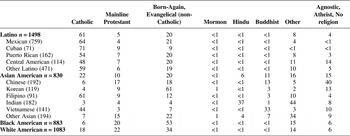
Before delving into a more thorough examination of whether the association between religion and political attitudes varies by racial category and national origin group, it is instructive to review some basic descriptive statistics related to religion and socioeconomic status across the major racial categories included in the current analysis (see Table 1).
Religious affiliation by racial category

Source: Barreto et al. (Reference Barreto, Frasure-Yokley, Hancock, Manzano, Ramakrishnan, Ramirez, Sanchez and Wong2008); each group weighted separately to reflect population distribution; 18% of Latinos, 10% of Asian Americans, and 1% of Black and White Americans identify as Catholic and charismatic.
Note: entries may not add up to 100 due to rounding.
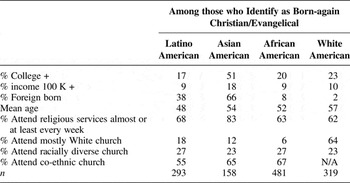
The proportion of respondents who identify as “born-again or evangelical” varies substantially across groups of registered voters in the CMPS sample. As expected based on past research, born-again identity is most prevalent among Black Americans. More than half of this group describe themselves as born-again Christians. Whites also demonstrate relatively high rates of evangelical or born-again identity (about one out of every three respondents). Although Latinos constitute the group most likely to identify as Catholic, fully 20% of this group in the CMPS sample identifies as born-again (and non-Catholic). Similarly, although Asian Americans are the racial group most likely to identify as “atheist, agnostic, or no religious affiliation” (15%), or as Hindu (6%), Buddhist (11%) or “Other” religion (16%), 20% of this group also describe themselves as born-again Christians.Footnote 7 Turning to Table 2, which presents demographic comparisons among those who identify as born-again or evangelical, one observes that despite their common religious affiliation, White, Black, Latino, and Asian American evangelicals differ in terms of key socioeconomic characteristics and religious behavior. For example, Asian American born-again Christians are more than twice as likely to report graduating from college than any other group. There is also a substantial income gap between Asian Americans and other groups. Approximately 25% of evangelical Asian Americans claim that their annual household income consists of $100,000 or more, compared to about 10 to 15% of other groups. As one would expect, more Asian American (66%) and Latino (38%) evangelicals indicate that they are foreign born compared to either White (2%) or Black (8%) evangelicals. The multi-variate analyses that follow thus attend to demographic variables such as income, age, education, and nativity.
Born-again identity and demographic characteristics across racial categories of registered voters

Source: Barreto et al. (Reference Barreto, Frasure-Yokley, Hancock, Manzano, Ramakrishnan, Ramirez, Sanchez and Wong2008); data are weighted, missing income replaced with mean income.
Despite prominent distinctions in socio-economic status, born-again survey respondents appear relatively similar in terms of religious commitment, regardless of racial identity. At least 60% of Latino, Asian, White, and Black evangelicals say that they attend religious services “almost every” or “at least every” week. To compare, less than 50% of mainline Christians or Catholics attend services as often. Higher attendance at religious services across all racial groups is consistent with other shared evangelical characteristics. Data from the General Social Survey and the Pew Forum on Religious Life suggest that regardless of racial background, evangelicals are more likely than those affiliated with other religious traditions to believe that the Bible is the ultimate word of God, to believe their religion is the “one true faith,” to pray, and to say living a religious life is very important to them (Pew Research Center 2014; Putnam and Campbell Reference Campbell and Putnam2012). With regard to many of these religious beliefs and behaviors, evangelical Asian Americans, Blacks, and Latinos indicate more religious commitment than their White counterparts (c.f . Greeley and Hout Reference Greeley and Hout2008; Lugo and Pond Reference Lugo and Pond2007; Pew Research Center 2011; 2012; 2014). It is important to note here that attendance at religious services and religious affiliation are related but distinct concepts. While a majority of those who identify as born-again do tend to attend religious services frequently, those who attend religious services at least weekly do not always or even mostly identify as born-again or evangelical. Among the sample as a whole, for example, two-thirds of those who identify as born-again also claim to attend religious services at least once a week. At the same time, only about half of those who report attending religious services at least once a week also identify as evangelical or born again.
METHODS
This article asks whether born-again identity plays a consistent role in determining political attitudes across racial groups. A range of political attitude questions were included in the CMPS survey. Respondents were also asked about partisanship, favorability toward various national political figures, and ideology. It is common for reporters and academic researchers who study “the evangelical vote” to focus on allegiance to the Republican Party, issues of abortion, and same-sex marriage (Brooks and Manza Reference Brooks and Manza1997; Hankins Reference Hankins2008; Hillygus and Shields Reference Hillygus and Shields2005; Lewis and de Bernardo Reference Lewis and De Bernardo2010; Olson et al. Reference Olson, Cadge and Harrison2006; Sherkat et al. Reference Sherkat, De Vries and Creek2010; Wilcox and Larson 2006). These attitudes are also considered here. In addition, several policies that fall outside of the traditional evangelical agenda are included. For instance, this analysis includes a foreign-policy-related attitude — support for getting United States troops out of Iraq. Also included are attitudes about the domestic role of government, having to do with whether the federal government should guarantee healthcare for everyone and whether the middle-class should get a tax cut by having the wealthiest pay a little more in taxes. Finally, a question about immigrant rights — whether undocumented immigrants should qualify for in-state tuition — is included. Each of these policy attitudes was coded such that the more conservative attitudes were scored higher. Question wording and variable coding are included in Appendix 3.
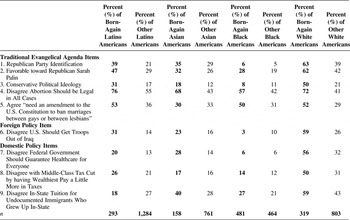
Table 3 details the bi-variate associations between born-again identity and the political attitudes described among Latinos, Asian Americans, Blacks, and Whites who took part in the CMPS. Recall that all of the respondents in the study are registered voters and citizens. Two distinct patterns emerge. First, within each racial category, if one compares those who identify as born-again to those who do not identify as born-again, those who identify as born-again express greater levels of Republican identification, more favorability toward Sarah Palin (prominent national Republican figure and Republican nominee for Vice President in 2008), and more conservative policy positions across the board. For example, almost 50% of Latinos who identify as born-again express favorable attitudes toward Republican Sarah Palin, but only 29% of non-born-again Latinos feel the same way about the former Vice Presidential candidate. Similarly, nearly one in three born-again Asian Americans feel favorably toward Palin compared to one in four non-born-again Asian Americans. Among Latinos, Asian Americans, and Whites, there are differences between those who identify as born-again and those who do not in terms of abortion attitudes, attitudes toward United States involvement in Iraq, and government guaranteed health care.
Descriptive statistics: Political attitudes and behavior across racial categories

Source: Barreto et al. (Reference Barreto, Frasure-Yokley, Hancock, Manzano, Ramakrishnan, Ramirez, Sanchez and Wong2008); data are weighted.
In almost every case, Black Americans, born-again or not, tend to be less conservative than their Latino, White, and Asian counterparts. However, when it comes to same-sex marriage, Asian Americans are the least conservative, particularly among those who identify as born-again. This is a bit surprising given the visible role of Chinese and Korean American Christian pastors in contesting marriage equality (Kim Reference Kim2010, 128).Footnote 8 Still, for the most part, the data in Table 3 mesh well with speculation by scholars and journalists that Latinos and Asian Americans may represent a rich source of potential growth for the Republican Party and potential coalition partners with similarly oriented White evangelicals and frequent worshippers.
These data also reveal, however, that variations remain between White born-again Christians and non-White born-again Christians — even on traditional evangelical consensus issues such as favorability toward Republican candidates, conservative ideology, and party identification. For example, in terms of Republican Party identification, about 20 percentage points separate Latino evangelicals and Latinos who do not identify as evangelicals (Table 3, row 1). A similar spread, about 20 percentage points, separates Republican identifiers among Latino evangelicals (39% Republican) and White evangelicals (63% Republican). Similarly, one observes that while a larger proportion of Asian Americans who identify as born-again view Sarah Palin favorably compared to non-born-again Asian Americans (32% vs. 26%), the difference Palin-support between born-again Asian Americans and born-again Whites is even more dramatic (32% vs. 62%).
At the same time, abortion continues to be a major policy issue across race within the evangelical community. Although evangelical Christians, particularly those aged 18–24, embraced a wide range of issue priorities in the 2008 election compared to previous election years (including anti-poverty policies and global human rights [Zogby Reference Zogby2008]), surveys suggest that young evangelicals tend to be as or more conservative on abortion rights than their elders (Cox Reference Cox2007; Jones and Cox Reference Jones and Cox2015). Consistent with this generational convergence, the data in Table 3 show different racial and ethnic groups coming together on the issue of abortion. Note that Latino evangelicals tend to be the most conservative on abortion, followed by Whites. More than 65% of all Asian Americans and 57% of Blacks who identify as born-again also oppose abortion.
Turning to political issues having to do with foreign or domestic economic policy (Table 3, rows 6 through 9) one observes that variations between White and non-White evangelicals persist. Among Latinos and Asian Americans, those who are born-again tend to be more conservative in terms of their attitudes toward United States troops in Iraq and government guaranteed healthcare than their non-born-again counterparts. However, support among born-again Latinos and Asian Americans for these policies is quite low compared to born-again Whites. Further, there are only minimal differences between born-again and non-born-again Latinos and Asian Americans in terms of attitudes toward taxing the wealthy, but substantial differences related to this policy exist between born-again and non-born-again Whites. The last row in the table shows a distinct pattern related to opposition to granting in-state tuition to undocumented immigrants who grew up in the respondent's state (these policies are commonly referred to as “Dream Acts”). On this policy, Latino evangelicals appear more liberal than other Latinos.
Note that with the exception of attitudes toward abortion, at the bi-variate-level, White evangelicals are much more likely to take a conservative position than non-White evangelicals. In addition, when it comes to identification with the Republican Party, attitudes about United States troops in Iraq, taxing the wealthy, government sponsored healthcare, and immigration policy, non-born-again Whites are as or more conservative than born-again Latinos, Asian Americans, and Blacks.
These basic comparisons hint that while evangelical religious affiliation certainly shapes the political orientation of Latinos and Asian Americans, with the exception of the issue of abortion, the effects of race may be equally important or even more powerful. That is, the role of born-again identity on political attitudes may shift according to one's racial background.
The data in Appendix 4 show that there are often differences in political attitudes between those who identify as evangelical and those who do not among Asian American and Latino national-origin sub-groups as well. For example, born-again Chinese Americans tend to hold more conservative political attitudes compared with non-born-again Chinese Americans. Born-again Central Americans are also more conservative than non-born-again Central Americans. For the most part, though, these differences between national-origin groups do not appear to be as dramatic as between White evangelicals and non-White evangelicals (see Table 2). Because the sample sizes for individual sub-groups, such as Chinese Americans, Korean Americans, Mexican Americans, Central Americans, and Puerto Rican Americans, are relatively small, caution must be taken in terms of interpreting these patterns (Appendix 4). However, it is important to show that the key patterns observed thus far are likely to hold among national-origin sub-groups within the broader Asian American and Latino populations.
A series of multi-variate regression models were employed to further identify the extent to which born-again identity is associated with political attitudes among different racial groups. The White, Black, Latino, and Asian samples were analyzed separately (Masuoka and Junn Reference Masuoka and Junn2013; McKenzie and Rouse Reference McKenzie and Rouse2013, 225). Each model included one of eight dependent variables related to a specific political attitude (more conservative positions coded as higher value): (1) party identification, (2) favorability toward 2008 Republican Vice Presidential nominee Sarah Palin, (3) disagreement with making abortion legal in every case, (4) agreement with a constitutional amendment banning same-sex marriage, (5) disagreement with getting United States troops out of Iraq, (6) disagreement with government-sponsored healthcare, (7) disagreement with raising taxes on the wealthy to provide a middle-class tax cut, and (8) allowing undocumented immigrants in-state tuition benefits if they have lived in the United States for a certain amount of time.
The key independent variable was identity as a born-again or evangelical Christian. In addition to demographic variables (sex, age, education, income, and nativity), the models also included conservative ideology or Republican Party identification. The models for party identification, favorability toward Sarah Palin, and attitudes related to the traditional evangelical agenda (policies related to abortion and same-sex marriage) included conservative ideology as a control variable to distinguish social conservatism from born-again identity. The models for other foreign and domestic policy attitudes included Republican Party identification to ensure the effects of born-again identity were not conflated with party identification. Party identification and conservative ideology were highly correlated and therefore not included in the same models, including analysis of party identification (dependent variable). Attendance at religious services was also included as a control variable. Unfortunately, sample sizes for specific sub- or national-origin groups (i.e., “Korean American” or “Puerto Rican”) were too small to disaggregate in the multivariate analyses that follow.
Does the Role of Born-Again Identity on Political Attitudes Vary Across Racial Groups?
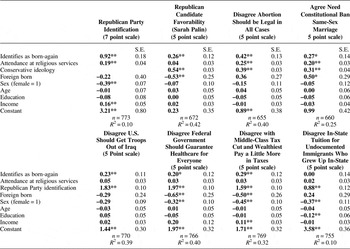
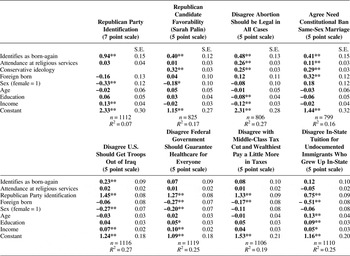
The analysis below addresses the question of whether, within each racial category, born-again identity is or is not associated with a range of policy attitudes, net of other factors. Even after taking into account socio-economic status and attendance at religious services, born-again identity is strongly associated with political attitudes among Whites (Table 4). Among Whites, born-again identity is a strong and statistically significant predictor of all but one of the political attitudes modeled in Table 4. In addition, for Whites, not only is born-again identity associated with identifying with the Republican party, favorable attitudes toward Sarah Palin, and the “hot button” issues most often associated with the evangelical agenda (abortion and same-sex marriage), it is also associated with beliefs that the United States should keep troops in Iraq and two important attitudes related to the role of government in American life — economic redistribution (“disagree with middle-class tax cut by having wealthiest pay a little more in taxes”) and government-sponsored health care (“disagree federal government should guarantee health care for every one”). That is, compared to non-born-again Whites, Whites who do identify as born-again are more likely to disagree with taxing the wealthy and more likely to disagree that the federal government should provide healthcare for everyone, net of socio-economic status, party identification, and attendance at religious services.
Multi-variate analysis: Born-again identity and political attitudes among Whites

Source: Barreto et al. (Reference Barreto, Frasure-Yokley, Hancock, Manzano, Ramakrishnan, Ramirez, Sanchez and Wong2008).
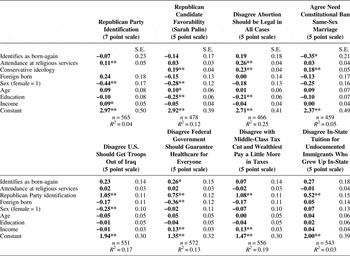
Turning to the Latino sample (Table 5), one observes that those Latinos who identify as born-again Christians are more likely than non-born-again Latinos to identify as Republican, favor Sarah Palin, and hold conservative attitudes toward abortion and same-sex marriage. Similar to Whites, born-again identity is also associated with disagreement about the United States getting its troops out of Iraq, even after controlling for other potential intervening variables. However, it is clear from Table 5 that born-again identity is associated with a narrower range of Latino political attitudes and behaviors than among Whites. In particular, for Latinos, born-again identity is not associated with attitudes about government-sponsored health care or redistributive tax policy.
Multi-variate analysis: Born-again identity and political attitudes among Latinos

Source: Barreto et al. (Reference Barreto, Frasure-Yokley, Hancock, Manzano, Ramakrishnan, Ramirez, Sanchez and Wong2008).
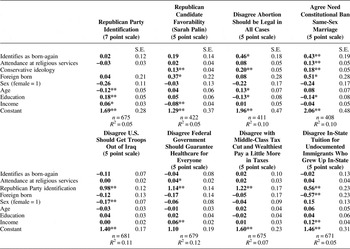
Among Asian Americans (Table 6), born-again identity is not associated with many attitudes related to the traditional evangelical agenda. For example, among Asian Americans, identifying as Republican, favoring Sarah Palin, and disagreeing with abortion appears unrelated to born-again identity once other factors are accounted for. Born-again identity is associated negatively with beliefs that the United States needs a constitutional ban on same-sex marriage. However, this somewhat counter-intuitive finding may be due to the vagaries of sampling and the fact that the CMPS is a registered voter sample. Analysis of the 2012 Pew Asian American Survey, which includes a larger sample of Asian Americans with registered and unregistered voters, reveals more conservatism among Asian American born-again Christians in terms of attitudes toward gays and lesbians than the current survey (Pew Forum 2012). However, the 2012 Pew Asian American Survey does not include a non-Asian American sample for comparison across racial categories. In fact, among Asian Americans in the CMPS sample, the only policy for which born-again identity is associated with a conservative stand-point is government-sponsored healthcare. The results of the multi-variate regression show that Asian Americans who identify as born-again are more likely than Asian Americans who do not identify as born-again to disagree with the idea that “the federal government should guarantee healthcare for everyone,” net of other variables, including partisanship.
Multi-variate analysis: Born-again identity and political attitudes among Asian Americans

Source: Barreto et al. (Reference Barreto, Frasure-Yokley, Hancock, Manzano, Ramakrishnan, Ramirez, Sanchez and Wong2008).
Similarly, among Blacks, born-again identity is of very limited value in terms of understanding support for the political attitudes and behaviors explored in Table 7. While born-again identity is associated with more conservative attitudes toward abortion and same-sex marriage among Black Americans, it is not associated with Republican Party identification or with attitudes about United States troops in Iraq, government-sponsored healthcare, or redistributive tax policy.
Multi-variate analysis: Born-again identity and political attitudes among Blacks

Source: Barreto et al. (Reference Barreto, Frasure-Yokley, Hancock, Manzano, Ramakrishnan, Ramirez, Sanchez and Wong2008).
One additional important finding should be mentioned here. First, born-again identity was not associated with attitudes toward allowing undocumented immigrant students who grew up in the United States and graduated from a United States high school to qualify for in-state tuition (“DREAM Act”) among any of the registered voters in this sample, including Black and White respondents. This is somewhat surprising since even as recently as 2006, White evangelicals in the mass public were much more conservative on immigration issues than other religious groups or the American population more generally (MacDonald Reference MacDonald2006). However, evangelical leaders have been moving to the left on this issue. By 2009, the National Association of Evangelicals, a group that initially refused to support a path to citizenship for undocumented immigrants, did support comprehensive immigration reform. Evangelical leaders seem to moving toward the center by pressing publicly for immigration reform and a path to citizenship for undocumented immigrants. Although some evangelicals contend that undocumented immigrants violate biblical teachings by breaking civil laws, others have embraced the Bible's command to “Welcome the Stranger.” The result of this analysis likely reflects the fact that there is no consensus evangelical position on the issue of immigration policy.
Further Analysis of the role of Born-Again Identity and Race on Policy Attitudes
Born-again identity may be associated with a wider range of political attitudes among Whites compared to non-Whites, but can we identify whether the effect of born-again identity actually differs between racial groups? Doing so requires a different analysis. For the following analysis, the entire sample is pooled and a set of interaction variables is included. Along with dummy variables for “Latino,” “Asian American,” and “Black,” the equations include variables measuring the interaction between racial category and born-again identity (i.e., “Latino × born-again”). Whites are the comparison category.
The dependent variables are attitudes related to two broad domestic policies: (1) disagreement with government-sponsored health care and (2) taxing the wealthy to provide a middle-class tax cut. Each of these policy questions was analyzed separately. The control variables included income, education, age, sex, nativity, party identification, and attendance at religious services. Main effects are captured by dummy variables for racial identity (“White” is the excluded category) and born-again identity.
The results of this analysis are consistent with the previous findings. Not only is born-again identity associated positively (in the vast majority of cases) with more conservative policy positions, but identifying as Black, Asian American, or Latino (compared to White) is associated with more liberal positions on government-sponsored healthcare and identifying as Black or Asian American is associated with a more liberal position on tax redistribution policy. In terms of the analysis of attitudes toward tax redistribution policy, the coefficient associated with Latino identity is negative, but not statistically significant.
Perhaps most important for the current investigation is that the analysis also shows that the effects of born-again identity likely depend on race. The main effects for race and the interaction terms for Black identity and Latino identity with born-again identity in the model of government-sponsored healthcare are both statistically significant. In the model of redistributive tax policy (“disagree with a middle-class tax cut by having the wealthiest pay a little more in taxes”), the main effects for race and all three interaction variables between racial identity and born-again identity are statistically significant.
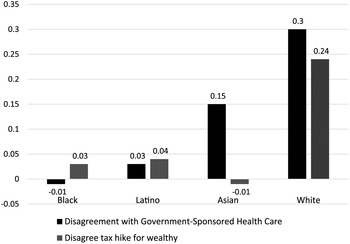
Figure 1 helps to illustrate more clearly the effects of born-again identity on attitudes toward government-sponsored healthcare and redistributive tax-policies across racial groups. The effect sizes associated with being born-again (relative to non-born-again members of the same racial group) on attitudes toward these two policies are much larger among Whites than among Blacks, Latinos, or Asian Americans. In the case of redistributive tax policy, for example, the effect size associated with being born-again is at least seven times larger among Whites than any other group (Full models used to calculate effects included in the online Appendix).
Effect sizes associated with being born-again on policy attitudes (relative to non-born-again members of same racial group). Data source: Barreto et al. (Reference Barreto, Frasure-Yokley, Hancock, Manzano, Ramakrishnan, Ramirez, Sanchez and Wong2008); for full-models see Appendix 5.

DISCUSSION AND CONCLUSION
In this article, I show that the role of born-again religious identity varies across racial groups. That is, born-again identity predicts a much wider range of policy attitudes among Whites versus non-Whites. I also provide some evidence that the effects of religious identity depend on racial identity.Footnote 9 Religious identity certainly matters for understanding political attitudes (Putnam Reference Putnam2010), but my findings also underscore that racial identity may shape political attitudes among people that share evangelical faith — even beyond the traditional Black-White binary. To this point, we see that by some measures, non-White evangelicals display greater levels of religiosity than White evangelicals, but very different political attitudes. For example, Asian American evangelicals (72%) are more likely than White evangelicals (49%) to say that their religion is the “one, true faith leading to eternal life” and they are more likely to attend religious services on a weekly basis (76% versus 64%) than their White counterparts (Pew Research Center 2012, 84), but Asian American evangelicals also express more liberal political attitudes than White evangelicals.
What mechanisms account for the different role that born-again identity plays in shaping political attitudes across groups? Although it is not directly tested here, past research suggests that we might expect to find differences in the role of religious identity across different racial groups due to variations in the social contexts shaping religious communities. For example, Paul Djupe and Christopher Gilbert's (Reference Djupe and Gilbert2009, 91) research contends that even within the same religious tradition, variation in political attitudes should be expected. These differences have to do with both broad social settings (see also Huckfeldt and Sprague Reference Huckfeldt and Sprague1995) and local, often church-based, social networks through which political information flows (Djupe and Gilbert Reference Djupe and Gilbert2009, 261).
Brian McKenzie and Stella Rouse (Reference McKenzie and Rouse2013, 219) provide a related explanation having to do with the theological emphasis in White versus non-White religious settings. They claim that because places of religious worship remain racially segregated, the spiritual development these communities will likely take place in different cultural settings or contexts. About three-fourths of every group in the current study claim to attend a racially homogenous place of worship. The racial context, then, remains quite distinct for both White and non-White evangelicals. McKenzie and Rouse suggest that in non-white communities there will be more emphasis placed on social justice, norms of community, and minority social location. They further contend that “White religious assemblies differ slightly because they primarily serve Whites, who are the majority population … In these settings, minority group status and issues of marginality are not regular topics of theological reflection” (McKenzie and Rouse Reference McKenzie and Rouse2013, 220). Variations in the political attitudes of different religious communities along racial lines may in part be explained by differences in theological interpretation and emphasis between White and non-White religious communities.
Adding to this argument, Djupe and Gilbert (Reference Djupe and Gilbert2009) argue that these broader racial differences in political attitudes among evangelicals may be established in more local, racially-specific social contexts, and not only as a result of differences in theological emphasis in non-White versus White churches. Instead, they write that “individuals may come to their political decisions not just through religious influence, but because of their involvement with others in a religious setting” (Djupe and Gilbert Reference Djupe and Gilbert2009, 261). Because the social networks in evangelical churches tend to be racially homogenous (Emerson and Smith Reference Emerson and Smith2001), the content of political discussion in evangelical communities will reflect social interactions shaped by distinct racial contexts (Djupe and Gilbert Reference Djupe and Gilbert2009, 111). While these interactions vary across local congregations and degree of involvement in small groups and other religiously-based social structures, a trickle-up effect is likely reflected in the systematic effects observed in the current study (Djupe and Gilbert Reference Djupe and Gilbert2009, 261).
Another mechanism that might explain the different role that evangelical identity plays in influencing political attitudes across racial categories might have to do with inter-religious interpersonal ties. Robert Putnam and David Campbell (Reference Putnam and Campbell2012) observe that inter-religious ties weaken intolerance. It is plausible that a greater potential for inter-religious ties among Asian Americans and Latinos might temper their political agenda as well. One might attribute differences in political attitudes between White versus Latino and Asian American evangelicals to the fact that evangelical Protestants make-up a smaller number and proportion of either the Latinos or Asian American populations compared with the White population. Sixty-percent of Latinos identify as Catholic and Catholicism has been a dominant cultural force among Latinos in the United States. Most Latinos likely count among their close friends and family members someone who does not consider themselves an evangelical or born-again Christian. Similarly, the Asian American community is religiously diverse and includes a large proportion (about 20%) of people who describe themselves as religiously unaffiliated. Again, one would expect that Asian Americans would exhibit friendships and interact with relatives who do not identify as born-again or evangelical Protestants. Further, Latinos and Asian Americans tend to have more racially diverse discussion networks than Whites (Leighley and Matsubayashi Reference Leighley and Matsubayashi2009). Future studies might investigate the degree to which inter-religious ties and inter-racial interactions vary across racial categories and if these ties affect political attitudes across groups.
Consistent with past research (Adkins et al. Reference Adkins, Layman, Campbell and Green2013; Djupe and Gilbert Reference Djupe and Gilbert2009), this research finds that policy domain matters and may also drive the results of this analysis. The difference between Whites and non-Whites who identify as born-again appears especially robust with regard to attitudes toward government-sponsored health-care and government policies designed to redistribute the tax burden from the middle class to wealthier segments of the population. Public opinion polls show that Latinos, Asian Americans, and Blacks prefer more government intervention and a more systematic approach to addressing inequality. This sets them apart from their White counterparts, even when they share important religious traits.
Asian American and Latino evangelicals are more open to the Republican Party, more ideologically conservative, and more likely to vote for a Republican candidate than other members of their racial and ethnic communities more generally. So while I demonstrate that Latino and Asian American born-again Christians are not “natural” Republicans, it is also true that they may not fit in easily within the traditional civil rights coalition and could pose a challenge to the conventional appeals to minorities used by secular ethnic advocacy groups.
Although I provide a starting point for thinking about the ways in which Asian American and Latino born-again Christians might converge and diverge with both Black and White born-again Christians, my analysis does not tap into the relative importance of any of the policy attitudes explored here. The intensity of issue preference, and the motivation to act politically on that preference, must be considered before speculating on whether or not Asian American and Latino evangelicals will remake the Christian Right (Brint and Abrutyn Reference Brint and Abrutyn2010; Djupe and Gilbert Reference Djupe and Gilbert2009, 104).
A focus on evangelical identity and the development of over-arching political frameworks (such as beliefs that “diversity is the hallmark of American democracy” or “America is a Christian nation”) may be important to consider as this research line is extended. For example, Benjamin Taylor and his colleagues (Reference Taylor, Gershon and Pantoja2014) find that Latino immigrants who identify as Protestant (evangelical or mainline) are more likely than other Latino immigrants to identify as “American” than with other identity labels and to believe that the United States is a “Christian nation.”
In this article, I set the groundwork for understanding how evangelical identity and race may simultaneously shape political attitudes and I argue that religious identity is not a homogenous force in American politics (Djupe and Gilbert Reference Djupe and Gilbert2009). Lydia Bean's (Reference Bean2014) work is instructive here. She argues that Canadian evangelicals share theological commitments, including an individualistic theology, with their (White) American counterparts, but that Canadian evangelicals are less conservative than American evangelicals in terms of their attitudes toward the role of government in serving the poor. She attributes this difference to distinctions between Canadian versus American evangelicals in terms of how they envision the boundaries of their religious and, importantly, their national communities. For Canadian evangelical communities, “the poor” are considered an extension of their cultural community, but among American evangelicals “the poor” are more likely to be considered out of the bounds of their cultural community (see also Bean et al. Reference Bean, Gonzalez and Kaufman2008; McAdams and Lance Reference McAdams and Lance2013). It may well be that, similar to Canadian evangelicals, Black, Latino, and Asian American evangelicals in the United States have developed, in the aggregate, different conceptions of national community than White evangelicals.
As Asian American and Latino first- and second-generation immigrants fill the pews of evangelical churches and other places of worship, they enter United States politics in a racialized context. Though both race and religion shape their political attitudes and behavior, a focus on Asian American and Latino evangelicals forces us to recognize that despite the significance of faith, race remains an enduring, and I argue, powerful force, in United States politics.
Supplementary materials and methods
To view supplementary material for this article, please visit http://dx.doi.org/10.1017/S1755048315000759