Introduction
The Southern Ocean water temperature decreases with latitudes pole-ward and drops sharply across the Antarctic Polar Front (APF), acting as a transition zone between the cold Antarctic surface water and warmer sub-Antarctic water (Knox Reference Knox2007, de Broyer & Koubbi Reference De Broyer and Koubbi2014). High latitude waters surrounding the Antarctic continent are the coldest with frequent or persistent ice presence and temperatures ranging from -1.0 to -1.9°C, the freezing point of seawater (Knox Reference Knox2007, Cziko et al. Reference Cziko, DeVries, Evans and Cheng2014). Low Antarctic latitudes just south of the APF are relatively milder, and water temperatures range from -1.0 to 5°C with seasonal pack ice in the colder areas (Knox Reference Knox2007). The northern border of the Southern Ocean is dynamic and not physiographically fixed, generally considered to correspond with the Subtropical Convergence that forms the northern limit of the sub-Antarctic area (Gordon et al. Reference Gordon, Molinelli and Baker1978, de Broyer & Koubbi Reference De Broyer and Koubbi2014). The sub-Antarctic waters are warmer and ice-free year-round with water temperatures reaching 12°C depending on the oceanic sector (de Broyer & Koubbi Reference De Broyer and Koubbi2014). The strong Antarctic Circumpolar Current (ACC), of which the APF is one component, serves as a physical barrier impeding migration of fish in a northerly or southerly direction. However, its eastward circumpolar flow (Kennett Reference Kennett1982) could lead to transport of pelagic eggs and larvae, thereby contributing to circumpolar distribution of some species (Loeb et al. Reference Loeb, Kellermann, Koubbi, North and White1993, Matschiner et al. Reference Matschiner, Hanel and Salburger2009). A number of notothenioid fish species phylogenetically positioned within the Antarctic clade of notothenioids had come to colonize waters around the sub-Antarctic islands as well as the southern coasts of South America and New Zealand during their evolutionary history. Some of these species, such as the nototheniids Notothenia rossii Richardson and N. coriiceps Richardson, occur on both sides of the APF today (DeWitt et al. Reference DeWitt, Heemstra and Gon1990).
Antarctic notothenioids have evolved antifreeze glycoproteins (AFGPs) that protect them from freezing death in their subzero, icy environments (DeVries & Cheng Reference DeVries and Cheng2005). The evolution of the AFGP gene was estimated to occur during the mid to late-Miocene, approximating the Miocene time of the freezing of the Antarctic marine environment, as well as the estimated time of diversification of notothenioid fishes (Chen et al. Reference Chen, DeVries and Cheng1997), and pre-dating the episodes of adaptive radiations of Antarctic notothenioids (Near et al. Reference Near, Dornburg, Kuhn, Eastman, Pennington, Patarnello, Zane, Fenandez and Jones2012). Thus, the AFGP trait has been regarded as a key evolutionary innovation and a synapomorphy shared by the monophyletic clade of predominantly Antarctic notothenioid fishes. The AFGP trait (genotype and phenotype) has been well documented for many high latitude Antarctic notothenioid fishes. Much less is known about the status of the AFGP trait in species inhabiting the less severe low Antarctic, and the non-freezing sub-Antarctic regions of the Southern Ocean. Since the AFGP trait is an Antarctic-specific synapomorphy, its status in the low Antarctic and sub-Antarctic species would serve as a useful measure in evaluating the evolutionary and geographical origins of these species. Antarctic notothenioids have a second antifreeze protein, the antifreeze potentiating protein (AFPP), that circulates at low concentrations which has minor antifreeze activity by itself but acts with the large-sized AFGP molecules to synergistically enhance the total antifreeze activity (Jin Reference Jin2003). The coding sequences of AFPP or AFPP homolog are present in the basal non-Antarctic, non-AFGP-bearing notothenioids (Cheng unpublished), thus it would not serve as an informative character for inferring evolutionary history of low Antarctic and sub-Antarctic species phylogenetically nested within the Antarctic clade.
The known function of AFGPs is to prevent the fish’s body fluids from freezing when in contact with ice (DeVries Reference DeVries1971, DeVries & Cheng Reference DeVries and Cheng2005), thus notothenioid species occupying ice-free waters would not be expected to need antifreeze protection. However, in sub-Antarctic notothenioid fishes examined thus far the AFGP trait is present in some species but differs in the circulatory AFGP levels. Gon et al. (Reference Gon, Hendry and Mostert1994) found that N. coriiceps from Marion Island in the south Indian Ocean has considerable levels of AFGPs in the blood, and possesses aglomerular kidneys that would conserve circulatory AFGPs similar to endemic Antarctic notothenioids. In contrast, N. angustata Hutton of the cool temperature water of the Otago Harbour of South Island, New Zealand, exhibits miniscule levels of serum AFGP (±0.23 μg ml-1) (Cheng et al. Reference Cheng, Chen, Near and Jin2003). However, another congeneric species, N. rossii from the sub-Antarctic water of Ob’ Seamount near Marion Island, possess substantial levels of serum AFGPs (4.8 mg ml-1), although the level was lower than those of specimens from higher latitudes south of the APF (11–15 mg ml-1) (Miya et al. Reference Miya, Gon, Mwale and Cheng2014). Wide variations are also seen in the magnitude of the AFGP genotype in sub-Antarctic species, from undetectable to a substantial family of putative AFGP genes based on probing genomic DNA Southern blots with radio-labelled AFGP gene probe (Cheng et al. Reference Cheng, Chen, Near and Jin2003, Cheng & Detrich Reference Cheng and Detrich III2007).
The paucity of investigations on the antifreeze trait in notothenioids from the sub-Antarctic waters to date was due to the lack of consistent logistic resources for sampling from such a vast marine realm. In this study we examined low Antarctic and sub-Antarctic islands notothenioid species from a wide geographical range collected during various opportunistic international and national cruises and from museum samples. We assessed the integrity and extent of the AFGP genotype by Southern blot analyses of genomic DNA, and the AFGP phenotype by measuring serum thermal hysteresis where serum samples were available. We constructed notothenioid phylogenies using a large taxon sampling inclusive of the studied species, and mapped the associated AFGP trait on the phylogenetic trees to gain insights into the evolutionary origin and history of the sub-Antarctic notothenioids.
Materials and methods
Sample collection
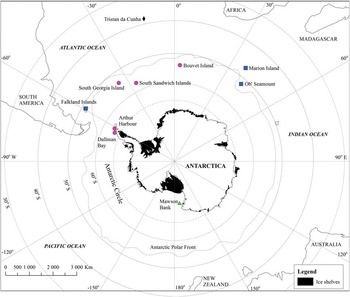
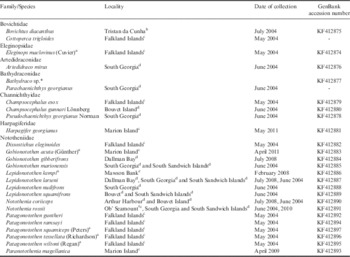
Specimens of notothenioid fishes were collected from localities at different Southern Ocean latitudes, including sub-Antarctic, low Antarctic and high Antarctic (Fig. 1, Table I). A total of 26 notothenioid species from 14 genera, representing both non-Antarctic and Antarctic families were collected. Specimens were collected using various methods, including otter trawl, longline and dip net as appropriate. Clove oil, MS222 or quinaldine were used to anaesthetize collected fishes before tissue and blood samples were harvested following institutionally approved protocols. The harvested tissue samples included muscle, liver, spleen, gills and clotted blood cells, which were preserved and stored in 90% ethanol at -20°C. Blood samples were drawn from the caudal vein of fish and allowed to clot, then centrifuged at 14 000 g for 10 minutes to separate serum from red blood cells. Serum samples were stored at -80°C until analysis. Of the 26 notothenioid species, 17 were examined for AFGP genotype and/or phenotype. All 26 notothenioid species, and an additional 43 Antarctic and two non-Antarctic notothenioid (Table S1 found at http://dx.doi.org/10.1017/S0954102015000413) with relevant molecular sequences available in the GenBank database, were included in the construction of notothenioid phylogenetic trees. Here, we follow the previously accepted notothenioid family classification (Table S1), instead of the recent revision to include four of the families (Artedidraconidae, Harpagiferidae, Bathydraconidae and Channichthyidae) as subfamilies in the remaining family (Nototheniidae) (Dettai et al. Reference Dettai, Berkani, Lautredou, Couloux, Lecointre, Ozouf-Costaz and Gallut2012).
Sampling localities of all of the specimens. The dotted line represents the Antarctic Polar Front. Green triangle: high Antarctic, pink circle: low Antarctic, blue square: sub-Antarctic and black diamond: non-Antarctic region.

Notothenioid species sampled, their localities and the GenBank accession numbers for ND2 gene sequences.

* Bathydraco sp. was found in the stomach of D. mawsoni collected in the waters of Lazarev Sea (70°04'S, 09°36').
† Used in serum AFGP activity analyses only.
aUsed in the notothenioid phylogenetic relationship construction only.
Temperature zones: bnon-Antarctic region, csub-Antarctic, dlow Antarctic and ehigh Antarctic.
Determination of serum antifreeze activities
Serum antifreeze activity was determined as thermal hysteresis (TH) using the Clifton nanolitre freezing point osmometer (Clifton Technical Physics), following the procedure of Bilyk & DeVries (Reference Bilyk and DeVries2010). Briefly, a single drop of serum was frozen by rapid cooling to -40°C and then melted by slowly increasing the temperature until only a single small ice crystal (5–10 µm diameter) stably remained. This temperature is the equilibrium melting/freezing point (eqMFP) of the ice crystal. The non-equilibrium freezing point (non-eqFP) was determined by holding the small ice crystal slightly below its eqMFP for 3–5 minutes and then cooling it slowly to the temperature when ice rapidly grew. Ice crystal growth morphology was observed under a compound light microscope (Zeiss Microscopy) at 200× magnification. Serum TH was calculated as the difference between the observed eqMFP and non-eqFP. The entire procedure was repeated at least twice for each sample. For species with only a single individual available, the average was taken as the final value. For species with multiple individuals, standard deviation was calculated for within species variation. In serum samples without definitively measurable TH, the presence of very low antifreeze protein concentration or very weakly active antifreeze-like molecules is inferred by the test seed ice expressing crystal faces resembling the prism faces of hexagonal ice crystal at or very near the eqMFP (DeVries Reference DeVries1986). The two antifreeze activities (AFGP and AFPP) in the total TH determined were not partitioned in this study for consistency of comparison across samples due to reasons of limited serum sample volumes for a number of species. Also, for samples without definitive TH, partitioning of the two activities becomes irrelevant.
Southern blot analysis of genomic DNA
High molecular weight (MW) genomic DNA was isolated from c. 200–300 mg of spleen, liver, gills or clotted red blood cells using standard tissue lysis and phenol-chloroform extraction. The extracted DNA was dialyzed against 0.5X TE (5 mM Tris.HCl, 0.5 mM EDTA, pH 8.0) instead of ethanol precipitation to maintain the DNA in high MW form. Amounts of 12–30 μg of genomic DNA was digested with an excess (100 U) of the restriction enzyme EcoRI (NEB) in a total volume of 200 µl at 37°C overnight. EcoRI was chosen as it sufficiently cleaves total DNA but does not cleave in the AFGP coding sequences of all characterized notothenioid AFGP genes (Hsiao et al. Reference Hsiao, Cheng, Fernandes, Detrich and DeVries1990, Chen et al. Reference Chen, DeVries and Cheng1997, Nicodemus-Johnson et al. Reference Nicodemus-Johnson, Silic, Ghigliotti, Pisano and Cheng2011). The digested DNA was ethanol precipitated, resuspended in 15 µl 0.5X TE and electrophoresed on a 0.9% agarose gel (24 cm length) in 1X TAE (40 mM Tris, 20 mM acetic acid and 1 mM EDTA) with buffer recirculation at 65 V for 14 hours. The electrophoretically resolved DNA fragments were vacuum-transferred (VacuGene) to Hybond-N nylon membrane (GE Healthcare Life Science) and pre-hybridized in QuickHyb solution (Sigma) containing 0.1 mg ml-1 sheared salmon sperm DNA at 55°C for five hours to overnight. The membrane was then hybridized at 55°C for 24 hours using a 32P-labelled probe derived from a 2.2 kb fragment of an AFGP 8 polyprotein gene (clone NcGP8, N. coriiceps) that contains only the coding sequence of the highly repetitive tripeptides of AFGP (Hsiao et al. Reference Hsiao, Cheng, Fernandes, Detrich and DeVries1990). The hybridized membrane was first washed in 1× SSC (150 mM NaCl, 15 mM Na citrate)/0.1% SDS at 45°C and then in 0.1× SSC/0.5% SDS at 50°C. The washed membrane was air dried and put on a phosphor storage screen overnight. The screen was scanned with a phosphor-imager (STORM® 860, Molecular Dynamics) to visualize the hybridization on the blot. The relative number and hybridization intensity of the AFGP-positive DNA fragments of the studied species are compared to those of the included reference species, the Antarctic AFGP-fortified Dissostichus mawsoni Norman known to have a large family of functional AFGP genes (Chen et al. Reference Chen, DeVries and Cheng1997, Nicodemus-Johnson et al. Reference Nicodemus-Johnson, Silic, Ghigliotti, Pisano and Cheng2011), to qualitatively infer the status and magnitude of the AFGP genotype in the former.
Phylogenetic analyses of notothenioid species
The mitochondrial DNA (mtDNA) protein coding gene, NADH dehydrogenase subunit 2 (ND2) was used for the phylogenetic analyses. The full length ND2 gene was amplified with the Gln/Asn primer pair (Kocher et al. Reference Kocher, Conroy, McKaye, Stauffer and Lockwood1995) in a 50 µl polymerase chain reaction (PCR) using the following conditions: initial denaturation step at 94°C for 3 minutes, 35 cycles at 94°C for 1 minute, 45–55°C for 45 seconds and 72°C for 1 minute 10 seconds, and a final extension at 72°C for 4 minutes. The amplified ND2 product was treated with 1.0 unit of Exonuclease I and shrimp alkaline phosphatase for 60 minutes at 37°C to degrade single stranded DNA and primers followed by 15 minutes at 85°C to inactivate the enzymes. The treated PCR products were directly sequenced in both directions using BigDye Terminator V.3 (Applied Biosystems) dideoxy chain termination chemistry, and read on an AB 3730xl sequencer at the W. M. Keck Centre for Comparative and Functional Genomics at the University of Illinois Urbana-Champaign. Sequences were edited manually using ChromasPro v.1.5 (Technelysium) and aligned with Lasergene v.10 (DNASTAR Inc., Madison) and/or Mega v.5.05 (Tamura et al. Reference Tamura, Peterson, Peterson, Stecher, Nei and Kumar2011).
Maximum parsimony (MP), maximum likelihood (ML) and Bayesian inference (BI) analyses were used for phylogenetic tree constructions. The MP analyses were performed in PAUP*4.0b10 (Swofford Reference Swofford2003) with equally weighted characters via heuristic search algorithm with tree-bisection-reconnection branch swapping method and 100 random addition replicate datasets. Node supports in MP trees were assessed with non-parametric bootstrap analysis using 1000 pseudoreplicates. The ML and BI analyses incorporated the evolution model (GTR+I+gamma) as identified by jModelTest v.2.1.4 (Darriba et al. Reference Darriba, Taboada, Doalla and Posada2012) to best fit the dataset under all assessment criteria. The ML analysis used PhyML 3.0 (Guindon et al. Reference Guindon, Dufayard, Lefort, Anisimova, Hordijk and Gascuel2010) and was executed on the PhyML server (http://www.atgc-montpellier.fr/phyml/), with 1000 bootstrap replicates to estimate node support. The BI analyses utilized MrBayes v3.0B (Ronquist & Huelsenbeck Reference Ronquist and Huelsenbeck2003) with two simultaneous runs of four chains of four million generations, and tree sampling every 100 generations. Likelihood values and stationarity were viewed with the program TRACER, based on which burnin was set to discard the first 2000 sampled trees. A 50% majority rule consensus tree was constructed from the remaining trees, and posterior probabilities greater than 90% were considered adequate node support. Trees were rooted with Bovichtidae, the accepted most basal non-Antarctic notothenioid family (Near & Cheng Reference Near and Cheng2008). Finally, the AFGP characters and geographical distribution of selected notothenioid species were mapped onto these phylogenetic trees.
Results
Serum antifreeze glycoprotein activity in low Antarctic and sub-Antarctic notothenioids
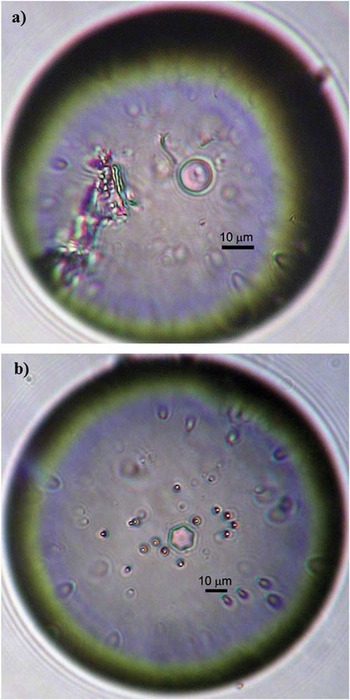
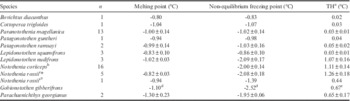
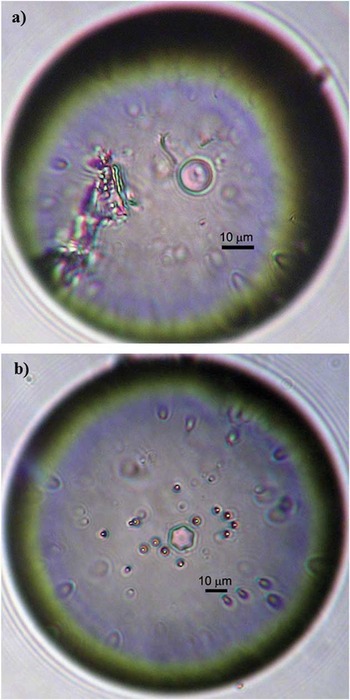
Serum AFGP activities were evaluated for available blood serum samples from two species of the basal non-Antarctic family Bovichtidae, and six nototheniids and one bathydraconid from low Antarctic and sub-Antarctic locations (Table II). The test single crystal seed ice in the serum of the two Bovichtids, Bovichtus diacanthus (Carmichael) from Tristan da Cunha and Cottoperca trigloides (Forster) from the Falkland Islands remained discoid in shape (Fig. 2a, for C. trigloides) and showed no difference between melting and freezing points (Table II), indicating an absence of any antifreeze or ice-active agent. Four nototheniids, Paranotothenia magellanica Forster from Marion Island, Patagonotothen guntheri (Norman) and P. ramsayi (Regan) from the Falkland Islands, and the low Antarctic Lepidonotothen squamifrons (Günther) from the South Sandwich Islands also had no measurable difference between serum melting and freezing points (Table II), i.e. lacking definitive TH. However, the small seed ice crystal became hexagonally faceted when held at the eqMFP (Fig. 2b), unlike the discoid crystal seen in bovichtid serum. Notothenioid AFGPs are known to adsorb to the prism faces and inhibit a-axes growth resulting in hexagonal ice and a large TH. Thus, the hexagonal faceting of ice with no measurable TH in the sera of these four low Antarctic and sub-Antarctic nototheniids indicates presence of ineffective or extremely low levels of AFGPs. In contrast to L. squamifrons, the two other low Antarctic nototheniids, L. nudifrons (Lönnberg) and N. rossi, exhibited substantial TH of over 1°C (Table II), and non-eqFP of c. -2.00°C, lower than the freezing point of seawater (-1.9°C). Thus, these two low Antarctic nototheniids possess sufficient blood antifreeze to avoid freezing should they encounter icy seawater. The low Antarctic bathydraconid Parachaenichthys georgianus (Fischer) of South Georgia also has substantial TH (0.65°C), and non-eqFP of -1.94°C indicating that it could also avoid freezing.
Single seed ice crystal in the blood serum of a. Cottoperca trigloides and b. Lepidonotothen squamifrons showing discoid and hexagonal faceting morphology, respectively (magnification x200).
Serum AFGP activity of selected notothenioid fishes collected from low Antarctic and sub-Antarctic localities.
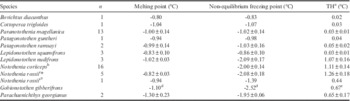
aThermal hysteresis (TH) values were calculated as the difference between the melting point and non-equilibrium freezing point observed using the Clifton nanolitre osmometer. TH±standard deviation are given for species with multiple individuals. TH values for species with a single individual are averages of at least two measurements of the same serum samples.
bJin & DeVries (Reference Jin and DeVries2006), cMiya et al. (Reference Miya, Gon, Mwale and Cheng2014) (*average of South Georgia specimens and †single Ob’ Seamount specimen), dDeVries (Reference DeVries1971) and eWöhrmann (Reference Wöhrmann1996).
Antifreeze glycoprotein gene sequence in genomic DNA of low Antarctic and sub-Antarctic notothenioids
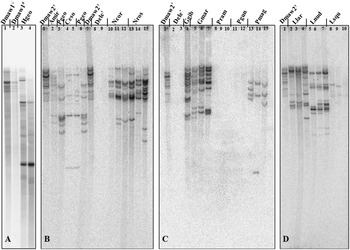
Southern blot analyses of genomic DNA digested with EcoRI was used to assess the status of AFGP genes and gene family for 16 notothenioid species (inclusive of most species in Table II) representing the five predominantly Antarctic families (Fig. 3). There are no EcoRI cleavage sites in the repetitive (AlaAlaThr) nucleotides coding region (a single exon) in characterized AFGP genes; thus, each hybridized band on the blot represents one or more AFGP coding gene or region. Since the magnitude (or lack of) of the AFGP genotype of many of the lower latitudes species in the study is unknown a priori, the amounts of DNA applied (15–40 µg) were in most cases are greater than that (10–15 µg) of the AFGP-fortified Antarctic reference species D. mawsoni. The criteria for assessing the status of the AFGP genotype are the approximate number of hybridizing DNA fragments (bands on the blot) and the hybridization intensity of these fragments relative to D. mawsoni. The two species collected from low Antarctic and sub-Antarctic locations, Artedidraco mirus Lönnberg (Artedidraconidae) and P. georgianus (Bathydraconidae), showed a less intense but comparable number of hybridized DNA fragments as D. mawsoni (Fig. 3b), suggesting that they may have functional AFGP genes. For P. georgianus from South Georgia (Fig. 3b, lanes 3 & 6) for which we have serum samples, the approximately six moderately intense hybridizing bands indicate that it retained a sizable AFGP genotype, consistent with its fairly substantial levels of serum AFGPs (0.65°C of TH as proxy; Table II). Champsocephalus esox (Günther; Channichthyidae) from the Falklands has four hybridized bands (Fig. 3b, lanes 4 & 5) of comparable intensities to P. georgianus, and thus, potentially representing functional AFGP genes; unfortunately no serum samples were available for validation of protein expression. The single representative of Harpagiferidae, Harpagifer georgianus Nybelin of Marion Island (Fig. 3a, lanes 3 & 4), had three clear, moderately strong hybridization bands indicating that it may possess some functional AFGP genes. Again serum samples would be needed to verify phenotype. Species of Nototheniidae, of which more representatives were available for analysis, exhibited varying degrees of hybridization from none to clusters of strongly hybridizing bands. The Falkland Islands specimens P. ramsayi (Fig. 3c, lanes 8–10), P. guntheri (Fig. 3c, lanes 11 & 12) and D. eleginoides Smitt (Fig. 3b, lanes 8 & 9 and Fig. 3c, lanes 2 & 3) the sister species of D. mawsoni, had no detectable hybridization bands. Thus, either AFGP coding sequences are absent in their genome, or the sequences have become greatly mutated and unrecognizable by the probe. In comparison, P. magellanica from Marion Island (Fig. 3c, lanes 13–15) and L. squamifrons from the South Sandwich Islands (Fig. 3d, lanes 8 & 9) and Bouvet Island (Fig. 3d, lane 10) have two to three very weakly AFGP-positive fragments in their DNA. The lack of measurable TH in these two species (Table II) indicate that the residual and weakly hybridizing AFGP coding sequences detected on the blot are probably mutated sequences, resulting in ineffectual and/or very low levels of protein. In contrast to L. squamifrons, the two congeneric low Antarctic species, L. larseni (Lönnberg) from Dallman Bay, South Georgia and the South Sandwich Islands (Fig. 3d, lanes 2, 3 and 4, respectively), and L. nudifrons of South Georgia (Fig. 3d, lanes 5–7) have many and much stronger AFGP-positive bands suggesting the presence of functional AFGP genes and a sizable AFGP gene family. Lepidonotothen nudifrons serum has substantial TH (1.07°C; Table II). If the comparable magnitude of AFGP genotype in L. larseni translates into similar amounts of AFGP, then both Lepidonotothen species would be protected when encountering ice-laden freezing waters. For the rest of the species, the low Antarctic nototheniids including N. coriiceps (Fig. 3b, lanes 10–12), N. rossii (Fig. 3b, lanes 13–15), Gobionotothen gibberifrons (Lönnberg) (Fig. 3c, lane 4) and G. marionensis (Günther) (Fig. 3c, lanes 5–7), a sizable AFGP gene family appear to be typical. These species showed multiple AFGP-positive bands, many with intense hybridization, indicating the presence of multiple co-localized AFGP gene-bearing DNA fragments.
EcoRI digested genomic DNA blots of low Antarctic and sub-Antarctic notothenioids hybridized to a 32P-labelled AFGP-specific probe. The gels for the four blots (a.–d.) were all electrophoresed for 14 hours. Dissostichus mawsoni (Dmaw1 and Dmaw2; DNA concentrations of #5, √10, *12 and †15 μg), known to possess a large family of functional AFGP genes (Chen et al. Reference Chen, DeVries and Cheng1997, Nicodemus-Johnson et al. Reference Nicodemus-Johnson, Silic, Ghigliotti, Pisano and Cheng2011), was used as the Antarctic standard reference species in all four blots. Low Antarctic and sub-Antarctic species from five Antarctic families were: Harpagiferidae: Hgeo, Harpagifer georgianus (a. lanes 3 & 4, Marion Island, 30 μg), Artedidraconidae: Amir, Artedidraco mirus (b. lane 2, South Georgia, 30 μg), Bathydraconidae: Pgeo, Parachaenichthys georgianus (b. lanes 3 & 6, Falkland Islands, 20 μg), Channichthyidae: Ceso, Champsocephalus esox (b. lanes 4 & 5, Falkland Islands, 20 μg), Nototheniidae: Dele, D. eleginoides (b. lanes 8 & 9 and c. lanes 2 & 3, Falkland Islands, *25 μg and †40 μg), Ncor, Notothenia coriiceps (b. lanes 10 & 11, Arthur Harbour and lane 12, Bouvet Island, 20 μg), Nros, N. rossii (b. lane 13, South Sandwich Islands and lanes 14 & 15 South Georgia, 20 μg), Ggib, Gobionotothen gibberifrons (c. lane 4, Dallman Bay, 20 μg), Gmar, G. marionensis (c. lane 5, South Georgia, and lanes 6 & 7, South Sandwich Islands, 25 μg), Pram, Patagonotothen ramsayi (c. lanes 8–10, Falkland Islands, 20 μg), Pgun, P. guntheri (c. lanes 11 & 12, Falkland Islands, 15 μg), Pmag, Paranotothenia magellanica (c. lanes 13–15, Marion Island, 15 μg), Llar, Lepidonotothen larseni (d. lane 2, Dallman Bay; lane 3, South Georgia; lane 4, South Sandwich Islands, 30 μg), Lnud, L. nudifrons (d. lanes 5–7, South Georgia, 20 μg), Lsqu, L. squamifrons (d. lanes 8 & 9, South Sandwich Islands, and lane 10, Bouvet Island, 30 μg).

Distribution of the antifreeze glycoprotein trait on the notothenioid phylogenetic tree
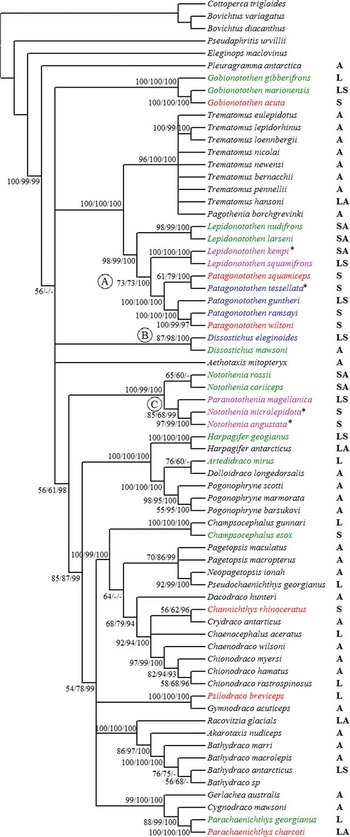
The aligned dataset of complete ND2 gene sequences in this study and published sequences downloaded from GenBank (Table S1) contained 1047 nucleotides. Sequences obtained in this study have been deposited into the GenBank database under the accession numbers KF412874–KF412897 (Table I). The MP, ML and BI inferred phylogenetic trees (Fig. 4, Fig. S1 found at http://dx.doi.org/10.1017/S0954102015000413) are comparable in overall topologies but with some nodes consistently lacking support across all three trees. Figure 4 shows the MP tree with bootstrap scores from MP, ML and posterior probability values from BI analyses indicated at the nodes. Most of the species examined in this study showing loss/reduction of AFGP trait are contained in the clades designated as A to C, which were recovered with good to strong node support. The status of the AFGP trait of the species as determined by qualitative assessments of genotype based on genomic DNA Southern blot analyses (Fig. 3) with or without phenotype (serum TH) measurements (Table II) is indicated by the colour codes. The known geographical distributions of species were also indicated as high Antarctic (A), low Antarctic (L) or sub-Antarctic (S) latitudes, or as latitudinal ranges.
Maximum parsimony phylogenetic tree of mtDNA ND2 gene. Numbers at nodes represent bootstrap values of MP (≥50), ML (≥50) and BI (posterior probabilities ≥90) analyses in that order. Different colours represent the AFGP trait in each species based on genotype and/or phenotype results: green=strong AFGP genotype and/or phenotype; pink=reduced AFGP genotype and/or phenotype; blue=AFGP genotype absent; red=AFGP trait undetermined; black=AFGP genotype and/or phenotype present based on table S4 of Near et al. (Reference Near, Dornburg, Kuhn, Eastman, Pennington, Patarnello, Zane, Fenandez and Jones2012) and the cited references. The encircled letters (A to C) indicate clades where AFGP gene loss or/and reduction has occurred. The AFGP trait of species marked with an asterisk is determined by other studies mentioned in the text. The letters after taxa represent the geographical distribution of the species: S=sub-Antarctic and/or cool-temperate, A=Antarctic, L=low Antarctic, SA=sub-Antarctic and Antarctic, LA=low and high Antarctic, LS=low Antarctic and sub-Antarctic. The geographical distribution of notothenioid species followed that of DeWitt et al. (Reference DeWitt, Heemstra and Gon1990).

Mapping of AFGP trait on the phylogenetic tree showed that it has been reduced or lost at least three separate times in the Antarctic notothenioids, specifically in the paraphyletic Nototheniidae. First, relative to the AFGP-bearing sister Lepidonotothen species (L. nudifrons and L. larseni), the low Antarctic L. squamifrons (Fig. 4, clade A) exhibits drastic trait reduction as indicated by having few and very weakly positive AFGP bands (Fig. 3d) and lack of measurable serum TH (Table II). In the same clade (A), loss AFGP gene probably occurred in the sub-Antarctic Patagonotothen as indicated by the complete absence of AFGP-positive bands on the genomic Southern blot. Second, in clade B comprising the Dissostichus genus, the AFGP gene was undetectable and presumed lost in the low Antarctic and sub-Antarctic D. eleginoides (Fig. 3b) in contrast to its sister species, the high Antarctic AFGP-fortified D. mawsoni. Third, reduction of AFGP trait occurred in P. magellanica in the Notothenia lineage (clade C), although it shows several weakly but clearly AFGP-hybridizing bands (Fig. 3c) but there was no measurable serum TH (Table II), in contrast to the congeneric AFGP-bearing N. coriiceps and N. rossii.
Discussion
Antifreeze glycoprotein trait in low Antarctic and sub-Antarctic notothenioid species
Antifreeze glycoproteins have been documented to be present in various species across the five Antarctic families: Nototheniidae, Harpagiferidae, Artedidraconidae, Bathydraconidae and Channichthyidae. This supported the hypothesis that these families share a most recent common AFGP-bearing ancestor (Chen et al. Reference Chen, DeVries and Cheng1997). A number of notothenioid species phylogenetically nested within these five Antarctic families also occur in the less severe lower Antarctic latitudes and/or the non-freezing sub-Antarctic waters today (Eastman Reference Eastman2005). The AFGP genotypic condition in notothenioid fishes could be assessed qualitatively by probing genomic DNA on Southern blot with an AFGP cds (coding sequence) probe (Fig. 3). The hybridization pattern of the AFGP-endowed D. mawsoni, a cluster of many AFGP-positive bands with robust hybridization intensity, is typical of notothenioid species having many functional AFGP genes (Cheng & Detrich Reference Cheng and Detrich III2007, Nicodemus-Johnson et al. Reference Nicodemus-Johnson, Silic, Ghigliotti, Pisano and Cheng2011) and substantial circulatory AFGPs (DeVries & Cheng Reference DeVries and Cheng2005) and can be used as a qualitative reference. The representative species of Artedidraconidae (A. mirus, South Georgia), Bathydraconidae (P. georgianus, South Georgia) and Channichthyidae (C. esox, Falkland Islands) appear to have similar genotype size, in having a fair number of AFGP-positive bands and intermediate hybridization intensities. In the absence of serum samples for testing, whether the AFGP coding sequences of A. mirus and C. esox are functional and would produce comparable amounts of AFGP activity as P. georgianus (Table II) is unknown. Although the representative species of Harpagiferidae (H. georgianus Marion Island) shows only three clear AFGP-positive bands in its DNA on the Southern blot these bands are of moderate to strong hybridization intensity, and thus, potentially functional (Fig. 3a). However, again, whether they produce AFGPs awaits available H. georgianus serum for testing.
For Nototheniidae, low Antarctic and sub-Antarctic species show variations in the AFGP trait (Table II, Fig. 3). Genomic DNA blot of low Antarctic species, L. nudifrons, L. larseni, G. gibberifrons, G. marionensis, N. rossii and N. coriiceps, revealed a large cluster (c. 6–12, Fig. 3) of AFGP-positive bands with robust hybridization signals on Southern blot, akin to the reference nototheniid D. mawsoni. For L. nudifrons, N. rossii, N. coriiceps and G. gibberifrons (as well as the bathydraconid P. georgianus), for which serum AFGP activities were measured (Table II), the strong AFGP-positive hybridizations on the Southern blot correlate with considerable amount of TH in their blood. This supports the general inference that a large AFGP gene dosage (cluster of strong AFGP-positive bands on genomic DNA blot) is a reasonable predictor of considerable circulatory AFGPs. At the other end of nototheniid AFGP trait range are species with no detectable AFGP sequences in their genome (Fig. 3), and no measurable TH in their serum (Table II). Patagonotothen guntheri and P. ramsayi from the Falkland Islands and D. eleginoides that occur north of the APF exemplify this category. A third manifestation of the AFGP trait is the presence of a few detectable AFGP sequences in the DNA but no measurable TH, seen in P. magellanica (Marion Island) and L. squamifrons (Bouvet Island and the South Sandwich Islands). There was one published report of substantial AFGP activity in L. kempi (Norman), a synonym of L. squamifrons, from the Lazarev Sea (Wöhrmann Reference Wöhrmann1996), in contrast to several other studies showing the contrary. Tests for blood AFGP activities of L. kempi from waters around the Balleny Islands (DeVries & Lin Reference DeVries and Lin1977) and L. squamifrons around the South Sandwich Islands (this study) showed no measurable TH. Tests of AFGP genotype in genomic DNA blot of specimens from waters near Brabant Island, west Antarctic Peninsula (Cheng & Detrich Reference Cheng and Detrich III2007), and from the South Sandwich and Bouvet islands (this study) consistently showed only around three very weakly AFGP-hybridizing bands. The corroborating phenotype (AFGP activity) and genotype data in these studies of specimens from both East and West Antarctica, as well as from the sub-Antarctic, strongly indicate that the conflicting high AFGP activity in the Lazarev Sea L. kempi specimen (Wöhrmann Reference Wöhrmann1996) are very likely to have resulted from species misidentification. The question remains as to how L. squamifrons avoids freezing in its low Antarctic habitats without adequate AFGP protection. It was suggested that the Balleny Islands population inhabits a non-freezing water layer (DeVries & Lin Reference DeVries and Lin1977), a hypothesis amenable to testing.
Whether the AFGP genotype is undetectable or minimal, available serum samples from species in these two categories produced hexagonal faceting of the test seed ice crystal. This contrasts the basal non-Antarctic notothenioids represented by the two Bovichtids in this study, which have no genomic AFGP sequences (Cheng et al. Reference Cheng, Chen, Near and Jin2003) and their serum produced no ice faceting (C. trigloides in Fig. 2a). The logical inference for hexagonal faceting in sub-Antarctic nototheniid serum is that extremely low level of AFGPs is present, and/or the AFGPs are grossly ineffective due to sequence mutations, both of which would lead to the absence of definitive serum TH. Apart from D. eleginoides for which a serum sample was unavailable, presence of vestigial ice activity (hexagonal faceting of ice with no TH) and little or no AFGP-positive hybridization on genomic DNA blot would argue for few and highly mutated AFGPs remaining in these species.
The ND2 phylogenetic trees constructed for the purpose of tracking AFGP trait distribution across Antarctic notothenioids are consistent in topologies with other reported molecular phylogenies of the Notothenioidei, including paraphyly of the family Nototheniidae, the genus Notothenia (including Paranotothenia) being sister group to the clade containing the other four families, and Gobionotothen being a sister group to both (Dettai et al. Reference Dettai, Berkani, Lautredou, Couloux, Lecointre, Ozouf-Costaz and Gallut2012, Near et al. Reference Near, Dornburg, Kuhn, Eastman, Pennington, Patarnello, Zane, Fenandez and Jones2012). The distribution of the AFGP trait on the notothenioid tree shows that it has diminished or become lost independently in at least three notothenioid lineages. The geographical distributions of these species are either low Antarctic or sub-Antarctic, supporting the hypothesis that trait reduction or loss is related to lessen or absence of selection from icy, freezing conditions in their habitats. The AFGP trait remains undetermined in several other low Antarctic and sub-Antarctic notothenioid species (red labels, Fig. 4) that were unavailable for this study. Determination of the AFGP trait in these species may reveal additional cases of reduction and/or loss of the AFGP trait.
Origin of the sub-Antarctic notothenioids
Since the AFGP-lacking sub-Antarctic species are nested within AFGP-bearing Antarctic relatives in the notothenioid phylogeny, it is unlikely that they diverged before the evolutionary gain of the AFGP gene at the base of the Antarctic families. An alternate hypothesis is that the AFGP genotype of their respective most recent common ancestor began evolutionary loss when it somehow arrived at their non-freezing environment. It is impossible to estimate the magnitude of the ancestral AFGP genotype. Thus, it is difficult to determine whether a greatly diminished or undetectable extant AFGP trait resulted from an ancestor that had not undergone significant AFGP gene family expansion, or expansion had occurred but the lineage experienced fast rate of genotype loss during its evolutionary history. What can be inferred from the phylogeny with more certainty is that there must be functional copies of AFGP genes in the ancestor they share with the nearest AFGP-bearing taxon. Whatever extent of AFGP trait remains today is quite certainly through mutational sequence drift in the absence of selection pressures for trait maintenance, resulting in ineffectual antifreeze protein, and eventually pseudogenization that is, in essence, genotype loss in species with no detectable AFGP trait. In this sequence drift/degeneration scheme, it is reasonable to infer for sub-Antarctic species still carrying substantial genotype and phenotype, such as South American C. esox and N. rossii of Ob’ Seamount, that the dispersal of the lineage or species to the non-freezing habitat occurred in more recent evolutionary past, such that not enough time has elapsed for extinction of the AFGP trait.
There are several possible scenarios of how sub-Antarctic notothenioids have come to inhabit waters north of the APF. i) The dynamic movements of the AFP through time and space (Kennett Reference Kennett1982, Kemp et al. Reference Kemp, Grigorov, Pearce and Garabato2010) have been invoked to explain the dispersal of Antarctic marine organisms out of Antarctica (Cheng et al. Reference Cheng, Chen, Near and Jin2003, Hüne et al. Reference Hüne, González-Wevar, Poulin, Mansilla, Fernandez and Barrera-Oro2014). The ancestor of the cool-temperate species of New Zealand N. angustata and N. microlepidota Hutton, and South American Harpagifer bispinis (Forster) might have occurred in low Antarctic latitudes and were carried north with the northward expansion of the APF then remained behind when it retreated. ii) The west-wind driven clockwise north- and eastward circumpolar flow of the ACC probably serves as a vehicle for transport of species around Antarctica. All five Antarctic notothenioid families have extended pelagic larval and early juvenile stages (Loeb et al. Reference Loeb, Kellermann, Koubbi, North and White1993), which could be passively entrained by the ACC to distant locations (Matschiner et al. Reference Matschiner, Hanel and Salburger2009), and conceivably north of the polar front on occasions resulting in vicariance or dispersal and speciation. iii) The dense Antarctic Bottom Water spread northward through deep oceanic channels to the tropical Atlantic and Indian oceans (Haine et al. Reference Haine, Watson, Liddicoat and Dickson1998, Rhein et al. Reference Rhein, Stramma and Krahmann1998), and may act as conduit for excursion out of Antarctica. Dissostichus eleginoides is known to occur down to c. 3000 m, thus its ancestor might have reached the sub-Antarctic via the deep sea route. The specimen of N. rossii caught recently at 1000 m at the Ob’ Seamount near Prince Edward Islands in the Indian Ocean sector (Miya et al. Reference Miya, Gon, Mwale and Cheng2014) might have resulted from similar dispersal. The substantial AFGP genotype and phenotype of this specimen may reflect an evolutionary recent arrival of the species to the Ob’ Seamount such that much of the trait still remains.
Acknowledgements
We are thankful to Dr Eric Anderson and Mr Lukanyiso Vumazonke of SAIAB for collecting tissue and blood samples during the ICEFISH2004 cruise funded by US NSF Polar Programs OPP 01-32032 to Dr H. William Detrich III. Messrs Bernard Mackenzi and Mark Lisher of SAIAB kindly assisted during the Marion Island 2009 and 2011 relief cruises, respectively. We are grateful for the samples provided by Mr Andrew Stewart, National Museum of New Zealand Te Papa Tongareva. Ms Samella Ngxande is thanked for her assistance in the molecular laboratory. Mr Willem Coetzer of SAIAB kindly assisted with the preparation of a map. Dr Kevin Bilyk of the University of Illinois and Prof Sarah Radloff of Rhodes University are thanked for their assistance in various aspects of the research. We thank two anonymous reviewers for their constructive comments. We are grateful for the support provided by the National Research Foundation (NRF) of South Africa through a South African National Antarctic Program (SANAP) Grant SNA 2006042100003 to Ofer Gon; and US NSF Polar Programs ANT 1142158 to Chi-Hing Christina Cheng. The authors acknowledge that opinions, findings and conclusions or recommendations expressed in this publication generated by the NRF supported research are those of the authors, and that the NRF accepts no liability whatsoever in this regard.
Author contribution
Tshoanelo Miya: execution, data analyses, interpretation of findings and writing of the manuscript. Ofer Gon: project conception, field work, proofreading and comments on the manuscript. Monica Mwale: data analyses, proofreading and comments on the manuscript. Christina Cheng: field work, data analyses, interpretation of findings, proofreading and comments on the manuscript.
Supplementary Material
A supplemental figure and table will be found at http://dx.doi.org/10.1017/S0954102015000413.