Introduction
Birth weight is both a maternal reproductive health outcome and a neonatal health indicator, and has been shown to be associated with several outcomes later in life. Birth weight (mainly in the form of low birth weight (LBW)) has been associated with intellectual impairment,Reference Breslau, Johnson and Lucia 1 , Reference Tong, Baghurst and McMichael 2 and with specific morbidities including obesity, coronary heart disease, type-2 diabetes, hypertension and metabolic syndrome, among others.Reference Godfrey and Barker 3 – Reference Gillman 6 Moreover, extensive literature shows an association between birth weight and mortality; LBW individuals have a higher probability of dying earlier compared to those with normal birth weight.Reference Leon, Lithell and Vagero 7 – Reference Kajantie, Osmond and Barker 13 The fact that this association is not confined to early life mortalityReference Leon, Lithell and Vagero 7 , Reference Power and Li 11 , Reference Friedlander, Paltiel and Deutsch 12 , Reference Malin, Morris, Riley, Teune and Khan 14 , Reference Sovio, Jones, Dos Santos Silva and Koupil 15 but is also observed in adulthoodReference Leon, Lithell and Vagero 7 , Reference Risnes, Vatten and Baker 8 , Reference Power and Li 11 – Reference Kajantie, Osmond and Barker 13 , Reference Andersen and Osler 16 , Reference Eriksson, Wallander, Krakau, Wedel and Svardsudd 17 suggests that the early-life environment may alter susceptibility to develop a disease across the life-course.Reference Smith, Hart, Blane, Gillis and Hawthorne 18 These findings are interpreted as evidence of the ‘Developmental Origins of Health and Diseases’.Reference Gluckman and Hanson 19
Despite the abundant evidence showing an association between birth weight and mortality, there still remain some important knowledge gaps and questions. For example, due to data limitations, most studies only explore associations using very wide age intervalsReference Kajantie, Osmond and Barker 13 , Reference Eriksson, Wallander, Krakau, Wedel and Svardsudd 17 , Reference Class, Rickert, Lichtenstein and D’Onofrio 20 and with few exceptionsReference Leon, Lithell and Vagero 7 , Reference Kajantie, Osmond and Barker 13 , Reference Eriksson, Wallander, Krakau, Wedel and Svardsudd 17 have been conducted in young cohorts.Reference Baker, Olsen and Sorensen 9 , Reference Power and Li 11 , Reference Friedlander, Paltiel and Deutsch 12 , Reference Class, Rickert, Lichtenstein and D’Onofrio 20 For example, a recent meta-analysisReference Risnes, Vatten and Baker 8 concluded that birth weight appears to be a predictor of all-cause mortality at fairly young to middle adult ages, but was unable to examine whether this was also the case at older ages because of a lack of studies.
The potential confounding role of social determinants is another aspect requiring further investigation.Reference Joseph and Kramer 21 Birth weight is considered to be a result of both biological and social determinants that interact in the womb when human nature is particularly ‘plastic’ (sensitive) to environmental stimuli.Reference Barker 22 , Reference Kuh, Ben-Shlomo, Lynch, Hallqvist and Power 23 Thus, early-life socioeconomic characteristics may be associated with a higher risk of mortality through ‘fetal programming’Reference Godfrey and Barker 3 or other mechanisms associated with unequal opportunities and material disadvantages.Reference Maggi, Irwin, Siddiqi and Hertzman 24 Very few studies,Reference Andersen and Osler 16 however, explicitly examine the contribution (as confounders or modifiers) of early-life social characteristics to the association between perinatal health and all-cause mortality. In addition, although some studiesReference Friedlander, Paltiel and Deutsch 12 , Reference Andersen and Osler 16 adjust for social characteristics in childhood, such information might be incomplete leading to residual confounding. This relates to a broader challenge in population-based studies, namely to establish how far associations between perinatal health and mortality reflect confounding by unmeasured (or mismeasured) environmental or genetic characteristics related to the mother. A previous study estimated that 49% of the total individual variance in birth weight was explained by maternal-level characteristics,Reference Juarez and Merlo 25 and attempting to minimize maternal confounding is therefore crucial. One way to deal with such confounding, and to strengthen the evidence for causality, is to compare siblings with discordant exposures (e.g. one was born low birth weight and the other was not).
Our study aims to address these gaps by studying the association between perinatal health indicators (gestational age, absolute and relative birth weight-for-gestational age) and all-cause mortality during different age intervals in cohorts followed between 1915 and 2009. This study further aims to assess the contribution of socioeconomic factors to these relationships, and use sibling analyses to investigate the potential contribution of unmeasured family-level confounding.
Methods
Study population
Our study is based on the first generation of the Uppsala Birth Cohort Multigenerational Study (UBCoS Multigen) (www.chess.su.se/ubcosmg/), which comprises all live births at Uppsala University Hospital between 1915 and 1929.Reference Koupil 26 , Reference Koupil and Goodman 27 Follow-up started from birth and continued until death, emigration or 31 December 2009, whichever was earliest. From a total of 14,192 live births, we excluded multiple births (n=444), as their growth rate is reduced in the final trimester.Reference Cunningham, Leveno and Bloom 28 We additionally excluded 6% of singleton births because of missing data on birth weight (n=101), gestational age (n=398), parity (n=1), maternal age (n=1), marital status (n=29) and parental occupation (n=370). We further excluded subjects if the recorded gestational age was below the biological viability threshold of 22 weeks (n=2) or if the individual could not be traced after their birth (n=282). The total sample size was 12,564 subjects (89% of all live births) of whom 53% were males.
Explanatory variables
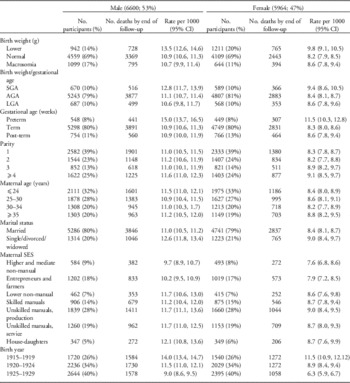
Table 1 presents the exposure variables of interest. Birth weight was classified into lower weight (<3000 g), normal weight (3000–3999 g) and macrosomia (⩾4000 g). Gestational age was categorized into preterm (<37 gestational weeks), term (37–41 weeks) and post-term (⩾42 weeks). Relative birth weight (birth weight-for-gestational age) was calculated by standardising birth weight on a week-by-week basis, standardizing separately for males and females. We used the means and standard deviations observed in UBCoS for the 13,599 members of the total cohort who were born at 30 or more completed weeks (i.e. an internal reference). For the 86 children born at 22–29 weeks we used external reference dataReference Kramer, Platt and Wen 29 adjusted for birth weight distributions observed within our cohort; full details available in the Supplementary material. We then categorized birth weight-for-gestational age using standard percentile thresholds: infants below the 10th percentile were ‘small-for-gestational age’ (SGA), infants between the 10th and the 90th percentiles were ‘adequate-birth weight-for-gestational age’ (AGA), and infants above the 90th percentile were ‘large-for-gestational age’ (LGA). Family socioeconomic information was derived based on the Swedish socioeconomic classification scheme, 30 using father’s occupation if recorded (80%) or otherwise using mother’s occupation (20%).Reference Goodman, Gisselman and Koupil 31 Occupational social class was categorized into higher and intermediate non-manual workers (including e.g. physicians, academic professions, teachers and engineers), entrepreneurs and farmers, lower non-manual, skilled manuals, unskilled manuals (manufacturing sector), unskilled manuals (service sector) and house-daughters (women who live with their parents at the moment of giving birth). Marital status was classified into two groups: married and single/divorced/widowed. Mother’s age was categorized into four groups ⩽24, 25–29, 30–34 and 35+ years old. Parity was assessed as 1, 2, 3, and ⩾4, and birth years into three groups: 1915–1919, 1920–1924 and 1925–1929.
Characteristics of the analyzed population, number and proportion of deaths, and mortality rates.

SES, socioeconomic status.
Uppsala Birth Cohort Multigenerational study, 1915–1929 (n=12,564).
Statistical analysis
We fitted Cox regression models defined on the age time scale. Because of expected time varying effects of the exposures of interest (absolute and relative birth weight, and gestational age) we allowed for interactions between the exposures and categorized age, with bands: <1, 1–4, 5–29, 30–44, 45–59, 60–69, 70–79 and 80+ years following a modified version of the categorization used by the World Health Organization.Reference Mathers, Bernard and Iburg 32 Contrary to the original classification, we disaggregated the first age interval (0–4) into two groups in order to investigate infant mortality (<1) and child mortality (1–4) separately. Also, we collapsed the central age groups (5–14 and 15–29) for statistical reasons. From these Cox regression models we derived estimates of age band-specific hazard ratios of overall mortality, with 95% confidence intervals derived from robust standard errors to account for within family correlations. We performed random effects meta-analysis to estimate l-squared statistics, and used this to test whether there was evidence of heterogeneity between the effects estimated at different ages.
To assess the extent to which family socioeconomic characteristics confounded the association between each exposure and mortality, we first estimated models with minimal adjustment (adjusted for sex, birth year and mutual adjustment for birth weight and gestational age); second we included maternal age and parity; and finally we included socioeconomic information (i.e. parental socioeconomic status and marital status). We also assessed whether the associations between perinatal variables and mortality were modified by socioeconomic status or gender. The significance of exposure effects and their interactions with age, gender and socioeconomic status were assessed using Wald tests.Reference Clayton and Hill 33
In order to explore whether unobserved maternal-level confounding affected the results, we additionally conducted within-family (sibling) analyses by comparing outcomes of siblings born to the same mother (i.e. 5843 (47%) newborns nested in 2323 mothers). This approach was originally designedReference Mann, De Stavola and Leon 34 and used in previous studiesReference Goodman, Heshmati, Malki and Koupil 35 for linear predictor variables. This paper uses an extension for binary predictor variables. To do this we first assigned each cohort member a binary variable for a predictor in question, for example 0 for ‘not SGA’ and 1 for ‘SGA’. We then created for each subject a ‘between-mother’ variable representing the average across all the mother’s offspring (e.g. the proportion of their children who were SGA) and a ‘within-mother’ variable representing the departure of each individual from that mean (e.g. the cohort member’s own SGA status minus the mother’s average: equations in the Supplementary material). We then used Wald tests to compare the effect sizes of these two variables when entered simultaneously into Cox regression analyses: if they differed significantly we interpreted this as evidence of residual maternal-level confounding.Reference Mann, De Stavola and Leon 34 If associations were entirely the product of such confounding, one would expect the within-mother effect to be (i) significantly weaker than the between-mother effect (in the case of positive confounding) or stronger than the between mother (if the confounding is driven by negative confounding) and (ii) not significantly different from zero. When comparing the between and within mother effect sizes we adjusted for sex, year of birth, mother’s age, parity and other birth information in order to control for those characteristics which may differ between siblings (i.e. temporal confounding).Reference Frisell, Oberg, Kuja-Halkola and Sjolander 36
We present descriptive statistics stratified by gender, but pool males and females in our main analyses as there was never convincing evidence of interactions between birth outcomes and gender with respect to mortality were not significant (all P⩾0.15 in tests for interaction in the total sample; all P⩾0.04 in tests for interaction in specific age strata). Combining the genders also had the advantage of increasing statistical power.
All analyses were performed using Stata, version 13, software (StatCorp, LP, College Station, TX, USA). This study was approved by the Regional Ethics Committee in Stockholm.
Results
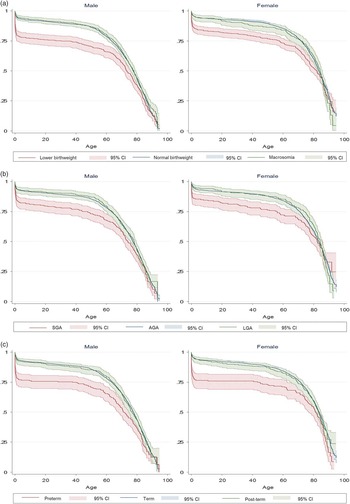
Table 1 shows the distribution of the number of subjects at risk, deaths from all causes, and death rates per 1000 person-years (pyar) by different levels of the explanatory variables. As expected, higher death rates were observed among lower birth weight and SGA subjects (≈11/1000 pyar) as well as among preterm subjects (13/1000 pyar). The death rate was higher among males than females (11/1000 v. 9/1000 pyar) and it progressively increased with parity. Offspring from mothers younger than 25 and older than 34 had higher death rates (≈10/1000 pyar) than those at central ages. As expected, there was a higher death rate among offspring of unmarried mothers (12/1000 pyar) and of mothers with low socioeconomic status (≈10/1000 pyar). Fig. 1 shows lower survival curves for lower birth weight, SGA, and preterm subjects in all ages. Preterm was the exposure with the highest survival differences relative to the reference category.
Kaplan–Meier survival curves by absolute (a), relative(b) birth weight and gestational age (c) stratified by gender.

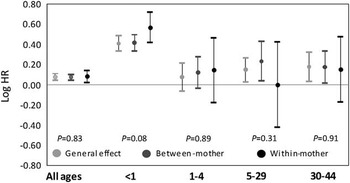
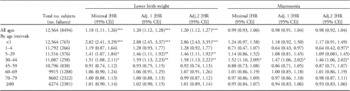
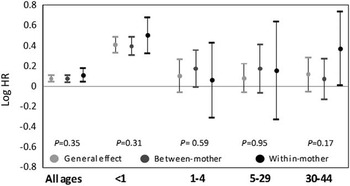
Table 2 shows the estimated associations between absolute birth weight and all-cause mortality at different ages with different levels of adjustment. Lower birth weight offspring had a higher rate of death than those with normal weight overall, but there was strong evidence that the strength of this effect differed according to age group (P<0.001 for heterogeneity). Specifically, the effect was largest in the first year of life and then continued up to 44 years of age (although it did not reach significance at the interval 1–4 years, plausibly because of low statistical power). These results were similar after partial and further adjustment for maternal and family characteristics. There was also never evidence in the sibling analysis that the between-mother and within-mother effect size differed for those age groups that show a higher risk (Fig. 2). In other words, among offspring of the same mother, the risk of increased mortality was specific to the infant born at lower birth weight and not to his or her siblings born at a normal birth weight. This provides evidence that the effects observed in Table 2 do not include residual maternal-level confounding, and supports the interpretation that lower birth weight has a causal effect on all-cause mortality.
Sibling analysis for the effect of lower v. normal birth weight by age band. Log, logarithm; HR, hazard ratio.

Survival analysis (hazard ratios (HR), 95% confidence intervals (CI)) for absolute birth weight (ref. 3000–3999 g) and all-cause mortality by age intervals and level of confounding control

Test for heterogeneity across age bands in minimally adjusted analyses I 2=90%, P<0.001 (Lower birth weight), I 2=40%, P=0.114 (Macrosomia).
Minimal (birth year, sex, and gestational age), adjusted 1 (minimal+parity and maternal age), adjusted 2 (adj.1+marital status and socioeconomic status).
*P<0.05, **P<0.01, ***P<0.001.
Pooling all age ranges, the effects of macrosomia on mortality were not significant (P=0.11) and there was no very clear pattern to the age-specific estimates. There was an indication of higher mortality rates in the age group 30–44 but the null result of the test for heterogeneity suggests that this may be due to chance. As such, we believe that the pooled effect estimate is the more appropriate effect estimate for macrosomia.
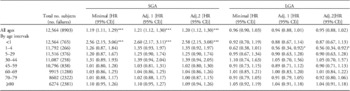
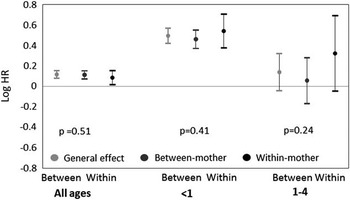
Table 3 shows the associations between birth weight-for-gestational age and all-cause mortality at different ages with different levels of adjustment. There was strong evidence of heterogeneity by age group in the effects of SGA (P<0.001 for heterogeneity). Compared to AGA subjects, SGA subjects showed a trend towards a higher mortality rate up to 44 years of age, although the differences were larger during the first year of life, and were only statistically significant during the first year of life. The sibling analysis indicated that there was no evidence that residual maternal-level confounding explained the higher rate of mortality among SGA subjects at all these ages (Fig. 3).
Sibling analysis for the effect of small age v. adequate-for-gestational age by age band. Log, logarithm; HR, hazard ratio.

Survival analysis for relative birth weight (reference AGA) and all-cause mortality by age intervals

HR, hazard ratios; CI, confidence intervals; AGA, adequate birth weight-for-gestational-age; SGA, small-for-gestational-age; LGA, large-for-gestational-age.
Test for heterogeneity across age bands in minimally-adjusted analyses I 2=84%, P<0.001 (SGA), I 2=9%, P=0.357 (LGA).
Minimal (birth year, sex and gestational age), adjusted 1 (minimal+parity and maternal age), adjusted 2 (adj.1+marital status and socioeconomic status).
*P<0.05, **P<0.01, ***P<0.001.
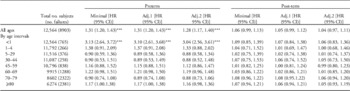
Table 4 shows the association between categories of gestational age with different levels of adjustment. There was strong evidence that this effect differed across different age groups (P<0.001 for heterogeneity), with this being driven by an increased mortality risk among infants born preterm during the first year of life. There was also a trend towards an increased risk between ages 1 and 4, although this was not statistically significant, suggesting a weakening effect of preterm birth as age increases. Above age 4 there was generally little or no evidence of an increase in mortality. As was the case for lower birth weight and SGA, the sibling analysis indicated that the higher risk of mortality among preterm subjects did not reflect residual confounding at the maternal level (Fig. 4).
Sibling analysis for preterm v. term by age band. Log, logarithm; HR, hazard ratio.

Survival analysis for gestational age (reference=term births) and all-cause mortality by age group

Test for heterogeneity across age bands in minimally-adjusted analyses I 2=89%, P<0.001 (Preterm), I 2=0%, P=0.999 (Post-term).
Minimal (birth year, sex and birth weight), adjusted 1 (minimal+parity and maternal age), adjusted 2 (adj.1+marital status and socioeconomic status).
*P<0.05, **P<0.01, ***P<0.001.
Finally, subjects born LGA or born post-term did not show a statistically significant different mortality rate compared with those born at term, and this was consistent across age bands (both P=0.99 for heterogeneity).
With regard to these effects on mortality in the pooled sample, neither socioeconomic status nor gender showed evidence of an interaction with absolute birth weight, relative birth weight or gestational age (all P>0.05, and most P>0.2). There was likewise no convincing evidence of interactions in equivalent analyses stratified by age group, with the exception of marginal evidence in the age group 5–29 that the effects of (a) relative birth weight and (b) gestational age were stronger in women (both P=0.04). In the context of multiple testing, however, this is likely to be a chance finding. We also tested for statistical interactions between perinatal health and socioeconomic characteristics on mortality but found no effect modification was found (P>0.05).
Discussion
Summary of results
This study provides evidence that both absolutely and relatively small newborns, as well as those born preterm, have a higher risk of mortality. However, these associations significantly differ by age intervals and according to the measure under scrutiny. Thus, while preterm birth is associated to a higher rate of all-cause mortality up to 4 years of age, lower birth weight and SGA appear to be associated with a higher mortality rate up until 44 years of age. We did not find evidence that observable early-life socioeconomic disadvantage explains or modifies the association between perinatal health and mortality. Our sibling analyses support this conclusion, and also indicate that the observed effects are not likely to reflect residual confounding at the maternal level.
Consistency with other research
Like many other studies,Reference Leon, Lithell and Vagero 7 – Reference Baker, Olsen and Sorensen 9 , Reference Power and Li 11 – Reference Malin, Morris, Riley, Teune and Khan 14 we found that birth weight was associated with all-cause mortality. Our results support a previous hypothesis that birth weight specifically predicts mortality at fairly young to middle adult ages, rather than at older ages,Reference Risnes, Vatten and Baker 8 since lower birth weight and SGA was associated to mortality up to 44 years of age. The effect observed in younger adult ages is consistent with one previous study which found a higher risk of all-cause mortality between 15 and 49 years.Reference Andersen and Osler 16
In line with another Swedish study carried out in a more contemporary context (Swedish men and women born 1973–2008),Reference Class, Rickert, Lichtenstein and D’Onofrio 20 we did not find a U-shaped association between birth weight and all-cause mortality at all ages – that is, we did not find a higher overall mortality rate among macrosomic subjects. There was some indication of a U-shaped association between birth weight and mortality in the age interval 30–44 which is consistent with another study (using the Danish School-based cohort, 1936–1979),Reference Baker, Olsen and Sorensen 9 that found similar evidence in a larger age window 25–68. Our finding of an effect at age 30–44 should, however, be interpreted with caution as the test for heterogeneity suggests that it may simply be due to chance.
The association between preterm birth and mortality in infancy and early childhood (up to 4 years of age) is consistent with a previous study conducted in Norway,Reference Swamy, Ostbye and Skjaerven 37 although unlike that study we did not find any effect for an effect of post-term birth in these age bands.
Like previous studies,Reference Baker, Olsen and Sorensen 9 , Reference Class, Rickert, Lichtenstein and D’Onofrio 20 , Reference Koupil, Leon and Lithell 38 we do not present analyses stratified by gender, because we did not find evidence of effect modification after testing for interactions of perinatal health and gender in their effect on mortality. Finally, in accordance with earlier studiesReference Friedlander, Paltiel and Deutsch 12 , Reference Andersen and Osler 16 , Reference Class, Rickert, Lichtenstein and D’Onofrio 20 the inclusion of observable early-life socioeconomic characteristics does not explain the association between perinatal health and all-cause mortality.
Originality
Our study is unique in assessing the association between birth weight and all-cause mortality with a focus on specific age intervals. Moreover, we investigated the potential contribution of unobserved familial confounding using a sibling design. Although one previous studyReference Class, Rickert, Lichtenstein and D’Onofrio 20 assessed this association looking for evidence of family-level confounding, the latter used fixed-effect models while we applies an approach that allowed formal statistical comparisons of between-mother v. within-mother effects. Our study is also original in that it focusses on the specific contribution of socioeconomic circumstances, not only as a possible confounder, but also as a modifier of the association between birth weight and all-cause mortality.
Strengths and limitations
The study is based on a unique historical data source which allows us to follow an almost complete cohort across their life-span. Although restricted to births in one hospital in Uppsala, this data has been shown to be representative of Sweden in 1915–1929.Reference Rajaleid, Manor and Koupil 39 Moreover, this cohort provided us with the possibility to better assess the association between macrosomia and mortality since, in contrast to studies based in contemporary settings, birth weight was not affected by obstetric interventions such as today’s planned caesarean-sections in cases of suspected macrosomia.Reference Chauhan, Grobman and Gherman 40 Other strengths include systematically testing for gender interactions, and examining associations not only with absolute birth weight but also with relative birth weight and with gestational age. The use of a family-based design is another important strength that benefits from the large numbers of siblings that we have in our cohort.
A potential limitation of this study is that observable socioeconomic characteristics may provide partial information, insofar as some parents of our cohort members were young adults who might still be consolidating their occupational position. Moreover, on other relevant confounders (e.g. maternal health status) we lack data altogether. Although these limitations are mitigated by our application of a sibling design, we cannot exclude the existence of residual temporal confounding (i.e. confounding by factors that differ between siblings). In addition, insofar as we identify siblings based on sharing the same biological mother, some heterogeneity will be introduced by the presence of half-siblings.
Another drawback in our design is that some decisions were driven by sample size limitations. Thus, we could not use the usual definition of low birth weight fixed at <2500 g. and we used instead a higher cut of point (<3000 g). Likewise, small numbers meant that we had to create a heterogeneous category of ‘unmarried mothers’ that combined single, divorced and widowed mothers.
Implications for future research
Our findings open new questions and hypotheses. Further studies focussing on specific causes of death by age intervals are needed. Such studies will allow assessment of whether the lack of association observed in this study between birth characteristics and mortality at older ages could reflect the offsetting effect of disease-specific associations in opposite directions. Previous studies, including ones also using the UBCoS Multigen data set, suggest this might be the case; lower birth weight and SGA have been associated with higher rates of cardiovascular disease,Reference Leon, Lithell and Vagero 7 , Reference Koupil, Leon and Lithell 38 while macrosomia has been associated with a higher rate of breast, prostate, endometrial and colon cancer.Reference Barker 4 , Reference Sovio, Jones, Dos Santos Silva and Koupil 15 , Reference Barker 41 – Reference Ross 43
Our study suggests that the effect of lower birth weight and SGA, lasts longer across the life course (up to age 44) than the effect of preterm birth, although the effect of preterm is stronger during the first year of life. Further investigation is needed to confirm this evidence, which contradicts the general expectation, that gestational age is a stronger predictor of short and long-term survival than birth weight.Reference Swamy, Ostbye and Skjaerven 37 , Reference Wilcox 44
Conclusion
Light, small and preterm newborns have a higher rate of mortality. These associations vary by age and measure under scrutiny. The associations with birth weight and gestational age were mostly confirmed in the sibling analysis, indicating that any residual maternal confounding is limited. Our findings support the message that policies oriented towards improving population health should invest in improving birth outcomes and hence, in maternal health.
Acknowledgements
None.
Financial Support
This study was supported by ‘Methods in register-based research in Life course and social epidemiology’ (funded by VR#2013-5104, PI Koupil), ‘Social mobility and health among Swedish men and women born 1915-2010’ (funded by FORTE # 2013-1084, PI Koupil), Swedish Social Mobility Network (funded by FORTE #2014-2693, PI Koupil), ‘New perspectives on the interplay between environmental factors, social issues and health’ (SIMSAM-Lund Early-life funded by VR # 2013-5474 PI Rignell-Hydbom) and Forte-centre: Human society as a life long determinant of human health (funded by FORTE #2006-1518, PI Lundberg).
Conflicts of Interest
None.
Ethical Standards
The authors assert that all procedures contributing to this work comply with the ethical permission approved by the institutional committees (the Regional Ethics Committee in Stockholm).
Supplementary Material
To view supplementary material for this article, please visit http://dx.doi.org/10.1017/S2040174416000179