INTRODUCTION
Jaguar (Panthera onca L.) and puma (Puma concolor L.) are the largest predators in the Neotropics and they coexist in most of the region (Sunquist & Sunquist Reference SUNQUIST and SUNQUIST2002). As they are of comparable size and morphology, and have a similar diet, they use resources in a similar way and therefore they are considered potential competitors (Donadio & Buskirk Reference DONADIO and BUSKIRK2006, Harmsen et al. Reference HARMSEN, FOSTER, SILVER, OSTRO and DONCASTER2009). In response to the risk of exploitative or interference competition, organisms can adjust their patterns of resource utilization to minimize the frequency or level of interaction (Palomares & Caro Reference PALOMARES and CARO1999). This niche differentiation among carnivore species including jaguar and puma has been usually evaluated on the food, habitat or time axes (Karanth & Sunquist Reference KARANTH and SUNQUIST2000, Scognamillo et al. Reference SCOGNAMILLO, MAXIT, SUNQUIST and POLISAR2003). Many studies on these cats have found niche differentiation on the food and at a fine scale on the space–niche axes (de Oliveira Reference DE OLIVEIRA, Medellín, Equihua, Chetkiewicz, Crawshaw, Rabinowitz, Redford, Robinson, Sanderson and Taber2002, Núñez et al. Reference NÚÑEZ, MILLER, LINDZEY, Medellín, Equihua, Chetkiewicz, Crawshaw, Rabinowitz, Redford, Robinson, Sanderson and Taber2002, Scognamillo et al. Reference SCOGNAMILLO, MAXIT, SUNQUIST and POLISAR2003, Silveira Reference SILVEIRA2004, Taber et al. Reference TABER, NOVARO, NERIS and COLMAN1997a). In contrast, and despite the fact that temporal separation has been proposed as a mechanism to enable the coexistence between some sympatric predators (Harrington et al. Reference HARRINGTON, HARRINGTON, YAMAGUCHI, THOM, FERRERAS, WINDHAM and MACDONALD2009, Karanth & Sunquist Reference KARANTH and SUNQUIST2000), previous studies have reported that jaguar and puma instead have very similar activity patterns when living in sympatry (Harmsen et al. Reference HARMSEN, FOSTER, SILVER, OSTRO and DONCASTER2009, Núñez et al. Reference NÚÑEZ, MILLER, LINDZEY, Medellín, Equihua, Chetkiewicz, Crawshaw, Rabinowitz, Redford, Robinson, Sanderson and Taber2002, Paviolo et al. Reference PAVIOLO, DI BLANCO, DE ANGELO and DI BITETTI2009, Scognamillo et al. Reference SCOGNAMILLO, MAXIT, SUNQUIST and POLISAR2003, Silveira Reference SILVEIRA2004).
It has been repeatedly suggested that the activity patterns of felids are mainly determined by those of their principal prey (Carrillo et al. Reference CARRILLO, FULLER and SAENZ2009, Emmons Reference EMMONS1987, Karanth & Sunquist Reference KARANTH and SUNQUIST2000, Mendes Pontes & Chivers Reference MENDES PONTES and CHIVERS2007). However, Carothers & Jaksic (Reference CAROTHERS and JAKSIC1984) argued that interference competition must be more prevalent than resource competition in driving temporal partitioning among competing species. Both jaguar and puma can be active at any hour of the day or night (Sunquist & Sunquist Reference SUNQUIST and SUNQUIST2002) and a few studies have found shifts in activity patterns of some populations due to the availability of prey at diurnal periods (Rabinowitz Reference RABINOWITZ1986, Schaller & Crawshaw Reference SCHALLER and CRAWSHAW1980, Sunquist & Sunquist Reference SUNQUIST and SUNQUIST2002), or due to anthropogenic disturbances (Paviolo et al. Reference PAVIOLO, DI BLANCO, DE ANGELO and DI BITETTI2009, Van Dyke et al. Reference VAN DYKE, BROCKE, SHAW, ACKERMAN, HEMKER and LINDZEY1986). This plasticity may allow puma and jaguar to avoid each other to reduce the probability of interference competition by using the habitat at different times of the day, or to target different prey species with different activity patterns to reduce exploitative competition.
Using data from camera trap surveys, we evaluated the activity patterns of jaguar and puma at four sites of the dry forest of southern Bolivia. We aimed to determine whether temporal separation between puma and jaguar could promote their coexistence. We also evaluated the relationship of the cats’ activity patterns with those of their potential prey species. We hypothesized that these cats maintain activity patterns that differ significantly from each other in order to avoid potentially risky encounters, thus temporal segregation facilitates their coexistence. An alternative hypothesis was that these cats determine their activity patterns by those of some prey species, so that they reduce exploitative competition by selecting different prey with different activity patterns.
METHODS
Study area
The Kaa-Iya National Park covers 34 400 km2 of the dry-forest of south-eastern Bolivia, in Santa Cruz Department (Taber et al. Reference TABER, NAVARRO and ARRIBAS1997b). This park contains the largest protected expanse of tropical dry forest in the world (Taber et al. Reference TABER, NAVARRO and ARRIBAS1997b). We carried out camera trapping surveys in the wet and dry seasons at each of four sites: Estación Isoso (18°25′S, 61°46′W), Tucavaca (18°30′S, 60°48′W), Ravelo (19°17′S, 60°37′W) and Cerro Cortado (19°31′S, 61°18′W) (Table 1). The elevations of all four study camps varies from 250–350 m asl, mean annual precipitation from 500–800 mm, and mean annual temperatures from 25–26 °C. Forest is deciduous and canopy height ranges from 4 to 8 m. Dry season lasts 6–8 mo and permanent sources of superficial water remain year-round at Ravelo, while at all other sites there are periods of up to several months with no surface water available during that season. For more information about the study areas, see Maffei et al. (Reference MAFFEI, CUÉLLAR and NOSS2004) and Cuéllar et al. (Reference CUÉLLAR, MAFFEI, ARISPE and NOSS2006).
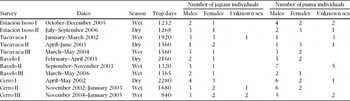
Characteristics of the systematic surveys and number of individual jaguar and puma by sex identified for each.

Field methods
We conducted two or three 60-d systematic camera trap surveys in all four field camps covering both wet and dry seasons (Table 1). We followed the method described by Karanth & Nichols (Reference KARANTH and NICHOLS1998) to determine the population densities of jaguar and puma. We identified individual jaguars based on their spot patterns (Maffei et al. Reference MAFFEI, CUÉLLAR and NOSS2004), whereas puma identification was based on the presence of wounds or scars, lingering juvenile spotting, tail kinks, ear nicks, sex and overall body colour and condition (Kelly et al. Reference KELLY, NOSS, DI BITETTI, MAFFEI, ARISPE, PAVIOLO, DE ANGELO and DI BLANCO2008). Although in the case of pumas identification may be uncertain, there was generally low variation in the identification of individuals by different investigators, and thus in the density estimates. For example for Estación Isoso II, the number of pumas according to three investigators varied between 5 and 6 and the mean density was 3.71 individuals per 100 km2 ± 0.45 SD. In all cases, after the identification by two or three authors, we had a discussion and reached a consensus on the identity of pumas and used it to estimate densities (Kelly et al. Reference KELLY, NOSS, DI BITETTI, MAFFEI, ARISPE, PAVIOLO, DE ANGELO and DI BLANCO2008). Therefore, although there may be some uncertainty in the number of pumas and their density, we think those estimations are close to reality.
We employed between 18 and 34 pairs of Camtrakker® or Trailmaster® passive and active film camera traps for each systematic survey, placing them on roads and trails and spacing them 1–3 km apart. These roads are rarely used as no towns or villages exist within the National Park. We did not rotate the cameras or use bait to attract animals. The cameras were active 24 h d−1 during the entire survey period and were programmed with a minimum delay of 3 min and to record the date and time of each photograph. We checked cameras for correct functioning every 2–7 d and reloaded them with alkaline batteries or film (ASA 100 or 200) if necessary. Alkaline batteries in the camera itself lasted for the 2-mo surveys, and the batteries for the infrared sensors were changed generally once during each survey. We scanned the negatives of photographs and printed black-and-white copies of the jaguar photos. In the case of pumas we processed the photos in colour. Using these photographs we constructed a database for each site. In addition to the systematic surveys, we conducted pilot surveys during long periods using 12–14 single camera traps at two camps (Tucavaca: May–December 2001, 2520 trap-days; Ravelo: February–July 2001, 1248 trap-days) to gather preliminary information on jaguar presence and habits at both study areas (Maffei et al. Reference MAFFEI, CUÉLLAR and NOSS2004).
Data analysis
We considered the distribution of the activity patterns of jaguar and puma as the response variable, and sex, locality, season and activity pattern of the prey species as the independent variables. Sample size per site was insufficient to compare the activity patterns among individuals, but we were able to compare sexes at each site. We considered that two observations of the same individual, or two observations of the same prey species in the same camera trap station, separated by at least 1 h were statistically independent, and we excluded the remaining observations from the analyses. This separation between events will allow comparisons with previous studies using the same time interval (Di Bitetti et al. Reference DI BITETTI, PAVIOLO and DE ANGELO2006, Reference DI BITETTI, PAVIOLO, FERRARI, DE ANGELO and DI BLANCO2008; Paviolo et al. Reference PAVIOLO, DI BLANCO, DE ANGELO and DI BITETTI2009). We constructed circular graphs to illustrate the daily activity patterns of jaguar, puma and their prey using the percentage of independent observations each hour.
We determined the sunrise and sunset hours using the software Moonrise 3.5 along with the coordinates and dates covered by each systematic survey. We classified jaguar, puma and their prey species at each site based on their activity patterns, modifying slightly the criteria of Gómez et al. (Reference GÓMEZ, WALLACE, AYALA and TEJADA2005). The species were classified as diurnal (<15% of observations at night), nocturnal (>85% of observations at night), mostly diurnal (15–35% of observations at night), mostly nocturnal (65–85% of observations by night), and the rest were classified as cathemeral (i.e. organisms active intermittently both day and night). Finally, we included the observations during twilight, which we considered to last from 1 h before to 1 h after sunrise and sunset. However, we considered these crepuscular observations independent from those in the day or night as it is very improbable that predators as big as jaguar and puma restrict their activity periods to twilight periods in an important way (van Schaik & Griffiths Reference VAN SCHAIK and GRIFFITHS1996). Therefore, we considered that the day began at sunrise and night at sunset and not after and before the crepuscular period, respectively.
As activity data show a circular distribution, we compared the distributions of two samples of activity patterns using non-parametric circular statistics, namely the Wheeler and Watson test (Zar Reference ZAR1999) which tests if there is no significant difference between two circular distributions. The test statistic, W, may be compared to a χ2 distribution with two degrees of freedom (Zar Reference ZAR1999). To compare more than two samples, we used a multisampling test modified from the Wheeler and Watson test (Zar Reference ZAR1999). As no post hoc analysis exists for this test, in order to carry out pairwise comparisons, we calculated the experimentwise error rate of the whole set of comparisons and divided it by the number of pairwise comparisons, thus decreasing the probability of making type I error (Zar Reference ZAR1999). As we used a significance level of P < 0.05 for statistical hypothesis testing, the significance level for the pairwise comparisons after those multisampling tests was P < 0.046 (four comparisons) for jaguar and P < 0.045 (five comparisons) for puma. In addition, and using the two-sample Wheeler and Watson test, we compared the activity patterns of jaguar and puma with each of six prey species known to be important for these cats in other areas of the Chaco (Taber et al. Reference TABER, NOVARO, NERIS and COLMAN1997a) and for which we had sufficient records at each site for the statistical comparisons. These species were: Mazama gouazoubira (Fischer), Tapirus terrestris (Linnaeus), Sylvilagus brasiliensis (Linnaeus), Pecari tajacu (Linnaeus), Tayassu pecari (Link) and Tolypeutes matacus (Desmarest).
The comparison of the activity patterns between seasons for each species was based on systematic surveys. Only in cases where we did not find significant differences between seasons did we include the data from pilot surveys to compare activity patterns between species at each site. The species classification with respect to activity patterns and the graphs were based only on systematic surveys.
RESULTS
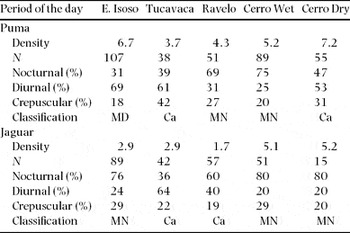
Between three and seven individual jaguars and between three and 12 individual pumas were identified at each survey (Table 1). Average puma density was generally higher than jaguar density across sites (Table 2). We did not find differences in activity patterns between seasons at any site, with the exception of puma at Cerro, which showed a wet-season activity pattern significantly different from that of the dry season (χ2 = 24.4, df = 2, P < 0.001) (Figure 1). In this site puma was mostly nocturnal during the wet season and cathemeral during the dry season (Table 2). Therefore, in the subsequent comparisons, we combined the data for both sexes and seasons for all populations of jaguar and puma, except both cats from Cerro, for which we analysed each season as a different sample. At the remaining three sites, Ravelo, Tucavaca, and Estación Isoso, puma was classified as mostly nocturnal, cathemeral and mostly diurnal, respectively (Table 2). Jaguar in turn was classified as mostly nocturnal at Cerro and Estación Isoso, and cathemeral at Tucavaca and Ravelo (Table 2).
Population density (individuals per 100 km2) and classification of the activity patterns of jaguar and puma across four sites in Bolivia. N refers to the number of independent observations. Classification is based on nocturnal and diurnal photographic records. Ca = Cathemeral, MN = Mostly nocturnal, MD = Mostly diurnal. The crepuscular observations are independent from the observations during day and night, therefore only the sum of the percentages of day and night equal 100%. Density estimates are the mean for each site.

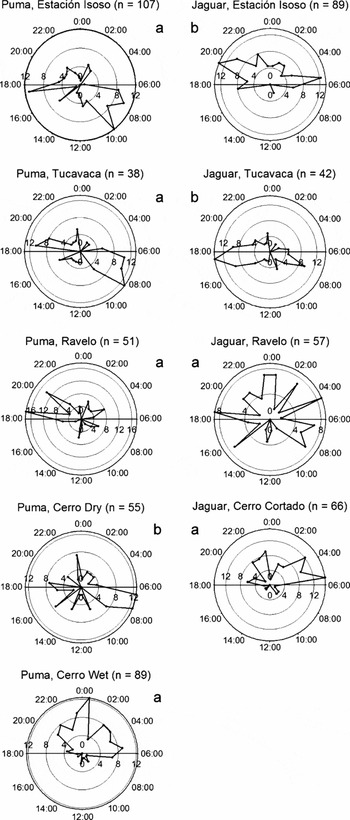
Daily activity patterns of puma and jaguar at four field-camps in Bolivia based on systematic camera trapping surveys. The scale on the axis refers to the percentage of independent observations each hour. Same letters mean that the activity patterns of puma and jaguar in each site are not significantly different (Weller and Watson test).

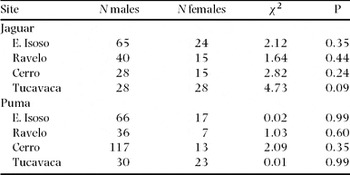
We found no significant differences between sexes for any species at any site (Table 3). Across sites there was generally a bias towards males in the number of individuals captured for jaguar (mean number of males = 2.65 ± 0.47 SD; females = 1.58 ± 0.68 SD) and for pumas (males = 3.75 ± 1.77 SD; females = 2.13 ± 0.48 SD) (Table 1). In addition, males had more independent observations than females both for jaguars (mean males = 40.2 ± 17.4 SD; mean females = 20.5 ± 6.56 SD) and pumas (mean males = 62.2 ± 39.7 SD; mean females = 15.0 ± 6.73 SD) (Table 3).
Number of independent observations of jaguar and puma's males and females and results of the comparisons of their activity patterns at each site. The comparisons were made using the Wheeler and Watson test and all of them have 2 degrees of freedom.

Across the study sites, the multisampling test revealed that for each cat species, at least one of the populations showed a significantly different activity pattern (puma: χ2 = 82.2, df = 8, P < 0.001; jaguar: χ2 = 57.3, df = 6, P < 0.001). In the case of jaguar, the activity patterns in E. Isoso and Ravelo were not different (χ2 = 4.09, df = 2, P = 0.12), but they were significantly different than Tucavaca and Cerro (χ2 = 41.0, df = 2, P < 0.001; χ2 = 8.15, df = 2, P = 0.017, respectively), whereas Tucavaca and Cerro were also different (χ2 = 43.0, df = 2, P < 0.001) (Figure 1). In the case of puma, on the other hand, E. Isoso, Tucavaca and Cerro dry were not significantly different (P > 0.045) and they tended to exhibit similar activity patterns at these sites (Figure 1). These activity patterns were, however, different to those at Cerro wet and Ravelo (χ2 = 52.5, df = 2, P < 0.001; χ2 = 15.7, df = 2, P < 0.001), whereas Cerro wet and Ravelo were also different (χ2 = 20.0, df = 2, P < 0.001).
We found statistically significant differences in the comparisons of activity patterns between puma and jaguar at three sites (Estación Isoso: χ2 = 45.9, df = 2, P < 0.001; Tucavaca: χ2 = 9.4, df = 2, P = 0.009; Cerro dry: χ2 = 6.8, df = 2, P = 0.032), whereas we did not find significant differences in either Ravelo (χ2 = 2.4, df = 2, P = 0.299) or Cerro wet (χ2 = 1.9, df = 2, P = 0.299). As Figure 1 shows, jaguar and puma showed little temporal overlap at the first three sites and had more similar activity patterns at the other sites.
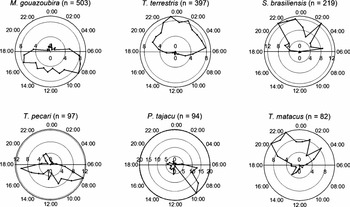
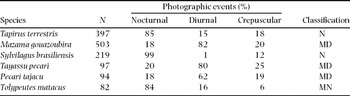
Most of the six prey species included in the analysis did not exhibit differences in their activity patterns between seasons at any site, with the exception of Sylvilagus brasiliensis at Cerro (χ2 = 7.1, df = 2, P = 0.028). Mazama gouazoubira, Tapirus terrestris and Tayassu pecari had at least one population with a significantly different activity pattern (χ2 = 35.1, df = 6, P < 0.001; χ2 = 17.3, df = 6, P = 0.008, χ2 = 13.9, df = 6, P = 0.031 respectively), whereas the remaining species did not. However, all those three species were mostly limited to one period of the day, and therefore their observations, as well as those for the remaining species, were combined for constructing Figure 2 and for the classification of their activity patterns in Table 4, but not for the statistical comparisons. Overall, prey species were more confined to one period of the day than their predators (Figure 2, Table 4).
Daily activity patterns of six prey species of puma and jaguar across four sites in Bolivia based on systematic camera trapping surveys. The observations of the four sites have been combined for the construction of the graphs. The scale on the axis refers to the percentage of independent observations each hour. The complete scientific names of these species are in Table 4.

Classification of activity patterns of six potential prey species of jaguar and puma at four areas in Bolivia. For this classification we have combined the data from all four studies. Classification is based on the nocturnal and diurnal observations. Abbreviations are as in Table 2.

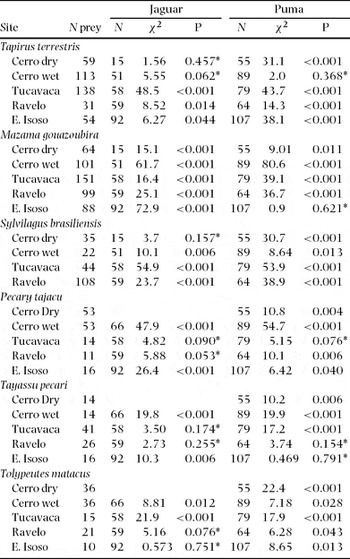
The great majority of the comparisons between the activity patterns of predators and prey species at each site resulted in significant differences (Table 5). Only a few prey species at some sites did not have activity patterns significantly different to those of the big cats (Table 5). For sample size values used in the comparisons of activity patterns between both cats and between the cats and their prey, see Table 5.
Results of the comparisons of the distribution of the activity patterns of some prey species with that of jaguar and puma at four sites in Bolivian dry forests. All the pairwise comparisons were made using the Wheeler and Watson test and have 2 degrees of freedom. For the later three species (P. tajacu, T. pecari and T. matacus) we combined the data from both seasons at Cerro for those comparisons because of the small sample size. For the comparisons with those three species, we also combined the data from both seasons for jaguars, but not for pumas. The asterisk emphasizes the comparisons that were not significantly different.

DISCUSSION
As in the cases of sympatric puma and jaguar across the Neotropics, temporal separation among other potentially competing carnivore species has rarely been reported (Palomares & Caro Reference PALOMARES and CARO1999). Schoener (Reference SCHOENER1974) drew similar conclusions in his review of resource partitioning in ecological communities, finding that temporal partitioning is significantly less common than partitioning on the axes of food or habitat. This occurs because restrictions exist in the endogenous clocks of many animals, and thus it is generally costly to shift from one type of circadian activity to another (Kronfeld-Schor & Dayan Reference KRONFELD-SCHOR and DAYAN2003). However, jaguar and puma are not strongly restricted to only one period of the day. Research to date has not reported a clear temporal separation at the circadian level between jaguar and puma in most regions of the Neotropics. However, results from this study show for the first time a statistically significant temporal separation at the circadian level between jaguar and puma, in some dry-forest sites.
In contrast with previous research that suggests that jaguars and pumas determine their activity based on those of their principal prey (Carrillo et al. Reference CARRILLO, FULLER and SAENZ2009, Emmons Reference EMMONS1987, Mendes Pontes & Chivers Reference MENDES PONTES and CHIVERS2007), at our study sites jaguar and puma did not follow the daily activity schedules of any particular prey species as a pattern across sites. In fact, in most of the comparisons the cats’ activity patterns differed significantly from those of their potential prey. However, both jaguar and puma showed more variation than the prey species for which we had sufficient observations across sites. In addition, at most sites cats were active both at day and night, whereas most of the prey species were more confined to one period of the day. These results suggest that jaguar and puma overlap their activity patterns with, and hence have more access to, many prey species by using different periods of the day, thus broadening their trophic niche. Probably the activity during dawn and dusk is particularly important, as most prey species showed around 20% of their activity during these periods, as did both cats. However, jaguar and puma seemed to segregate in their use of time at a fine scale during these periods at the sites where they showed separation (Figure 1). Given that they do not seem to determine their activity patterns based on any particular prey species, and as they are versatile in their diet (Taber et al. Reference TABER, NOVARO, NERIS and COLMAN1997a) as well as their activity patterns in this dry forest, jaguars and pumas may segregate in time to avoid each other. However, interference and resource competition are not mutually exclusive: temporal partitioning may therefore be generated by interference and yet act to reduce resource overlap, or vice versa (Kronfeld-Schor & Dayan Reference KRONFELD-SCHOR and DAYAN2003).
For the interpretation of our results, we assumed that when predators and prey were simultaneously active according to the camera traps (i.e. walking) the cats could be hunting the prey (Lima Reference LIMA2002). In addition, literature suggests that both predators hunt by opportunistic encounters of prey (Cavalcanti Reference CAVALCANTI2008, Emmons Reference EMMONS1987). However, there is still the possibility that hunting may also occur when prey is not active or when the animals are active at different times than we found, and outside the detection range of the camera traps. We think, however, that the latter situations are rare and that our results reflect the general pattern of probability of hunting events through the circadian clock.
The factors that lead to separation at some sites, but not in Ravelo or Cerro during the wet season are not completely understood. The population density of both cats varied across our study areas but puma density was higher than jaguar density at all the sites, probably because they are better adapted to drier ecosystems than jaguars, whereas in more humid forest jaguars seem to be more abundant (Noss et al. Reference NOSS, KELLY, CAMBLOS, RUMIZ, Bodmer, Puertas and Antunez2004). At Ravelo, where there was no temporal separation between them, jaguar density was much lower than that of puma, probably making encounters less likely and in turn separation may not be necessary. Also, during the Cerro wet season, when puma density was lower than during the dry season, there was no segregation in time between the predators, whereas during the dry season there was segregation. However, in Estación Isoso, with a large difference between the densities of both cats, the temporal separation between them was significant. Creel et al. (Reference CREEL, SPONG, CREEL, Gittleman, Funk, Macdonald and Wayne2001) proposed that the factor most influencing interference competition is the abundance of the interacting species. Although some indication exists that the cats’ densities are influencing the existence or not of temporal separation in the Chaco, probably a larger sample of sites would reveal a clearer pattern. In addition, studies on the diet, spatial behaviour and prey availability at these sites may elucidate other factors influencing this segregation in time at some sites but not at others.
Harmsen et al. (Reference HARMSEN, FOSTER, SILVER, OSTRO and DONCASTER2009) found little evidence of mutual avoidance among individual jaguars or individual pumas in Belize, but significantly greater avoidance between the two species. They found clustering of conspecifics in time at a particular location that was separated from individuals of the other species. They suggested that this occurs because jaguars live at high densities (10 individuals per 100 km2) and they widely overlap in space with many other jaguars, especially males, and therefore they may have a tolerant social system. Similarly, although we lack sufficient data to compare activity patterns of different individuals of the same species at each site, we found that males and females of neither species segregated in time. This suggests that intraspecific variation is less than interspecific variation in the activity patterns of jaguar and pumas in the Chaco, and thus the difference between these species would be due to temporal separation.
At our study sites, despite lower densities than in Belize (Table 2), many individual jaguars and pumas (up to eight of both species) were captured at the same camera trap station at all the sites, suggesting wide intraspecific and interspecific spatial overlap. In addition, the relatively homogeneous forest of the Chaco and the scarcity of travel routes may not allow habitat or spatial separation at our study areas.
The tendency towards feeding on larger prey species by jaguar, in addition to the fact that it is generally bigger than the sympatric puma (Iriarte et al. Reference IRIARTE, FRANKLIN, JOHNSON and REDFORD1990), and the suggestion that the puma appear to avoid the jaguar spatio-temporally on a fine scale at some sites (Emmons Reference EMMONS1987, Harmsen et al. Reference HARMSEN, FOSTER, SILVER, OSTRO and DONCASTER2009, Scognamillo et al. Reference SCOGNAMILLO, MAXIT, SUNQUIST and POLISAR2003), has driven the notion that the jaguar is the dominant predator in the Neotropics (Harmsen et al. Reference HARMSEN, FOSTER, SILVER, OSTRO and DONCASTER2009, Sunquist & Sunquist Reference SUNQUIST and SUNQUIST2002). Indeed, Crawshaw (Reference CRAWSHAW1987) reported one instance in which a pair of jaguars killed a puma in the Brazilian Pantanal. In accordance, it is probable that the puma is responding to the jaguar by changing its activity to avoid encounters. In addition, the puma has a wider trophic niche than the jaguar in the Paraguayan Chaco dry forest (Taber et al. Reference TABER, NOVARO, NERIS and COLMAN1997a), perhaps allowing the puma to be more plastic in its behaviour (Figure 1). Therefore, as Carothers & Jaksic (Reference CAROTHERS and JAKSIC1984) argue, temporal separation between jaguar and puma at the three sites has probably been caused by a response to the risk of interference competition, although it is very unlikely that similar-sized predators interact physically because it would be too risky for both of them (Donadio & Buskirk Reference DONADIO and BUSKIRK2006).
In conclusion, our study emphasizes the usefulness of camera traps for obtaining behavioural data that contribute to understanding the structure of carnivore communities. Our results confirmed temporal separation between jaguar and puma at three of the four sites surveyed. This separation seems to be determined more by avoidance behaviour between both species than by prey selection and thus it may be an important behavioural factor promoting the coexistence of the two cat species in Estación Isoso, Tucavaca and during the dry season in Cerro. Karanth & Sunquist (Reference KARANTH and SUNQUIST2000) suggested that in tropical forests ecological factors are more important than behavioural factors in structuring predator communities. Our study, however, indicates that behavioural factors such as interspecific avoidance and temporal separation may actually be important in promoting coexistence of potentially competing carnivores at some areas of the tropics. Time is a niche axis along which separation could contribute to the coexistence of large predators with flexible activity patterns, such as big cats.
ACKNOWLEDGEMENTS
This research was supported by the United States Agency for International Development (USAID/Bolivia Cooperative Agreement No. 511-A-00-01-00005). The opinions expressed are those of the authors and do not necessarily coincide with the views of USAID or of Bolivia's National Park Service SERNAP. The Wildlife Conservation Society, Jaguar Cars, Gas TransBoliviano and the Fundación Kaa-Iya also provided financial support. We thank the DGB, SERNAP, the Kaa-Iya National Park administration, and CABI for research permits and support. We are grateful to all our assistants (J. Barrientos, F. Mendoza, J. Ity, E. Ity, R. Peña, T. Dosapei, B. Julio, R. Paredes, A. Posiño, J. Segundo, G. Castro, R. Arispe, J. Healy, A. Hesse and R. Montaño) for their help in the field work. J.C. Pérez gave suggestions on statistical analyses. L. Pacheco, Lucy Tallents, five anonymous reviewers and many people from the WILDCRU, University of Oxford, made important suggestions that improved this manuscript significantly.