


Introduction
Palygorskite is structurally distinct from the typical 1:1 and 2:1 layer structures. It occurs commonly in Indian tropical soils in arid dry (AD), semi-arid dry (SAD), and sub-humid dry (SHD) climatic environments (Pal, Reference Pal2020). It has a fibrous morphology in contrast to the platy morphology of most other clay minerals. In an early review, the presence of palygorskite was reported in the desert soils of Rajasthan (Sarma and Sidhu, Reference Sarma, Sidhu and Randhawa1982). In recent years, this mineral has been identified in deep cracking clay soils (Vertisols) in northwestern, central, and western peninsular India in the states of Rajasthan (Pal et al., Reference Pal, Bhattacharyya, Ray and Bhuse2003), Maharashtra (Hillier and Pharande, Reference Hillier and Pharande2008; Kolhe et al., Reference Kolhe, Chandran, Ray, Bhattacharyya, Pal and Sarkar2011; Zade et al., Reference Zade, Chandran and Pal2017), Gujarat (Pal et al., Reference Pal, Bhattacharyya, Ray and Bhuse2003; Bhattacharyya et al., Reference Bhattacharyya, Ray, Chandran, Karthikeyan and Pal2018), and Chhattisgarh (Paul et al., Reference Paul, Karthikeyan, Vasu, Tiwary and Chandran2021). It also occurs in many zeolitic Vertisols that developed in the alluvium of the Deccan Basalt under rainfed and irrigated agriculture practices (Pal et al., Reference Pal, Bhattacharyya, Ray and Bhuse2003; Zade et al., Reference Zade, Chandran and Pal2017; Bhattacharyya et al., Reference Bhattacharyya, Ray, Chandran, Karthikeyan and Pal2018). Palygorskite was also found in the Vertisols developed on red boles in Maharashtra (Kolhe et al., Reference Kolhe, Chandran, Ray, Bhattacharyya, Pal and Sarkar2011).
Over the last few decades, palygorskite has been reported increasingly in soils and its origin in various parts of the world has been discussed, especially in SAT regions (Singer, Reference Singer, Singer and Galán1984; Jones and Galán, Reference Jones, Galán and Bailey1988; Singer, Reference Singer, Dixon and Schulze2002; Galán and Pozo, Reference Galán, Pozo, Galán and Singer2011). Various views regarding the origin of the palygorskite include: pedogenic, detrital, or through smectite transformation. Many researchers have suggested that palygorskite in soils is due to pedogenic processes (Millot et al., Reference Millot, Paquet and Ruellan1969; Singer and Norrish, Reference Singer and Norrish1974; Yaalon and Wieder, Reference Yaalon and Wieder1976; Abtahi, Reference Abtahi1977; Elprince et al., Reference Elprince, Mashhady and Aba-Husayn1979; Mashhady et al., Reference Mashhady, Reda, Wilson and Mackenzie1980; Singer, Reference Singer, Singer and Galán1984; Monger and Daugherty, Reference Monger and Daugherty1991; Ducloux et al., Reference Ducloux, Delhoume, Petit and Decarreau1995). However, others pointed out that palygorskite is mainly an inherited mineral from parent materials (Shadfan and Mashhady, Reference Shadfan and Mashhady1985; Khademi and Mermut, Reference Khademi and Mermut1998; Heidari et al., Reference Heidari, Mahmoodi, Roozitalab and Mermut2008). For many palygorskite-containing soils, marine geologic deposits of Late Cretaceous and Cenozoic age have been reported as the parent materials (Callen, Reference Callen, Singer and Galan1984; Singer, Reference Singer, Dixon and Weed1989).
In general, palygorskite occurs associated ubiquitously with smectite. For this reason, its formation is thought to occur at the expense of smectite (Bigham et al., Reference Bigham, Jaynes and Allen1980). It has been suggested that an intense dissolution of the smectite increases the Al + Fe and Mg/Ca ratio in soils, and the palygorskite forms by an adjustment in the structure of smectite (Kadir and Eren, Reference Kadir and Eren2008; Xie et al., Reference Xie, Chen, Zhou, Xu, Xu, Ji, Lu and Balsam2013). Studies in North Africa (i.e. Morocco, Tunisia, Libya, and Egypt), the Middle East (i.e. Syria, Lebanon, Iraq, Iran, and Israel), and the southern Hemisphere (i.e. Australia, Senegal, and Kenya) indicate that under semi-desert conditions, the pedogenic formation of palygorskite is very common, provided that free CaCO3 is present (Sombroek, Reference Sombroek1981). The presence of palygorskite in deep-cracking clay soils of central and western peninsular India in the state of Maharashtra is ascribed to contemporary pedogenic processes in irrigation-induced saline-sodic Vertisols (Hillier and Pharande, Reference Hillier and Pharande2008).
It is necessary to consider the stability of the palygorskite with respect to variations in pH, Mg, and Si (Singer and Norrish, Reference Singer and Norrish1974). It is stable at very high Si and Mg levels when the pH is ~6. Furthermore, at a pH of ~9, stable palygorskite can form at either low Mg or high Si concentrations or conversely at high Mg and relatively low Si concentrations (Singer and Norrish, Reference Singer and Norrish1974). However, under laboratory conditions, palygorskite could not be grown successfully even after creating the specific conditions of high activity of Mg and Si, some Al, and a pH of ~8 (Singer, Reference Singer, Dixon and Weed1989).
Bhattacharyya et al. (Reference Bhattacharyya, Ray, Chandran, Karthikeyan and Pal2018) showed that both silt- and clay-sized palygorskite occur in sodic shrink-swell soils, but it is absent from the adjacent, spatially associated Typic Haplusterts, which indicates inheritance of palygorskite from the adjoining red bole beds of the Deccan Basalt. The enrichment of Ca2+ ions both in the cation exchange sites and soil-solution of the majority of Vertisols will probably prevent the development of the higher Mg/Ca ratios required for the formation of palygorskite (Xie et al., Reference Xie, Chen, Zhou, Xu, Xu, Ji, Lu and Balsam2013).
The presence of palygorskite impairs the hydraulic properties of soils (Singer, Reference Singer, Dixon and Schulze2002), and this has been realized recently in both zeolitic and non-zeolitic SAT Vertisols to the extent that crops suffer an almost 50% reduction in their yields (Pal et al., Reference Pal, Bhattacharyya, Ray and Bhuse2003; Kolhe et al., Reference Kolhe, Chandran, Ray, Bhattacharyya, Pal and Sarkar2011; Bhattacharyya et al., Reference Bhattacharyya, Ray, Chandran, Karthikeyan and Pal2018; Zade et al., Reference Zade, Chandran and Pal2017). Mg2+ ions are released when soils containing palygorskite are irrigated, and large amounts of exchangeable Mg2+ causes dispersibility, which makes soils poorly drained systems, especially in dry areas where irrigation for cultivation is often introduced (Neaman and Singer, Reference Neaman and Singer2004).
Given the diverse genetic understanding of palygorskite in soils, this mechanistic review was undertaken to highlight the formation of palygorskite either as a pedogenic, geogenic, or climate-induced clay mineral in Indian tropical soils, especially in SAT shrink-swell soils, and its role as an unfavorable soil modifier in the management of soils.
Unique properties of representative Vertisols containing palygorskite
The majority of Vertisols in Indian tropical environments occur in lower physiographic positions, i.e. in the lower piedmont plains or valleys or in micro-depressions (Pal and Deshpande, Reference Pal and Deshpande1987; Bhattacharyya et al., Reference Bhattacharyya, Pal and Deshpande1993; Pal et al., Reference Pal, Bhattacharyya, Chandran, Ray, Satyavathi, Durge, Raja and Maurya2009). These Vertisols developed in the alluvium of weathered Deccan Basalt during the Holocene (Pal et al., Reference Pal, Bhattacharyya, Chandran, Ray, Satyavathi, Durge, Raja and Maurya2009; Pal et al., Reference Pal, Wani and Sahrawat2012). The Vertisols are characterized by 30–70% total clay (<2 μm) fractions, neutral to highly alkaline reactions, and are moderately to highly calcareous. The electrical conductivity (EC) of the saturated soil extract of <4 dS m–1 in these soils indicates their non-saline character, even though some Vertisols have been under irrigation for the last 1–2 decades. Some of these Vertisols are sodic according to the criteria of the United States Salinity Laboratory (Richards, Reference Richards1954), and some are non-sodic. For example, some of the Vertisols in the Yavatmal district of Maharashtra, although sodicity has developed (pH >8.5, exchangeable sodium percentage (ESP) <15 to >15, and EC <4 dS m–1), they have not yet turned out to be saline-sodic, unlike other Vertisols that are reported to be saline-sodic in Maharashtra.
To highlight the unique soil properties of palygorskitic Vertisols, it is necessary here to detail the specific methods followed for their determination, such as cation exchange capacity (CEC), exchangeable sodium percentage (ESP), exchangeable magnesium percentage (EMP), and exchangeable calcium percentage (ECP). The CEC was determined by leaching the soils with 1.0 N sodium acetate adjusted to pH 8.2; exchangeable Na and K were determined on total fine earth (<2 mm) by standard methods by leaching with 1 N ammonium acetate solution at pH 7 (Richards, Reference Richards1954). Exchangeable calcium and magnesium were determined from <2 mm sieved samples by leaching with 1 N NaCl solution (Piper, Reference Piper1950) and titrating the leachate against saturated EDTA solution as per the method of Richards (Reference Richards1954). The ESP, EMP, and ECP were calculated on the basis of the CEC value as standard procedure following the method of Richards (Reference Richards1954). The presence of palygorskite is common in Sodic Haplusterts and Sodic Calciusterts of Peninsular India, but the associated Typic Haplusterts contain no palygorskite (Kolhe et al., Reference Kolhe, Chandran, Ray, Bhattacharyya, Pal and Sarkar2011; Zade et al., Reference Zade, Chandran and Pal2017). The unique properties of the representative Vertisols of Indian tropical environments include: (1) the calcareous, non-sodic, and sodic Vertisols with and without Ca-zeolites showing distinct physical and chemical properties in terms of saturated hydraulic conductivity (sHC), pH, ECP, EMP, ESP, and exchangeable Ca/Mg ratio (hereafter Exch. Ca/Mg); (2) the depth distribution of sHC in the first 1 m in Sodic Haplusterts (Pedons 1 and 6) indicates a sharp reduction, but the enrichment of both ESP and EMP in the subsoils where EMP > ECP was observed; (3) the Exch. Ca/Mg thus showed a value of <1 in Pedon 1, and <2 in Pedon 6 (Table 1). Despite the presence of Ca-zeolites in soils, the sHC in the subsoils of Pedon 6 is <5 mm h–1, suggesting the adverse effect of EMP mediated through the release of Mg2+ ions from palygorskite. On the other hand, in non-zeolitic Sodic Haplusterts (Pedon 1), the adverse effect of EMP on sHC reduction is more explicit when Exch. Ca/Mg shows a poor value (<1).
Some unique physical and chemical properties of Vertisols containing palygorskite
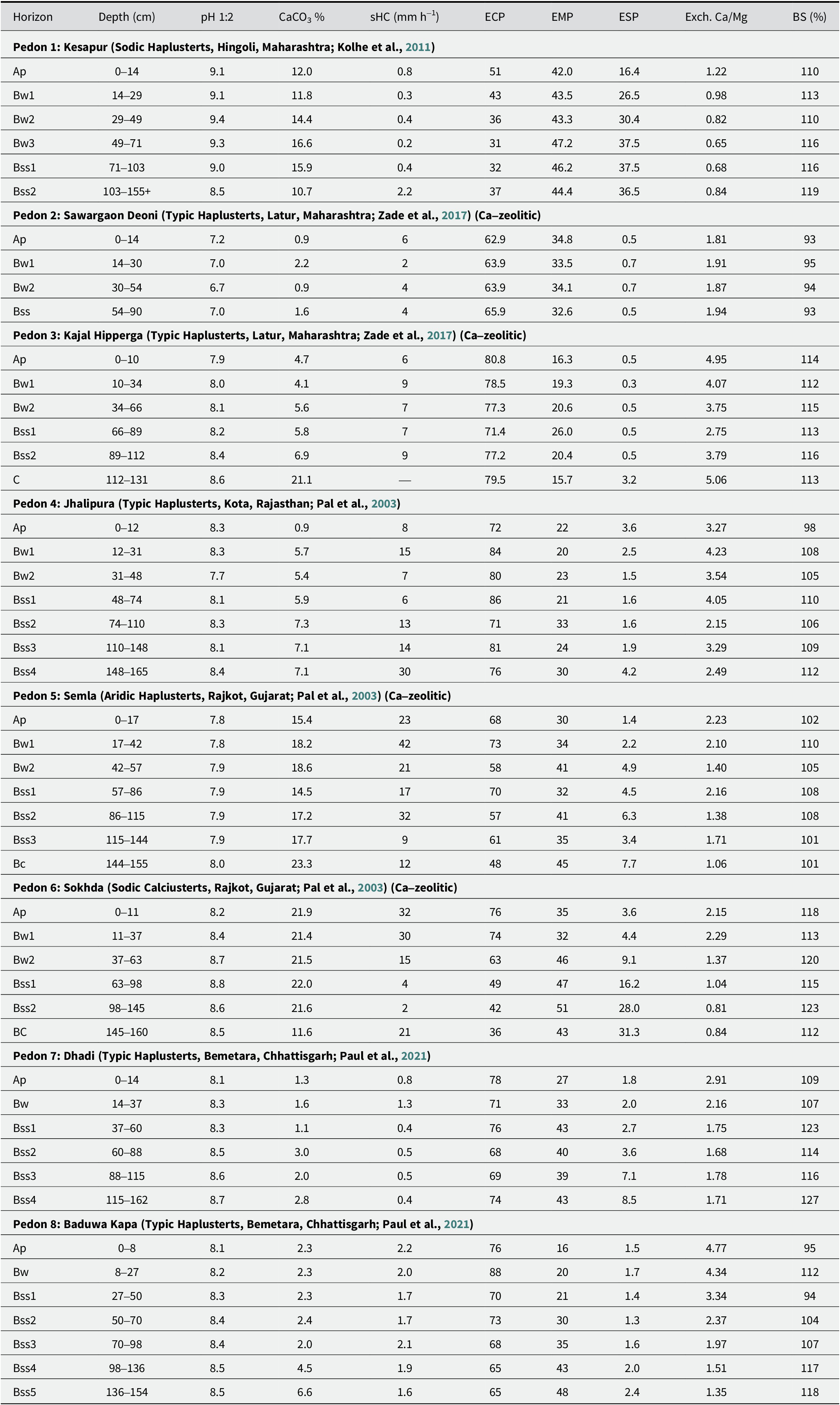
sHC = saturated hydraulic conductivity; ECP = exchangeable calcium percentage; EMP = exchangeable magnesium percentage; ESP= exchangeable sodium percentage; Exch. Ca/Mg = exchangeable Ca/Mg ratio; BS = per cent base saturation.
In contrast, non-sodic Vertisols like Aridic/Typic Haplusterts in the first 1 m soil depth showed a reduction in values of sHC: <5 mm h–1 in Pedon 2, <10 mm h–1 in Pedon 3, <20 mm h–1 in Pedon 4, <20 mm h–1 in Pedon 5, and <2 mm h–1 in Pedons 7 and 8. It is well known that the dispersibility of clay colloids impairs the sHC of Vertisols caused by the development of ESP in the presence or absence of soil modifiers (Pal et al., Reference Pal, Wani and Sahrawat2012). However, note that in Aridic/Typic Haplusterts, the reduction in sHC is due to an increase in EMP with a concomitant decrease in ECP and Exch. Ca/Mg in the subsoils (Table 1). Thus the percentage of base saturation (BS) of such Vertisols ≥100 indicates that the enrichment of Mg2+ ions is due to the presence of palygorskite. Palygorskite was demonstrated to becomes disaggregated easily in a clay mineral assemblage containing palygorskite, smectite, and kaolin in soils with ESP <5 (Neaman et al., Reference Neaman, Singer and Stahr1999). Consequently, palygorskite fibers do not associate with aggregates in soils and suspensions, even when the soils are saturated with Ca2+ ions. This unique property of palygorskite makes its fine-sized particles move downward in the profile preferentially over smectite and eventually clog the soil pores (Neaman and Singer, Reference Neaman and Singer2004).
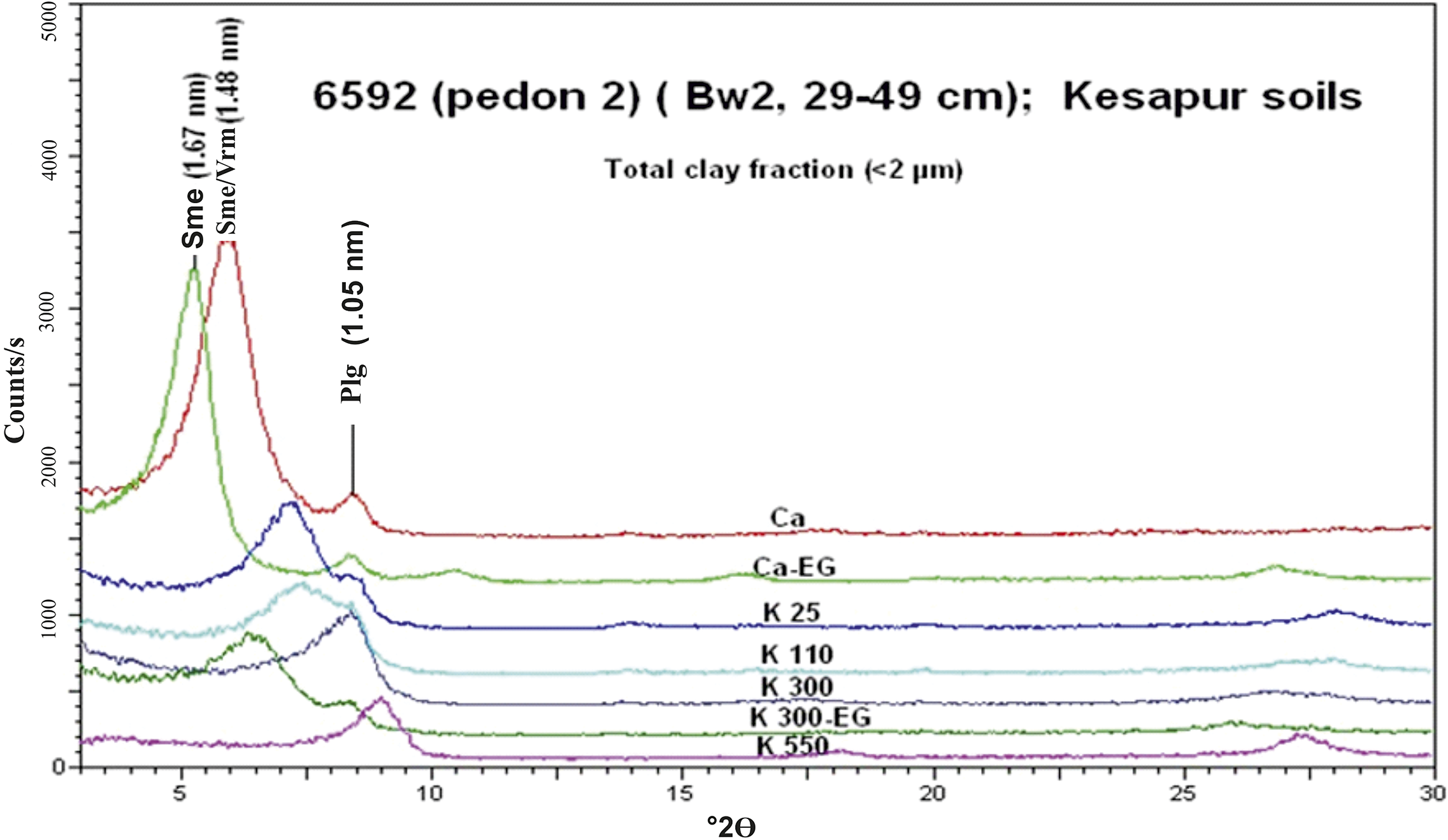
A similar observation on preferential translocation of palygorskite was also observed in some Sodic Calciusterts of Maharashtra and Gujrat, India (Fig. 1) (Pal et al., Reference Pal, Bhattacharyya, Ray and Bhuse2003; Bhattacharyya et al., Reference Bhattacharyya, Ray, Chandran, Karthikeyan and Pal2018). The downward movement of fine palygorskite particles results in larger values for EMP than ECP in the subsoils of Aridic Typic Haplusterts, which then results in the dispersion of the clay colloids. This interaction causes drainage problems, which are further aggravated by irrigation, presenting a predicament for crop production. Identification of palygorskite in Indian Vertisols by X-ray diffraction (XRD) has not always been straightforward because, when present in moderate amounts it is detected easily (Fig. 2), but when it occurs in small amounts, it is often overlooked due to the lack of a characteristic sharp peak at 1.05 nm (Fig. 3). In addition, its presence could be destroyed due to the chemical pre-treatments that are routinely applied to separate soil clay fractions. To circumvent this problem, water-dispersible clays of Vertisols are used for XRD analysis, and the broad peak at ~1.05 nm is resolved by slow-scanning at a speed of 1°2θ min–1 and 0.5°2θ min–1 (Zade et al., Reference Zade, Chandran and Pal2017). The broad peak of 1.05 nm could be better resolved by using the deconvolution method (Paul et al., Reference Paul, Karthikeyan, Vasu, Sahoo, Tiwary, Gaikwad and Chandran2020).
Representative depth-wise distribution of (a) palygorskite and (b) smectite in TC (<2 μm) fractions of the Sodic Calciusterts (Sokhda Vertisols, Gujarat; Pal et al., Reference Pal, Bhattacharyya, Ray and Bhuse2003).

Representative XRD patterns of total clay fractions of Sodic Haplusterts. Sme = smectite; Sme/Vrm = smectite or vermiculite; Plg = palygorskite; Ca = calcium saturated; CaEG = Ca-saturated and ethylene glycolated; K25/K110/K300/K550 = K-saturated and heated at 25, 110, 300, and 550°C, respectively; K300EG = K-saturated and heated at 300°C and ethylene glycolated. Adapted from Kolhe et al. (Reference Kolhe, Chandran, Ray, Bhattacharyya, Pal and Sarkar2011).
Representative XRD patterns of the total clay fraction of Aridic/Typic Haplusterts. Ca = Ca saturated; CaEG = Ca saturated plus glycol vapor; K25/K110/K300/K550 = K saturated and heated to 25, 110, 300, and 550°C, respectively; Sme = smectite; Vrm = vermiculite; Chl = chlorite; Plg = palygorskite; Mca = mica; Kn = kaolin. Adapted from Zade et al. (Reference Zade, Chandran and Pal2017).

The unique depth distribution of sHC, ECP, EMP, Exch. Ca/Mg, and BS ≥100 in the Typic Haplusterts (Table 1) of the SAT climate would be enough to ensure the presence of palygorskite even when XRD facilities are not available (Pal, Reference Pal2019). Poor sHC causes inadequate plant-available water content, which results in a loss of soil productivity (Kadu et al., Reference Kadu, Vaidya, Balpande, Satyavathi and Pal2003; Deshmukh et al., Reference Deshmukh, Chandran, Pal, Ray, Bhattacharyya and Potdar2014; Zade et al., Reference Zade, Chandran and Pal2017; Pal, Reference Pal2020). Non-sodic and calcareous Indian Vertisols (Aridic/Typic Haplusterts) with palygorskite must, therefore, be considered naturally degraded soils (Pal et al., Reference Pal, Wani and Sahrawat2012) and thus they stand for a revised classification at a higher level for the benefit of various stakeholders such as farming communities in rainfed regions, in particular.
Genesis of palygorskite
The presence of palygorskite could also be due to neo-formation when smectites dissolve in the soil environment (Millot et al., Reference Millot, Paquet and Ruellan1969; Abtahi, Reference Abtahi1977; Elprince et al., Reference Elprince, Mashhady and Aba-Husayn1979; Singer, Reference Singer, Singer and Galán1984; Ducloux et al., Reference Ducloux, Delhoume, Petit and Decarreau1995; Mashhady et al., Reference Mashhady, Reda, Wilson and Mackenzie1980; Monger and Daugherty, Reference Monger and Daugherty1991; Singer and Norrish, Reference Singer and Norrish1974; Wilson, Reference Wilson2013; Yaalon and Wieder, Reference Yaalon and Wieder1976). The argument is that an intense dissolution of the smectite increases the Al + Fe and Mg/Ca ratio in soils, and the palygorskite forms by an adjustment in the structure of smectite (Hillier and Pharande, Reference Hillier and Pharande2008; Kadir and Eren, Reference Kadir and Eren2008; Xie et al., Reference Xie, Chen, Zhou, Xu, Xu, Ji, Lu and Balsam2013). Available evidence provided in support of pedogenic formation of palygorskite is unclear. Moreover, the neoformation of palygorskite at the expense of smectite should not be regarded as the only transformation pathway. In this context it is important to point out that inheritance of palygorskite appears to be a more probable genetic pathway in Vertisols of the Indian tropical environment because a pedochemical environment would not favor the formation of palygorskite at the expense of smectite.
The pedochemical conditions that are necessary for the formation of palygorskite have been specified as the high activity of Mg and Si, some Al, and a pH of ~8 (Singer, Reference Singer, Dixon and Weed1989). Precipitation of CaCO3 in a SAT environment is reported to increase Mg in the soil solution, which in turn promotes dolomite and palygorskite formation (Hillier and Pharande, Reference Hillier and Pharande2008; Owliaie et al., Reference Owliaie, Abtahi and Heck2006; Xie et al., Reference Xie, Chen, Zhou, Xu, Xu, Ji, Lu and Balsam2013). An extensive micromorphological study of the Indian Vertisols has confirmed the presence of only micritic and sparitic forms of calcite, but the presence of dolomite was not detected (Pal et al., Reference Pal, Dasog, Vadivelu, Ahuja, Bhattacharyya, Lal, Kimble, Eswaran and Stewart2000; Srivastava et al., Reference Srivastava, Bhattacharyya and Pal2002; Pal et al., Reference Pal, Bhattacharyya, Chandran, Ray, Satyavathi, Durge, Raja and Maurya2009). Smaller amounts of Exch. Ca/Mg (<1) in the subsoils of Vertisols (Table 1) are due to the rapid formation of CaCO3 in the SAT environment with concomitant development of subsoil sodicity (Pal et al., Reference Pal, Dasog, Vadivelu, Ahuja, Bhattacharyya, Lal, Kimble, Eswaran and Stewart2000; Pal et al., Reference Pal, Bhattacharyya, Ray, Chandran, Srivastava, Durge and Bhuse2006; Pal et al., Reference Pal, Bhattacharyya, Chandran, Ray, Satyavathi, Durge, Raja and Maurya2009). The main pedogenic process observed in Indian SAT Vertisols is the dissolution of non-pedogenic CaCO3 (NPC) to release Ca2+ ions and their recrystallization as pedogenic CaCO3 (PC) in the near vicinity of NPC (Fig. 4) (Pal et al., Reference Pal, Dasog, Vadivelu, Ahuja, Bhattacharyya, Lal, Kimble, Eswaran and Stewart2000; Srivastava et al., Reference Srivastava, Bhattacharyya and Pal2002). The formation of the PC not only impairs sHC but also results in simultaneous development of sodicity as an example of regressive pedogenesis (Pal et al., Reference Pal, Dasog, Vadivelu, Ahuja, Bhattacharyya, Lal, Kimble, Eswaran and Stewart2000; Srivastava et al., Reference Srivastava, Bhattacharyya and Pal2002). Given the formation of PC at the expense of NPC as evidence of regressive pedogenesis, the transformation of smectite to palygorskite in the SAT Vertisols could not have taken place during pedogenic activity. The formation of the PC at the expense of NPC also supports the hypothesis that progressive pedogenesis is not operative in the SAT Vertisols.
Micromorphological features of both PC and NPC in the Vertisols of central, western and southern peninsular India, in cross-polarized light. PCs are generally observed in close proximity to the NPCs; the distance could be ≤30 μm. Adapted from Pal et al. (Reference Pal, Dasog, Vadivelu, Ahuja, Bhattacharyya, Lal, Kimble, Eswaran and Stewart2000) and Srivastava et al. (Reference Srivastava, Bhattacharyya and Pal2002).

Thus, palygorskite in the SAT Vertisols is a non-pedogenic entity despite the fact that the palygorskite fibers are commonly associated with CaCO3, as observed in SEM images (Bhattacharyya et al., Reference Bhattacharyya, Ray, Chandran, Karthikeyan and Pal2018). Detailed clay mineralogical studies confirmed that the parent material for these Vertisols consists mainly of a low-charge dioctahedral smectite derived from weathering of Deccan Basalt in an earlier humid climate (Pal et al., Reference Pal, Deshpande, Venugopal and Kalbande1989; Pal et al., Reference Pal, Bhattacharyya, Ray, Chandran, Srivastava, Durge and Bhuse2006; Pal et al., Reference Pal, Wani and Sahrawat2012). The non-leaching environment of the SAT Vertisols has caused its preservation in such soils (Pal et al., Reference Pal, Bhattacharyya, Chandran, Ray, Satyavathi, Durge, Raja and Maurya2009). It is also supported by the facts that (1) smectites in the fine clay (<0.2 μm) fractions of the Vertisols in AD, SAD, and SHD climates are reasonably well crystallized with sharp basal reflections and higher-order reflections on glycolation, and (2) no evidence of its transformation has been found except for low to moderate hydroxy interlayering (Fig. 5) (Pal and Deshpande, Reference Pal and Deshpande1987; Pal et al., Reference Pal, Dasog, Vadivelu, Ahuja, Bhattacharyya, Lal, Kimble, Eswaran and Stewart2000; Pal et al., Reference Pal, Bhattacharyya, Ray and Bhuse2003; Pal et al., Reference Pal, Wani and Sahrawat2012).
Representative XRD patterns of fine clay fractions (<0.2 μm) of the Bss horizons of Vertisols of central India; Ca = Ca-saturated; Ca-EG = Ca-saturated plus ethylene glycol vapour treated; CaGLV = Ca-saturated plus glycerol vapour treated; Li = Li-saturated and heated to 25°C, 250°C (16 h); LiGLV 30-D = Li-saturated and heated at 250°C plus glycerol vapour treated and scanned after 30 days; K25/110/300/550 = K-saturated and heated to 25, 110, 300, or 550°C, respectively; K300EG = K-saturated and heated to 300°C plus ethylene glycol vapour treated; 6NHCl = 6 N HCl treated fine clays; Sme = smectite, Bei/Non = beidellite/nontronite; Vrm + Chl = vermiculite plus chlorite; Mca = mica; Kn = kaolin; Fs = feldspars. Adapted from Pal et al. (Reference Pal, Bhattacharyya, Ray and Bhuse2003).

Semi-quantitative estimates of smectite and palygorskite in the total clay (TC) fractions (<2 μm) of representative SAT Vertisols showed a decrease in smectite and an increase in palygorskite with depth (Fig. 1). Note that in the event of the formation of palygorskite at the expense of smectite during pedogenesis, the smectite content would decrease and the palygorskite would increase in the upper soil horizons. This fact is also reflected in the increasing trend of clay CEC (88 in the Ap horizon to 71 in the Bss2 horizon) upward in the soil profile. In the event of loss of smectite at the soil surface, clay CEC values would have been much less than the subsurface layers (see tables 1 and 2 of Pedon 7, Sokhda; Bhattacharyya et al., Reference Bhattacharyya, Ray, Chandran, Karthikeyan and Pal2018). Another argument, however, is that larger amounts of palygorskite in the subsoils may be due to the influence of the groundwater, but this possibility is very remote because in most of the Vertisol areas the groundwater is under phreatic, semi-confined, and confined conditions. The general depth of the water table varies from 10 to 40 m below ground level (Elangovan, Reference Elangovan1985; Vaidya and Pal, Reference Vaidya and Pal2002).
Under the SAT environment, weathering is more intense on the soil surface and clay illuviation is the most important pedogenic process in SAT Vertisols in Holocene time (Pal et al., Reference Pal, Bhattacharyya, Ray, Chandran, Srivastava, Durge and Bhuse2006; Pal et al., Reference Pal, Wani and Sahrawat2012). The clay illuviation is facilitated due to the formation of pedogenic calcium carbonate (PC), which causes a rise in pH and concomitantly creates subsoil sodicity (ESP). This pedogenic process is regarded as the regressive pedogenic process in the SAT climate in the Holocene period (Pal et al. Reference Pal, Dasog, Vadivelu, Ahuja, Bhattacharyya, Lal, Kimble, Eswaran and Stewart2000; Srivastava et al., Reference Srivastava, Bhattacharyya and Pal2002; Pal et al., Reference Pal, Bhattacharyya, Sahrawat and Wani2016). In Pedon 7 of the Sokhda profile (see tables 1 and 2 of Pedon 7, Sokhda; Bhattacharyya et al., Reference Bhattacharyya, Ray, Chandran, Karthikeyan and Pal2018), the active clay illuviation process is also reflected in the increasing trend of both total and fine clay content with soil depth (total clay from 31% in the Ap horizon to 43% in the BSS2 horizon and fine clay from 13% in the Ap horizon to 20% in the Bss2 horizon), which justifies the preferential downward movement of inherited palygorskite as a result of this major pedogenic process. Thus, the observed depth distribution of smectite and palygorskite is not consistent with the formation of palygorskite at the expense of smectite even in a calcareous and highly alkaline environment in the Sodic Calciusterts over the last 4 ka (Table 1) (Pal et al., Reference Pal, Bhattacharyya, Ray, Chandran, Srivastava, Durge and Bhuse2006). The depth distribution of these two minerals implies the preferential movement of inherited fine clay palygorskite over smectite even in Ca2+-dominated systems (Neaman and Singer, Reference Neaman and Singer2004). This suggests that the palygorskite in SAT Vertisols of India is non-pedogenic. Furthermore, the absence of palygorskite in some of the SAT Typic/Sodic Haplusterts is also inconsistent with the origin of palygorskite by smectite transformation or pedogenic processes (Pal et al., Reference Pal, Bhattacharyya, Ray and Bhuse2003; Kolhe et al., Reference Kolhe, Chandran, Ray, Bhattacharyya, Pal and Sarkar2011; Bhattacharyya et al., Reference Bhattacharyya, Ray, Chandran, Karthikeyan and Pal2018).
Given the above observations, it is quite unlikely that the formation of palygorskite could have taken place at the expense of smectite or through neoformation in the presence of soluble carbonate and bicarbonate in the SAT Vertisols. This inference is also supported by the fact that the transformation of smectite to palygorskite in a solid state is unlikely to be due to the structural differences between the two minerals (Singer, Reference Singer1979; Daoudi et al., Reference Daoudi2004). Thus, the hypothesis on the formation of palygorskite at the expense of smectite is inadequate to explain the genesis of palygorskite in SAT Vertisols under both rainfed and irrigated agriculture systems in India.
The inter-trappean beds between two basaltic flows contain, on average, 10–14 m of red clay paleosols or bole beds, siltstone, marl, and limestone deposited under shallow marine incursions in the coastal regions. The clay mineral assemblage in these sediments contains ~70% palygorskite (Keller et al., Reference Keller, Adatte, Bajpai, Mahobey, Widdowson, Khosla, Sharma, Khosla, Gertsch, Fleitmann and Sahani2009; Roy et al., Reference Roy, Parthasarathy and Sreenivas2023). There is a strong possibility that the source of palygorskite in the modern SAT Vertisols is related to the inter-trappean beds of Andhra Pradesh (Siddiqui, Reference Siddiqui1967), Karnataka, and Gujarat (Shrivastava et al., Reference Shrivastava, Salil and Pattanayak2000). Because palygorskite occurs in large amounts in these inter-trappean beds which were deposited under palustrine to shallow-marine settings and arid to semi-arid environments (Shrivastava et al., Reference Shrivastava, Salil and Pattanayak2000; Keller et al., Reference Keller, Adatte, Bajpai, Mahobey, Widdowson, Khosla, Sharma, Khosla, Gertsch, Fleitmann and Sahani2009; Roy et al., Reference Roy, Parthasarathy and Sreenivas2023), the genesis of the closely associated red and black shrink-swell soils in Maharashtra in the vicinity of the inter-trappean beds shows that they developed mainly on palygorskite-rich sources (Kolhe et al., Reference Kolhe, Chandran, Ray, Bhattacharyya, Pal and Sarkar2011). The fine clay fractions (<0.2 μm) of the red cracking clay soils (Sodic Calciusterts) do not contain kaolin as evidence of the transformation of smectite to 0.7 nm minerals in humid climates but indicate an arid environment. In contrast, the fine clay fractions of the closely associated Typic Haplusterts contain kaolin but not palygorskite (Kolhe et al., Reference Kolhe, Chandran, Ray, Bhattacharyya, Pal and Sarkar2011). This characteristic difference in mineralogical make-up of the fine clay fractions of the red Sodic Haplusterts and black Typic Haplusterts suggests that the formation of palygorskite is not due to pedogenic processes in the SAT environment.
The possibility of palygorskite inheritance from rocks other than the alluvium of the weathering Deccan Basalt thus merits attention. Pal and Deshpande (Reference Pal and Deshpande1987) and Pal et al. (Reference Pal, Wani and Sahrawat2012) reported a major phase, or phases, of redistribution of smectite-rich alluvium of the weathering Deccan Basalt in the lower physiographic positions, i.e. in the lower piedmont plains or valleys or in micro-depressions. During the erosional and depositional episodes, minerals such as quartz, K-feldspar, chlorite, and mica, which have no legacy to the Deccan Basalt, were also incorporated due to the exhumation of the inter-trappean beds or infra-trappean beds in the Deccan Basalt (Pal and Deshpande, Reference Pal and Deshpande1987). In such erosional and depositional episodes, palygorskite was also included from the inter-trappean and/or infra-trappean beds that contain large amounts of palygorskite in sediments (Siddiqui, Reference Siddiqui1967; Shrivastava et al., Reference Shrivastava, Salil and Pattanayak2000; Keller et al., Reference Keller, Adatte, Bajpai, Mahobey, Widdowson, Khosla, Sharma, Khosla, Gertsch, Fleitmann and Sahani2009; Roy et al., Reference Roy, Parthasarathy and Sreenivas2023). For example, the Lameta Formation sediments of marine origin that underlie the Deccan Basalt contain 70% palygorskite (Srivastava et al., Reference Srivastava, Kandwal, Krishnakumar and Krishnan2020). This indicates that palygorskite occurring in soils and alluvium derived from Deccan Basalt is due to its inheritance from the exhumed inter-trappean and infra-trappean beds during the erosional and depositional cycles in the geological past (Bhattacharyya et al., Reference Bhattacharyya, Ray, Chandran, Karthikeyan and Pal2018).
Therefore, the occurrence of palygorskite in the SAT Vertisols is neither of pedogenic nor pedoclimatic origin. To justify this contention, an example of palygorskite in the weakly developed calcic soils of the Thar Desert is worthy of discussion. Here, the occurrence of palygorskite as a non-pedogenic entity and its legacy to marine sedimentary rocks of Rajasthan have been well established (Hameed et al., Reference Hameed, Raja, Ali, Upreti, Kumar, Tripathi and Srivastava2018).
Origin of palygorskite in calcic soils from the Western Thar Desert
The Thar Desert is one of the hottest and most arid regions in the world and represents the easternmost extension of the northern hemispheric mid-latitude desert belt, including the Sahara and Arabia (Roy et al., Reference Roy, Nagar, Juyal, Smykartz-Kloss and Singhvi2009). The desert is marked by an extreme moisture deficit, potential evapotranspiration of 1500–2000 mm year–1, and a mean annual rainfall of about 500 mm in the easternmost part and about 100 mm in the westernmost part (IMD, 2009). In the past, the Thar Desert was explored extensively for calcretes and lacustrine sediments for various sedimentological and paleoclimatic aspects (Wasson et al., Reference Wasson, Smith and Agarwal1984; Enzel et al., Reference Enzel, Ely, Mishra, Ramesh, Amit, Lazar, Rajaguru, Baker and Sandler1999; Dhir et al., Reference Dhir, Tandon, Sareen, Rao, Kailath and Sharma2004; Prasad and Enzel, Reference Prasad and Enzel2006). Late Quaternary calcrete shows four distinct phases of calcrete formation at 150 ka, 100 ka, 60 ka, and 27–14 ka (Dhir et al., Reference Dhir, Tandon, Sareen, Rao, Kailath and Sharma2004; Dhir et al., Reference Dhir, Tandon, Singhvi, Kar and Sareen2009). The lacustrine sediments suggest alternating wet and dry phases with a relative dominance of fluvial and aeolian processes over the last 100 ka (Ghose et al., Reference Ghose, Singh and Kar1977; Kar, Reference Kar1995; Kar, Reference Kar and Paliwal1999; Kar et al., Reference Kar, Singhvi, Rajaguru, Juyal, Thomas, Banerjee and Dhir2001). At present, the Thar is dominated by aeolian landforms and dune-building activity over lacustrine and fluvial landforms (Moharana et al., Reference Moharana, Gaour, Chaoudhary, Chauhan and Rajpurohit2013).
Part of the Thar Desert, the Jaisalmer region, Rajasthan, is covered by Quaternary aeolian deposits that are underlain by Jurassic to Eocene sediments of marine origin, namely, the Lathi, Jaisalmer, Bhadesar, Sanu, Parihar, Habur, Khuiala, and Bandah Formations (Geological Map of India, 1993; Pandey et al., Reference Pandey, Choudhary, Bahadur, Swami, Poonia and Sha2012). The major rock types surrounding the Jaisalmer region include limestone, marl, and sandstone, which were deposited in subtidal and shallow intertidal environments (Geological Map of India, 1993; Pandey et al., Reference Pandey, Choudhary, Bahadur, Swami, Poonia and Sha2012).
The surface calcic soils provide an opportunity to assess the relationship between pedogenesis and aeolian activity during the last 30 ka in the western Thar. In a detailed investigation of the calcic soils of the Jaisalmer region, Thar gives a systematic record of the macroscopic, microscopic, sub-microscopic, clay mineralogical, and geochemical characteristics of the soil profiles extending to depths of up to 3.1 m (Hameed et al., Reference Hameed, Raja, Ali, Upreti, Kumar, Tripathi and Srivastava2018). The key micromorphological, submicroscopic, and clay mineralogical features of the calcic soils are critical to understanding the genesis of the palygorskite that commonly occurs in these soils. The calcic soils are characterized by weakly pedogenized aeolian sediments with large amounts of pedogenic carbonates, which show an increase of up to ~80% in lower parts of the profiles. The soil profiles are marked by frequent lithological discontinuities. The weakly developed pedogenic features occur in the Bw, Bk, Bss, and BC horizons, and the soils correspond to Entisols, Inceptisols, vertic intergrades, and a few Alfisols of the US Soil Taxonomy.
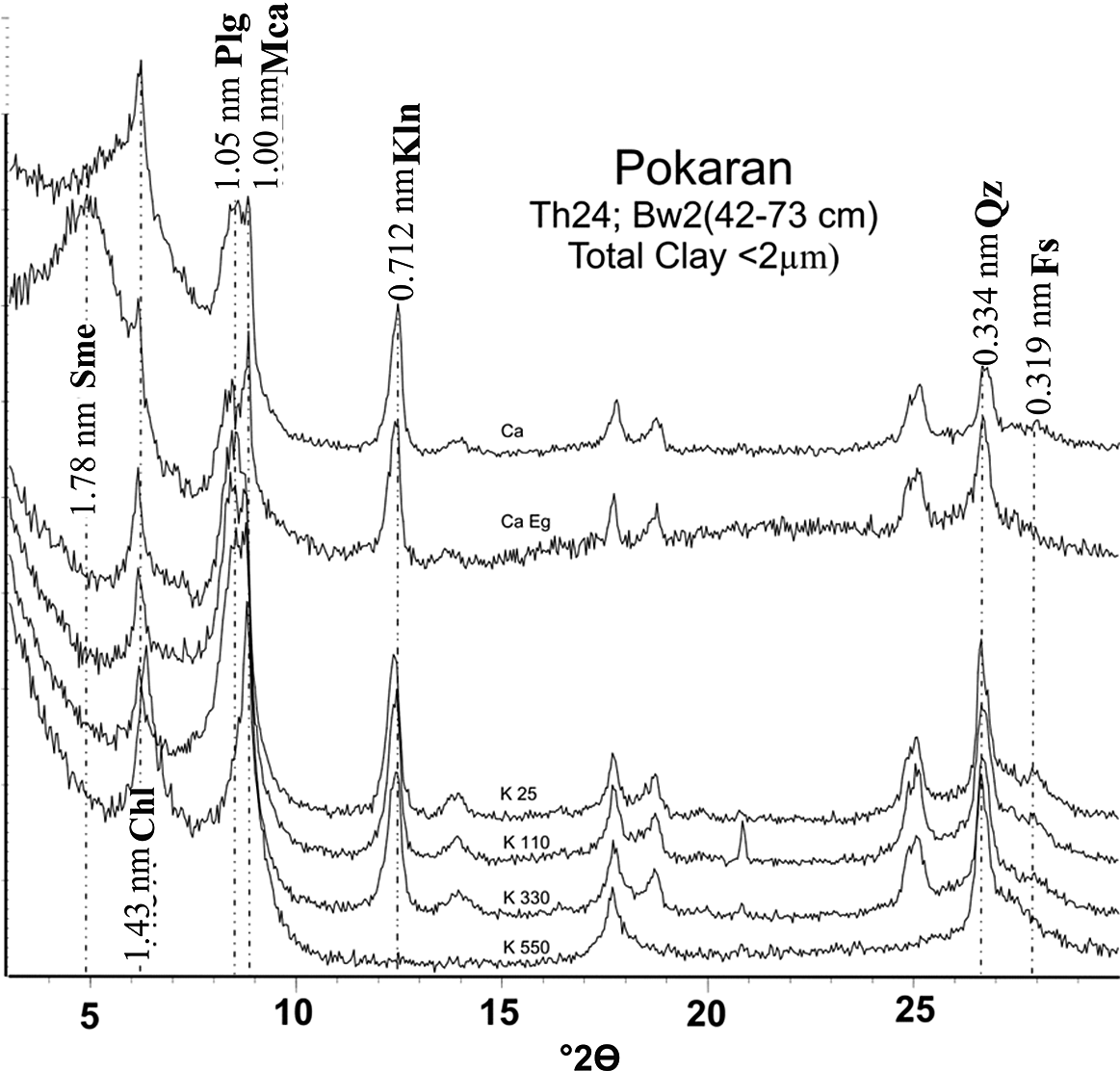
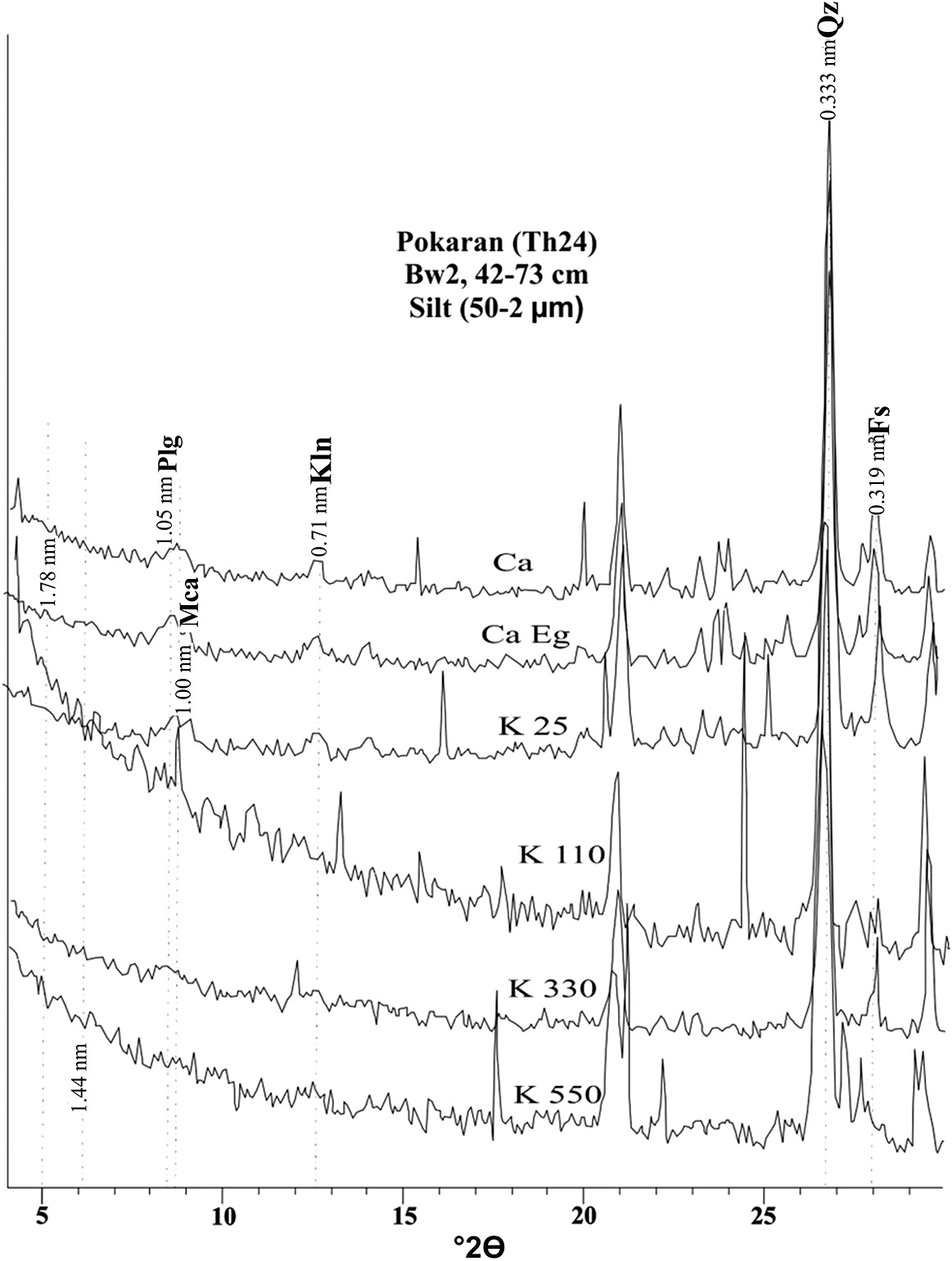
The micromorphology of these Jaiselmer soils confirms weak to moderate pedality and a well-sorted groundmass. The pedogenic CaCO3 occurs mainly as soft, diffuse nodules of micrite to microsparite and well-indurated coalesced nodules (Fig. 6). Scanning electron microscopy (SEM) of these calcretes shows a large amount of fibrous palygorskite in the pore spaces of micritic and sparitic nodules (Fig. 7). The XRD analysis of the TC (<2 μm) and FC (<0.2 μm) fractions of these soils shows the dominance of smectite (38.7% avg.), palygorskite (16.5% avg.), chlorite (7.8% avg.), mica (7.8% avg.), kaolin (16.5% avg.), quartz (10.6% avg.), feldspar (3.5% avg.), and mixed layer (5–10% avg.) (Fig. 8). Notably, palygorskite also occurs in the silt fractions (50–2 μm) of these soils (Fig. 9). This observation supports the contention that the frequent association of smectite and palygorskite need not be explained as a possible solid-phase transformation of one into the other, despite their proximity in the stability field (Singer, Reference Singer, Dixon and Weed1989; Galán and Pozo, Reference Galán, Pozo, Galán and Singer2011). Moreover, the transformation of smectite into palygorskite may not be feasible to explain the kinetics in terms of energy required for the transformation of stable layer clay into chain clay (Weaver and Beck, Reference Weaver and Beck1977; Watts, Reference Watts1980; Singer, Reference Singer, Dixon and Weed1989). The large amount of well crystallized smectite present in the calcic soils of western Thar appears to be detrital as a weathering product of primary minerals transported and deposited as aeolian deposits (Hameed et al., Reference Hameed, Raja, Ali, Upreti, Kumar, Tripathi and Srivastava2018).
(a) Pedogenic CaCO3 nodule from Pedon 3 (Pokaran) showing the coalescence of several calcrete or multiphase calcrete, TH25, Bwk1 horizon, 0.73–0.95 m; (b) thin section details of (a) showing soft calcareous groundmass (C1) and dull white nodules (C2) and yellowish older calcrete (C3), TH25, Bwk1 horizon, 0.73–0.95 m; (c) multiphase micritic pedogenic CaCO3 in voids and groundmass of well-sorted coarse mineral grains, TH6, 2Btk, 1.2–1.6 m from Pedon 1 (Badabagh); (d) dense micritic nodule showing biogenic activity (arrow) and coating by iron oxide, TH23, Bwk1 horizon, 0.2–0.42 m from Pedon 3 (Pokaran). Adapted from Hameed et al. (Reference Hameed, Raja, Ali, Upreti, Kumar, Tripathi and Srivastava2018).

SEM features of palygorskite in calcretes of calcic soils, Thar Desert. (a) Biogenic precipitation of micrite and microsparite with numerous fibrous palygorskite (Plg) infillings, TH22, 0.0.22 m, Pedon 3; (b) large amount of palygorskite as a thick mat over calcite grains in pore spaces of calcrete, TH27, Pedon 3; (c) large amount of fibrous palygorskite infilling in pore spaces of sparitic calcite of the calcrete, TH14, 1.10–1.35 m, Pedon 2; (d) bundles of large amounts of fibrous palygorskite in pore spaces of sparite and prismatic calcite of the calcrete, TH30, Pedon 3, 2.15–2.30 m. Adapted from Hameed et al. (Reference Hameed, Raja, Ali, Upreti, Kumar, Tripathi and Srivastava2018).

Representative XRD patterns of the total clay (<2 μm) fraction, TH24, Bw2 horizon, 0.42–0.73 m, Pedon 3 (Pokaran), calcic soils of the Thar showing smectite (Sme), chlorite (Chl), palygorskite (Plg), mica (Mca), kaolin (Kn), quartz (Qz), and feldspar (Fs). Labels: Ca = Ca-saturated; CaEg = Ca-saturated and glycolated; K25 = K-saturated and ambient temperature; K110, K330, and K550 = K-saturated and heated to 110, 330, and 550°C, respectively. Adapted from Hameed et al. (Reference Hameed, Raja, Ali, Upreti, Kumar, Tripathi and Srivastava2018).
Representative XRD patterns of the silt (50–2 μm) fraction, TH24, Bw2 horizon, 0.42–0.73 m, Pedon 3 (Pokaran), calcic soils of the Thar showing smectite (Sme), chlorite (Chl), palygorskite (Plg), mica (Mca), kaolin (Kn), quartz (Qz), and feldspar (Fs). Labels: Ca = Ca-saturated; CaEg = Ca-saturated and glycolated; K25 = K-saturated and ambient temperature; K110, K330, and K550 = K-saturated and heated to 110, 330, and 550ºC, respectively. Adapted from Hameed et al. (Reference Hameed, Raja, Ali, Upreti, Kumar, Tripathi and Srivastava2018).
The geochemical conditions that favor the formation of palygorskite include high Mg2+, high silica, and high alumina activities and moderate alkalinity, pH ≤8.5 (Jones and Galán, Reference Jones, Galán and Bailey1988). However, the geochemical attributes of the calcic soils in Jaiselmer, Thar, do not support such conditions, as the Thar soils are characterized by low Mg2+, moderate to high silica, low alumina, and very high Ca2+ (Hameed et al., Reference Hameed, Raja, Ali, Upreti, Kumar, Tripathi and Srivastava2018). Thus, palygorskite in calcic soils of the Thar is neither due to the transformation of smectite nor to authigenic precipitation in the soils (Hameed et al., Reference Hameed, Raja, Ali, Upreti, Kumar, Tripathi and Srivastava2018). Generally, at a pH of 8.2 and above, smectite structure is subjected to dissolution to create soluble forms of Si and Al. A safe conjecture is that unless the pH becomes <7 (Rengasamy et al., Reference Rengasamy, Sarma, Murthy and Krishnamurti1978), reorganizations of the soluble forms of Si and Al for recrystallization to form a palygorskite mineral may not be possible because soils under a SAT climate remain calcareous with a pH of 8.2 and above (Table 1). Thus, pedogenic formation of palygorskite in SAT Vertisols appears to be difficult to reconcile.
The presence of palygorskite in the Bw, Bss, Bwk, and BC horizons of the calcic soils in Thar is related to non-pedogenic processes because of weak pedogenesis, frequent lithological discontinuities, geochemical composition, and silt-size palygorskite, which suggest its inheritance from shallow marine sedimentary rocks in the area. Thus the inference is that dry periods favored rapid aeolian aggradation with palygorskite as part of the sedimentary flux derived from marine sedimentary rocks of the Jaisalmer Formation over the last 30 ka. A decrease in or complete absence of palygorskite from the Btk and Bw horizons and sediments is related to intervening wetter conditions over the last 30 ka (Hameed et al., Reference Hameed, Raja, Ali, Upreti, Kumar, Tripathi and Srivastava2018).
In the Thar Desert, the calcrete occurs in large amounts (70–80%) as nodules of varying size that often coalesce (Hameed et al., Reference Hameed, Raja, Ali, Upreti, Kumar, Tripathi and Srivastava2018). Micromorphology and SEM studies suggest the prevalence of both abiogenic and biogenic processes that lead to the formation of pedogenic calcium carbonate on a large scale in the soils of western Thar (Figs 6 and 7). The age relationship of the Thar soils and calcrete development shows that relatively dry conditions prevailed during the last glacial maxima (LGM); at ~20 ka it changed to a relatively wetter climate at ~6 ka and again became a dry climate at ~4 ka due to fluctuating southwestern monsoon over the last 30 ka (Hameed et al., Reference Hameed, Raja, Ali, Upreti, Kumar, Tripathi and Srivastava2018). It follows that the aeolian aggradational activity during arid conditions resulted in palygorskite-rich silt- to clay-size flux in the calcic soils during the last 30 ka. The large amount of fibrous palygorskite in the pore spaces of CaCO3 nodules is fundamentally of non-pedogenic origin, which may be corroborated by the origin of palygorskite in Vertisols of tropical India (Bhattacharyya et al., Reference Bhattacharyya, Ray, Chandran, Karthikeyan and Pal2018).
Conclusions
Amidst the diverse understanding of the formation of palygorskite in SAT soils all over the world, this review was undertaken to determine whether pedogenic processes played any role in the formation of palygorskite in the SAT Vertisols of India. This exercise found that the genesis of palygorskite, which occurs in close association with smectite in the calcic soils of the Thar Desert, is non-pedogenic. Like palygorskite in the Thar, the genesis of palygorskite in the Indian SAT Vertisols is also non-pedogenic and is related to its inheritance from the exhumed inter-trappean, infra-trappean, and bole beds of the Deccan Basalt. The origin of the palygorskite in the calcic soils of the Thar Desert supports the contention that palygorskite in SAT Vertisols is inherited from the adjoining exhumed marine sediments. Thus, pedologists, soil mappers, and natural resource managers should take a cautious approach while managing soils for maximum productivity when small, moderate, or large amounts of palygorskite are present in non-sodic, but poorly drained soils because this mineral causes severe drainage problems.
Author contributions
Conceptualization: P.S., D.K.P; Investigations: P.S., D.K.P., Writing original draft: P.S., D.K.P., Writing-review and editing: P.S., D.K.P., Supervision: D.K.P.
Acknowledgements
The authors thank numerous researchers and many MSc and PhD students of the Geology Department, Delhi University, New Delhi, and the Division of Soil Resource Studies, ICAR-NBSS& LUP, Nagpur, India, for significant research contributions in this study on the genesis of palygorskite in SAT soils of India. The authors thank the Editor in Chief and Associate Editor for considering this manuscript, and acknowledge three anonymous reviewers. The revised versions have benefited immensely from their comments and suggestions. The authors also thank Professor D.C. Srivastava for helpful discussions that improved the revised version of the manuscript.
Financial support
This research review work did not receive any specific grant from funding agencies in the public, commercial, or not-for-profit sectors.
Competing interests
On behalf of all authors, the corresponding author states that there are no competing interests.



