1. Introduction
A growing body of work indicates that speakers of different languages describe events in the world differently (e.g., Hickmann & Robert, Reference Hickmann and Robert2006; Kopecka & Narasimhan, to appear; papers in Strömqvist & Verhoeven, Reference Strömqvist and Verhoeven2004). Furthermore, such differences are not limited to surface linguistic forms, but also extend to linguistic conceptualization (Carroll, von Stutterheim & Nüse, Reference Carroll, von Stutterheim, Nuese, Habel and Pechmann2004; von Stutterheim, Nüse & Murcia-Serra, Reference von Stutterheim, Nüse, Murcia-Serra, Hasselgård, Johansson, Behrens and Fabricius–Hansen2002), that is, differences in which information is considered relevant for expression, also referred to as “thinking for speaking” (Slobin, Reference Slobin, Gumperz and Levinson1996a). One area of intense focus has been the expression of motion, particularly the expression of Path, which varies robustly across languages (Slobin, Reference Slobin, Shibatani and Thompson1996b; Talmy, Reference Talmy1991, Reference Talmy2000). Here, typological differences in lexicalization patterns have been argued to have consequences for event construal, or differences in what information is verbalized (von Stutterheim & Nüse, Reference von Stutterheim and Nüse2003).
Cross-linguistic differences in linguistic conceptualization pose a challenge for second language acquisition (SLA). Traditionally, the field of SLA queries the acquisition of form but does not necessarily probe the extent to which linguistic conceptualizations are reorganized. Studies that have addressed the issue generally find that linguistic conceptualization is resistant to restructuring in the second language (L2), using evidence of preserved first language (L1) conceptualizations (e.g., Carroll & von Stutterheim, Reference Carroll, Von Stutterheim and Ramat2003). Such evidence, however, typically assumes that the L1 is a static entity and portrays the relationship between the L1 and the L2 as unilateral, without asking whether and to what extent the systems interact and whether the L1 itself may develop or change.
The current study tackles the problem of the restructuring of event conceptualization in SLA. It is part of a larger research enterprise examining bidirectional cross-linguistic influence in the expression of motion in both L1 and L2 production as compared to monolingual production. The current study looks specifically at the expression of Path. We explore patterns of lexicalization and probe their effects on event construal by focusing on different components of a trajectory: Source, Via and Goal Paths. Crucially, we compare the same speakers performing in both the L1 and the L2 to ascertain whether the languages influence each other. We argue for the potential for restructuring, even at modest levels of proficiency in an L2, by drawing on data which suggest that L1 patterns guide construal in the L2 but also that L2 patterns may subtly and simultaneously shape construal in the L1 within an individual learner. Therefore, even if target-like patterns are not achieved in the L2, restructuring may occur as a consequence of an underlying gradual convergence between the L1 and L2 systems. These findings have implications for the traditional view of the L1 as an invariably stable benchmark and for our understanding of the nature of the relationship between established and emerging languages within the multilingualFootnote 1 mind.
2. Background
2.1 Typological expression of Path
Path of motion is defined as the trajectory taken by a “Figure”, the object undergoing translocational motion, which moves with respect to a “Ground”, the reference object for the Figure (Talmy Reference Talmy and Shopen1985). Talmy (Reference Talmy1991) divided languages into two groups, satellite- versus verb-framed, based on their framing of Path. “Satellite-framed” languages, for example English, lexicalize the core trajectory in satellites or verb particles, as exemplified in (1) with the Path elements underlined. Since the inception of the original framework, such elements have been expanded to include adpositional phrases (Talmy, Reference Talmy2000). In contrast, “verb-framed” languages, for example Japanese, lexicalize Path in the verb root, as illustrated in (2).
(1) The ball rolls down.
(2)


Although the typology reflects characteristic preferences in a language, there are alternative options for Path lexicalization in both satellite-framed and verb-framed languages. In addition to the preponderance of satellites and prepositions, English, for example, possesses a number of Latinate Path verbs such as descend, ascend, etc. Japanese, in parallel, possesses a number of frequent alternative options for Path expression besides simple main verbs – postpositions, compound verbs and complex motion predicates. Yet while the dichotomy may be a simplification (see Slobin (Reference Slobin, Stromqvist and Verhoeven2004b), for example, for a discussion of equipollently framed languages), numerous studies have provided empirical support for this basic typological division (e.g., papers in Strömqvist & Verhoeven, Reference Strömqvist and Verhoeven2004).
2.2 Event conceptualization of Path
It has been suggested that the fundamental cross-linguistic differences in lexicalization patterns have consequences for how events are construed or linguistically conceptualized, that is, for what information speakers of a particular language consider as relevant and therefore select for expression. Berman and Slobin (Reference Berman and Slobin1994) suggested that:
frequent use of [linguistic] forms directs attention to their functions, perhaps even making those functions (semantic and discursive) especially salient on the conceptual level. That is, by accessing a form frequently, one is also directed to the conceptual content expressed by that form. (Berman & Slobin, Reference Berman and Slobin1994, p. 640)
In later articulation of this line of thought, Slobin claimed that “typology predisposes speakers towards certain types of construal or conceptualization of events” (Slobin, Reference Slobin, Moder and Martinovic–Zic2004a, p. 197). Unlike claims regarding linguistic relativity or the relationship between the language one speaks and general cognition (Lucy, Reference Lucy1992), Slobin's claim is restricted to the domain of linguistic cognition in a process he describes as “thinking for speaking” (Slobin, Reference Slobin, Gumperz and Levinson1996a). In other words, speakers are expected typically to attend to the aspects of an event that their language has the readily available and commonly used linguistic means to express.
Over time, this habitual attention is predicted to lead to certain rhetorical styles. In research on motion events, one line of investigation has focused on the extent to which the Manner in which a protagonist moves is explicitly encoded (Slobin, Reference Slobin, Shibatani and Thompson1996b; Talmy, Reference Talmy and Shopen1985, Reference Talmy1991; inter alia). However, another fruitful avenue has examined the degree of granularity and tightness of packaging in the expression of Path. For instance, Slobin (Reference Slobin, Moder and Martinovic–Zic2004a) describes how speakers of satellite-framed languages decompose motion events and mention more Path segments overall than speakers of verb-framed languages do. He found that English texts often include more Path segments per individual clause than Spanish texts (Slobin, Reference Slobin, Shibatani and Thompson1996b). He argues that because satellite-framing generally locates Path outside the verb root, Path elements (i.e., adverbials such as verb particles and adpositional phrases introducing Ground information) can be stacked within a clause, often generating more extensive Path descriptions. In contrast, with Path located in the verb, verb-framing typically requires separate verb clauses for each Path component, which may lead to less information about Path overall.
2.3 Expression of Path and event conceptualization in Japanese and English
As part of a larger research project exploring bidirectional cross-linguistic influence, a preliminary benchmark study on Path expression in native Japanese and English both confirmed and challenged established typological differences (Brown & Gullberg, Reference Brown and Gullberg2010). In line with previous research, Japanese speakers were found to lexicalize Path primarily in a wide range of verbs, whereas English speakers lexicalized Path primarily in a wide range of adverbials. However, the range of morphosyntactic devices uniquely available in Japanese for expression of Path, that is postpositions, compound verbs and complex motion predicates, licensed greater stacking of Path expressions in the verb clause than typically predicted for other verb-framed languages, as shown in (3) (although see Ibarretxe-Antunano (Reference Ibarretxe–Antunano, Stromqvist and Verhoven2004) for a similar phenomenon in Basque). Indeed, Japanese speakers stacked significantly more Path expressions per clause than speakers of English.
(3)
This example illustrates several kinds of Path expression: the complex motion predicate, consisting of a participial verb form with a deictic verb (cf. Mastumoto, 1996), agatte itte “go rising”, a combination of agaru “rise” and the deictic verb iku “go”, and two postpositions, kara “from”, ni “to”.
Such accumulation of Path expressions warranted further investigation in the current study because, in addition to cross-linguistic variations in lexicalization, there are also variations in the semantic–conceptual elements that these resources cover. Both verbs and adverbials in English can express Source of Path, e.g., leave/from, and Goal of Path, e.g., arrive/to, as well as Via Paths, where a Figure moves past a reference object (Lakusta & Landau, Reference Lakusta and Landau2005), e.g., descend/down. In Japanese, on the other hand, while verbs can encode all Path elements, e.g., shuppatsu-suru “depart”, tadoritsuku “arrive” and tsutau “go.along”, adverbials encode only Source, e.g., kara “from”, or Goal, e.g., made “until/to” (see Inagaki (Reference Inagaki2002b) for a discussion of Goal expressions in Japanese).Footnote 3 Thus, one question this study addresses is whether, depending on the morphosyntactic resource employed, monolingual speakers of Japanese and English display differing event construals with respect to selective encoding of different aspects of Paths. Assuming a difference in this monolingual baseline, a second question is how second language learners reconcile such a difference in their L2 but also in their L1.
2.4 Expression of Path and event conceptualization in a second language
Cross-linguistic differences in surface forms and accompanying linguistic conceptualizations raise potential problems for L2 learners. To be target-like, they need to acquire not only novel linguistic forms to be mapped onto L1 meanings but also to learn to select different types of information for expression and to package them in appropriate ways. There is evidence that learners continue to rely on event construals typical of the L1 when speaking the L2, even at advanced levels of L2 proficiency (e.g., Carroll & Lambert, Reference Carroll, Lambert, Dimroth and Starren2003; Carroll & von Stutterheim, Reference Carroll, Von Stutterheim and Ramat2003; for overviews, see Jarvis & Pavlenko, Reference Jarvis and Pavlenko2008; Odlin Reference Odlin2005). These phenomena can be observed in the expression of Path.
Inagaki (Reference Inagaki2001), for example, found that even advanced-level English-speaking learners of Japanese incorrectly accepted ungrammatical combinations of Manner verbs with directional prepositional phrases in their L2, constructions that are grammatical in the L1. Likewise, Cadierno and Ruiz (Reference Cadierno and Ruiz2006), comparing Danish (satellite-framed) and Italian (verb-framed) learners of Spanish (verb-framed), showed that Danish learners of Spanish displayed more structural inaccuracies and a greater number of Ground phrases per verb, all traceable to the L1, than Italian learners of Spanish. (See also Cadierno, Reference Cadierno, Achard and Niemeier2004; Choi & Lantolf, Reference Choi and Lantolf2008; Inagaki, Reference Inagaki2002a; Navarro & Nicoladis, Reference Navarro, Nicoladis and Eddington2005; Negueruela, Lantolf, Jordan, and Gelabert, Reference Negueruela, Lantolf, Jordan and Gelabert2004; and Stam, Reference Stam2006, for similar findings.)
The expression of Path in an L2, then, seems to be characterized by L1 transfer. Studies suggest a limited capacity for the reorganization of linguistic conceptualization, with habitual patterns for event construal in the L1 constraining and guiding event construal in an L2. Yet L1 transfer is not the only phenomenon at work. There may also be general learner effects. In a longitudinal case study of an adult Spanish-speaking learner of French, Giacobbe (Reference Giacobbe1992) found significant L2 use of adverbials to express Path. However, since both Spanish and French are verb-framed languages, adverbial use was a prominent feature of neither the source nor target language. Similarly, in Cadierno and Ruiz (Reference Cadierno and Ruiz2006), both Danish and Italian learners elaborated Path in a redundant way in their L2, Spanish, by adding directional Path adverbs to verbs already encoding Path semantics. This can be likened to an L1 developmental pattern, also characterized by redundant encoding of Path (Berman & Slobin, Reference Berman and Slobin1994), suggesting that increased use of satellites in learner production may be a general feature of language development.
On the one hand, evidence from L2 data indicates that linguistic conceptualization is resistant to restructuring even at high levels of proficiency, as shown by the L1 transfer effects. On the other hand, there is data implying that construal of Path may also be subject to general learner effects, that construal may be restructured, but not necessarily in a target-like way. Furthermore, there is tentative evidence that the L2 affects the L1 in this domain. In the preliminary study, Brown and Gullberg (Reference Brown and Gullberg2010) found that the aforementioned stacking of Path expressions in Japanese discourse appeared more prominent among Japanese speakers with knowledge of English than among monolingual Japanese speakers. These data suggest that the restructuring of linguistic conceptualization may be possible even in the L1.
3. The current study
This study aims to investigate bidirectional cross-linguistic influence in the domain of Path expression within the same group of speakers in order to assess the learner potential for the restructuring of linguistic conceptualizations. As Japanese and English differ typologically in this arena, we observe the expression of Path in production by monolingual speakers of Japanese, a verb-framed language, and English, a satellite-framed language, as well as production by native Japanese speakers with knowledge of English in their L1 and L2.
In previous analyses, we have shown that native Japanese speakers lexicalize Path in the verb, whereas native English speakers use adverbials (Brown & Gullberg, Reference Brown and Gullberg2010). Furthermore, we have shown that native Japanese speakers also use adverbials, which can be stacked within the clause, but that this pattern appears to be more prevalent in Japanese speakers with knowledge of English as opposed to monolingual speakers of Japanese. In new analyses, we add data from L2 production to allow within-subject comparisons of Japanese speakers with knowledge of English performing both in their L1 and their L2, and, as a window on linguistic conceptualization, we also examine how monolingual and bilingual speakers of Japanese and English encode different aspects of Path.
On the basis of previous research on L2 discourse, we expect to find evidence of an influence of the L1 on the L2 reflected in the use of a combination of verbs and adverbials to lexicalize Path in the L2, English. Based on preliminary indications of subtle shifts in the L1 in this domain, we predict similarities in L1 and L2 lexicalization of Path within individuals, i.e., use of verbs and adverbials. Given the differences in the mapping of Path semantics onto adverbials in particular in English and Japanese, we explore the possibility of potentially altered linguistic conceptualizations arising from cross-linguistic influence in lexicalization patterns by comparing mentions of Source, Via and Goal Paths.
4. Method
4.1 Participants
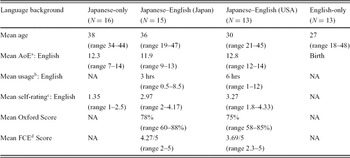
Fifty-seven adults aged 18 to 48 participated in this study: 16 monolingual speakers of Japanese resident in Japan (Japanese-only), 13 monolingual speakers of English resident in the USA (English-only), 15 native Japanese speakers with knowledge of English resident in Japan (Japanese–English [Japan]) and 13 native Japanese speakers with knowledge of English resident in the USA (Japanese–English [USA]).
Biographical information and information on general language usage was obtained using a detailed questionnaire (Gullberg & Indefrey, Reference Gullberg and Indefrey2003). The “monolingual” speakers of each language were of course not truly monolingual, but had had less exposure to an L2, were not engaged in active study of an L2 and did not use an L2 in their everyday lives; “minimally bilingual” in Cook's terms (2003, p. 14). In contrast, all Japanese–English speakers actively used their L2. However, the Japanese–English [Japan] speakers had never lived in an English-speaking country, whereas their counterparts in the US had been residents for between one and two years. This contrast in residence controlled for effects of L1 loss. Bidirectional cross-linguistic influence seen only in the production of participants in the USA might be explained by attrition of the L1 due to residence in the L2 community. However, similar patterns in both groups would render such an explanation less likely.
Three separate measurements of learners' knowledge of English were taken to ensure uniform proficiency in the L2. Participants rated their own proficiency in speaking, listening, writing, reading, grammar and pronunciation. They also completed the first grammar section of the Oxford Placement Test (Allan, Reference Allan1992). Finally, oral proficiency was evaluated using the University of Cambridge Local Examinations Syndicate (UCLES) oral testing criteria for the first certificate in English (FCE).Footnote 4 The criteria were applied to the narrative data elicited as part of the study, i.e., descriptions of the Canary Row cartoon stimulus (Freleng, Reference Freleng1950). Two Cambridge-certified examiners scored grammar and vocabulary, discourse management, pronunciation and global achievement.
According to all measures, the Japanese–English speakers were within intermediate range. The Japanese–English [Japan] speakers did not significantly differ in proficiency from the Japanese–English [USA] speakers as measured by self-ratings (t(26) = –1.222, p = .233) or the Oxford Placement Test (t(25) = .795, p = .434), and only marginally differed in proficiency as measured by the Cambridge FCE criteria (t(26) = 1.982, p = .058), with the Japanese–English [Japan] speakers unexpectedly scoring slightly higher than the Japanese–English [USA] speakers.
Table 1 summarizes participants' language usage and English proficiency data.
Summary of language usage/proficiency data.

notes:a age of exposure
b hours of current usage per day
c a composite score of individual skill scores
d Cambridge First Certificate in English
4.2 Stimuli
Motion descriptions were elicited by narrative retellings of the Canary Row cartoon (Freleng, Reference Freleng1950), which depicts Sylvester the cat's repeated but failed attempts to catch Tweety the bird. Following McNeill (Reference McNeill1992), the cartoon was broken down and shown in scenes, separated by a blank screen, in order to increase the likelihood of mention of individual motion events. Two different sequences were constructed, which maintained the first and last scenes in first and last position. Participants were shown one of the two sequences to control for the effects of participant fatigue on the description of any one scene. The stimuli contained numerous motion events. Four of these, which contained different Path trajectories and were consistently described by participants, were selected for analysis, yielding the following Paths: climb through, roll down, clamber up, swing across.
4.3 Procedure
Monolingual participants narrated in their L1. Japanese–English speakers produced narratives in their L1 and L2. The language order was counterbalanced across participants with a minimum of three days between appointments. This minimized the likelihood of both the L1 and L2 being fully active at the same time, controlling for the effects of “language mode” (Grosjean, Reference Grosjean1998, p. 132).
Depending on the language of the retelling, participants interacted with either a native English- or native Japanese-speaking confederate. The participant and experimenter engaged in a brief warm-up in the target language, consisting of small talk, in order to establish and sustain a “monolingual mode”. Then the experimenter instructed participants to watch the series of animated scenes from Canary Row on a computer screen and describe each one immediately after viewing to the interlocutor in as much detail as they could remember. The confederate was trained to appear fully engaged in participant narratives, but to avoid asking questions and crucially to avoid supplying the target Path.
Prior to elicitation of narratives in the L2, participants were given a word list containing key nouns from each scene. This word list remained within view throughout the experiment, and participants were free to consult it at any time. The list provided low-frequency nouns previously identified as difficult in the L2 (e.g., birdcage, trolley) in order to minimize participant requests for lexical assistance. The list also served as a memory trigger in case participants forgot the events in a given scene.
4.4 Segmentation and coding
Narratives were transcribed from digital video by a native speaker of the relevant language. The framework developed by Berman and Slobin (Reference Berman and Slobin1994) for the linear segmentation of spontaneous speech was adopted; therefore, descriptions were divided into “clauses”, defined as “any unit that contains a unified predicate . . . (expressing) a single situation (activity, event, state)” (p. 660). Next, clauses describing the four target motion events were identified and coded for the expression of Path.
Following previous studies (e.g., Kita & Özyürek, Reference Kita and Özyürek2003; Slobin, Reference Slobin, Shibatani and Thompson1996b, Reference Slobin, Bybee, Haiman and Thompson1997, Reference Stam2004b; Weingold, Reference Weingold, Egli, Pause, Schwarze, von Stechow and Weingold1995), all lexical elements encoding information about the trajectory followed by the protagonist were coded as Path, including adpositional phrases indicating the specific direction with respect to a reference object and deictic verbs indicating the direction with respect to the speaker. Spatial nouns indicating locations were not included in the coding of trajectory, e.g., rolled on the street, saka-o korogatte “rolled on the hill”. An additional level of coding distinguished Source, Goal and Via Paths.
Furthermore, several language-specific guidelines were employed (cf. Brown & Gullberg, Reference Brown and Gullberg2010). Compound verbs in Japanese containing more than one motion component, e.g., toori-nukeru “go.through~go.through”, were divided, and each Path component was coded separately. Complex motion predicates, e.g., agatte iku “go rising”, were treated similarly. Following Kita's (Reference Kita1999) claim that the Japanese verbs hairu “enter'” and deru “exit” in their bare forms express discrete changes of state without motion semantics, these verbs were not coded as motion verbs unless they were combined with kuru “come” or iku “go” as auxiliaries or adpositional phrases such as ni “to” (see Tsujimura (Reference Tsujimura2002) for an alternative analysis of Japanese enter and exit verbs). In English, in, into or inside were coded as Path if used adverbially to express motion, e.g., went in/inside/into, and not location, e.g., be in/inside.
Examples of clause segmentation and coding in descriptions of the “swing across” event in Japanese and English appear in (4) and (5), with clause boundaries marked by brackets and Path expressions underlined.
(4)
(5) [he's just going to swing acrossinto the window from one building to the next]
Example (4) from Japanese contains three Path expressions: a verb embedded in a complex motion predicate, iku “go”, and two adverbials, jibun-no ie kara “from his own house” and tori-no tokoro ni “to the bird's place”. Here, all components of Path are expressed within the clause: Source, Via and Goal. Example (5) from English contains four adverbial Path expressions: across, into, from and to. Again, all components of Path are expressed within the clause.
Segmentation and coding of L2 data presented some challenges. L2 data, especially at this level of proficiency, is characterized by numerous false starts, repetitions and unclear semantics; therefore it is difficult to segment into clauses, identify as relevant for a given motion event and code for semantic representation. An example clause from a learner of English describing the ‘roll down’ event is given in (6):
(6) [there was sucked into the ah the cat sucked into the bowling center]
In example (6), the first five words were treated as a false start and were not included in the clause proper, which was determined to begin at the cat as the subject of the clause that followed. An alternative possibility would have been to treat the noun phrase the cat as part of an initial passive construction was sucked, and then a new clause, without an overt subject, initiated at the second instance of the verb. This would have resulted in two clauses. This example is complicated by the fact that the verb suck is not an appropriate description for the cat rolling into the bowling alley. In general, in cases where at least parts of a preceding phrase were repeated, the first phrase was treated as a false start and maintained as part of the main clause.
4.5 Reliability of coding
To establish reliability of data coding, 15% of the entire dataset was segmented and coded by a second coder. For L1 data, 95% agreement was reached on the selection of relevant clauses for coding and, of these, 100% agreement was reached on semantic coding. For L2 data, 90% agreement was reached on the selection of relevant verb clauses for coding and, of these, 100% agreement was reached on semantic coding. Disagreements were settled by accepting the judgment of the initial coder.
4.6 Analysis
The earlier study reports on a portion of the L1 data (monolingual English, monolingual Japanese and non-monolingual Japanese) targeting the lexical repertoire of Path expressions and the extent to which Path expressions in general were stacked within the clause (Brown & Gullberg, Reference Brown and Gullberg2010). This follow-up study adds a new dataset of L2 production as well as new analyses of L1 production (a) to enable between-subject analyses of learner L2 as compared to source and target language production, (b) to enable within-subject comparisons of learner production in the L2 and L1 and (c) to investigate the expression of particular aspects of Path in all language groups. Three main analyses are presented. First, we describe the lexical types used to encode Path among monolingual speakers as compared to the learner groups in their L1 and L2. Two possible morphosyntactic categories are distinguished in this analysis: verbal and adverbial expressions of Path. Second, we determine the quantitative distribution of Path verbs and adverbials within the verb clause across and within monolingual and learner groups. Third, we compute the number of Source, Via and Goal Path expressions per clause across and within monolingual and learner groups.
Repetitions, particularly in the L2 data, caused difficulty for quantitative analyses. An example of a clause from a learner of English describing the “climb through” event is given in (7).
(7) [This time he she tried climbing up to the room ah through the drainpipe ah along the wa mmm ah mmm through the drainpipe]
This is a crucial example that could impact analyses because the locus of disfluency is exactly in the part of the clause that describes the relevant motion, i.e., climbing through the drainpipe. Here, all instances of Path expression could have been analyzed: up, to, through, along and through. In reality, though, use of the word along appears to have been abandoned as it is followed by substantial hesitation and a restatement of the original through. In order to be maximally conservative in cases such as these, only a non-abandoned expression and only one instance of an exact repetition was counted, in this case use of up, to and through.
In the quantitative analyses, the Japanese–English [Japan] speakers were compared to their counterparts resident in the USA. If no differences were found between them, the data were collapsed to form a single group of Japanese–English speakers. Non-parametric equivalents of ANOVA, Independent-Sample and Paired-Sample T-Tests, were used, namely Kruskal–Wallis for multiple group analyses, Mann–Whitney for between group analyses and Wilcoxon for repeated-measures analyses.
5. Results
5.1 Lexical types for Path expression
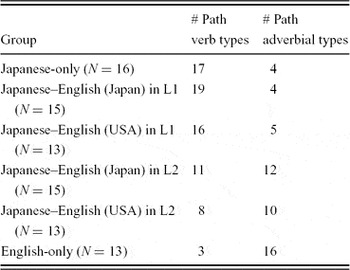
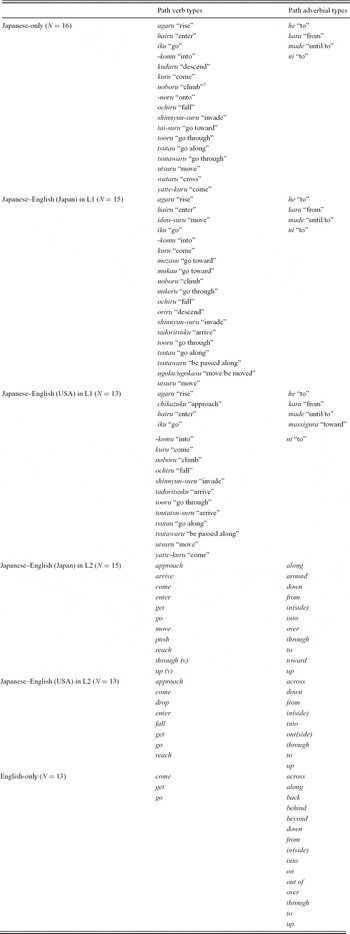
Table 2 shows the number of verbal and adverbial Path types used by monolingual Japanese speakers, Japanese–English [Japan] [USA] speakers in their L1 and L2 and monolingual English speakers (the lexical items themselves are listed in the Appendix). Here, descriptions of all four motion events are combined.
Number of lexical types used for Path expression.

Descriptively, all groups employed both verbs and adverbials to lexicalize Path. As previously shown (Brown & Gullberg, Reference Brown and Gullberg2010), a cross-linguistic difference is clearly visible in the monolingual baseline. Japanese-only speakers employed a greater number of verb than adverbial types, whereas English-only speakers displayed the reverse pattern. In their L1, Japanese–English speakers resembled their monolingual counterparts with comparable numbers of verb and adverbial types. However, in the current analyses of L2 production, these same learners showed roughly equal lexical diversity in verbs and adverbials. In this sense, they occupied a middle position between the monolingual Japanese source and the monolingual English target. There were also some cases of learner-specific production, for instance, use of adverbials as verbs, as example (8) shows.
(8) [and he throughedinside the drainpipe]
Such examples, i.e., use of the adverbial through as a verb to indicate trajectory, were coded as Path and are extremely interesting as they suggest learner attempts to fit target language lexical items into source language discourse frames, which may indicate cross-linguistic influence of the L1 on the L2.
5.2 Distribution of Path verbs and adverbials within the clause
As examples (9) and (10) show, Path verbs and adverbials were combined within a single clause in Japanese and English. Multiple adverbials were also stacked within a clause in each language as illustrated in (11) and (12). Finally, example (13) demonstrates that Japanese allows the stacking of verbs in compound or complex predicate constructions, but English typically does not, although learners occasionally tried to do this in L2 production, as shown in (14).
(9)
(10) [he's goingup there]
(11)
(12) [he starts rolling down the street into a bowling alley]
(13)
(14) [the cat goesenter the bowling center]
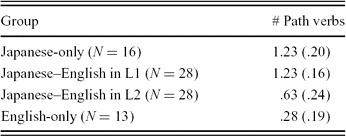
In the analysis of the use and distribution of lexical resources, we calculated the number of Path verbs versus adverbials per clause. Table 3 shows the mean number of verbs expressing Path per clause in all clauses containing Path information in Japanese-only, English-only and Japanese–English discourse in the L1 and in the L2. There was no significant difference between the Japanese–English speakers in Japan versus the USA in the L1 (z = –1.322, p = .186) or in the L2 (z = –.324, p = .746). The groups were therefore collapsed across residence.
Mean number (SD) of Path verbs per clause in all clauses containing Path.

In the preliminary study of the L1 (Brown & Gullberg, Reference Brown and Gullberg2010), English-only speakers produced fewer Path verbs per clause than both Japanese-only and Japanese–English speakers in their L1, with no difference between Japanese-only and Japanese–English speakers in their L1. The new analysis shows that Japanese-only, English-only and Japanese–English speakers performing in their L2, English, differed significantly in the mean number of Path verbs per clause (χ2 (2, N = 57) = 40.930, p < .001). Specifically, Japanese–English speakers in their L2, English, produced significantly fewer Path verbs per clause than Japanese-only speakers (z = –5.337, p < .001), but significantly more than English-only speakers (z = –3.886, p < .001). A further within-subject analysis revealed that Japanese–English speakers produced significantly more Path verbs per clause in their L1 than in their L2 (z = –4.623, p < .001).
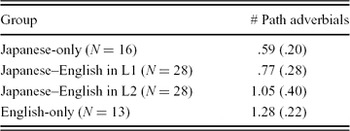
Table 4 shows the mean number of adverbials expressing Path per clause in all clauses containing Path information in all groups. There was no significant difference between the Japanese–English speakers resident in Japan versus the USA in the L1 (z = –.278, p = .781) or in the L2 (z = –.947, p = .344). Thus, the groups were collapsed across residence.
Mean number (SD) of Path adverbials per clause in all clauses containing Path.

Again, previous analyses of the L1 have indicated that English-only speakers produced more Path adverbials per clause than Japanese–English speakers in their L1, Japanese, who in turn produced more Path adverbials per clause than Japanese-only speakers (Brown & Gullberg, Reference Brown and Gullberg2010). In the current analysis, Japanese-only, English-only and Japanese–English speakers performing in their L2, English, also differed significantly in mean number of Path adverbials per clause (χ2 (2, N = 57) = 25.543, p < .001). Here, Japanese–English speakers in their L2, English, produced significantly more Path adverbials per clause than Japanese-only speakers (z = –3.921, p < .001), but significantly fewer than English-only speakers (z = –1.996, p = .046). The within-subject analysis revealed that Japanese–English speakers produced significantly more adverbials per clause in their L2 than in their L1 (z = –2.934, p = .003).
In sum, analyses of the distribution of morphosyntactic resources within the verb clause revealed both between- and within-language differences. As previously reported, there was a clear monolingual baseline difference in this domain with more verbs per clause in monolingual Japanese discourse and more adverbials per clause in monolingual English discourse. Differences in verb use between learner and monolingual production were restricted to L2 production; that is, learners in their L2 produced more verbs than monolingual English speakers but fewer than monolingual Japanese speakers. This suggests influence of the L1 on the L2 for verb use. However, as both the current and previous analyses demonstrate, differences in adverbial use between learner and monolingual production affected both the L2, English, and the L1, Japanese. Here, Japanese–English speakers, both in their L1 and L2, employed more adverbials than monolingual Japanese speakers, but fewer than monolingual English speakers. This suggests influence of the L1 on the L2 but also influence of the L2 on the L1 for adverbial use, implying a possible gradual convergence between the L1 and L2 systems. Although effects of the L1 on the L2 in general appear much stronger than effects in the reverse direction in these analyses, any effect at all of the L2 on the L1 is rather striking given the participants' level of proficiency in the L2.
5.3 Encoding of different Path components
In the final analysis, we examined the encoding of different Path components by calculating the number of Via, Source and Goal Path expressions in the verb clause. Examples (15) to (19) illustrate with data from Japanese and English.
(15)
(16) [he tried to fly with a rope from his room to the bird's room]
(17)
(18) [tried to getoverto Tweety's window]
(19) [he reachedto the building]
This particular dataset contained expressions of Goal Paths in verbs and adverbials and expressions of Source Paths in adverbials but not verbs. Examples (15) and (16) illustrate adverbial use for Source and Goal in Japanese (kara “from” and ni “to”) and English (from and to). Examples (17) and (18) demonstrate combinations of verbs and adverbials to encode Goal and Via Path in Japanese (made “until/to” and iku “go”) and English (get, to and over). Finally, there were instances of non-target-like production in the L2 data, exemplified in (19), (reach to the building), where both reach and to were included as they appeared to indicate a double marking of Goal.
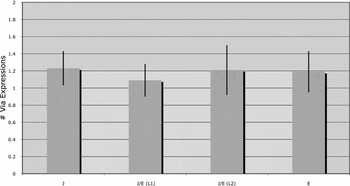
Figure 1 shows the mean number of Via Path expressions per clause in all clauses containing Path information in Japanese-only, English-only and Japanese–English discourse in the L1 and in the L2. There was no significant difference between the Japanese–English speakers resident in Japan versus the USA in the L1 (z = –.808, p = .419) or in the L2 (z = –1.572, p = .116). Hence the groups were collapsed across residence.
Mean number of Via Path expressions per clause in all clauses containing Path: J (Japanese-only speakers), J/E (L1) (Japanese–English speakers: L1 production), J/E (L2) (Japanese–English speakers: L2 production) E (English-only speakers).

For ease of presentation, Figure 1 collapses three main analyses. The first analysis found no significant difference between groups (Japanese-only speakers, English-only speakers and Japanese–English speakers performing in their L1, Japanese), in the mean number of Via Path expressions per clause (χ2 (2, N = 57) = 4.126, p = .127). The second analysis also found no significant difference between groups (Japanese-only speakers, English-only speakers and Japanese–English speakers performing in their L2, English) in the mean number of Via Path expressions per clause (χ2 (2, N = 57) = .224, p = .894). The third within-subject analysis again revealed no significant difference in production of Via Path expressions by Japanese–English speakers in their L1 and their L2 (z = –1.575, p = .115).
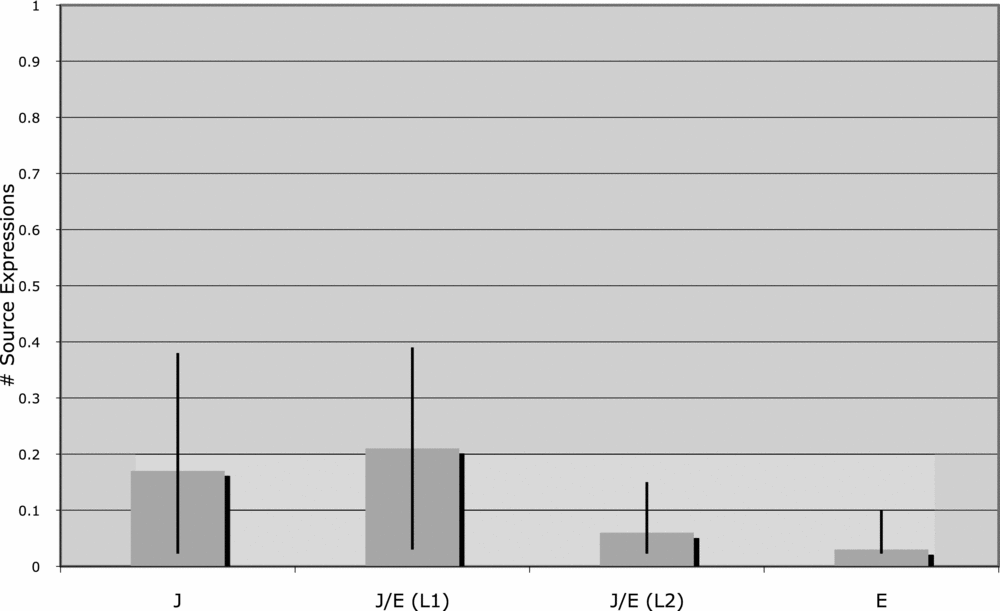
Figure 2 shows the mean number of Source Path expressions per clause in all clauses containing Path information in all groups. As before, there was no significant difference between the Japanese–English speakers resident in Japan versus the USA in the L1 (z = –.810, p = .418) or in the L2 (z = –.501, p = .616), so the groups were collapsed.
Mean number of Source Path expressions per clause in all clauses containing Path: J (Japanese-only speakers), J/E (L1) (Japanese–English speakers: L1 production), J/E (L2) (Japanese–English speakers: L2 production) E (English-only speakers).
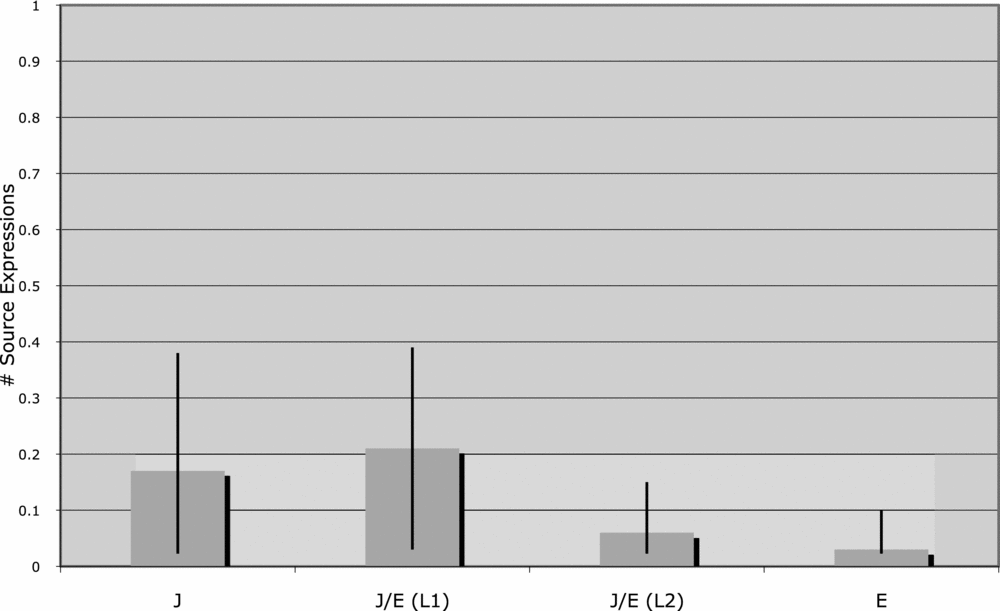
In the first analysis presented in Figure 2, Japanese-only speakers, English-only speakers and Japanese–English speakers performing in their L1, Japanese, differed significantly in the mean number of Source expressions per clause (χ2 (2, N = 57) = 11.463, p = .003). English-only speakers produced marginally fewer Source expressions per clause than Japanese-only speakers (z = –1.845, p = .065) but significantly fewer than Japanese–English speakers in their L1, Japanese, (z = –3.570, p < .001). Within Japanese, there was no significant difference between Japanese-only and Japanese–English speakers (z = –1.018, p = .309). The second analysis found no significant difference between groups (Japanese-only speakers, English-only speakers and Japanese–English speakers performing in their L2, English) in the mean number of Source expressions per clause (χ2 (2, N = 57) = 4.155, p = .125). The third within-subject analysis revealed that Japanese–English speakers produced significantly more Source expressions per clause in their L1 than in their L2 (z = –3.743, p < .001).
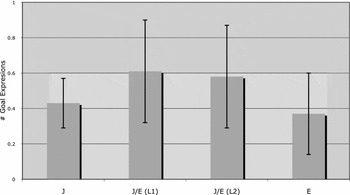
Figure 3 shows the mean number of Goal Path expressions per clause in all clauses containing Path information in all groups. Once more, there was no significant difference between the Japanese–English speakers resident in Japan versus the USA in the L1 (z = –.692, p = .489) or in the L2 (z = –.439, p = .660); therefore, one group was formed.
Mean number of Goal Path expressions per clause in all clauses containing Path: J (Japanese-only speakers), J/E (L1) (Japanese–English speakers: L1 production), J/E (L2) (Japanese–English speakers: L2 production) E (English-only speakers).

In the first analysis presented in Figure 3, Japanese-only speakers, English-only speakers and Japanese–English speakers performing in their L1, Japanese, differed significantly in the mean number of Goal expressions per clause (χ2 (2, N = 57) = 8.660, p = .013). Japanese–English speakers in their L1, Japanese, produced significantly more Goal expressions per clause than both Japanese-only (z = –2.410, p = .016) and English-only speakers (z = –2.328, p = .020), who did not significantly differ from each other (z = –.862, p = .389). In the second analysis, Japanese-only speakers, English-only speakers and Japanese–English speakers performing in their L2, English, differed significantly in the mean number of Goal expressions per clause (χ2 (2, N = 57) = 6.717, p = .035). Japanese–English speakers in their L2, English, produced significantly more Goal expressions per clause than both Japanese-only (z = –1.989, p = .047) and English-only speakers (z = –2.152, p = .031). Finally, the third analysis showed that Japanese–English speakers did not differ in the number of Goal expressions used per clause whether performing in the L1 or the L2 (z = –.584, p = .559).
The analyses of expressions of different components of Path revealed fewer between-language and more within-language differences. Looking first at the monolinguals, despite the difference in possibilities for lexicalization of Via Path, i.e., encoding in verbs in Japanese and both verbs and adverbials in English, there was no cross-linguistic difference in the number of Via Path expressions within the clause. Further, there was only a marginal difference between monolingual Japanese and monolingual English speakers in the number of Source expressions and no difference at all in the number of Goal expressions. Thus, regardless of the different morphosyntactic resources used, monolingual speakers of each language gave Via, Goal and to some extent Source Paths comparable weight within the clause.
In contrast, native Japanese speakers with knowledge of English patterned somewhat differently. This difference was less visible with respect to the expression of Source, where distributions were somewhat lower in general and where the only between-subject difference lay between non-monolingual Japanese speakers in their L1 and monolingual English speakers. However, the difference was more prominent in the expression of Goal. Here, despite the fact that they were speaking very different languages, native Japanese speakers with knowledge of English were indistinguishable in their L1, Japanese, and their L2, English, producing significantly more Goal expressions per clause than either group of monolingual speakers. Moreover, this difference in expressions of Goal did not arise at the expense of expressions of Via Path, where no differences between the groups existed. Since there was little apparent difference in the monolingual baseline, at face value these results reflect a unique bilingual pattern that is hard to explain from the perspective of bidirectional cross-linguistic influence. However, we will argue below that unique learner patterns for the expression of Goal may have arisen as an indirect consequence of cross-linguistic influence in a related domain.
6. General discussion
This study examined monolingual versus learner expressions of Path in L1 and L2 in three main areas: lexicalization patterns, the use and distribution of morphosyntactic resources, and the expression of different components of Path. Starting with the monolingual baseline, previous preliminary findings suggested that monolingual Japanese speakers use a wider range of verb types and more verbs per clause than monolingual English speakers, who instead use a wider range of adverbial types and more adverbials per clause. The new analyses showed that, despite these differences, monolingual speakers of Japanese and English did not differ in their tendency to express different components of Path within the clause.
Turning to Japanese speakers with knowledge of English, this group differed from monolingual speakers in their L2 but also in their L1 in a number of respects. In their L2, English, learners employed a rather wide range of both verb and adverbial types. Furthermore, the distribution of verbs and adverbials within the L2 clause was midway between source and target languages. Surprisingly, the expression of Goal of motion was more prominent in L2 than in monolingual discourse. In their L1, the same group of learners also showed a unique distribution of verbs and adverbials within the clause, specifically, more verbs than monolingual English speakers but also more adverbials than their monolingual Japanese counterparts. While they did encode more Source of motion than monolingual speakers of English, most striking was the increased number of mentions of Goal of motion, which was higher in learner L1 discourse than in monolingual discourse and was not offset by any difference in the encoding of Via Paths. Indeed, in this domain, learners patterned similarly in their L1 and their L2. Crucially, in neither the L1 nor the L2 did learners in Japan behave differently from those in the USA. The preference for encoding Goal as opposed to Source Paths is compatible with findings suggesting a general bias for perception and encoding of Goal over Source of motion (e.g., Lakusta & Landau, Reference Lakusta and Landau2005; Regier & Zheng, Reference Regier and Zheng2003).
The important comparison between learners in Japan versus those in the USA implies that similarities between the L1 and L2 linguistic systems within the individual do not necessarily arise from attrition of the L1. If that were the case, we would have expected stronger results among learners resident in the L2 speech community, the USA, and there were none. Furthermore, although L2 production was to some extent non-target-like, as predicted for this level of proficiency, L1 production was wholly grammatical in both groups.Footnote 5 Indeed, with continued depiction of Via and Source Paths, but elevated depiction of Goal Paths, the presence of the L2 appeared to have an enhancing effect on event construal in the L1.
We tentatively suggest that these results may indicate the existence of bidirectional cross-linguistic influence: a strong influence of the L1 on the L2 and a more subtle influence of the L2 on the L1. Whereas monolinguals had clear morphosyntactic preferences for expression of Path (verbs in Japanese and adverbials in English), learners employed both verbs and adverbials to encode Path in their L1 and L2 in a pattern that resembled a gradual convergence between the two systems. A speculative explanation for this could be that cross-linguistic transfer of the use of adverbials from the L2 has consequences above the level of surface form in the L1. Since adverbials only encode Source and Goal as opposed to Via Paths in Japanese, and the encoding of Goal appears to be universally privileged over the encoding of Source in language (Lakusta & Landau, Reference Lakusta and Landau2005), an increase in adverbial use would have naturally increased linguistic attention towards the endpoint of a trajectory. At the same time, expression of the trajectory itself was preserved through continuous use of verbs. Such a shift in the learner's L1 may have engendered a consequent effect back in the L2 in a process of iterative, back-and-forth transformation. This combination of factors may have led to what appears to be a unique bilingual pattern.
The fact that bilingual speakers construe motion events differently from monolingual speakers of their L2 but also differently from monolingual speakers of their L1 implies that it is possible to restructure linguistic conceptualization, that is, to direct attention to different information considered relevant for expression. A one-sided view of learners' performance in the L2 might have suggested no evidence of any restructuring. Insofar as L2 speakers differ significantly from native speakers of the target language and show evidence of construal patterns typical of their L1, this is often interpreted as a lack of restructuring. However, when the same speakers are examined in their L1 and show subtle traces of construal patterns typical of the L2, this does suggest that attention has been expanded to include other elements. The striking finding here is that such restructuring may be detected in the L1 even at very moderate levels of proficiency in the L2 and even in a core domain such as the expression of Path. Moreover, if changes are detectable in the L1, then it is conceivable that changes are also taking place in L2 event construal. Although it may be difficult to shift attention away from the elements that the L1 habitually guides attention to, exposure to an L2 may broaden attention to new categories. Thus, the very degree to which patterns remain “habitual” in the L1 of a multilingual speaker becomes an area requiring further investigation.
These results support a body of evidence showing L1–L2 interactions in functional bilinguals (e.g., papers in Cook, Reference Cook2003; Dussias & Sagarra, Reference Dussias and Sagarra2007; Flecken & Schmiedtová, in press; Hohenstein, Eisenberg & Naigles, Reference Hohenstein, Eisenberg and Naigles2006; Pavlenko & Jarvis, Reference Pavlenko and Jarvis2002). The contribution of the data presented here is to extend these findings to learners with considerably lower proficiency in the L2. Note that it will be crucial to study additional language pairings to reliably distinguish cross-linguistic influence from possible general effects of bilingualism (see Jarvis (Reference Jarvis2000) for a discussion of the methodological rigor needed to identify true cross-linguistic influence). This is particularly important in the current context, where some of the learner phenomena described, at least on the surface, do not reflect a simple process of one-to-one loan translation or transfer and where general learner effects have been suggested in previous work (cf. Cadierno & Ruiz, Reference Cadierno and Ruiz2006; Giacobbe, Reference Giacobbe1992).
In conclusion, our findings speak to the relationship between the established and emerging language within the multilingual mind. Our data suggest that the acquisition of an L2 may prompt a shift away from a monolingual and towards a multilingual construal of motion within individuals. We argue that this can happen with relatively little exposure to an L2 and does not result in language attrition but is rather a normal, additive effect of knowing more than one language.
Lexical repertoires used for Path expression in all language groupsFootnote 6

notes: -: only in compound form
v: verb use