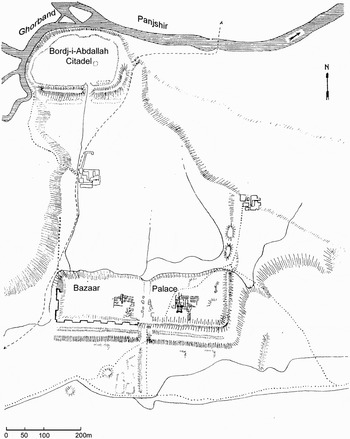
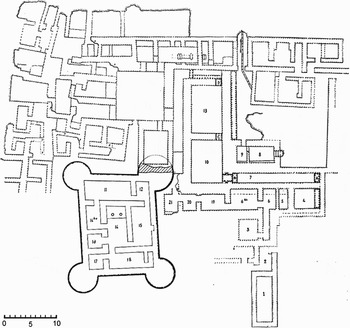
The Begram site is located some 60 km to the north of Kabul, capital of Afghanistan, lying at the confluence of the Gorband and Panjshir rivers to the north and the intersection of two trade routes – an east–west route between the Mediterranean Sea and India, and a north–south route between Pakistan and China. Undoubtedly a strategic spot in ancient times, it first caught the attention of the two European adventurers Charles Masson and Claude-Auguste Court in the early nineteenth century.Footnote 1 The thousands of ancient coins they gathered there immediately aroused interest from the western world, and in 1936 the French Archaeological Delegation began to undertake systematic excavations, which brought to light a fortified town 550 meters across, consisting of a main street and two residential areas (fig. 1). The most exciting discoveries come from the eastern area, especially Rooms No. 10 and No. 13 (fig. 2), which have yielded an extraordinary wealth of Roman glassware and bronze sculptures, Indian ivory and bone carvings, as well as Chinese lacquerwares.Footnote 2
Plan of Begram. (Reproduced from Ghirshman Reference Ghirshman1946, pl. XXIV.)

The palace area of Begram. (Reproduced from Hackin Reference Hackin1954, p. 9.)

Ever since its discovery, generations of scholars have pondered over the identity of this ruined city. Nineteenth-century scholars associated Begram with the Macedonian Alexandria of the Caucasus or the Hellenistic Nikæa erected in the fourth century BC.Footnote 3 A. Foucher, director of the French Archaeological Delegation, delved into Chinese texts and matched it with Kapisa, the summer capital of the Kushan Empire, which ruled the region about three centuries later.Footnote 4 This identification laid the foundation for his fellow archaeologists, principally J. Hackin and R. Ghirshman, to designate the eastern residential area as a palace of the empire, and Rooms No. 10 and No. 13 as the royal treasury. Later studies, however, have raised other possibilities. Sanjyot Mehendale considers Begram to be a trading city of the Kushan Empire, and the two rooms “merchant storehouses.”Footnote 5 Pierre Cambon opines that Kapisa was the capital of an earlier Greek kingdom.Footnote 6
The discussion of the identity of Begram, to a great extent, is entangled with the early history of Afghanistan in general and the chronology of Begram in particular. In his study of the Roman glassware, together with the Indian ivory and bone carvings from Room No. 10, Hackin delineates a wide span of Begram's history from the first to early fourth century.Footnote 7 His later report on the treasures from Room No. 13 lays out a more detailed story. The first and second centuries were the most prosperous period in Begram, when it profited from the transcontinental trade between Rome and China. In the third century, it began to decline as this trade activity slackened. In the fifth century, it fell to the rule of the Huns, which is reflected in the citadel with four towers in the palace area.Footnote 8
On the basis of stratigraphic evidence, Ghirshman discerns three levels of construction in the western residential area. The earliest level corresponds to the time of the Greek kingdoms in the second century BC, whereas the third level terminates in the fourth century AD. He believes the occupational period of the eastern residential area roughly parallels the second level, the era of the Kushan Empire,Footnote 9 and attributes the destruction of the “palace” to the Sassanian king Shapur I, who presumably occupied Begram between AD 241 and 250.Footnote 10 David Whitehouse, however, does not accept this date. Examining Roman objects from Rooms No. 10 and No. 13, including bronze sculptures, glassware, and plaster casts, he comes up with a much earlier date of about AD 50–125.Footnote 11 Yet more recently, Beat Rütti re-dates a Pharos beaker, which had been customarily assigned to the first century AD, to the late third–early fourth century AD, and the closure of the two treasure rooms to AD 356–357, when the Sassanian king Shapur II invaded Afghanistan.Footnote 12
Apart from these studies centering on Roman goods, specialists have also paid much attention to the Indian ivories and bone carvings from Begram. Comparing motifs on these carvings, Hackin delineates a range of dates from the mid-first century BC till the turn of the third and fourth centuries.Footnote 13 But other scholars reject this broad chronology. Philippe Stern argues that the carvings should all be dated to the first and second centuries AD.Footnote 14 J. L. Davidson narrows the chronology to the first century BC, whereas Mehendale assigns it to the first century AD.Footnote 15 In fact, Mehendale and Cambon believe that all the artifacts from Rooms No. 10 and No. 13 are synchronic and date from the first century AD.Footnote 16
In comparison with Roman and Indian goods, the Chinese lacquerware fragments, which were uncovered from Room No. 13, have received less attention.Footnote 17 The reason possibly lies in the poor condition of these objects. Due to soil humidity, the organic (wooden and/or hemp) frames of the original wares have rotted away, and what the excavators retrieved are merely fragments of lacquer coating. Eighteen pieces were uncovered, but only a few of them were published in the excavation report.Footnote 18 Three black-and-white photos show several caskets in situ, and another the décor of a platter. Six fragments are reproduced in four sketches, and they furnish us with a modest amount of information, which is supplemented to some extent by the description in the report.Footnote 19 The one photo and the four sketches thus comprise the entire dataset. Hackin generally links them with the Han dynasty.Footnote 20 V. Elisséeff later made a special study of these finds.Footnote 21 Citing several datable lacquerwares from Pyŏngyang, the seat of the Han-dynasty Lelang (Nangnang in Korean) Commandery 樂浪郡 in North Korea, Elisséeff is able to narrow the date of the Begram lacquerwares to the first half of the first century AD, and specifically to AD 40–50.
At the time Hackin and Elisséeff were wrestling with the Begram lacquerwares, the majority of comparable items had come from Pyŏngyang. Dozens of tombs of ruling aristocrats there were opened by Japanese archaeologists during the first half of the twentieth century.Footnote 22 The tomb of Wang Xu 王盱 is particularly significant as point of reference, because it yields several pieces datable to AD 45–69 and others comparable to the Begram finds. A few more datable items came from Xiongnu aristocrats' tombs at Noin-Ula (Noyon uul in Mongolian) in Northern Mongolia, which were excavated by Soviet archaeologists in the first half of the twentieth century also.Footnote 23
Recently, Michèle Pirazzoli-t'Serstevens re-examines two items – Nos. 215 and 229 in the original numbering of Hackin's report. Quoting two newly discovered items, she confirms Elisséeff's dating.Footnote 24 However, this study fails to take into account the full current database of Han dynasty tombs and accompanying lacquerwares. From the 1950s, North Korean archaeologists continued to excavate tombs in the precinct of Pyŏngyang, even though no datable lacquerware was found.Footnote 25 And, international archaeologists have opened more Xiongnu tombs in Mongolia and Trans-Baikal and sometimes collected sizable caches of Han dynasty lacquerwares, for instance, at the Tamir-1 and Tsaraam cemeteries.Footnote 26 An informative report of these findings is yet to come out; the pieces published so far are too fragmentary to offer a basis for comparison. In China proper, discoveries of Han dynasty lacquerwares, which started in the 1940s, grew rapidly after 1949, the founding year of the People's Republic of China, as a result of extensive construction projects. To date, many discoveries have been made in China, mostly in wet southern provinces such as Hubei, Hunan, Jiangsu, Anhui, and Sichuan, but sometimes in dry northern provinces such as Gansu, Hebei, and Shandong, among others.Footnote 27 A few of the excavated lacquerwares, including the two cited by Pirazzoli-t'Serstevens, can be dated to specific years of production by inscriptions; most of the un-inscribed pieces can be assigned to broad temporal frames by accompanying ceramics. Beyond that, we may further consider the question of the production sites of the Begram lacquerwares, which may throw new light on the nature of the international contacts that brought Chinese goods to Begram. Pirazzoli-t'Serstevens attributes the two items she cites to two state workshops located in Sichuan,Footnote 28 but with the given database, we may re-attribute them as well as the other pieces from Begram.
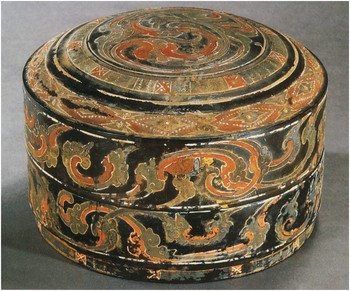
In demarcating the chronology of the Begram lacquerwares, one must take into consideration not only datable pieces, but undatable ones as well, and in addition one must have some sense of the stylistic development of Han lacquerwares. A thorough study on this subject, however, has not been done. For the purpose of this article, I would mention a few trends. To begin with, one must bear in mind that lacquerwares are luxury goods, and as the current database shows, they are concentrated in aristocratic tombs. They are also delicate, and their chance of surviving the ravages of time is contingent upon the burial environment. In this context, the early Western Han (206–118 BC) boasts a remarkably large quantity of lacquerwares,Footnote 29 the major share of which is made up of ear-cups and toilet-boxes for domestic use.Footnote 30 Decorative motifs include clouds, dragons, and phoenixes that depict the immortal world. Mostly painted in red on black ground or black on red ground, they are exquisite, colorful, and energetic (fig. 3). As inscriptions on these wares indicate, numerous workshops sponsored by imperial and princely houses were scattered across the empire.Footnote 31 A prominent one was “Cheng Shi 成市” or Cheng Workshop located at the city of Chengdu in Sichuan Province, whose products have been found in Hunan and Hubei Provinces.Footnote 32
A toilet-box from Tomb No. 3 at Mawangdui in Changsha City, Hunan Province, early Western Han, diameter 24.1 cm, height 16.9 cm, in the Hunan Provincial Museum. (From Fu Reference Fu Juyou1998a, pl. 78; reproduced with permission from the Fujian Meishu Chubanshe.) (A color version of this figure is available at journals.cambridge.org/ASI)

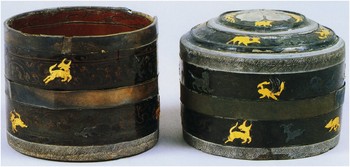
A series of changes occur in lacquerwares from the middle Western Han (118–75 BC). In general, the multiple-color palette of the previous period gives way to the two-color (black and red) one during this period. Strokes become finer and individual motifs smaller in size; compositions become more sophisticated and compact. In the meantime, the workshop marks found on earlier pieces largely disappear. Moreover, a number of innovations come about. First, precious metals like silver and gold are often used in decorating and reinforcing lacquerwares. Two toilet-boxes from Tianchang City in Anhui Province, for instance, are equipped with silver quatrefoils on the cover and many gold-foil animals on the cover and wall.Footnote 33 Here we find another innovation: animals stand out from the clouds to become focal motifs (fig. 4). Albeit obscure in both lacquerware inscriptions and historical texts, several excavation reports identify a major production center in the Yangzhou region of Jiangsu Province.Footnote 34
A toilet-box from Tomb No. 1 at Sanjiaoxu in Tianchang County, Anhui Province, middle Western Han, diameter 9.9 cm, height 9.5 cm, in the Tianchang Museum. (From Fu Reference Fu Juyou1998a, pl. 194; reproduced with permission from the Fujian Meishu Chubanshe.) (A color version of this figure is available at journals.cambridge.org/ASI)

This trend of stylistic development continues in the late Western Han (74 BC–AD 8) and succeeding Xin dynasty (AD 9–23). Décor is executed with even filaments and composition becomes even more intricate. In the meantime, the clouds and animals turn simple, monochromic, and static (fig. 6.2, fig. 7.2, fig. 8.3). Gold, silver, as well as jewels are more often employed, and lacquerwares are ever more extravagant. Animals and figural motifs made of precious metals eclipse the cloud design on the ground. Bands of figural stories also appear on three toilet-boxes from Tomb No. 101, the tomb of a middle-rank official of the Guangling 廣陵 Princedom, at Yaozhuang 姚莊 in Hanjiang County, Jiangsu Province.Footnote 35
An outstanding characteristic of this period is the appearance of long inscriptions, which provide dates and places of production, on dozens of lacquerwares from Pyŏngyang, Noin-Ula, and China proper. Of these, the earliest goes back to 85 BC, and the latest AD 102. During these 187 years, the most enduring workshops are the Western Workshop of Shu Commandery 蜀郡西工, and the State Workshop of Guanghan Commandery 廣漢郡工官, both of which are located in present-day Sichuan Province – the former may even have been the direct successor of the early Western Han “Cheng Shi.” Other known workshops are less stable or ephemeral establishments such as “Kaogong 考工”Footnote 36 and “Gonggong 供工,”Footnote 37 and “Changle Daguan 長樂大官,”Footnote 38 which were operated at the capital of the Western Han and Xin dynasties, Chang'an 長安.Footnote 39 These workshops often imitated the products of the Western Workshop of Shu Commandery and the State Workshop of Guanghan Commandery and produced lesser items.Footnote 40 Within this period, we find the intriguing phenomenon that two types of wares and two types of motifs prevail.Footnote 41 Ear-cups are decorated with the motif of two confronting phoenixes (fig. 7.2), whereas platters are decorated with the motif of three bears (fig. 6.2). The decorative schemes of Han dynasty lacquerwares are in general modular creations, drawing upon a stable repertoire of motifs – cloud, dragon, phoenix, and geometric designs.Footnote 42 But the confronting-phoenix and three-bear motifs, although varying in style and technique of execution, are the commonest ones in the decoration repertoires of the state workshops.Footnote 43
Most products of these state workshops were evidently intended for the imperial house. This is manifested by the two characters sheng yu 乘輿, which refer first of all to imperial chariots but also to overall supplies for the imperial house, that appear most often in the above-mentioned inscriptions. These inscriptions, which also enumerate long lists of working artisans and administrative staff, suggest that these workshops were highly industrialized. As one typical piece tells us, the staff engaged on a permanent basis included core-makers (su gong 素公), base-lacquerers (xiu gong 髹工), topcoat lacquerers (shang gong 上工), gilders (tong'er huang tu gong 銅耳黄涂工), design painters (hua gong 畫工), cinnabar painters (dan gong 丹工), cleaners (qing gong 清工), and touch-up artisans (zao gong 造工). It also included a team of administrative staff, like the commandery clerk for workshop inspection (hu gong zushi 護工卒史), factory chief (zhang 長), assistant factory chief (cheng 丞), bureau head (yuan 掾), and foreman clerk (lingshi 令史).Footnote 44 With such specialized and organized production, these workshops manufactured the most exquisite and extravagant items of their times.
Lacquerwares of the Eastern Han dynasty are rather modest in quantity. This is partly due to the widespread use of the spacious and airy brick tomb chamber, which is unfriendly to organic objects such as lacquerwares, instead of the earlier air- and water-tight wooden chamber, which is favorable for the preservation of lacquerwares.Footnote 45 But more importantly, extravagant lacquerwares gradually fell out of favor with Eastern Han rulers, who began to impose frugal spending on luxury goods; in AD 105, the court altogether dismissed products from the aforementioned state workshops.Footnote 46 Apart from those from Pyŏngyang, only a few dozens of intact wares and well-preserved fragments have been uncovered in China proper. It is striking to note that the two types of motifs described above disappear and that almost all the extant items inscribed with the names of the state workshops from Pyŏngyang are plain.Footnote 47 Other products manufactured by these workshops are sometimes undecorated too (fig. 5).Footnote 48 When decoration occurs, it carries on the stylistic development of the preceding period, composed of large focal motifs of animals and birds on exquisite grounds.Footnote 49 While the ground designs are static, the focal motifs are rather animated. It appears that the aristocratic tastes of this period changed significantly.
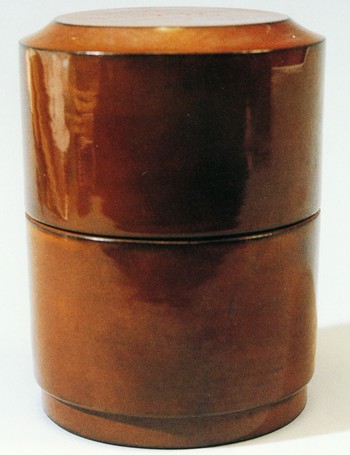
A case from Longshenggang in Guangzhou City, Guangdong Province, Eastern Han, diameter 8.2 cm, height 12.5 cm, in the Guangzhou Museum. (From Fu Reference Fu Juyou1998a, pl. 298; reproduced with permission from the Fujian Meishu Chubanshe.) (A color version of this figure is available at journals.cambridge.org/ASI)

Among the Begram lacquerwares, the bowl of No. 92 (in Hackin's numbering) is visually vague. Severely damaged, it supplies little information about its décor. But Elisséeff proposes that it is a three-register composition like No. 186, and assigns it to the first century AD. Actually, the description only mentions four bands on the exterior, and a certain motif between the second and third bands. Our database shows that such composition already appears on a bowl-like toilet-box of the late Western Han (74 BC–AD 8).Footnote 50 The color combination, Saturn red on the interior and red décor on a brown-black ground, is a prevalent pattern in Han dynasty lacquerwares. Due to the lack of more details, little can be said beyond that.
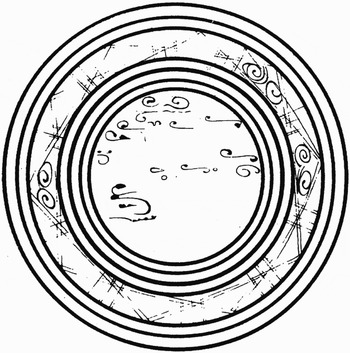
No. 215 (fig. 6.1) contains four fragments of a platter. The bottom piece (fig. 6.1a) exhibits a roundel consisting of three spirals at the center, three units of identical motif alternating with three clusters of beads, and a ring of beads on the border outside. The motif is rather abstract; Hackin believes that it is a stylized version of the “three bears” motif.Footnote 51 As related above, the three bears is the standard motif on platters from the state workshops of the late Western Han and Xin dynasties. To date thirteen datable pieces with the three-bear motif from Pyŏngyang and Noin-Ula and two additional pieces from China proper are known, the earliest of which dates to 28 BC and the latest to AD 14. Throughout this temporal span, the three-bear motif is relatively realistic, and the heads, bodies, and limbs of the bears are recognizable. Moreover, the motif is surrounded by a cloud band. It is so strikingly different from the Begram fragment in that it bears no recognizable resemblance to the latter. One piece that may fill the gap comes from Wang Xu's tomb.Footnote 52 In terms of both the three-bear motif and the cloud band, it is a transitional piece. This platter, however, does not bear a datable inscription, and one is left unsure if Elisséeff is right in assigning the bowl to AD 20–50.Footnote 53
Lacquerware No. 215 from Begram, from Hackin Reference Hackin1954.

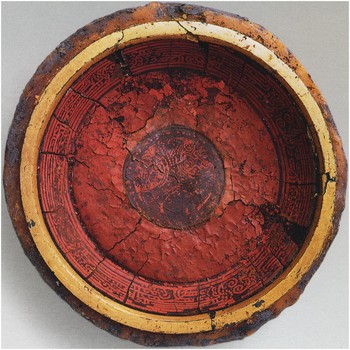
The other three fragments of No. 215, which escaped the attention of Elisséeff and Pirazzoli-t'Serstevens, may offer us some clue. One fragment (fig. 6.1b) exhibits a composition of parallel lines and a jigsaw pattern, and another (6.1c) a composition of parallel lines, coils shaped like the numeral “8,” and dots. The former fragment may have bordered the bottom, to which the latter belongs. No such composition, however, occurs among the datable pieces known to us. The third fragment (6.1d) displays a composition of a coil and a cloud, and as frequently attested to by the known samples, constitutes the exterior of the wall of the original ware. The even and stout strokes used to execute the exquisite designs on all the four fragments are found on a number of datable pieces of 16 BC–AD 14, among which the one from Xinqiao 新橋 in Qingzhen County, Guizhou Province is the closest comparable (fig. 6.2).Footnote 54 Based on this comparison, we may assign No. 215 to this temporal range.
A platter from a tomb at Xinqiao in Qingzhen County, Guizhou Province, Yuanshi year 4 (AD 4), diameter 27.2 cm, height 4.1 cm, in the Guizhou Provincial Museum. (From Fu Reference Fu Juyou1998a, pl. 293; reproduced with permission from the Fujian Meishu Chubanshe.) (A color version of this figure is available at journals.cambridge.org/ASI)

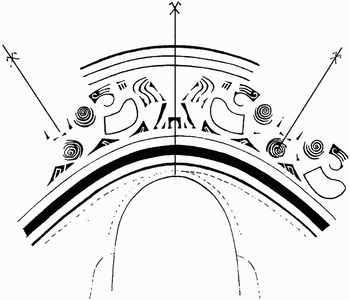
No. 229 (fig. 7.1) is easily recognizable as an ear-cup. Its exterior bears elements of coils, triangles, and what Hackin calls “felt shoe” and “comb” ornaments. Elisséeff immediately recognizes this composition as two confronting phoenixes, a familiar motif on lacquerwares from Pyŏngyang. By the stylized rendering of the motif, he dates this fragment to AD 5–13, but after considering the evolution of this motif, he gives a later span of AD 13–50. He perceives that the diagrams inside the X frame change from semicircle to rectangle and finally to triangle.Footnote 55 The current database allows us to trace the origin of the confronting phoenixes back to the early Western Han. One sample is an ear-cup from a tomb at Gufenyuan 古墳垸 in the city of Changsha, Hunan Province, which shows two confronting phoenixes.Footnote 56 Their beaks and eyes are realistic, but other parts are sketchy – the two legs and the tail are in the form of lines. Between the two slender birds, there are two large semicircles tangent to each other, with two small ovals inside. The felt-shoe-like wings are not found here. For the middle Western Han, Tomb No. 17 in Hanjiang County provides an ear-cup bearing the same motif. The phoenixes on this ware have lengthy necks and felt-shoe-like wings but without legs.Footnote 57 An 8 BC piece from Pyŏngyang continues this type of bird image, but shows a short tail ending in coils and semicircles with hooks inside the X frame.Footnote 58 It is in AD 3 that the square frame begins to replace the semicircular one, as shown in a piece from a tomb at Yalongba 玡瓏垻 in Qingzhen County, Guizhou Province (fig. 7.2). The painting strokes are bolder and the motif becomes more compact. No. 229, which unmistakably exhibits the square frame in the lower half of the X frame and the coils, does not resemble the earlier two samples, but looks like a close copy of the Yalongba piece. This is the type of bird motif that adorns ear-cups from 2 BC–AD 13.Footnote 59 By contrast, the few Eastern Han pieces known to us are all plain.Footnote 60 No actual example of the triangular frame, the final stage of Elisséeff's evolutionary chart, has ever been found. On these grounds, I am inclined to place No. 229 in the temporal scope of 2 BC–AD 13.
Lacquerware No. 229 from Begram, from Hackin Reference Hackin1954.

An ear-cup from a tomb at Yalongba in Qingzhen County, Guizhou Province, Yuanshi year 3 (AD 3), diameter 16.6 cm, height 3.8 cm, in the Guizhou Provincial Museum. (From Fu Reference Fu Juyou1998a, pl. 292; reproduced with permission from the Fujian Meishu Chubanshe.) (A color version of this figure is available at journals.cambridge.org/ASI)

The motifs of the three bears on No. 215 and the confronting phoenixes on No. 229, as commented on above, occur exclusively on products of the state workshops. Pirazzoli-t'Serstevens attributes them to the Western Workshop of Shu Commandery and the State Workshop of Guanghan Commandery. This is not necessarily so. As noted earlier, the state workshops at Chang'an also produced the two types of wares within the given temporal frame. The original wares of the Begram fragments could have been produced at any of these state workshops.
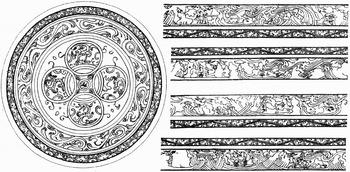
The designs of No. 216 (fig. 8.1) and No. 219 (fig. 8.2) are similar in many ways. No. 219 shows the exterior of a toilet-box. No. 216 is thought by Elisséeff to be a fragment of an ear-cup; but because the design never occurs on any known ear-cup, the original ware is more likely an oval toilet-box with a straight end, like the item from Wang Xu's tomb (fig. 9.2). The décor on No. 216 consists of two registers, one composed of interlacing wavy filaments and the other of interlacing angular filaments, which constitute polygon-like shapes. That of No. 219 is composed of interlacing pentagonal filaments. In both cases, the décor contains C-shaped clouds in the angles and parallel lines crosscutting the filaments. By contrast, the bottoms of the two wares are decorated with worm-like curves. The entire ensemble of motifs finds no analogy among known samples. Elisséeff generally comments that the interlacing filaments are current in the first half of the first century AD. But with the aid of the currently available database, we may delineate with greater precision the dates of individual components.
Lacquerware No. 216 from Begram, from Hackin Reference Hackin1954.

Lacquerware No. 219 from Begram, from Hackin Reference Hackin1954.

The motif of interlacing polygonal filaments first deserves our attention. It can be traced back to two items found in a case from Tomb No. 5, dating to the middle Western Han, at Wuzuofen 五座墳 in Guanghua City, Hubei Province, which bear two interlacing pentagons.Footnote 61 However, in many cases the number of angles varies. The most similar design is found on the bottom and cover of a toilet-box from Tomb No. 101 of the late Western Han at Yaozhuang (fig. 8.3).Footnote 62 The encircling border is executed with double filaments and a single filament; C-like clouds and parallel lines are profusely interposed along the filaments. The bottom shows a band of interlacing polygonal filaments. With this comparison, we may assign Begram No. 216 and No. 219 to the late Western Han.Footnote 63
A toilet-box from Tomb No. 101 at Yaozhuang, Hanjiang County, Jiangsu Province, late Western Han, diameter 22.5 cm, height 14.5 cm, in the Yangzhou Museum. (From Yangzhou Bowuguan Reference Bowuguan1988, p. 38, fig. 30.5.4, reproduced with permission from the Yangzhou Museum.)

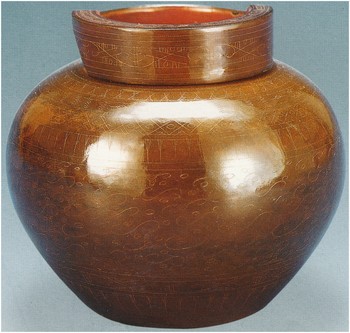
Like the above interlacing filaments, the worm-like motif on No. 216 and No. 219 results from a long-term stylization of clouds. An early example is found on a platter from Tomb No. 1 of the early Western Han at Dafentou 大墳頭, in Yunmeng County, Hubei Province.Footnote 64 There the large clouds are executed with modulated lines, and the bold ones take the shape of large worms. A simpler version is found on a rectangular box of the middle Western Han from Sanjiaoxu 三角圩 in Tianchang County, Anhui Province.Footnote 65 The closest parallel appears on a jar from the late Western Han Tomb No. 101 at Yaozhuang (fig. 8.4).Footnote 66 The belly of the jar is inscribed with S- and O-like strokes, which are the extreme stylization of the clouds of previous periods.
A jar from Tomb No. 101 at Yaozhuang, Hanjiang County, Jiangsu Province, late Western Han, diameter 7.8 cm, height 6.9 cm, in the Yangzhou Museum. (From Fu Reference Fu Juyou1998a, pl. 260; reproduced with permission from the Fujian Meishu Chubanshe.) (A color version of this figure is available at journals.cambridge.org/ASI)

Although the compounding of the above two types of motifs on the fragments never recurs on any known samples, it most likely took place during the late Western Han. Due to the lack of inscriptional materials, a narrower chronology cannot be delineated at present.
The production site of No. 216 and No. 219 is not easy to determine, because boxes bearing long inscriptions are few. So far only two items of this kind have been discovered in Tomb No. 2 of the consort of the prince of Quanling at Yaoziling 鷂子嶺 in Yongzhou City, Hunan Province.Footnote 67 The inscription on one zhi 卮-goblet indicates that the cover and body were produced, in 8 BC and 16 BC respectively, at the workshop “Gonggong.” The other was produced at the workshop “Kaogong” in 8 BC. The former is painted with interlacing wavy filaments only, and the latter zhi-goblet the incised diamonds and parallel lines, a conventional motif of the Western Han. Neither of them exhibits the polygonal filaments that adorn No. 216 and No. 219, which implies that the motif does not belong to the decoration repertoires of state workshops.
The comparison of Begram No. 216 and No. 219 with the toilet-box from Tomb No. 101 at Yaozhuang nevertheless enlightens us as to the issue of provenance. Unlike the décor of the state workshops that is executed in bold strokes, the interlacing filaments on these wares are meticulously rendered. These complementary motifs, however, appear to be the stylized derivative of the bands of consecutive rhombi often seen, with variation, on toilet-boxes, an 案-tables, he 盒-boxes, and si 笥-boxes from tombs found at Huchang 胡塲,Footnote 68 Ligangcun 李崗村,Footnote 69 Laoshan 老山Footnote 70 in Hanjiang County, and SanjiaoxuFootnote 71 in Tianchang County. Dating from the middle Western Han through the Xin dynasty, these bands have their individual units filled with C-like clouds, circles, and feathers. All these sites, like Yaozhuang, fall within the territory of the Guangling Princedom during the late Western Han and Xin dynasties.Footnote 72 The concentration of this distinctive motif, over a protracted length of time, indicates a local artistic tradition in this territory. Indeed, during this time the Guangling Princedom had a prominent lacquerware production center,Footnote 73 to which we may attribute Begram No. 216 and No. 219.
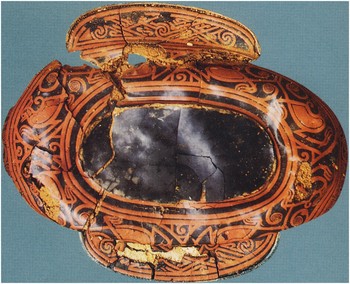
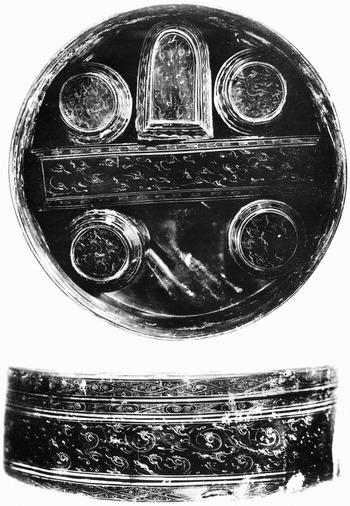
No. 186 (fig. 9.1) comprises three fragments, possibly from one small box. One fragment shows a band of three double-ovals. Such motifs occur rarely, and the only known examples are seen on five toilet-boxes, all of which are placed in one case, from Wang Xu's tomb (fig. 9.2). The other two fragments of No. 186 display the identical design that consists of a band of coiling clouds executed with fine lines. Despite being in the form of a sketch, the clouds resemble those that adorn the covers of these five wares and the wall of the containing case. Neither of the two motifs helps us with the task of dating. The double-oval does not repeat itself beyond this tomb and the clouds are not confined to any particular time period. What helps us is the designs on the wall of the containing case. The top and bottom registers, the same in composition, are made up of a band of interlacing filaments which form rhombi traced with beads. Inside and outside, the diamonds are painted with C-like clouds. The ensemble of interlacing filaments and C-like clouds and the extravagant décor align the case with the previously mentioned group of lacquerwares, particularly an an-table from the Baonüdun tomb of the Xin dynasty,Footnote 74 and appear to be from the same group from which No. 186 probably originated.
Lacquerware No. 186 from Begram, from Hackin Reference Hackin1954.

A case from Wang Xu's tomb at Pyŏngyang, Eastern Han, diameter 26.2 cm, height 8.6 cm, in the National Museum of Korea. From Umehara Reference Umehara1948, pl. XVIII.

The example from Wang Xu's tomb also gives us a clue regarding the provenance of No. 186. The design, consisting of a section of interlacing filaments filled with parallel lines alternating with a section of C-like clouds, falls into line with that of the abovementioned group of lacquerwares that were probably products of local workshops of the Guangling Princedom, to which I am inclined to assign No. 186.
The foregoing analysis offers no dramatic changes but some slight adjustments to Elisséeff and Pirazzoli-t'Serstevens's dating. The present database allows us to ascribe the Begram lacquerware fragments to the late Western Han and Xin dynasties, or 74 BC–AD 23. This chronology, however, coincides with a misty period in the history of Central Asia. P. Bernard tells us that the last Greek kingdom at Begram succumbed around 70 BC to some unnamed nomadic tribes.Footnote 75 The next known power in this region is the Kushan Empire, but the actual date of its emergence is still uncertain. A crucial point in the chronology of Kushan is the era of Kanishka, the fourth king of this empire. To date there have been widely differing opinions on the time he lived, varying from AD 78 to 278; weighing the available evidence, B. N. Puri insists on his earlier opinion that this era starts around AD 142. If so, the Kushan Empire might have arisen around the turn of the second century AD.Footnote 76 The Yuezhi nomads, as Chinese written records tell us, conquered Bactria to the north of the Hindu Kush between 139 and 128 BC.Footnote 77 But it is not sure whether or not they ruled Begram to the south between 74 BC and AD 23.
As Chinese historical texts inform us, Central Asia came to the attention of the Western Han empire from the late second century BC. In the course of dealing with the Xiongnu nomads, Emperor Wu 武帝 (r. 140–87 BC) obtained the intelligence that the Xiongnu had driven away the Yuezhi people. In 138 BC, he sent Zhang Qian 張騫 to them in the hope of securing an alliance against the Xiongnu. The mission did not succeed, but it brought the Western Han regime to the attention of the Western world. In 120 BC, the Western Regions (roughly the present-day Tarim Basin and parts of Central Asia to the west of it), the intermediary area lying between China and Afghanistan, came under the control of the Western Han empire. In the same year, Zhang Qian set out on another mission to Wusun and other Central Asian states. The mission again failed, but it attracted diplomatic missions from various states to China. In 108 and 101 BC, two Han military expeditions were dispatched to Central Asia and the second one conquered Ferghana. Thereafter, by appointing officers and founding colonies, China maintained, with some brief interruptions, direct control over the Western Regions – the gateway to Central Asia.Footnote 78 These actions induced most of the Central Asian states to send tribute and hostages to China as a symbol of submission, although Yingshih Yu points out that such contact was not just political – many missions were actually merchants seeking profitable transactions with the Chinese court.Footnote 79 The Western Han empire, for the sake of its own political interests, often dispatched missions to these states with enormous gifts. With the downfall of the Xin dynasty, however, Chinese power dwindled and the Western Regions reverted to the sway of the Xiongnu nomads; it was not until AD 73 that the Eastern Han empire re-established dominance in this region.Footnote 80 In this context, it is no coincidence that lacquerwares of the late Western Han and Xin dynasties made their way to Begram.
The question of how the Chinese lacquerwares arrived at Begram cannot be answered with certainty. They might have traveled along the sea route, landed in India and continued their journey to Begram. The available evidence, however, favors the possibility that they reached there via the Silk Road. For one thing, a number of lacquerwares of the Western Han and later dynasties, some of which might have been produced at state workshops of the Guanghan and Shu Commanderies, have been found at many sites along the northern and southern routes girding the Tarim Basin.Footnote 81 For another thing, a wooden slip of 63–13 BC found at the postal station Xuanquanzhi 懸泉置 near Dunhuang records that a Western Han officer provided food to Yuezhi envoys. Another slip from around 65 BC, originally found by Aurel Stein at Niya 尼雅, another site along the Silk Road, tells that a Kushan envoy delivered a memorial to the Western Han empire requesting an envoy.Footnote 82 Given the intimate connection of politics and trade, the Chinese lacquerwares might have been brought to Begram by these envoys.
The Begram lacquerwares further enlighten us as to the nature of contact between China and Central Asia. According to the analysis given above, nos. 215 and 229 were probably produced at state workshops, whereas nos. 186, 216 and 219 possibly came from local workshops of the Guangling Princedom. While products from the local workshops were meant for aristocratic families, those from the state workshops were for the imperial house. Data from mortuary remains cited above demonstrate that both types of products were included in the lists of gifts that the imperial house bestowed upon domestic aristocrats (i.e. of Guangling Princedom, Lelang Commandery) as well as foreign aristocrats (i.e. of the Xiongnu).Footnote 83 In this context Begram could be a princely residence – although we do not know which polity it belonged to. Given Yingshih Yu's caution, one could also consider it to be a residence of merchants, who went to China in the disguise of princely delegates. But the concentration of luxury goods from various sources, i.e. lacquerwares from China, ivory and bone carvings from India, and glass vessels and bronze sculptures from Rome, identifies Rooms No. 10 and No. 13 more likely with the residence of a local polity, which had some politico-economic contact with China between 74 BC to AD 23.
APPENDIX
Note: some of the illustrations are published in color in the online version of this article, available at: journals.cambridge.org/ASI.