

Some three decades of ‘guild rehabilitation’ have shown that guild regulations were neither necessarily at odds with economic growth nor by definition opposed to flexibility and innovation.Footnote 1 The empirically established correlation between rising numbers of guilds and economic expansion (for instance, during the golden ages of the Southern Netherlands and the Dutch Republic) suggests that economic growth and guild regulation could perfectly well go hand in hand.Footnote 2 Moreover, economic historians, using concepts from ‘new institutional economics’ and game theory, have developed thought-provoking theories in which guilds are seen as helping (in the words of S. R. Epstein) ‘to overcome the persistent market failures caused by thin, underdeveloped, or non-existent markets’ (Epstein Reference Epstein2008, p. 168). Craft guilds appear to have played a relevant role, especially in skill- and technology-intensive industries producing high-quality goods (Pfister Reference Pfister, Epstein and Prak2008, pp. 46–7). They are said to have been of major importance for the development and diffusion of (transferable) skills. According to Epstein, guilds could enable masters to recover the cost of training by paying wages below the marginal product of labour, while at the same time stimulating apprentices to train by means of bonds (entry fees) and end-term rewards (higher wages or a privileged entrance to the labour market as an employee or an employer).Footnote 3 Moreover, guilds are thought to have guaranteed product quality and developed customer trust in the products and skills involved in making them. By monitoring skills and product quality, selling imperfect substitutes, and investing in brand loyalty, craft guilds were able to prevent adverse selection and to raise prices above marginal cost (Munro Reference Munro, Miskimin, Herlihy and Udovitch1977, Reference Munro, Aerts and Munro1990; Gustafsson Reference Gustafsson1987; Pfister Reference Pfister, Epstein and Prak2008; Richardson Reference Richardson2001, Reference Richardson2008).
Recently, however, some serious doubts have been cast on these arguments, in particular in a fierce discussion between S. R. Epstein and S. Ogilvie (Ogilvie Reference Ogilvie2007, Reference Ogilvie2008; Epstein Reference Epstein2008; see also Boldorf Reference Boldorf2009). While Epstein has specifically developed a theory on the possible positive economic effects of apprenticeship arrangements – which are considered not only as advantageous to product quality but also to have facilitated human capital formation and technological innovation (Epstein Reference Epstein1998; reprinted in Epstein and Prak Reference Epstein and Prak2008, pp. 52–80), Ogilvie (Reference Ogilvie2003) has questioned the positive impact of guilds altogether. Based on a case study of the worsted industry in the Wildberg canton in Württemberg and on an extensive ‘deconstruction’ of existing theories and models, Ogilvie (Reference Ogilvie1997, Reference Ogilvie2004, Reference Ogilvie2007) has argued that ‘distributional conflicts’ provide better explanation for the enduring existence of guilds in early modern Europe. Ogilvie thus rehabilitates an older tradition in which guilds were seen as (inefficient) vehicles for rent-seeking behaviour, suggesting that they should be examined also from a social and cultural perspective.Footnote 4 Next to power relations and conflicts over resources and entrance to markets, other norms and values – which could be at odds with economic efficiency – should be taken into account when trying to explain the introduction and enduring existence of guild regulations.
Notwithstanding intense debate, it remains inconclusive. Ogilvie's arguments are set aside because of her case study's atypical characteristics – the worsteds produced in the western Black Forest were of relatively low quality and Württemberg's proto-industry was controlled not by ‘powerful’ guilds but by a guild-like association of merchant-entrepreneurs who left the weavers little economic leeway (Pfister Reference Pfister, Epstein and Prak2008, pp. 46–7; Lis and Soly Reference Lis, Soly, Epstein and Prak2008, p. 99). Nor are the models and theories supporting the view that guilds were economically beneficial unambiguous. The role of apprenticeship arrangements in particular is hard to pinpoint. According to Epstein, craft guilds enforced contractual norms that reduced opportunism by both masters and apprentices. Since apprentices were liable to be exploited as cheap labour and could be discharged before acquiring the agreed skills, they needed to make sure they would receive adequate training. Masters, in turn, needed to ensure that there would be a return on their investment in training, so they ‘demanded rights over the apprentice's labour through long-term training agreements upheld by formal or informal sanction’. Yet Epstein is very unclear on why precisely guilds were needed. He assumes that guilds had contract-enforcing effects related to apprentice contracts (to keep the apprentices on the shop floor longer), not least because masters were vested with the legal prerogatives of fathers (Epstein Reference Epstein1998, pp. 687, 690–2). However, this was not necessarily introduced formally by the guilds, and could just as well have been the result of customs or informal rules, perhaps in the context of a brotherhood. Introducing it formally or sanctioning it in practice could just as well have been the work of urban or central authorities. Moreover, as the possible positive economic effects referred to in Epstein's theory were largely unintended, guilds may have had rent-seeking intentions while remaining economically beneficial.
The aim of this article is not to examine economic effects, but to shed light on the reasons behind (formal) apprenticeship arrangements and (hence) on the intentions behind their introduction. The choice of Antwerp during its so-called ‘golden age’ should answer the need for a more representative region or city. In the long sixteenth century, Antwerp was renowned for its economic accomplishment and its high-quality and skill-intensive products.Footnote 5 Moreover, at its economic peak the large majority of artisans worked in guild-based industries, and whenever new industries took off, they were generally soon incorporated, mostly at the request of the masters themselves.Footnote 6 The role of apprenticeship, however, is far from straightforward. In manufacturing guilds, apprenticeship materialized mostly in fixed minimum terms to serve and ex post assessment of skills with standardized masterpieces. Interestingly, in Antwerp these rules were introduced mostly in (or at least in the run-up to) its ‘golden age’, i.e. from the second half of the fifteenth century to 1585 (the so-called Fall of Antwerp). Not only did the number of guilds increase during its economic expansion,Footnote 7 but a masterpiece was typically introduced in the ‘long sixteenth century’ as well.Footnote 8 Fragmentary data suggest that even a fixed minimum term of service was all but standard until well into the fifteenth century.Footnote 9 At least until the first decades of that century guild officials simply had to declare before the city magistrates who someone was when accepting him as a new member.Footnote 10 Finally, restrictions on the number of apprentices per master and entry fees for apprentices were introduced (or became pecuniary) in the fifteenth and sixteenth centuries.
What problems did guild officials try to solve in devising these apprenticeship rules? Were they related to economic efficiency or to distributional conflicts? If the latter, was there awareness of possible economic effects? I will argue that apprenticeship arrangements as they were established by the Antwerp guilds should be understood as a consequence rather than a cause of economic expansion. Unsurprisingly, Antwerp's ‘golden age’ – the peaks of which should be situated between the end of the fifteenth century and the third quarter of the sixteenth – was accompanied by unprecedented demographic growth. Between the end of the fourteenth century and the 1560s – the period in which apprenticeship arrangements were formalized and standardized – the city expanded from less than 10,000 to about 100,000 inhabitants (Blondé and Limberger n.d., 307–9). This raises questions on how the introduction of apprenticeship arrangements was related to the inclusion (or exclusion) and integration of new entrants (both apprentices and masters). Moreover, demographic growth was accompanied by changing labour relations. Current research on the economic history of the South Netherlandish (export) industries tends to stress the co-existence of merchant capitalism and powerful guilds, but this did not prevent power relations from shifting drastically – as the fierce debates between large and small masters and between masters and merchant capitalists reveal.Footnote 11 While the former typically debated the size of workshops, the latter discussed the boundaries of the group of privileged freemen (masters) and the entrance to the masters’ labour market monopsony (De Munck Reference De Munck2007a, Reference De Munck2008, Reference De Munck2010a). Again, the question is what part apprenticeship arrangements played.
Analysing this, I will specifically address Epstein's theory on apprenticeship. In the first section, I will reflect on the practice of concluding apprentice contracts from the perspective of human capital formation. While apprentice contracts could in theory be concluded without guilds, in the Southern Netherlands it was a relatively autonomous activity even in guild-based sectors (De Munck Reference De Munck2010b). The crucial question to ask, then, is what guilds may have added to this practice. From this perspective, the second and third sections analyse the introduction of fixed terms and standardized master tests, exploring in particular whether they served a contract-enforcing goal. By closely following their earliest changes and comparing them with a sample of apprenticeship contracts, it will be shown that these regulations were not introduced for economic reasons. From the perspective of the formation of ‘human capital’ and the inclusion of skills, they did more to create problems than to solve them. While fixed terms of service and standardized masterpieces were geared to transferable skills in particular (i.e. more or less general skills applicable in a specific range of firms, for example across a craft guild), the emphasis in Antwerp appears to have shifted to a need for specific skills. Moreover, increasing immigration brought about a concern about the inclusion of skills, rather than the production of skills. In my opinion, therefore, these regulations first of all served to guard the guilds’ labour market monopsony against the intrusion of merchants and illegal entrepreneurs in the context of increasing immigration and a strain on face-to-face relations, as will become clear in the fourth section. The subsequent analysis of the maximum number of apprentices per master in this section will show that the Antwerp guilds should be seen, at least in part, as brotherhoods who tried to guard a certain equality among members in the face of concentration trends (large masters favouring deregulation). Hence, the guilds’ alleged exclusiveness should be qualified too. In the fifth section, it will be shown that rising entry fees for apprentices served to counterbalance rising entry fees for masters. As such, they may have served a contract-enforcing goal, but only so as to check raising barriers of entry for masters, which climbed unintentionally – in part as a result of cultural and symbolic preoccupations. Expanding on this, some possible other explanations than Epstein's for the positive economic effects of guild regulations will be reflected upon in the sixth section.
My analysis is based on a broad sample of guild ordinances, beginning with the first ever edited (mostly fifteenth century) up to about 1650. A carefully selected sample of trades will be studied in more detail: the barber-surgeons, the cloth dressers, the cabinetmakers (including the ebony workers), the gold and silversmiths, the pewterers and plumbers, and the shoemakers and tanners. For these industries I have also analysed a sample of apprentice contracts, starting from a database of 272 contracts which I developed in the course of my PhD research on apprenticeship in Antwerp (see De Munck Reference De Munck2007c). Most of these contracts date from the second half of the seventeenth and the eighteenth centuries, so there is a time lag between the bulk of the corporative regulations studied and the bulk of the contracts. Moreover, the contracts we found were mostly drawn up before a public notary, suggesting that they might be rather atypical (as registering the contracts was not obligatory). The appearance of these contracts might even be considered a response to shifts related to apprenticeship in the sixteenth century. As a result, I will not use the contracts in order to reveal a reality which preceded the sixteenth-century regulations, but rather as a possible alternative to them. With respect to the guild rules, the empirical base is far more substantial: the first and most important ordinances of all the craft guilds of any significance in Antwerp were used.Footnote 12 For the most part they are used qualitatively, paying attention to the arguments used and the co-appearance of different regulations while linking them to the socio-economic and political context. However, for three guilds I have been able to empirically link the establishment of formal apprenticeship arrangements to the demographic context (using immigration figures as a proxy). As these groups are either exemplary of Antwerp's success (on wider markets) in its golden age (ribbon makers) or typical of any urban economy in that era (carpenters and shoemakers) they should have at least a limited representativity.
Of course, I am fully aware of the gap between norm and reality and between the discursive strategies of guild boards and genuine intentions, but a close reading, which pays attention to both small but significant adaptations over time and the co-appearance of different types of regulations, should enable me to reveal some of the guild boards’ aims. Given that Antwerp should, moreover, be considered a city with ‘strong’ guilds, in which masters mostly held the reins and had a considerable say in the guilds’ policy, we should, then, get an impression of the masters’ preoccupations. Even assuming that there had already been unwritten customs before a guild statute, privilege, or ordinance was edited, the rules provide a good insight into what guilds considered important enough to regulate or enforce.
1. Apprenticeship and contract enforcement?
The apprentice contracts illustrate that a boy's training could perfectly well be agreed upon, apart from guilds, between a master and the boy's father.Footnote 13 The length of the term could differ according to the range of skills to be learned and the price that was agreed upon. Shorter apprenticeship terms were more expensive; while boys who could pay less were required to have a longer learning period in order to settle their debt with unpaid labour.Footnote 14 From the perspective of the efficiency of the transfer of technical knowledge, this practice has complex consequences. Some boys were forced to stay on the shop floor longer, but it is unclear whether they were indeed learning rather than providing cheap labour, performing repetitive or preparatory jobs. Moreover, we can assume that apprentice contracts involved a certain lack of trust. Apprentices who served longer terms than strictly necessary to learn their craft tended to run away once they had learned what could be learned from a particular master or workshop. This hold-up problem (one party exploiting an improved bargaining position) was dealt with in default clauses (cf. Smits and Stromback Reference Smits and Stromback2001, pp. 71, 76–7). In addition to up-front payments, which were agreed upon in most contracts, it was sometimes stated that previous payments would not be refunded, that apprentices who violated their contract still had to pay the full amount, or that a penalty had to be paid, the amount of which could vary according to the precise moment of departure.Footnote 15 Moreover, there were end-term rewards. Some apprentices simply received an amount of money or some tools at the end of the term (in five of our cases), or else every year a specific ‘new year’ was provided (three cases).Footnote 16 More often (in 18 per cent of the contracts) they were entitled to some gradually rising pocket money, called ‘gratuity’ (dringeld or speelgeld).Footnote 17 Boarding-out contracts by the boy's orphanage, which were typically free of charge, included stipulations about pocket money, which systematically rose as the boy acquired more skills.Footnote 18 It is, of course, difficult to quantify, but the sum of the pocket money seems to have been related to the opportunity cost of the apprentice. As an apprentice acquired more skills, his opportunities to earn a wage (elsewhere) rose, so we can view the pocket money as intended to keep apprentices on the shop floor longer.
In short, in the context of well-established contract-enforcing mechanisms, an apprentice contract could be a very flexible economic instrument, one which already solved the most important problems the contractees faced (cf. Reyerson Reference Reyerson1992, p. 360). How, then, if at all, did guild boards try to intervene in the practice of learning on the shop floor? Did they promulgate new rules and sanctions in order to stimulate learning and investing in the transfer of skills? In theory, apprenticeship might have been part of a strategy devised to solve the so-called ‘quality problem’ – along with quality scrutiny of the raw materials, the production process, and the products (sanctioned by the application of trademarks) (Gustafsson Reference Gustafsson1987, pp. 21–2; Epstein Reference Epstein2008, pp. 157–9). However, as it was synonymous with the obligation of spending a certain amount of time on the shop floor – while any sanctioning for whether apprentices actually learned there was absent – skill quality was likelier to have been checked by the obligation of making a masterpiece (see below). Apprenticeship itself is more likely to be broached from the perspective of contract enforcement. In order not to be exploited as cheap labour and perform only preparatory or repetitive tasks, apprentices needed to ensure they would actually learn and acquire technical knowledge. Masters, for their part, in order to warrant a return on their investment in training, sought to ensure that the apprentices would stay on their shop floor long enough. According to Epstein, guild coercion in this context could serve as ‘a means of enforcing apprenticeship rules’, but in practice it remains unclear exactly how – if at all – masters actually pursued this (Epstein Reference Epstein1998, pp. 687, 690–2). How did guilds ensure (1) that apprentices stayed on the shop floor long enough and (2) that new apprentices entered the masters’ ateliers – notwithstanding entry requirements of guilds?
On an informal level, mastership as a status may have enhanced the patriarchal authority of fathers – so the first question should be whether guilds solidified the patriarchal authority of fathers via written rules. Absent a strong state or centralized legislation, guilds may have acted as a third party, but whether they actually did so is impossible to determine in the absence of figures on completion rates or quantifiable data from juridical proceedings – as is the case in Antwerp in the sixteenth century.Footnote 19 However, as any reference to the authority of fathers (qua masters) is lacking in the ordinances, it would seem that this was not the guild boards’ first concern. How, then – if at all – did they serve contract-enforcing goals? Apart from solidifying the masters’ legal prerogatives, guilds may have introduced either end-term rewards (such as a privileged entrance to the labour market for journeymen or to the guilds’ labour market monopsony for masters) or entry fees (stimulating the apprentices to serve out the contract). They may also have simply tried to keep apprentices on the shop floor longer when introducing minimum terms.
As both the guilds’ labour market monopsony and entry fees are likely to be addressed from the perspective of ‘distributional conflicts’ from the start, let us begin with the fixed term to serve, which was standardized from about the mid-fifteenth century onwards. Minimum terms to serve may have helped in solving the hold-up problem for masters – as a result of which they may have invested in training more (Smits and Stromback Reference Smits and Stromback2001, pp. 38–42, 72–4). Moreover, as time and effort were essential in early modern learning, minimum terms may have increased the output in terms of ‘human capital’ as such (Epstein Reference Epstein2008, p. 166; De Munck Reference De Munck2007c, ch. 1.3). However, in the absence of national legislation and from the perspective of individual guilds, a minimum term to serve may also have had exclusionary effects. Social historians have mostly considered long apprenticeship terms a sign of exclusionist motives rather than concerns about training. According to R. Reith, there was a tendency to extend the terms, first because of higher qualification requirements and specialization, but from the sixteenth century onwards because of labour market regulations (Reith Reference Reith1989, p. 3; see also Kaplan Reference Kaplan1993, p. 451). Of course, insofar as long apprenticeship terms are concerned, one can argue that they answered both social (exclusionary) and economic preoccupations, but things become more complicated when apprenticeship periods (prescribed by guilds) were fairly short – as was the case in the Southern Netherlands.Footnote 20 In Antwerp, most obligatory apprenticeship terms were two years, and more than four years was exceptional.Footnote 21 Did these apprenticeship terms intend to keep the apprentices on the shop floor longer? And if so, was it to improve the creation of ‘human capital’?
2. Fixed terms to serve versus specialization
Apprenticeship terms may have been intended to keep apprentices on the (same) work floor longer when they were first established. There are indications that the length of the term had initially been tied to the difficulty of the craft,Footnote 22 and that in the beginning it was even adjusted to changing production techniques. In 1524 the gold and silversmiths ruled that their pupils had to serve an additional two years as journeymen before they could become masters, apparently responding to shifts in the nature of demand.Footnote 23 In the same vein lengthening the apprenticeship of aspiring cabinetmakers from two to three years in 1497 may be attributed to changing expectations related to skills, as it coincided with their split from the coopers, a trade that may have been easier to learn than cabinetmaking.Footnote 24 The strange fact is, however, that the terms were not extended when the trades became even more complex in the course of the sixteenth and the first half of the seventeenth century. In 1515 the cabinetmakers reacted to a complaint about apprenticeship being neglected by requiring a more difficult masterpiece, not with additional regulations about apprenticeship itself.Footnote 25 In 1543 the apprenticeship term was reduced again to two years, whereas the craft (if anything) became even more complex.Footnote 26 Inversely, the diamond cutters tried to lengthen the term in a period of increasing standardization of production. At the end of the seventeenth century a (short-lived) term of nine years was prescribed notwithstanding a shift towards more simple and standardized types of jewellery (Schlugleit Reference Schlugleit1969, p. 84). In fact, the most important feature of the apprenticeship terms in Antwerp is that they did not change at all after about 1600. They remained relatively short, ranging from one to four years. When terms were lengthened – as happened in a few cases in the seventeenth century – exclusionary motives seem to have been behind it.Footnote 27 In 1659 the ribbon makers, for example, extended the apprenticeship term from two to four years because of the excessive numbers of outsiders settling in the city. Only the deans of the camlet dyers extended the apprentice period from two to three years in 1577, arguing that after two years many apprentices had not yet mastered the required techniques (Thijs Reference Thijs1969, pp. 107, 121; Reference Thijs1987, p. 400 n. 62).
By comparing obligatory apprenticeship terms with the diversity of apprentice contracts, it becomes clear that fixing the terms may have been an impossible task from the perspective of economic efficiency. The average terms agreed on in apprentice contracts (at least in the seventeenth and eighteenth centuries) were often longer than the terms prescribed by guilds. Boys apprenticed to a pewterer or a plumber on average served 4.34 years (n = 26), while the guild only required that they serve two years. Most of them learned both tin smithing and plumbing, so perhaps we should view four years as the normal term of service (for the guild), but the agreed-on average term for indentures to carpenters was also significantly longer (3.0 years, n = 7) than what the guild prescribed (two years). The cabinetmakers (including the ebony workers) apprenticed for an average of 3.8 years (n = 6), whereas the guild only required apprentices to serve two years. Admittedly, the most highly skilled crafts were somewhat exceptional in prescribing a relatively long term (four years for the gold and silversmiths, five years for the diamond cutters),Footnote 28 so that in these sectors the official terms tended to correspond roughly with the real terms when first established. The average term agreed upon in gold and silversmith indentures, for example, was 4.3 years (n = 157). Yet all in all, it remains to be seen whether apprenticeship arrangements really kept apprentices on the shop floor longer.Footnote 29
In the face of specialization in particular, establishing a minimum and uniform term was an intricate enterprise. Although the contracts stipulate that the youth normally had to ‘learn and exercise the trade’ or to ‘exercise the craft and everything depending on it’ (sometimes adding ‘as far as the boy can understand’ or ‘as far as the master can do it himself’), apprentice contracts could also be concluded for specialized training. First, they could specify that the apprentice had to learn ‘everything depending on the shop’, qualifying the need to learn the trade as a whole.Footnote 30 Moreover, in 10 to 15 per cent of the contracts standard phrases were replaced with phrases pointing to very specific knowledge. With the gold and silversmiths, for example, contracts referred to gold-beating, wire-drawing, engraving, enamelling, gilding, diamond-setting, or fabricating silver buttons or thimbles.Footnote 31 Sometimes contracts only envisaged ‘completion’ (perfectioneren) for an apprentice, suggesting that he had already learned his craft elsewhere.Footnote 32 As a result, although on average the apprentice contracts lasted longer than the term prescribed by the guilds, the contracts could be shorter as well. The terms agreed on could range from one to seven or eight years, depending on the premium paid as well as the degree of specialization and skills the apprentice wanted to learn or already possessed when entering into the agreement.
In my opinion, therefore, the short apprenticeship terms found in Antwerp should be understood as a compromise or middle path between the need for an apprenticeship term and the need for flexibility and inclusivity in a context of increasing specialization and an influx of skilled, semi-skilled and unskilled artisans of all sorts. As a result of the growing importance of the industrial sectors and the high added-value industries, Antwerp became ever more attractive for all sorts of economic immigrants – a substantial number of whom were skilled one way or the other.Footnote 33 For the local authorities and the guilds’ boards, it was imperative not to raise barriers for these workers and entrepreneurs, for this would amount to increasing competition from either the surrounding countryside or other cities. So it is as if guild officials, when establishing an obligatory term for apprentices, almost immediately checked the possible negative effects (in terms of economic efficiency) by keeping the terms short. This would at least explain the strange additional rule stipulated by the cabinetmakers in 1497 that the master and the apprentice could always agree on longer terms if they saw fit.Footnote 34 It would also explain why the ebony workers in 1621 (when they were officially included in the cabinetmakers guild) also prescribed an apprenticeship of only two years, while their trade was one of the most complex.Footnote 35
3. Standardized masterpieces and the guilds’ labour market monopsony
Significantly, the shape and characteristics of the masterpieces appear to have contained the same compromise between the necessity to intervene in the conditions of entry through learning requirements on the one hand and the preoccupation to remain flexible and inclusive on the other. In theory, masterpieces may have been established with an eye to standardizing the imparted skills. Apart from the problem that the exchange was not synchronized in time, the contracting parties faced the problem that the ‘commodity’ to be exchanged was difficult to define, and this perhaps hindered an apprentice from paying upfront (Humphries Reference Humphries, David and Thomas2003, pp. 75ff.). Were masterpieces a response to this? Did they intend to objectify when exactly a boy was fully trained? Judging from the apprentice contracts, they did not. Occasionally, masters promised to have the apprentices registered in the guilds’ ledgers (in 31 contracts or 11.4 per cent of our sample),Footnote 36 or to train them until they could do the master trial or become masters (in 14 contracts or 5.1 per cent of our sample).Footnote 37 The majority of contracts, however, contained no references to the craft guild and did not reflect corporative stipulations. Still, when they were established the master trials seem to have been closely aligned to the product market. The first few decades, the trial evolved along with changes in product types and forms. The trial of the cabinetmakers, for example, evolved from two different cabinets and a table in 1497 to one dressoir in 1543, perhaps answering to shifts in demand.Footnote 38 Yet at least towards the end of the sixteenth century, guild officials gave up the idea of aligning masterpieces closely to the product. The founding ordinance of the diamond cutters in 1582 contained a very elaborate and detailed description of a masterpiece, but in the end the guild officials were free to choose ad hoc what a would-be master had to make.Footnote 39 The same was true for the tests of the gold and silversmiths in 1524, the cabinetmakers in 1543, and the ribbon makers in 1565, which could all be adapted at the discretion of the deans.Footnote 40 This freedom to choose may have been a result of specialization in the trade, just as with the goldsmiths in Paris, suggesting that the deans wanted to include all specializations (Bimbenet-Privat Reference Bimbenet-Privat and Mitchell1995, p. 29).
Based on these data, it is doubtful whether the corporative regulations on apprenticeship were established – typically between the mid-fifteenth and the end of the sixteenth century – with an eye to solving economic problems. Given the informal character of early modern learning processes and the importance of tacit knowledge, it may seem sensible to restrict the formal apprenticeship system to a minimum length of service and a test at the end of this service. However, considering the geographic mobility in the labour market (journeymen entering a city with skills that had been acquired elsewhere) and specialization within the craft (causing unstable boundaries among general, transferable and specific skills), establishing a uniform apprenticeship term and a masterpiece must have been counterintuitive. In his efforts to highlight the economic advantages, Epstein appears to have underestimated the exclusive offshoots of the guilds’ apprenticeship systems. The problem with his theory is that it assumes (1) that apprenticeship involved only transferable skills, (2) that guild-based artisans were better trained than outsiders, and (3) that specialized skills of outsiders diverged from the masters’ all-round expertise (Epstein Reference Epstein1998, p. 690 n. 25; Reference Epstein2008, p. 162). In reality, high-quality skills and the mastering of complex techniques were of course not limited to guild-based artisans.Footnote 41 Some immigrants were better trained than locals (as is clear from their higher wages),Footnote 42 suggesting that for masters it was a question of benefiting from their entrance, rather than having them trained.Footnote 43 Moreover, as a result of subcontracting and specialization, it may have been far more efficient for some masters to invest in specific skills – as a result of which standardizing skills may have been counterindicative. Indeed, guilds may have had contract-enforcing effects – because they either added to the informal authority of masters or formally functioned as a ‘third party’ – but as they first of all introduced a minimum (and fixed) term of service and (uniform) masterpieces, the price was a lack of flexibility.
It remains to be seen, then, whether a minimum term of service and a uniform masterpiece were introduced for economic reasons at all. My hypothesis is that craft guilds created (or maintained) a labour market monopsony for social and rent-seeking reasons. This may have had beneficial effects in terms of either the availability or creation of skills or the enhancement of product quality (see below), but this was not the guild boards’ intention. As I have argued elsewhere, the Antwerp craft guilds were very much preoccupied with unfree work – i.e. unfree work at the employer level, not at the employee level. While apprenticeship distinguished masters from faux-maîtres, masters faced large entrepreneurs who were not themselves masters, yet employed journeymen and apprentices, thus circumventing the masters’ labour market monopsony. Apprentices were inscribed in the guild books without really being present on the shop floor to learn, not only because they worked elsewhere for large (merchant) entrepreneurs (who were not members of the guild) but perhaps more so because they were in fact such entrepreneurs themselves. The logical thing for the guild to do to counter this was to establish a masterpiece requirement. Without really altering the learning content, masterpieces served to obstruct unfree entrepreneurs who wanted to bypass mastership and integrate production processes (see De Munck Reference De Munck2007a, Reference De Munck2008). When the cabinetmakers prescribed another masterpiece in 1515, the alleged intention was to prevent artisans from becoming masters ‘without it being checked whether it were workers’.Footnote 44 So the aim was not to exclude incompetent workers, but to prevent those who had not learned at all (among whom were merchants and large entrepreneurs) from entering the trade as a master.
This is confirmed when considering the accompanying measures concerning the place where the trade was to be carried out and working in company. While masters and their employees were to work exclusively in the master's own house, working in company was prohibited. Both practices had enabled irregular entrepreneurs ‘to be freed’, i.e. to use the trademark of a regular master.Footnote 45 Even the obligation for apprentices to live under their master's roof should be understood from this perspective. After establishing a masterpiece, illegal entrepreneurs still managed to become masters. The response of the guild boards was to explicitly oblige apprentices to live under the roof of their master. Every time this decree occurs in guild ordinances in sixteenth- and seventeenth-century Antwerp, it was issued solely to prevent people from being registered as an apprentice and at the same time work on their own (or for an illegal entrepreneur).Footnote 46 Hence, the obligation to board did not serve a patriarchal and contract-enforcing goal. Above all, exactly who was qualified to be a master (or in some cases a journeyman) needed to be unambiguous.Footnote 47
4. Labour market mobility and the maximum number of apprentices per master
Unfortunately, due to a lack of data on immigration (before 1533) and the number of new entrants in the guilds concerned (before the eighteenth century), it is impossible to establish a correlation between the number of masters and apprentices entering the city or the guild on the one hand and on the other, the introduction of fixed terms of service and standardized masterpieces. Yet it can hardly be a coincidence that both types of regulations were introduced exactly when Antwerp experienced unprecedented expansion from the second half of the fifteenth century on. Previously, apart from declaring new members to the local authorities,Footnote 48 trials were prescribed ad hoc, especially for immigrants whose antecedents and level of experience (especially whether they had finished an apprenticeship) were uncertain.Footnote 49 Literally, an artisan immigrating to Antwerp and immediately aspiring to mastership was obliged to prove ‘that he is able to do his craft reasonably’.Footnote 50 Between about 1450 and 1550 virtually all guilds introduced fixed terms of service, and by the end of the sixteenth century most also had standardized trials. As both were established in a period of dazzling demographic growth – which was, as in all early modern cities, largely due to immigration (Blondé and Limberger n.d., pp. 307–9) – it would seem that these rules were introduced because monitoring entrance to the guilds (and excluding free riders and outsiders) failed in the face of economic and demographic expansion.
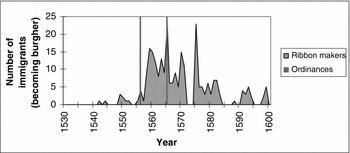
The study of the establishment of new guilds (with the introduction of a fixed term of service as a standard ingredient from about the second half of the fifteenth century onwards) after 1533 (for which we have immigration figures based on burgher books) justifies the hypothesis that they were instigated by a group of established artisans facing growth and immigration. In the case of the ribbon makers (who founded a guild subordinate to the mercers’ guild in 1556) some 150 masters were active at the time when the guild was founded. In the early 1570s, there were about 280 but as Figure A1 in the Appendix demonstrates, the start of the growth (in terms of immigration) pre-dates the foundation of the guild.Footnote 51 The guild, moreover, reaffirmed some of its regulations – among which was the masterpiece requirement – and became autonomous after years of increasing immigration (in 1565).Footnote 52 As the prelude to the ordinance makes clear, this happened against the will of unfree ribbon makers, who protested especially the obligation to make a masterpiece.Footnote 53
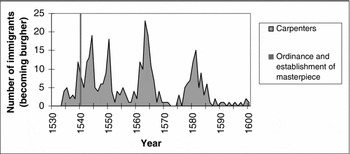
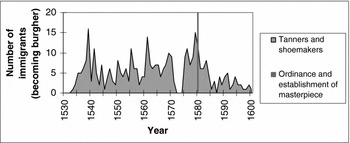
The examination of the introduction of masterpieces in existing guilds confirms this trend. Using the immigration of burghers as a proxy for the number of new masters and apprentices and the establishment of a masterpiece as a proxy for the standardization of apprenticeship, I have been able to link the guilds’ policy to labour market mobility twiceFootnote 54 (Figures A2 and A3). In each case, regulation followed rising immigration figures; in one case it was, in turn, followed by a sharp decline in the number of new entrants (perhaps due to higher entrance fees).Footnote 55 Hence my hypothesis that regulation followed rather than preceded economic expansion in the Antwerp case.
Were Antwerp guilds, then, rent-seeking cartels who sacrificed economic efficiency to their particularistic group interests? Perhaps the relevant field of tension should rather be understood as one between, on the one hand, a guild ethos emphasizing friendship and mutual aid and, on the other, individualistic and liberal notions related to what Anthony Black has called ‘civil society’.Footnote 56 From the perspective of late medieval confraternal ideas and attitudes, established masters may have been concerned about: (1) the total size of the group of masters and (2) equality among masters. Both problems can be broached from the perspective of the limited number of apprentices per master, which from the perspective of human capital formation is a very disturbing element. In theory, four reasons may have prompted putting a ceiling to the number of apprentices per master: (a) the quality of training, (b) the protection of youths against exploitation, (c) avoiding concentration by large masters who tended to attract all potential apprentices, and (d) reducing the number of new masters. The first three possibilities may be consistent with Epstein's view (Reference Epstein1998, pp. 691–2), as apprentices receiving proper training is likely to have been economically beneficial on an aggregate level. Yet as these maximums were mostly prescribed along with maximums on the number of journeymen a master could hire, it is likely that guild officials were primarily concerned about ‘equality’ among masters.
Some guilds explicitly referred to equality and solidarity among masters when defining the number of apprentices per master (and even the length of the term).Footnote 57 Moreover, the judicial micromanagement of the number of apprentices suggests a compromise between large and small masters. In the fifteenth and sixteenth centuries one apprentice per master seems to have been standard,Footnote 58 but in some guilds this rule was gradually relaxed. The shoemakers and tanners allowed one apprentice per master in the fifteenth century but two at the beginning of the seventeenth century, suggesting that the concentration within this sector had increased. Apparently some masters had tried to abolish the maximum, as the argument in favour of a (new) fixed maximum was the need ‘to maintain a certain equality among the masters’.Footnote 59 In 1606 the cabinetmakers – who had maintained a maximum of one apprentice per master – ruled that a second apprentice could be hired when the first had completed one year and nine months of his two-year term, increasing the possible turnover of apprentices for large masters.Footnote 60 In 1556 the ribbon makers established that a second apprentice could be taken on when the first had finished one year of his apprenticeship term, adding that a third could be taken on when the first had completely finished his (two-year) term.Footnote 61 Thus the maximum may have prevented some masters from cornering the market on apprentices.Footnote 62
The protection of youths can of course have been a reason as well. Significantly, in 1582 the diamond cutters ruled that a master could hire three apprentices at the same time, adding that they could not hold other ‘aspirants or house servants’.Footnote 63 Additional clauses concerning the number of apprentices per master suggest that apprentices in this sector were protected from being exploited by large masters. Guild masters were not only obliged to register their apprentices,Footnote 64 the exact time of registering was a bone of contention. According to the founding ordinance of the diamond cutters, a trainee had to be registered in the guild books at least fourteen days after he began to work with his master. Furthermore, within six weeks the master must again go to the guild chamber to make a statement about what ‘he intends to do with the boy’. This stipulation was supposed to prevent masters from using apprentices as cheap workers, since masters who did not really want to engage the boy as an apprentice had two more weeks to discharge him.Footnote 65
However, although the quality of the training (which from the perspective of the trainee was dependent on not being exploited) could in theory have been a factor as well, in the Antwerp case it appears to have been secondary at best. This can be deduced from additional clauses concerning the maximum number of apprentices per master. In 1454 the gold and silversmiths specified that a master could train two apprentices at a time, but the second could not be hired before the first had completed two years of the four he was supposed to serve.Footnote 66 This could lead to the assumption that a master was unable to teach two (new) apprentices adequately at the same time, but when the rule changed in 1524 a clause was added that stated: if an apprentice ran away, his master could not take on a new one before both parties had agreed that the term was over or acquitted. Moreover, when the apprentice left, he had to promise he would not establish himself as a gold or silversmith, which suggests that illicit work was the real issue.Footnote 67
5. Entrance fees and inclusive strategies
In short, these stipulations may be understood from both the perspective of unfree work (the need to clearly distinguish those who had finished an apprenticeship term and those who had not) and confraternal ideas on ‘friendship’ among masters. Using the terms of Ogilvie, the final aim of these orders must have been ‘distributional’, but this is not to say that guilds were exclusive. Other regulations confirm that the challenge for guilds was to guard their labour market monopsony while at the same time including the available workforce. From an economic perspective craft guilds or the urban authorities not only needed to ensure that apprentices stayed on the shop floor longer and were less inclined to run away (stimulating masters to invest in training), but also to maximize the number of apprentices by making the end-term reward more attractive (stimulating apprentices to invest in training). To some extent these are conflicting goals, as will become clear as we follow Epstein's arguments that both entry fees and end-term rewards served as stimuli for apprentices to conclude and to serve out contracts.
Epstein qualifies the notion that entry fees served to restrict entry to the trade, and suggests that they should rather be understood as either ‘a bond on future performance’ (solving the problem of asymmetric information about the apprentice's ability and willingness to repay his training costs) or ‘a mortgage on trust’ (which was necessary to prevent less well-known masters from exploiting the guild) (Epstein Reference Epstein1998, p. 691; Reference Epstein2008, p. 165). In theory, increasing entry fees could (on top of the fees agreed upon in contracts) indeed stimulate apprentices to serve their term, but in practice it seems to have been more complex. To understand this complexity, we should not only distinguish between training fees (to be paid to the master) and entry fees (to the guilds), but also between entry fees paid by new masters and entry fees paid by new apprentices (which Epstein fails to do). Examined closely, apprentice fees charged by the guilds (registration fees hereafter) seem to have been more a response to the exclusive effects of master fees (entry fees for masters) than an economic stimulus. Up to the second half of the sixteenth century, registration fees were either nonexistent or very low, but they systematically rose in the course of the seventeenth and eighteenth centuries. Proportionately the registration fees rose even more than the master fees.Footnote 68 And yet they were not intended to exclude prospective apprentices; quite the contrary. Some guild officials explicitly stated that higher registration fees served to deter apprentices from using the skills acquired from a guild-based master outside the guild framework.Footnote 69 In addition, it was often stipulated that part of the registration fees could be deducted from the master fees, again deterring apprentices from applying their skills elsewhere.Footnote 70
Contrary to the introduction of fixed terms of service and uniform masterpieces, this may have been consistent with Epstein's view, the more so as the stipulation that apprentices (or journeymen) had to finish their terms and the prohibition against masters employing apprentices who had not was standard in the Antwerp guild ordinances of the sixteenth century. It suggests that guilds attached apprentices to their masters and at the same time solved the free-rider problem (masters employing apprentices or journeymen trained by other masters), as Epstein argued.Footnote 71 However, the economic rationale should again be qualified. To be precise, rising registration fees were meant to solve the exclusionary effects of rising master fees, which needed to be increased because guilds needed funds to balance their accounts and settle their debts. Their debts resulted from judicial litigations and building expensive guild houses, altars and the like.Footnote 72 Especially after 1585, when the number of new members had fallen drastically – severely reducing the guilds’ yearly income – guild officials had no other option than to raise entry fees to stave off bankruptcy (see De Munck Reference De Munck2007c, ch. 2.3.2). But of course rising fees had exclusionary effects, which the guilds tried to compensate for. When entry fees were raised expensive meals and treats were often waived in the same ordinances. Or else, simpler and less costly masterpieces were prescribed, while yearly payments were substituted for entrance fees – all measures intended to raise the guilds’ income without raising the financial barriers of entry.Footnote 73 So rising registration fees were a response to what appears to have been – at first sight at least (see below) – very ineffective investment strategies from an economic perspective.
Was the end-term reward of apprenticeship thus the crucial element? Were end-term rewards introduced to attract apprentices and to motivate them to serve out their term? Again, the complexity has been underestimated in recent research. From the perspective of a craft guild, possible end-term rewards included the right either to become a master or to work as a ‘free’ journeyman (at minimum wage). The former was always the case, but affected only a minority of the apprentices (at best about one-third).Footnote 74 The problem here is to find out to what extent the existence of mastership attracted apprentices who would not have learned (in Antwerp, in that sector) in the absence of a guild (again taking into account entry fees). The second was the case in only a minority of the guilds. Most guilds did not at all exclude ‘unfree’ journeymen (those who had not finished an apprenticeship term) (De Munck Reference De Munck2010a). In the tanners and shoemakers guild, for example, it seems to have been the custom that journeymen who had not finished an apprenticeship term worked under regular masters.Footnote 75 Other guilds even explicitly stated that immigrating artisans could work within the guilds without having finished an apprenticeship term or masterpiece, provided they worked for a free master.Footnote 76 The guilds that did distinguish between ‘free’ and ‘unfree’ journeymen were typically those with large numbers of journeymen who had succeeded in acquiring a so-called ‘right of preference’.Footnote 77 The right of preference prevented masters from hiring outsiders (who had not finished an apprenticeship term) and circumventing the minimum wage of free journeymen. Such guilds may have succeeded in attracting apprentices because of their regulations pertaining to apprenticeship, but as it concerned minimum wages and the exclusion of unfree journeymen, the guild officials were not to blame, but rather the free journeymen.
6. Product quality as a convention
The fact that trial pieces for journeymen existed only in sectors with a right of preference for journeymenFootnote 78 supports the idea that they served exclusionary (or rather ‘distinguishing’) goals. Yet this is not to say that the guilds’ regulations and practices were diametrically opposed to economic efficiency. At first sight, the guilds’ efforts to obtain conspicuous halls (preferably in the city centre) and to embellish or preserve their chapels and altars (preferably in the cathedral) are hard to understand from an economic perspective.Footnote 79 Common sense would be to relate these investments in outward appearances to the social cohesion in the groups, or else to attempts to literally materialize their political ambitions in the heart of the city. However, guilds may have enhanced economic efficiency (perhaps unintentionally), despite their rules regarding apprenticeship not being conceived with an eye on a more efficient transfer of skills and technical knowledge. Simply establishing a labour market monopsony may have stimulated investments in skills or technological innovation whatever the ambitions of guild officials (see Smits and Stromback Reference Smits and Stromback2001, ch. 2). Moreover, as the guilds’ rising entry fees were related to their investments in cultural and symbolic capital while serving inclusive goals, a possible hypothesis might be that they contributed to the guilds’ attractiveness, and hence stimulated youngsters to come to Antwerp or register as an apprentice in a guild-based industry. The guilds’ cultural and symbolic capital – to use Bourdieu's terms – may have been what attracted prospective apprentices and masters from elsewhere. To set the record straight, therefore, we should in future research be able to measure the return on these investments in terms of new entrants (taking into account the exclusionary effect of higher financial barriers).
Next to the attraction of artisans, positive economic effects may have resulted from the guilds’ impact on product quality. Firstly, apprenticeships and masterpieces could check product quality ex ante. The ordinances of the fifteenth and sixteenth centuries often stated that those who failed to make the trial piece had to train for another year (or two).Footnote 80 This suggests that the trial did at least increase skill levels (and, in the end, product quality) for those officially registered as apprentices. However, apart from a few guilds – not coincidentally those with a right of preference for free journeymen – only masters had to pass a test. So, at best, a trial piece had to ensure that the supervisors of manufacturing processes knew their job. Presumably, this means that guilds were more concerned about masters knowing and applying the product standards than about their technical abilities. From the perspective of economic efficiency this is not necessarily inadequate of course. The existence of master status and related instruments such as searches and trademarks enabled masters not only to guard product quality, but to standardize products and to solve information asymmetries. Besides prescribing an apprenticeship term and masterpiece, most guilds checked product quality ex post extensively. Either every finished product had to be inspected by the deans or elders (in the guildhall) or guild officials had the right to visit the masters’ workshops.Footnote 81
Here, too, however, one could ask why guilds were needed. Because maintaining product quality often benefited merchants (especially in export sectors), craft guilds theoretically might just as well oppose quality controls, or at least leave it to others. Were the Antwerp craft guilds used by merchants (or urban authorities) to delegate their monitoring costs, as U. Pfister (Reference Pfister, Epstein and Prak2008) would argue, or was there more to it? To start with, merchants were not opposed to the foundation of guilds. They only fought guilds when they were used to establish price cartels, as some groups of dyers did at the end of the sixteenth and the beginning of the seventeenth century (Thijs Reference Thijs1987, pp. 191–200). In the preface to the founding ordinances of the silk weavers and the diamond cutters, merchants were even said to benefit from the existence of the guild in terms of product quality. But this is not to say that product quality arrangements, as we find them in guild ordinances, had to be imposed on the guilds; quite the contrary. Apprenticeship requirements equally well enabled masters to distinguish between ‘qualified’ and ‘unqualified’ artisans and to represent their own skills as superior. While this may again appear inefficient, even rent-seeking and distributional intentions may have been advantageous in economic terms, provided product quality is taken into account. After all, this distinction between ‘qualified’ and ‘unqualified’ was precisely what enabled masters to tackle problems related to information asymmetries and adverse selection – be it intentionally or not – effectively.
Prior to guarding product quality or to producing information on product quality, there has to be agreement on what constitutes high quality.Footnote 82 Arguing for the foundation of the guild of the diamond cutters in 1582, the spokesmen of the masters claimed that ‘it happened daily that some were cutting stones who were not capable to do so nor had learned it, contracting work from merchants (who did not know them) and employing apprentices who had just begun to learn’.Footnote 83 What happened here was that a group of established masters – who, to be sure, did not have to be born Antwerpeners for generations – asked for the establishment of a guild in order to exclude unfree and foreign entrepreneurs who were successful in driving a wedge between masters and apprentices. Although the ultimate argument was product quality, the goal was to guard a pre-existing (informal?) type of labour market monopsony. Claiming that unqualified entrepreneurs had deprived them of their apprentices before they had finished learning (and were therefore producing stones of inferior quality), they contrasted those who were not ‘in the trade from childhood’ with those ‘who had exercised in the art since their early days, and out of love for the noble stones and for the honour of the city’.Footnote 84 Similar arguments appear in the preface to the silk weavers founding ordinance from 1533. The silk weavers allegedly needed a guild because their journeymen and apprentices were lured away.Footnote 85 The camlet dyers argued (in 1574) that they needed a guild because quality was a serious problem, but this – in their eyes – was again the result of the increased number of dyers.Footnote 86
In a way, guilds solved a social and an economic problem at the same time. Establishing a guild went hand in hand with fixing product quality and determining how it should be measured and represented with trademarks and seals of approval. In the founding ordinance of the gold and silversmiths (1454) all attention was focused on the content of the alloy, the association of the alloy with specific trademarks, and possible ways to circumvent that. The ordinance defined what silver should be used, what the alloy should be, how it should be assessed, and what trademarks should be applied for what kind of work (i.e. alloy). Additionally, the ordinance elaborately sums up all kinds of fraud, such as the gilding of copper or the use of inferior silver.Footnote 87 In my opinion, therefore, rather than simply safeguarding product quality, guilds represented a given product quality as the product quality, thus defining what the necessary skills were and which conventions should be applied. While distinguishing insiders from outsiders, guilds helped objectify what – in the case of the diamond cutters – a ‘well and carefully cut’ diamond was.
7. Conclusion
To conclude, the guilds’ requests and normative sources suggest that the establishment of a craft guild (including apprenticeship, masterpieces, and the like) should be addressed from the perspective of ‘distributional conflicts’. Founding a guild not only restricted manufacturing activities to a limited group of masters, it also created the exclusive right to the available workforce for these masters (as only masters could hire apprentices and journeymen). From the perspective of masters it served to exclude merchants and entrepreneurs of all sorts from engaging in producing activities by hiring skilled workers themselves. In theory, just as guilds were not needed in order to have learning on the shop floor, a fixed term of service and a masterpiece were not necessary for the definition of master status. Membership could just as well be regulated informally and ad hoc. However, while immigration put a strain on informal and ad hoc mechanisms in regulating entrance to the group, guild boards confronted entrepreneurs who tried to circumvent the masters’ labour market monopsony. This problem in particular was tackled in prescribing a minimum term of service and a masterpiece, which were introduced to (re)define the boundaries of the group and to guard the masters’ labour market monopsony. The absence of a distinction between ‘free’ and ‘unfree’ journeymen in most cases confirms that apprenticeship was related not to entrance to the labour market for journeymen but to the status of masters.
Taking the immigrating workforce into account, the main purpose of the craft guild was not ‘to share out the unattributed costs and benefits of training among its members’, as Epstein (Reference Epstein1998, pp. 687–8) had it, but to share the available unskilled and skilled labour. To distribute the available skills more or less evenly over the pool of established masters, a maximum number of apprentices per master was established, preventing large masters from cornering the market and exploiting youths as cheap labour. In combination with measures against luring away apprentices this may have had contract-enforcing effects, but as guild boards deliberately tried to compensate for the exclusionary offshoot of their rules, it is very unlikely that they were introduced for economic reasons. When introducing these regulations, the guilds considered in this article clearly faced the complexity of the labour market – in particular a growing specialization within the craft. The corporative apprenticeship rules in Antwerp came about at a time when the labour relations grew ever more complex – with subcontracting intensifying in particular. In this context, introducing standardized regulations such as a fixed term to serve and a standardized masterpiece was not at all self-evident. While the skills transferred in apprentice contracts could range from general and transferable skills to very specific and specialized ones, formal apprenticeship rules could only be accommodated to transferable skills. Consequently, while the minimum terms had been related to the difficulty of the craft when they were first prescribed, most guilds retained unchanged, relatively short apprenticeship terms from the late sixteenth century onwards. Masterpiece requirements changed as product forms changed during the first decades of their establishment, but at least from the second half of the sixteenth century on they could be prescribed ad hoc, according to the specialized skills of the would-be master. Apparently, it simply became impossible to adjust the prescribed terms and the masterpiece to the exact needs of every (or the average) master.
The exact shape of the rules was the outcome of negotiations between different power groups within the guild, especially with regard to the maximum number of apprentices per master and the entry fees. Most Antwerp guilds (at least in the export sectors) were known for the all-pervasive conflicts among three parties: merchants, large entrepreneurs (or masters) and small masters. As guild structures were used in order to exclude merchant-entrepreneurs from the labour market, we can assume that masters mostly held the reins in these guilds. The fine-tuning of rules related to workshop size suggests that power shifted towards larger masters, as Lis and Soly have convincingly argued before.Footnote 88 Further research might examine how shifting power relations affected the entry conditions of the craft. My idea would be to focus on the (judicial and financial) fine tuning of entry barriers and to pay attention in particular to the shifting difference between registration fees and master fees and between fees for masters’ sons and others (including immigrants). These differences should be linked to the possible influence of the various power groups in the sector concerned: journeymen, small masters, large masters, merchants, and last but not least, the local authorities. Depending, for example, on whether merchants (perhaps via the local authorities) or large masters had a say, the entry barriers might have been intended to include either a maximum number of masters or a maximum number of journeymen. At least in theory, merchants must have favoured easy entrance for masters, while (large) masters must have welcomed low entry barriers for journeymen.
When it comes to the masters’ motives and intentions, social concerns seem to have been more important than economic concerns – at least for small masters, who, convened in a type of brotherhood, tried to maintain a certain equality among masters. In a long-term perspective, therefore, it may perhaps make more sense to presuppose a shift from collective brotherhood-like values such as equality, mutual aid and friendship towards more liberal and individualistic notions (see De Munck Reference De Munck, Van Der Heijden and Vermeesch2009, Reference De Munck2010b). As to the question of economic effects, they should in future research be addressed from a perspective other than Epstein's. At first sight, the mechanisms related to the entry fees seem to support Epstein's hypothesis – with rising registration fees intended to bind the apprentices to the trade –, but in the end the level of the entry fees was first of all determined by the guild's massive debts, which dictated higher income fees. Entry fees for apprentices were needed to compensate for rising master fees. Perhaps the real issue, then, is the relationship of the investments in cultural capital (prestige and trust, embodied in guild houses, chapels, altars and the like), on the one hand, to economic return (the attraction of apprentices), on the other hand – taking into account exclusionary effects. Moreover, a guild enabled masters not only to enhance and standardize product quality but also to objectify product quality – which was an important condition for an effective communication both among masters and towards customers.
So, from the perspective of the guild members themselves, there may hardly have been a conflict between economic efficiency and distributional motives. While the guild-based masters seem to have been concerned with either rent-seeking or the social fabric of their brotherhood, the unintended result of their investments in cultural and symbolic capital (from trademarks to guild houses) can be perhaps be seen as investments in the reputation of their ‘brand’, which in turn can have been beneficial in two ways: it may have resulted in: (1) the guild's increased attractiveness to newcomers (apprentices and masters) and (2) a higher value and price for their products.
Acknowledgements
This article was written in the context of the IAP-project 6/32 ‘City and society in the Low Countries, 1200–1800: space, knowledge, social capital’. Thanks are due to Jan De Meester and Jan Luiten van Zanden for their comments on an earlier version.
Appendix
Immigration of ribbon makers and the introduction of the founding ordinances of the guild

Immigration and the introduction of a masterpiece among the carpenters in Antwerp

Immigration and the introduction of a masterpiece among the shoemakers and tanners in Antwerp